ZYNLO Bank Review: 1.25% APY (No Longer Available To New Signups), 100% Match on Roundups

Update: As of 4/8/21, the ZYNLO website now lists their money market as “no longer available”, although the rate is still 1.25% APY if you opened it in time. The savings account pays 0.80% APY and still includes the roundups. There is a new “Tomorrow Savings” account that only pays 0.40% APY, so I’m not sure why anyone would pick that one.

ZYNLO Bank is another new “digital-first” bank, backed by the FDIC insurance of PeoplesBank in Massachusetts. Along with the common features of no monthly fees and Allpoint ATM network access, ZYNLO differentiates itself from the banking app crowd in a few different ways.

0.80% to 1.25% APY. Their main page advertises 0.80% APY on their Money Market account, which is already a competitive rate, but if you enter the promo code BANK (should auto-populate at this promo link) at account opening, they promise a higher promo rate of 1.25% APY on up to $250,000. Looks like promo code NERD gives the same result. Unfortunately, there is no rate guarantee as to how long either rate will last.

100% match on Roundups. When you purchase something with the ZYNLO debit card from their checking account (ex. $4.44), they will round up the transaction to the nearest dollar (ex. $5), deposit that amount (ex. 56 cents) into your savings account, and also match that amount (ex. another 56 cents). Their Savings Account (not the same as Money Market) offers a 100% match on “roundups” during their first 100 days. After that, you must maintain an average daily balance of $3,000 to continue to receive a 100% match. Otherwise, you only get a 25% match. The savings account pays negligible interest.

Let’s say you make 20 debit card purchase per month. If your purchase amounts are random over time, you will average a roundup of 50 cents per transaction. At a 100% match, that works out to $10 a month in matches per month (plus $10 of your own money being put aside in savings for you). 40 debit transaction per month = $20 a month at 100% roundup, and so on. If you make a lot of debit card purchases, it might be worth keeping a $3,000 balance to keep that 100% match.

Note that they don’t accept applications from a few states:

Who can use ZYNLO?
Any U.S. citizen 18 or older with a valid Taxpayer Identification Number. We can open accounts for people throughout the United States with the exception of CA, CT, MA, & NY.

My take. The money market promo rate may be attractive to those with very high balances as it applies to balances up to $250,000. The roundup matching might be attractive for people that make a lot of purchases on their debit cards. The negative is that there is no rate guarantee period and thus the slightly higher promo rate may not be high to guarantee a solid return over what might be a short period of time, given the other bank options near 3% APY available.

Hat tip to DepositAccounts.

TIPS Inflation Bonds Performance: Breakeven vs. Actual Inflation Rates

I own inflation-linked bonds as part of my investment portfolio. Specifically, Treasury Inflation-Protected Securities (TIPS) make up about 1/3rd of the bond portion, or 10% of my total portfolio. I go into more detail in my post Reasons To Own TIPS, but essentially they pay interest based on a fixed real yield plus ongoing inflation. To simplify: if the real yield is 1% and inflation is 3%, they pay 4%.

Traditional “nominal” Treasury bonds simply pay a flat interest rate that doesn’t change with inflation (i.e. 3%). The difference between the TIPS real yield and the nominal Treasury yield is at any given time is what inflation would have to be for them to pay out the exact same total yield, called the “breakeven inflation rate”. If the real yield on TIPS is 1% while the nominal rate is 3% at the same moment, then the breakeven rate is 2%. You could call it a market-based prediction of future inflation.

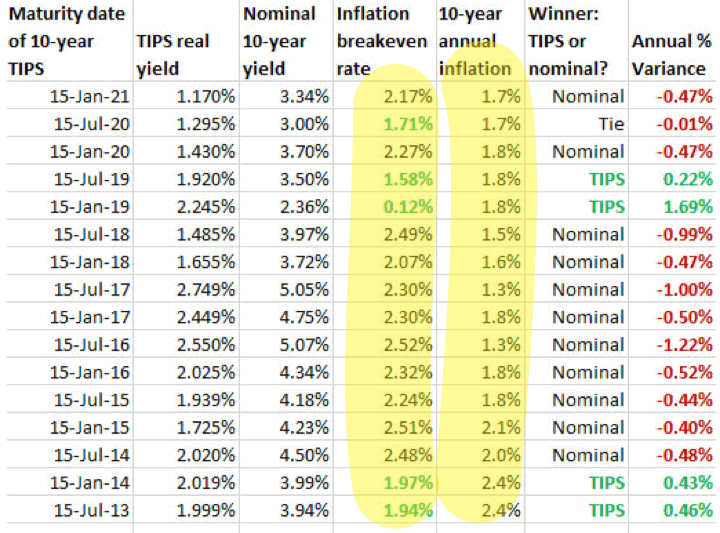
It turns out that 10-year TIPS bonds that matured over the last several years mostly underpeformed regular nominal Treasuries, as the actual inflation turned out to be less than the breakeven inflation rate. David Enna of TIPS Watch created the interesting chart below comparing the final performance of TIPS vs. nominal Treasury bonds maturing over the last several years, where green means that TIPS “won” and red means TIPS “lost” in terms of total return. I removed some columns and highlighted the initial breakeven rate (the market-based guess) and the actual inflation rate.

Enna states:

Still, the market-determined inflation breakeven rate measures sentiment and should not be viewed as an accurate prediction. In fact, the market often does a lousy job of predicting future inflation. The fact is, over the last decade, investors have been betting on higher inflation than actually resulted, and that has led to TIPS (in general) under-performing nominal Treasuries of the same term.

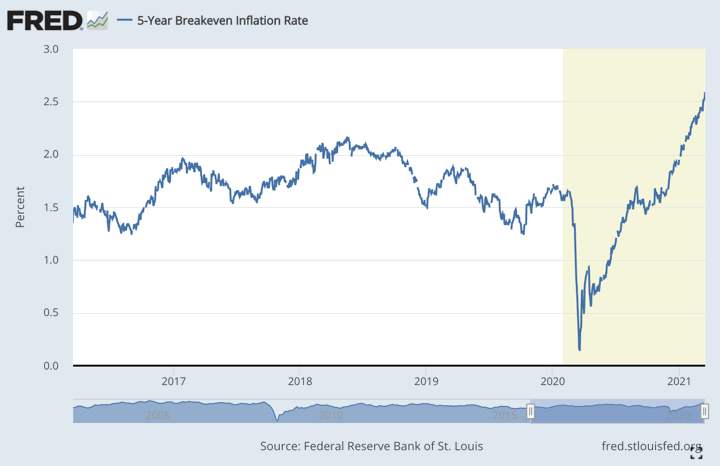
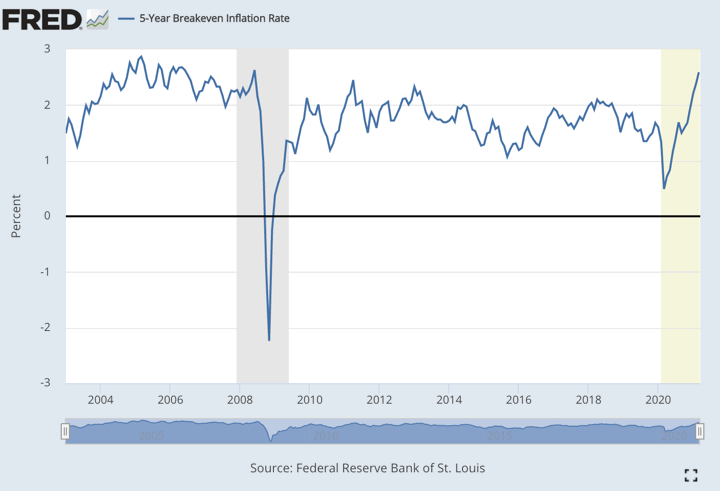
I have read some articles suggesting that you could adjust your TIPS holdings based on the real yield, but perhaps another way is to adjust your holdings based on inflation breakeven rate instead. You can track the 5-year and 10-year breakeven inflation rates at FRED. As of this writing in March 2021, the breakeven inflation rate has been rising very quickly since dropping quickly in early 2020.

The last time that the breakeven inflation rate dropped so drastically was in 2009. As with stocks, it can pay off to buy when everyone else is afraid. I was lucky to buy a chunk of long-term TIPS in 2009, but I didn’t buy much in 2020 since the real yields were still quite low.

I hold Treasuries, TIPS, and FDIC/NCUA-insured CDs because I like my “safe” assets to be of the highest quality, with no worries about getting both my principal and interest. In addition, TIPS also serves as a hedge against higher-than-expected inflation. However, that also means I might suffer if there is lower-than-expected inflation. My “insurance” didn’t pay out over the last 10 years, but that’s okay. I’m also fine if my don’t make a claim on my auto insurance, homeowners insurance, (and definitely life insurance!).

p.s. If you want to buy TIPS, these days you should consider buying Series I Savings Bonds first these days (up to the purchase limits). Their 0% real yield is better than the negative real yields on nearly all TIPS right now.

Best Interest Rates on Cash – March 2021

Here’s my monthly roundup of the best interest rates on “safe” cash as of March 2021, roughly sorted from shortest to longest maturities. I keep 12 months of expenses as part of my semi-retirement cashflow planning, and there are many lesser-known opportunities to improve your yield while still being FDIC-insured or equivalent. Check out my Ultimate Rate-Chaser Calculator to see how much extra interest you’d earn by moving money between accounts. Rates listed are available to everyone nationwide. Rates checked as of 3/8/2021.
Fintech accounts
Available only to individual investors, fintech accounts oftentimes pay higher-than-market rates in order to achieve high short-term growth (i.e. higher interest via venture capital). I define “fintech” as a software layer on top of a different bank’s FDIC insurance. Although I have open accounts with the ones listed below after doing my own due diligence, read about the Beam app for potential pitfalls and best practices.

  • 3% APY on up to $100,000. The top rate is 3% APY for January through March 2021, and they have not indicated any upcoming rate drop. Sign up now and complete a direct deposit to get the highest tier in April. HM Bradley requires a recurring direct deposit every month and a savings rate of at least 20%. See my HM Bradley review.
  • 3% APY on 10% of direct deposits + 1% APY on $5,000. One Finance lets you earn 3% APY on “auto-save” deposits (up to 10% of your direct deposit, up to $1,000 per month). Separately, they also pay 1% APY on up to another $25,000 with direct deposit. New $50 bonus via referral. See my One Finance review.
  • 3% APY on up to $15,000. Porte requires a one-time direct deposit of $1,000+ to open a savings account. $50 bonus via referral. See my Porte review.
  • 2.15% APY on up to $5k/$30k. Limited-time offer of free membership to their higher balance tier for 6 months with direct deposit. See my OnJuno review.

High-yield savings accounts
While the huge megabanks pay essentially no interest, it’s easy to open a new “piggy-back” savings account and simply move some funds over from your existing checking account. The interest rates on savings accounts can drop at any time, so I list the top rates as well as competitive rates from banks with a history of competitive rates. Some banks will bait you with a temporary top rate and then lower the rates in the hopes that you are too lazy to leave.

  • T-Mobile Money has the top rate at the moment at 1.00% APY with no minimum balance requirements. The main focus is on the 4% APY on your first $3,000 of balances as a qualifying T-mobile customer plus other hoops, but the lesser-known perk is the 1% APY for everyone. Thanks to the readers who helped me understand this. There are several other established high-yield savings accounts at closer to 0.50% APY.

Short-term guaranteed rates (1 year and under)
A common question is what to do with a big pile of cash that you’re waiting to deploy shortly (just sold your house, just sold your business, legal settlement, inheritance). My usual advice is to keep things simple and take your time. If not a savings account, then put it in a flexible short-term CD under the FDIC limits until you have a plan.

  • No Penalty CDs offer a fixed interest rate that can never go down, but you can still take out your money (once) without any fees if you want to use it elsewhere. Marcus has a 7-month No Penalty CD at 0.45% APY with a $500 minimum deposit. AARP members can get an 8-month CD at 0.55% APY. Ally Bank has a 11-month No Penalty CD at 0.50% APY for all balance tiers. CIT Bank has a 11-month No Penalty CD at 0.30% APY with a $1,000 minimum deposit. You may wish to open multiple CDs in smaller increments for more flexibility.
  • Lafayette Federal Credit Union has a 12-month CD at 0.80% APY ($500 min). Early withdrawal penalty is 6 months of interest. Anyone can join this credit union via partner organization ($10 one-time fee).

Money market mutual funds + Ultra-short bond ETFs
Normally, I would say to watch out for brokerage firms that pay out very little interest on their default cash sweep funds (and keep the difference for themselves). However, money market fund rates are very low across the board right now. Ultra-short bond funds are another possible alternative, but they are NOT FDIC-insured and may experience short-term losses in extreme cases. I personally don’t think the risk is worth the tiny yield at this time.

  • The default sweep option is the Vanguard Federal Money Market Fund which has an SEC yield of 0.01%. Vanguard Cash Reserves Federal Money Market Fund (formerly Prime Money Market) currently pays 0.01% SEC yield.
  • Vanguard Ultra-Short-Term Bond Fund currently pays 0.38% SEC yield ($3,000 min) and 0.48% SEC Yield ($50,000 min). The average duration is ~1 year, so there is more interest rate risk.
  • The PIMCO Enhanced Short Maturity Active Bond ETF (MINT) has a 0.24% SEC yield and the iShares Short Maturity Bond ETF (NEAR) has a 0.38% SEC yield while holding a portfolio of investment-grade bonds with an average duration of ~6 months.

Treasury Bills and Ultra-short Treasury ETFs
Another option is to buy individual Treasury bills which come in a variety of maturities from 4-weeks to 52-weeks. You can also invest in ETFs that hold a rotating basket of short-term Treasury Bills for you, while charging a small management fee for doing so. T-bill interest is exempt from state and local income taxes. Right now, this section isn’t very interesting as T-Bills are yielding close to zero!

  • You can build your own T-Bill ladder at TreasuryDirect.gov or via a brokerage account with a bond desk like Vanguard and Fidelity. Here are the current Treasury Bill rates. As of 3/5/2020, a new 4-week T-Bill had the equivalent of 0.04% annualized interest and a 52-week T-Bill had the equivalent of 0.08% annualized interest.
  • The Goldman Sachs Access Treasury 0-1 Year ETF (GBIL) has a -0.01% SEC yield and the SPDR Bloomberg Barclays 1-3 Month T-Bill ETF (BIL) has a -0.08% (!) SEC yield. GBIL appears to have a slightly longer average maturity than BIL.

US Savings Bonds
Series I Savings Bonds offer rates that are linked to inflation and backed by the US government. You must hold them for at least a year. If you redeem them within 5 years there is a penalty of the last 3 months of interest. The annual purchase limit is $10,000 per Social Security Number, available online at TreasuryDirect.gov. You can also buy an additional $5,000 in paper I bonds using your tax refund with IRS Form 8888.

  • “I Bonds” bought between November 2020 and April 2021 will earn a 1.68% rate for the first six months. The rate of the subsequent 6-month period will be based on inflation again. More info here.
  • In mid-April 2021, the CPI will be announced and you will have a short period where you will have a very close estimate of the rate for the next 12 months. I will have another post up at that time.
  • See below about EE Bonds as a potential long-term bond alternative.

Prepaid Cards with Attached Savings Accounts
A small subset of prepaid debit cards have an “attached” FDIC-insured savings account with exceptionally high interest rates. The negatives are that balances are severely capped, and there are many fees that you must be careful to avoid (lest they eat up your interest). Some folks don’t mind the extra work and attention required, while others do. There is a long list of previous offers that have already disappeared with little notice. I don’t personally recommend nor use any of these anymore.

  • One of the few notable cards left in this category is Mango Money at 6% APY on up to $2,500, along with several hoops to jump through. Requirements include $1,500+ in “signature” purchases and a minimum balance of $25.00 at the end of the month.

Rewards checking accounts
These unique checking accounts pay above-average interest rates, but with unique risks. You have to jump through certain hoops which usually involve 10+ debit card purchases each cycle, a certain number of ACH/direct deposits, and a certain number of logins per month. If you make a mistake (or they judge that you did) you risk earning zero interest for that month. Some folks don’t mind the extra work and attention required, while others would rather not bother. Rates can also drop suddenly, leaving a “bait-and-switch” feeling.

  • The Bank of Denver pays 2.00% APY on up to $25,000 if you make 12 debit card purchases of $5+ each, receive only online statements, and make at least 1 ACH credit or debit transaction per statement cycle. The rate recently dropped. If you meet those qualifications, you can also link a Kasasa savings account that pays 1.00% APY on up to $50k. Thanks to reader Bill for the updated info.
  • Devon Bank has a Kasasa Checking paying 2.50% APY on up to $10,000, plus a Kasasa savings account paying 2.50% APY on up to $10,000 (and 0.85% APY on up to $50,000). You’ll need at least 12 debit transactions of $3+ and other requirements every month. The rate recently dropped.
  • Presidential Bank pays 2.25% APY on balances up to $25,000, with fewer hoops than some others.
  • Evansville Teachers Federal Credit Union pays 3.30% APY on up to $20,000. You’ll need at least 15 debit transactions and other requirements every month.
  • Lake Michigan Credit Union pays 3.00% APY on up to $15,000. You’ll need at least 10 debit transactions and other requirements every month.
  • Find a locally-restricted rewards checking account at DepositAccounts.

Certificates of deposit (greater than 1 year)
CDs offer higher rates, but come with an early withdrawal penalty. By finding a bank CD with a reasonable early withdrawal penalty, you can enjoy higher rates but maintain access in a true emergency. Alternatively, consider building a CD ladder of different maturity lengths (ex. 1/2/3/4/5-years) such that you have access to part of the ladder each year, but your blended interest rate is higher than a savings account. When one CD matures, use that money to buy another 5-year CD to keep the ladder going. Some CDs also offer “add-ons” where you can deposit more funds if rates drop.

  • Wings Financial Federal Credit Union has a 5-year CD from 1.26% APY ($500 min)up to 1.41% APY ($250,000 min) . Early withdrawal penalty is big – 2 years of interest! Anyone can join this credit union via partner organization for as little as $5 (Wings Financial Foundation).
  • Affinity Plus Federal Credit Union has a 5-year certificate at 1.25% APY ($500 minimum). Early withdrawal penalty is 1 year of interest. 4-year at 1.05% APY, and 3-year at 0.95% APY ($500 minimum). Anyone can join this credit union via partner organization ($25 one-time fee).
  • You can buy certificates of deposit via the bond desks of Vanguard and Fidelity. You may need an account to see the rates. These “brokered CDs” offer FDIC insurance and easy laddering, but they don’t come with predictable early withdrawal penalties. I see a 5-year CD at 0.90% APY right now, which might still pay more than the other options at your brokerage. Be wary of higher rates from callable CDs listed by Fidelity.

Longer-term Instruments
I’d use these with caution due to increased interest rate risk, but I still track them to see the rest of the current yield curve.

  • Willing to lock up your money for 10 years? You can buy long-term certificates of deposit via the bond desks of Vanguard and Fidelity. These “brokered CDs” offer FDIC insurance, but they don’t come with predictable early withdrawal penalties. You might find something that pays more than your other brokerage cash and Treasury options. Right now, I see a 10-year at Vanguard for 1.80% APY. Watch out for higher rates from callable CDs from Fidelity.
  • How about two decades? Series EE Savings Bonds are not indexed to inflation, but they have a unique guarantee that the value will double in value in 20 years, which equals a guaranteed return of 3.5% a year. However, if you don’t hold for that long, you’ll be stuck with the normal rate which is quite low (currently 0.10%). I view this as a huge early withdrawal penalty. But if holding for 20 years isn’t an issue, it can also serve as a hedge against prolonged deflation during that time. Purchase limit is $10,000 each calendar year for each Social Security Number. As of 3/8/2021, the 20-year Treasury Bond rate was 2.18%.

All rates were checked as of 3/8/2021.

PPP Updates For Self-Employed and Independent Contractors: Single-Page Forgiveness Form, 2nd Draw Applications Open

Updated. There are many people who are eligible for 100% forgivable federal assistance from the Paycheck Protection Program, but aren’t applying for it, either due to misinformation or being discourage by all the bureacracy. Many PPP loan recipients are self-employed workers, sole proprietors, freelancers and/or independent contractors that file a Schedule C who may be eligible only for a modest amount, but that amount can still make a big difference. I am not an accountant nor a lawyer, but I encourage the (really) small businesses out there to get help if impacted by COVID. It’s not too late, and COVID isn’t over!

New focus on business with LESS than 20 employees. The Treasury Department just announced that businesses with more than 20 employees will be shut out of the PPP for a two-week period starting Wednesday, 2/24. In other words, only businesses with less than 20 employees can apply for PPP loans during the next two weeks. From ABC News:

In an attempt to improve equitable distribution of loans, administration officials said changes would also be aimed at helping sole proprietors, independent contractors and self-employed individuals to receive more financial support by revising the program’s funding formula.

PPP Round 2 loan applications now open. First of all, if you never took a PPP loan, you can still apply for a first-draw PPP loans under the more lenient first-draw eligibility rules. Second-draw PPP loans have a different set of eligibility rules, notably you need to show a reduction in revenue. If you are a self-employed worker with no other employees and have higher than a $100,000 net income (2019 IRS Form 1040 Schedule C line 31 or equivalent), then you must reduce it to $100,000. Here are the full SBA 2nd Draw guidelines. In terms of loan size, you can still get 2.5 times your average monthly net profit from 2019.

The next general hurdle is that you must show a 25% drop in income when comparing the same quarter in 2019 and 2020:

Applicant must demonstrate that gross receipts in any calendar quarter of 2020 were at least 25 percent lower than the same quarter of 2019. Alternatively, Applicants may compare annual gross receipts in 2020 with annual gross receipts in 2019 if they were in business in 2019.

Looking for a PPP lender? One problem is that most banks are restricting PPP applications to those with existing business credit relationships. Many freelancer and independent contractors don’t have that. The small-business fintech Fundera has an open PPP loan application (both for first and second-draw loans) to help freelancers and independent contractors find a lender without any no prior relationship.

Single-page form for PPP Round 1 loan forgiveness now available. If you have an existing loan under $150,000, there is now a single-page form that requires you to submit no additional documentation (it must still exist, of course, and they may ask you for it later if audited). That form, called the PPP Loan Forgiveness Application Form 3508S, has been released and lenders are starting to accept them. You may even be able to use the longer 24-week covered period and get more of your loan forgiven than with the previous 8-week period. (I haven’t heard of widespread final forgiveness being granted by the SBA yet.)

Looking for a self-employed or small business payroll provider? I want to mention Gusto here, as I use them for payroll and saw them create many tools this year to help their users satisfy the PPP documentation requirements and help them take advantage of this relief. If you are a single-person company, they have a basic tier that costs only $25 per month, which is much less than the major payroll providers. (You can also split up your direct deposit however you like, handy for various banking promotions.) Right now, referred user can get a $100 Visa gift card after running your first payroll with Gusto (my referral link).

Debit Card Arbitrage: $4.7M Tax Payment Results in $47,000 Cash Back

An under-the-radar loophole is now out in the open, thanks to fintech app Jiko* publishing a PR release bragging about their $4.7 million debit card charge, which led to Axios writing about it as quite likely the “largest consumer debit transaction ever”. In a nutshell: Someone made a $4.7 million tax payment to the IRS using a Jiko debit card, paying less than $4 in fees while earning $47,000 in cash back!

As noted in my post on How Fintech Bank Apps like Chime Make Money, a significant portion of fintech revenue comes from debit card fees. Large banks have their debit card interchange fees regulated, as Durbin fee limits only apply to large banks with $10 billion in assets and above. But smaller banks are classified as exempt, and the Federal Reserve shows the average intercharge fee is 1.4% for exempt transactions. This is why small fintech banks can offer 1% cash back on debit card purchases.

Meanwhile, it appears that the fee that the IRS payment processors charge is based on the regulated interchange fee of 0.05% (yes, 1/20th of 1%!) plus 21 cents per debit card transaction. That means even a $10,000 tax payment would result in a regulated interchange fee of $5.21, and the vast majority of tax payments are much less than $10,000. Perhaps they have some sort of special agreement? Either way, they all charge a flat fee ranging from $2.55 to $3.95 on any payment amount.

This creates an arbitrage opportunity between the fees paid and cash back earned for those can that justify really large tax payments (usually those with really large incomes). On a $10,000 payment, your net profit would be about $96. Meanwhile, making an unnecessarily high payment might encourage an audit or raise other flags. You’ll also need to fund and use an appropriate fintech bank that offers 1% cash back with no limits. I’m not sure if this was a smart move by Jiko, as the added spotlight may also end this important source of revenue for all fintech banks.

* The Jiko app doesn’t act as a bank as they hold your money in a brokerage account and invest your money in US Treasury bills (essentially equally safe, but not the same). However, they do have their own bank charter, apparently to process debit card charges – Jiko Bank, a division of Mid-Central National Bank, Member FDIC. I’m confused too! But interestingly since funds are backed by T-Bills, it made it safer to hold $4.7 million at Jiko, as that huge balance would have exceeded the FDIC insurance limits.

Best Interest Rates on Cash – February 2021

Here’s my monthly roundup of the best interest rates on cash as of February 2021, roughly sorted from shortest to longest maturities. I track these rates because I keep 12 months of expenses as a cash cushion and there are many lesser-known opportunities to improve your yield while still being FDIC-insured or equivalent. Check out my Ultimate Rate-Chaser Calculator to see how much extra interest you’d earn by moving money between accounts. Rates listed are available to everyone nationwide. Rates checked as of 2/3/2021.

Fintech accounts
Available only to individual investors, fintech accounts oftentimes pay higher-than-market rates in order to achieve high short-term growth. I will define “fintech” as an app software layer on top of a different bank’s FDIC insurance backbone. You should read about the story of the Beam app for potential pitfalls and best practices. Below are some current options with decent balance limits:

  • 3% APY on up to $100,000. I am happy to see the top rate staying at 3% APY for January through March 2021. HM Bradley requires a recurring direct deposit every month and a savings rate of at least 20%. See my HM Bradley review.
  • 3% APY on 10% of direct deposits. One Finance lets you earn 3% APY on “auto-save” deposits (up to 10% of your direct deposit, up to $1,000 per month). Separately, they also pay 1% APY on up to another $25,000 with direct deposit. New $50 bonus via referral. See my One Finance review.
  • 3% APY on up to $15,000. Porte requires a one-time direct deposit of $1,000+ to open a savings account. $50 bonus via referral. See my Porte review.
  • 2.15% APY on up to $5k/$30k. Limited-time offer of free membership to their higher balance tier for 6 months with direct deposit. See my OnJuno review.

High-yield savings accounts
While the huge megabanks pay essentially no interest, it’s easy to open a new “piggy-back” savings account and simply move some funds over from your existing checking account. The interest rates on savings accounts can drop at any time, so I list the top rates as well as competitive rates from banks with a history of competitive rates. Some banks will bait you with a temporary top rate and then lower the rates in the hopes that you are too lazy to leave.

  • T-Mobile Money has the top rate at the moment at 1.00% APY with no minimum balance requirements. The main focus is on the 4% APY on your first $3,000 of balances as a qualifying T-mobile customer plus other hoops, but the lesser-known perk is the 1% APY for everyone. Thanks to the readers who helped me understand this. There are several other established high-yield savings accounts at closer to 0.50% APY for now.

Short-term guaranteed rates (1 year and under)
A common question is what to do with a big pile of cash that you’re waiting to deploy shortly (just sold your house, just sold your business, legal settlement, inheritance). My usual advice is to keep things simple and take your time. If not a savings account, then put it in a flexible short-term CD under the FDIC limits until you have a plan.

  • No Penalty CDs offer a fixed interest rate that can never go down, but you can still take out your money (once) without any fees if you want to use it elsewhere. Marcus has a 7-month No Penalty CD at 0.45% APY with a $500 minimum deposit. AARP members can get an 8-month CD at 0.55% APY. Ally Bank has a 11-month No Penalty CD at 0.50% APY for all balance tiers. CIT Bank has a 11-month No Penalty CD at 0.30% APY with a $1,000 minimum deposit. You may wish to open multiple CDs in smaller increments for more flexibility.
  • Lafayette Federal Credit Union has a 12-month CD at 0.80% APY ($500 min). Early withdrawal penalty is 6 months of interest. Anyone can join this credit union via partner organization ($10 one-time fee).

Money market mutual funds + Ultra-short bond ETFs
Normally, I would say to watch out for brokerage firms that pay out very little interest on their default cash sweep funds (and keep the difference for themselves). However, money market fund rates are very low across the board right now. The following ultra-short bond funds are a possible alternative, but they are NOT FDIC-insured and will also fluctuate in price somewhat:

  • The default sweep option is the Vanguard Federal Money Market Fund which has an SEC yield of 0.01%. Vanguard Cash Reserves Federal Money Market Fund (formerly Prime Money Market) currently pays 0.01% SEC yield.
  • Vanguard Ultra-Short-Term Bond Fund currently pays 0.44% SEC yield ($3,000 min) and 0.54% SEC Yield ($50,000 min). The average duration is ~1 year, so there is more interest rate risk.
  • The PIMCO Enhanced Short Maturity Active Bond ETF (MINT) has a 0.23% SEC yield and the iShares Short Maturity Bond ETF (NEAR) has a 0.43% SEC yield while holding a portfolio of investment-grade bonds with an average duration of ~6 months.

Treasury Bills and Ultra-short Treasury ETFs
Another option is to buy individual Treasury bills which come in a variety of maturities from 4-weeks to 52-weeks. You can also invest in ETFs that hold a rotating basket of short-term Treasury Bills for you, while charging a small management fee for doing so. T-bill interest is exempt from state and local income taxes. Right now, this section isn’t very interesting as T-Bills are yielding close to zero!

  • You can build your own T-Bill ladder at TreasuryDirect.gov or via a brokerage account with a bond desk like Vanguard and Fidelity. Here are the current Treasury Bill rates. As of 2/3/2020, a new 4-week T-Bill had the equivalent of 0.04% annualized interest and a 52-week T-Bill had the equivalent of 0.08% annualized interest.
  • The Goldman Sachs Access Treasury 0-1 Year ETF (GBIL) has a -0.01% SEC yield and the SPDR Bloomberg Barclays 1-3 Month T-Bill ETF (BIL) has a -0.06% (!) SEC yield. GBIL appears to have a slightly longer average maturity than BIL.

US Savings Bonds
Series I Savings Bonds offer rates that are linked to inflation and backed by the US government. You must hold them for at least a year. If you redeem them within 5 years there is a penalty of the last 3 months of interest. The annual purchase limit is $10,000 per Social Security Number, available online at TreasuryDirect.gov. You can also buy an additional $5,000 in paper I bonds using your tax refund with IRS Form 8888.

  • “I Bonds” bought between November 2020 and April 2021 will earn a 1.68% rate for the first six months. The rate of the subsequent 6-month period will be based on inflation again. More info here.
  • In mid-April 2021, the CPI will be announced and you will have a short period where you will have a very close estimate of the rate for the next 12 months. I will have another post up at that time.
  • See below about EE Bonds as a potential long-term bond alternative.

Prepaid Cards with Attached Savings Accounts
A small subset of prepaid debit cards have an “attached” FDIC-insured savings account with exceptionally high interest rates. The negatives are that balances are severely capped, and there are many fees that you must be careful to avoid (lest they eat up your interest). Some folks don’t mind the extra work and attention required, while others do. There is a long list of previous offers that have already disappeared with little notice. I don’t personally recommend nor use any of these anymore.

  • One of the few notable cards left in this category is Mango Money at 6% APY on up to $2,500, along with several hoops to jump through. Requirements include $1,500+ in “signature” purchases and a minimum balance of $25.00 at the end of the month.

Rewards checking accounts
These unique checking accounts pay above-average interest rates, but with unique risks. You have to jump through certain hoops which usually involve 10+ debit card purchases each cycle, a certain number of ACH/direct deposits, and a certain number of logins per month. If you make a mistake (or they judge that you did) you risk earning zero interest for that month. Some folks don’t mind the extra work and attention required, while others would rather not bother. Rates can also drop suddenly, leaving a “bait-and-switch” feeling.

  • The Bank of Denver pays 2.50% APY (dropping to 2.00% APY on 2/18/21) on up to $25,000 if you make 12 debit card purchases of $5+ each and at least 1 ACH credit or debit transaction per statement cycle. If you meet those qualifications, you can also link a Kasasa savings account that pays 1.50% APY (but dropping to 1.00% APY on 2/18/21) on up to $50k. Thanks to reader Bill for the updated info.
  • Devon Bank has a Kasasa Checking paying 3.50% APY on up to $10,000, plus a Kasasa savings account paying 3.50% APY on up to $10,000 (and 1.25% APY on up to $50,000). You’ll need at least 12 debit transactions of $3+ and other requirements every month.
  • Presidential Bank pays 2.25% APY on balances up to $25,000, with fewer hoops than some others.
  • Evansville Teachers Federal Credit Union pays 3.30% APY on up to $20,000. You’ll need at least 15 debit transactions and other requirements every month.
  • Lake Michigan Credit Union pays 3.00% APY on up to $15,000. You’ll need at least 10 debit transactions and other requirements every month.
  • Find a locally-restricted rewards checking account at DepositAccounts.

Certificates of deposit (greater than 1 year)
CDs offer higher rates, but come with an early withdrawal penalty. By finding a bank CD with a reasonable early withdrawal penalty, you can enjoy higher rates but maintain access in a true emergency. Alternatively, consider building a CD ladder of different maturity lengths (ex. 1/2/3/4/5-years) such that you have access to part of the ladder each year, but your blended interest rate is higher than a savings account. When one CD matures, use that money to buy another 5-year CD to keep the ladder going. Some CDs also offer “add-ons” where you can deposit more funds if rates drop.

  • Affinity Plus Federal Credit Union has a 5-year certificate at 1.50% APY ($500 minimum). Early withdrawal penalty is 1 year of interest. 4-year at 1.20% APY, and 3-year at 0.95% APY ($500 minimum). Anyone can join this credit union via partner organization ($25 one-time fee).
  • Hiway Federal Credit Union has a 5-year certificate at 1.34% APY ($25k minimum) and 1.24% APY with a $10,000 minimum. Early withdrawal penalty is 1 year of interest. 4-year at 1.19% APY, and 3-year at 1.10% APY ($25k minimum). Anyone can join this credit union via partner organization ($10 one-time fee).
  • You can buy certificates of deposit via the bond desks of Vanguard and Fidelity. You may need an account to see the rates. These “brokered CDs” offer FDIC insurance and easy laddering, but they don’t come with predictable early withdrawal penalties. I see nothing special right now, but it might still pay more than your other brokerage cash and Treasury options. Be wary of higher rates from callable CDs listed by Fidelity.

Longer-term Instruments
I’d use these with caution due to increased interest rate risk, but I still track them to see the rest of the current yield curve.

  • Willing to lock up your money for 10 years? You can buy long-term certificates of deposit via the bond desks of Vanguard and Fidelity. These “brokered CDs” offer FDIC insurance, but they don’t come with predictable early withdrawal penalties. You might find something that pays more than your other brokerage cash and Treasury options. Right now, I see a 10-year at Vanguard for 1.35% APY. Watch out for higher rates from callable CDs from Fidelity.
  • How about two decades? Series EE Savings Bonds are not indexed to inflation, but they have a unique guarantee that the value will double in value in 20 years, which equals a guaranteed return of 3.5% a year. However, if you don’t hold for that long, you’ll be stuck with the normal rate which is quite low (currently 0.10%). I view this as a huge early withdrawal penalty. But if holding for 20 years isn’t an issue, it can also serve as a hedge against prolonged deflation during that time. Purchase limit is $10,000 each calendar year for each Social Security Number. As of 2/3/2021, the 20-year Treasury Bond rate was 1.69%.

All rates were checked as of 2/3/2021.

How Fintech Bank Apps like Chime Make Money: Debit Card and ATM Fees

An uncomfortable fact of personal finance is that you don’t necessarily “pay for what you get”. When a bank offers “Free Checking”, it means “we won’t charge you a monthly fee but we’ll get our money from overdraft charges, ATM fees, and more”. For example, US banks charged their customers over $11 billion in overdraft charges in 2019. Many people had zero overdrafts, while 80% of the overdraft fees were paid by just 9% of account holders. A minority of users often ends up subsidizing the perks for everyone else. This extends to everything from no-annual-fee credit cards to free-trade stock brokers.

Fintech banks like Chime are growing in popularity with their lower cost structure and user-friendly apps. Chime doesn’t charge overdraft fees at all! But despite their claim of “no hidden bank fees” and heavy use of emojis, these are still profit-seeking businesses. This Axios article provides some interesting numbers:

  • Chime made an average of $208 per user per year (annual gross revenue) as of June 2020.
  • The majority of Chime’s revenue was through debit card interchange fees. Chime does not offer any cash back on its debit card. Whenever you use their debit card, Chime keeps whatever transaction fees it generates. Given that other debit card programs offer up to 1% cash back, I can only estimate that Chime can end up making a little more than 1% of purchases overall.*
  • ~20% of Chime’s revenue was from their $2.50 fees for every out-of-network ATM cash withdrawal. This fee in on top of whatever is charged to you by the ATM owner itself. According to the article, Chime only pays about 10 cents to the ATM owner and the rest is profit.

This is not to criticize Chime, as they provide a useful and valuable service to many people who might otherwise not qualify for a traditional bank account, all without charging monthly fees. A lot of people basically use Chime to get their electronic direct deposit as opposed to the traditional paper check, and then spend it right away. Chime’s business model is well-suited for that customer, who previously may have paid a check-cashing service. I have an account with Chime myself (my review + $75 easy bonus) and I can understand why they have become so popular.

My point is that understanding how financial services make money can help you adjust your behavior and/or comparison shop. For banking apps, watch out for overdraft charges and ATM fees adding up despite no monthly fees, as well as spending too much on debit cards when you could be earning better rewards elsewhere. For credit cards, don’t focus on earning frequent flier miles when your debt balance is growing exponentially at 18% interest. For brokerage accounts, those free trades are partially offset by paying nearly no interest on your idle cash.

* Large banks have their debit card interchange fees regulated, but Chime (Stride Bank) is on the exempt list of smaller issuers. Durbin fee limits only apply to large banks with $10 billion in assets and above. The Federal Reserve shows average fee is 1.4% for exempt transactions and 0.54% for covered transactions for debit cards. But both Bancorp and Stride Bank (the two banks behind Chime) are on the exempt list of smaller bank issuers.

Alliant CU Ultimate Opportunity Savings Review – $100 Bonus

Alliant Credit Union, one of the top 10 largest US credit unions by assets, has teamed up with Suze Orman to promote their new Ultimate Opportunity Savings account. The interest rate of 0.55% APY and structure appears to be the same as their existing High-Rate Savings account, just with an added $100 cash bonus if you deposit at least $100 a month for 12 consecutive months. Unfortunately, it is open to new Alliant CU members only. Thanks to reader Bill for the tip.

Note that the fine print also states that you must have at least $1,200 in your account at the end of the period (you can’t have withdrawn it after the deposits).

The $100 bonus is automatically deposited into The Ultimate Opportunity Savings Account after you’ve successfully made a monthly deposit of $100 or more for 12 consecutive months. To qualify for the bonus, you must keep a minimum balance of $100 in your savings account, and have $1,200 (or more) in your account at the end of the 12-month period.1

There is no minimum balance required, but you must accept paperless statements to avoid a monthly fee.

Bonus math. In terms of equivalent interest rate, earning an extra $100 of interest for a $100 monthly deposit is roughly 16% APY, so definitely better than any other non-bonus savings account out there. (Without the bonus, this account would earn less than 4 bucks!) Add in the normal 0.55% APY, and your total APY is ~16.5% APY. It’s much less exciting for bigger deposits, but this can still be a pretty good incentive if you want to start building up an emergency fund.

Alliant CU membership eligibility. Credit unions are supposed to be a cooperative non-profit that serves a specific community, but Alliant is pretty much open to anyone nationwide. If you start the online membership application, it will walk you through their various eligibility options. Here are their membership groups:

Any employee or retiree of a Qualifying Company.
Any member of a Qualifying Organization.
Any immediate family member of an existing Alliant member.
Anyone who lives or works in a Qualifying Chicagoland Community.
Anyone who is a member of the Foster Care to Success charity group.

You’ll find that it only costs $5 to join Foster Care to Success, and Alliant will pay that fee on your behalf!

Other potential member perks. Alliant has a good checking account product and their savings account rates have been historically pretty competitive. Like many other credit unions, they also offer competitive rates on auto loans on both new and used cars.

They also have a 2.5% cashback credit card, but there is a $10,000 monthly cap on purchases plus a $99 annual fee after the first year. After that first year, you’ll need to spend at least $19,800 annually (average $1,650 monthly) and less than $10,000 per month to exceed to do better than a 2% cash back card.

Bottom line. If you’ve been meaning to join a credit union and/or start a new savings/emergency fund for the new year, this $100 bonus might be a nice incentive to reach the modest savings goal of $100 per month.

Best Interest Rates on Cash – January 2021

Here’s my monthly roundup of the best interest rates on cash for January 2021, roughly sorted from shortest to longest maturities. I track these rates because I keep 12 months of expenses as a cash cushion and there are many lesser-known opportunities to improve your yield while still being FDIC-insured or equivalent. Check out my Ultimate Rate-Chaser Calculator to see how much extra interest you’d earn by moving money between accounts. Rates listed are available to everyone nationwide. Rates checked as of 1/6/2021.

Fintech accounts
Available only to individual investors, fintech accounts oftentimes pay higher-than-market rates in order to achieve high short-term growth. I will define “fintech” as an app software layer on top of a different bank’s FDIC insurance backbone. You should read about the story of the Beam app for potential pitfalls and best practices. Below are some current options with decent balance limits:

  • 3% APY on up to $100,000. New customers should be happy to see the top rate staying at 3% APY for January through March 2021. HM Bradley requires a recurring direct deposit every month and a saving rate of at least 20%. See my HM Bradley review.
  • 3% APY on 10% of direct deposits. One Finance lets you earn 3% APY on auto-save deposits (up to 10% of your direct deposit, up to $1,000 per month). See my One Finance review.
  • 3% APY on up to $15,000. Porte requires a one-time direct deposit of $1,000+ to open a savings account. See my Porte review.
  • 2.15% APY on up to $5k/$30k. Limited-time offer of free membership to their higher balance tier for 6 months with direct deposit. See my OnJuno review.

High-yield savings accounts
While the huge megabanks pay essentially no interest, it’s easy to open a new “piggy-back” savings account and simply move some funds over from your existing checking account. The interest rates on savings accounts can drop at any time, so I list the top rates as well as competitive rates from banks with a history of competitive rates. Some banks will bait you with a temporary top rate and then lower the rates in the hopes that you are too lazy to leave.

  • T-Mobile Money has the top rate at the moment at 1.00% APY with no minimum balance requirements. The main focus is on the 4% APY on your first $3,000 of balances as a qualifying T-mobile customer plus other hoops, but the lesser-known perk is the 1% APY for everyone. Thanks to the readers who helped me understand this. There are several other established high-yield savings accounts at closer to 0.50% APY for now.

Short-term guaranteed rates (1 year and under)
A common question is what to do with a big pile of cash that you’re waiting to deploy shortly (just sold your house, just sold your business, legal settlement, inheritance). My usual advice is to keep things simple and take your time. If not a savings account, then put it in a flexible short-term CD under the FDIC limits until you have a plan.

  • No Penalty CDs offer a fixed interest rate that can never go down, but you can still take out your money (once) without any fees if you want to use it elsewhere. Marcus has a 7-month No Penalty CD at 0.45% APY with a $500 minimum deposit. AARP members can get an 8-month CD at 0.55% APY. Ally Bank has a 11-month No Penalty CD at 0.50% APY for all balance tiers. CIT Bank has a 11-month No Penalty CD at 0.30% APY with a $1,000 minimum deposit. You may wish to open multiple CDs in smaller increments for more flexibility.
  • CommunityWide Federal Credit Union has a 12-month CD at 0.80% APY ($1,000 min). Early withdrawal penalty depends on how early you withdraw. Anyone can join this credit union via partner organization ($5 one-time fee).

Money market mutual funds + Ultra-short bond ETFs
If you like to keep cash in a brokerage account, beware that many brokers pay out very little interest on their default cash sweep funds (and keep the difference for themselves). The following money market and ultra-short bond funds are NOT FDIC-insured and thus come with a possibility of principal loss, but may be a good option if you have idle cash and cheap/free commissions.

  • The default sweep option is the Vanguard Federal Money Market Fund which has an SEC yield of 0.02%. Vanguard Cash Reserves Federal Money Market Fund (formerly Prime Money Market) currently pays 0.02% SEC yield.
  • Vanguard Ultra-Short-Term Bond Fund currently pays 0.49% SEC yield ($3,000 min) and 0.59% SEC Yield ($50,000 min). The average duration is ~1 year, so there is more interest rate risk.
  • The PIMCO Enhanced Short Maturity Active Bond ETF (MINT) has a 0.28% SEC yield and the iShares Short Maturity Bond ETF (NEAR) has a 0.50% SEC yield while holding a portfolio of investment-grade bonds with an average duration of ~6 months. Note that there was a sudden, temporary drop in net asset value during the March 2020 market stress.

Treasury Bills and Ultra-short Treasury ETFs
Another option is to buy individual Treasury bills which come in a variety of maturities from 4-weeks to 52-weeks. You can also invest in ETFs that hold a rotating basket of short-term Treasury Bills for you, while charging a small management fee for doing so. T-bill interest is exempt from state and local income taxes. Right now, this section isn’t very interesting as T-Bills are yielding close to zero!

  • You can build your own T-Bill ladder at TreasuryDirect.gov or via a brokerage account with a bond desk like Vanguard and Fidelity. Here are the current Treasury Bill rates. As of 1/6/2020, a new 4-week T-Bill had the equivalent of 0.09% annualized interest and a 52-week T-Bill had the equivalent of 0.11% annualized interest.
  • The Goldman Sachs Access Treasury 0-1 Year ETF (GBIL) has a -0.01% SEC yield and the SPDR Bloomberg Barclays 1-3 Month T-Bill ETF (BIL) has a -0.06% (!) SEC yield. GBIL appears to have a slightly longer average maturity than BIL.

US Savings Bonds
Series I Savings Bonds offer rates that are linked to inflation and backed by the US government. You must hold them for at least a year. If you redeem them within 5 years there is a penalty of the last 3 months of interest. The annual purchase limit is $10,000 per Social Security Number, available online at TreasuryDirect.gov. You can also buy an additional $5,000 in paper I bonds using your tax refund with IRS Form 8888.

  • “I Bonds” bought between November 2020 and April 2021 will earn a 1.68% rate for the first six months. The rate of the subsequent 6-month period will be based on inflation again. More info here.
  • In mid-April 2021, the CPI will be announced and you will have a short period where you will have a very close estimate of the rate for the next 12 months. I will have another post up at that time.
  • See below about EE Bonds as a potential long-term bond alternative.

Prepaid Cards with Attached Savings Accounts
A small subset of prepaid debit cards have an “attached” FDIC-insured savings account with exceptionally high interest rates. The negatives are that balances are severely capped, and there are many fees that you must be careful to avoid (lest they eat up your interest). Some folks don’t mind the extra work and attention required, while others do. There is a long list of previous offers that have already disappeared with little notice. I don’t personally recommend nor use any of these anymore.

  • One of the few notable cards left in this category is Mango Money at 6% APY on up to $2,500, along with several hoops to jump through. Requirements include $1,500+ in “signature” purchases and a minimum balance of $25.00 at the end of the month.

Rewards checking accounts
These unique checking accounts pay above-average interest rates, but with unique risks. You have to jump through certain hoops which usually involve 10+ debit card purchases each cycle, and if you make a mistake you won’t earn any interest for that month. Some folks don’t mind the extra work and attention required, while others would rather not bother. Rates can also drop suddenly, leaving a “bait-and-switch” feeling.

  • Consumers Credit Union Free Rewards Checking (my review) still offers up to 4.09% APY on balances up to $10,000 if you make $500+ in ACH deposits, 12 debit card “signature” purchases, and spend $1,000 on their credit card each month. The Bank of Denver has a Free Kasasa Cash Checking offering 2.50% APY on balances up to $25,000 if you make 12 debit card purchases and at least 1 ACH credit or debit transaction per statement cycle. (BoD now says debit transactions must be $5 minimum each and must reflect “normal, day-to-day spending behavior”.) If you meet those qualifications, you can also link a savings account that pays 1.50% APY on up to $50k. Thanks to reader Bill for the updated info. Presidential Bank has another competitive offering. Find a locally-restricted rewards checking account at DepositAccounts.

Certificates of deposit (greater than 1 year)
CDs offer higher rates, but come with an early withdrawal penalty. By finding a bank CD with a reasonable early withdrawal penalty, you can enjoy higher rates but maintain access in a true emergency. Alternatively, consider building a CD ladder of different maturity lengths (ex. 1/2/3/4/5-years) such that you have access to part of the ladder each year, but your blended interest rate is higher than a savings account. When one CD matures, use that money to buy another 5-year CD to keep the ladder going. Some CDs also offer “add-ons” where you can deposit more funds if rates drop.

  • Affinity Plus Federal Credit Union has a 5-year certificate at 1.50% APY ($500 minimum). Early withdrawal penalty is 1 year of interest. 4-year at 1.20% APY, and 3-year at 0.95% APY ($500 minimum). Anyone can join this credit union via partner organization ($25 one-time fee).
  • Hiway Federal Credit Union has a 5-year certificate at 1.35% APY ($25k minimum) and 1.25% APY with a $10,000 minimum. Early withdrawal penalty is 1 year of interest. 4-year at 1.20% APY, and 3-year at 1.10% APY ($25k minimum). Anyone can join this credit union via partner organization ($10 one-time fee).
  • You can buy certificates of deposit via the bond desks of Vanguard and Fidelity. You may need an account to see the rates. These “brokered CDs” offer FDIC insurance and easy laddering, but they don’t come with predictable early withdrawal penalties. I see nothing special right now, but it might still pay more than your other brokerage cash and Treasury options. Be wary of higher rates from callable CDs listed by Fidelity.

Longer-term Instruments
I’d use these with caution due to increased interest rate risk, but I still track them to see the rest of the current yield curve.

  • Willing to lock up your money for 10 years? You can buy long-term certificates of deposit via the bond desks of Vanguard and Fidelity. These “brokered CDs” offer FDIC insurance, but they don’t come with predictable early withdrawal penalties. You might find something that pays more than your other brokerage cash and Treasury options. Watch out for higher rates from callable CDs from Fidelity.
  • How about two decades? Series EE Savings Bonds are not indexed to inflation, but they have a unique guarantee that the value will double in value in 20 years, which equals a guaranteed return of 3.5% a year. However, if you don’t hold for that long, you’ll be stuck with the normal rate which is quite low (currently 0.10%). I view this as a huge early withdrawal penalty. But if holding for 20 years isn’t an issue, it can also serve as a hedge against prolonged deflation during that time. Purchase limit is $10,000 each calendar year for each Social Security Number. As of 1/6/2021, the 20-year Treasury Bond rate was 1.60%.

All rates were checked as of 1/6/2021.

Best Interest Rates on Cash – December 2020

Here’s my monthly roundup of the best interest rates on cash for December 2020, roughly sorted from shortest to longest maturities. I track these rates because I keep 12 months of expenses as a cash cushion and there are many lesser-known opportunities to improve your yield while still being FDIC-insured or equivalent. Check out my Ultimate Rate-Chaser Calculator to see how much extra interest you’d earn by moving money between accounts. Rates listed are available to everyone nationwide. Rates checked as of 12/10/2020.

Fintech accounts
In the currently low-interest rate environment, individual investors can get higher-than-market rates by moving their money into fintech accounts that are trying to achieve high short-term growth through a combination of lower cost structure and venture capital. I will define “fintech” as an app software layer on top of a different bank’s FDIC insurance backbone. You should read about the story of the Beam app for potential pitfalls and best practices. Below are some current options with decent balance limits:

  • 3% APY on up to $100,000. HM Bradley requires a recurring direct deposit every month and a saving rate of at least 20%. See my HM Bradley review.
  • 3% APY on 10% of direct deposits. One Finance lets you earn 3% on auto-save deposits (up to 10% of your direct deposit, up to $1,000 per month). See my One Finance review.
  • 3% APY on up to $15,000. Porte requires a one-time direct deposit of $1,000+ to open a savings account. See my Porte review.
  • 2.15% APY on up to $5k/$30k. OnJuno just went live. More details to come after I open an account.

High-yield savings accounts
While the huge megabanks pay essentially no interest, it’s easy to open a new “piggy-back” savings account and simply move some funds over from your existing checking account. The interest rates on savings accounts can drop at any time, so I list the top rates as well as competitive rates from banks with a history of competitive rates. Some banks will bait you with a temporary top rate and then lower the rates in the hopes that you are too lazy to leave.

Short-term guaranteed rates (1 year and under)
A common question is what to do with a big pile of cash that you’re waiting to deploy shortly (just sold your house, just sold your business, legal settlement, inheritance). My usual advice is to keep things simple and take your time. If not a savings account, then put it in a flexible short-term CD under the FDIC limits until you have a plan.

  • No Penalty CDs offer a fixed interest rate that can never go down, but you can still take out your money (once) without any fees if you want to use it elsewhere. Marcus has a 7-month No Penalty CD at 0.45% APY with a $500 minimum deposit. AARP members can get an 8-month CD at 0.55% APY. Ally Bank has a 11-month No Penalty CD at 0.55% APY for all balance tiers. CIT Bank has a 11-month No Penalty CD at 0.30% APY with a $1,000 minimum deposit. You may wish to open multiple CDs in smaller increments for more flexibility.
  • CommunityWide Federal Credit Union has a 12-month CD at 0.90% APY ($1,000 min). Early withdrawal penalty depends on how early you withdraw. Anyone can join this credit union via partner organization ($5 one-time fee).

Money market mutual funds + Ultra-short bond ETFs
If you like to keep cash in a brokerage account, beware that many brokers pay out very little interest on their default cash sweep funds (and keep the difference for themselves). The following money market and ultra-short bond funds are NOT FDIC-insured and thus come with a possibility of principal loss, but may be a good option if you have idle cash and cheap/free commissions.

  • The default sweep option is the Vanguard Federal Money Market Fund which has an SEC yield of 0.02%. Vanguard Cash Reserves Federal Money Market Fund (formerly Prime Money Market) currently pays an 0.03% SEC yield.
  • Vanguard Ultra-Short-Term Bond Fund currently pays 0.55% SEC yield ($3,000 min) and 0.65% SEC Yield ($50,000 min). The average duration is ~1 year, so there is more interest rate risk.
  • The PIMCO Enhanced Short Maturity Active Bond ETF (MINT) has a 0.30% SEC yield and the iShares Short Maturity Bond ETF (NEAR) has a 0.51% SEC yield while holding a portfolio of investment-grade bonds with an average duration of ~6 months. Note that there was a sudden, temporary drop in net asset value during the March 2020 market stress.

Treasury Bills and Ultra-short Treasury ETFs
Another option is to buy individual Treasury bills which come in a variety of maturities from 4-weeks to 52-weeks. You can also invest in ETFs that hold a rotating basket of short-term Treasury Bills for you, while charging a small management fee for doing so. T-bill interest is exempt from state and local income taxes. Right now, this section isn’t very interesting as T-Bills are yielding close to zero!

  • You can build your own T-Bill ladder at TreasuryDirect.gov or via a brokerage account with a bond desk like Vanguard and Fidelity. Here are the current Treasury Bill rates. As of 12/9/2020, a new 4-week T-Bill had the equivalent of 0.07% annualized interest and a 52-week T-Bill had the equivalent of 0.10% annualized interest.
  • The Goldman Sachs Access Treasury 0-1 Year ETF (GBIL) has a -0.01% SEC yield and the SPDR Bloomberg Barclays 1-3 Month T-Bill ETF (BIL) has a -0.05% (!) SEC yield. GBIL appears to have a slightly longer average maturity than BIL.

US Savings Bonds
Series I Savings Bonds offer rates that are linked to inflation and backed by the US government. You must hold them for at least a year. If you redeem them within 5 years there is a penalty of the last 3 months of interest. The annual purchase limit is $10,000 per Social Security Number, available online at TreasuryDirect.gov. You can also buy an additional $5,000 in paper I bonds using your tax refund with IRS Form 8888.

  • “I Bonds” bought between November 2020 and April 2021 will earn a 1.68% rate for the first six months. The rate of the subsequent 6-month period will be based on inflation again. More info here.
  • In mid-April 2021, the CPI will be announced and you will have a short period where you will have a very close estimate of the rate for the next 12 months. I will have another post up at that time.
  • See below about EE Bonds as a potential long-term bond alternative.

Prepaid Cards with Attached Savings Accounts
A small subset of prepaid debit cards have an “attached” FDIC-insured savings account with exceptionally high interest rates. The negatives are that balances are severely capped, and there are many fees that you must be careful to avoid (lest they eat up your interest). Some folks don’t mind the extra work and attention required, while others do. There is a long list of previous offers that have already disappeared with little notice. I don’t personally recommend nor use any of these anymore.

  • One of the few notable cards left in this category is Mango Money at 6% APY on up to $2,500, along with several hoops to jump through. Requirements include $1,500+ in “signature” purchases and a minimum balance of $25.00 at the end of the month.

Rewards checking accounts
These unique checking accounts pay above-average interest rates, but with unique risks. You have to jump through certain hoops, and if you make a mistake you won’t earn any interest for that month. Some folks don’t mind the extra work and attention required, while others do. Rates can also drop to near-zero quickly, leaving a “bait-and-switch” feeling. If you want rates above 2% APY, this is close to the only game in town.

  • Consumers Credit Union Free Rewards Checking (my review) still offers up to 4.09% APY on balances up to $10,000 if you make $500+ in ACH deposits, 12 debit card “signature” purchases, and spend $1,000 on their credit card each month. The Bank of Denver has a Free Kasasa Cash Checking offering 2.50% APY on balances up to $25,000 if you make 12 debit card purchases and at least 1 ACH credit or debit transaction per statement cycle. (BoD now says debit transactions must be $5 minimum each and must reflect “normal, day-to-day spending behavior”.) If you meet those qualifications, you can also link a savings account that pays 1.50% APY on up to $50k. Thanks to reader Bill for the updated info. Presidential Bank has another competitive offering. Find a locally-restricted rewards checking account at DepositAccounts.

Certificates of deposit (greater than 1 year)
CDs offer higher rates, but come with an early withdrawal penalty. By finding a bank CD with a reasonable early withdrawal penalty, you can enjoy higher rates but maintain access in a true emergency. Alternatively, consider building a CD ladder of different maturity lengths (ex. 1/2/3/4/5-years) such that you have access to part of the ladder each year, but your blended interest rate is higher than a savings account. When one CD matures, use that money to buy another 5-year CD to keep the ladder going. Some CDs also offer “add-ons” where you can deposit more funds if rates drop.

  • Hiway Federal Credit Union has a 5-year certificate at 1.35% APY ($25k minimum) and 1.25% APY with a $10,000 minimum. Early withdrawal penalty is 1 year of interest. 4-year at 1.20% APY, and 3-year at 1.10% APY ($25k minimum). Anyone can join this credit union via partner organization ($10 one-time fee).
  • You can buy certificates of deposit via the bond desks of Vanguard and Fidelity. You may need an account to see the rates. These “brokered CDs” offer FDIC insurance and easy laddering, but they don’t come with predictable early withdrawal penalties. Vanguard has nothing special right now, but it might still pay more than your other brokerage cash and Treasury options. Be wary of higher rates from callable CDs listed by Fidelity.

Longer-term Instruments
I’d use these with caution due to increased interest rate risk, but I still track them to see the rest of the current yield curve.

  • Willing to lock up your money for 10 years? You can buy long-term certificates of deposit via the bond desks of Vanguard and Fidelity. These “brokered CDs” offer FDIC insurance, but they don’t come with predictable early withdrawal penalties. You might find something that pays more than your other brokerage cash and Treasury options. Watch out for higher rates from callable CDs from Fidelity.
  • How about two decades? Series EE Savings Bonds are not indexed to inflation, but they have a unique guarantee that the value will double in value in 20 years, which equals a guaranteed return of 3.5% a year. However, if you don’t hold for that long, you’ll be stuck with the normal rate which is quite low (currently 0.10%). I view this as a huge early withdrawal penalty. But if holding for 20 years isn’t an issue, it can also serve as a hedge against prolonged deflation during that time. Purchase limit is $10,000 each calendar year for each Social Security Number. As of 12/9/2020, the 20-year Treasury Bond rate was 1.48%.

All rates were checked as of 12/10/2020.

Emergency Funds Are The First Building Block For Retirement

The Blackrock article Emergency Savings = Better Retirement? comes from Blackrock’s department that helps companies manage their retirement plans. They propose the idea of creating a separate “sidecar savings account” in order to prevent early withdrawals via 401k loans (and often defaults):

A “sidecar savings” account may help build short-term stability, giving participants the confidence to commit to long-term retirement goals. […] Plan sponsors could help participants meet short-term financial needs by taking steps to help reduce [401k loan] defaults.

In other words, they want to give employees an emergency fund! Not exactly a new idea, but it supports the idea that the highest priority should be a short-term emergency fund, even if the real goal is higher retirement savings balances.

At the recent BlackRock Retirement Summit, Rachel Schneider of the Aspen Institute Financial Security Program explained that if participants have confidence about near-term stability through access to emergency cash, it may improve long-term behavior. “If they have more security today,” she said, “It should translate into more long-term savings.”

Build up your financial fortress in stages:

  • Looking past the next payday. Going from paycheck-to-paycheck to having $1,500 in the bank lets many things become minor speed-bumps instead of derailing your life. Do whatever you can to create this fund. For example, I’d even deliver Uber Eats/Doordash/Instacart in my open hours.
  • Looking past your current job. Going from having a minimal emergency fund to ~$10,000 gives you the ability to take career risks and thus the opportunity to turbo-boost your income. You might deliver on Uber Eats to build up this fund, but Uber Eats won’t take to you financial freedom. You need to build up valuable skills and/or business equity.
  • Reaching the point of inevitable financial freedom. Finally, going from $10,000 to $100,000 is amazing because that’s when you realize that reaching financial independence is a matter of WHEN, not IF. It’s a sign that you’ve put in the dirty work and developed the habits and structure required. The only remaining component is time, so now you can make some more minor adjustments to make that time more enjoyable. Similar job with more flexible hours? Less hours? Less politics? Better boss? “The first $100,000 is a b****.”

I prefer the comfort of cash in the bank, but you just need something that you know will float you in the short-term, be it cash or a stock portfolio or whatever else you’re willing to sell. I’ve heard various things like “I can just use my credit cards” or “I can just take a home-equity loan”. Unfortunately, 2020 has shown us that long-term unemployment and long-term depressed wages can happen out of nowhere. Taking on debt when you don’t even have enough income to make the payments can quickly spiral out of control.

One Finance Review (3% APY Offer Expired)

Update September 2022: The ONE app feature set has been changed. They now offer only up to 1% APY on all balances and pockets. As such, this app no longer offers a competitive savings interest rate and I no longer use it. I will leave the original review up for context as to why I used to talk about it, but please consider it outdated.

Expired review:

One Finance is an app that USED TO offer up to 3% APY on select balances and replaces overdraft fees with a line-of-credit. Thanks to reader Matt for the tip. FDIC insurance is provided by their partner bank, Coastal Community Bank.

Let’s cut straight to what earns the 3% APY in their “Auto-Save Pocket”:

  • Paycheck Auto-Save. Add your paycheck direct deposit and contribute up to 10% of each paycheck. Up to $1,000/month.
  • Debit card automated round-ups. Round up every One card purchase to the next dollar and deposit the difference.

If you have any sort of Direct Deposit, you can earn 1% APY on up to another $25,000 (“Save Pocket”). If you don’t have Direct Deposit, you earn 1% APY on up to $5,000.

This structure is rather clever, as it directly incentives real-world savings while inherently limiting the balance on which they pay 3% APY. Even if you made 100 debit card purchases a month, you’d only average $50 a month in savings via roundups. Most people would also have to move over their entire direct deposit to take full advantage of the paycheck deferral portion. It would take $10,000 in monthly direct deposits to max it out.

(There is also no cash back or round-up matching on those debit card purchases, so you’d be giving up potentially valuable cashback/points/miles rewards to get that 3% APY. I’d prefer the 2% cash back, personally.)

Another somewhat unique feature is the no-fee line-of-credit for overdraft protection (charges 12% APY). There is no interest at all if you repay any negative balance by the end of the same month. Even at 12% APY, this can be a lot less painful than a $35 flat fee if you only overdraft by a few dollars for a few days. For example, overdrafting by $500 for a week would cost nothing if you went back up by the end of the month, or about $1.15 if you didn’t. I’m guessing that most other big banks don’t do this because charging those $35 fees is much more profitable.

Additional features.

  • No monthly fees, no minimum balances.
  • Fee-free access to Allpoint ATM network.
  • Free debit Mastercard.
  • Person-to-person payment system.

Finally, they promise “World-Class Live Customer Service”. That is a bold claim coming from a crowd of startups trying to get by with the bare minimum of customer service *cough* Robinhood *cough*. It’s truly refreshing whenever I speak to a knowledgeable, caring customer service rep these days. I hope they pull it off, a la Zappos.