Connexus Credit Union: Rewards Checking $300 Bonus + 5% APY

Connexus Credit Union has a $300 bonus for their Xtraordinary Checking Account, which is a “Rewards” checking account that requires a number of debit card transactions and other activities to earn a special rate (currently 5% APY). Anyone can join this credit union via partner organization Connexus Association for a one-time $5 fee. Here are the promo highlights:

  • Must open a new Xtraordinary Checking Account between 9/08/2025 and 11/09/2025 with promo code XTRABONUS. Individuals who previously had a Connexus Checking Account are eligible, so long as the account closure occurred before 7/01/2025.
  • Meet the following account requirements for two month-end periods within 120 days of account opening:
    • Make 15 debit card purchases or accumulate $500 in debit card spending.
    • Be subscribed to eStatements.
    • Make one monthly deposit of at least $500 from either a direct deposit or an ACH deposit.
  • Bonus will be based on your average daily balance during the two qualifying months:
    • $0 bonus: $999.99 or less
    • $100 bonus: $1,000.00 – $4,999.99
    • $200 bonus: $5,000.00 – $9,999.99
    • $300 bonus: $10,000.00 or more

Notably, the “monthly deposit” does not have to be a Direct Deposit of payroll. ACH transfers count. From their fine print:

What qualifies as a monthly direct deposit or an ACH deposit (from a non-Connexus account) into my Xtraordinary Checking Account?
Some example deposits for this account requirement include direct deposit from payroll, retirement benefits, or government benefits.

Additionally, you can use Connexus Digital Banking to link to an external account at a different financial institution and transfer funds into your Xtraordinary Checking Account each month to meet the ACH deposit requirement.

I currently have my direct deposit going to another institution. Can I set up a monthly $500 ACH transfer from my other financial institution to meet this account requirement?
Yes, this would meet the monthly direct deposit account requirement. Please contact us to ensure you have the correct information to set up your ACH transfer.

Besides the bonus, these same monthly requirements will also qualify you for the top 5.00% APY rate on balances up to $25,000. This means you can get both. The checking account has no monthly fees and no minimum balance requirement. They offer a handy tool to make sure you are qualifying.

Technically, you can earn the $300 bonus with a $10,000 balance held for only 2 months (say 60 days) or even less if you finish the qualifying activities within a partial month (like the rest of September and then October). $300 on $10,000 held for 60 days is 18% APY annualized. You’d also be getting the 5% APY rate as well with qualifying activities.

Connexus CU has historically offered some competitive CD rates in the past. Readers at DoC report that they are tight on identity verification and thus may ask for a utility bill, Social Security card, etc. I like that you don’t have to switch over your direct deposit for this bonus, although you do have to make a bunch of debit card purchases. Amazon $1 purchases and Self-checkout are your friend!

Best Interest Rates Survey: Bank Accounts, Treasury Bills, Money Markets, ETFs – September 2025

Here’s my monthly survey of the best interest rates on cash as of September 2025, roughly sorted from shortest to longest maturities. Banks and brokerages love taking advantage of our idle cash, and you can often earning more money while keeping the same level of safety by moving to another FDIC-insured bank or NCUA-insured credit union. Check out my Ultimate Rate-Chaser Calculator to see how much extra interest you could earn from switching. Rates listed are available to everyone nationwide. Rates checked as of 9/9/2025.

TL;DR: Savings account interest rates are mostly stable (maybe a tiny bit lower on average) with one at 4.8% APY but most struggling to stay above 4.00% APY. Short-term T-Bill rates have fallen slightly, now ~4.2%. Top 5-year CD rates are ~4.25% APY, while 5-year Treasury rate is ~3.6%.

High-yield savings accounts*
Since the huge megabanks still pay essentially no interest, everyone should at least have a separate, no-fee online savings account to piggy-back onto your existing checking account. The interest rates on savings accounts can drop at any time, so I list the top rates as well as competitive rates from banks with a history of competitive rates and solid user experience. Some banks will bait you with a temporary top rate and then lower the rates in the hopes that you are too lazy to leave.

  • The top saving rate at the moment: HUSTL Financial at 4.80% APY (no min), a division of Vantage West Credit Union, member NCUA (and thus not a fintech). No direct experience with this one; was recently lowered from 5%. The “good/excellent” savings rate zone appears to be roughly 4% and above. CIT Platinum Savings is now at 4.00% APY with $5,000+ balance. There are many banks in between.
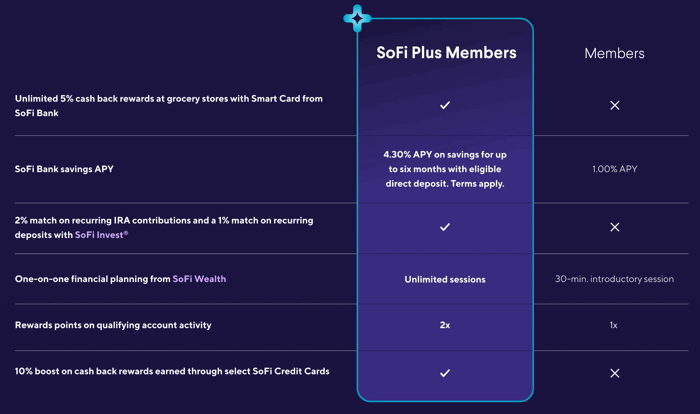
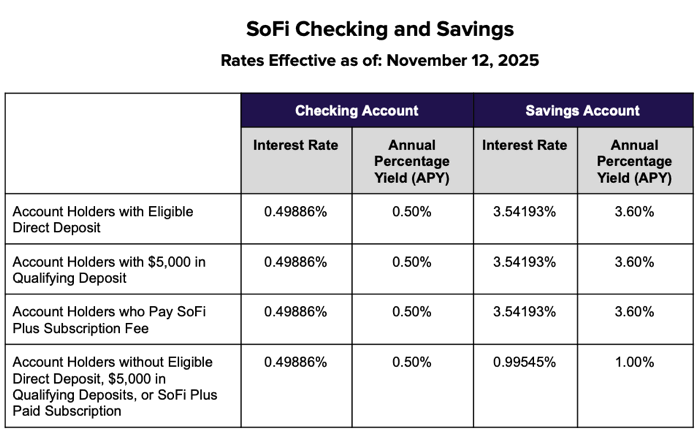
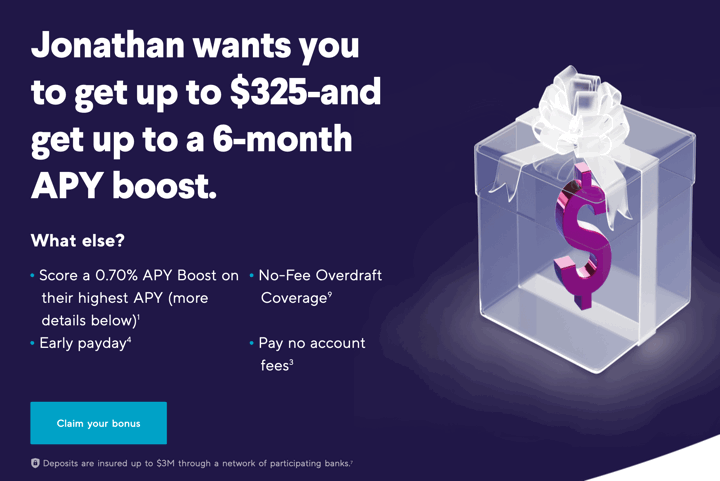
  • SoFi Bank is at 3.80% APY + up to 4.50% APY for 6 months + $325 new account bonus with qualifying direct deposit. You must maintain a direct deposit of any amount (even $1) each month for the higher APY. SoFi has historically competitive rates and full banking features.
  • Here is a limited survey of high-yield savings accounts. They aren’t the top rates, but a group that have historically kept it relatively competitive such that I like to track their history. I call this the “okay/good” zone of 3.50%+.

Short-term guaranteed rates (1 year and under)
A common question is what to do with a big pile of cash that you’re waiting to deploy shortly (plan to buy a house soon, just sold your house, just sold your business, legal settlement, inheritance). My usual advice is to keep things simple and take your time. If not a savings account, then put it in a flexible short-term CD under the FDIC limits until you have a plan.

  • No Penalty CDs offer a fixed interest rate that can never go down, but you can still take out your money (once) without any fees if you want to use it elsewhere. Marcus has a 13-month No Penalty CD at 4.15% APY ($500 minimum deposit). Farmer’s Insurance FCU has a 9-month No Penalty CD at 4.25% APY ($1,000 minimum deposit). USA USALLIANCE Financial CU has a 11-month No Penalty CD at 4.20% APY ($500 minimum deposit).
  • Eagle Bank has a 12-month certificate at 4.40% APY ($1,000 min). Early withdrawal penalty is 90 days of interest.

Money market mutual funds
Many brokerage firms that pay out very little interest on their default cash sweep funds (and keep the difference for themselves). Note: Money market mutual funds are highly-regulated, but ultimately not FDIC-insured, so I would still stick with highly reputable firms.

  • Vanguard Federal Money Market Fund (VMFXX) is the default sweep option for Vanguard brokerage accounts, which has an SEC yield of 4.20% (changes daily, but also works out to a compound yield of 4.28%, which is better for comparing against APY). Odds are this is much higher than your own broker’s default cash sweep interest rate.
  • Vanguard Treasury Money Market Fund (VUSXX) is an alternative money market fund which you must manually purchase, but the interest will be mostly (100% for 2024 tax year) exempt from state and local income taxes because it comes from qualifying US government obligations. Current SEC yield of 4.20% (compound yield of 4.28%).

Treasury Bills and Ultra-short Treasury ETFs
Another option is to buy individual Treasury bills which come in a variety of maturities from 4-weeks to 52-weeks and are fully backed by the US government. You can also invest in ETFs that hold a rotating basket of short-term Treasury Bills for you, while charging a small management fee for doing so. T-bill interest is exempt from state and local income taxes, which can make a significant difference in your effective yield.

  • You can build your own T-Bill ladder at TreasuryDirect.gov or via a brokerage account with a bond desk like Vanguard and Fidelity. Here are the current Treasury Bill rates. As of 9/9/25, a new 4-week T-Bill had the equivalent of 4.16% annualized interest and a 52-week T-Bill had the equivalent of 3.68% annualized interest.
  • The iShares 0-3 Month Treasury Bond ETF (SGOV) has a 4.21% SEC yield (0.09% expense ratio) and effective duration of 0.10 years. SPDR Bloomberg Barclays 1-3 Month T-Bill ETF (BIL) has a 4.14% SEC yield (0.136% expense ratio) and effective duration of 0.15 years. The new Vanguard 0-3 Month Treasury Bill ETF (VBIL) has a 4.21% SEC yield (0.07% expense ratio) and effective duration of 0.10 years.

US Savings Bonds
Series I Savings Bonds offer rates that are linked to inflation and backed by the US government. You must hold them for at least a year. If you redeem them within 5 years there is a penalty of the last 3 months of interest. The annual purchase limit for electronic I bonds is $10,000 per Social Security Number, available online at TreasuryDirect.gov.

  • “I Bonds” bought between May 2025 and October 2025 will earn a 3.98% rate for the first six months. The rate of the subsequent 6-month period will be based on inflation again. More on Savings Bonds here.
  • In mid-October 2025, the CPI will be announced and you will have a short period where you will have a very close estimate of the rate for the next 12 months. I will post another update at that time.

Rewards checking accounts
These unique checking accounts pay above-average interest rates, but with unique risks. You have to jump through certain hoops which usually involve 10+ debit card purchases each cycle, a certain number of ACH/direct deposits, and/or a certain number of logins per month. If you make a mistake (or they judge that you did) you risk earning zero interest for that month. Some folks don’t mind the extra work and attention required, while others would rather not bother. Rates can also drop suddenly, leaving a “bait-and-switch” feeling.

  • OnPath Federal Credit Union (my review) pays 7.00% APY on up to $10,000 if you make 15 debit card purchases, opt into online statements, and login to online or mobile banking once per statement cycle. Anyone can join this credit union via $5 membership fee to join partner organization. You can also get a $150 Visa Reward card when you open a new account and make qualifying transactions.
  • Genisys Credit Union pays 6.75% APY on up to $7,500 if you make 10 debit card purchases of $5+ each per statement cycle, and opt into online statements. Anyone can join this credit union via $5 membership fee to join partner organization.
  • NEW: Oklahoma Central Credit Union pays 6.00% APY on up to $10,000 if you make 15 debit card purchases (non-ATM) per statement cycle. Anyone can join this credit union if they are “affiliated with another credit union”.
  • La Capitol Federal Credit Union pays 5.75% APY on up to $10,000 if you make 15 debit card purchases of at least $5 each per statement cycle. Anyone can join this credit union via partner organization, Louisiana Association for Personal Financial Achievement ($20).
  • First Southern Bank pays 5.50% APY on up to $25,000 if you make at least 15 debit card purchases, 1 ACH credit or payment transaction, and enroll in online statements.
  • Credit Union of New Jersey pays 6.00% APY on up to $25,000 if you make 12 debit card purchases, opt into online statements, and make at least 1 direct deposit, online bill payment, or automatic payment (ACH) per statement cycle. Anyone can join this credit union via $5 membership fee to join partner organization.
  • Andrews Federal Credit Union pays 5.50% APY (down from 6%) on up to $25,000 if you make 15 debit card purchases, opt into online statements, and make at least 1 direct deposit or ACH transaction per statement cycle. Anyone can join this credit union via partner organization.
  • Find a locally-restricted rewards checking account at DepositAccounts.

Certificates of deposit (greater than 1 year)
CDs offer higher rates, but come with an early withdrawal penalty. By finding a bank CD with a reasonable early withdrawal penalty, you can enjoy higher rates but maintain access in a true emergency. Alternatively, consider building a CD ladder of different maturity lengths (ex. 1/2/3/4/5-years) such that you have access to part of the ladder each year, but your blended interest rate is higher than a savings account. When one CD matures, use that money to buy another 5-year CD to keep the ladder going. Some CDs also offer “add-ons” where you can deposit more funds if rates drop.

  • Mountain America Credit Union (MACU) has a 5-year certificate at 4.25% APY ($500 minimum), 4-year at 4.20% APY, 3-year at 4.15% APY, 2-year at 4.00% APY, and 1-year at 4.15% APY. Early withdrawal penalty for the 4-year and 5-year is 365 days of interest. Anyone can join this credit union via partner organization American Consumer Council for a one-time $5 fee (or try promo code “consumer”).
  • Lafayette Federal Credit Union (LFCU) has a 5/4/3/2/1-year certificates at 4.28% APY ($500 min). Slightly higher rates with jumbo $100,000+ balances. Note that the early withdrawal penalty for the 5-year is a relatively large 600 days of interest. Anyone nationwide can join LFCU by joining the Home Ownership Financial Literacy Council (HOFLC) for a one-time $10 fee.
  • You can buy certificates of deposit via the bond desks of Vanguard and Fidelity. You may need an account to see the rates. These “brokered CDs” offer FDIC insurance and easy laddering, but they don’t come with predictable early withdrawal penalties. Right now, I see a 5-year non-callable brokered CD at 3.70% APY (callable: no, call protection: yes). Be warned that both Vanguard and Fidelity will list higher rates from callable CDs, which importantly means they can (and will!) call back your CD if rates drop significantly later.

Longer-term Instruments
I’d use these with caution due to increased interest rate risk (tbh, I don’t use them at all), but I still track them to see the rest of the current yield curve.

  • Willing to lock up your money for 10 years? You can buy long-term certificates of deposit via the bond desks of Vanguard and Fidelity. These “brokered CDs” offer FDIC insurance, but they don’t come with predictable early withdrawal penalties. You might find something that pays more than your other brokerage cash and Treasury options. Right now, I see a 10-year CDs at [n/a] (non-callable) vs. 4.08% for a 10-year Treasury. Watch out for higher rates from callable CDs where they can call your CD back if interest rates drop.

All rates were checked as of 9/9/25.

* I no longer recommend fintech companies due to the possibility of significant loss due to poor recordkeeping and the lack of government protection in such scenarios. (Ex. Evergreen Wealth at 5% APY is a fintech.)

Photo by insung yoon on Unsplash

Capital One 360 Savings Class Action Settlement Thoughts

Capital One settled a class action settlement involving alleged deceptive marketing because it kept the interest rate on customers with deposits in their older “360 Savings Account” lower without closing them, while simultaneously marketing a new “360 Performance Savings Account” at a higher interest. Many people in the older accounts either thought they were the same or thought they were getting the higher, marketed interest rate. Anyone who had an original “360 Savings” account between 9/18/19 and 6/16/25 is included in the settlement.

The Consumer Financial Protection Bureau estimated that Capital One avoided paying $2 billion in interest by not automatically converting each 360 Savings account to a 360 Performance Savings account. Meanwhile, the settlement amount is really $300 million, with another $125 million earmarked for higher interest rates in the future for the older accounts.

Via this NYT article, you can see charts of both the different interest rates (above) and what would have happened to a single account with $10,000 balance (below).

I just received my postcard regarding the settlement, and the main takeaways are:

  • The cash payments will be related to the historical account balances in the older, low-interest accounts. There is no evidence to submit. For me, that is probably very little if any. However, they do have a provision to perhaps distribute any leftover funds pro-rata, so who knows.
  • I should still choose an electronic payment, because if the amount is less than $5, they will not be sending paper checks and will only send the funds to you via electronic payment. I usually prefer Venmo.

Random side-story! During a jury duty stint years ago, a personal injury lawyer once spent time to explain to us the details of the infamous “I spilled McDonald’s hot coffee on myself” lawsuit. To make it very brief, it was a specific McDonald’s location that decided to speed up its morning rush by making extra, extra hot coffee (180-190°F) and portioning it into cups ahead of time so that in theory it would stay hot for longer. Coffee made under normal, industry-standard operating procedures would not be that hot (135-140°F). 190°F is hot enough for instant 3rd-degree burns requiring skin grafts. To summarize, the details matter.

In this case, one of the problems was that “360 Savings” and “360 Performance Savings” were basically identical. There was no other “plausible deniability” reason for them to have the new account, other than to disadvantage their existing customers. With other banks, they will often tweak something so that the two accounts are a little bit different. Maybe the minimum balance changes, so they are targeted “higher balance” accounts which are thus cheaper to manage (and justify a higher interest rate). Maybe one will require a direct deposit or recurring transfers, again justifying a different interest rate.

Nearly every consumer financial company takes advantage of behavioral tendencies like forgetfulness or inertia. Checking account overdraft fees. Credit card late payment fees. Auto-renewing subscriptions for Netflix on down. Charles Schwab made over $9 billion in “net interest income” in 2024, which was basically half of their total revenue. Guess what uninvested cash in your Schwab brokerage account earns? 0.05% APY.

Best Interest Rates Survey: Bank Accounts, Treasury Bills, Money Markets, ETFs – August 2025

Here’s my monthly survey of the best interest rates on cash as of August 2025, roughly sorted from shortest to longest maturities. Banks and brokerages love taking advantage of our idle cash, and you can often earning more money while keeping the same level of safety by moving to another FDIC-insured bank or NCUA-insured credit union. Check out my Ultimate Rate-Chaser Calculator to see how much extra interest you could earn from switching. Rates listed are available to everyone nationwide. Rates checked as of 8/10/2025.

TL;DR: Savings account interest rates are mostly stable (maybe a tiny bit lower on average) with one at 5% APY but most struggling to stay above 4.00% APY. Short-term T-Bill rates at around 4.3%. Top 5-year CD rates are ~4.25% APY, while 5-year Treasury rate is ~3.8%.

High-yield savings accounts*
Since the huge megabanks still pay essentially no interest, everyone should at least have a separate, no-fee online savings account to piggy-back onto your existing checking account. The interest rates on savings accounts can drop at any time, so I list the top rates as well as competitive rates from banks with a history of competitive rates and solid user experience. Some banks will bait you with a temporary top rate and then lower the rates in the hopes that you are too lazy to leave.

  • The top saving rate at the moment: HUSTL Financial at 5.00% APY (no min), a division of Vantage West Credit Union, member NCUA (and thus not a fintech). No direct experience with this one; wonder how long it will last? The “good/excellent” savings rate zone appears to be roughly 4% and above. CIT Platinum Savings is now at 4.00% APY with $5,000+ balance. There are many banks in between.
  • SoFi Bank is at 3.80% APY + up to $325 new account bonus with direct deposit. You must maintain a direct deposit of any amount (even $1) each month for the higher APY. SoFi has historically competitive rates and full banking features. See details at $25 + $300 SoFi Money new account and deposit bonus.
  • Here is a limited survey of high-yield savings accounts. They aren’t the top rates, but a group that have historically kept it relatively competitive such that I like to track their history. I’d call this the “okay/good” zone of 3.50%+.

Short-term guaranteed rates (1 year and under)
A common question is what to do with a big pile of cash that you’re waiting to deploy shortly (plan to buy a house soon, just sold your house, just sold your business, legal settlement, inheritance). My usual advice is to keep things simple and take your time. If not a savings account, then put it in a flexible short-term CD under the FDIC limits until you have a plan.

  • No Penalty CDs offer a fixed interest rate that can never go down, but you can still take out your money (once) without any fees if you want to use it elsewhere. Marcus has a 13-month No Penalty CD at 4.15% APY ($500 minimum deposit). Farmer’s Insurance FCU has a 9-month No Penalty CD at 4.25% APY ($1,000 minimum deposit). USA USALLIANCE Financial CU has a 11-month No Penalty CD at 4.20% APY ($500 minimum deposit).
  • Eagle Bank has a 12-month certificate at 4.40% APY ($1,000 min). Early withdrawal penalty is 90 days of interest.

Money market mutual funds
Many brokerage firms that pay out very little interest on their default cash sweep funds (and keep the difference for themselves). Note: Money market mutual funds are highly-regulated, but ultimately not FDIC-insured, so I would still stick with highly reputable firms.

  • Vanguard Federal Money Market Fund (VMFXX) is the default sweep option for Vanguard brokerage accounts, which has an SEC yield of 4.22% (changes daily, but also works out to a compound yield of 4.30%, which is better for comparing against APY). Odds are this is much higher than your own broker’s default cash sweep interest rate.
  • Vanguard Treasury Money Market Fund (VUSXX) is an alternative money market fund which you must manually purchase, but the interest will be mostly (100% for 2024 tax year) exempt from state and local income taxes because it comes from qualifying US government obligations. Current SEC yield of 4.24% (compound yield of 4.32%).

Treasury Bills and Ultra-short Treasury ETFs
Another option is to buy individual Treasury bills which come in a variety of maturities from 4-weeks to 52-weeks and are fully backed by the US government. You can also invest in ETFs that hold a rotating basket of short-term Treasury Bills for you, while charging a small management fee for doing so. T-bill interest is exempt from state and local income taxes, which can make a significant difference in your effective yield.

  • You can build your own T-Bill ladder at TreasuryDirect.gov or via a brokerage account with a bond desk like Vanguard and Fidelity. Here are the current Treasury Bill rates. As of 8/8/25, a new 4-week T-Bill had the equivalent of 4.36% annualized interest and a 52-week T-Bill had the equivalent of 3.92% annualized interest.
  • The iShares 0-3 Month Treasury Bond ETF (SGOV) has a 4.24% SEC yield (0.09% expense ratio) and effective duration of 0.10 years. SPDR Bloomberg Barclays 1-3 Month T-Bill ETF (BIL) has a 4.16% SEC yield (0.136% expense ratio) and effective duration of 0.15 years. The new Vanguard 0-3 Month Treasury Bill ETF (VBIL) has a 4.21% SEC yield (0.07% expense ratio) and effective duration of 0.10 years.

US Savings Bonds
Series I Savings Bonds offer rates that are linked to inflation and backed by the US government. You must hold them for at least a year. If you redeem them within 5 years there is a penalty of the last 3 months of interest. The annual purchase limit for electronic I bonds is $10,000 per Social Security Number, available online at TreasuryDirect.gov.

  • “I Bonds” bought between May 2025 and October 2025 will earn a 3.98% rate for the first six months. The rate of the subsequent 6-month period will be based on inflation again. More on Savings Bonds here.
  • In mid-October 2025, the CPI will be announced and you will have a short period where you will have a very close estimate of the rate for the next 12 months. I will post another update at that time.

Rewards checking accounts
These unique checking accounts pay above-average interest rates, but with unique risks. You have to jump through certain hoops which usually involve 10+ debit card purchases each cycle, a certain number of ACH/direct deposits, and/or a certain number of logins per month. If you make a mistake (or they judge that you did) you risk earning zero interest for that month. Some folks don’t mind the extra work and attention required, while others would rather not bother. Rates can also drop suddenly, leaving a “bait-and-switch” feeling.

  • OnPath Federal Credit Union (my review) pays 7.00% APY on up to $10,000 if you make 15 debit card purchases, opt into online statements, and login to online or mobile banking once per statement cycle. Anyone can join this credit union via $5 membership fee to join partner organization. You can also get a $100 Visa Reward card when you open a new account and make qualifying transactions.
  • Genisys Credit Union pays 6.75% APY on up to $7,500 if you make 10 debit card purchases of $5+ each per statement cycle, and opt into online statements. Anyone can join this credit union via $5 membership fee to join partner organization.
  • La Capitol Federal Credit Union pays 5.75% APY on up to $10,000 if you make 15 debit card purchases of at least $5 each per statement cycle. Anyone can join this credit union via partner organization, Louisiana Association for Personal Financial Achievement ($20).
  • First Southern Bank pays 5.50% APY on up to $25,000 if you make at least 15 debit card purchases, 1 ACH credit or payment transaction, and enroll in online statements.
  • Credit Union of New Jersey pays 6.00% APY on up to $25,000 if you make 12 debit card purchases, opt into online statements, and make at least 1 direct deposit, online bill payment, or automatic payment (ACH) per statement cycle. Anyone can join this credit union via $5 membership fee to join partner organization.
  • Andrews Federal Credit Union pays 5.50% APY (down from 6%) on up to $25,000 if you make 15 debit card purchases, opt into online statements, and make at least 1 direct deposit or ACH transaction per statement cycle. Anyone can join this credit union via partner organization.
  • Find a locally-restricted rewards checking account at DepositAccounts.

Certificates of deposit (greater than 1 year)
CDs offer higher rates, but come with an early withdrawal penalty. By finding a bank CD with a reasonable early withdrawal penalty, you can enjoy higher rates but maintain access in a true emergency. Alternatively, consider building a CD ladder of different maturity lengths (ex. 1/2/3/4/5-years) such that you have access to part of the ladder each year, but your blended interest rate is higher than a savings account. When one CD matures, use that money to buy another 5-year CD to keep the ladder going. Some CDs also offer “add-ons” where you can deposit more funds if rates drop.

  • Mountain America Credit Union (MACU) has a 5-year certificate at 4.25% APY ($500 minimum), 4-year at 4.20% APY, 3-year at 4.15% APY, 2-year at 4.00% APY, and 1-year at 4.15% APY. Early withdrawal penalty for the 4-year and 5-year is 365 days of interest. Anyone can join this credit union via partner organization American Consumer Council for a one-time $5 fee (or try promo code “consumer”).
  • Lafayette Federal Credit Union (LFCU) has a 5/4/3/2/1-year certificates at 4.28% APY ($500 min). Slightly higher rates with jumbo $100,000+ balances. Note that the early withdrawal penalty for the 5-year is a relatively large 600 days of interest. Anyone nationwide can join LFCU by joining the Home Ownership Financial Literacy Council (HOFLC) for a one-time $10 fee.
  • You can buy certificates of deposit via the bond desks of Vanguard and Fidelity. You may need an account to see the rates. These “brokered CDs” offer FDIC insurance and easy laddering, but they don’t come with predictable early withdrawal penalties. Right now, I see a 5-year non-callable brokered CD at 3.95% APY (callable: no, call protection: yes). Be warned that both Vanguard and Fidelity will list higher rates from callable CDs, which importantly means they can (and will!) call back your CD if rates drop significantly later.

Longer-term Instruments
I’d use these with caution due to increased interest rate risk (tbh, I don’t use them at all), but I still track them to see the rest of the current yield curve.

  • Willing to lock up your money for 10 years? You can buy long-term certificates of deposit via the bond desks of Vanguard and Fidelity. These “brokered CDs” offer FDIC insurance, but they don’t come with predictable early withdrawal penalties. You might find something that pays more than your other brokerage cash and Treasury options. Right now, I see a 10-year CDs at 3.85% (non-callable) vs. 4.27% for a 10-year Treasury. Watch out for higher rates from callable CDs where they can call your CD back if interest rates drop.

All rates were checked as of 8/10/25.

* I no longer recommend fintech companies due to the possibility of loss due to poor recordkeeping and lack of government regulation. (Ex. Evergreen Wealth at 5% APY is a fintech.)

Photo by insung yoon on Unsplash

US Bank Smartly Credit Card Review: More Negative Changes September 2025

Update August 2025: Previously-grandfathered “V1” cardholders should have received both paper and e-mail notifications of new changes that are to be effective 9/15/25. The e-mail subject will be “Important information about your U.S. Bank Smartly Visa Signature Card”. There appears to be two possible sets of new requirements.

The more restrictive version basically changes you to the current version available to new applicants, which requires all qualifying balances to be held in a checking account earning essentially zero interest. There are also new excluded categories like tuition and estimated tax payments.

Updated rewards earning
You will continue to earn unlimited 2% cash back on every purchase with no caps.¹

The way in which you earn a Smartly Earning Bonus will be updated as follows:
Earn up to an additional 2% cash back on your first $10,000 in eligible Net Purchases each billing cycle when paired with a U.S. Bank Smartly® Savings account plus qualifying balances in U.S. Bank Smartly® Checking and/or Safe Debit account(s).¹
– Earn a total of 2.5% cash back with a qualifying balance between $10,000 and $49,999.
– Earn a total of 3% cash back with a qualifying balance between $50,000 and $99,999.
– Earn a total of 4% cash back with a qualifying balance of $100,000 or more.

Not all purchases are eligible to earn the Smartly Earning Bonus. Purchases classified in the categories listed below may be excluded from earning the Smartly Earning bonus:
– Education/school, gift cards, insurance, or tax
– Business-to-business transactions (i.e. advertising services, construction material suppliers, etc.)
– Transactions using third-party bill payment services

These purchases will earn the base 2% cash back and are not calculated as part of the $10,000 billing cycle cap.

The less restrictive version is mostly the same, with the very important difference being that your qualifying balances can still be held in an investment account. Thanks to reader Playc.

Updated rewards earning
You will continue to earn unlimited 2% cash back on every purchase with no caps.¹

The way in which you earn a Smartly Earning Bonus will be updated as follows:
Earn up to an additional 2% cash back on your first $10,000 in eligible Net Purchases each billing cycle when paired with a U.S. Bank Smartly® Savings account and average daily combined qualifying balances in U.S. Bank deposit, trust or investment accounts.¹
– Earn a total of 2.5% cash back with a qualifying balance between $5,000 and $49,999.
– Earn a total of 3% cash back with a qualifying balance between $50,000 and $99,999.
– Earn a total of 4% cash back with a qualifying balance of $100,000 or more.

Not all purchases are eligible to earn the Smartly Earning Bonus. Purchases classified in the categories listed below may be excluded from earning the Smartly Earning bonus:
– Education/school, gift cards, insurance, or tax
– Business-to-business transactions (i.e. advertising services, construction material suppliers, etc.)
– Transactions using third-party bill payment services

These purchases will earn the base 2% cash back and are not calculated as part of the $10,000 billing cycle cap.

Unfortunately, I got the more restrictive version. That means they will have completely changed their advertised and promised features less than 6 months from getting this card. As a result, I will be closing my Smartly Checking, Smartly Savings, Smartly credit card, and US Bank brokerage account. Not a good look for a place that wants to be taken seriously as one of the major nationwide banks. Unreliability is not something most banks want to be known for.

Update 4/15/25: The rumors were true and have taken effect as of 4/15/25. If you have not applied yet, I wouldn’t bother. Given the spending cap and bonus category exclusions, in nearly all cases, the potential lost interest on the required cash deposits (earning no interest) will be higher than any additional potential cash back rewards earned. I consider this now basically a 2% cash back card.

Update 4/8/25: The same Reddit user has posted follow-up details, and they appear to confirm the details of the initial rumor. Please refer to the newest Reddit post, screenshot #1, screenshot #2, and screenshot #3. They appear legitimate in my opinion.

For existing cardholders, no changes have been announced. Everything is the same, for now. No $10k/month spending cap. Balance tiers are the same. Investment account balances still count. No new bonus category exclusions. Hope the grandfathering of loyal customers lasts, as we went through a good amount of trouble moving over significant assets.

For new cardholders that apply after April 14th, this card is no longer attractive above the base 2% cash back. They will require the qualifying deposits to be held in the Smartly Checking or Safe Debit accounts, which earn zero or essentially zero interest. Balances held in a brokerage account no longer qualify. Even balances held in their own Smartly Savings account (currently up to 3.50% APY) no longer qualify. Given the spending cap and bonus category exclusions, in nearly all cases, the potential lost interest on this cash will be higher than the additional potential cash back rewards earned. Goodbye, Smartly, we hardly knew ye.

Update 4/7/25: The rumors have gotten more supporting evidence. Reddit user Zanutrees posted this screenshot from an internal US Bank e-mail that appears to be legitimate. The two most critical quotes:

  • A revised U.S. Bank Smartly Visa Signature® Card is launching soon and will be available for application in branches starting April 14! Resources to help you prepare for the launch of the revised card will become available on Card Central tomorrow, April 8.
  • It is important to note that existing Bank Smartly cardmembers as well as any clients who applied prior to April 14 will receive the original Bank Smartly Card features and benefits; the revised card features and benefits will only affect clients who apply for the card on or after April 14.

Overall, the two actionable responses are the same as below (apply ASAP or never). We just got more support behind the 4/14 deadline and the fact that they will be offering grandfathering (for an unspecified amount of time).

Update 4/2/25: Doctor of Credit reports a Reddit rumor that the US Bank Smartly credit card will be undergoing some major negative changes as of 4/14/25. This includes:

  • Base is still 2% cash back on unlimited amounts. Bonus cash back (up to another 2% for a total of 4%) is capped to $10,000 in purchases per statement cycle.
  • Bonus cash back now excludes: Educational/school, gift cards, insurance, taxes, business to business transactions, and 3rd party bill payments.
  • For new cardmembers after April 14th, only checking account balances count now towards the $10k/$50k/$100k deposit requirements. Critically, savings account balances and investment balances do not count after 4/14 for new cardmembers. Existing customers will be grandfathered in for now.

Again, the above is a rumor. However, I do believe the following are true:

  • There is basically no way that this card can continue to exist without some sort of added restrictions. 4% with no cap simply does not math out, as I guarantee that some people are paying $100,000 in college or private school tuitions, $300,000+ in tax bills on this card, and who knows how many business transactions between “friendly” parties…
  • US Bank has a history of first rolling out a consumer-friendly product, and then later pulling it from the market or changing the features.
  • US Bank also has a history of grandfathering in existing customers of those products and continuing to offer them some/all of the old features.

Therefore, I see two possible actionable responses:

  1. Giving up on this Smartly card and not applying at all, and possibly avoiding the US Bank ecosystem altogether. It’s hard to work with unreliable people. If these changes take place, after 4/14 the lost interest on $100,000 in cash will outweigh the extra 2% by a good margin.
  2. Working extra fast right now in order to open up your US Bank Smartly savings account (this seems to be the easiest to open), then Smartly checking w/ bonus, then the US Bank self-directed brokerage account, fund it with $100,000, and apply for the Smartly credit card all as soon as possible, definitely before the rumored 4/14 deadline. Take advantage of the fact that they probably have to grandfather in these current terms at least for a year or so, otherwise in theory they would be bait-and-switching and might get in trouble.

Since my last update, I opened a new US Bank brokerage account, moved over $101,000 in cash, and then invested it all into the SGOV ETF that holds Treasury Bills. (I could have moved over stock ETFs instead, but I had the cash available.) I then applied for the Smartly credit card and was approved with a $25,000 limit despite my previous lack of “pre-approval”. I was hoping that reaching their top rewards tier first would encourage them to approve my new card, and maybe it helped. I’m okay with accepting the rumored changes as long as they grandfather me in on the brokerage balances; it could have been worse. What do you think?

I just took a quick look at the application page. Everything still looks the same as before as of today. I did take some screenshots in case there are subtle changes later.

Update 11/11/24: Applications for this card are now open. No sign-up bonus. It let me check if I was “pre-approved” with a soft pull (had to unfreeze TransUnion for it to work), but I was not pre-approved. That might be because I recently applied for the Altitude Reserve (now-discontinued) after setting up a Smartly Checking and Savings account to get “in” with them but was getting impatient (was denied for US Bank credit cards in the past without a banking relationship due to my geographic area). Will have to sit this one out for now, but plan to try again later if they don’t pull it quickly.

Original pre-review post:

US Bank recently announced the US Bank Smartly Visa Signature Card, a new rewards credit card that offers up to 4% cash back on all purchases, if you have enough qualifying balances with them. This is the newest entrant to relationship banking, where banks offers you extra perks for combining multiple account types with them like savings accounts and investment/retirement accounts.

The card is not open to applications yet, but you can get on an e-mail waitlist. Here are the details of how that “up to 4% cash back” breaks down according to this US Bank press release and CNBC article.

Base rewards of 2% cash back on all purchases, with no limit. Technically, this card earns 2 points per $1 spent in eligible net purchases. In order get 2% cash back, you must redeem those points into an eligible U.S. Bank checking or savings account.

Bonus rewards of 0.5%, 1% or 2% cash back based on your qualifying combined balances at US Bank. You must also have an open Bank Smartly Savings account. Your qualifying combined balances with U.S. Bank include “open consumer checking account(s), money market savings account(s), savings account(s), CDs and/or IRAs, U.S. Bancorp Investments and personal trust account(s).” Business accounts, commercial accounts, and the Trustee only (IFI) client relationship do not qualify.

  • $5,000 – $49,999.99 earns 2.5% total cash back. Total of 2.5 Points per $1 (a base of 2 Points plus the Smartly Earning Bonus of 0.5 Points),
  • $50,000 – $99,999.99 earns 3% total cash back. Total of 3 Points per $1 (a base of 2 Points plus the Smartly Earning Bonus of 1 Point).
  • $100,000+ earns 4% total cash back. Total of 4 Points per $1 (a base of 2 Points plus the Smartly Earning Bonus of 2 Points).

Other bits: CNBC article reports no annual fee. Points will expire if there is no reward, purchase, or balance activity on your account for 12 consecutive statement cycles. Bank Smartly Credit Card and Bank Smartly Savings available in all 50 states.

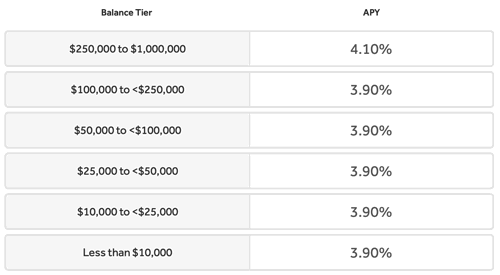
Bank Smartly savings account. Let’s take a closer look at the Bank Smartly Savings account, which also earns difference rates based on both your balance inside the Smartly savings account itself AND your qualifying combined balances at US Bank. Here’s their current interest rate grid, updated as of 9/3/2024.

Importantly, these rates can change at any time. But right now, if you have at least $25k in Smartly and $25k in combined qualifying combined balances across US Bank, you can get the current top rate of 4.10% APY.

There is also a $5 monthly maintenance fee, which is waived if you have a Bank Smartly® Checking account (or Safe Debit account which also costs $4.95 a month). The Bank Smartly® Checking account itself has a $6.95 monthly fee, waived with $1,500+ average account balance, qualifying U.S. Bank consumer credit card, or combined monthly direct deposits totaling $1,000+.

Therefore, technically if you get this credit card, that would make the Bank Smartly Checking account free, which in turn would make the Bank Smartly Savings account free. Right now there is also a $450 bonus for new Bank Smartly Checking customers with a direct deposit requirement.

Rough opportunity costs with depositing cash at Bank Smartly Savings. Let’s try some rough theoretical numbers. Let’s say you actually have $100,000 in cash lying around, but you could get ~5.10% APY elsewhere and so you would be giving up ~1% APY to park your money at US Bank instead. If you held all of it at Bank Smartly Savings to qualify for the 4% cash back on the credit card, you’d be giving up $1,000 in taxable interest each year ($100,000 x 1%).

In exchange, you are getting 2% extra cash back over your existing, flat 2% cash back card. Cash back rewards are generally considered non-taxable as they are a rebate on your purchase. If you assume a marginal tax rate of 0% (this is just a guess), then you’d need $50,000 in annual purchases ($4,166 a month) at 2% extra cash back to break even with the hit from the lower interest. If you assume a marginal tax rate of 22%, then you’d need a little less: $39,000 in annual purchases ($3,350 a month) at 2% extra cash back to break even with the hit from the lower interest.

US Bank self-directed investments accounts! As with the Bank of America Preferred Rewards program, an alternative way to satisfy the balance requirements with minimal opportunity costs is to transfer over existing assets into a self-directed US Bank brokerage account. For example, you could transfer over $100,000 in index ETFs inside an IRA or taxable brokerage account. This would appear to fully satisfy the requirements as a “U.S. Bancorp Investments” account. This way, US Bank also gets a stronger foothold in the world of wealth management, as all the banks seem to want these days.

Be careful though, as US Bank’s self-directed brokerage account has a slightly higher fee schedule than much of the competition. Stock trades are $4.95 each, although you get 100 free trades per calendar year if you have both a Bank Smartly Checking account and paperless statements. There is a $50 annual account fee and a separate $50 annual IRA fee; these are waived if you have $250,000 in combined statement household balances.

My quick take. If all of these details actually hold through launch, they would be a potential improvement over the best current situation of 2.62% cash back on all purchases via the Bank of America Preferred Rewards program (also requires $100k in assets held at BofA) and a BofA cash back credit card. (The Robinhood 3% credit card is still “coming soon”.) But will it last? Even the BofA 2.62% has remained something of an outlier, but my hunch is that it has encouraged enough of people to keep a ton of cash at BofA earning zero interest so that BofA is still happy overall. Given that this new US Bank program actually offers a decent interest rate and an even higher cash back rate, I am concerned about its longevity. On the other hand, maybe this is US Bank’s big push to become a major player on the national level of Bank of America or Chase.

I’d have to open a lot of new accounts to go for this one. Savings account, brokerage account, credit card, move over assets, all for a bonus that is based on my credit card spend so will trickle in slowly. (None of these have a big upfront bonus.) Given the amount of shady stuff US Bank will probably have to deal with when paying 4% cash back, I’d also have to trust that it will last long enough to be worth the effort.

US Bank has a history of making cards and then pulling them from the market, but sometimes they also let the grandfathered users keep the old perk system. Hmm…

Capital One 360 Savings Deposit Promo ($300 to $1,500 Bonus)

Offer is back again/still around. Capital One has brought back a deposit promotion worth up to $1,500 for new 360 Savings accountholders. It’s a good bonus, but only for “new” customers and those that are willing to keep an eye on things. Here’s their definition of “new”:

If you have or had an open 360 Performance Savings, 360 Savings, 360 Money Market, Savings Now or Confidence Savings account as a primary or secondary account holder with Capital One on or after January 1, 2022, you will be ineligible for the bonus. If your account is in default, closed or suspended, or otherwise not in good standing, you will not receive the bonus.

Note: Some readers have reported in the past that they were not able to apply the promo code even as valid new customers, and Capital One responded that this was a targeted promotion even though there is no such language on the offer page nor in the terms and conditions. This offer seems clearly available to the public, however. After applying, I would contact them and make sure that the promo code “BONUS1500” was accepted before making a large deposit for this promo.

The steps:

  • Open a new 360 Performance Savings account with promo code BONUS1500 on or after April 3, 2024.
  • Deposit $20,000+ of external funds during the 15-day Initial Funding Period after opening your account.
  • Hold the deposit(s) in your account for an additional 90 days after the 15-day Initial Funding Period ends.
  • $20,000+ deposited = $300 bonus.
  • $50,000+ deposited = $750 bonus.
  • $100,000+ deposited = $1,500 bonus.
  • See the bonus in your new account within 60 days after holding.
  • You’ll also earn their normal interest rate (variable, but currently 3.80% APY as of 12/22/24). No monthly fees or minimum balance requirements.

Note that the 90-day “maintain balance” period is after and in addition to the end of the 15-day “initial funding period”. So if you are counting from the opening day, that is a total of 105 days after opening. This is important as other readers have gotten denied for the bonus when withdrawing after 91-100 days. You may wish to chat with Capital One to confirm the exact date.

As long as you hit the tiers exactly, you are getting 1.5% of your deposit with technically a minimum holding period of 90 days, but you’ll probably want to send it in a little early and take it out a little late to be safely within the deadlines. Let’s call it 120 days for a conservative round number. This means the bonus by itself works out to the equivalent of (a little more than) a 4.5% annualized yield. Add in your expected interest rate for the total annualized yield for those 120 days.

Again, this one is only for new customers or those that have closed their previous CapOne360 savings-type accounts by January 1, 2022.

OnPath FCU: 6.00% APY Rewards Checking ($150 Bonus) + 4.40% APY Elite Money Market

APY now 6.00% APY. Bonus now increased to $150 (was $100). OnPath Federal Credit Union now has two accounts that are competitive in the high-interest cash landscape:

Credit union membership requirements (easy). OnPath FCU is based in Louisiana, a their field of membership starts with people that live and work in that area. However, anyone nationwide can join OnPath FCU with a $5 donation to OnPath Foundation. I did not experience a hard credit check, which was nice.

Elite Money Market details. This is a new account type, and it looks like they are looking to pull in some big deposits. (OnPath has been growing, recently merging with Louisiana Federal Credit Union.) You have to open with at least $25,000 and maintain at least a $25,000 balance to earn the highest APY. Funds must be new to OnPath. This account offers NCUA excess-share insurance up to $1,000,000.

It’s a little hidden on their website, but you it’s in the Savings section and look for “Elite Money Market” on the left menu.

Note: The Elite Money Market (EMM) has some ACH restrictions. My understanding is that they do have some limitations when you initiate ACH transactions internally (at OnPath) between an internal (OnPath) and external (outside) account. They also appear to not allow externally-initiated ACH transfers directly to/from the EMM account. To work around this, you can perform an instant transfer of your money into an OnPath checking account (no limits), and then withdrawal the money via that OnPath checking account using an externally-initiated pull.

6.00% APY High-Yield Rewards Checking details. Their High-Yield Rewards Checking earns 7% APY on balances up to $10,000 and .50% APY on balances over $10,000, if you meet these three qualifications per monthly cycle.

  • Have 15 or more debit card purchases post and settle.
  • The primary owner must log into online or mobile banking at least once.
  • Be enrolled in and receive electronic statements.

Qualification cycles start on the last day of each month and end on the second to last day of the following month. Here are the exact dates for each cycle [pdf]. They will e-mail you at the end of each month to confirm if you’ve met the qualifications. All balances for non-qualified accounts earn .01% APY.

Out-of-network, domestic ATM fee rebates ($10 max per month) are also included if you meet the qualifications. No monthly service fee, no minimum balance requirement, and $25 minimum deposit to open.

OnPath has been pretty reliable and hasn’t given me any problems. There are no minimum debit purchase amounts, although I still try to vary the amounts. I also avoid waiting until the end of the month, because it says you have to post and settle, which might take a couple business days.

$150 Refer-a-Friend Bonus. This bonus is independent of the checking account qualifications above, but you need to pick a checking account and I picked the one above since it stacks well. Note that this refer-a-friend bonus has a $10 minimum per transaction, but the ongoing requirements for the 7% APY do not include the minimum.

  • First, register your information at member’s $100 bonus referral link (that’s mine). I have already registered on my end, and successfully referred members in the past.
  • Become an OnPath FCU member and open a new OnPath FCU personal or business checking account.
  • Within 60 days of account opening, make at least 15 debit card transactions of $10 or more (excluding ATM transactions), AND have one (1) or more direct deposits totaling at least $250.
  • Both referring and referred parties will receive a $100 Visa Reward card mailed to them upon completion. I got my prepaid Visa in the mail with no issues. You can cash out the Visa Reward card by purchasing an Amazon gift card, or buy using it as a funding source for the Cash App (via PayPal) or Apple Cash.

Here’s a quick screenshot of the OnPath FCU user interface. They use the same backend provider as many other credit unions.

New Vanguard Bond ETFs: Total TIPS ETF (VTP) & Total Treasury ETF (VTG)

Following Vanguard’s stated plans to expand into fixed income, Vanguard recently announced the following new bond ETFs (press release):

  • Vanguard Total Inflation-Protected Securities ETF (VTP). Seeks to track the performance of an index of the full market of inflation-protected public obligations of the U.S. Treasury including short-, intermediate-, and long-term maturities. Expense ratio of 0.05%.
  • Vanguard Total Treasury ETF (VTG). Seeks to track the total U.S. Treasury bond market including short-, intermediate-, and long-term maturities. Expense ratio of 0.03%.
  • Vanguard Government Securities Active ETF (VGVT). Actively-managed bond ETF that seeks to outperform the benchmark (Bloomberg Government Total Return Index) with an expense ratio of 0.10%.

In my opinion, the most notable addition here is the Vanguard Total Inflation-Protected Securities ETF (VTP) because the only previous TIPS ETF available was Vanguard Short-Term Inflation Protected ETF (VTIP). Finally, we have an ETF option for those that want a longer-duration TIPS ETF with usually a higher real yield and thus higher expected long-term return for long-term holders. Of course, this also comes with higher real interest rate risk, meaning higher volatility and price fluctuations with changes in the real yield.

In contrast, there are already multiple Treasury ETFs from Vanguard with your choice of short-term (VGSH), intermediate-term (VGIT), or long-term (VGLT) flavors.

My current pick in this category, the Schwab U.S. TIPS ETF (SCHP) currently has a lower expense ratio at 0.03%. I hope that VTP will also become cheaper as the assets grow.

I personally only use TIPS ETFs in taxable brokerage accounts because they simplify the “phantom tax” situation with individual TIPS in those accounts. Otherwise, in my tax-sheltered accounts, I try to just own the individual TIPS directly since I am manually building a long-duration ladder.

Overall, Vanguard entering a sector is a good thing, as more competition is better. Vanguard also recently announced new extremely short-term Treasury ETFs including the Vanguard 0-3 Month Treasury Bill ETF (VBIL), which are potential cash/T-bill alternatives.

Best Interest Rates Survey: Savings Accounts, Treasury Bills, Money Markets, ETFs – July 2025

Here’s my monthly survey of the best interest rates on cash as of July 2025, roughly sorted from shortest to longest maturities. Banks and brokerages love taking advantage of our idle cash, and you can often earning more money while keeping the same level of safety by moving to another FDIC-insured bank or NCUA-insured credit union. Check out my Ultimate Rate-Chaser Calculator to see how much extra interest you could earn from switching. Rates listed are available to everyone nationwide. Rates checked as of 7/9/2025.

TL;DR: Savings account interest rates are mostly stable (maybe a tiny bit lower on average), top rates are still those above 4.00% APY. Short-term T-Bill rates at around 4.3%. Top 5-year CD rates are ~4.25% APY, while 5-year Treasury rate is ~4%.

High-yield savings accounts*
Since the huge megabanks still pay essentially no interest, everyone should at least have a separate, no-fee online savings account to piggy-back onto your existing checking account. The interest rates on savings accounts can drop at any time, so I list the top rates as well as competitive rates from banks with a history of competitive rates and solid user experience. Some banks will bait you with a temporary top rate and then lower the rates in the hopes that you are too lazy to leave.

  • The top saving rate at the moment: HUSTL Financial at 5.00% APY (no min), a division of Vantage West Credit Union, member NCUA (and thus not a fintech). No direct experience with this one; wonder how long it will last? The “good/excellent” savings rate zone appears to be roughly 4% and above. CIT Platinum Savings is now at 4.00% APY with $5,000+ balance. There are many banks in between.
  • SoFi Bank is at 3.80% APY + up to $325 new account bonus with direct deposit. You must maintain a direct deposit of any amount (even $1) each month for the higher APY. SoFi has historically competitive rates and full banking features. See details at $25 + $300 SoFi Money new account and deposit bonus.
  • Here is a limited survey of high-yield savings accounts. They aren’t the top rates, but a group that have historically kept it relatively competitive such that I like to track their history. I’d call this the “okay/good” zone of 3.50%+.

Short-term guaranteed rates (1 year and under)
A common question is what to do with a big pile of cash that you’re waiting to deploy shortly (plan to buy a house soon, just sold your house, just sold your business, legal settlement, inheritance). My usual advice is to keep things simple and take your time. If not a savings account, then put it in a flexible short-term CD under the FDIC limits until you have a plan.

  • No Penalty CDs offer a fixed interest rate that can never go down, but you can still take out your money (once) without any fees if you want to use it elsewhere. Marcus has a 7-month No Penalty CD at 4.15% APY ($500 minimum deposit) and 13-month at 4.00% APY. Farmer’s Insurance FCU has a 9-month No Penalty CD at 4.25% APY ($1,000 minimum deposit). USA USALLIANCE Financial CU has a 11-month No Penalty CD at 4.20% APY ($500 minimum deposit).
  • Eagle Bank has a 12-month certificate at 4.45% APY ($1,000 min). Early withdrawal penalty is 90 days of interest.

Money market mutual funds
Many brokerage firms that pay out very little interest on their default cash sweep funds (and keep the difference for themselves). Note: Money market mutual funds are highly-regulated, but ultimately not FDIC-insured, so I would still stick with highly reputable firms.

  • Vanguard Federal Money Market Fund (VMFXX) is the default sweep option for Vanguard brokerage accounts, which has an SEC yield of 4.23% (changes daily, but also works out to a compound yield of 4.31%, which is better for comparing against APY). Odds are this is much higher than your own broker’s default cash sweep interest rate.
  • Vanguard Treasury Money Market Fund (VUSXX) is an alternative money market fund which you must manually purchase, but the interest will be mostly (100% for 2024 tax year) exempt from state and local income taxes because it comes from qualifying US government obligations. Current SEC yield of 4.18% (compound yield of 4.26%).

Treasury Bills and Ultra-short Treasury ETFs
Another option is to buy individual Treasury bills which come in a variety of maturities from 4-weeks to 52-weeks and are fully backed by the US government. You can also invest in ETFs that hold a rotating basket of short-term Treasury Bills for you, while charging a small management fee for doing so. T-bill interest is exempt from state and local income taxes, which can make a significant difference in your effective yield.

  • You can build your own T-Bill ladder at TreasuryDirect.gov or via a brokerage account with a bond desk like Vanguard and Fidelity. Here are the current Treasury Bill rates. As of 7/8/25, a new 4-week T-Bill had the equivalent of 4.30% annualized interest and a 52-week T-Bill had the equivalent of 4.11% annualized interest.
  • The iShares 0-3 Month Treasury Bond ETF (SGOV) has a 4.18% SEC yield (0.09% expense ratio) and effective duration of 0.10 years. SPDR Bloomberg Barclays 1-3 Month T-Bill ETF (BIL) has a 4.15% SEC yield (0.136% expense ratio) and effective duration of 0.15 years. The new Vanguard 0-3 Month Treasury Bill ETF (VBIL) has a 4.19% SEC yield (0.07% expense ratio) and effective duration of 0.10 years.

US Savings Bonds
Series I Savings Bonds offer rates that are linked to inflation and backed by the US government. You must hold them for at least a year. If you redeem them within 5 years there is a penalty of the last 3 months of interest. The annual purchase limit for electronic I bonds is $10,000 per Social Security Number, available online at TreasuryDirect.gov.

  • “I Bonds” bought between May 2025 and October 2025 will earn a 3.98% rate for the first six months. The rate of the subsequent 6-month period will be based on inflation again. More on Savings Bonds here.
  • In mid-October 2025, the CPI will be announced and you will have a short period where you will have a very close estimate of the rate for the next 12 months. I will post another update at that time.

Rewards checking accounts
These unique checking accounts pay above-average interest rates, but with unique risks. You have to jump through certain hoops which usually involve 10+ debit card purchases each cycle, a certain number of ACH/direct deposits, and/or a certain number of logins per month. If you make a mistake (or they judge that you did) you risk earning zero interest for that month. Some folks don’t mind the extra work and attention required, while others would rather not bother. Rates can also drop suddenly, leaving a “bait-and-switch” feeling.

  • OnPath Federal Credit Union (my review) pays 7.00% APY on up to $10,000 if you make 15 debit card purchases, opt into online statements, and login to online or mobile banking once per statement cycle. Anyone can join this credit union via $5 membership fee to join partner organization. You can also get a $100 Visa Reward card when you open a new account and make qualifying transactions.
  • Genisys Credit Union pays 6.75% APY on up to $7,500 if you make 10 debit card purchases of $5+ each per statement cycle, and opt into online statements. Anyone can join this credit union via $5 membership fee to join partner organization.
  • La Capitol Federal Credit Union pays 5.75% APY on up to $10,000 if you make 15 debit card purchases of at least $5 each per statement cycle. Anyone can join this credit union via partner organization, Louisiana Association for Personal Financial Achievement ($20).
  • First Southern Bank pays 5.50% APY on up to $25,000 if you make at least 15 debit card purchases, 1 ACH credit or payment transaction, and enroll in online statements.
  • Credit Union of New Jersey pays 6.00% APY on up to $25,000 if you make 12 debit card purchases, opt into online statements, and make at least 1 direct deposit, online bill payment, or automatic payment (ACH) per statement cycle. Anyone can join this credit union via $5 membership fee to join partner organization.
  • Andrews Federal Credit Union pays 5.50% APY (down from 6%) on up to $25,000 if you make 15 debit card purchases, opt into online statements, and make at least 1 direct deposit or ACH transaction per statement cycle. Anyone can join this credit union via partner organization.
  • Find a locally-restricted rewards checking account at DepositAccounts.

Certificates of deposit (greater than 1 year)
CDs offer higher rates, but come with an early withdrawal penalty. By finding a bank CD with a reasonable early withdrawal penalty, you can enjoy higher rates but maintain access in a true emergency. Alternatively, consider building a CD ladder of different maturity lengths (ex. 1/2/3/4/5-years) such that you have access to part of the ladder each year, but your blended interest rate is higher than a savings account. When one CD matures, use that money to buy another 5-year CD to keep the ladder going. Some CDs also offer “add-ons” where you can deposit more funds if rates drop.

  • Mountain America Credit Union (MACU) has a 5-year certificate at 4.25% APY ($500 minimum), 4-year at 4.20% APY, 3-year at 4.15% APY, 2-year at 4.00% APY, and 1-year at 4.20% APY. Early withdrawal penalty for the 4-year and 5-year is 365 days of interest. Anyone can join this credit union via partner organization American Consumer Council for a one-time $5 fee (or try promo code “consumer”).
  • Lafayette Federal Credit Union (LFCU) has a 5/4/3/2/1-year certificates at 4.28% APY ($500 min). Slightly higher rates with jumbo $100,000+ balances. Note that the early withdrawal penalty for the 5-year is a relatively large 600 days of interest. Anyone nationwide can join LFCU by joining the Home Ownership Financial Literacy Council (HOFLC) for a one-time $10 fee.
  • You can buy certificates of deposit via the bond desks of Vanguard and Fidelity. You may need an account to see the rates. These “brokered CDs” offer FDIC insurance and easy laddering, but they don’t come with predictable early withdrawal penalties. Right now, I see a 5-year non-callable brokered CD at 4.05% APY (callable: no, call protection: yes). Be warned that both Vanguard and Fidelity will list higher rates from callable CDs, which importantly means they can (and will!) call back your CD if rates drop significantly later.

Longer-term Instruments
I’d use these with caution due to increased interest rate risk (tbh, I don’t use them at all), but I still track them to see the rest of the current yield curve.

  • Willing to lock up your money for 10 years? You can buy long-term certificates of deposit via the bond desks of Vanguard and Fidelity. These “brokered CDs” offer FDIC insurance, but they don’t come with predictable early withdrawal penalties. You might find something that pays more than your other brokerage cash and Treasury options. Right now, I see a 10-year CDs at 4.00% (non-callable) vs. 4.33% for a 10-year Treasury. Watch out for higher rates from callable CDs where they can call your CD back if interest rates drop.

All rates were checked as of 7/9/25.

* I no longer recommend fintech companies due to the possibility of loss due to poor recordkeeping and lack of government regulation. (Ex. Evergreen Wealth at 5% APY is a fintech.)

Photo by insung yoon on Unsplash

CIT Bank eChecking Promo: $100 Bonus (New and Existing Customers)

CIT Bank has a new promo for their eChecking account. Their eChecking has a minimum opening deposit of $100, no minimum balance, and no monthly service fee. The interest rate is low (0.10% on balances under $25,000), but a checking account can be a handy addition to savings accounts as they offer unlimited withdrawals and/or debit card access.

Promo details. Must open a new eChecking account with the promo code EC2025, or existing customers with an eChecking account must enroll their accounts through the offer link.

If you deposit at least $2,500 in new funds within 30 days after opening, you get a $100 bonus. Or if you deposit at least $1,000, you get a $50 bonus. Only new funds deposited or transferred from outside of CIT Bank count toward bonus eligibility.

Bonus is calculated 30 days after you open your eChecking account or enroll your existing account using the promo code EC2025. If you meet the promotion requirements, your bonus will be added to your account within 60 days of qualifying (up to 90 days after account opening).

Seems like a pretty straightforward bonus. No direct deposit requirement, just needs to be new money. Even works for existing customers.

Disclosures:

This limited time offer to qualify for a $50 cash bonus with a minimum deposit of $1,000 or a $100 bonus with a minimum deposit of $2,500 is available to New and Existing Customers who meet the eChecking promotion criteria. The Promotion begins on May 28, 2025 and can end at any time without notice.

Found via DoC.

Best Interest Rates Survey: Savings Accounts, Treasuries, CDs, Money Markets, ETFs – June 2025

Here’s my monthly survey of the best interest rates on cash as of June 2025, roughly sorted from shortest to longest maturities. Banks and brokerages love taking advantage of our idle cash, and you can often earning more money while keeping the same level of safety by moving to another FDIC-insured bank or NCUA-insured credit union. Check out my Ultimate Rate-Chaser Calculator to see how much extra interest you could earn from switching. Rates listed are available to everyone nationwide. Rates checked as of 6/4/2025.

TL;DR: Savings account interest rates are mostly stable overall, topping out around 4.60% APY. Short-term T-Bill rates at around 4.3%. Top 5-year CD rates are ~4.25% APY, while 5-year Treasury rate is ~4%.

High-yield savings accounts*
Since the huge megabanks still pay essentially no interest, everyone should at least have a separate, no-fee online savings account to piggy-back onto your existing checking account. The interest rates on savings accounts can drop at any time, so I list the top rates as well as competitive rates from banks with a history of competitive rates and solid user experience. Some banks will bait you with a temporary top rate and then lower the rates in the hopes that you are too lazy to leave.

  • The top saving rate at the moment: Elevault at 4.60% APY (no min), which appears to be an app-only subsidiary of Southern Bancorp, member FDIC (and thus not a fintech). The “good/excellent” savings rate zone appears to be roughly 4% and above. CIT Platinum Savings is now at 4.10% APY with $5,000+ balance. There are many banks in between.
  • There are also now a lot of savings accounts with higher rates but also added hoops. Examples: Roger.bank at 4.65% APY (no min), but does require an additional companion checking account. Axos One Savings at 4.66% APY (no min), but requires an Axos One Checking with direct deposit of $1,500+ and minimum balance of $1,500.
  • SoFi Bank is at 3.80% APY + up to $325 new account bonus with direct deposit. You must maintain a direct deposit of any amount (even $1) each month for the higher APY. SoFi has historically competitive rates and full banking features. See details at $25 + $300 SoFi Money new account and deposit bonus.
  • Here is a limited survey of high-yield savings accounts. They aren’t the top rates, but a group that have historically kept it relatively competitive such that I like to track their history. I’d call this the “okay/good” zone of 3.50%+.

Short-term guaranteed rates (1 year and under)
A common question is what to do with a big pile of cash that you’re waiting to deploy shortly (plan to buy a house soon, just sold your house, just sold your business, legal settlement, inheritance). My usual advice is to keep things simple and take your time. If not a savings account, then put it in a flexible short-term CD under the FDIC limits until you have a plan.

  • No Penalty CDs offer a fixed interest rate that can never go down, but you can still take out your money (once) without any fees if you want to use it elsewhere. Marcus has a 7-month No Penalty CD at 4.00% APY ($500 minimum deposit) and 13-month at 3.90% APY. Farmer’s Insurance FCU has 9-month No Penalty CD at 4.25% APY ($1,000 minimum deposit). Kinecta FCU has 9-month Liquid CD at 4.25% APY ($10,000 minimum) that allows for daily penalty-free withdrawals of up to 50% of the start of day balance. Consider opening multiple CDs in smaller increments for more flexibility.
  • Eagle Bank has a 12-month certificate special at 4.55% APY ($1,000 min). Early withdrawal penalty is 90 days of interest.

Money market mutual funds
Many brokerage firms that pay out very little interest on their default cash sweep funds (and keep the difference for themselves). Note: Money market mutual funds are highly-regulated, but ultimately not FDIC-insured, so I would still stick with highly reputable firms.

  • Vanguard Federal Money Market Fund (VMFXX) is the default sweep option for Vanguard brokerage accounts, which has an SEC yield of 4.23% (changes daily, but also works out to a compound yield of 4.31%, which is better for comparing against APY). Odds are this is much higher than your own broker’s default cash sweep interest rate.
  • Vanguard Treasury Money Market Fund (VUSXX) is an alternative money market fund which you must manually purchase, but the interest will be mostly (100% for 2024 tax year) exempt from state and local income taxes because it comes from qualifying US government obligations. Current SEC yield of 4.23% (compound yield of 4.31%).

Treasury Bills and Ultra-short Treasury ETFs
Another option is to buy individual Treasury bills which come in a variety of maturities from 4-weeks to 52-weeks and are fully backed by the US government. You can also invest in ETFs that hold a rotating basket of short-term Treasury Bills for you, while charging a small management fee for doing so. T-bill interest is exempt from state and local income taxes, which can make a significant difference in your effective yield.

  • You can build your own T-Bill ladder at TreasuryDirect.gov or via a brokerage account with a bond desk like Vanguard and Fidelity. Here are the current Treasury Bill rates. As of 6/4/25, a new 4-week T-Bill had the equivalent of 4.28% annualized interest and a 52-week T-Bill had the equivalent of 4.08% annualized interest.
  • The iShares 0-3 Month Treasury Bond ETF (SGOV) has a 4.17% SEC yield (0.09% expense ratio) and effective duration of 0.10 years. SPDR Bloomberg Barclays 1-3 Month T-Bill ETF (BIL) has a 4.13% SEC yield (0.136% expense ratio) and effective duration of 0.15 years. The new Vanguard 0-3 Month Treasury Bill ETF (VBIL) has a 4.19% SEC yield (0.07% expense ratio) and effective duration of 0.10 years.

US Savings Bonds
Series I Savings Bonds offer rates that are linked to inflation and backed by the US government. You must hold them for at least a year. If you redeem them within 5 years there is a penalty of the last 3 months of interest. The annual purchase limit for electronic I bonds is $10,000 per Social Security Number, available online at TreasuryDirect.gov.

  • “I Bonds” bought between May 2025 and October 2025 will earn a 3.98% rate for the first six months. The rate of the subsequent 6-month period will be based on inflation again. More on Savings Bonds here.
  • In mid-October 2025, the CPI will be announced and you will have a short period where you will have a very close estimate of the rate for the next 12 months. I will post another update at that time.

Rewards checking accounts
These unique checking accounts pay above-average interest rates, but with unique risks. You have to jump through certain hoops which usually involve 10+ debit card purchases each cycle, a certain number of ACH/direct deposits, and/or a certain number of logins per month. If you make a mistake (or they judge that you did) you risk earning zero interest for that month. Some folks don’t mind the extra work and attention required, while others would rather not bother. Rates can also drop suddenly, leaving a “bait-and-switch” feeling.

  • OnPath Federal Credit Union (my review) pays 7.00% APY on up to $10,000 if you make 15 debit card purchases, opt into online statements, and login to online or mobile banking once per statement cycle. Anyone can join this credit union via $5 membership fee to join partner organization. You can also get a $100 Visa Reward card when you open a new account and make qualifying transactions.
  • Genisys Credit Union pays 6.75% APY on up to $7,500 if you make 10 debit card purchases of $5+ each per statement cycle, and opt into online statements. Anyone can join this credit union via $5 membership fee to join partner organization.
  • La Capitol Federal Credit Union pays 5.75% APY on up to $10,000 if you make 15 debit card purchases of at least $5 each per statement cycle. Anyone can join this credit union via partner organization, Louisiana Association for Personal Financial Achievement ($20).
  • First Southern Bank pays 5.50% APY on up to $25,000 if you make at least 15 debit card purchases, 1 ACH credit or payment transaction, and enroll in online statements.
  • Credit Union of New Jersey pays 6.00% APY on up to $25,000 if you make 12 debit card purchases, opt into online statements, and make at least 1 direct deposit, online bill payment, or automatic payment (ACH) per statement cycle. Anyone can join this credit union via $5 membership fee to join partner organization.
  • Andrews Federal Credit Union pays 5.50% APY (down from 6%) on up to $25,000 if you make 15 debit card purchases, opt into online statements, and make at least 1 direct deposit or ACH transaction per statement cycle. Anyone can join this credit union via partner organization.
  • Find a locally-restricted rewards checking account at DepositAccounts.

Certificates of deposit (greater than 1 year)
CDs offer higher rates, but come with an early withdrawal penalty. By finding a bank CD with a reasonable early withdrawal penalty, you can enjoy higher rates but maintain access in a true emergency. Alternatively, consider building a CD ladder of different maturity lengths (ex. 1/2/3/4/5-years) such that you have access to part of the ladder each year, but your blended interest rate is higher than a savings account. When one CD matures, use that money to buy another 5-year CD to keep the ladder going. Some CDs also offer “add-ons” where you can deposit more funds if rates drop.

  • Mountain America Credit Union (MACU) has a 5-year certificate at 4.25% APY ($500 minimum), 4-year at 4.20% APY, 3-year at 4.15% APY, 2-year at 4.00% APY, and 1-year at 4.20% APY. Early withdrawal penalty for the 4-year and 5-year is 365 days of interest. Anyone can join this credit union via partner organization American Consumer Council for a one-time $5 fee (or try promo code “consumer”).
  • Lafayette Federal Credit Union (LFCU) has a 5/4/3/2/1-year certificates at 4.28% APY ($500 min). Slightly higher rates with jumbo $100,000+ balances. Note that the early withdrawal penalty for the 5-year is a relatively large 600 days of interest. Anyone nationwide can join LFCU by joining the Home Ownership Financial Literacy Council (HOFLC) for a one-time $10 fee.
  • You can buy certificates of deposit via the bond desks of Vanguard and Fidelity. You may need an account to see the rates. These “brokered CDs” offer FDIC insurance and easy laddering, but they don’t come with predictable early withdrawal penalties. Right now, I see a 5-year non-callable brokered CD at 4.30% APY (callable: no, call protection: yes). Be warned that both Vanguard and Fidelity will list higher rates from callable CDs, which importantly means they can (and will!) call back your CD if rates drop significantly later.

Longer-term Instruments
I’d use these with caution due to increased interest rate risk (tbh, I don’t use them at all), but I still track them to see the rest of the current yield curve.

  • Willing to lock up your money for 10 years? You can buy long-term certificates of deposit via the bond desks of Vanguard and Fidelity. These “brokered CDs” offer FDIC insurance, but they don’t come with predictable early withdrawal penalties. You might find something that pays more than your other brokerage cash and Treasury options. Right now, I see a 10-year CDs at [none listed] (non-callable) vs. 4.35% for a 10-year Treasury. Watch out for higher rates from callable CDs where they can call your CD back if interest rates drop.

All rates were checked as of 6/4/25.

* I no longer recommend fintech companies due to the possibility of loss due to poor recordkeeping and lack of government regulation. (Ex. Evergreen Wealth at 5% APY is a fintech.)

Photo by insung yoon on Unsplash

Merrill Edge + BofA Preferred Rewards = Up to $1,000 ACAT Transfer Bonus, Improved Credit Card Rewards

Updated May 2025. Merrill Edge is the self-directed brokerage arm formed after Bank of America and Merrill Lynch merged together. They are currently offering an increased cash bonus of up to $1,000 for moving “new money” or assets over to them from another brokerage firm. The offer code is 1000PR. Offer valid for both new and existing IRAs and taxable brokerage accounts (they call them Cash Management Accounts).

Here’s an overview along with my personal experience as I’ve had an account with them for a few years now.

Cash bonus. If you are holding shares of stock, ETFs, or mutual funds elsewhere, you can simply perform an “in-kind” ACAT transfer over to Merrill Edge. Your 100 shares of AAPL will remain 100 shares of AAPL, so you don’t have to worry about price changes, lost dividends, or tax consequences. Any cost basis should transfer over as well. Make a qualifying transfer and/or deposit to your new account within 45 days and maintain your balance for at least 90 days. The fine print version:

  1. You must enroll by entering the offer code in the online application during account opening or by providing it when speaking with a Merrill Financial Solutions Advisor at 877.657.3847.
  2. Fund your account with at least $20,000 in qualifying net new assets within 45 days of account opening. Assets transferred from other accounts at MLPF&S, Bank of America Private Bank, or 401(k) accounts administered by MLPF&S do not count towards qualifying net new assets.
  3. You must be enrolled in Preferred Rewards as of 90 days from meeting the funding criteria described in Step 2.
  4. After 90 days from meeting the funding criteria described in Step 2, your cash reward will be determined by the qualifying net new assets in your account (irrespective of any losses or gains due to trading or market volatility) as follows:
  • $100 bonus with $20,000+ in new assets
  • $200 bonus with $50,000+ in new assets
  • $400 bonus with $100,000+ in new assets
  • $1,000 bonus with $250,000 or more in new assets

Customers not enrolled in Preferred Rewards as of 90 days after funding will receive the following cash reward: qualifying net new assets of $20,000 to $49,999 receive $100; for $50,000-$99,999, receive $150; for $100,000-$249,999, receive $250; for $250,000 or more, receive $600.

Note that Preferred Rewards tiers usually requires a while to reach, unless you satisfy their “fast track” requirements:

You can enroll, and maintain your membership, in the Bank of America Preferred Rewards® program if you have an active, eligible personal checking account with Bank of America® and maintain the balance required for one of the balance tiers. The balance tiers are $20,000 for the Gold tier, $50,000 for the Platinum tier, $100,000 for the Platinum Honors tier, and $1,000,000 for the Diamond Honors tier. Balances include your combined, qualifying Bank of America deposit accounts (such as checking, savings, certificate of deposit) and/or your Merrill investment accounts (such as Cash Management Accounts, 529 Plans). You can satisfy the combined balance requirement for enrollment with either:

– a three-month combined average daily balance in your qualifying deposit and investment accounts, or
– a current combined balance, provided that you enroll at the time you open your first eligible personal checking account and satisfy the balance requirement at the end of at least one day within 30 days of opening that account.

After I did a similar bonus a couple years ago with a partial transfer (just enough to satisfy one of the tiers), a Merrill Edge rep contacted me and offered me a custom bonus to move even more assets over. (The bonus ratios were about the same, but higher limits.) Therefore, if you are considering this and happen to have more than $250,000 to transfer over, you may want to give them a call and see if they can offer even more money.

(Additional Outgoing ACAT Fee Reimbursement: Merrill Edge will also reimburse you any outgoing ACAT transfer fee or final closure fees that your old broker may charge you. You will need to contact Merrill directly and then send them a copy of your final statement with the fee shown.)

You can even transfer in Admiral Shares of Vanguard mutual funds – they won’t let you buy any additional shares, but you can only hold or sell them. You can, however, buy more shares of the corresponding Vanguard ETF if you wish. (Alternatively, you should consider having Vanguard convert your Admiral share into ETFs on a one-time basis that will preserve your original cost basis. After you have ETFs, you can move those over to Merrill Edge and trade them as you wish.)

The features for the account itself seem like most other online brokerages. Unlimited commission-free online stock, ETF and options trades (+ $0.65 per-contract fee). You can trade ETFs, fixed income, mutual funds, and options.

Preferred Rewards bonus. The Preferred Rewards program is designed to rewards clients with multiple account and higher assets located at Bank of America banking, Merrill Edge online brokerage, and Merrill Lynch investment accounts. Here is a partial table taken from their comparison chart (click to enlarge):

BofA checking accounts. With Gold status ($20k in assets) and above, you’ll get the monthly maintenance fee on up to 4 checking or savings accounts waived. That means you no longer have to worry about a minimum balance or maintaining direct deposit, depending on your account type. You’ll also get waived ATM fees at non-BofA ATMs at Platinum and above (12/year at $50k assets, unlimited at $100k). Free cashier’s checks.

Credit card rewards. With the Preferred Rewards boost, you can get up to 2.6% cash back on all your purchases with the Bank of America Unlimited Cash Rewards card, or 2.6% towards travel and no foreign transaction fees with the Bank of America Travel Rewards Card. You can also get 5.2% cash back on the first $2,500 in combined grocery/wholesale club/gas purchases each quarter with the Bank of America Customized Cash Rewards Card.

My personal experience. In terms of Merrill Edge, I’ve had an account with them for several years now and my lightning review is that they have a “okay/good” user interface and solidly “good” customer service (i.e. real, informed humans available 24/7 on the phone, not email-only customer service that takes hours to days like Robinhood). I am not an active trader and only make about 10-15 trades a year, but have been quite satisfied with the account. I can also move money instantly between my Merrill Edge and Bank of America checking accounts, making it relatively easy to sweep out idle cash into an external savings account, as their default cash sweep pays nearly zero interest. Don’t leave too much cash there!

The biggest financial benefit to this BofA/Merrill Edge combo with Preferred Rewards has probably been the 75% boost to their credit card rewards, allowing me to get a flat 2.625% cash back on virtually all my daily purchases. The second biggest benefit has probably been this cash bonus, and the third is the waived checking and ATM fees.

The ongoing credit card rewards would be the main reason to do this deposit offer, as the bonus percentages alone aren’t that high. For example, a $400 bonus on a $100,000 transfer amount is only 0.4%. Other brokerage transfer bonuses can be 1%, even 2%, and up.

Bottom line. Merrill Edge is currently offering up to $1,000 if you move over new assets to their self-directed brokerage. This can simply be mutual fund or ETFs shares currently being held elsewhere. When you keep enough assets across Bank of America and Merrill Edge, their Preferred Rewards program can offer ongoing perks like waived bank account fees and boosted credit card rewards.