How To Redeem ThankYou Points For Student Loan Checks, Mortgage Payments, or Expedia Travel Credit

Thank You Image

Since I can now get 5x ThankYou points on restaurants and Amazon.com purchases from my Citi Forward® Card, I have been looking into the best way to maximize my redemption value.

The goal is to get as close to making the 5x points equate to 5% cash back by making 100 points = $1. My standard option is to redeem 10,000 points for $100 gift cards to Target and Home Depot, but since the retailer list is getting a bit thinner here are some good alternatives.

Student Loan Rebate Check
Here we can achieve 100 points = $1, but in the form of a check written towards a student loan. From their website:

With the student loan program redemption, Customers can apply their points towards any student loan program -financial institution. Please call 1-800-THANKYOU for details.

You can redeem in increments as small as 2,500 points for a $25 check. You have to call them up, no online redemption. The CSR will ask you for your lender’s name, and they’ll mail you a check written out to your lender (i.e. Citi Student Loans). You are then supposed to add in your account number or whatever else is necessary, and then send it on to your lender. Reader Chris shared that he has a workaround if you lender doesn’t take third-party checks:

I just have the check written out to my bank, Chase, and then write my checking account number in the memo space. I drop it in an ATM and they have always deposited it into my checking account just fine. I’ve been doing this for years with no problem. I would just apply the money myself to my auto-payments and keep my 0.25% rate reduction.

Mortgage Payments
Here we can get up to about 100 points = $0.80. (5x = 4% cash back.) The increments are as low as $25 for 3,300 points, and the ratio gets slightly better with larger check amounts. From the website:

ThankYou Members who redeem will receive a letter with a check issued on behalf of ThankYou Network made out to the financial lending institution to be used towards their monthly mortgage payment. To redeem, members must contact our ThankYou Service Center (1-800-THANKYOU) and must provide the Agent with the name and correct spelling of your mortgage financial lending institution.

Again, you must confirm with your mortgage servicer that they will accept checks from a third-party. I would still prefer to just cash the check and apply it to the mortgage myself.

Expedia Travel Credit
This is another method that we can achieve 100 points = $1 by booking travel directly through the ThankYou/Expedia website. It’s basically Expedia.com, except that the flight costs are shown in ThankYou points. So instead of a $200 flight, it will ask for 20,000 points*.

Expedia Travel Points Screenshot

One benefit of this system is that there are no blackout dates or seat availability issues. If you can find the flight on Expedia.com, you can book it with points. Also, all taxes, fees, and surcharges are included in the point total. In this way, the variable redemption is actually better than the old fixed point option, where the points only covered the base cost of the tickets and you had to pay the taxes and fees separately.

* I just checked this by testing out a SFO-LAS flight on both sites. It was either 12,700 points or $119, which is a little bit off. However, this is because Expedia.com is currently running a promotion until 5/31/09 which waives their booking fees. Otherwise, it should match up almost exactly.

Citi Forward Card Review + Rewards Summary

Citi Forward CardI ended up applying for the Citi Forward® Card mentioned several days ago. It ends up being great card for those who want the best rewards on eating out at restaurant and buying anything at Amazon.com. Here’s why…

This card works off the same ThankYou points system as many other Citibank cards. 10,000 points = $100 gift card at stores like Sears, Macy’s, Staples, Old Navy, Gap, etc. 14,000 points = $100 prepaid Visa credit card. 16,000 points = $100 in straight cash (a check sent directly to you). If you can find a store where you can use a $100 gift card = 10,000 points, that basically a penny per point.

What makes this card unique is that you get 100 points for each month you paid on time and don’t exceed your credit limit, as well as a highly touted 0.25% interest rate reduction after 3 months in a row of making a purchase, staying within limit and paying on time (max reduction 2%).

You also get 5 points for every $1 you spend on restaurants, book stores, video rental stores and movie theaters. On everything else, you get the plain vanilla 1 reward point for every $1 spent. There is no annual fee for the card.

5x Rewards at Restaurants
Again, at 1 penny per point with gift cards, getting 5x points is like getting 5% back when eating out. At that rate, eating out $170 a month will get me a $100 gift card every year. Even if you convert to straight cash, that’s still 3.125% cash back at restaurants (5/1.6). Or 3.57% back if you are okay with prepaid Visa card, which I am since they are usable anywhere that takes credit cards.

5x Rewards on Books = 5% back at Amazon
Here’s an interesting question. Who’s the most popular bookstore? Amazon.com. With the Citi mtvU card for college students, the 5% back on books worked on all purchases at Amazon, even if it wasn’t 100% books, since they really have no way of telling. Update: I have verified 5x points at Amazon.com.

Escape Card from Discover Review: 25,000 Mile Bonus + Free Primary Rental Car Insurance

The new Escape by Discover® Card is a new travel rewards credit card with some profit potential. Here’s my review and analysis:

25,000 Miles Sign-Up Bonus ($250 credit towards Travel)
You get 1,000 Miles for each month that you make any purchase on this card, up to 25,000 miles. The simplest way to achieve this is to put some sort of automatically recurring charge on this card, like a cell phone or utility bill. But you may not want to use up all 25 months…

Rewards Program – “Unlimited Double Miles”
With this card, you earn two Miles for every dollar spent on any purchase. There is no cap on earning Miles. Now, a “Mile” in this program does not convert directly to any other specific hotel award or airline frequent flier program. I find it is easier to think of them as just “points”, but I’ll stick with the Miles name for now. I called an confirmed that this is the same Miles program that comes with the Miles Card by Discover*. Here are the redemption options:

Travel Credit. The best way to maximize this rewards program by far is to redeem for travel credit. Basically, you get cash, but only towards a travel purchase made with the card. 10,000 Miles = $100.

First, you just book any flight, cruise, vacation package, hotel or car rental – from any website. Then, within 90 days, you just log into your account, select the amount of Miles you want to redeem, and the credit shows up a few days later. The hardest part for me was remembering to use the card when I had travel plans. If redeemed for travel credit in this way, you can view this card as a 2% cash back on everything card.

Cash Option. If you want a direct credit or deposit into your bank account, then the minimum redemption is 5,000 Miles for $25 cash. Since you lose 50% of your potential value this way, I’d avoid this. Gift Cards. A middle ground. For example, 4,000 Miles = $25 Gift Card. 12,000 Miles = $100 Gap or Macy’s Gift Card.

Primary Car Rental Insurance
This is another big draw for me. Most credit cards only offer what is called secondary rental car insurance, which only kicks in after your own personal auto insurance. This means you’ll have to file a claim (likely raising your future rates) and pay your own deductible. In my case, that’s $1,000!

Primary car rental insurance essentially replaces the Collision Damage Waiver (CDW) that costs $10-$20 per day that they try to sell you at the rental car counter. You know, the insurance that you buy so you don’t have to worry about parking lot dings, or them finding some bogus “new scratch” when you return it. You’re covered up to $50,000, and there is no deductible.

More perks:

  • Lost or Damaged Luggage Insurance – Reimbursement for lost or damaged baggage up to $2,500.
  • Travel Delay Insurance – Up to $150 per day of unexpected food and lodging expenses. (My parents could have really used this over the winter holidays. Delta canceled an entire flight and made them wait another 18 hours until the next day to fly out. No compensation was offered!)
  • Trip Cancellation Insurance – Up to $2,500 to travel another time should you become ill and unable to travel.

Conclusion: Annual Fee and Total Value Calculations
The Escape by Discover® Card is meant to be a “premium” travel card, so this card has a $60 annual fee. At a rate of 1,000 miles per month, the intro bonus is worth ~$120 per year if you do the travel credit route. Since the bonus is only good for 25 months, I’d note when they actually charge the annual fee, as I wouldn’t want to pay for the 3rd year.

But if you time things right, you’ll net a ~$60 bonus ($120 minus $60 annual fee) for the first two years (~$120 total), during which you’ll also have two years of free primary car rental insurance.

* The Miles Card by Discover has a similar offer – 12,000 bonus Miles over 12 months. The upside is that there is no annual fee to worry about, but also no double miles and primary insurance. As outlined above, 12,000 miles = $100 Gift Card to various stores, or $100 credit towards travel.

Free FICO Score For Joining MyFico Forums

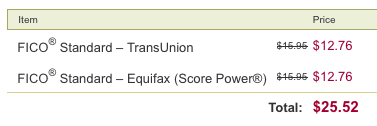
myFICO.com is offering a free credit score to members of their discussion forum. New visitors can register instantly and grab your score. No credit card or trial required. This is an official FICO score based on your Equifax credit file. Score only, no credit report. First 10,000 only – be quick!

Directions
Visit the main myFICO Forums page, register, make sure you’re logged in, and then go back to the main page and click on the link “Get your Free FICO score now!” in the top right. For some reason, you’ll have to re-enter all your info again.

My score was 744, down 10 points from their last free FICO offer. I blame the issuers who closed my inactive credit cards! 😛

More Inactive Credit Cards Being Closed: Protect Your FICO Credit Score

If you haven’t heard already, several large credit card issuers (Chase, Washington Mutual, Citibank, Capital One, HSBC) are currently closing millions of consumers’ credit cards without prior warning due to inactivity. This is their legal right, but it can also negatively affect your credit score. Here’s why and some steps that you can do about it:

How Can Closed Credit Cards Affect My Credit Score?

FICO has previously revealed the following breakdown of factors considered in credit scoring. We can also read between the lines of the questions asked by the free FICO Score Estimator by myFICO.

altext

Capacity used. This simply means how much of your available credit you are using, sometimes referred to as utilization ratio. A lower ratio is better, either by lower balances or higher credit limits. If you’re maxed out on all your cards, obviously that’s not a good sign. Logically, closing credit cards means you have less available credit.

Length of credit history and past credit applications. To be specific, not the only length of your oldest line, but also the average age of all your accounts matters. In addition, you’ll have less need for new credit applications if you can keep your existing purchasing power.

Closed by creditor or consumer? A lesser concern is whether the account is marked as “closed by creditor” as opposed to “closed at consumer’s request”. Since FICO doesn’t release the details of their scoring algorithm, it is still debated whether this matters to the numeric score. Some credit repair experts say it does, others disagree. However, if someone does a manual review of your credit report, it can raise some questions as to why the account was closed by the lender.

How To Protect Your Credit Score

Okay, so we’ve established that just waiting for our inactive cards to be canceled can be bad. So what should we do about it? Here’s an action plan:

  1. Gather up or make a list of all your credit cards. I have mine in a spreadsheet – it is a pretty long list! Misplaced some? Grab your free report from the official AnnualCreditReport.com, which should list them all.
  2. Rank them according to importance to your credit score. From above, we see that credit cards with high limits and long histories are the best. Newer credit cards with low limits are least important.
  3. Start using the important ones! If you have a cell phone or cable bill, chances are that they accept credit cards. Not only that, but you can use multiple charges across multiple cards. I spent 20 minutes just charging $5-$10 to my Sprint bill across about 8 different cards to put some activity on them. Start from the most important card onwards.
  4. Consider canceling the rest. If you have a newer card with a low limit that you don’t ever plan on using again (just wanted the sign-up bonus?), it may actually help your score to simply cancel it. This way, it will also show as “closed by consumer”.

    Make sure that it has a zero balance first, otherwise you make be stuck with penalties or your credit limit will be lowered to your balance amount, jacking up your utilization percentage and hurting your score.

I was too late for two Chase accounts and one Washington Mutual account I mentioned before, but I ended up closing a few cards preemptively and put some activity on the rest. All in all, perhaps this worked out for the best. Don’t we all want less clutter for the new year? 🙂

Use Your Inactive Credit Cards At Least Once A Year

I just got a letter from Washington Mutual / Chase telling me that they have closed my credit card account with them effective November 14th, 2008. That’s nearly a month ago! The reason stated was simply that I hadn’t used it in over 12 months. I normally wouldn’t care too much, but this is a relatively old card (back from when they were Providian) which helps your credit score and it also gave me a free FICO score update each month. Doh! I might call them and see if there is anything that can be done.

Now, it’s totally within their rights to do this, but it is kind of annoying and not the best customer service in my opinion. Last month, I got a similar letter from Citibank, but it warned me that if I didn’t use it within a month, it would be closed. So I just used it quickly and everything was fine. That seems like a more reasonable response.

The easy solution is to remember to use each of your credit cards at least once per year. I would simply use it to pay $5 towards your cell phone or cable bill online, since they let you do multiple partial payments. Then mark the card and tuck it away again.  Here’s a solid list of the best credit cards for 2012 to get you started.

Charles Schwab 2% Cashback Credit Card

Schwab brokerage is offering a new credit card that gives you 2% cash back on all purchases. The only catch is that the rewards can only be redeemed into a SchwabOne brokerage account. When linked to the Schwab card, the SchwabOne account has no minimum balance requirement or monthly service charges.

With no annual fee and no cashback limit, this is a very competitive card. I just hope it sticks around – many, many 2% cashback on everything cards have come and gone, from Farm Bureau to Countrywide, as that level of rewards make the issuer’s cut very slim. I’m sure they are counting on fees from the SchwabOne brokerage account to make up for the difference. Fidelity has a similar 2% back American Express card.

Call Your Credit and ATM Card Issuers Before Traveling Internationally

I just finished calling all of the issuers for the credit and ATM cards that I plan on using internationally – Capital One, Citibank, WaMu, and Bank of America – in order to avoid my cards being frozen due to fraud concerns. I remember doing this occasionally before, but not for all of them.
Surprisingly, every single card issuer seemed to have a specific protocol to handle such concerns. I was either forwarded to some sort of Fraud Specialist or asked to fill out a form outlining where I was traveling to and the exact start and end dates. It seems like their fraud monitoring systems are getting quite advanced. All of them thanked me for calling ahead of time, which made me feel like they’ve probably had to deal with a lot of angry (stranded?) travelers.

Oh, and they also told me the international toll-free numbers to reach their customer service from abroad. Using them is easy. Go to a pay phone, reach the operator, and call the number collect. I decided to simply write these numbers on the signature panel on the back of the cards. I’m glad I called!

For more information, see my other post on this subject: Travel and Money: Best Way To Get Cash, Best Credit Cards, and Safety Concerns. It includes why I hate traveler’s checks, why I use my Capital One card exclusively while traveling, and emergency numbers for Visa and Mastercard.

Discover Card Holiday Mall Promotion: $20 off each $200 spent

Discover $20 Gift CardDiscover Card is again running their Holiday Mall Promotion, which gives you $20 back for every $200 that you spend at limited mall locations.

Get a $20 Discover® Gift Card when you make $200 in purchases with your Discover Card at a participating mall between 11/01/08–01/04/09, while supplies last. Original receipts and the Discover Card used to make the purchases must be presented to a participating mall’s Customer Service by 01/04/09. Limit 5 Gift Cards per account, while supplies last, during the promotion period. Gift Card is valid through July 31, 2009.

Basically, you can get up to 10% back if you spend an exact multiple of $200, with a maximum $100 off $1,000 per Discover card account. (Additional cardholders seem to count as a separate “account”.) Not a bad deal if you’re gonna spend that much anyways. Mmm… Macbook…

During a previous year, a reader happened upon a loophole: If you return your purchase, there is no requirement to return the gift cards. Maybe you found something cheaper elsewhere. This brought up some ethical problems. Keep them? Or try handing them back to the Customer Service clerk? But be careful, because if you end up deciding to buy more stuff again later, you won’t be able to participate again since they don’t have any official mechanism to return the gift cards.

New Discover Card Sign-Up Promotions: $50 to $100
This would go nicely with the Discover More Card which now offers 0% on balance transfers and purchases for 15 months. 1% cash back on most purchases, and 5% back on rotating special categories.

The Miles by Discover Card also offers 12,000 Miles (1,000 miles per month with any purchase for a year). This can be redeemed for $100 cash credit towards any travel purchase put on the card (air, hotel, car rental), or you can get a $50 gift card + $25 cash.

Discover More: 0% APR Balance Transfer Fee Cap Ends October 31st

It looks like the credit crunch continues to trickle down to everything financial, including tightening up in the credit card industry. I have it on good authority that the $75 balance transfer fee cap on the Discover More card will end on October 31st. (Update: Yes, the cap is now gone.)

Why care? The Discover More Card – No Balance Transfer Fee* is just about the last credit card with a 0% APR balance transfer for 12 months, as well as a $75 balance transfer fee cap. This is important because you may have noticed that nearly all other 0% APR cards have an uncapped 3% fee. So if you transferred $10,000, the fee would be $300. On a $20,000 balance, that would be $600!. The cap saves you lots of money, and these offers have only gotten more scarce with time.

Even though I don’t carry a balance, I have used this card to make some extra money off credit card arbitrage.

Getting Your Money
You can usually request a balance transfer to be sent directly to a card with a balance on it. (Or you could send it to a Citibank card without a balance on it, and request a refund check.) However, a reader wrote in last week to say that you can also call them up afterward and request a balance transfer check to be sent to you directly from Discover.

If you’ve been thinking about applying but putting it off, now would be the time to do it! According a Discover CSR, if you apply now to lock in the offer, you have until February to request your balance transfer. (Update: There is now no cap.)

Chase Freedom Rewards Card – 5% Back On Popular Spending Categories

Travel and Money: Best Way To Get Cash, Best Credit Cards, and Safety Concerns

I wouldn’t say my wife and I are well-traveled, but we do try and experience other cultures whenever we can. Given work constraints and Corporate America’s hatred of vacations (2 weeks a year??), we are lucky if we can manage one trip per year. However, I think we’ve worked out a pretty good system of managing money needs while abroad.

Travelers Checks?
I never buy travelers checks. You often have to pay a fee when you buy them, and then you might have to pay a fee for exchanging them to local currency. Or you’re searching all day for the American Express office. Less and less stores accept them for purchases, due to fraud and theft. If your signatures don’t exactly match, they give you grief. If you get them wet, they are useless and you have to replace them.

Most importantly: Any place that does take them will most likely accept credit cards, which are a better alternative (see below).

Best Credit Card For International Travel
Whenever possible, I use a credit card for making purchases while abroad. Hotels, transportation, sightseeing tickets, and so on. However, most credit cards are pretty expensive when it comes to foreign currency purchases. Visa and Mastercard charge a standard 1% “conversion” fee on top of the wholesale “interbank” exchange rate. Many major credit card issuers like Citi, Chase, and American Express charge you another 2%-3% on top of that. You’re losing up to 4% off the bat.

So what do I use? My favorite card, hands down, is my credit card from Capital One . I have used this card from China to France with no issues at all. Capital One charges you only the interbank currency exchange rate. They pay the Visa/Mastercard 1% fee for you, and they don’t have any self-imposed surcharge. Finally, this specific card gives you 1% cash back on all purchases (2% for groceries/gas) and has no annual fee.

Net result: Not only do I get the best exchange rate possible, but I actually gain 1% cash back on my foreign purchases. It’s better than cash!

(I only use this card internationally. While in the US, I prefer these cash back credit cards.)

ATM Cards / Getting Cash
I used to worry about bringing some local currency with me, but it is usually expensive to get this done in the US. (Always compare their rates with the interbank rates at Oanda.com.) Nowadays, if you are arriving in a large international airport, there is hardly any chance they won’t have ATMs available. I do bring $100 in US $20 bills in my money belt as an added backup.

When it comes to getting cash in local currency from ATMs, there are also fees to be aware of. The local ATM may charge a fee, although bigger banks are less likely to. Your bank may also charge a fee for using a non-network foreign ATM. Finally, they may charge a surcharge for the currency exchange itself.

Because I use a credit card for most large purchases, I usually only need cash for restaurants and other small things. Therefore, I usually take out all the cash I expect to spend during my stay all at once, as it is no more than a few hundred dollars. Since I only have to pay these fees once, I don’t worry about them as much.

For example, on a $300 withdrawal using my normal WaMu Free Checking account, I will be charged a 3% exchange fee + no ATM fees. I am okay with paying a one-time fee of $9 for this convenience. My backup card is with Bank of America, where it would have cost $8 total (1% + $5), though they do have some partner banks with no fees. I like sticking with big banks here.

A good comparison of all these card fees is located here.

Money Belt and Wallet
After experiencing firsthand how slick a professional pickpocket can be in an Italian train, I don’t go anywhere without my trusty money belt keeping everything hidden safely underneath my clothes. I usually put in my week’s worth of cash, my backup credit card, two ATM cards, emergency numbers, and my passport.

My wallet only holds a day’s worth of cash (~$40) and my primary credit card. I usually also have travel pants with zippered pockets. This way, if it gets stolen I am only out a small amount of money and one credit card.

Lost Your Credit Card While Traveling?
You can easily report your lost card to the major issuers while traveling internationally by calling these US numbers collect. Write them down and keep in your money belt, along with any credit card numbers.

  • Visa: 410-581-9994
  • Mastercard: 636-722-7111
  • American Express: 336-393-1111