Upgrade Rewards Checking: $300 Referral Bonus (Improved) + 5.21% APY Savings

Update: This exact offer has expired, the bonus is down to $200 and APY has been reduced.
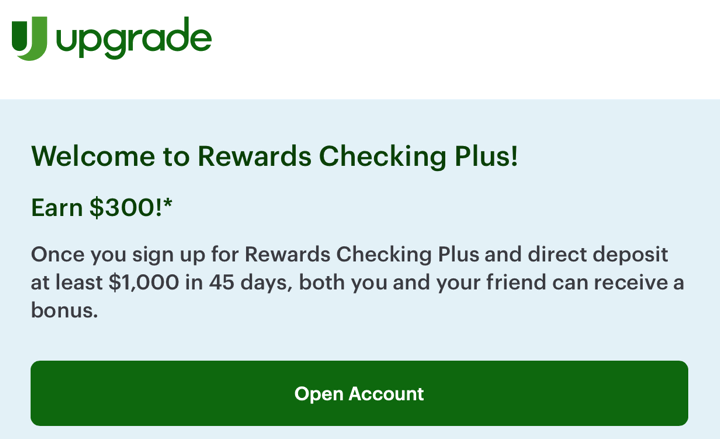
Upgrade has increased the bonus from $150 to a $300 bonus via referral link on their Rewards Checking Plus account (referred gets $50). Must set up direct deposits totaling at least $1,000 within 45 days. Note: This promo usually scheduled to end at the end of the current month, but has been getting extended a month at a time.

Good news is the account opening process was very quick and easy, literally under 5 minutes. I did not have to upload any extra documentation and I did not experience any hard credit checks. The account was open and ready the day after application. FDIC insurance on deposits held at Cross River Bank. (NOTE: This is a good bonus, but Upgrade is a fintech and therefore has a nonzero risk that your funds may be not tracked correctly and FDIC insurance does not cover the failure of a non-bank fintech. FDIC insurance only covers an event when a bank fails. I would not keep this as your primary day-to-day account, nor maintain significant funds there.)

Here are the highlights of the Rewards Checking account, if you maintain that $1,000+ in monthly direct deposits:

  • Debit card earning 2% cash back at restaurants, gas stations, utilities, convenience stores, drugstores, select monthly subscriptions (including Netflix, SiriusXM, Spotify, Disney Plus), and cell phone providers (including AT&T, T-Mobile, Verizon Wireless, Cricket Wireless). Maximum of $500 in 2% rewards per calendar year.
  • Debit card earns 1% cash back on everything else. (unlimited)
  • No minimum balance, no monthly fees (even without direct deposit).
  • ATM fees rebated when charged by another institution for debit card withdrawals in the United States, up to five times per calendar month.
  • Can fund up to $500 instantly via debit card. Some of you may have other debit cards that earn rewards.

An “Eligible Direct Deposit” is a recurring deposit to your Account by Automated Clearing House (“ACH”) from your employer, payroll, or benefits provider, or gig economy payer OR a deposit by Original Credit Transaction (“OCT”) from your gig economy payer. One-time direct deposits, including tax refunds, bank ACH transfers, bank verification or trial deposits, peer-to-peer transfers from services, such as PayPal or Venmo, merchant transactions, mobile check deposits, and cash loads or deposits are not Eligible Direct Deposits.

You can also add on their Performance Savings account with the following features, again with $1,000+ in monthly direct deposits into the Rewards Checking Plus:

  • 5.21% APY as of 2/27/24 (lower APY without direct deposits)
  • No minimum balance, no monthly fees (with or without direct deposits).

They also offer a Premier Savings account also at 5.21% APY which is currently offering an up to $200 deposit bonus if you deposit enough new money with them.

A straightforward checking direct deposit promotion that doesn’t incur a hard credit check, nor a large number of debit card transactions, nor require joining any partner organizations. Perfect if you can switch over and/or split direct deposits easily. Gig economy payments count.

Robinhood Gold x Free $1,000 Margin ($2,000 Until August 2024)

If you joined the Robinhood Gold subscription service for the (expired) 3% IRA transfer bonus, you have have noticed that it includes $1,000 of margin interest-free (0% APR). Right now, they are increasing this amount to $2,000 of margin interest-free until 8/18/24. (It goes back to $1,000 afterward.) Some folks have been using this free loan to buy safe securities and collecting the dividends/interest. While I’m not usually a fan of debt and/or leverage, I’m alright if it is collateralized with something safe and liquid.

What is margin? Basically, it’s a loan for which you put up your investments as collateral. You must have a “margin account” instead of a “cash account” in order to be eligible for this line of credit. From Investopedia:

Margin is the money borrowed from a broker to purchase an investment and is the difference between the total value of an investment and the loan amount.

Margin trading refers to the practice of using borrowed funds from a broker to trade a financial asset, which forms the collateral for the loan from the broker.

A margin account is a standard brokerage account in which an investor is allowed to use the current cash or securities in their account as collateral for a loan.

Leverage conferred by margin will tend to amplify both gains and losses. In the event of a loss, a margin call may require your broker to liquidate securities without prior consent.

How do I know if I’m using margin? From the Robinhood Margin FAQ:

Before you can invest on margin, you have to apply and will only have access if you meet eligibility requirements.

You’ll only start investing on margin after the cash in your investing account has been fully invested. This means that if you have cash in your account, you won’t invest on margin until it’s fully spent.

For example, suppose you have $3,000 in your investing account—$2,800 in stocks and $200 cash. If you buy an additional $500 of MEOW stock, you will use your $200 in remaining cash first and the remaining $300 would be invested on margin using the securities in your account as collateral.

Once you have used margin funds for investing, you can check your total margin used amount in Investing — Buying power

How much money do I need in my account to invest on margin? For the most part, you need $2,000 to apply for margin. Here’s the official answer:

To purchase a security on margin, FINRA (a government-authorized regulator of brokerage firms) requires that you have at least $2,000 or 100% of the security’s purchase price (whichever value is less) deposited into your account. This is called the margin minimum.

If you’re flagged as a pattern day trader, you must have $25,000 in portfolio value (minus any crypto positions) before you can continue day trading.

Robinhood Securities, LLC (RHS) may also impose additional requirements and certain customers may not be eligible to use margin based on RHS internal guidelines.

Why is Robinhood giving me free margin? As a perk, and as a little free trial to hopefully get you to regularly use even more margin and thus pay them interest. They paid out a lot of money for those retirement asset bonuses. They added over $4 billion in assets. Times 3% is $120 million! From Marketwatch:

Robinhood has seen a significant increase in assets under management in 2024. Customers transferred over $4 billion in retirement assets from brokerage competitors between January and April of this year, with transfers averaging over $90,000 per customer. With account balances that big, some of these more seasoned investors may be used to using more advanced tools, like margin investing, and competing brokerages.

Robinhood attributes this recent growth to its 3% retirement match and 1% deposit boost promotions that were active at the start of this year. Those two programs meant Robinhood would essentially pay people to transfer their assets into Robinhood, and keep them there.

Now that Robinhood has those customers on its platform and signed up for its Robinhood Gold paid subscription service, it has to convince them to stay with the brokerage.

They do have some relatively low margin rates. From their press release:

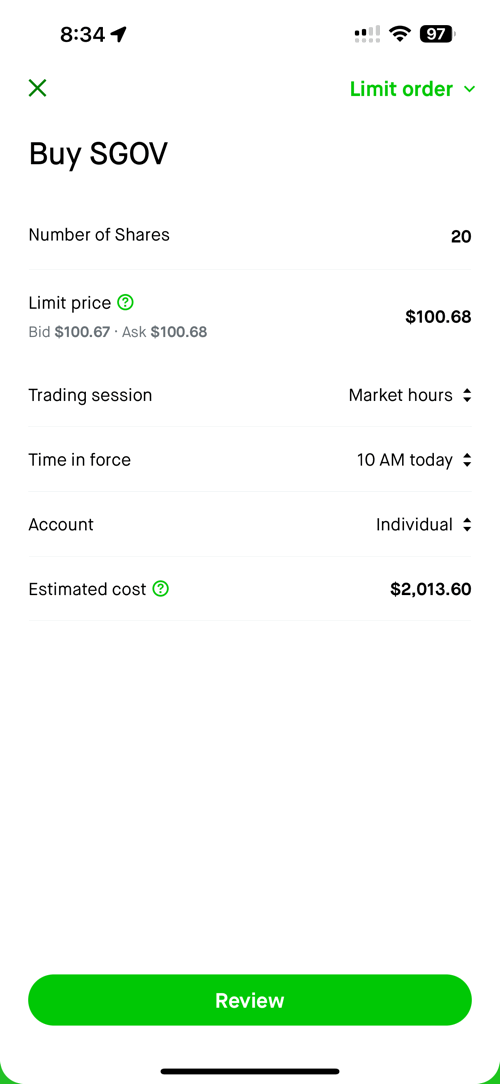
I’m not sure I’ll keep doing this, but I’ll try it out for a couple months. I deposited a little over $2,000 of new cash into my existing taxable brokerage account (which previously just had a bit of stocks from past bonuses) and put in a limit buy order to 20 shares of SGOV, which is an ETF that holds short-term US Treasury Bills.

The share price of SGOV is usually around $100, depending on how much interest has accumulated in the NAV (net asset value). The share price of SGOV rises steadily until the beginning of the month when it makes a distribution. Here’s the SGOV dividend history. You could probably use fractional shares, but those use market orders which are usually just fine here, and I’m old-fashioned and prefer the control of limit orders. The bid/ask spread of SGOV is usually very tight, most often just $0.01. Screenshots below. (Note that I placed these orders sometime in late May 2024, as this post has been languishing as an unfinished draft for a few weeks…)

As noted, I can check to see how much margin I’m using by navigating to “Investing” and then “Buying power”. Right now, the SEC yield of SGOV is roughly 5.25%, so I’m earning ~$8.75 of interest each month on $2,000 (exempt from state/local income taxes). I haven’t used every penny of available margin since I bought whole shares, but I could with another dollar-based fractional share purchase. Many others have pointed out that even with $1,000 of free margin this can offset much of the Robinhold Gold fee of ~$5 per month. Just be sure to avoid the trap of thinking you can reliably make easy money with options trading, with or without margin.

United Quest Card Review: 90,000 Bonus Miles + 500 PQP

The United Quest Card is a new premium travel card that offers a lot of added perks on United Airlines for a higher annual fee. Here are the highlights:

  • 90,000 bonus United miles and 500 Premier qualifying points after $4,000 in purchases in the first 3 months. Plus, earn 5,000 bonus miles after you add an authorized user to your account in the first 3 months your account is open.
  • First AND second checked bags are free for both you and a companion (a savings of up to $360 per roundtrip) when you use your Card to purchase your ticket. Terms apply.
  • Priority boarding.. The primary Cardmember and companions on the same reservation will be invited to board United-operated flights prior to general boarding.
  • Up to a $125 United(R) purchase credit and up to 10,000 miles in award flight credits each year (terms apply).
  • Earn up to 9,000 Premier qualifying points per calendar year (1 PQP for every $20 you spend on purchases).
  • Up to $120 Global Entry, TSA PreCheck® or NEXUS fee credit.
  • Expanded award availability and free upgrades. Having this card makes it easier to find that saver award economy ticket. No blackout dates for MileagePlus members booking award flights on United.
  • $250 annual fee.

Here are the ongoing rewards on purchases:

  • 3X miles on United(R) purchases
  • 2X miles on all other travel.
  • 2X miles on dining.
  • 2X miles on select streaming services.
  • 1X mile per dollar spent on all other purchases.
  • No foreign transaction fees.
  • 25% Back on United inflight purchases (Wi-Fi, Food and Drinks).

The United Quest card is considered a new product, which means you can get this new bonus even if you’ve had other United card flavors in the past 24 months:

This card product is available to you if you do not have this card and have not received a new Cardmember bonus for this card in the past 24 months.

This card is very focused on making it a better experience for regular United customers. You have the first and second checked bag for free on United flights, both for your and a companion traveling on the same reservation. The bag fees are $40 first bag and $50 second bag per person, each way, so that adds up to a potential $360 total value roundtrip.

After each card anniversary, you automatically get $125 back on United purchases charged to your card, which already covers half the $250 annual fee. You save another 5,000 points (up to twice a year) when you book an award ticket with miles. You also get Priority Boarding, and while onboard, you get 25% back on your inflight purchases of WiFi, food, and drinks.

If you are trying to make Premier status on United, this card offers the ability to earn up to 9,000 Premier qualifying points a year (1 PQP for every $20 you spend on purchases).

Expanded award seat availability. You earn United miles for all your purchases, but then they also make it easier for you to redeem those miles on Saver level tickets with no blackout dates. No blackout dates for MileagePlus members booking award flights on United. Expanded award seat availability is another of the top perks from this card, and I’ve found a very significant difference when searching. If you’re constantly trying to find economy tickets for the entire family like me, this is a big deal. Saver Award ticket redemptions start at 12,500 miles one-way within the continental U.S. and Canada.

If you are a Premier® status member and traveling on an award ticket, with this card you can take advantage of Premier Upgrades on United-operated flights.

Another unique feature of this card is that it offers primary coverage on the Auto Rental Collision Damage Waiver. On most other consumer cards, this coverage is offered as secondary coverage, meaning it only kicks in after your personal auto insurance has been exhausted.

Bottom line. The United Quest Card offers a long list of special perks for folks that fly United on a regular basis. For the right person, the benefits can be worth much more than the annual fee.

Also see: Top 10 Best Credit Card Bonus Offers.

The information for the United Quest(SM) Card has been collected independently by My Money Blog. The card details on this page have not been reviewed or provided by the card issuer.

Best Interest Rates on Cash Roundup – June 2024

Here’s my monthly roundup of the best interest rates on cash as of June 2024, roughly sorted from shortest to longest maturities. There are lesser-known opportunities available to individual investors, often earning you a lot more money while keeping the same level of safety by moving to another FDIC-insured bank or NCUA-insured credit union. Check out my Ultimate Rate-Chaser Calculator to see how much extra interest you could earn from switching. Rates listed are available to everyone nationwide. Rates checked as of 6/12/2024.

TL;DR: Very minor changes since last month. Still 5%+ savings accounts and short-term CDs, with long-term CD rates holding roughly steady since last month. Compare against Treasury bills and bonds at every maturity, taking into account state tax exemption. I no longer recommend fintech companies due to the possibility of loss of cash access for months in the event of a company or middleman failure.

High-yield savings accounts
Since the huge megabanks STILL pay essentially no interest, everyone should have a separate, no-fee online savings account to piggy-back onto your existing checking account. The interest rates on savings accounts can drop at any time, so I list the top rates as well as competitive rates from banks with a history of competitive rates and solid user experience. Some banks will bait you with a temporary top rate and then lower the rates in the hopes that you are too lazy to leave.

  • The top rate at the moment is at My Banking Direct at 5.55% APY . Poppy at 5.50% APY (3-month rate guarantee). I have no personal experience with them, but they are the top rates at the moment. CIT Platinum Savings at 5.00% APY with $5,000+ balance.
  • SoFi Bank is at 4.60% APY + up to $325 new account bonus with direct deposit. You must maintain a direct deposit of any amount each month for the higher APY. SoFi has historically competitive rates and full banking features. See details at $25 + $300 SoFi Money new account and deposit bonus.
  • Here is a limited survey of high-yield savings accounts. They aren’t the top rates, but a group that have historically kept it relatively competitive such that I like to track their history. Sad to see Ally Bank falling even further behind.

Short-term guaranteed rates (1 year and under)
A common question is what to do with a big pile of cash that you’re waiting to deploy shortly (plan to buy a house soon, just sold your house, just sold your business, legal settlement, inheritance). My usual advice is to keep things simple and take your time. If not a savings account, then put it in a flexible short-term CD under the FDIC limits until you have a plan.

  • No Penalty CDs offer a fixed interest rate that can never go down, but you can still take out your money (once) without any fees if you want to use it elsewhere. Marcus has a 13-month No Penalty CD at 4.70% APY with a $500 minimum deposit. Also available at 7- and 11-months. Consider opening multiple CDs in smaller increments for more flexibility.
  • NexBank has a 1-year certificate at 5.40% APY ($25,000 min). There is a 180-day interest penalty if you withdraw your CD funds before maturity.
  • CIBC Agility Online has a 12- and 13-month CD at 5.36% APY ($1,000 min). Reasonable 30-day penalty if you withdraw your CD funds before maturity.

Money market mutual funds + Ultra-short bond ETFs
Many brokerage firms that pay out very little interest on their default cash sweep funds (and keep the difference for themselves). Note: Money market mutual funds are highly-regulated, but ultimately not FDIC-insured, so I would still stick with highly reputable firms. I am including a few ultra-short bond ETFs as they may be your best cash alternative in a brokerage account, but they may experience losses.

  • Vanguard Federal Money Market Fund is the default sweep option for Vanguard brokerage accounts, which has an SEC yield of 5.27% (changes daily, but also works out to a compound yield of 5.40%, which is better for comparing against APY). Odds are this is much higher than your own broker’s default cash sweep interest rate.
  • The PIMCO Enhanced Short Maturity Active Bond ETF (MINT) has a 5.34% SEC yield and the iShares Short Maturity Bond ETF (NEAR) has a 5.16% SEC yield while holding a portfolio of investment-grade bonds with an average duration of ~6 months.

Treasury Bills and Ultra-short Treasury ETFs
Another option is to buy individual Treasury bills which come in a variety of maturities from 4-weeks to 52-weeks and are fully backed by the US government. You can also invest in ETFs that hold a rotating basket of short-term Treasury Bills for you, while charging a small management fee for doing so. T-bill interest is exempt from state and local income taxes, which can make a significant difference in your effective yield.

  • You can build your own T-Bill ladder at TreasuryDirect.gov or via a brokerage account with a bond desk like Vanguard and Fidelity. Here are the current Treasury Bill rates. As of 6/11/24, a new 4-week T-Bill had the equivalent of 5.35% annualized interest and a 52-week T-Bill had the equivalent of 5.16% annualized interest.
  • The iShares 0-3 Month Treasury Bond ETF (SGOV) has a 5.26% SEC yield and effective duration of 0.10 years. SPDR Bloomberg Barclays 1-3 Month T-Bill ETF (BIL) has a 5.21% SEC yield and effective duration of 0.08 years.

US Savings Bonds
Series I Savings Bonds offer rates that are linked to inflation and backed by the US government. You must hold them for at least a year. If you redeem them within 5 years there is a penalty of the last 3 months of interest. The annual purchase limit for electronic I bonds is $10,000 per Social Security Number, available online at TreasuryDirect.gov. You can also buy an additional $5,000 in paper I bonds using your tax refund with IRS Form 8888.

  • “I Bonds” bought between May 2024 and October 2024 will earn a 4.28% rate for the first six months. The rate of the subsequent 6-month period will be based on inflation again. More on Savings Bonds here.
  • In mid-October 2024, the CPI will be announced and you will have a short period where you will have a very close estimate of the rate for the next 12 months. I will have another post up at that time.

Rewards checking accounts
These unique checking accounts pay above-average interest rates, but with unique risks. You have to jump through certain hoops which usually involve 10+ debit card purchases each cycle, a certain number of ACH/direct deposits, and/or a certain number of logins per month. If you make a mistake (or they judge that you did) you risk earning zero interest for that month. Some folks don’t mind the extra work and attention required, while others would rather not bother. Rates can also drop suddenly, leaving a “bait-and-switch” feeling.

  • OnPath Federal Credit Union pays 7.00% APY on up to $10,000 if you make 15 debit card purchases, opt into online statements, and login to online or mobile banking once per statement cycle. Anyone can join this credit union via $5 membership fee to join partner organization. You can also get a $100 Visa Reward card when you open a new account and make qualifying transactions.
  • Genisys Credit Union pays 6.75% APY on up to $7,500 if you make 10 debit card purchases of $5+ each per statement cycle, and opt into online statements. Anyone can join this credit union via $5 membership fee to join partner organization.
  • Credit Union of New Jersey pays 6.00% APY on up to $25,000 if you make 12 debit card purchases, opt into online statements, and make at least 1 direct deposit, online bill payment, or automatic payment (ACH) per statement cycle. Anyone can join this credit union via $5 membership fee to join partner organization.
  • Andrews Federal Credit Union pays 6.00% APY on up to $25,000 if you make 15 debit card purchases, opt into online statements, and make at least 1 direct deposit or ACH transaction per statement cycle. Anyone can join this credit union via partner organization.
  • Pelican State Credit Union pays 6.05% APY on up to $20,000 if you make 15 debit card purchases, opt into online statements, log into your account at least once, and make at least 1 direct deposit, online bill payment, or automatic payment (ACH) per statement cycle. Anyone can join this credit union via partner organization membership.
  • Orion Federal Credit Union pays 6.00% APY on up to $10,000 if you make electronic deposits of $500+ each month (ACH transfers count) and spend $500+ on your Orion debit or credit card each month. Anyone can join this credit union via $10 membership fee to partner organization membership.
  • All America/Redneck Bank pays 5.15% APY on up to $15,000 if you make 10 debit card purchases each monthly cycle with online statements.
  • Find a locally-restricted rewards checking account at DepositAccounts.

Certificates of deposit (greater than 1 year)
CDs offer higher rates, but come with an early withdrawal penalty. By finding a bank CD with a reasonable early withdrawal penalty, you can enjoy higher rates but maintain access in a true emergency. Alternatively, consider building a CD ladder of different maturity lengths (ex. 1/2/3/4/5-years) such that you have access to part of the ladder each year, but your blended interest rate is higher than a savings account. When one CD matures, use that money to buy another 5-year CD to keep the ladder going. Some CDs also offer “add-ons” where you can deposit more funds if rates drop.

  • Credit Human has a 59-month CD at 4.65% APY. 48-month at 4.65% APY. 35-month at 4.75% APY. 23-month at 5.03% APY. 1-year at 4.95% APY. $500 minimum. The early withdrawal penalty (EWP) for CD maturities of 36 months or more is 365 days of interest. For CD maturity of 1 year, the EWP is 270 days of interest. This is actually a credit union, but is open nationwide with a American Consumer Council (ACC) membership. Try promo code “consumer” when signing up at ACC for a free membership.
  • First Internet Bank has a 5-year CD at 4.50% APY. 4-year at 4.45% APY. 3-year at 4.61% APY. 2-year at 4.76% APY. 1-year at 5.26% APY. $1,000 minimum. The early withdrawal penalty (EWP) for CD maturities of 2 years or more is 360 days of interest. For CD maturity of 1 year, the EWP is 180 days of interest.
  • BMO Alto has a 5-year CD at 4.80% APY. 4-year at 4.70% APY. 3-year at 4.60% APY. 2-year at 4.65% APY. 1-year at 5.05% APY. No minimum. The early withdrawal penalty (EWP) for CD maturities of 1 year or more is 180 days of interest. For CD maturities of 11 months or less, the EWP is 90 days of interest. Note that they reserve the right to prohibit early withdrawals entirely (!). Online-only subsidiary of BMO Bank.
  • You can buy certificates of deposit via the bond desks of Vanguard and Fidelity. You may need an account to see the rates. These “brokered CDs” offer FDIC insurance and easy laddering, but they don’t come with predictable early withdrawal penalties. Right now, I see a 5-year non-callable CD at 4.70% APY (callable: no, call protection: yes). Be warned that now both Vanguard and Fidelity will list higher rates from callable CDs, which importantly means they can call back your CD if rates drop later.

Longer-term Instruments
I’d use these with caution due to increased interest rate risk (tbh, I don’t use them at all), but I still track them to see the rest of the current yield curve.

  • Willing to lock up your money for 10 years? You can buy long-term certificates of deposit via the bond desks of Vanguard and Fidelity. These “brokered CDs” offer FDIC insurance, but they don’t come with predictable early withdrawal penalties. You might find something that pays more than your other brokerage cash and Treasury options. Right now, I see a 10-year CDs at n/a (callable: no, call protection: yes) vs. 4.33% for a 10-year Treasury. Watch out for higher rates from callable CDs where they can call your CD back if interest rates drop.

All rates were checked as of 6/12/2024.

Photo by micheile henderson on Unsplash

Pizza Hut Camp BOOK IT! Summer Reading Program (2024 Now Sold Out)

Update: Unfortunately, it “sold out” already!

Due to an overwhelming response, the 2024 Camp BOOK IT! summer program is now closed.

Registration live for Summer 2024 as of June 1st. If you were a kid in the 80s and 90s, you may remember the Pizza Hut “Book It!” program that rewarded reading books with free pizza. Well, Camp Book It! is again open to free enrollment for the summer:

All parents with students in PreK-6th grade (ages 4-12) can enroll in Camp BOOK IT!, our reading program created to stop the summer slide. In June, July and August, parents can use our digital tools to track and reward their kids reading with a free one-topping Personal Pan Pizza®.

This program is usually either run directly through schools or restricted to homeschooling parents during the academic school year, but is open to all age-eligible children from Pre-K to 6th grade during the summer. If it works like it did in the past, once you reach 20 days of reading in one calendar month (our goal is 20 minutes per day per child), you complete the goal and a prize code will be emailed to you. The code works online, so it’s easy to order and simply pick it up or add it to an existing order.

Encourage my kids to read books and feed them for me? That’s my kind of deal! The little Personal Pan Pizza rewards are a novelty to our kids, making it feel like a special treat that they earned. We also stack this with the Summer Reading program at our local library, which gives out other small trinkets to help build the “reading for fun” habit. This year we are also stacking with the Barnes & Noble Summer Reading Program.

Barnes & Noble Summer Reading Program 2024 (Free Book, Kids Gr 1-6)

Barnes & Noble is running their Summer Reading Program for kids in Grades 1-6. I like that the steps are pretty simple:

  1. Read any eight books this summer and record them in this Summer Reading Journal [printable PDF]. Tell us which part of the book is your favorite, and why.
  2. Bring your completed journal to a Barnes & Noble store between July 1 and August 31, 2024.
  3. Choose your free reading adventure from the eligible books listed here [PDF]. (Boxcar Children! 🙌) Valid while supplies last.

Upside App Promo Codes: $1.50+/Gallon Cash Back on Gas, 15%+ Off Restaurants

Update July 2024: Upside closed my account effective immediately and without prior warning because I used “unauthorized” promo codes. Just FYI, I would cash out now and whenever you have enough of a balance.

Original post:

(Update: Added new codes SOFI35, SHSBPO , and SHSVBALL. SOFI35 looks to for those initially signing up for a new account and offer $0.35 off/gal, and SHSBPO/SHSVBALL was able to be applied to my existing account and should increase the cash back from eligible restaurants by 5%. I saw up to 25% off in total.)

Upside is an app that earns cash back rewards on gas and restaurants. The cash back is on top of whatever cash back or rewards your credit card already earns. For the most part, you look up a local gas station or restaurant on the Upside app, “claim” the offer, and then shop at the gas station or restaurant with a linked credit card. Upside somehow tracks your credit card number through their systems and match up the transactions (takes a few days). The cash back can then be redeemed directly back into your bank account (no fees if $10 minimum cash out).

They used to require you to take pictures of your receipts, but I didn’t have to for my gas purchases. They might still ask in some cases, I believe.

Right now, there are several live promo codes that are stackable such that you can earn $1.50+/gallon on your first few purchases. I successfully earned a total of $1.75/gallon back on my first fill-up, which works out to over $20 cash back. Here are the promo codes which are potentially stackable starting with my referral code.

  • Download the Upload app first and create an account.
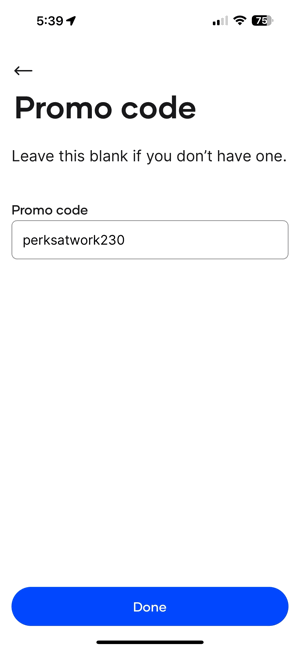
  • After installing, click on the person icon in the top right, then “Profile”, and then “Promo code” box. Try to enter each of the codes below. You may need to go back to the “Profile” screen to re-enter the next code. If it doesn’t give you an error, the code should be been applied. There is no other confirmation, other than seeing your cash back offer values go up.
  • JONATHAN633925 for extra 15 cents/gallon on first purchase. Should be auto-filled if you used the link above.
  • UBERPC20
  • UBER35
  • SHOPPERS35
  • USHIP35
  • YOUTUBE10
  • GOPUFF35
  • GOPUFF15
  • AMEX35
  • PERKSATWORK230
  • CASHCABK25
  • SOFI35
  • SHSBPO

Sources: These were collected across Doctor of Credit and GetUpside Reddit. Many of them might not work, but honestly I just tried them all to see whatever would stick. Also, I think most of them only work for the first 3 fill-ups or so.

After entering them all one-by-one, you can go back and look on your local map to see what gas stations are available nearby. Remember to first link up the credit card you use for gas (person icon > “Wallet”), and then claim the offer before you fill up and pay using that specific credit card. It’s a rather vague process, but the cash back magically showed up after 2-3 days. Hopefully, I can rack up at least $50 in cash back on gas with these promo codes.

Beyond a lot of fast food chains, I’m also seeing 6% to 20% off at a lot of local restaurants that also participate in Neighborhood Nosh (formerly iDine), which is a similar program in that the cash back is on top of credit card rewards and through linked credit card numbered. The Upside cash back percentages I’ve seen are often higher, however, so this app might actually be a long-term keeper if it keeps working reliably.

IKEA Gift Card Promo: Buy $50 eGift Card, Get $10 eGift Card (Limit $500)

ikea0Buy a $50 IKEA eGift card, get bonus $10 eGift Card. That’s $10 off every $60 of IKEA stuff, which seems pretty good. Limit $500 total gift cards purchased ($100 in bonus gift cards). The website URL is funky, but it is linked directly from the IKEA.com gift card page, so looks legit. Set to run 5/15 through 5/21/24, but this offer has ended early in the past. Terms and conditions:

*Valid in U.S. only. Limited quantities of Bonus Cards available. Valid on Digital Gift Card purchases of $50 or more only from IKEA-USA.com. Not valid on physical or in-store Gift Card purchases. Offer will apply automatically at check-out if purchase qualifies. Additional $10 Digital Gift Card (“Bonus Card”) will be emailed automatically to the purchaser’s email address provided at check-out within 24-48 hours. LIMIT: $500 in Digital Gift Cards/10 Bonus Cards per purchaser during offer period. Gift Cards not redeemable for cash (unless required by law). Except for purchase limits set forth above, offer subject to IKEA Gift Card terms and conditions, https://www.ikea.com/us/en/customer-service/gift-cards-pub3d1efe50. Other restrictions may apply. See IKEA-USA.com for details. ©Inter IKEA Systems B.V. 2024.

Note the waiting period of 24-48 hours for the bonus gift card to show up. Found via Doctor of Credit.

5.10% APY CDs, 5.10% APY No-Penalty CDs, 5.276% APY Savings via Raisin (Limited-Time Bonus Boost, up to $200)

Limited-time Referral Bonus Boost: The Raisin referral bonus for new accounts has been hiked for a limited time, doubled on some tiers and now up to $200. The new tiers are below. At the $5,000 and $10,000 amounts, the bonus works out to 1% of the deposit for a minimum 90 day hold, which works out to a 4% annualized boost above the existing interest rates. ($50k tier = 1.2% APY annualized boost, $100k tiers = 0.8% annualized boost). Here is my referral link and my personal referral code is jonathanp31786. Thanks if you use it.

Full review:

Updated rates for July 2024. Raisin.com (formerly SaveBetter) is a financial marketplace that allows you to access high-interest certificates of deposit and savings accounts from multiple different banks and credit unions without having to open up a new account at each one. Every participation institution is either FDIC-insured or NCUA-insured. The participating banks, product terms, and interest rates change regularly. SaveBetter is now Raisin, to better match the same popular service that runs in Europe. Here are the top Raisin offers as of 5/1/2024:

High-Yield CDs

  • 5.10% APY for 12-month CD. CDs are for locking in a rate. I don’t really consider anything less than a year term to be useful. Minimum opening deposit is $1.

No-Penalty CDs

  • 5.10% APY for a 9-month No Penalty CD. Your rate will never go down, but there is also no early withdrawal penalty. Withdrawals may be made 30 days after opening.

Liquid Savings

  • 5.27% APY Savings Account. Minimum opening deposit is $1. No limit on number of transactions.

Background on Raisin. Raisin is a marketplace for partner banks and credit unions looking to promote their deposit products. They offer liquid savings account, No-Penalty CDs, and High-Yield traditional CDs. Funds are held in a custodial account at the bank or credit union that is providing your selected savings product(s). The banks are all FDIC-insured and the credit unions are all NCUA-insured. Raisin does not charge any monthly maintenance fees. Raisin’s US operations are a subsidiary of Raisin GmbH, a German financial company that also offers high-interest deposit products across Europe.

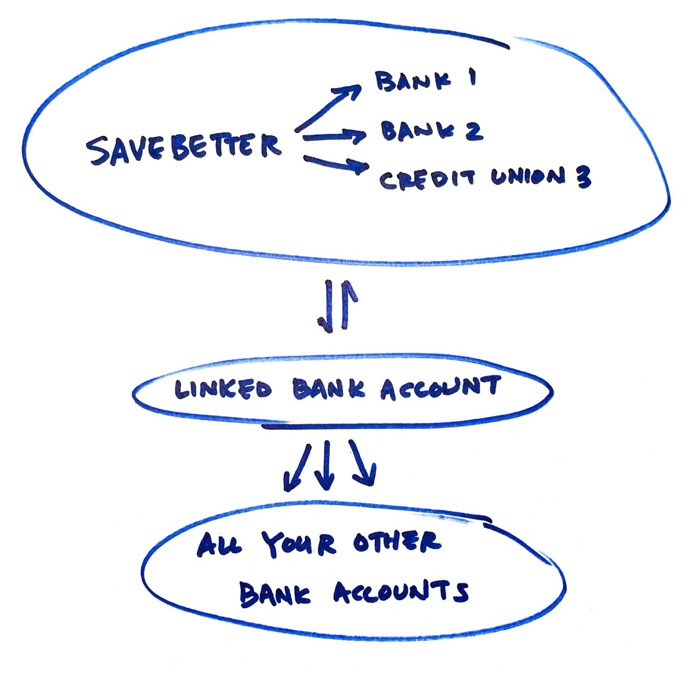
The benefit for the consumer is that you can easily access promotional rates at a new bank or credit union without having to open yet another new account (and endure credit checks, identify verification hurdles, join partner organizations, leave funds in share savings accounts, etc). This makes it easier to chase higher savings accounts and CD rates. You must link a single external bank account and make all your deposits and withdrawals electronically through that linked account. You can only have one external bank account linked at a time, so choose carefully.

A drawback is that you do not get direct access to your Raisin sub-accounts via routing number and account number. You must go through the Raisin site to open accounts, make deposits, and make withdrawals. Your single linked external bank is your only access to Raisin, so in a way I mentally name it also as my “Raisin bank account”. Here is a simple illustration I made that helps me visualize this setup:

Here are some more details from the Raisin site:

5. What is a custodial account and how does it work?
Custodial accounts are involved in how Raisin directs the money transfers from customers to the banks and credit unions holding their savings. When a customer makes a deposit through their Raisin account into a savings product offered by a given financial institution, the funds move from the customer’s external bank account (also referred to as the reference account) to an omnibus custodial account held by Lewis and Clark Bank (functioning in the role as a custodian bank) at the financial institution offering the savings product.

6. How does pass-through deposit insurance work?
Although Raisin customers’ deposits are pooled in omnibus accounts, there is no impact on the eligible deposit insurance coverage you receive from the financial institution holding your savings. This is because the government entities providing federal deposit insurance — the FDIC for banks and NCUA for credit unions — permit pass-through coverage. So your money that’s pooled in a custodial account still has the coverage it would have were it held in an individual account in your name.

I suspect this setup is a lower cost structure for the banks as well, which in turn allows higher interest rates. After learning about omnibus accounts, I noticed that other places like Fidelity Investments also use them in their cash sweep accounts as temporary holding accounts. Search for “omnibus” in your terms and conditions. This is also similar to how “brokered CDs” are usually managed when you buy them through a broker like Vanguard and Fidelity – the funds are pooled together at the issuing bank and don’t include individual account numbers. Same with the FDIC-insured accounts inside many 529 plans.

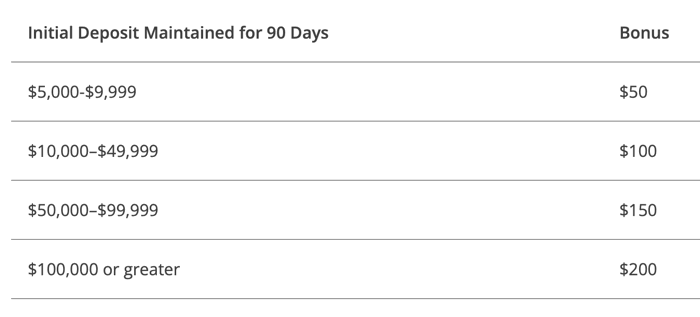
Referral bonus ($5,000+ deposit required). The minimum deposit for both their savings and CDs are usually as low as $1 (each product has different terms). However, if you are new to Raisin and plan to deposit at least $5,000, they do have a referral program if you open via a referral link and enter my personal referral code jonathanp31786. You must deposit $5,000 for 90 days to earn $25, and then additional $5 for every subsequent $5,000 deposit past that, up to a max of $125 bonus ($105,000 total deposit). Here’s the fine print:

Making $125 has never been so easy or rewarding. Simply enter in the code you received from your friend or family member when you sign up for an account with Raisin. Once you fund your account and maintain an initial balance of $5,000 or more for 90 days, you will earn a minimum bonus of $25 and a maximum bonus of $125 depending on the account balance you maintained after 90 days. The bonus will be paid out within 30 days of qualification. Funds will be deposited into your external bank account linked to Raisin.

The referral bonus has gone up for a limited-time. Please see the top of the post for the current tiers.

Juno Finance App: Banking Interruptions, 5% APY and 5% Cashback Terminated

Update May 2024: Juno just sent out the following e-mail today, which may be the best of example of public relations double-speak that I’ve seen in a while. Look at all those meaningless words! 😳 Juno paid out a lot of above-average valuable perks for a while, even before their crypto pivot, and I’m still not sure where the money came from. Unfortunately, the music has finally stopped and the party looks to be over. 🎉 🙅 They are reporting banking interruptions (ACH transfers + debit cards) and are terminating their 5% APY interest and 5% cashback program with only 48 hours notice (5/15/24). If you still have money there, I would recommend starting the withdrawal process but also having some patience. I have no reason to expect any principal losses but these types of disruptions do occur with fintech apps at times, unfortunately. This tweet says they are looking to switch banking providers in the next 4 weeks (!), but when you allow something like this to happen, that may be too little too late.

Dear Jonathan,
Juno stands at the intersection of banking and cryptocurrency, providing the quickest and easiest access to over 20 blockchains in the United States through ACH, Wire, Cash App, and more. We pride ourselves on promoting self-custody by eliminating mandatory holding periods for crypto withdrawals, distinguishing us from many U.S. crypto exchanges.

The past 18 months have witnessed remarkable growth in crypto and stablecoin sectors. These innovations are essential for creating fair and transparent financial services. At Juno, we are committed to a future where financial control rests with the users, not the banks.

In the past few days, banking services on Juno have been temporarily disrupted. Our team is hard at work collaborating with our banking services provider, Evolve Bank & Trust, and brokerage partner, Synapse Brokerage LLC., to resolve the disruptions as quickly as possible. This disruption, however, further strengthens our commitment to build a future where you are in control of your money at all times, not the banks.

Introducing Juno 2.0 – Reimagining Banking for Tomorrow

In 2024, Juno will focus intensively on developing financial services centered around crypto and stablecoins to ensure that you are always in control of your money. Our goal is to seamlessly integrate banking and crypto infrastructures to foster innovative experiences in savings, payments, and investments, making crypto and stablecoins practical for everyday use.

As part of this strategic realignment, starting May 15, 2024:

Cash held in Juno accounts will no longer accrue the 5.00% bonus, regardless of the account balance.
Additionally, purchases made with the Juno card will no longer receive a 5% cashback.

We recognize that these changes might be disappointing. However, please be assured that this decision was made with careful consideration of our long-term vision to give Juno members financial freedom by placing crypto and stablecoins at the heart of banking and financial services.

Thank you for your understanding and continued support. Should you have any questions or need more information, our customer support team is always here to assist you.

Update January 2024: Juno is now paying a 5.00% annualized bonus on balances from $20,000 up to $250,000 and 3.00% annualized on balances below $20,000.

Original post below, now outdated, last updated circa 2023:

Juno.finance (formerly OnJuno) is a fintech that combines an FDIC-insured bank account and a crypto custodian. Details:
  • New: Earn 5.00% annualized bonus on all cash deposits up to $250,000 and 3.00% annualized on balances below $20,000. This applies to traditional cash deposits (USD), which are FDIC-insured through Evolve Bank & Trust. Applies to both the Basic and Metal tiers. No transaction or direct deposit requirements.
  • New: JCOIN Loyalty Program. Earn loyalty tokens “JCOIN” when you complete certain actions with Juno. Existing users should check their accounts as Juno may have given you a bunch for free that you must claim. These loyalty tokens are redeemable inside the app for various perks including gift cards.

OnJuno partners with Evolve Bank and Trust for FDIC insurance. A reminder that cryptocurrencies, including USDC stablecoins, are not covered by FDIC insurance even though the creators claim they are backed 1:1 by US dollars. Juno has added support for crypto and external wallets. Don’t confuse your FDIC-insured USD deposits with stablecoins.

Traditional Bank-to-bank transfers. OnJuno uses the Plaid service to link with external bank accounts for funding and free ACH transfers (both deposits and withdrawals). They also provide you with the full account number and routing number, which you can use to connect with other banks like Ally, Marcus, CapOne 360, etc. The routing number is 084106768 which is confirmed as that of Evolve Bank & Trust. I was able to make a deposit and withdrawal initiated at Ally without issue (subject to transfer limits of $20,000 daily/$500,000 monthly). As with some other fintechs, their in-house limits are lower.

Bonus rate, not APY? You may notice that they don’t use “APY” and instead say “bonus rate”. Here’s their reason:

The Bonus Rate is offered entirely by OnJuno and is not interest provided by Evolve Bank and Trust. The bonus rate You earn will be credited to Your account at the beginning of each month. Your funds begin generating a bonus rate once they are available on Your OnJuno Checking Account. Please note that OnJuno reserves the right to cancel, remove, and change this bonus at any time. OnJuno also reserves the rights, in sole discretion, to refuse this bonus without cause, reason, and notice.

I’ve been getting my bonus rate every month without issue at the proper annualized rate, so this just seems to be a legal thing. Your interest is still shown on a 1099-INT at the end of the year.

Additional details.

  • Customer service. You can contact them via phone at 415-969-5775 (9am to 6pm Pacific) or online message (they replied to me within a few hours).
  • No minimum balance requirement.
  • Fee-free access to both Allpoint and Moneypass ATM networks (85,000+ locations).
  • Free debit Mastercard.
  • No mobile check deposit yet.

Bottom line. Juno is a fintech banking app with a high-interest checking account with no direct deposit or debit card usage requirements. FDIC-insurance from Evolve Bank and Trust. It does have ties with crypto, which may be either a plus or minus for you.

Best Interest Rates on Cash Roundup – May 2024

Here’s my monthly roundup of the best interest rates on cash as of May 2024, roughly sorted from shortest to longest maturities. There are lesser-known opportunities available to individual investors, often earning you a lot more money while keeping the same level of safety by moving to another FDIC-insured bank or NCUA-insured credit union. Check out my Ultimate Rate-Chaser Calculator to see how much extra interest you could earn from switching. Rates listed are available to everyone nationwide. Rates checked as of 5/8/2024.

TL;DR: Mostly only minor changes since last month. Still 5%+ savings accounts and short-term CDs, with long-term CD rates holding roughly steady since last month. Compare against Treasury bills and bonds at every maturity, taking into account state tax exemption.

Fintech accounts
Available only to individual investors, fintech companies often pay higher-than-market rates in order to achieve fast short-term growth (often using venture capital). “Fintech” is usually a software layer on top of a partner bank’s FDIC insurance.

  • 5.26% APY ($1 minimum). Raisin lets you switch between different FDIC-insured banks and NCUA-insured credit unions easily without opening a new account every time, and their liquid savings rates currently top out at 5.26% APY across multiple banks. See my Raisin review for details. Raisin does not charge depositors a fee for the service.
  • 5.36% APY (before fees). MaxMyInterest is another service that allows you to access and switch between different FDIC-insured banks. You can view their current banks and APYs here. As of 5/8/24, the highest rate is from Customers Bank at 5.36% APY. However, note that they charge a membership fee of 0.04% per quarter, or 0.16% per year (subject to $20 minimum per quarter, or $80 per year). That means if you have a $10,000 balance, then $80 a year = 0.80% per year. This service is meant for those with larger balances. You are allowed to cancel the service and keep the bank accounts, but then you may lose their specially-negotiated rates and cannot switch between banks anymore.

High-yield savings accounts
Since the huge megabanks STILL pay essentially no interest, everyone should have a separate, no-fee online savings account to piggy-back onto your existing checking account. The interest rates on savings accounts can drop at any time, so I list the top rates as well as competitive rates from banks with a history of competitive rates and solid user experience. Some banks will bait you with a temporary top rate and then lower the rates in the hopes that you are too lazy to leave.

  • The top rate at the moment is at My Banking Direct at 5.55% APY . Poppy at 5.50% APY (3-month rate guarantee). I have no personal experience with them, but they are the top rates at the moment. CIT Platinum Savings at 5.00% APY with $5,000+ balance.
  • SoFi Bank is at 4.60% APY + up to $325 new account bonus with direct deposit. You must maintain a direct deposit of any amount each month for the higher APY. SoFi has historically competitive rates and full banking features. See details at $25 + $300 SoFi Money new account and deposit bonus.
  • Here is a limited survey of high-yield savings accounts. They aren’t the top rates, but a group that have historically kept it relatively competitive such that I like to track their history. Sad to see Ally Bank falling even further behind.

Short-term guaranteed rates (1 year and under)
A common question is what to do with a big pile of cash that you’re waiting to deploy shortly (plan to buy a house soon, just sold your house, just sold your business, legal settlement, inheritance). My usual advice is to keep things simple and take your time. If not a savings account, then put it in a flexible short-term CD under the FDIC limits until you have a plan.

  • No Penalty CDs offer a fixed interest rate that can never go down, but you can still take out your money (once) without any fees if you want to use it elsewhere. Raisin has a 9-month No Penalty CD at 5.10% APY with $1 minimum deposit and 30-day minimum hold time. Marcus has a 13-month No Penalty CD at 4.70% APY with a $500 minimum deposit. Also available at 7- and 11-months. Consider opening multiple CDs in smaller increments for more flexibility.
  • NexBank has a 1-year certificate at 5.40% APY ($25,000 min). There is a 180-day interest penalty if you withdraw your CD funds before maturity.
  • CIBC Agility Online has a 13-month CD at 5.36% APY ($1,000 min). Reasonable 30-day penalty if you withdraw your CD funds before maturity.

Money market mutual funds + Ultra-short bond ETFs
Many brokerage firms that pay out very little interest on their default cash sweep funds (and keep the difference for themselves). Note: Money market mutual funds are highly-regulated, but ultimately not FDIC-insured, so I would still stick with highly reputable firms. I am including a few ultra-short bond ETFs as they may be your best cash alternative in a brokerage account, but they may experience losses.

  • Vanguard Federal Money Market Fund is the default sweep option for Vanguard brokerage accounts, which has an SEC yield of 5.26% (changes daily, but also works out to a compound yield of 5.39%, which is better for comparing against APY). Odds are this is much higher than your own broker’s default cash sweep interest rate.
  • The PIMCO Enhanced Short Maturity Active Bond ETF (MINT) has a 5.33% SEC yield and the iShares Short Maturity Bond ETF (NEAR) has a 5.24% SEC yield while holding a portfolio of investment-grade bonds with an average duration of ~6 months.

Treasury Bills and Ultra-short Treasury ETFs
Another option is to buy individual Treasury bills which come in a variety of maturities from 4-weeks to 52-weeks and are fully backed by the US government. You can also invest in ETFs that hold a rotating basket of short-term Treasury Bills for you, while charging a small management fee for doing so. T-bill interest is exempt from state and local income taxes, which can make a significant difference in your effective yield.

  • You can build your own T-Bill ladder at TreasuryDirect.gov or via a brokerage account with a bond desk like Vanguard and Fidelity. Here are the current Treasury Bill rates. As of 5/7/24, a new 4-week T-Bill had the equivalent of 5.37% annualized interest and a 52-week T-Bill had the equivalent of 5.15% annualized interest.
  • The iShares 0-3 Month Treasury Bond ETF (SGOV) has a 5.27% SEC yield and effective duration of 0.10 years. SPDR Bloomberg Barclays 1-3 Month T-Bill ETF (BIL) has a 5.21% SEC yield and effective duration of 0.08 years.

US Savings Bonds
Series I Savings Bonds offer rates that are linked to inflation and backed by the US government. You must hold them for at least a year. If you redeem them within 5 years there is a penalty of the last 3 months of interest. The annual purchase limit for electronic I bonds is $10,000 per Social Security Number, available online at TreasuryDirect.gov. You can also buy an additional $5,000 in paper I bonds using your tax refund with IRS Form 8888.

  • “I Bonds” bought between May 2024 and October 2024 will earn a 4.28% rate for the first six months. The rate of the subsequent 6-month period will be based on inflation again. More on Savings Bonds here.
  • In mid-October 2024, the CPI will be announced and you will have a short period where you will have a very close estimate of the rate for the next 12 months. I will have another post up at that time.

Rewards checking accounts
These unique checking accounts pay above-average interest rates, but with unique risks. You have to jump through certain hoops which usually involve 10+ debit card purchases each cycle, a certain number of ACH/direct deposits, and/or a certain number of logins per month. If you make a mistake (or they judge that you did) you risk earning zero interest for that month. Some folks don’t mind the extra work and attention required, while others would rather not bother. Rates can also drop suddenly, leaving a “bait-and-switch” feeling.

  • OnPath Federal Credit Union pays 7.00% APY on up to $10,000 if you make 15 debit card purchases, opt into online statements, and login to online or mobile banking once per statement cycle. Anyone can join this credit union via $5 membership fee to join partner organization. You can also get a $100 Visa Reward card when you open a new account and make qualifying transactions.
  • Credit Union of New Jersey pays 6.00% APY on up to $25,000 if you make 15 debit card purchases, opt into online statements, and make at least 1 direct deposit, online bill payment, or automatic payment (ACH) per statement cycle. Anyone can join this credit union via $5 membership fee to join partner organization.
  • Andrews Federal Credit Union pays 6.00% APY on up to $25,000 if you make 15 debit card purchases, opt into online statements, and make at least 1 direct deposit or ACH transaction per statement cycle. Anyone can join this credit union via partner organization.
  • Pelican State Credit Union pays 6.05% APY on up to $20,000 if you make 15 debit card purchases, opt into online statements, log into your account at least once, and make at least 1 direct deposit, online bill payment, or automatic payment (ACH) per statement cycle. Anyone can join this credit union via partner organization membership.
  • Orion Federal Credit Union pays 6.00% APY on up to $10,000 if you make electronic deposits of $500+ each month (ACH transfers count) and spend $500+ on your Orion debit or credit card each month. Anyone can join this credit union via $10 membership fee to partner organization membership.
  • All America/Redneck Bank pays 5.15% APY on up to $15,000 if you make 10 debit card purchases each monthly cycle with online statements.
  • Find a locally-restricted rewards checking account at DepositAccounts.

Certificates of deposit (greater than 1 year)
CDs offer higher rates, but come with an early withdrawal penalty. By finding a bank CD with a reasonable early withdrawal penalty, you can enjoy higher rates but maintain access in a true emergency. Alternatively, consider building a CD ladder of different maturity lengths (ex. 1/2/3/4/5-years) such that you have access to part of the ladder each year, but your blended interest rate is higher than a savings account. When one CD matures, use that money to buy another 5-year CD to keep the ladder going. Some CDs also offer “add-ons” where you can deposit more funds if rates drop.

  • Credit Human has a 59-month CD at 4.70% APY. 48-month at 4.70% APY. 35-month at 4.75% APY. 23-month at 5.30% APY. 1-year at 5.05% APY. $500 minimum. The early withdrawal penalty (EWP) for CD maturities of 36 months or more is 365 days of interest. For CD maturity of 1 year, the EWP is 270 days of interest. This is actually a credit union, but is open nationwide with a American Consumer Council (ACC) membership. Try promo code “consumer” when signing up at ACC for a free membership.
  • First Internet Bank has a 5-year CD at 4.50% APY. 4-year at 4.45% APY. 3-year at 4.61% APY. 2-year at 4.76% APY. 1-year at 5.26% APY. $1,000 minimum. The early withdrawal penalty (EWP) for CD maturities of 2 years or more is 360 days of interest. For CD maturity of 1 year, the EWP is 180 days of interest.
  • BMO Alto has a 5-year CD at 4.50% APY. 4-year at 4.50% APY. 3-year at 4.50% APY. 2-year at 4.65% APY. 1-year at 5.05% APY. No minimum. The early withdrawal penalty (EWP) for CD maturities of 1 year or more is 180 days of interest. For CD maturities of 11 months or less, the EWP is 90 days of interest. Note that they reserve the right to prohibit early withdrawals entirely (!). Online-only subsidiary of BMO Bank.
  • You can buy certificates of deposit via the bond desks of Vanguard and Fidelity. You may need an account to see the rates. These “brokered CDs” offer FDIC insurance and easy laddering, but they don’t come with predictable early withdrawal penalties. Right now, I see a 5-year non-callable CD at 4.60% APY (callable: no, call protection: yes). Be warned that now both Vanguard and Fidelity will list higher rates from callable CDs, which importantly means they can call back your CD if rates drop later.

Longer-term Instruments
I’d use these with caution due to increased interest rate risk (tbh, I don’t use them at all), but I still track them to see the rest of the current yield curve.

  • Willing to lock up your money for 10 years? You can buy long-term certificates of deposit via the bond desks of Vanguard and Fidelity. These “brokered CDs” offer FDIC insurance, but they don’t come with predictable early withdrawal penalties. You might find something that pays more than your other brokerage cash and Treasury options. Right now, I see a 10-year CDs at 4.50% (callable: no, call protection: yes) vs. 4.47% for a 10-year Treasury. Watch out for higher rates from callable CDs where they can call your CD back if interest rates drop.

All rates were checked as of 5/8/2024.

Photo by micheile henderson on Unsplash

Robinhood ACAT Bonus: 1% of Taxable Brokerage Assets Transferred w/ No Cap, 2-Year Hold

Offer is back, new deadline is June 28th. Robinhood has brought back their 1% ACAT Transfer bonus of a flat 1% of the transferred amount with no cap. That means a transfer of $10,000 in asset value from an external brokerage account will earn a $100 bonus, a $100,000 transfer will earn a $1,000 bonus, and a $1,000,000 transfer will earn a $10,000 bonus. The bonus should arrive about 2 weeks after the completed transfer, but note that you must keep the assets there for 2 years otherwise they will claw it back. Here is the full PDF fine print. Here is the online FAQ.

For eligible Robinhood customers who complete an ACATS transfer within the Offer Period, Robinhood will deposit 1% of the net transferred asset value to the customer’s Brokerage Account, subject to a two-year earn-out as discussed below. “Net transferred asset value” is the total value of the initiated ACATS minus the value of any outflows from April 30, 2024 at 12:00:00 AM ET until the ACATS is settled, excluding outflows that led to a chargeback. The Bonus will be provided within approximately two weeks from when the customer’s eligible ACATS transfers are completed. The Offer Period begins April 30, 2024 and ends June 28, 2024; however, Robinhood may change these dates at any time without notice. Transferred assets are eligible if they are initiated during the Offer Period.

As with all similar ACAT transfer offers, you can transfer over your existing stock holdings and the cost basis should also transfer over with no tax consequences. You don’t have to move cash. You just keep your same old shares of Apple or Coca-Cola or S&P 500 index ETFs or whatever at a different broker. If you already wanted to hold cash, you could also own things like Treasury bill ETFs or ultra-short term bond ETFs and earn interest on top of the bonus, but in that case this bonus isn’t that great because you’re only getting 1% spread over two years.

I’ve explored some of my Robinhood concerns during their 3% IRA transfer promotion. Here is some of that same information copy-and-pasted here.

Robinhood doesn’t allow all asset types, so you can’t own mutual funds, individual bonds, and closed-end funds. Robinhood is not a full-featured brokerage firm. Here is the full list of what is and isn’t allowed. They support the following:

  • U.S. exchange-listed stocks and ETFs
  • Options contracts for U.S. Exchange-Listed Stocks and ETFs
  • ADRs for over 650 globally-listed companies

This means that if you want to move your balance over to Robinhood, you will have to sell any mutual funds (or convert them to ETFs), individual bonds, brokered CDs, and so on. I converted my Vanguard mutual funds to ETFs, and it took 1-2 business days.

SIPC insurance limits and excess insurance. Robinhood is a member of the Securities Investor Protection Corporation (SIPC), which steps if a broker fails. Robinhood has also purchased additional excess SIPC insurance on the private market. From the Robinhood site:

Robinhood Financial LLC and Robinhood Securities, LLC are both members of SIPC, which protects securities for customers of its members up to $500,000 (including $250,000 for claims for cash). Explanatory brochure available upon request or at www.sipc.org.

We’ve purchased an additional insurance policy for Robinhood Markets, Inc., Robinhood Financial LLC, and Robinhood Securities, LLC to supplement SIPC protection. The additional insurance becomes available to customers in the event that SIPC limits are exhausted. This additional insurance policy provides protection for securities and cash up to an aggregate of $1 billion, and is limited to a combined return to any customer of $50 million in securities, including $1.9 million in cash. Similar to SIPC protection, this additional insurance doesn’t protect against a loss in the market value of securities.

From SIPC.org::

SIPC protects against the loss of cash and securities – such as stocks and bonds – held by a customer at a financially-troubled SIPC-member brokerage firm. The limit of SIPC protection is $500,000, which includes a $250,000 limit for cash.

Is SIPC a U.S. Government Agency?
No. SIPC is not an agency or establishment of the United States Government. SIPC is a non-profit membership corporation created under the Securities Investor Protection Act.

My brokerage firm has excess SIPC insurance. How does that work?
Excess SIPC insurance is insurance provided by a private insurer and not by SIPC. The insurance is intended to protect brokerage customers against the risk that customers will not recover all of their cash and securities in the proceeding under the Securities Investor Protection Act (SIPA). Under many of these policies, customer eligibility for recovery is not determined until after the SIPA liquidation of the customer’s brokerage firm has concluded and the amount of the customer’s recovery in that proceeding has been established.

Some people have concerns that Robinhood is a smaller company with a history of questionable judgment and violating securities regulations. Robinhood holds the current record for highest FINRA fine ever. As a result, you may choose to limit the amount transferred to Robinhood to under $500,000 in assets (and $250,000 cash) per eligible account type. Here are the different “capacities”. For example, you could have an individual taxable account, a traditional IRA, and a Roth IRA at Robinhood and each one would have $500,000 in coverage. I will be staying under these limits as well, but my IRA balance simply isn’t that big anyway.

Note that if you opt-in (or don’t opt-out) to Stock Lending during the account transfer or account opening process, any securities that are loaned out are no longer protected by the SIPC. This is usually offset by a promise of 100% collateral, but that assumes trust that Robinhood will post that collateral. See Gamestop short squeeze for a very recent example of Robinhood… not posting enough collateral. Therefore, I also don’t recommend Stock Lending with Robinhood.

Robinhood limitations on beneficiaries. Robinhood only allows a primary beneficiary who is an adult. That means no trusts, no minors, and no “per stirpes” instructions. See article.

Whom can I designate as my beneficiary?
To be eligible as a TOD or IRA beneficiary, the individual must be a person who is at least 18 years old, a US Citizen, or otherwise be legally permitted to open a Robinhood account.

Robinhood will also reimburse your transfer fees up to $75 if you transfer at least $7,500 worth of assets. After the transfer is completed, you must contact then via the live chat function and they will reimburse you after you upload a screenshot of the fee charged.

When you transfer out eventually, Robinhood does charge a $100 Outgoing ACAT fee. Ideally, there will be another broker to reimburse that fee in the future, but who knows. Here is their full fee schedule [pdf].

Customer service tips. Robinhood does not have a traditional phone number to reach customer service. You have to go the help section, search for a topic, and then look for the “Contact Us” button at the bottom of the page (presumably after you have read the canned answer and still need help). Then you can either have a Live Chat or request a Callback where they will call you back on the phone at a later time.

Security and Privacy tips. To access these settings on the iPhone app, click on the head/body icon on the bottom right, then the three lines icon on the top left, and then “Security and privacy”. On the plus side, Robinhood supports a variety of 2FA options: SMS, Device passkeys, and Authenticator apps. Scroll down further and you can also opt out of their data sharing.

Bottom line. Two years is a longer hold period than some other broker offers, but 1% of assets is still pretty solid overall and worth considering for transferring some buy-and-hold index funds where you don’t want to move them again for a while. (For example, you might get 0.4% of assets elsewhere, but also only have to keep it there for 90 days and be free to chase another bonus afterward.) Some people may also choose to consolidate their taxable brokerage accounts at Robinhood if they already took advantage of the 3% IRA offer. The deadline for this revived offer is currently June 28th, 2024. The bonus value will most likely be reported as taxable income on a 1099-INT as interest earned, but may also end up as 1099-MISC income. (I am reminded again how good the 3% IRA offer was, as the bonus was a non-taxable increase in your Roth IRA balance as compared to this 1% offer that is at best taxable ordinary income.)