Voyager App: $50 Free Bitcoin For New Users (Now Live in All States but NY)

Improved $50 refer-a-friend offer. The Voyager app offers trading of various cryptocurrencies including bitcoin (BTC) and Ethereum (ETH). They also currently pay 3.25% APY on up to 0.25 BTC and 9% APY on USDC balances up to $25,000 for those that have done their due diligence on asset-backed stablecoins. It is now live in 49 out of 50 states (all but New York).

Refer-a-Friend bonus. They have recently improved their refer-a-friend program to $50 in free Bitcoin for new users (formerly $25) after they open an account and trade $100 minimum. The referrer gets $50 in VGX token (formerly $25). You can easily just perform a quick buy-and-sell transaction to satisfy the requirements, and transfer dollars back into your bank account if you wish. Quickly link your existing bank account for deposits and withdrawals using the Plaid service.

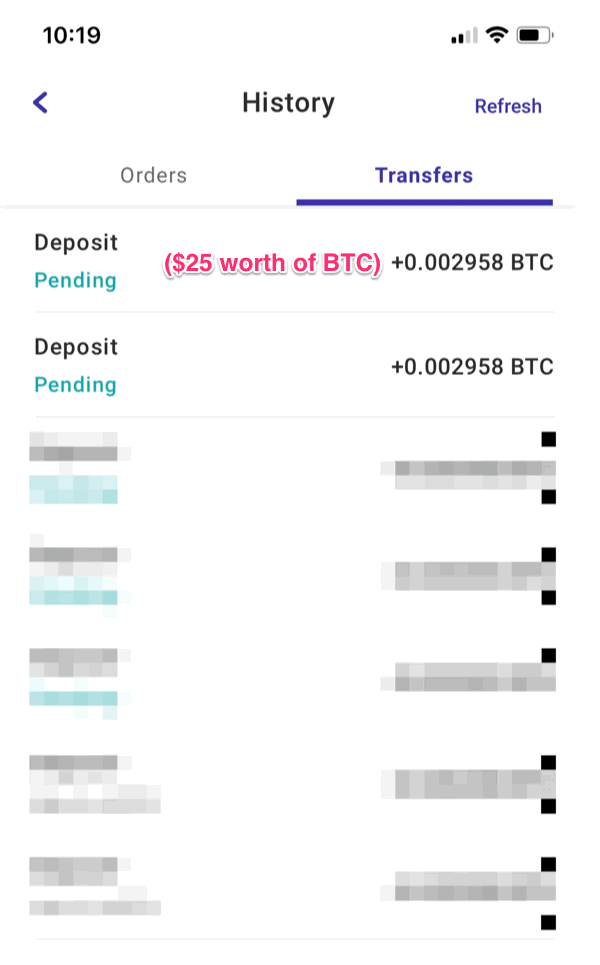
Here is my $25 BTC referral link (open via smartphone), although it just redirects to the App Store. Thanks if you use it! In order to ensure you are credited properly, be sure to enter my referral promo code JONA3F in the “Reward Code” area during the account sign-up process, fund your account, and trade $100 of BTC. You should then see $50 of BTC deposited in your account within 72 hours as a referral bonus. You can also then start referring others for more bonuses. Contact rewards@investvoyager.com if you need support. Here’s a screenshot from my account showing the former $25 BTC bonuses:

Voyager’s CEO is Stephen Ehrlich, the former CEO and founder of Lightspeed Financial (spun off by E*Trade). Oscar Salazar, Uber co-founder and former Chief Technical Officer. Philip Eytan, an early Uber investor. Here is a Fortune magazine profile. Voyager is listed on the Canadian Securities Exchange (CSE) and owns a FINRA broker-dealer license.

Teachers Federal Credit Union New Member Promotion (DO NOT TRY)

Update 6/16/22: More than two weeks after joining and taking my deposit, they have finally refunded the deposit and officially declined my application due to vague reasons suggesting fraud. They have made no effort to contact me or to otherwise explain their actions. I’d never use this credit union, even if I lived in their region. 🙄

Update 6/13/22: Myself and many other readers report that this credit union has locked them out of online access and refunded the initial deposit, all without any further communication. All after approving the account, providing account numbers and routing numbers, and allowing us to set up direct deposits. Not a great look for them. I would not try for this bonus anymore if you have not already done so.

Original post as of 5/30/22:

Teachers Federal Credit Union has a new member offer worth up to $400 that consists of a $300 direct deposit bonus and $100 debit card spending bonus. The terms also state that you can stack this with the $50 refer-a-friend promotion. Teacher’s FCU has 32 physical branches in New York state, but membership is open to anyone applying online. Must enter promo code OFFER400 to participate in this offer. Hat tip to DepositAccounts. Offer ends 7/31/22.

$300 Direct Deposit bonus details.

  • Offer available to new members only.
  • Must enroll in Online Banking and eStatements.
  • Open a new Teachers checking account.
  • Have qualifying direct deposits totaling at least $2,500.00 within the first three monthly statement cycles after account opening.
  • Qualifying direct deposits include payroll or government benefits. Transactions that will not count toward direct deposits include external transfers, point of sale credits and in-person check or cash deposits, wire transfers, ATM transfers, and Online and Mobile Banking transfers.
  • For accounts opened online, you must use offer code OFFER400 to be eligible.
  • May be combined with the Refer-a-Friend promotion.

$100 Debit Card Spend bonus details.

  • Offer available to new members only.
  • Must enroll in Online Banking and eStatements.
  • Open a new Teachers checking account with a debit card.
  • Make $500 in eligible purchases using the Teachers debit card linked to that account.
  • The $500 must be spent within the first three monthly statement cycles in order to qualify. Qualifying debit card purchases do not include: ATM transactions, cash-back, Peer-to-Peer (“P2P”) payments, loan payments, account funding and disputed or unauthorized transactions.
  • For accounts opened online, you must use offer code OFFER400 to be eligible.
  • May be combined with the Refer-a-Friend promotion.

$50 Refer-a-Friend bonus details.

  • Referred person must keep account open for 60 days in good standing with a balance greater than $0.
  • Referred person must perform 10 qualifying transactions in 60 days – transactions include debit card purchases, direct deposits, mobile deposits, Teachers bill pay, in-branch deposits and ATM deposits
  • If these requirements are satisfied, both the referrer and referred person will each get a $50 bonus deposited into their Regular Savings account.
  • Here is my $50 refer-a-friend link. Enter your e-mail address to use. Thanks if you use it!

Smart Checking 1.00% APY details. There is a barebones Share Draft Checking with no minimum balance and no monthly fee, but also no interest paid. Alternatively, the high yield Smart Checking account earns 1.00% APY on balances up to $15,000 (and 0.10% APY on balances greater than $15,000) when you meet one of these qualifications:

  • Average monthly balance of $5,000 in your Smart Checking account
  • $20,000 in combined end of month deposit balances
  • Establish direct deposit(s) of $500 or more AND complete 10 debit card purchases each month

(Note that there is a inactivity fee if the Share Savings account balance falls below $100 AND there has been no account activity during the previous two years.)

Application and bonus qualification details. Here are some tips based on my account opening experience.

  • First, start by clicking on a $50 refer-a-friend link from a member and enter your e-mail address. This qualifies you for the $50 Refer-a-friend offer and you will move on to the application process. You can pick either the Share Draft Checking or Smart Checking (both have no monthly fee).
  • You will enter your personal information including name, address, drivers license/ID, Social Security number, and so on. They will ask you some identity verification questions. You will not have to join any special organizations to gain credit union membership, not even a $5 nominal fee. In fact, they will deposit $1 for you into a savings account to get you started.
  • Be sure to enter the promo code OFFER400 when prompted towards the end of the application.
  • Your initial deposit can be charged on a credit card, up to $5,000. I recommend using a 2% cash back card or similar to earn some rewards. If everything goes smoothly, you should receive an e-mail with your member number shortly, which allows you to sign up for online access. Otherwise, they may ask for some additional documentation.
  • They seem to be pretty good about frequent email communication. Once you get the account number (routing number is 221475786), you can use that for establishing direct deposit within the required timeframe. (Note the offer page says 60 days in some places, but the fine print clarifies it is within three monthly statement cycles.) Don’t forget to sign up for eStatements and make those 10 transactions as well to get the $50 referral bonus.

Altogether, this is a very attraction promotion on a pretty decent no-fee checking account. Teachers FCU also has competitive CD rates at times. They currently offer a unique 24 month “Smart CD” that pays 2.00% APY in Year 1 and 2.50% APY in Year 2 (as of 5/30/22).

Hulu Black Friday: $0.99/Month for 12 Months (w/ Ads), Add Disney+ For $2/Month

Hulu has a Black Friday deal of $0.99/month for 12 months on their Ad-supported plan that includes two devices and HD resolution. Regular price is $7.99/month. You can also add on Disney+ (Ad-supported) for $2/month or add Starz for $0.99/month for 6 months. Works for new and returning members (must have canceled for at least a month). Set a calendar reminder if you don’t want to auto-renew.

Savings compared to current regular monthly price. Offer for Hulu (With Ads) plan only: $.99/month for 12 months, then auto-renews at $7.99/month or then-current regular monthly price. Ends 11:59 PM PST on 11/28/23. Cancel anytime, effective at the end of your billing period. No refunds or credits for partial months. New and eligible returning subscribers (who have not been Hulu subscribers in the past 1 month) only; Disney+ Basic (With Ads) and Disney Bundle subscribers are not eligible.

Peerstreet Update 2022: Interest Rate Spreads, Secondary Market, Pocket 3.5% APY

Another one of my Peerstreet loans was paid off recently, and I realized that it has been over a year since my last update on this experiment in real-estate debt. Here’s my current view on this unique investment.

Peerstreet in a nutshell. “Fractional investments meet hard money lending”. Real estate investors need money quickly to purchase a property, so they pay a higher interest rate for lighting-fast funding but usually only hold the debt for 12-36 months. This used to be for wealthy folks with lots of cash lying around, but Peerstreet lets SEC-accredited investors put in as little as $1,000 to fund a portion of any specific property. The loans are backed by a first lien on the real estate property.

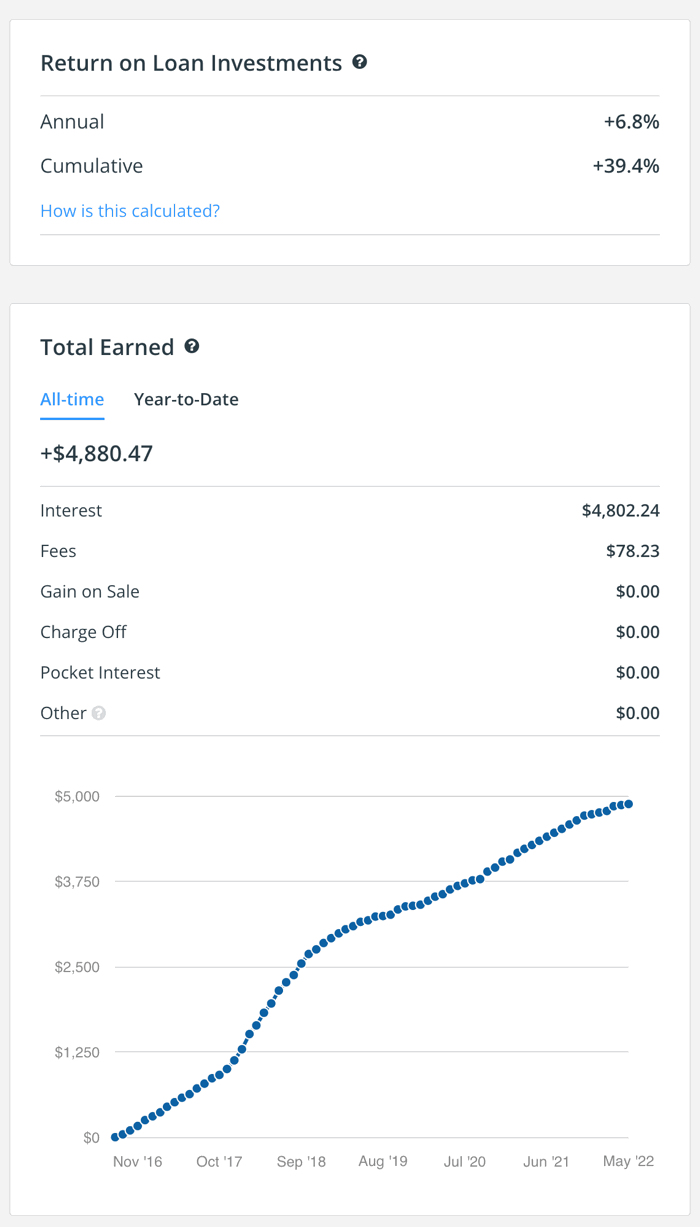
My performance in a nutshell. Since 2016, I have funded 72 loans on 72 different properties with between $1,000 to $5,000 each. I have earned nearly $5,000 in interest at an overall IRR of 6.8% so far (verified with Excel). 67 of the loans have been paid off, 2 are current on their payments and mature in 2022, and 3 are in various stages of being late. Due to rising real estate prices, I am just being patient and letting Peerstreet handle the legal gymnastics.

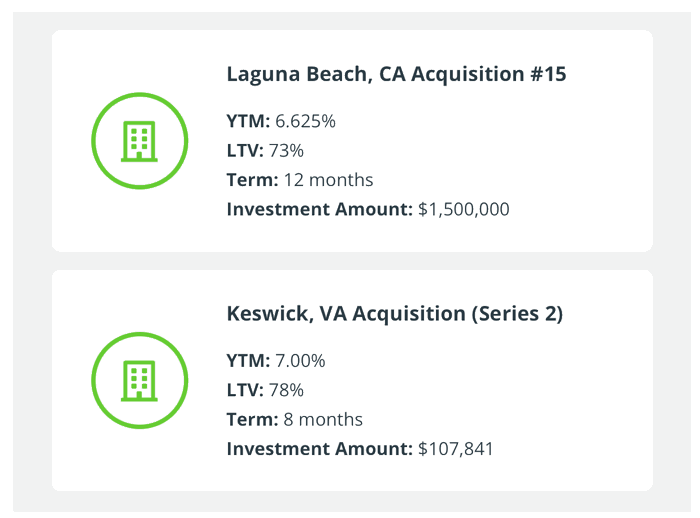
Why I stopped investing in a nutshell. My 72 loans were all between 7% and 10% interest. The median was 7.50% and the average was closer to 8%. However, in the past year the rates have been more often in the 6.5% to 7% range. Traditional 30-year fixed mortgage rates are now close to 6%, and Peerstreet’s rates are a bit higher now but I am still choosing to sit out at these offered rates. I have been seeing loans taking longer to become fully funded so perhaps I’m not alone. Below are the two most recent loans available, just as an example:

Secondary marketplace. Peerstreet has added a new feature where selected people (usually larger institutions) can make offers on your existing loans prior to maturity, possibly offering you valuable liquidity. In my experience, I have only received a few lowball bids on my loans that are in foreclosure, on the order of 50 cents on the dollar. No thanks. It will be much more interesting if/when they open this up to everyone, so that you can have a more efficient marketplace for loans in default.

Peerstreet Pocket 3.5% APY. Peerstreet also rolled out an optional feature called Pocket that pays higher-than-online-bank rates on your short-term cash. They just raised the rate up to 3.5% APY. You can deposit daily, but only withdraw once a month (with two weeks notice). The funds are not FDIC-insured and are backed by the financial ability of Peerstreet (effectively this is lending money to a young start-up company).

Bottom line. I still like the idea of Peerstreet and have had an overall positive experience (you do need enough invested to maintain proper diversification across loans), but the interest rates currently being paid out just aren’t high enough to maintain my interest. I’m currently withdrawing my funds gradually as the loans get paid back over time and investing them elsewhere. 10% interest rates would get my attention back, though! 💰

If you are interested, you can sign up and browse investments at PeerStreet for free before depositing any funds or making any investments. You must qualify as an accredited investor (either via income or net worth) to invest. If you already invest with them, they now sync with Mint.com.

Boost Mobile Annual Plans $8.33/mo for 1 GB, $25/mo for 35 GB “Unlimited” Data (AT&T MVNO)

Boost Mobile now uses the T-Mobile and AT&T 4G/5G networks after the T-Mobile/Sprint merger completed. Now owned by Dish Network, they have rolled out some aggressively-priced annual plans that are cheaper than the ones from Mint Mobile (which I still use), plus some people may prefer access to AT&T network coverage. Light data users can get 1 GB a month for only $100 a year, while heavy data users can get 35 GB a month for $300 a year ($25 a month). Here are all of the the annual plans and pricing:

  • 1 GB 5G/LTE Data + Unlimited Talk/Text for $8.33/month ($100 for 12 months paid upfront)
  • 5 GB 5G/LTE Data + Unlimited Talk/Text for $14/month ($168 for 12 months paid upfront)
  • 15 GB 5G/LTE Data + Unlimited Talk/Text for $20/month ($240 for 12 months paid upfront)
  • “Unlimited” 35 GB 5G/LTE Data + Unlimited Talk/Text for $25/month ($300 for 12 months paid upfront, data speeds throttled after 35 GB)

After you enter your zip code and e-mail, you should be able to confirm the network based on the SIM card that you purchase. Here is a screenshot of the SIM card that will use the AT&T 4G/5G network:

New Bring Your Own Device (BYOD) customers get a free SIM card, free shipping, no credit check, no contract. Taxes will depend on zip code. Mobile Hotspot included based on your high-speed data allotment (limited to 12 GB for Unlimited plan).

Best Interest Rates on Cash – May 2022 Update

Here’s my monthly roundup of the best interest rates on cash as of May 2022, roughly sorted from shortest to longest maturities. We all need some safe assets for cash reserves or as a bond substitute, and there are often lesser-known opportunities available to individual investors. Check out my Ultimate Rate-Chaser Calculator to see how much extra interest you’d earn by moving money between accounts. Rates listed are available to everyone nationwide. Rates checked as of 5/10/2022.

Significant changes since last month: Rates are moving. Brokered CDs and US Treasury bonds close to 3% for 5 years. 1-year Treasury close to 2%. 9.62% Savings I Bonds still available if you haven’t done it yet. 4% APY on up to $6,000 for liquid savings at Current with no direct deposit requirement.

Fintech accounts
Available only to individual investors, fintech companies often pay higher-than-market rates in order to achieve fast short-term growth (often using venture capital). “Fintech” is usually a software layer on top of a partner bank’s FDIC insurance.

  • 4% APY on $6,000. Current offers 4% APY on up to $6,000 total ($2,000 each on three savings pods). No direct deposit required. $50 referral bonus for new members with $200+ direct deposit with promo code JENNIFEP185. Please see my Current app review for details.
  • 3% APY on up to $100,000, but requires direct deposit and credit card spend. HM Bradley pays up to 3% APY if you open both a checking and credit card with them, and maintain $1,500 in total direct deposit each month and make $100 in credit card purchases each month. Please see my updated HM Bradley review for details.
  • 3% APY on 10% of direct deposits + 1% APY on $25,000. One Finance lets you earn 3% APY on “auto-save” deposits (up to 10% of your direct deposit, up to $1,000 per month). Separately, they also pay 1% APY on up to another $25,000 with direct deposit. New customer $50 bonus via referral. See my One Finance review.
  • 3% APY on up to $15,000, requires direct deposit and credit card transactions. Porte requires a one-time direct deposit of $1,000+ to open a savings account. Porte then requires $3,000 in direct deposits and 15 debit card purchases per quarter (average $1,000 direct deposit and 5 debit purchases per month) to receive 3% APY on up to $15,000. New customer bonus via referral. See my Porte review.
  • 1.20% APY on up to $50,000. You must maintain a $250 direct deposit each month for this balance cap, otherwise you’ll still earn 1.20% on up to $5,000. They also pay 6% on USDC stablecoin, but I avoid this as it is not FDIC-insured (and you can get higher rates elsewhere if you did want to hold USDC.) New customer $100 bonus via referral. See my OnJuno review.
  • 1.25% APY (no balance cap). SoFi is now offering 1.25% APY with no balance cap. You must maintain a direct deposit each month of any amount. Convenient if you already have a relationship with them. See $25 + $300 SoFi Money new account and deposit bonus.

High-yield savings accounts
Since the huge megabanks pay essentially no interest, I think every should have a separate, no-fee online savings account to accompany your existing checking account. The interest rates on savings accounts can drop at any time, so I list the top rates as well as competitive rates from banks with a history of competitive rates. Some banks will bait you with a temporary top rate and then lower the rates in the hopes that you are too lazy to leave.

Short-term guaranteed rates (1 year and under)
A common question is what to do with a big pile of cash that you’re waiting to deploy shortly (plan to buy a house soon, just sold your house, just sold your business, legal settlement, inheritance). My usual advice is to keep things simple and take your time. If not a savings account, then put it in a flexible short-term CD under the FDIC limits until you have a plan.

  • No Penalty CDs offer a fixed interest rate that can never go down, but you can still take out your money (once) without any fees if you want to use it elsewhere. CFG Bank has a 13-month No Penalty CD at 1.07% APY with a $500 minimum deposit. Ally Bank has a 11-month No Penalty CD at 0.60% APY for all balance tiers. Marcus has a 13-month No Penalty CD at 0.75% APY with a $500 minimum deposit. You may wish to open multiple CDs in smaller increments for more flexibility.
  • Department Of Commerce Federal Credit Union has a 12-month certificate at 2.15% APY. $500 minimum. 180 day interest penalty on early withdrawals. Anyone can join this credit union through a $5 membership in the American Consumer Council (ACC). Enter ACC membership number on the online application.

Money market mutual funds + Ultra-short bond ETFs
Many brokerage firms that pay out very little interest on their default cash sweep funds (and keep the difference for themselves). Unfortunately, money market fund rates are very low across the board right now. Ultra-short bond funds are another possible alternative, but they are NOT FDIC-insured and may experience short-term losses at times. These numbers are just for reference, not a recommendation.

  • The default sweep option is the Vanguard Federal Money Market Fund which has an SEC yield of 0.53%.
  • Vanguard Ultra-Short-Term Bond Fund currently pays 1.79% SEC yield ($3,000 min) and 1.89% SEC Yield ($50,000 min). The average duration is ~1 year, so your principal may vary a little bit.
  • The PIMCO Enhanced Short Maturity Active Bond ETF (MINT) has a 1.68% SEC yield and the iShares Short Maturity Bond ETF (NEAR) has a 1.38% SEC yield while holding a portfolio of investment-grade bonds with an average duration of ~6 months.

Treasury Bills and Ultra-short Treasury ETFs
Another option is to buy individual Treasury bills which come in a variety of maturities from 4-weeks to 52-weeks. You can also invest in ETFs that hold a rotating basket of short-term Treasury Bills for you, while charging a small management fee for doing so. T-bill interest is exempt from state and local income taxes. Right now, this section isn’t very interesting as T-Bills are yielding close to zero!

  • You can build your own T-Bill ladder at TreasuryDirect.gov or via a brokerage account with a bond desk like Vanguard and Fidelity. Here are the current Treasury Bill rates. As of 5/9/2022, a new 4-week T-Bill had the equivalent of 0.50% annualized interest and a 52-week T-Bill had the equivalent of 1.94% annualized interest.
  • The Goldman Sachs Access Treasury 0-1 Year ETF (GBIL) has a 0.38% SEC yield and the SPDR Bloomberg Barclays 1-3 Month T-Bill ETF (BIL) has a 0.23% (!) SEC yield. GBIL appears to have a slightly longer average maturity than BIL.

US Savings Bonds
Series I Savings Bonds offer rates that are linked to inflation and backed by the US government. You must hold them for at least a year. If you redeem them within 5 years there is a penalty of the last 3 months of interest. The annual purchase limit for electronic I bonds is $10,000 per Social Security Number, available online at TreasuryDirect.gov. You can also buy an additional $5,000 in paper I bonds using your tax refund with IRS Form 8888.

  • “I Bonds” bought between May 2022 and October 2022 will earn a 9.62% rate for the first six months. The rate of the subsequent 6-month period will be based on inflation again. More on Savings Bonds here.
  • In mid-October 2022, the CPI will be announced and you will have a short period where you will have a very close estimate of the rate for the next 12 months. I will have another post up at that time.
  • See below about EE Bonds as a potential long-term bond alternative.

Prepaid Cards with Attached Savings Accounts
A small subset of prepaid debit cards have an “attached” FDIC-insured savings account with exceptionally high interest rates. The negatives are that balances are severely capped, and there are many fees that you must be careful to avoid (lest they eat up your interest). There is a long list of previous offers that have already disappeared with little notice. I don’t personally recommend nor use any of these anymore, as I feel the work required and the fees charged if you mess up exceeds any small potential benefit.

  • Mango Money pays 6% APY on up to $2,500, if you manage to jump through several hoops. Requirements include $1,500+ in “signature” purchases and a minimum balance of $25.00 at the end of the month.
  • NetSpend Prepaid pays 5% APY on up to $1,000 but be warned that there is also a $5.95 monthly maintenance fee if you don’t maintain regular monthly activity.

Rewards checking accounts
These unique checking accounts pay above-average interest rates, but with unique risks. You have to jump through certain hoops which usually involve 10+ debit card purchases each cycle, a certain number of ACH/direct deposits, and/or a certain number of logins per month. If you make a mistake (or they judge that you did) you risk earning zero interest for that month. Some folks don’t mind the extra work and attention required, while others would rather not bother. Rates can also drop suddenly, leaving a “bait-and-switch” feeling.

  • Quontic Bank is offering 1.01% APY on balances up to $150,000. May be useful for those with high balances. You need to make 10 debit card point of sale transactions of $10 or more per statement cycle required to earn this rate.
  • The Bank of Denver pays 2.00% APY on up to $10,000 if you make 12 debit card purchases of $5+ each, receive only online statements, and make at least 1 ACH credit or debit transaction per statement cycle. If you meet those qualifications, you can also link a Kasasa savings account that pays 1.00% APY on up to $25k. Thanks to reader Bill for the updated info.
  • Presidential Bank pays 2.25% APY on balances between $500 and up to $25,000, if you maintain a $500+ direct deposit and at least 7 electronic withdrawals per month (ATM, POS, ACH and Billpay counts).
  • Evansville Teachers Federal Credit Union pays 3.30% APY on up to $20,000. You’ll need at least 15 debit transactions and other requirements every month.
  • Lake Michigan Credit Union pays 3.00% APY on up to $15,000. You’ll need at least 10 debit transactions and other requirements every month.
  • (I no longer recommend this credit union myself, but the rate is still good.) Lafayette Federal Credit Union is offering 2.02% APY on balances up to $25,000 with a $500 minimum monthly direct deposit to their checking account. No debit transaction requirement. They are also offering new members a $100 bonus with certain requirements. Anyone can join this credit union via partner organization ($10 one-time fee).
  • Find a locally-restricted rewards checking account at DepositAccounts.

Certificates of deposit (greater than 1 year)
CDs offer higher rates, but come with an early withdrawal penalty. By finding a bank CD with a reasonable early withdrawal penalty, you can enjoy higher rates but maintain access in a true emergency. Alternatively, consider building a CD ladder of different maturity lengths (ex. 1/2/3/4/5-years) such that you have access to part of the ladder each year, but your blended interest rate is higher than a savings account. When one CD matures, use that money to buy another 5-year CD to keep the ladder going. Some CDs also offer “add-ons” where you can deposit more funds if rates drop.

  • Department Of Commerce Federal Credit Union has a 5-year certificate at 3.05% APY. $500 minimum. 180 day interest penalty on early withdrawals. Anyone can join this credit union through a $5 membership in the American Consumer Council (ACC). Enter ACC membership number on the online application.
  • Live Oak Bank has a 5-year CD at 2.75% APY ($2,500 minimum) with an early withdrawal penalty of 180 days of interest.
  • KS StateBank has a 5-year CD at 2.70% APY ($500 min). Early withdrawal penalty is 18 months of interest.
  • You can buy certificates of deposit via the bond desks of Vanguard and Fidelity. You may need an account to see the rates. These “brokered CDs” offer FDIC insurance and easy laddering, but they don’t come with predictable early withdrawal penalties. Right now, I see a 5-year CD at 3.20% APY. Be wary of higher rates from callable CDs listed by Fidelity.

Longer-term Instruments
I’d use these with caution due to increased interest rate risk, but I still track them to see the rest of the current yield curve.

  • Willing to lock up your money for 10 years? You can buy long-term certificates of deposit via the bond desks of Vanguard and Fidelity. These “brokered CDs” offer FDIC insurance, but they don’t come with predictable early withdrawal penalties. You might find something that pays more than your other brokerage cash and Treasury options. Right now, I see a 10-year CD at 3.00% APY vs. 2.98% for a 10-year Treasury. Watch out for higher rates from callable CDs from Fidelity.
  • How about two decades? Series EE Savings Bonds are not indexed to inflation, but they have a unique guarantee that the value will double in value in 20 years, which equals a guaranteed return of 3.5% a year. However, if you don’t hold for that long, you’ll be stuck with the normal rate which is quite low (currently 0.10%). I view this as a huge early withdrawal penalty. But if holding for 20 years isn’t an issue, it can also serve as a hedge against prolonged deflation during that time. Purchase limit is $10,000 each calendar year for each Social Security Number. As of 5/9/2022, the 20-year Treasury Bond rate was 3.38%.

All rates were checked as of 5/10/2022.

Warren Buffett’s Activision Merger Arbitrage “Bank/Credit Card Bonus” Deal

While listening to the 2022 Berkshire Hathaway Annual Meeting Q&A session (full video and transcript at CNBC), I was amused to hear that Warren Buffett announced that he bought shares of Activision Blizzard stock as part of a “workout”.

The very short version is that Microsoft (MSFT) has entered an agreement to purchase Activision Blizzard (ATVI) for $95 a share. As of close today 5/9/2022, you could buy ATVI for about $77.17 a share. If the sale goes through and closes in June 2023, you would earn a 23% return a little over a year.

The amusing part is that given the size of Berkshire Hathaway, even buying 10% of ATVI at the current price would only cost about $6 billion with a fixed upside of around $1.4 billion. If the deal closes, Berkshire would increase its $700 billion market cap at most by a one-time 0.2%. That’s the same ratio as someone with a $100,000 net worth doing a bank or credit card bonus deal for $200. 🤔

Even though Warren Buffett spends most of his time gradually building Berkshire Hathaway into a cash-gushing legacy fortress that will run for the next 100 years, he still can’t give up a good short-term deal either! It’s like an old habit. I love it! 🤣 Here’s how he ends it:

And incidentally, I don’t talk this over with Charlie. I mean, you know, he knows that occasionally I’ll see an arbitrage deal and do it. And, you know, 50 years ago we were doing it together, and his general feeling is, “Why is Warren fooling around with this kind of stuff, even.”

But it’s the old fire horse that occasionally it looks like the odds are in our favor. But absolutely we can lose money on that company, and, you know, fairly large sums of money, depending on what happened if the deal blows up.

And there will be a lot of people that want the deal to blow up. But Microsoft doesn’t want it to blow up, so we’ll just have to see what happens.

In addition, you and I can stroll over any brokerage app and participate in this “special situation” opportunity as well. There is still risk involved, and I’m sure there is plenty of discussion about it on various stock trading forums that I never visit, but here are my notes:

  • Around October and November 2021, Berkshire Hathaway acquired shares of ATVI at an average price of about $77 a share. This was the decision of either Ted Weschler or Todd Combs, as Buffett corrected. This would indicate that $77 a share would already reflect a margin of safety below intrinsic value, by their estimation, even without any acquisition talks.
  • In January 2022, Microsoft announced an agreement to buy ATVI at $95 a share in an all-cash deal. MSFT has more than enough cash to comfortably pay for this deal.
  • Since then, the shares have traded around $75 to $82 a share. Even after Buffett announced his participation in this deal, the price hasn’t moved much.
  • The primary risk is that US or EU regulators will stop the transaction due to anti-trust concerns. MSFT will pay a break-up fee of approximately $4 a share if it fails due to anti-trust issues.
  • Although he downplays it, I can only assume that Buffett – with all his experience – really does believe that this transaction has a good likelihood of going through, and even if it doesn’t the downside is limited. He has a different view than the market, and is willing to bet real money on it.

As an illustration, for every $1,000 invested into ATVI at $77.17 a share and cashed out at $95 a share, the upside potential is a $230 as of June 2023 (deal deadline, a little over 13 months from now). You can scale this number up or down based on your investment. $10,000 invested means $2,300 upside, and so on. The downside potential is unknown if it falls apart, and theoretically unlimited as with any business.

Disclosure: I bought a small position in ATVI in my side money account. This is not a recommendation for your situation and you should perform your own due diligence. Some people like to bet on a football game because it makes it more interesting, but I’d rather participate in something with an expected positive return and an educational component. I don’t believe in paper trading; skin in the game is a better teacher.

Billionaire Crypto CEO Explains DeFi Farming… Sounds Exactly Like a Ponzi Scheme

Sam Bankman-Fried (nicknamed “SBF”) used the “sell shovels during the Gold Rush” model on cryptocurrency and has made billions as the CEO of FTX, a crypto derivatives exchange. He has a background in quantitative trading and performed a now-famous arbitrage of the different selling prices of Bitcoin between Japan and the US when the market was inefficient, buying millions of dollars worth every day where it was cheaper and selling it where it was slightly more expensive.

I’m also a Matt Levine Money Stuff fan, and so I listened to this Bloomberg Odd Lots podcast with Matt Levine and Sam Bankman-Fried with great interest. If you don’t want to listen, definitely read this partial transcript. The whole thing was very educational, like one of those casino documentaries showing you how things really work. Here’s an even shorter excerpt:

Matt Levine: (21:17)
Can you give me an intuitive understanding of farming? I mean, like to me, farming is like you sell some structured puts and collect premium, but perhaps there’s a more sophisticated understanding than that.

Sam Bankman-Fried: (21:28)
Let me give you sort of like a really toy model of it, which I actually think has a surprising amount of legitimacy for what farming could mean. You know, where do you start? You start with a company that builds a box and in practice this box, they probably dress it up to look like a life-changing, you know, world-altering protocol that’s gonna replace all the big banks in 38 days or whatever. Maybe for now actually ignore what it does or pretend it does literally nothing. It’s just a box. So what this protocol is, it’s called ‘Protocol X,’ it’s a box, and you take a token. You can take ethereum, you can put it in the box and you take it out of the box. Alright so, you put it into the box and you get like, you know, an IOU for having put it in the box and then you can redeem that IOU back out for the token.

So far what we’ve described is the world’s dumbest ETF or ADR or something like that. It doesn’t do anything but let you put things in it if you so choose. And then this protocol issues a token, we’ll call it whatever, ‘X token.’ And X token promises that anything cool that happens because of this box is going to ultimately be usable by, you know, governance vote of holders of the X tokens. They can vote on what to do with any proceeds or other cool things that happen from this box. And of course, so far, we haven’t exactly given a compelling reason for why there ever would be any proceeds from this box, but I don’t know, you know, maybe there will be, so that’s sort of where you start.

And then you say, alright, well, you’ve got this box and you’ve got X token and the box protocol declares, or maybe votes by on-chain governance, or, you know, something like that, that what they’re gonna do is they are going to take half of all the X tokens that were re-minted. Maybe two thirds will, two thirds will offer X tokens, and they’re going to give them away for free to whoever uses the box. So anyone who goes, takes some money, puts in the box, each day they’re gonna airdrop, you know, 1% of the X token pro rata amongst everyone who’s put money in the box. That’s for now, what X token does, it gets given away to the box people. …

So, you know, X tokens [are] being given out each day, all these like sophisticated firms are like, huh, that’s interesting. Like if the total amount of money in the box is a hundred million dollars, then it’s going to yield $16 million this year in X tokens being given out for it. That’s a 16% return. That’s pretty good. We’ll put a little bit more in, right? And maybe that happens until there are $200 million in the box. So, you know, sophisticated traders and/or people on Crypto Twitter, or other sort of similar parties, go and put $200 million in the box collectively and they start getting these X tokens for it.

And now all of a sudden everyone’s like, wow, people just decide to put $200 million in the box. This is a pretty cool box, right? Like this is a valuable box as demonstrated by all the money that people have apparently decided should be in the box. And who are we to say that they’re wrong about that? Like, you know, this is, I mean boxes can be great. Look, I love boxes as much as the next guy. And so what happens now? All of a sudden people are kind of recalibrating like, well, $20 million, that’s it? Like that market cap for this box? And it’s been like 48 hours and it already is $200 million, including from like sophisticated players in it. They’re like, come on, that’s too low. And they look at these ratios, TVL, total value locked in the box, you know, as a ratio to market cap of the box’s token.

And they’re like ‘10X that’s insane. 1X is the norm.’ And so then, you know, X token price goes way up. And now it’s $130 million market cap token because of, you know, the bullishness of people’s usage of the box. And now all of a sudden of course, the smart money’s like, oh, wow, this thing’s now yielding like 60% a year in X tokens. Of course I’ll take my 60% yield, right? So they go and pour another $300 million in the box and you get a psych and then it goes to infinity. And then everyone makes money.

Matt: (27:13)
I think of myself as like a fairly cynical person. And that was so much more cynical than how I would’ve described farming. You’re just like, well, I’m in the Ponzi business and it’s pretty good.

So many words, but the bottom line is… people pay more for the “cool box” because other people paid more for the box, which makes other people pay more for the box… Really? You are one of the smartest people in this space, and that the best explanation you can give me?

There’s more in the podcast, and SBF actually came off as knowledgable, reasonable, and practical. He was almost a little too honest about things, and as a result laid bare the reality of how little actually backs most of these schemes. Read between the lines, and you start to see the tricks and manipulations. Bitcoin might be limited to a finite amount, but most of these other random coins and tokens can be created in a day and are thus unlimited. If you get in really early and get out early enough in a Ponzi scheme, you can make money without hard work. But many people are collectively losing billions on these “cool boxes”, often the same people who put a lot of their hard-earned income into lottery tickets. Meanwhile, the shovel-sellers keep getting richer.

Sometimes the best idea is to simply avoid an risky area that will eventually implode. Focus your energy somewhere where your consistent work can grow a competitive advantage over time.

Mastercard Free ID Theft Protection and Credit Monitoring

Update April 2022: Just a quick update that this has been a useful, additional free identity theft protection service. Today, I electronically signed some “power of attorney”-type papers through Docusign and they had me answer some identity verification questions like “which address have you been associated with?” that pulled from my credit reports and driver’s license data. Immediately, I got the following alert from Mastercard Identity Protection that even included the exact questions asked:

Previously, this service has also alerted me that my personal information like name/email have been found in data breaches from random websites like autoexpresscars.com and drivesure.com. These are all events that did not trigger any alerts from my other credit bureau-based monitoring services. Therefore, I feel signing up for this additional free service rounds them out. Services like Docusign are useful but open you up to potentially more severe cases of fraud.

Original post:

Data breaches are scary fact of life these days. If you have a Mastercard, did you know that they offer a Mastercard ID Theft Protection service to cardholders for free? If you activate it, Mastercard has paid on your behalf for a private-label identity theft protection service provided by Generali Global Assistance, Inc. (GGA). The same way that Safeway doesn’t actually make their generic version of Cheerios, Mastercard has outsourced this service. Thanks to reader Bill P for the tip.

Services are provided by Generali Global Assistance, Inc. (GGA), one of the largest providers of private-label identity protection services in the United States. GGA has handled thousands of identity-related cases and has protected millions of customers since it began offering the service in 2003. GGA’s in-house identity theft resolution specialists are certified identity theft risk management specialists – CITRMS® certification by the Institute of Consumer Financial Education (ICFE) and FCRA-certification (Fair Credit Reporting Act by the Consumer Data Industry Association).

You’ll receive an alert if there’s a change to your TransUnion credit report (e.g., new inquiries, new accounts, updated personal information by creditors). That’s nice, but I already get more comprehensive coverage from all three bureaus than this from my combination of Credit Sesame, Credit Karma, and FreeCreditScore.

The difference that caught my eye was their emphasis on full-service, human help if you do become a victim of identity theft. Emphasis mine:

This program is designed to help protect you from identity theft and provide full-service, hands-on assistance in the event of an incident. Studies have shown that the largest cost to victims of identity theft is lost time and stress associated with figuring out how to restore their identity, including replacing cards and documents while communicating with creditors to dispute fraudulent activity. In the event of an incident, we will assign you with a personal case manager to help you resolve issues, saving you countless hours and reducing the stress associated with identity theft.

Their package of services includes: identity theft affidavit assistance and submission, creditor notification, dispute and follow-up, 3-bureau fraud alert placement, inform police/legal authorities, placement of credit freeze and opt-out services provided by certified identity theft resolution specialists.

These could be hollow claims, but hopefully they are truly helpful in taking care of these things on your behalf. If you have a Mastercard, it may be another worthwhile service to add to your defenses.

I Savings Bonds: Nearly 10% Yield + 10X More Popular!

Nothing like a 10% yield with no principal risk to attract more attention to a quiet little investment option. The WSJ has a new article What Are I Bonds? Everything You Need to Know to Earn Nearly 10% Interest as a follow-up to The Safe Investment That Will Soon Yield Almost 10% (paywall?). No groundbreaking discoveries, but you might find something useful as they are admittedly more complicated than a traditional bank savings account. Here’s an interesting stat of how TreasuryDirect is selling several billions of dollars more than in previous years:

Americans snatched up nearly $11 billion in I Bonds, which are inflation-adjusted U.S. savings bonds, over the past six months, compared with around $1.2 billion during the same period in 2020 and 2021, according to Treasury Department records. That figure will likely rise even higher on an expected jump in rates next month.

Another common question is to buy this week in April or wait until May. Here is another perspective:

I Bonds will be subject to at least one rate change in a 12-month period. Elliot Pepper, a financial planner in Baltimore, doesn’t know what the next rate after 9.6% will be. So, he’ll try to mitigate the risk that it will be lower than 7.12% by taking half of his annual limit and “locking in” the combined 7.12% and 9.6% and then buying the remaining $5,000 in late October, when he has more visibility about the next rate.

If the rate then is lower than 7.12%, Mr. Pepper said he would have been better off investing his $10,000 maximum before May. If the rate is higher than 7.12%, he would have been better off buying the bonds after May, he said.

My view remains that historically, a 7.12% inflation rate is much higher than average. So if you take a step back, your options are:

7.12% for 6 months + 9.62% for 6 months + ??? for 6 months

Or:

9.62% for 6 months + ??? for 6 months + ???? for 6 months

I’d rather lock in the 7.12% over an unknown number. However, if the new rate in October does end up being even higher, I will still eventually get that future ??? rate as a long-term holder of I bonds (it’ll just be shifted six months later). Finally, you get to start earning the interest a month earlier if bought in April. As I had the cash available in other low-interest vehicles, I saw no reason to wait. I’ve already maxed out for 2022 and 2021 (and 2020 and 2019…)

Till Financial Review: Kid Banking App That Teaches Compound Interest

There are many apps in the “reloadable debit card for kids” category, where parents can transfer money into their account and kids can spend it. However, I have been looking for a better app that can illustrate the power of compound interest and deferred gratification. Till Financial allows the parent to incentivize savings via both custom matching and interest amounts. The idea is to provide them a safe place to fail and learn, such that they don’t have to learn it later through missed opportunities and credit card debt. Here are some important highlights followed by details about my favorite features:

  • No monthly fees. No premium tier exists, so not even requests to “upgrade”.
  • Child can be of any age. Family owner must be 18+.
  • Free virtual and optional physical Visa debit card.
  • Now supports both iOS and Android app.
  • Banking services provided by Coastal Community Bank, Member FDIC.
  • No interest paid.

Match each savings contribution. Parents can encourage transfers to savings by matching each transfer by a custom percentage. For example, if they move $10 from their Spend bucket to the Savings bucket, you might match another $5 or $10. Any transfers both in and out of savings must be approved by a parent/admin account.

Pay monthly “interest” on savings balances. Parents can also encourage savings accumulation by paying a custom “interest” rate. For example, you might pay them 5% or 10% monthly for a while and see if they notice how fast it can compound if they don’t touch it. 5% growth every month compounded for a year is +80% growth, i.e. $100 would turn into $180. 10% growth every month compounded for a year is +213% growth, i.e. $100 would turn into $313!

Automatic weekly allowance or one-time transfers. You set the allowance to “auto-pilot” once a week, or just give manually.

Save for a specific goal. Your child can set a goal (ex. $100 for Airpods) and then redirect their allowance, other income, or requested gifts from friends and family into that goal.

Tasks. You can create a menu of specific tasks along with specific payouts (ex. $25 for mowing the lawn.) Tasks can be made available daily, weekly, or on a one-time basis.

If it’s free, how does Till plan on making money? This quote from TechCrunch sums it up well:

Besides making money on interchange fees, Till aims to earn revenue by partnering with merchants to offer rewards to users. It also plans to earn referral fees by referring the teens to other financial institutions when they get older and have different needs.

“It’s not our intention to be your son or daughter’s forever bank. It’s our intention to be their first bank,” Burton said. “So, when they hit the age of majority, we’re actually giving them a high-five off of our platform and introducing them to maybe their first college loan or their first credit card.”

Does Till offer a sign-up bonus for new customers? Yes, if you apply at this link and enter my referral code JP8548 during sign-up, you will get $25 (now only $10?) once you set up an account, create a family, fund, and make one debit card purchase transaction. My cash bonus arrived without problem.

My kids are still on the younger side, so I have been using this mostly as a virtual piggy bank for my kids so far, as they can log into their account and see the (growing) balance. I expect to gradually allow them to handle money and take some responsibility for their spending and saving decisions.

Bottom line. If you are looking for an educational spending app for your kids, check out Till. This is not a “high interest” account, but more about showing them how compound interest and consistent savings adds up. Hopefully, they can use the app to learn deferred gratification in a real-world environment. There is currently a referral bonus for new customers.

INVEST: New American Express and Vanguard Co-Branded Robo-Advisor

I had to double-check the date when I received the press release for this product to make sure it wasn’t April 1st. 🤯 INVEST is a new partnership between Vanguard and American Express, but Vanguard provides all of the financial investment advice. More accurately, Vanguard is paying a credit card company to find new customers and charging those new customers higher prices to cover the marketing costs. Yes, the same Vanguard that made its brand by putting its customers first, selling direct, and not paying sales commissions to financial advisors though big upfront loads on mutual funds. Somebody please create an animated GIF with Jack Bogle shaking his disappointed head. 😞

Another step towards the “New” Vanguard(TM). I wonder how many “consultants” were involved. Ah well, I suppose I should take a closer look anyway.

  • Annual gross advisory fee of 0.50%. (Waived for the first 90 days.)
  • Minimum $10,000 to eligible assets to start.
  • Includes Vanguard’s digital advisory platform.
  • Access to a 30-minute consultation where you can talk with a Vanguard advisor.
  • If you maintain $100,000 or more in your account(s) managed by INVEST, you get ongoing access to “an unlimited number of advisory phone calls”
  • Bonus American Express Membership Rewards® points annually based on the average annual taxable assets: 5,000 points for $50,000+, 25,000 points for $100,000+, 50,000 points for $500,000+.
  • Interest boost on American Express High Yield Savings Account. Get $15 for every $10,000 in average daily balance over the last 12 months (up to $50,000) in your Amex Savings account.

We basically have a few add-ons wrapped around the basic Vanguard Digital Advisor Services (VDAS) product (my review). As a reminder, VDAS sets you up with a model portfolio of low-cost Vanguard index ETFs and charges an annual gross advisory fee of only 0.20% and a lower minimum investment of $3,000.

So let’s add on the perks. Everyone gets a one-time 30-minute phone call. Thirty whole minutes! With a real, live human! If you give them $100,000, then you get unlimited phone calls. They don’t promise access to certified financial planners or anything specific. But if you had $50,000 to invest, you could alternatively upgrade to Vanguard Personal Advisory Services (VPAS) which also includes access to human advisors and more complex advice. VPAS charge an annual advisory fee of 0.30% on top of the expenses from underlying investments. Add on the estimated 0.05% from a model underlying ETF portfolio, and you’d have 0.35%.

For the bonus points, using a value of of 1 cent per Membership Rewards point, the bonus works out to a $50 value on exactly a $50,000 balance, or 0.10%. But that’s a little deceiving because you need $10,000 to open an account. That makes the bonus worth only 0.05%. $250 value on exactly a $100,000 balance is 0.25%. $500 value on exactly a $500,000 balance is 0.10%. So $100,000 is the sweet spot, but the cutoff is a bit severe if you miss it.

For the savings account interest boost, you are adding about 0.15% to the interest rate at the most optimistic on the AmEx online savings account. Their current rate is 0.50% APY. That’s about the same as most “high yield online savings accounts”, but comparison shoppers can almost always do much better. I wouldn’t really consider this a worthwhile bonus since 0.15% is not a significant margin when you don’t know if the base rate will stay competitive.

To summarize, the added perks do not reliably offset the higher cost of this product when compared to going directly through Vanguard.

Vanguard, known for not paying commissions to financial advisors…. is paying a commission to American Express. So why are you paying 0.15% to 0.30% more annually than going direct through Vanguard? Well, you should know that up to half of the fees that you pay will go directly into American Express’s pocket.

American Express (Amex) will receive a promoter fee in an amount that is up to 50% of the advisory fee that you pay to Vanguard Advisers, Inc. (VAI) if you enroll in INVEST. The promoter fee Amex receives will be reduced by certain costs, including the cost of your advisory calls with VAI Financial Advisors and other benefits that provide an incentive for you to consider INVEST. This promoter fee will be paid by VAI to Amex for so long as you maintain your advisory relationship with VAI.

Is this the most evil thing ever? No. You can always argue that anything that exposes people to investing is good, even if it’s a bit more expensive than necessary. I’m still disappointed. Vanguard was different because it was boring with little advertising and letting the product sell itself.

Bottom line. INVEST has Vanguard’s robo-advisor at its core but with a higher costs and added perks. The added perks do not reliably offset the higher cost of this product when compared to going directly through Vanguard. The reason for this is that… wait for it…. costs matter. Vanguard has to pay American Express a cut of half of your fees forever for this marketing relationship, which eventually lowers your returns as an investor. I wonder what company taught me that?!

via GIPHY