Marriott Rewards Premier Plus Card Review

The Marriott Rewards Premier Plus Credit Card is the new co-branded card from Chase and the newly-merged Marriott/Starwood/Ritz-Carlton rewards program. The current bonus is 75,000 bonus Marriott Rewards points after spending $3,000 in 3 months. Here are the card highlights:

  • Earn 75,000 bonus points after spending $3,000 within the first three months.
  • 1 Free Night Award (valued up to 35,000 points) every year after account anniversary.
  • 6X points per $1 spent at participating Marriott Rewards & SPG hotels.
  • 2X points for every $1 spent on all other purchases.
  • Automatic Silver Elite Status each account anniversary year.
  • Get upgraded to Gold Status when you spend $35,000 on purchases each account year.
  • 15 Elite Night Credits each calendar year.
  • Free in-room, premium internet access while staying at participating Marriott Rewards® and SPG® Hotels.*
  • No foreign transaction fees.
  • $95 Annual Fee.

Note the following:

The product is not available to either:

(1) current cardmembers of the Marriott Rewards® Premier or Marriott Rewards® Premier Plus credit card, or
(2) previous cardmembers of the Marriott Rewards Premier or Marriott Rewards Premier Plus credit card who received a new cardmember bonus within the last 24 months.

The Marriott and Starwood merger is now complete, and you can use these points at either Marriott properties (Ritz-Carlton, Renaissance Hotels, Courtyard, Residence Inn, Springhill Suites, Fairfield Inn & Suites) or Starwood Properties (Westin, Sheraton, The Luxury Collection, Four Points by Sheraton, W Hotels, St. Regis, Le Méridien, Aloft).

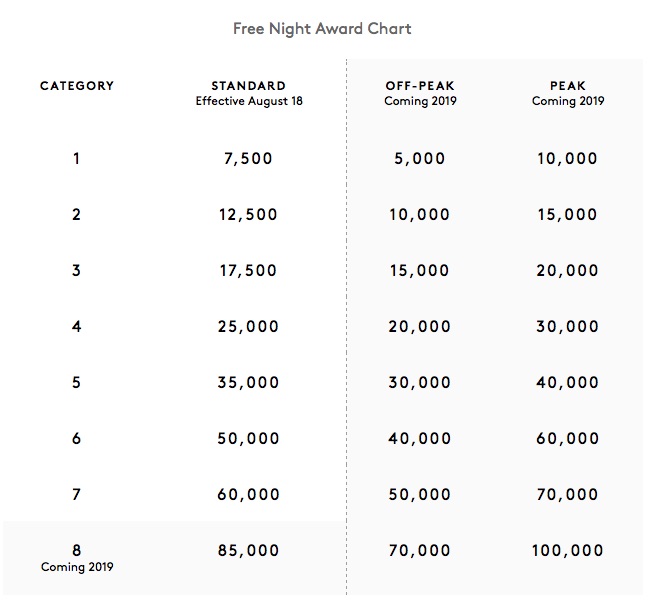
Here’s the new award chart information:

You could use 70,000 points on two free nights at a Category 5 hotel like the Courtyard Waikiki Beach in Hawaii on a standard date, or you could get 4 free nights at a Category 3 hotel like the Residence Inn Austin Arboretum.

You can still turn your points into airline miles with a bonus. 60,000 Marriott points = 25,000 airline miles. Similar to the old Starwood bonus structure, they will add 15,000 points for every 60,000 points you transfer to airline miles.

Finally, Marriott points are also convertible to gift cards, but it takes 60,000 points to redeem for a $200 gift card for Marriott or retailers like Best Buy, Home Depot, or Nordstrom. That ratio isn’t all that great so you’ll definitely get the most value via hotel night redemptions or airline miles transfer.

After your account anniversary and paying the $95 annual fee, you’ll get an Anniversary Free Night Award automatically deposited into your account within 8 weeks. The Anniversary Free Night Award is valid for a one night hotel stay at a property with a redemption level up to 35,000 points. Getting $95 value out of hotel night is pretty easy to achieve, as long as you use it before it expires after 12 months.

Bottom line. The Marriott Rewards Premier Plus Credit Card is an updated version of their Premier card and is currently offering 75,000 bonus points after spending $3,000 in 3 months. As with all hotel cards, the value is dependent on your unique travel preferences. If you stay at Marriott/Starwood properties regularly, the free annual night award should easily cover the annual fee. If you have the old card you may be able to get a bonus for upgrading.

Barron’s Best Stock Brokerage Rankings 2018

barrons2018Barron’s has released their 2018 online broker rankings. The considerations include trading experience/technology, usability, mobile trading, range of offerings, research tools, customer service, and cost.

The Barron’s list always comes from the perspective of their subscriber base – high-net-worth active investors – which may or may not describe you. The overall winner this year was Interactive Brokers. Last year’s winner Fidelity Investments was pushed back to #2. Thankfully, Barron’s also supplied separate rankings for novice investors, long-term investors, and those that value in-person service:

Top 5 Brokers for Novice Investors

  1. TD Ameritrade.
  2. Fidelity
  3. Merrill Edge
  4. Charles Schwab
  5. Ally Invest

Top 5 Brokers for Long-Term Investing

  1. TD Ameritrade.
  2. Fidelity
  3. Charles Schwab
  4. Merrill Edge
  5. E-Trade

Top 5 Brokers for In-Person Service

  1. Merrill Edge.
  2. Charles Schwab
  3. Fidelity
  4. TD Ameritrade
  5. E-Trade

Commentary. A few thoughts on the rankings and other overlooked brokers:

Interactive Brokers is hard to argue against for very active traders. Their average account made 476 trades last year! However, they have a minimum commission of $10 a month for accounts under $100,000, or a minimum commission of $20/month under $2,000. You must pay them $120/$240 a year no matter what. That doesn’t work out for me, as some months I don’t trade at all. IB is not for newbies.

TD Ameritrade recently showed a lack of commitment to their commission-free ETF list and went for quantity over quality. The free ETF list is still decent, but that move didn’t scream “long-term” in my book. I think the customer service is solid, and some people may feel better knowing that they merged with Scottrade and their physical branch network. (E*Trade ate OptionsHouse. Schwab ate OptionsXpress. TD Ameritrade ate Scottrade. Ally ate TradeKing, now Ally Invest.)

Vanguard was included this year for the first time in recent memory, and they were promptly knocked to the bottom for being the most expensive broker due to their high trading costs on non-Vanguard ETFs and mutual funds. Vanguard doesn’t court active traders, and active traders probably won’t like it at Vanguard.

Robinhood was ignored again this year, despite the fact they have free trades and recently added a web interface for trading and free options trading. They probably would have also ranked low due to limited feature set.

M1 Finance is another free investing app that just popped on my radar. It lets you pick a customized basket of individual stocks (or ETFs) and then lets you buy them with zero commission. I used to worry that Robinhood was alone, but now there is competition. Maybe Barron’s will notice one day.

I keep most of my long-term assets directly at Vanguard along with a Solo 401k at Fidelity. My (much more modest) individual stock trading is done through Merrill Edge. I’m happy with them so far. If you have $50,000 in assets across Merrill Lynch, Merrill Edge, and Bank of America accounts, you get 30 free trades per month. That’s already more trades than I need, but $100k in combined assets gets you 100 free trades per month.

Disclosure: I am now an affiliate of M1 Finance and TD Ameritrade, and may be compensated if you click through my referral link and open a new account. I am not an affiliate of Interactive Brokers, Fidelity, Merrill Edge, or Vanguard.

Best Interest Rates on Cash – May 2018

cream225Interest rates are rising. Rate-chasing is becoming more worthwhile again. Here is my monthly roundup of the best safe rates available, roughly sorted from shortest to longest maturities. Check out my Ultimate Rate-Chaser Calculator to get an idea of how much additional interest you’d earn if you switched over. Rates listed are available to everyone nationwide. Rates checked as of 5/1/18.

High-yield savings accounts
While the huge brick-and-mortar banks rarely offer good yields, there are a number of online savings accounts offering much higher rates. Keep in mind that with savings accounts, the interest rates can change at any time.

  • Popular Direct is at 2% APY with a $5,000 minimum opening deposit. SalemFiveDirect is at 1.85% APY, albeit for new money only/not valid for existing customers. DollarSavingsDirect is at 1.80% APY (no min). CIT Bank Money Market is at 1.75% APY (no min, $100 to open).
  • My “hub” bank account is the Ally Bank Savings + Checking combo due to their history of competitive savings/CD rates, 1-day external bank transfers, and overall user experience. The free overdraft transfers from savings allows to me to keep my checking balance at a minimum. Ally Savings has been raising their rates, but it still lags a bit at 1.50% APY. I’ve been keeping more money in no-penalty/short-term CDs.

Money market mutual funds + Ultra-short bond ETFs
If you like to keep cash in a brokerage account, you should know that money market and short-term Treasury rates have been rising. The following money market and ultra-short bond funds are not FDIC-insured, but may be a good option if you have idle cash and cheap/free commissions.

  • Vanguard Prime Money Market Fund currently pays an 1.82% SEC yield. The default sweep option is the Vanguard Federal Money Market Fund, which has an SEC yield of 1.58%. You can manually move the money over to Prime if you meet the $3,000 minimum investment.
  • Vanguard Ultra-Short-Term Bond Fund currently pays 2.23% SEC Yield ($3,000 min) and 2.33% SEC Yield ($50,000 min). The average duration is ~1 year.
  • The PIMCO Enhanced Short Maturity Active Bond ETF (MINT) has a 2.12% SEC yield and the iShares Short Maturity Bond ETF (NEAR) has a 2.22% SEC yield while holding a portfolio of investment-grade bonds with an average duration of ~6 months.

Short-term guaranteed rates (1 year and under)
I am often asked what to do with a big wad of cash that you’re waiting to deploy shortly (just sold your house, just sold your business, legal settlement, inheritance). My usual advice is to keep things simple. If not a savings account, then put it in a flexible short-term CD under the FDIC limits until you have a plan.

  • CIT Bank 11-Month No-Penalty CD is at 1.85% APY with a $1,000 minimum deposit and no withdrawal penalty seven days or later after funds have been received. The lack of early withdrawal penalty means that your interest rate can never go down for 11 months, but you keep full liquidity. Full review. You can open multiple CDs in smaller increments if you want more flexibility.
  • Several banks have 12-month CDs at 2% APY and above. Watch the early withdrawal penalties. For example, MidFirst Direct has a 2.25% APY 12-month CD, but the early withdrawal penalty is a fixed 1% of the amount withdrawn + $25. Meanwhile, Ally Bank has a 9-month CD at 2% APY and a 12-month CD at 2.10% APY with $25,000 minimum deposit and early withdrawal penalty of 60 days interest.

US Savings Bonds
Series I Savings Bonds offer rates that are linked to inflation and backed by the US government. You must hold them for at least a year. There are annual purchase limits. If you redeem them within 5 years there is a penalty of the last 3 months of interest.

  • “I Bonds” bought between May 2018 and October 2018 will earn a 2.52% rate for the first six months. The rate of the subsequent 6-month period will be based on inflation again. More info here.
  • In mid-October 2018, the CPI will be announced and you will have a short period where you will have a very close estimate of the rate for the next 12 months. I will have another post up at that time.

Prepaid Cards with Attached Savings Accounts
A small subset of prepaid debit cards have an “attached” FDIC-insured savings account with exceptionally high interest rates. The negatives are that balances are capped, and there are many fees that you must be careful to avoid (lest they eat up your interest). The offers also tend to disappear with little notice. Some folks don’t mind the extra work and attention required, while others do.

  • Insight Card is one of the best remaining cards with 5% APY on up to $5,000 as of this writing. Fees to avoid include the $1 per purchase fee, $2.50 for each ATM withdrawal, and the $3.95 inactivity fee if there is no activity within 90 days. If you can navigate it carefully (basically only use ACH transfers and keep up your activity regularly) you can still end up with more interest than other options. Earning 3% extra interest on $5,000 is $150 a year.

Rewards checking accounts
These unique checking accounts pay above-average interest rates, but with unique risks. You have to jump through certain hoops, and if you make a mistake you won’t earn any interest for that month. Some folks don’t mind the extra work and attention required, while others do. Rates can also drop quickly, leaving a “bait-and-switch” feeling. For example, Northpointe Bank was mentioned for several months here but later dropped to 1% APY. That’s just how it goes with these types of accounts.

  • Consumers Credit Union offers up to 4.59% APY on up to a $20k balance, although getting 3.09% APY on a $10k balance has a much shorter list of requirements. The 4.59% APY requires you to apply for a credit card through them (other credit cards offer $500+ in sign-up bonuses). Keep your 12 debit purchases small as well, as for every $500 in monthly purchases you may be losing out on 2% cashback (or $10 a month after-tax). Find a local rewards checking account at DepositAccounts.

Certificates of deposit (greater than 1 year)
You might have larger balances, either because you are using CDs instead of bonds or you simply want a large cash reserves. By finding a bank CD with a reasonable early withdrawal penalty, you can enjoy higher rates but maintain access in a true emergency. Alternatively, consider a custom CD ladder of different maturity lengths such that you have access to part of the ladder each year, but your blended interest rate is higher than a savings account.

  • Synchrony Bank has a 14-month CD at 2.35% APY ($2,000 min). Live Oak Bank has an 18-month CD at 2.35% APY and a 24-month CD at 2.50% APY ($2,500 min). Early withdrawal penalty for both banks is 90 days of interest.
  • Ally Bank has a 5-year CD at 2.60% APY ($25k minimum) with a relatively short 150-day early withdrawal penalty. For example, if you closed this CD after 2 years you’d still get a 2.07% effective APY even after accounting for the penalty.
  • Mountain America Credit Union has a 5-year Share Certificate at 3.00% APY (minimum deposit varies). Anyone can join via a partner organization for a one-time $5 fee, usually right on the online application. However, note the early of withdrawal penalty of 365 days of interest. You can also find a 5-year non-callable brokered CD at 3.20% APY from both Vanguard and Fidelity. More info below.

Longer-term Instruments
I’d use these with caution due to increased interest rate risk, but I still track them to see the rest of the current yield curve.

  • Willing to lock up your money for 10+ years? You can buy certificates of deposit via the bond desks of Vanguard and Fidelity. These “brokered CDs” offer FDIC insurance, but they don’t come with predictable fixed early withdrawal penalties. As of this writing, Vanguard is showing a 10-year non-callable CD at 3.25% APY (Watch out for higher rates from callable CDs from Fidelity.) Unfortunately, current CD rates do not rise much higher even as you extend beyond a 5-year maturity.
  • How about two decades? Series EE Savings Bonds are not indexed to inflation, but they have a guarantee that the value will double in value in 20 years, which equals a guaranteed return of 3.5% a year. However, if you don’t hold for that long, you’ll be stuck with the normal rate which is quite low (currently a sad 0.10% rate). I view this as a huge early withdrawal penalty. You could also view it as long-term bond and thus a hedge against deflation, but only if you can hold on for 20 years.

All rates were checked as of 5/1/18.


CIT Bank No-Penalty CD

Amazon Price Hike: Gift of Prime Membership Still $99

amazon200Amazon Prime has announced the following price increases to $119 per year:

  • Starting May 11, 2018, new members will be charged $119/year for an annual Prime membership and $59/year for an annual Prime Student membership.
  • Starting June 16, 2018, existing Prime members with an annual membership will renew at a rate of $119/year. Prime Student members with an annual membership will renew at a rate of $59/year.

You can still buy a Gift of Prime Membership for $99 (plus applicable taxes). I assume this will also go up in price as of May 11th, but I’d buy it sooner rather than later. I debated for a while whether it was worth the trouble, but since I had 5 minutes this weekend I decided to save 20 bucks. Here’s the rundown.

  • You can cancel the auto-renewal of your Amazon Prime membership in your account. You’ll have to go through a lot of “Are you sure?” prompts. They make it feel like you’re canceling your membership right then and there, but again you’re just canceling your auto-renewal. Your Prime membership will still continue through your anniversary date. Mine was in October 2018.
  • Buy a Gift of Prime Membership for $99 (plus applicable taxes) and send it to yourself or alternative e-mail. Note that if you try to apply the Amazon Gift of Prime when you have an active membership, it won’t work. You just get the exact value paid (including any taxes) in the form of an Amazon gift card. The goods news it that you don’t lose any value.
  • Set a calendar reminder of when your Amazon Prime year expires, and keep that e-mail with the gift membership link (perhaps in a special folder). If you apply the Amazon Gift of Prime the day after your current membership expires, then it will renew you with one year of Amazon Prime. You don’t need to start a new Amazon account or change your e-mail, everything will carry over from before. You’ll simply not have Prime for a day or less. Easy.

az_gift

Note that if you have an older grandfathered Amazon Prime that lets you have 5 household members share the benefits, you may not want that to expire.

Amazon Prime has a bunch of features beyond the faster shipping that are useful to me, as I don’t pay for Netflix video or Spotify radio subscriptions and use the Amazon Video and Amazon Music apps instead. There are also Prime-only deals throughout the year that save me money.

Audible Returning Trial Members: 2 Free AudioBooks + $10 Amazon Gift Card (Targeted)

dalioIf you’ve already done a free trial of Audible.com and gotten some free audiobooks… Amazon might like to offer you another trial with two more free audiobooks plus a $10 Amazon gift card! This offer may be targeted and appears to be open to those who have been an Audible member or participated in an Audible trial in the past.

  • The first 60 days are free including 2 free audiobooks. After that, it’s just $14.95 per month.
  • Don’t like a book exchange it for another.
  • In two weeks, you will receive an email with your $10 Amazon.com gift card.
  • No commitment. Cancel anytime and keep all your audiobooks.

The two books that I plan to listen to are Principles: Life and Work by Ray Dalio and Born Standing Up by Steve Martin.

Amazon Prime: Buy Sample Box, Get Equal Credit Towards Similar Products

snackaz

Updated with new Snack and other sample boxes. Amazon Prime members can buy sample boxes that come with a credit towards a future purchase in that specific product category. Right now, you can buy a snack sample box for $9.99 and then you’ll get an equal $9.99 credit towards a future purchase of any eligible items in that category. You’ll still get Amazon Prime free shipping. Here are the currently available sample boxes along with the eligible products:

Due to the way this deal is structured, I choose to view it is a “free box of goodies” if you would already otherwise purchase something on their eligible item lists. That way you’re not buying something you don’t need anyway.

The sample boxes do go out of stock for extended periods of time, so if you see something you like, I would buy it now. A week after your product ships, you will receive an email with instructions on how to use your promotional credit.

Georgia Tech Online Master’s Degree Update: Computer Science $7,000, Data Analytics $10,000

georgiatech

Maybe I’m foolish, but I remain hopeful about the potential of software leading to more affordable, accessible education. In 2014, Georgia Tech launched an Online Master of Science in Computer Science (OMSCS) with the goal of offering an accredited, top-tier education at a surprising price of $7,000. The program has been regularly ranked in the Top 10 by U.S. News & World Report, and the traditional residential program costs $28,000 two years of tuition (out-of-state, not including housing).

OMSCS offers the same lectures from the same professors, the same homework assignments, and the same exams. A few other top universities have online versions of their masters programs, but they charge the same tuition as in-person ($40,000+). The diploma is exactly the same as those of on-campus graduates, with no special “online” designation.

Would there be enough interest from qualified candidates? Would it remain financially viable? Would the online program cannibalize from the traditional on-campus program? Would employers discriminate if they found out that this was an online degree? Would the careers prospects be different due to the lack of in-person networking opportunities?

EducationNext recently published an article An Elite Grad-School Degree Goes Online addresses some of these questions. InsiderEd has a an article Online, Cheap — and Elite that summarizes the findings.

Analyzing the first six cohorts of the online program, from spring 2014 to fall 2016, the report found that the typical applicant to the online program was a 34-year-old midcareer American, while the typical applicant to the in-person degree was a 24-year-old recent graduate from India.

Of the 18,000 students who applied to the in-person and online degrees, less than 0.2 percent applied to both, the report said.

Students admitted to the online program typically had slightly lower academic credentials than those admitted to the in-person program, but they performed slightly better in their identical and blind-marked final assessments — a finding the study hailed as “the first rigorous evidence that we know of showing that an online degree program can increase educational attainment.”

Overall, the program has been a success in terms of expanding access to high-quality computer science education. Total enrollment is now over 6,000 students. The questions about career effects will be addressed in future studies.

In 2017, Georgia Tech announced a new Online Masters Degree in Analytics for under $10,000. This is also a nationally-ranked Top 10 program where the traditional in-person tuition ranges from $36,000 for in-state students to $49,000 for out of state. The data analytics program is an interdisciplinary collaboration between the College of Engineering, College of Computing and the Scheller College of Business.

1.1.1.1: Free DNS Server for Faster Internet, Better Privacy

Every time you visit a domain like mymoneyblog.com, you use a DNS server to find its “address”, specifically IP address. However, your internet service provider (ISP) may be logging every single request then selling this data to other advertisers. CloudFlare and APNIC partnered to create 1.1.1.1, an alternative free DNS resolver that doesn’t sell data to advertisers. It also uses CloudFlare’s network of servers to even faster than other DNS servers, even Google’s version.

1111speed

Better privacy and faster internet? Sounds good to me. The main concern is that this is a private effort and you have to trust that they will maintain this unprofitable venture. I’ll try it out while it lasts. Learn more here. Installation directions (you must change a few settings) here.

Target Car Seat Trade-In Program: 20% Off Car Seats and Strollers

targetcarseatIn the market for a new car seat or stroller? Target is running their Car Seat Trade-in Event from Sunday, April 22 through Saturday, May 5, 2018. Simply bring in an old car seat or car seat base into a Target store and they will give you a 20% off coupon toward a new car seat, booster seat, car seat base, travel system or stroller. Coupons can be applied to both in-store and online purchases through May 19, 2018.

Certainly, re-use if you can, but car seats actually “expire” after 5-6 years or any sort of accident. The plastics degrade over time (it sits in your car all day) and may no longer handle the extreme stress of a car accident. All car seats made after 2009 should be marked with an expiration date by the manufacturer. In addition, many places don’t accept car seats for recycling. Target will recycle your car seat “to create new products such as grocery carts, plastic buckets and construction materials such as steel beams and carpet padding”.

Firstrade Commission-Free ETF Program Review – Includes Vanguard, iShares Core, Schwab Index ETFs

firstradefree1

Online brokerage Firstrade just announced a new Commisssion-Free ETF program that includes 700+ ETFs from 40 fund families. This is a bold move as it includes both a lot of ETFs (quantity) but also the best ETFs (quality) from providers like Vanguard, iShares, WisdomTree, SPDR State Trust, and Schwab.

Firstrade already cut their standard trade commission to $2.95 per trade in 2017. The program is designed for long-term investors and the ETFs must be held for at least 30 days (if less than 30 days, the commission is the standard $2.95). Leveraged ETFs are not included. There is no need for any special enrollment for this ETF program.

Low-cost, broadly-diversified ETFS across major asset classes. Here is a partial list of ETFs that I noticed:

Vanguard (52 ETFs total)

  • Vanguard S&P 500 ETF (VOO)
  • Vanguard Total International Stock ETF (VXUS)
  • Vanguard Dividend Appreciation ETF (VIG)
  • Vanguard Small-Cap Value ETF (VBR)
  • Vanguard FTSE Developed Markets ETF (VEA)
  • Vanguard FTSE All-Wld ex-US ETF (VEU)
  • Vanguard Global ex-US Real Est ETF (VNQI)
  • Vanguard FTSE Emerging Markets ETF (VWO)
  • Vanguard Short-Term Infl-Prot Secs ETF (VTIP)
  • Vanguard Total International Bond ETF (BNDX)

Notably absent: Vanguard Total Stock Market ETF (VTI)

iShares (173 ETFs total)

  • iShares Core S&P Total US Stock Mkt ETF (ITOT)
  • iShares Core S&P 500 ETF (IVV)
  • iShares Core MSCI Total Intl Stk ETF (IXUS)
  • iShares Core US REIT ETF (USRT)
  • iShares Core MSCI EAFE ETF (IEFA)
  • iShares Core MSCI Emerging Markets ETF (IEMG)
  • iShares Core Dividend Growth ETF (DGRO)
  • iShares Core US Aggregate Bond ETF (AGG)
  • iShares Core International Aggt Bd ETF (IAGG)
  • iShares Short Maturity Bond ETF (NEAR)

Schwab (20 ETFs total)

  • Schwab US Broad Market ETF (SCHB)
  • Schwab US Dividend Equity ETF (SCHD)
  • Schwab Emerging Markets Equity ETF (SCHE)
  • Schwab International Equity ETF (SCHF)
  • Schwab US REIT ETF (SCHH)
  • Schwab US TIPS ETF (SCHP)
  • Schwab US Aggregate Bond ETF (SCHZ)

With this move, they take the title of “Largest Commission-Free ETF Program” from TD Ameritrade. Here’s their comparison chart.

firstradefree2

My take. Overall, competition is good and I always like to see lower prices for long-term ETF investors. Additional considerations:

  • Sustainable? This list is very similar to what TD Ameritrade used to offer commission-free, at least in terms of offering the most popular ETFs. However, TD Ameritrade eventually went for quantity over quality, dropping most of their widely-held ETFs and replacing them with niche ETFs and index ETFs from SPDR. One can only assume this is a loss-leader offering for Firstrade. Will it last?
  • Truly simple portfolios can just stick to the source. If you really want to construct a simple portfolio, you can open an account at Vanguard, Fidelity (iShares), and Schwab and buy ETFs (limited to their family) with no commission. The benefit is that in-house discounts are much more likely to stay free.
  • Tax-loss harvesting. A potential benefit of using a brokerage account is if you do tax-loss harvesting with ETFs. For example, you could sell iShares Core S&P Total US Stock Mkt ETF (ITOT) and buy Schwab US Broad Market ETF (SCHB), all commission-free and in the same account. With the big list above, ETF pairing for almost every asset class are available.

New account promotions. Firstrade is also offering the following new account cash + free trades promotions based on opening deposit. You can get up to $300 cash and 500 free trades. They will also cover up to $200 in account transfer fees when you switch from another broker and $25 in wire fees when you wire money to Firstrade.

Bottom line. Firstrade has a new Commisssion-Free ETF program that offers both quantity (700+ ETFs from 40 fund families) and quality (top-rated and popular ETFs from Vanguard, iShares, and others) for long-term investors (30-day minimum holding period). The standard commission on other stocks and ETFs is $2.95. This sure looks nice, but I hope it is sustainable. We recently saw TD Ameritrade cut back on their Commisssion-Free ETF program.

Delta Airlines Hack: Free Credit Monitoring From All Three Bureaus for 2 Years

allclear0In early April 2018, Delta disclosed that hackers may have compromised credit card information from ticket buyers on Delta.com between September 26 and ending October 12, 2017. However, as with many of these “cyber incidents”, this may just be the tip of the iceberg. If you realized actual damages, call 1-855-815-0534 and an AllClearID investigator will help recover financial losses, restore your credit and make sure your identity is returned to its proper condition.

Delta has also paid AllClearID to provide 2 years of free credit repair and monitoring services starting April 7th, 2018 to anyone who thinks they have been impacted. Visit https://delta.allclearid.com to get a unique code that you can redeem at enroll.allclearid.com. AllClear Fraud Alerts with Credit Monitoring includes:

  • Protection at the three national credit bureaus: Starting with the ability to request, renew, and remove a 90-day fraud alert through TransUnion. TransUnion will relay the request to set the fraud alert to Experian and Equifax, and AllClear will send a reminder email when it is time to reset the fraud alert.
  • Credit Monitoring: To detect creditors that ignore the fraud alert law. Available with single or triple bureau option.
  • Annual TransUnion credit report and VantageScore 3.0: For added visibility into your credit file.
  • $1 Million in Identity Theft Insurance Coverage: Provides reimbursement of certain fees, lost wages, and fraud losses related to identity recovery. There is no deductible for this insurance.

The primary thing of value that I see is the free credit monitoring of all three credit bureaus for free. I already have credit monitoring of TransUnion and Experian through various free credit score websites, but none of them cover all three at once. If you actually have damages from identity theft, the repair services and insurance coverage may also be of benefit. I don’t know why they focus on the 90-day fraud alerts, as they are already free to anyone that fills out a simple online form without AllClearID.

Opt-in to 3-bureau monitoring. I signed up, and I should note the the default option is single-bureau credit monitoring. The stated reason is that they don’t want to alert you three times if a the same new event is reported to all three credit bureaus. Really? I am quite interested to see if it is reported to one and not the others. Therefore, I was sure to opt into the 3-bureau option. Screenshot:

allclear3

I would also note that AllClearID will call your phone every single time you log in and require you to enter a PIN number and/or voice verification.

SaverLife Review: Starting Saving $20 a Month, Get Another $10 a Month Boost

saverlife0The importance of an emergency fund is often mentioned, but often the hardest thing is to get started. SaverLife.org is a program run by the nonprofit EARN to help working families by encouraging savings. Their idea here, essentially, is to kickstart a savings habit by paying a cash incentive for saving a least $20 each month for 6 months.

How it works. First, make sure you are age 18+ and have a US bank or credit union account. Taken from their FAQ:

  1. Join now by clicking the “Join Now” button at the top right corner of this page.
  2. Enter your name and email address.
  3. Connect your bank account to SaverLife by entering your online credentials so we can track how much you save.
  4. Save at least $20 each month for 6 months in your own bank account. We don’t touch your money, so you’ll need to move money to your linked account yourself.
  5. Earn $10 in rewards each month that you save at least $20.
  6. After 6 months, you can claim your rewards ($60 max) by completing an exit survey and entering your bank’s routing number and your account number.

You can set a goal higher than $20 a month if you’d like, they just set the bar to be encouraging to as many people as possible to start saving. You’ll receive weekly savings tips as well. SaverLife is not a bank or savings account. The money paid is not interest. If you sign up by April 13th, they promise additional “prizes”. Here’s an example of the motivation behind the nonprofit EARN:

saverlife1

Ideally, you should connect a savings account as they will basically take a snapshot every 30 days to see if your balance is $20 higher than the previous month. For example, if you join on April 10th, then they will check your balance again on May 9th. If you have a savings account, it will be easier to make sure you qualify by simply adding $20 to the account. Having a separate high-yield savings account is a better way to encourage savings anyway.

Bottom line. SaverLife is a free program designed to encourage household savings for working households. Link a bank account and earn $10 cash for every month that you save at least $20 (up to $60 total). I think this is a worthy effort, although I hope they perform some honest, long-term tracking and share if it really helps to develop a regular savings habit.