
Freakonomics Radio has a podcast called Why Is My Life So Hard? where they talked with Tom Gilovich of Cornell and Shai Davidai of the New School for Social Research about the concept of headwinds/tailwinds asymmetry:
Most of us feel we face more headwinds and obstacles than everyone else — which breeds resentment. We also undervalue the tailwinds that help us — which leaves us ungrateful and unhappy. How can we avoid this trap?
Here’s a more specific example:
GILOVICH: The idea should be familiar to anyone who cycles or runs for exercise. Sometimes you’re running or cycling into the wind, and it’s not pleasant. You’re aware of it the whole time. It’s retarding your progress and you can’t wait until the course changes so that you get the wind at your back. And when that happens you’re grateful for about a minute. And very quickly, you no longer notice the wind at your back that’s helping push you along. And what’s true when it comes to running or cycling is true of life generally.
This psychological bias relates to all kinds of things in life, including why you think your parents were easier on your siblings than you or why everyone thinks their sports team is always treated unfairly.
Personally, this reminded me of some relationship advice that I was given years ago. Here’s are the basic observations:
- You are accurately aware of every single good thing you do for your spouse or partner.
- You are not going to notice every single good thing your spouse/partner does for you.
Simple logic leaves you with the following conclusion:
Your goal should be to feel like you are giving more than you receive. Even if in reality both of you are doing equal numbers of good things for each other, you should still feel like you are doing a bit more because you missed things. Alternatively, if you don’t feel like you are giving at least a bit more than you are receiving, then you probably aren’t doing enough. This concept could also be applied somewhat to professional work relationships.
A similar idea is that when you visit a or national park or campground, try to leave it cleaner than you arrived. You might have left some bit of garbage that you didn’t even notice.


 If one of your New Year’s Resolutions is to create an estate plan for you and your loved ones, here’s a good starter kit. The American Red Cross has a free Estate Planning Guide and Workbook which comes in both electronic fillable PDF form or a paper workbook format if you give them your address. It is roughly 50 pages and includes blanks to store your asset and beneficiary information, make future edits when needed, and print multiple copies to share with your attorney and family members. The guide will help you to:
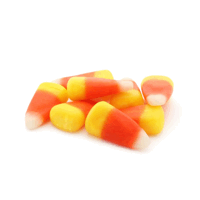 Do you let your kids create the memories of Trick-or-Treating but not the subsequent cavities from actually eating all that candy? A nationwide network of over 2,500 dentists will buy back your Halloween candy (usually for $1 per pound, up to 5 pounds) at
  The NY Times has a new essay called


 We are currently planning a 4-week European trip with our young children (age 1 and 3). The most common reactions are “Cool. Wait, you’re not bringing the kids, are you?” followed by “You’re nuts.” At first, we didn’t think it could be done either. It does take a lot of additional planning for car seats, cribs, kid-friendly itineraries, and so on.


 The Best Credit Card Bonus Offers – 2026
 Big List of Free Stocks from Brokerage Apps
 Best Interest Rates on Cash - 2026
 Free Credit Scores x 3 + Free Credit Monitoring
 Best No Fee 0% APR Balance Transfer Offers
 Little-Known Cellular Data Plans That Can Save Big Money
 How To Haggle Your Cable or Direct TV Bill
 Big List of Free Consumer Data Reports (Credit, Rent, Work)