Fidelity U.S. Bond Index Fund (FBIDX): Trying To Beat The Benchmark?

Since I am expanding my portfolio to beyond just IRAs and 401ks, I will need to move my more tax-inefficient investments like bonds into those tax-deferred accounts. This way, I’ll put more of my stocks in a plain taxable account which is taxed at the more favorable long-term capital gains rates.

Fidelity is my Solo 401k provider, so I was looking through their bond offerings. Their only bond index funds are the Fidelity U.S. Bond Index Fund (FBIDX) and essentially a US Treasury bond index fund with different maturity lengths. Looking at FBIDX, its benchmark is the Barclays Capital U.S. Aggregate Bond Index. This index covers the all US bonds on the market that are investment grade and taxable, including Treasuries, corporate bonds, and mortgage-backed and asset-backed securities.

This is basically the same benchmark index as the Vanguard Total Bond Market Index fund (VBMFX), which follows the Barclays Capital U.S. Aggregate Float Adjusted Bond Index. (ETF version is ticker BND.) The “float-adjusted” part just accounts for all those Fannie Mae bonds that are now owned by the government and thus not actually available on the market anymore. They should be the same, right? Nope.

A perk of being a financial blogger is companies give you free stuff to try, and Morningstar offered me a free 1-year subscription to their paid Morningstar Premium service which offers stock and mutual fund research. Being a mostly a low-cost index fund investor, most of their content didn’t really interest me. However, I started reading the FBIDX Analyst Report and was surprised. The teaser line was:

Although this fund is designed to track the Barclays Capital U.S. Aggregate Bond Index, it lagged that bogy by more than 3 percentage points from mid-2007 through the end of 2008.

Lagging a benchmark by 3 full percentage points is a lot in the index world. Passive investors want low costs and low tracking error from the target benchmark! That’s how we get our greater-than-average return over the long run. It turns out that Fidelity had been making “modest” bets outside of the index in order to juice their returns, including minor exposure to subprime mortgages through an “ultra-short” bond portfolio*. FBIDX costs more than VBMFX by about 0.12% a year, so they would always lag if all other things were equal, and needed to take such additional risks in order to have better performance numbers.

The report goes on to report that the fund hired a new manager in February 2009, who says he’ll run a tighter ship:

Since joining the fund in February 2009, he [lead manager Curt Hollingsworth] has taken steps to ensure that it will closely track its benchmark from month to month. He thinks actively run internal bond portfolios have no place in this passively run offering, which should reduce the chance of things going awry. He also pared the fund’s exposure to out-of-index bonds from 8% to just 2% of assets lately.

Well, that’s nice to hear, but too late for me. When I see “index” in the fund name, I expect it to match the benchmark, not try to beat it like everyone else. Thus, I’m most likely going to construct my portfolio out of Vanguard bond ETFs instead. My transaction size should be great enough to counteract the hit from each individual stock trade. (Read about the Vanguard ETF vs. mutual fund cost comparison tool.)

Sharebuilder – $50 Bonus, IRAs Get Free Trades During 2010

Sharebuilder has a new promotion offering free window trades for all of 2010 if you open an IRA with them before April 15th (1,500 max). These usually cost $4 each, $12/month for 6, or $20/month for 20. Thanks to reader Ron for the tip.

Open an IRA before 4/15/10 to receive 1,500 Automatic Investment Plan credits. The trade credits will be posted to your account the next business day and will expire on 12/31/10. This offer applies to Individual Retirement Accounts only. AIP credits for mutual fund purchases apply only after the minimum investment has been met.

It is important to note that these Automatic Investments are not real-time market/limit trades that most brokerages offer, but market orders that only execute in batches once a week on Tuesdays. In most cases, this is best suited for people gradually dollar-cost-averaging into ETFs or widely-traded stocks. If you want to do an ACAT transfer out, it will cost you $75.

For taxable accounts, Sharebuilder is offering a $50 cash bonus as long as you open a new account with $50 by April 16th with promo code 50WCFA. It doesn’t appear that you even need to make a trade.

You must open a new account with ShareBuilder and deposit at least $50 to be eligible for this promotion. Initial deposit must be completed by 4/16/10. ShareBuilder will deposit a $50 bonus approximately 4-6 weeks after your first $50 deposit. The $50 bonus offer is available for Individual, Joint and Custodial accounts only.

For more background, you can see my slightly-dated Sharebuilder review as well as a follow-up post on a possibly better way to invest with them.

15-Minute Resolution #5: Check the Asset Allocation of your Investment Portfolio

Here’s the next installment of my series on New Year’s Resolutions that can be done today, and not put off for “some day” in the future. We all know how that usually turns out…

Last year was definitely a roller coaster year when it came to the stock market, and you may have taken the “just don’t open the scary statements” solution. Well, it’s time to take a peek and see where you stand. I won’t pretend that recent performance has been great, but if you made regular contributions throughout, you may be surprised to see your portfolio balance higher than it was in 2007. (Maybe.)

Asset allocation is how your investments are split between different asset classes. The most generic examples are stocks and bonds, but you can also divide them further into categories like large companies vs. small companies, international vs. domestic stocks, or different safety grades of bonds. Other asset classes include real estate, commodities, or precious metals. Your mix of assets has a great impact on the volatility and expected future return of your portfolio.

The easiest way is gather all your most recent financial statements and plug your holdings into the Morningstar Instant X-Ray tool.

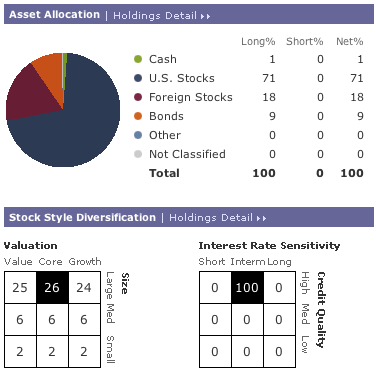
(If you want it to remember your portfolio, you must sign up for a free site membership.) The site will then “x-ray” your holdings and break it down by asset class:

How do I know if my asset allocation is correct?

Well, ideally you would already have set your target asset allocation, and all you would need to do is to rebalance your assets to that target. Rebalancing is a way to maintain the risk/reward balance that you have chosen for your investments, and also forces you to buy temporarily under-performing assets and sell over-performing assets (buy low, sell high). How often one should re-balance their portfolio depends on a few factors. See this post on How often should I rebalance my portfolio?

Otherwise, setting an asset allocation can be a very complex topic. I recently pondered a very general rule-of-thumb where you set your stock percentage to double your tolerable loss in one year. So if you could only stomach a 30% stock, you should only invest a maximum of 60% of your portfolio in stocks.

Here’s a big collection of my posts that I did when deciding on my own target asset allocation:

Simplified Theoretical Stuff

  1. Disclaimer and General Philosophy
  2. Consider Simply Buying The Entire Market
  3. Efficient Frontier and Modern Portfolio Theory

Choosing An Asset Allocation

  1. Deciding On The Stocks/Bonds Ratio
  2. Deciding On The Domestic/International Ratio
  3. Considering The Diversification Benefits Of Small and Value Stocks
  4. Equity Asset Allocation: Comparison of 8 Model Portfolios
  5. Investing In Real Estate Through REITs?
  6. Interim Target Asset Allocation: Looking Back & Some Decisions

…See the rest of my 2010 Instant New Year’s Resolutions here!

Marketing, Lies, and Scary 529 Investment Options

Let’s say you’ve dutifully opened up a 529 college savings plan for your child and are looking for a suitable investment options. You’re not looking for a miracle, just a conservative investment to grow your savings for a while since college is coming up fast. You read the brochure for one of the funds:

The OIM Core Plus Fixed Income strategy is rooted in the idea that individual security selection produces the best opportunity for risk-adjusted excess returns over time. Through an extensive, bottom-up research process, our portfolio management team focuses on optimal bond selection of investment grade corporate bonds, mortgage-backed securities, US Government Treasuries and taxable municipal bonds. The team employs a tightly controlled duration discipline and closely manages all portfolio risk factors. The portfolio management team’s objective is to produce predictable, consistent excess returns net of fees over the Barclay’s Capital Aggregate Bond Index.

Sounds pretty good, all the buzzwords are hit. Risk-adjusted excess returns. Predictable, consistent, yup. Beat the average! This reminds me of the Money Magazine Mad Libs game.

Fast forward a couple of years:

In the Illinois BrightStart 529 plan, the Oppenheimer Core Plus bond fund lost 38% of its value in 2008, while the fund’s benchmark actually rose 5.24%. How’s that for “excess” returns? It turns out the fund used leverage and invested in mortgage-linked securities. After a lawsuit, Oppenheimer settled for $77 million, which amounts to only half of the losses.

In the Oregon College Savings 529 Plan, the Oppenheimer Core Bond fund made up 10% to 40% of the popular automatic age-based portfolios for the 529 plans. The fund dropped roughly 35% in 2008. Oppenheimer settled for $20 million, which is about 57% of the losses. In the New Mexico 529 Plan – you guessed it – the same thing happened and they recently settled for $67 million.

This means that in 2008 Oppenheimer lost roughly $300 million of people’s college savings across just three states in a fund that was supposed to be very conservative and sold to those with children within 5 years of college. I would never invest in any Oppenheimer fund after reading this. Not only did they mislead their investors – if not outright lied – they only partially reimbursed them after being sued and faced with a huge jury penalty.

Stories like this to keep me happily investing in low-cost passively-managed bond funds which are satisfied to carefully track a set benchmark. You really never know what a manager is doing when trying to “beat the benchmark”. When it comes to bond funds, it is very very hard to do so without taking on more risk, especially when they have to overcome their own high fees.

Resources
Found via: Mish’s Economics Blog, CNN More Money Blog.
News articles: AP, Star-Tribune, Oregon 529 Press Release

Tolerable Loss = Half of Equity Allocation Percentage?

There a regular poster on the Bogleheads forum called Adrian Nenu who always posts the following, which is said to have origins with author Larry Swedroe.

Tolerable Loss x 2 = Equity Allocation < 50%

I don’t know if I agree with the last part that says that your equity position should always be less than 50%. However, the first part seems to offer a good rule of thumb when it comes to investing in a target date retirement fund.

Let’s say you have the Vanguard Target Retirement 2050 Fund (VFIFX) and it currently contains 90% stocks. Using this rule of thumb would mean that a possible one-year loss for such a fund is 45%. You should ask yourself – can you handle a 45% drop in the value of your retirement assets, even if you have 40 years before you need it? The good thing about living through 2008/2009 is that you probably have a better idea of the truth. If you’re going to run for cover in cash, only to buy back in later (like now) when prices are 50% higher, then that’s something to avoid.

One thing that I recommend to my more conservative friends who still want a simple investment is to simply buy a different “date”. For example, if you could purchase the Vanguard 2025 Fund (VTHRX) which has 75% in stocks. Who cares if the label is 2025. Meanwhile, I encourage them to continue to learn more about investing so that the can understand the risks trade-offs better and adjust their tolerances accordingly (up or down).

How Does Your Target Retirement Fund’s Glide Path Compare?

Inside this recent Morningstar article about the pros and cons of Fidelity’s Freedom Funds was an interesting chart that incorporated data from all of the target-date retirement funds. These funds were getting really popular as a set-and-forget type of investment, until many people found found out in 2009 that their risk tolerance didn’t necessarily mesh with the what the investment company thought it would be.

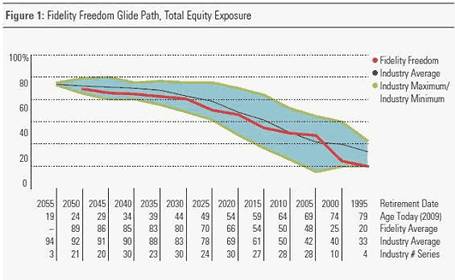
A fund’s “glide path” is how they shift their asset allocation to be more conservative as time goes on and they near the retirement target date. A very general way to measure this is to take the percentage of the fund invested in equities (stocks).

As you can see, there can be a significant variation between the industry maximums and minimums for each year. Fidelity’s fund tend to be near the average, perhaps a tiny bit below most of the time. I looked at Vanguard’s funds, and they are also very close to the average. TRP’s glide path is almost always above the average, but not by more than 5-10%.

You can see the specific glide path chart of other funds with a Morningstar Premium membership (see below). However, you can always use the free Instant X-Ray tool with the ticker symbols from your own series of funds and plot it yourself. How does yours compare?

This is just one component of what you should be looking at when choosing between fund choices, with other examples being cost (expense ratio?), equity breakdown (international exposure?), and bond breakdown (quality?). Of course, some of us are just stuck with one choice in our 401k/403b plans.

List of the 20 most popular target date funds:

* AllianceBernstein Retirement Strategies Target-Date Fund Series
* American Century LIVESTRONG Target-Date Fund Series
* American Funds Target Date Retirement Target-Date Fund Series
* DWS LifeCompass Target-Date Fund Series
* Fidelity Advisor Freedom Target-Date Fund Series
* Fidelity Freedom Target-Date Fund Series
* ING Solution Target-Date Fund Series
* John Hancock Lifecycle Target-Date Fund Series
* JPMorgan SmartRetirement Target-Date Fund Series
* MassMutual Select Destination Rtmt Target-Date Fund Series
* MFS Lifetime Target-Date Fund Series
* Oppenheimer Transition Target-Date Fund Series
* Principal LifeTime Series Target-Date Fund Series
* Putnam RetirementReady Target-Date Fund Series
* Schwab Target Target-Date Fund Series
* TIAA-CREF Lifecycle Target-Date Fund Series
* T. Rowe Price Retirement Target-Date Fund Series
* Vanguard Target Retirement Target-Date Fund Series
* Vantagepoint Milestone Target-Date Fund Series
* Wells Fargo Advantage DJ Target-Date Fund Series

Fidelity Cuts 529 Plan Fees, Changes Age-Based Asset Allocations

On December 1st, Fidelity Investments made significant reductions to the management fees on the 529 college savings plans that they manage. From this AP article:
Fees on indexed plans will be cut in half, while fees on actively managed and advisor-sold plans will be cut by a third, the firm said. Fidelity manages plans sold in Arizona, California, Delaware, Massachusetts and New Hampshire.

The changes mean a family with $50,000 in an indexed portfolio might now pay $125 a year in fees, instead of $250, assuming the amount in the plan remained unchanged. […]

Fidelity, which is based in Boston, said total fees for its direct-sold indexed portfolios will now range from 0.25 percent to 0.35 percent of assets. Total fees for actively managed plans will now range from 0.59 percent to 1.04 percent of assets.

Here is a PDF of their current expense ratios for their active and passive investment options.

According to this WSJ article, they’ll also be changing up their age-based asset allocations a bit:

Fidelity also said it plans to increase the international equity exposure in both its direct- and advisor-sold plans’ age-based portfolios to 30% of the overall equity allocation from a current range of 0 to 20%, and plans to add an emerging-markets fund to its age-based portfolios.

Both changes will be phased in over the next 12 to 18 months.

The reason for this is hardly altruistic, as Fidelity is a privately-held for-profit company. They needed to do this in order to stay competitive. The only reason I have 529 fund at Fidelity is that I have had it connected to their 2% back credit card. I’m still happy with the change though, which follows their recent addition of index fund options back in August 2009.

Despite these improvements, I still plan on shifting everything eventually to my account at the Ohio CollegeAdvantage 529 Plan, which offers inflation-protected bonds (TIPS) at a very low expense which I think are a great “safe” option for saving up for college. (They also offer a variety of low-priced index options from Vanguard.) Fidelity has no such TIPS option.

Also, until December 15th (soon!), they are still running a promotion where you can get $25 for signing up, $50 for referring others, and $25 for starting up automatic deposits. (A couple could earn $150 free for their kid’s education this way.) If you need it, my CollegeAdvantage referral code is 2439350.

Monthly Net Worth & Goals Update – December 2009

Net Worth Chart 2009

Wow, December already…

Credit Card Debt
Up until now, I have taken money from credit cards at 0% APR and placed it into online savings accounts, bank CDs, or savings bonds that earn up to 4-5% interest (less recently), and keeping the difference as profit. However, given the current lack of good no fee 0% APR balance transfer offers , I am no longer playing this “game”. The balance that you do see is either before the end of the statement or during the grace period, where I’m also not paying any interest.

Retirement and Brokerage accounts
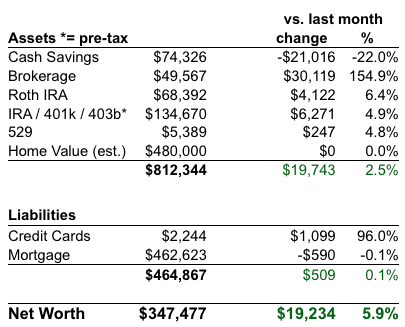
Mrs. MMB and I have both maxed out our 401k salary deferrals for 2009. We have also started to invest in regular taxable accounts by investing $30,000 that was previously being held as cash. I’ll outline the trade activity in an upcoming portfolio update.

Our total retirement portfolio is now $231,368 or on an estimated after-tax basis, $191,475. At a theoretical 4% withdrawal rate, this would provide $638 per month in after-tax retirement income, which brings me to 26% of my long-term goal of $2,500 per month.

We are also getting ready for a Traditional-to-Roth conversion once the income limits are removed in 2010. We’ll need to gather up some information in order to see how much tax we owe on any gains. More details on this to come.

Cash Savings and Emergency Funds
We keep a year’s worth of expenses in our emergency fund. Potential large expenses include $10,000 for home improvement projects (minor roof repair and solar water heating), as well as $15,000-$20,000 on a new car to replace our 1995 Nissan. Hope it can last us 15 years as well!

Home Value
I am no longer using any internet home valuation tools to track home value. Some people have suggested using my tax assessed value, but I also think that is too high. I simply picked what I felt is a conservative number based on recent comparables, $480,000, and keep it for at least 6 months if not a year. (Currently on month 3 out of 6.) For the most part I am concerned about mortgage payoff, which I still plan to accomplish in 20 years at most.

You can view previous net worth updates here.

David Swensen’s Updated Model Asset Allocation

If you don’t know the name David Swensen, he is an investment manager who is best know for managing Yale Universities huge endowment. What makes him interesting is that even though he does invest in some hedge funds and private equity, he doesn’t believe that the common investor should try to emulate this. An excerpt from a recent interview in the Yale Alumni Magazine sums it up:

That’s why the most sensible approach is to come up with specific asset allocation targets that you can implement with low-cost, passively managed index funds and rebalance regularly. You’ll end up beating the overwhelming majority of participants in the financial markets.

In his 2005 book Unconventional Success: A Fundamental Approach to Personal Investment, he proposed a model asset allocation using what he believes are the 6 “core asset classes” that an individual investor should own:

Unconventional Success Model Portfolio Breakdown

Asset Allocation For 70% Stocks/30% Bonds (with ETF examples)
30% Domestic Equity (VTI, IYY)
15% Foreign Developed Equity (EFA, VEA)
5% Emerging Markets (VWO, EEM)
20% Real Estate (VNQ, ICF)
15% U.S. Treasury Bonds (SHY, IEF)
15% Inflation-Protected Securities (TIP, IPE)

But in the Yale interview, he proposes a slight change that reduced real estate exposure in exchange for increased emerging markets holdings:

Today, Swensen says, economic conditions might call for a modest revision. He now recommends that investors have 15 percent of their assets in real estate investment trusts, and raise their investment in emerging-market stock funds to 10 percent.

This interview was printed in March/April 2009, so I’m not sure if you could call this performance chasing or not. I don’t follow his model asset allocation exactly anyway – I think the best idea is to read his excellent book and find out his reasoning for holding each asset class. The exact weightings you can hash out later. It definitely added another dimension to my investing views.

Berkshire Hathaway Stock Split, S&P 500, & Index Funds

Berkshire Hathaway’s (BRK) recent announcement that it was buying railroad Burlington Northern Santa Fe (BNI) also included a provision for a 50-for-1 stock split of B shares so that smaller shareholders of BNI would be able to be converted to Berkshire shares and avoid capital gains. Warren Buffett has been trying to avoid this for years, so after some random web surfing — I mean… research, I figured I’d share my findings.

At the end of trading yesterday 11/18, Berkshire’s A shares currently cost $103,100 apiece and B shares were $3,430. After a 50-to-1 split, a B share would cost about $69. Several news articles are talking about how this brings the share price down to the “common man”. For a $69 investment, you should able to attend the Berkshire Hathaway Annual Meeting in Omaha this May, although you could also buy tickets for $5 on eBay directly from BRK.

But wait, you may already own a piece of Berkshire… or you may soon.

S&P 500
Right now, Berkshire Hathaway is not part of the S&P 500. Many folks (including me in the past) thought the S&P 500 was simply the largest 500 companies in the US, but not quite. I’ve read that BRK is likely excluded due to inadequate trading volume of their high-priced shares. If the stock split occurs, it is possible that BRK will become part of the S&P 500 and thus be bought by every S&P 500 index fund out there. I’m sure Wall Street traders have already begun the speculating.

As of 1/18, the market cap of BRK was roughly $160 Billion. Looking at this chart of S&P 500 components sorted by size, BRK would actually be #9 on that list, as it is worth more than even Chevron or AT&T. If included, BRK would constitute about 1.65% of the index.

Total Stock Market
However, you may already own a piece of Berkshire if you own part of a mutual fund that tracks an index following the “total” US stock market. For example there’s the Vanguard Total Stock Market Index Fund (VTSMX), which is held within all of the Vanguard Target Retirement Funds. By my rough calculations, BRK is approximately 1.3% of the broad US market. So for every $10,000 of VTSMX or VTI you hold, you own $130 of BRK already.

Sharebuilder
Of course, for years now you could own $1 or $50 or $500 of BRKB by buying partial shares of BRKB through Sharebuilder ($50 bonus). You wouldn’t want to go too small as the $1 to $4 commission would take too big a bite, but it can be one way to gradually accumulate BRK shares. I think I have about $45 worth right now, myself, mainly due to an opening bonus.

LendingClub Offers No-Fee IRA

Speaking of LendingClub, I saw that they now offer a IRA with no opening fees and no annual maintenance fees. Previously, there was a $250 annual fee. However, it does now require an increased $15,000 minimum opening balance, which essentially restricts it to a 401k rollover or the transfer of existing IRA funds.

Since P2P loan interest is taxed at ordinary income rates like interest from savings accounts, the ability to place them in a tax-deferred account is attractive. But since person-to-person lending is such a new asset class, I would hesitate to make it larger than say 5% of my portfolio, which would require a total portfolio size of $300,000. So, I’m out.

It is interesting that the custodian EntrustCAMA allows a lot of options in their Self-Directed IRAs like holding physical precious metals, investing in private small businesses, and investing directly in real estate. I’m not sure if you can only hold LC notes in this free IRA.

Human Capital: Are You a Stock or a Bond?

Over at Bogleheads there was an interesting thread which explored how finance professor Moshe Milevsky has been pushing the concept of human capital as an additional variable to the traditional ideas of net worth, portfolio construction, and asset allocation. These are explored in this this trade magazine article for financial advisors, this draft academic paper, and also in his book Are You a Stock or a Bond?.

Human Capital
There are some differing definitions, but below is a brief explanation (taken from the magazine article above) of what is meant by human capital here:

Human capital is a measure of the present value of your client’s future wages, income and salary (net of any future income taxes and expenses). For example, if she is a doctor, lawyer, engineer or even a professor, she has probably invested an enormous amount of time, effort and money to finance her education. That investment will hopefully pay off over many future years of productive labour income in the form of job dividends over the next 10, 20 or even 30 years. Sure, clients can’t really touch, feel or see human capital, but like an oil reserve deep under the sands of Alberta, it will eventually be extracted and so it’s definitely worth something now.

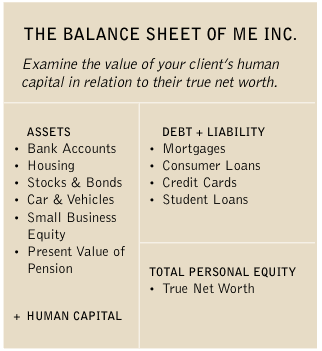
Milevsky likes to talk about people as businesses and thus includes human capital on the balance sheet of “Me, Inc.”:

When you’re young, your human capital may very well dwarf your 401k balance. With this in mind, it may make you feel better about any short-term losses.

Your human capital can be viewed as a hedge against the losses in your financial capital. So, as a 50-, 40-, or especially 30-year old, you should be willing to take more chances with your total portfolio, perhaps even borrow to invest or leverage into the stock market, because you have the ability to mine more human capital if needed.

Am I a Stock or a Bond?
One characteristic of your human capital to think about is if it tends to act like a stock or a bond. As a tenured university professor, Milevsky offers himself up as a good example of a bond that offers a reliable and steady coupon (paycheck). However, an small business owner, investment banker, or even a car salesman would have an income that is much more correlated with current economic conditions – much like a stock would.

A common piece of advice that relates to this is when people are told not to hold too much of their employer’s company’s stock (often in 401k plans). Since your salary is already tied to that company, it would be wise to add some diversification so that all your eggs aren’t in one basket.

Along the same diversification argument, if you are a “bond” then you may be able to take more equity risk in your retirement portfolio. On the other hand, if you are a “stock” then you may want to reduce your exposure to stock market swings. “Your invested assets should zig when your salary zags… tilt your financial portfolio away from your human capital.”

Thoughts
Unfortunately, rarely are things so simple. Human capital is at best a guess of the future, and you could be really far off. And just because your income isn’t tied to the stock market, doesn’t necessarily mean you can stomach the swings of a highly risky portfolio. If you’re the type to panic and sell at the bottom, perhaps increasing stocks would only hurt your long-term investment returns.

I like to imagine a good financial couple as one that pairs up a stock and bond. Perhaps one person holds a steady government job with a pension and healthcare benefits into retirement, while the other is an entrepreneur that takes some risks and tries to strike it big.

Also, what if I don’t want take advantage of all my human capital? Sure I could work for another 35 years and consider a big chunk of human capital in my net worth, but I’d really rather not. 🙂

What do you think of this concept?