Creating a Completely Automated Financial Household

Meet Bill and Jan. They are my imaginary couple that loves putting their personal finances on auto-pilot. They don’t worry about bill due dates, they never visit the bank, and only check their balances online once a month if there are no e-mail alerts sent to them. (Apparently they also don’t have lips or eyes, so it works well for them…) Let’s take a look at how they do it!

Income
Bill and Jan both elected to receive their regular income via direct deposit, so there are no checks to deposit. Even though Jan does some freelancing, she gets paid via PayPal, which she sets to automatically sweep any money into their bank account at the end of each business day. This feature is called Auto Sweep and is not heavily advertised, you must contact PayPal directly to enable it.

Long-Term Savings
Like everyone else, their 401(k) plans are funded via an automatic deferral each payday. For their Roth IRA, they simply take out $500 per month via an automatic transfer from their checking account for 10 months, which can be set up easily at Vanguard.com or any other major mutual fund provider. If you like individual stocks or ETFs, try automatic investing at ShareBuilder.

Short-Term Savings
For their annual vacation and other savings goals, they have an automatic transfer from their checking to an online savings account like the original Capital One Consumer Bank.

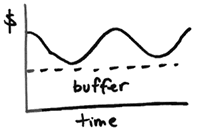
They do keep a certain buffer amount in their checking account, similar to this simple budgeting method. If the balance falls too low for any reason, an e-mail and text message alert are sent to both of them.
Housing
If they had a mortgage, most lenders will happily set up an automatic ACH from bank account each month. If they wanted to set up a biweekly payment plan and it isn’t free, they could simply take out 1/12th of their monthly mortgage payment each month automatically into Capital One 360. Once a year, they send one full mortgage payment to their lender.

If they rented, they would set their Online Billpay service to send a snail-mail check automatically each month and deduct the amount from the bank account.

Utilities
Most utility companies will allow to you sign up for them to automatically withdraw the full bill amount from your bank account. Contact them directly, and when available use your credit card to earn some extra rewards.

Insurance
Instead of dealing with large payments either annually or semi-annually, they have signed up for State Farm Payment Plan (SFPP), which groups their insurance premiums and divides them into one single monthly payment which is taken from their bank account. Check with your insurer to see if they have something similar.

Credit Card Bills
Most large credit cards issuers allow you to sign up a service like Citi’s AutoPay, where you can have the full amount sucked out of your bank account each month. Since the Citi Forward Card gives you 5x rewards on restaurants and Amazon.com, this most of their disposable income as well. To find it, go to CitiCards.com> (Login) > Payments Tab > Enroll in AutoPay.
What else?
With all this set up, all Bill and Jan have to do is show up for work and spend their money wisely. Is there anything else that could make their life even more easy? I thought about using an online grocery store like Peapod, where you can access past orders and possibly create default orders which you only tweak slightly each month.

Personal Rates of Return: Money Weighted vs. Time Weighted

There was a good question in my last retirement portfolio update about how my personal rate of return was 41% YTD, which was actually higher than any individual mutual fund in my portfolio*. The reason for this is mainly due to terminology, which can be especially confusing since the definitions seem to have shifted with time.

The two primary types are money-weighted and time-weighted returns, listed below with commonly associated names. Both have been called “personal rates of return” in the past.

Time-Weighted Returns Money-Weighted Returns
Reported returns
Portfolio returns
Investment returns
Geometric mean return
Dollar-weighted returns
Internal Rate of Return (IRR)

Time-Weighted Return Details
This methodology does not account for any cash inflows or outflows. In a way, finding your return using this method assumes that you don’t make any transactions at all. For a year-to-date calculation, it’s the same as asking how $100 invested on January 1st would end up today.

My favorite term for this method is Investment Return, because it essentially tracks the performance of your investments, and nothing else. If you have 30% US Stocks, 30% International Stocks, 30% Bonds, and 10% Orange Juice Futures, such a set of investments will have a unique performance from January 1st until today. Along the same lines, this time-weighted performance is what you get when looking up the total returns of a specific mutual fund (example). This also makes it easy to compare to a benchmark, such as the S&P 500 Index.

Money-Weighted Return Details
This methodology does account the size and timing of any cash inflows or outflows into your portfolio. Here’s an example of the difference. In your brokerage statements, look for any reference to accounting for “deposits and withdrawals”. Below is a chart of the S&P 500 index for all of 2009. Let’s say you started with $10,000 invested in the S&P 500 on January 1st. Then in early April before the tax deadline, you hurry and purchase $5,000 more worth.

As you might imagine, your $5,000 inflow was some good timing, and the performance of that money is a lot better (+25%) than the performance of your $10,000 from January 1st (+17%). If you managed to get your money in around March 9th, the return of that money year-to-date would be over 50%.

I prefer to call this methodology the Personal Rate of Return because it is truly personal. It is unlikely that any people have the exact same transaction amounts and dates as you. However, while this number may seem more accurate, it’s harder to compare against a benchmark and use for future investment decisions. As seen above, luck in the timing of your investments can swing the numbers either way.

I have an older post on how to calculate this dollar-weighted rate of return, but the Zohosheets aren’t displaying ideally right now. You can click on “Full Screen View” or try this page instead if you have Excel and the XIRR function installed.

What method do major investment firms use?
When Fidelity first started including “personal rate of return” in people’s 401(k) statements, it was a time-weighted rate of return. According to this 2000 LA Times article, Fidelity thought it was more appropriate to allow comparisons to published mutual fund numbers. At that same time, a spokesperson from Vanguard thought investors would be too confused either way, so they published nothing:

“We have several reservations about such reporting,” says Vanguard Group spokesman John Woerth. “Among them: Personal returns and fund returns are likely to differ, and perhaps substantially, which could confuse–even mislead–investors.”

How about today? When I checked my statements, both Fidelity and Vanguard use the money-weighted method for their “personal rate of return”. Our other 401(k) provider did as well, so it seems like things are shifting. I guess Vanguard thinks we’re smart enough to see the number now. 😉 In the end, as long as you understand the differences, I think both stats can be useful.

* This is mostly true, but actually my small allocation to an Emerging Markets fund (VEIEX) is up 60% YTD.

2009 Q3 Investment Portfolio Update – 9/21/09

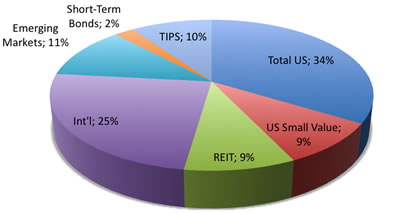
2009 Q3 Portfolio Breakdown
 
Retirement Portfolio Actual Target
Asset Class / Fund % %
Broad US Stock Market ($64,794) 33.8% 34%
VTSMX – Vanguard Total Stock Market Index Fund
DISFX – Diversified Stock Index Institutional Fund*
FSEMX – Fidelity Spartan Extended Market Index Fund*
US Small-Cap Value ($17,554) 9.1% 8.5%
VISVX – Vanguard Small Cap Value Index Fund
Real Estate (REITs) $18,004 9.4% 8.5%
VGSIX – Vanguard REIT Index Fund
Broad International Developed $46,820 24.4% 25.5%
FSIIX – Fidelity Spartan International Index Fund*
International Emerging Markets $21,678 11.3% 8.5%
VEIEX – Vanguard Emerging Markets Stock Index Fund
Bonds – Short-Term $4,484 2.3% 3.8%
VFISX – Vanguard Short-Term Treasury Fund
Bonds – Inflation-Indexed $18,568 9.7% 11.3%
VIPSX – Vanguard Inflation-Protected Securities Fund
Total Portfolio Value $191,902
* denotes 401(k) holding given limited investment options.

Like many others, for most of this year I’ve just been trying to keep my head down, make my regular stock contributions like a good boy, and not looking at my statement balances too much! There’s been a lot of “wow, my portfolio isn’t so bad anymore” talk due to the recent market run, so I figured it was time for a checkup. You know of course, that this also means the market will tank today… 🙂

Contribution Details
So far in 2009, we have made the following contributions:

  • $5,000 x 2 for 2008 non-deductible IRA contributions
  • $5,000 x 2 for 2009 IRA contributions
  • $33,052 for both of our 401k contributions, including salary deferral and company match. One is maxed out, the other has a little left to go.

2009 Performance
In my last update back in April, I had found our year-to-date performance to be about -15%. According to my spreadsheet, the 2009 year-to-date dollar-weighted performance of our personal portfolio is now 41% YTD.

For reference, the Vanguard S&P 500 Fund (VFINX) has returned 20.52% YTD, their FTSE All World Ex-US fund (VFWIX) has returned 35.72% YTD, and their Total Bond Index fund (VBMFX) is 5.11% YTD as of 9/18/09. The Vanguard Target 2045 Fund (VTIVX) has returned 23.4% YTD, which as a similar stock/bond breakdown to our portfolio, but less international exposure. Part of the good relative performance (which was previously relatively poor) is also likely due due to the timing of my large lump-sum investments.

Investment Changes
We have used our new contributions to keep us close to our asset allocation target, with a 85% stocks/15% bonds split. Right now, we are not too far off. The target percentages for each asset class are shown above as well. Currently, with the run-up in equities, we are a bit underweight in bonds.

You can view all my previous portfolio snapshots here.

Efficient Market Hypothesis and Supermarket Lines

I ran across another nice tidbit from the book The Undercover Economist by Tim Harford the other day, which like the concept of price targeting, also manages to involve supermarkets. I guess everyone goes to supermarkets. 🙂

In a chapter exploring stock market pricing, he covers the the idea of rational investors, the “efficient market theory”, and the related “random walk hypothesis”.

You can see the same phenomenon at work at the supermarket checkout. Which line is the quickest? The simple answer is that it’s just not worth worrying about. If it was obvious which line was the quickest, people would already have joined it, and it wouldn’t be the quickest any more. Stand in any line and don’t worry about it. Yet if people really just stood in any line, then there would be predictable patterns that an expert shopper could exploit; for example, if people start at the entrance and work their way across the store, the shortest line should be back near the entrance. But if enough experts knew that, it wouldn’t be the shortest any more.

The truth is that busy, smart, agile, and experienced shoppers are a bit better at calling the fastest lines and can probably average a quicker time than the rest of us. But not by much.

To me, this is a nice and simple way to explain the argument of efficient markets to say, a fifth-grader. If the market price of a stock was a lot lower than the “true” value, people would start buying, and soon the market value would equal true value. Even someone that young can appreciate trying to pick the shortest line, weighing the possibility of getting through quicker with the possibility of ending up actually waiting longer than if I had just stayed put. In the end, how much do you really gain on average?

Relative Efficiency

I would expand this analogy a bit further, however. In the stock market, if you can reliably “beat” the average person by just a few percentage points a year, you would become rich. Really rich. In the supermarket, the prize is a few extra minutes. I think people would agree that a lot more people around the world are trying a lot harder to get rich, than people are trying to get through the supermarket line. In the stock market, you’re trading against professional arbitrageurs and some supercomputer programmed by a genius hired by Goldman Sachs.

Imagine a supermarket full of world-class athletes connected via radio to spotters placed above each checkout line! This constant competition increases the “efficiency” of the market, and therefore makes it much harder to be above average.

Switching Costs

Despite the slight chance of improvement, I still like to try and find the shortest line at the supermarket. But what if I had to pay 50 cents every time I switched lines? I’d probably stay put.

This is similar to what happens when you try and actively trade the stock market. An actively managed mutual fund will cost nearly a full 1% of your total assets a year, while a passive index fund will be around 1/5th that cost (0.20%). Over time, that really adds up. If you do it yourself, you’re also looking at stock commissions. If you spent $10 a trade and bought $500 of a single stock a month, that’s a 2% hit for a buy, and 4% round-trip. High costs are the primary reason why you always hear that actively managed funds don’t outperform index funds.

In the land of investing, you can keep trying to pick the fastest line, but be realistic about the competition and watchful of your costs. By “staying put” with low-cost mutual funds, you’re guaranteed to be above average.

Ohio CollegeAdvantage $25 Systematic Savings Incentive

Along with the $25 “Refer a Friend” bonus for new members (possibly more if you have more than one child), the Ohio CollegeAdvantage 529 plan is giving out an additional $25 “Systematic Savings Incentive” if you start a new automatic transfer from your bank account or payroll deduction. Here is the fine print, but the major points are below.

To earn the $25 bonus, the electronic funds transfer (EFT) or payroll deduction must be started between September 1, 2009 and January 31, 2010. The bonus will be applied to your CollegeAdvantage account 90 days after you start the EFT or payroll deduction and meet the following requirements:

  • A minimum of $25 must be deducted per month.
  • The EFT and payroll deduction must still be active at the 90-day mark.
  • For EFT only, a minimum of three EFT pulls must have occurred within the 90 days.
  • For payroll deduction only, at least one payroll check must be applied within the 90 days.

Got two 529 contributors? You can get $50:

More than one Systematic Savings Incentive bonus may be awarded per account in the case where the Account Owner and other Contributors sign up for a recurring EFT or payroll deduction for the same account. For example, the Account Owner could start a recurring EFT and the spouse could also start a recurring EFT or payroll deduction as a Contributor for the same account. In that case, the account would receive a total of $50 if all other criteria for the bonus are met.

If you are like me and already have an automatic transfer in place:

CollegeAdvantage direct accounts with a current recurring EFT or payroll deduction are eligible for the bonus offer if a “new” recurring EFT or payroll deduction is started for the Account by either the Account Owner or Contributor, provided they are not the party currently responsible for the current recurring EFT or payroll deduction. For example, if the current recurring EFT was established by the Account Owner, a Contributor could also start a recurring EFT or payroll deduction and potentially qualify for the bonus as a “new” recurring EFT or payroll deduction. In this case a $25 bonus would be applied for the new recurring EFT or payroll deduction. The Systematic Savings Incentive bonus is intended to reward new systematic savers. The account will not qualify for the bonus if a current recurring EFT or payroll deduction is stopped and a new one started between September 1, 2009 and January 31, 2010.

By this, I read that my wife could start contributing an automatic amount as well, and we could get one $25 bonus. However, stopping and re-starting an existing automatic transfer won’t work.

Lending Club Investors $25 + $2,500 Giveaway

Last month, peer-to-peer lending website LendingClub reached $50 million in issued loans. This month, they are expected to get their 25,000th registered investor, and are going to give that lucky lender $2,500 cash. The rules:

* To enter the contest simply open a free investing account by completing all three steps of the investor registration process: create a password, verify your identity and link your bank account
* No purchase is necessary to win
* The winner will be announced after October 31, 2009

$25 New Lender Bonus
In addition, you can still use this special $25 lender sign-up link to get a free $25 to try it out with no future obligation. There is no credit check and you don’t even have to deposit anything. After you are approved, the $25 will show up in your account balance, and you can lend it out immediately. You must reside in a state that allows such investments.

Want to learn more? See my previous posts on LendingClub. I’ve invested in everything from someone’s $38,000 house to a taiko drumming training center.

Insider Trading Activity vs. S&P 500

If you’re a corporate “insider” such as an officer, director, or other certain employees, your purchases and sales of stock must be reported to the SEC in order to reduce illegal insider trading. Technically, an insider is not supposed to trade if they have “material nonpublic information” when making the purchase or sale. But still, who would know better?

Therefore, it’s interesting to see how insider trading activity as a whole by comparing the amount of shares being bought and sold during all this volatility, and then compare that with the market. See the graph below compiled in this CNN Money article:

Insiders loaded up overall during the panicky months of February and March, and then seemed to sell off a bit in happy August. I wouldn’t necessarily base future trades on this relationship, but it is definitely food for thought!

Ohio CollegeAdvantage 529 Plan: Free $25 Starter Bonus

The Ohio CollegeAdvantage 529 Savings Plan is again offering a $25 refer-a-friend bonus if you open an account and deposit at least $25 by December 15, 2009. You can be a resident of any state, and there are no application or annual fees.

Rated a Top 529 Plan by Morningstar
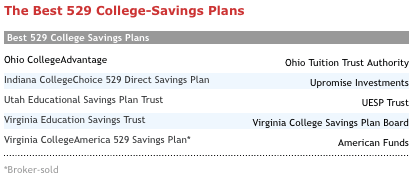
In a recent article The Best and Worst 529 College-Savings Plans by Morningstar, the Ohio CollegeAdvantage plan was rated in the top 5 plans:

Features they liked included having a wide variety of investment options (including active/passive, multiple age-based options, and even ultra-safe CDs), as well as low total expenses. In-state resident can also deduct up to $2,000 of contributions per year, with excess carryover allowed.

My Personal Experience
So far, I am quite impressed with the Ohio plan. The website itself is functional and fast, there are a variety of investment choices (cash, index funds, active funds), they are upfront with the fees, and the expenses are very competitive – either the lowest or near the lowest in the nation. There are no inactivity fees, minimum balance fees, or other bogus fees. The only bad thing I can think of is that every time I make a purchase I get a snail-mail confirmation with no paperless option, which seems wasteful.

I have gotten the $25 bonuses plus several referrals, with no complaints from the people I referred. I have also started an auto-debit from my checking account for $50 a month. Right now, half of my 529 is in the Vanguard inflation-protected bond fund. This is an investment option that is unavailable in most state plans. I feel that since college is only at most 18 years away with a big lump-sum payment, I would prefer less volatility while marching towards that goal. This is in contrast to saving for retirement, where I currently have 35 years until I turn 65, and hopefully another 20 years after that as well.

Referral Bonus Instructions
Currently the newly referred person gets $25, and the referring person gets $50, and I’d love for you to help fund my kid’s college dreams. 😀 Here’s how:

  1. You can enroll online or via mail. The online process was quick and easy, and I didn’t have to mail in anything.
  2. The first step is to input your personal info and choose a login/password. Next, you’ll verify your e-mail and complete the application.
  3. After that, you’ll choose your funding amount and select an investment fund. Your initial deposit must be a least $25, and is funded using the account/routing numbers of your bank account. At the bottom, you will need to enter a referral code to get the bonus. Enter *.
  4. In 1-3 days, your initial deposit will be taken from your bank account, and in 5-7 business days you will get your $25 bonus. The $25 will be deposited directly into the 529 account, and will be invested in the same thing as your initial deposit.

If a child has two parents, one parent may sign-up and then refer the 2nd parent to get another bonus, while both can list the same child as the beneficiary. If your child is not born yet or does not have a Social Security number yet, you can choose yourself or another family member as the beneficiary, and then later on fill out a Change of Beneficiary form.

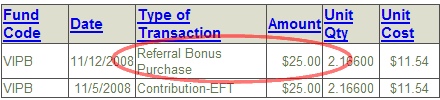
Here is a screenshot of me getting my $25 bonus successfully and as promised:

* Javascript is required. If you can’t see any numbers, please use 2439350.

Investing in California Municipal Bonds?

Recently, I’ve been taking another look at investing in California municipal bonds. Even if you don’t live in California, the yields can be quite attractive. But is it a good idea?
Tax-Equivalent Yields
Right now, the Vanguard California Intermediate-Term Tax-Exempt Fund (VCAIX) has a yield of 3.49% with an average maturity of 7 years. In addition, since the interest from this fund is exempt from both federal and California state income taxes, the equivalent taxable yield is actually much higher. You can use a tax-equivalent yield calculator to find out how it works out for your tax brackets.

If you are in the 33% federal tax bracket and 9.3% CA bracket, that 3.49% would be the same as a taxable bond yielding 5.74%. Even for an out-of-state investor, the federal tax exemption alone gets you to 5.21%, which is higher than many mortgage interest rates.

If you are in the 25% federal tax bracket and 9.3% CA bracket, that 3.49% would be the same as a taxable bond yielding 5.13%. For an out-of-state investor, the equivalent yield is 4.65%. As you can see, these yields are definitely more attractive for those in higher tax brackets.

Safety Concerns
Is this reckless rate chasing? Let’s look at a few articles on California munis by Vanguard, Schwab, and Fidelity. Here are some highlights:

  • You’re nearly first in line. California’s constitution requires that state general-obligation bond payments take priority over other payments except for those that fund education. This means as a bondholder you’re ahead of other government employees, firefighters, and basically everyone else.
  • Diversify. If you do invest, don’t make it all of your portfolio. There is still some risk. You can still hold other national muni funds, US. Treasury bonds, and investment-grade corporate bonds.
  • Buy a bond fund. I would invest in a managed municipal fund and not in individual securities unless I was very experienced. You don’t want to have to navigate a minefield of call risk, GO bonds, bonds based on sales tax revenue vs. utility fees, and other tricky details.

Holding Period Concerns
It’s important to note the maturity and duration of the bonds you’re buying, because if you have to sell sooner than the average maturity, you’ll be greatly exposed to price volatility. For example, if California’s credit rating drops further, then the current market value of the bonds you buy will also drop. If you sell early, you’ll have to take a loss. However, if you are able to hold a bond until maturity, you’ll still get the fixed yield and the principal back, so it won’t affect you.

Also, if you sell early and the bond value has increased, you may be subject to capital gains taxes from which you are not exempt.

My Personal Opinions
I’ve been keeping track of all the ways the state of California has been trying to manage this budget shortfall, and it is clear they are ready to take some very drastic steps to cut expenses. In any event, I fail to see how the U.S. government would not bail out California if things got really bad. If private corporations can get bailed out, why not a state full of voters? I’m not alone, however, as these bonds have been rallying as of late.

I am thinking of investing in California municipal bonds for a very specific scenario: I would buy them instead of paying down my mortgage further, as the tax-equivalent interest rate from the bonds is actually higher than my (tax-deductible) mortgage interest rate. This way, I both come out ahead in terms of interest and I have good liquidity if I wish to access the money for some reason. I also don’t see myself as taking too much extra risk, as I would with a stock fund for example.

Monthly Net Worth Update – September 2009

Net Worth Chart 2009

Credit Card Debt
For newer readers, I have taken money from credit cards at 0% APR and placed it into online savings accounts, bank CDs, or savings bonds that earn 4-5% interest (much less recently), and keeping the difference as profit. I even put together a series of step-by-step posts on how to make money off of credit cards in this way. However, given the current lack of great no fee 0% APR balance transfer offers, I am mostly waiting on existing offers to end.

Retirement and Brokerage accounts
Not much stock market movement this past month. Wife’s 401k was already maxed out at $16,500 for 2009. I made another $5,000 contribution to my Solo 401k, for a total of $10,000 contributed in 2009. This makes us about 80% done with our goal of maxing out both our 401k salary contributions for 2009.

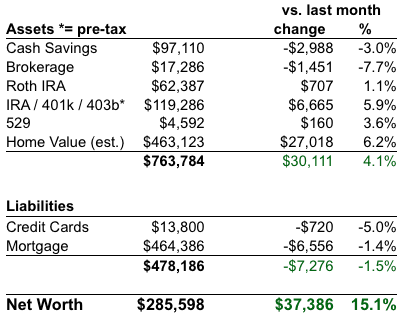
Our total retirement portfolio is now $181,673, or on an estimated after-tax basis, $145,887. At a 4% withdrawal rate, this would provide $486 per month in tax-free retirement income, which brings me to 22% of my long-term goal of $2,500 per month.

Cash Savings and Emergency Funds
I did pay an additional $6,000 towards my mortgage this month, which ate up a lot of cash. This is roughly two extra mortgage payments, which if I do this every year will put me on track to shorten my 30 year mortgage to 20 years. Depending on interest rates, future contributions may be invested into municipal or government bonds.

We still have a little over a year’s worth of expenses in our emergency fund.

Home Value
Using four different internet valuation tools – Zillow, Cyberhomes, Coldwell Banker, and Bank of America (old version) – I again took the average and took off 5% to be conservative and 6% for real estate agent commissions. This ended up giving me a 6% value increase this month, which again makes my home value movements dwarf all other activity for this net worth measurement.

I’ve been using these internet tools for 10 months now, and while I like being able to track the overall trend in home values, the wide swings in estimates make me very skeptical of their accuracy. I expect to do this for another 2 months so that I have an entire year of data, but after that I will switch to another less volatile method.

You can view previous net worth updates here.

Should You Keep Your Emergency Fund In Your 401k?

Before you jump to an answer or nasty comment, please give me a chance to elaborate. 🙂 Recently, I ran across an interesting article in the Bogleheads Wiki titled Placing Cash Needs in a Tax-Advantaged Account. Essentially, because of the way the U.S. tax code works it can often be better to keep certain asset classes like cash inside tax-advantaged accounts like IRAs and 401ks. Therefore, if your emergency fund is cash, why not put it inside as well?

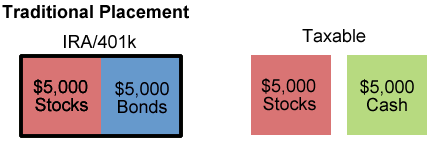
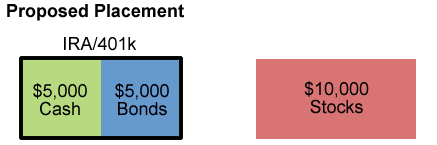
I’ll use the example given. Let’s say you have a 401(k) with a balance of $10k and also taxable assets of $10k, for $20,000 total. You choose to have $10k in stocks, $5k in bonds, and $5k in cash for your emergency account. The “traditional” placement for an emergency fund is in your regular taxable account, perhaps in a bank savings account. The rest of the assets are distributed according to this tax-efficient placement chart.

However, in this scenario all your interest earned on your cash will be taxed at your marginal ordinary income tax rate, which can be as high as 35%. See table of 2009 Marginal Tax Rate Brackets. Meanwhile, your stocks will mostly give off dividends, which are taxed at a current maximum rate of 15%, and possibly quite less. So why not put the cash into the 401k?

Emergency!

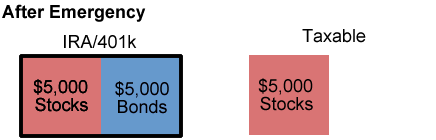
You may wonder what happens if you do need access to that $5,000. You would simply sell $5,000 of the stocks in your taxable account, and simultaneously buy $5,000 of stocks in your 401k plan. This way, your final asset allocation will look exactly the same as if you just spent your cash from the traditional setup:

If you happen to sell your stocks at a loss, then you may be able to deduct a loss if you avoid a wash sale. You can do this by not purchasing a “substantially identical” security within 30 days, but you can buy something very similar. For example, you might buy the S&P 500 ETF (IVV) and sell the Russell 1000 ETF (IWB). They are very strongly correlated, as shown in this chart. This may or may not be worth the hassle depending on how big a loss you’re looking at.

If you happen to sell your stocks at a long-term gain, then you’ll again only paid long-term capital gains taxes of at most 15%. If you sell at a short-term gain (held less than a year), then you’ll have to pay ordinary taxes on the gain. So it might be good to wait a year to institute this new setup.

The Catch
So there you have it, there is an argument for some people to put their emergency funds into their 401ks! However, for most people I don’t think this idea is very practical. For one, most people have relatively small emergency funds, so the difference in taxation scenarios won’t be very high. This is especially true in the current low-interest rate environment. The highest potential tax savings would go to those with large 401k balances and high income tax brackets.

Finally, besides a few stable value funds that I’ve seen, the yields on money market funds found inside retirement plans are rarely the best available. I can usually find much higher interest rates outside my 401k, usually by at least 2% APY or more.

Zecco Promotion Code: 20 Free Trades w/ New Account

If you’ve been considering opening an account with Zecco Trading, they just e-mailed me a new promotion that offers 20 free trades for new customers. Use the promotion code “bonus1” in the application:

Offer expires 9/13/09, and the trades are available for 90 days. More details:

Get 20 free stock trades when you sign up with Zecco Trading!

Zecco Trading is offering 20 free stock trades — a $90 value — to all new brokerage customers who sign up by Sunday, September 13th 2009! Use promo code “bonus1” to qualify.

These free stock trades are special, because you have a whole 90 days to use them. Some other brokerages give you free equity trades to use within 30 days of signing up, so by the time you transfer money into your account, the free stock trades might have expired! With Zecco Trading, you have more time to use your free stock trades when it makes sense to trade. […]

Be sure to use the promotion code “bonus1” when signing up. Be sure to use all lowercase or the code won’t work. Special terms and conditions:

* New Zecco Trading accounts must be opened and approved by Sunday, September 13th, 2009.
* The 20 free stock trades will be granted on or before September 16th, 2009. The free trades will expire 90 days after the date they are granted.
* Offer not eligible to existing Zecco Trading customers.
* Limit one bonus per household.

Zecco Quick Overview

I’ve had a Zecco account for a couple years now, so here’s a quick snapshot. The standard commission cost is $4.50 per trade. There are no minimum balance requirements and no inactivity fees. They offer free online ACH cash transfers in/out. Idle cash can be put into a money market sweep that is usually not that bad (CSAXX), but right now all money market yields are pitiful. Online statements are free, but paper statements cost $2 per month.

However, if you maintain a total account equity of $25,000 or make 25 traders per month, then you get 10 free trades per month. Account equity isn’t just cash, it’s the total value of your holdings including stocks, so you might consider shifting some outside holdings to Zecco to qualify. As long as you hit the $25k mark once during the month, you’ll get 10 free trades that month. (This is in addition to the 20 free trades given out above.)