Best Interest Rates on Cash – December 2021 Update

via GIPHY

Here’s my monthly roundup of the best interest rates on cash as of December 2021, roughly sorted from shortest to longest maturities. Significant changes since last month: Not much… NASA FCU has updated their CD specials, and I finished buying up to the individual limits on the 7% Savings I Bonds for both of us. T-Bills, money market funds, and ETFs are still a pass.

I look for lesser-known opportunities earning more than most “high-yield” savings accounts and money market funds while still keeping your principal FDIC-insured or equivalent. Check out my Ultimate Rate-Chaser Calculator to see how much extra interest you’d earn by moving money between accounts. Rates listed are available to everyone nationwide. Rates checked as of 12/5/2021.

Fintech accounts
Available only to individual investors, fintech companies often pay higher-than-market rates in order to achieve fast short-term growth (often using venture capital). “Fintech” is usually a software layer on top of a partner bank’s FDIC insurance. Read about the types of due diligences you should do whenever opening a new bank account.

  • 3% APY on up to $100,000. The top rate is still 3% APY for October through December 2021 (can be 3.5% APY with their credit card), and they have not indicated any upcoming rate drop. HM Bradley requires a recurring direct deposit every month and a savings rate of at least 20%. Due to high demand, you must currently use a referral link to join. If you have any available to share (you only get 3), thanks to those who have dropped theirs in the comments of my HM Bradley review.
  • 3% APY on 10% of direct deposits + 1% APY on $25,000. One Finance lets you earn 3% APY on “auto-save” deposits (up to 10% of your direct deposit, up to $1,000 per month). Separately, they also pay 1% APY on up to another $25,000 with direct deposit. New customer $50 bonus via referral. See my One Finance review.
  • 3% APY on up to $15,000. Porte requires a one-time direct deposit of $1,000+ to open a savings account. New customer $50 bonus via referral. Important note: Porte is adding additional restrictions including minimum monthly transactions in January 2022. See my Porte review.
  • 1.20% APY on up to $50,000. You must maintain a $500 direct deposit each month for this balance cap, otherwise you’ll still earn 1.20% on up to $5,000. See my OnJuno review.

High-yield savings accounts
Since the huge megabanks pay essentially no interest, I think every should have a separate, no-fee online savings account to accompany your existing checking account. The interest rates on savings accounts can drop at any time, so I list the top rates as well as competitive rates from banks with a history of competitive rates. Some banks will bait you with a temporary top rate and then lower the rates in the hopes that you are too lazy to leave.

  • T-Mobile Money is still at 1.00% APY with no minimum balance requirements. The main focus is on the 4% APY on your first $3,000 of balances as a qualifying T-mobile customer plus other hoops, but the lesser-known fact is that the 1% APY is available for everyone. Thanks to the readers who helped me understand this. Unfortunately, some readers have reported their applications being denied.
  • Evangelical Christian Credit Union (ECCU) is offering new members 1.01% APY on up to $25,000 when you bundle a High-Yield Money Market Account & Basic Checking. (Existing members can get 0.75% APY.) To join this credit union, you must attest to their statement of faith.
  • There are several other established high-yield savings accounts at closer to 0.50% APY. Marcus by Goldman Sachs is on that list, and if you open a new account with a Marcus referral link (that’s mine), they will give you and the referrer a 1.00% APY for your first 3 months (a 0.50% boost). You can then extend this by referring others to the same offer.

Short-term guaranteed rates (1 year and under)
A common question is what to do with a big pile of cash that you’re waiting to deploy shortly (plan to buy a house soon, just sold your house, just sold your business, legal settlement, inheritance). My usual advice is to keep things simple and take your time. If not a savings account, then put it in a flexible short-term CD under the FDIC limits until you have a plan.

  • No Penalty CDs offer a fixed interest rate that can never go down, but you can still take out your money (once) without any fees if you want to use it elsewhere. CFG Bank has a 13-month No Penalty CD at 0.62% APY with a $500 minimum deposit. Ally Bank has a 11-month No Penalty CD at 0.50% APY for all balance tiers. Marcus has a 7-month No Penalty CD at 0.45% APY with a $500 minimum deposit. You may wish to open multiple CDs in smaller increments for more flexibility.
  • Lafayette Federal Credit Union has a 1-year CD at 0.80% APY ($500 min). Early withdrawal penalty is 6 months of interest. Anyone can join this credit union via partner organization ($10 one-time fee).

Money market mutual funds + Ultra-short bond ETFs
Many brokerage firms that pay out very little interest on their default cash sweep funds (and keep the difference for themselves). Unfortunately, money market fund rates are very low across the board right now. Ultra-short bond funds are another possible alternative, but they are NOT FDIC-insured and may experience short-term losses at times. These numbers are just for reference, not a recommendation.

  • The default sweep option is the Vanguard Federal Money Market Fund which has an SEC yield of 0.01%.
  • Vanguard Ultra-Short-Term Bond Fund currently pays 0.45% SEC yield ($3,000 min) and 0.55% SEC Yield ($50,000 min). The average duration is ~1 year, so your principal may vary a little bit.
  • The PIMCO Enhanced Short Maturity Active Bond ETF (MINT) has a 0.35% SEC yield and the iShares Short Maturity Bond ETF (NEAR) has a 0.44% SEC yield while holding a portfolio of investment-grade bonds with an average duration of ~6 months.

Treasury Bills and Ultra-short Treasury ETFs
Another option is to buy individual Treasury bills which come in a variety of maturities from 4-weeks to 52-weeks. You can also invest in ETFs that hold a rotating basket of short-term Treasury Bills for you, while charging a small management fee for doing so. T-bill interest is exempt from state and local income taxes. Right now, this section isn’t very interesting as T-Bills are yielding close to zero!

  • You can build your own T-Bill ladder at TreasuryDirect.gov or via a brokerage account with a bond desk like Vanguard and Fidelity. Here are the current Treasury Bill rates. As of 12/3/2021, a new 4-week T-Bill had the equivalent of 0.04% annualized interest and a 52-week T-Bill had the equivalent of 0.25% annualized interest.
  • The Goldman Sachs Access Treasury 0-1 Year ETF (GBIL) has a -0.07% SEC yield and the SPDR Bloomberg Barclays 1-3 Month T-Bill ETF (BIL) has a -0.09% (!) SEC yield. GBIL appears to have a slightly longer average maturity than BIL.

US Savings Bonds
Series I Savings Bonds offer rates that are linked to inflation and backed by the US government. You must hold them for at least a year. If you redeem them within 5 years there is a penalty of the last 3 months of interest. The annual purchase limit for electronic I bonds is $10,000 per Social Security Number, available online at TreasuryDirect.gov. You can also buy an additional $5,000 in paper I bonds using your tax refund with IRS Form 8888.

  • “I Bonds” bought between November 2021 and April 2022 will earn a 7.12% rate for the first six months. The rate of the subsequent 6-month period will be based on inflation again. We have both bought up to the individual limits for 2021. Details here.
  • In mid-April 2022, the CPI will be announced and you will have a short period where you will have a very close estimate of the rate for the next 12 months. I will have another post up at that time.
  • See below about EE Bonds as a potential long-term bond alternative.

Prepaid Cards with Attached Savings Accounts
A small subset of prepaid debit cards have an “attached” FDIC-insured savings account with exceptionally high interest rates. The negatives are that balances are severely capped, and there are many fees that you must be careful to avoid (lest they eat up your interest). There is a long list of previous offers that have already disappeared with little notice. I don’t personally recommend nor use any of these anymore, as I feel the work required and risk of messing up exceeds any small potential benefit.

  • Mango Money pays 6% APY on up to $2,500, if you manage to jump through several hoops. Requirements include $1,500+ in “signature” purchases and a minimum balance of $25.00 at the end of the month.

Rewards checking accounts
These unique checking accounts pay above-average interest rates, but with unique risks. You have to jump through certain hoops which usually involve 10+ debit card purchases each cycle, a certain number of ACH/direct deposits, and/or a certain number of logins per month. If you make a mistake (or they judge that you did) you risk earning zero interest for that month. Some folks don’t mind the extra work and attention required, while others would rather not bother. Rates can also drop suddenly, leaving a “bait-and-switch” feeling.

  • Quontic Bank is offering 1.01% APY on balances up to $150,000. This is best for people who have high balances, as the rate is not as high as other rewards checking accounts. You need to make 10 debit card point of sale transactions of $10 or more per statement cycle required to earn this rate.
  • The Bank of Denver pays 2.00% APY on up to $10,000 if you make 12 debit card purchases of $5+ each, receive only online statements, and make at least 1 ACH credit or debit transaction per statement cycle. The rate recently dropped. If you meet those qualifications, you can also link a Kasasa savings account that pays 1.00% APY on up to $25k. Thanks to reader Bill for the updated info.
  • Presidential Bank pays 2.25% APY on balances between $500 and up to $25,000, if you maintain a $500+ direct deposit and at least 7 electronic withdrawals per month (ATM, POS, ACH and Billpay counts).
  • Evansville Teachers Federal Credit Union pays 3.30% APY on up to $20,000. You’ll need at least 15 debit transactions and other requirements every month.
  • Lake Michigan Credit Union pays 3.00% APY on up to $15,000. You’ll need at least 10 debit transactions and other requirements every month.
  • Find a locally-restricted rewards checking account at DepositAccounts.

Certificates of deposit (greater than 1 year)
CDs offer higher rates, but come with an early withdrawal penalty. By finding a bank CD with a reasonable early withdrawal penalty, you can enjoy higher rates but maintain access in a true emergency. Alternatively, consider building a CD ladder of different maturity lengths (ex. 1/2/3/4/5-years) such that you have access to part of the ladder each year, but your blended interest rate is higher than a savings account. When one CD matures, use that money to buy another 5-year CD to keep the ladder going. Some CDs also offer “add-ons” where you can deposit more funds if rates drop.

  • NASA Federal Credit Union has a special 49-month Share Certificate at 1.70% APY ($10,000 min of new funds). Early withdrawal penalty is 1 year of interest. They also have a 15-month special at 1.05% APY and 8-month at 0.80% APY.
    Anyone can join this credit union by joining the National Space Society (free). However, NASA FCU will perform a hard credit check as part of new member application.
  • Lafayette Federal Credit Union has a 5-year CD at 1.26% APY ($500 min). Early withdrawal penalty is 6 months of interest. Anyone can join this credit union via partner organization ($10 one-time fee). PenFed and other credit unions now offer rates close to 1.25% on a 5-year CD.
  • You can buy certificates of deposit via the bond desks of Vanguard and Fidelity. You may need an account to see the rates. These “brokered CDs” offer FDIC insurance and easy laddering, but they don’t come with predictable early withdrawal penalties. Right now, I see a 5-year CD at 1.25% APY. Be wary of higher rates from callable CDs listed by Fidelity.

Longer-term Instruments
I’d use these with caution due to increased interest rate risk, but I still track them to see the rest of the current yield curve.

  • Willing to lock up your money for 10 years? You can buy long-term certificates of deposit via the bond desks of Vanguard and Fidelity. These “brokered CDs” offer FDIC insurance, but they don’t come with predictable early withdrawal penalties. You might find something that pays more than your other brokerage cash and Treasury options. Right now, I see a 10-year CD at 1.80% APY vs. 1.29% for a 10-year Treasury. Watch out for higher rates from callable CDs from Fidelity.
  • How about two decades? Series EE Savings Bonds are not indexed to inflation, but they have a unique guarantee that the value will double in value in 20 years, which equals a guaranteed return of 3.5% a year. However, if you don’t hold for that long, you’ll be stuck with the normal rate which is quite low (currently 0.10%). I view this as a huge early withdrawal penalty. But if holding for 20 years isn’t an issue, it can also serve as a hedge against prolonged deflation during that time. Purchase limit is $10,000 each calendar year for each Social Security Number. As of 12/3/2021, the 20-year Treasury Bond rate was 1.77%.

All rates were checked as of 12/5/2021.

Morningstar Safe Withdrawal Rate Report: 3.3% Base Rate + Ways To Increase It

Financial freedom seekers usually have a Number – the value at which their investments can support their spending indefinitely. This is directly linked to “safe withdrawal rates”. For example a 4% safe withdrawal rate is a 25x multiplier – meaning $30,000 in spending needs not covered by Social Security, annuities, or pensions would require 25 x $30,000 = $750,000. Morningstar recently released a 59-page research paper called The State of Retirement Income: Safe Withdrawal Rates (summary article) that digs deeper into the “4% rule”. The headline is that they now estimate 3.3% a conservative base rate (30x multiplier):

What’s a safe withdrawal rate for retirees? We estimate 3.3%. However, there are various factors that could affect this percentage, resulting in the retiree withdrawing a significantly higher amount. This report explores ways that retirees can make their savings last longer without compromising their standard of living.

Instead of focusing on the 3.3% base rate, look at the various ways you can improve it. The 3.3% base rate assumes a 50% stock/50% bond portfolio, fixed withdrawals (adjusted upwards for inflation annually, no matter what) over a 30-year time horizon, and a 90% probability of success. What if you changed up some of these assumptions?

Lever #1: Hold a higher percentage of stocks. Historically, having a minimum amount of stocks is important in order to outpace inflation. However, going past 50% to 75% stocks no longer helps your minimum safe withdrawal rate. Not much room for improvement here.

Lever #2: Tolerate lower safety (success rate). This chart is useful to help accept the role of luck for a stock-based retirement portfolio. The fact is that 50% of the time, you could have withdrawn 4.7% and been just fine. You simply don’t know. (This is hard for me as a planner.) The retiree “Class of 2011” could have spent more than that so far without even denting their nest egg. However, the “Class of 2021” may have a very different experience. Going down to 80% probability of success moves you up from 3.3% to 3.9%.

Lever #3: Don’t keep adjusting upward for inflation. Your personal inflation rate might not keep up with the national averages. You might very well spend less as you age. If you adjust for 3/4th of inflation, that 3.3% goes up to 3.6%.

Forgoing inflation adjustments–at least in part–is another lever. That might seem farfetched in the current environment, given that inflation is top of mind. But research from David Blanchett, formerly of Morningstar but now at PGIM, has demonstrated that retirement spending doesn’t necessarily track inflation and often trends down throughout the lifecycle. Our research shows that the retiree who adjusts his or her paycheck by just 75% of the actual inflation rate would be able to take a starting withdrawal of 3.6%, for example.

Lever #4: Work longer. Make more money, make retirement period shorter. Not much fun, but effective. My view is that any amount of income will help reduce your withdrawal rate, if you have the time and ability. It is less common nowadays to go from full-time job to zero income. Working 10 hours a week feels much different than 40-50 hours a week.

Reducing the time horizon for drawdown–for example, by delaying retirement a few years–can likewise contribute to a higher starting safe withdrawal rate. For example, delaying retirement by five years and truncating the in-retirement spending horizon to 25 years from 30 results in a starting safe withdrawal amount of 4.1%.

Lever #5: Flexible spending based on market performance. There are several ways that you could adjust your spending in retirement in response to your portfolio’s return. In general, you’d want to spend less when the market is down. Some of this will come naturally as it’s easier to cut back on spending when you see your friends and neighbors cutting back as well. However, I was surprised to see that several of the proposed methods really don’t change the numbers much.

The method that does help significantly is called the Guyton-Klinger “guardrails” method, which allows inflation adjustments but applies “guardrails” so that the spending rate stays within 20% of the initial withdrawal percentage. Lets say your initial percentage is 4%. If markets go sky-high, the guardrails let you spend at least 3.2% of your new portfolio value (with inflation adjustments). If markets plummet, the guardrails let you spend at most 4.8% of your new portfolio value (with inflation adjustments).

Hold up! Early Retirement Now has an excellent post about how the Guyton-Klinger guardrails are much more “variable” than just +/- 20%. The guardrails move with the portfolio value. If you started out taking $40,000 out of a $100,000 portfolio, by following this rule starting in 1966, your income would have dropped to below $20,000 a year! A 50% drop in income is far too flexible for most people.

My personal thoughts. Every year that passes, I pay less attention to historical backtests and precise safe withdrawal rates. Instead, I care more about understanding the earning power of the assets that I own (including my own skills), and understanding the structure and flexibility of my expenses.

In regards to market returns, it is better to be lucky than anything else. Let’s say you retired about a year ago on October 31st, 2020 and owned the Vanguard Balanced Index Fund (VBIAX) that is 60% US stocks and 40% US bonds. If you had a $1,000,000, a 4% withdrawal rate is $40,000. But a year later, on October 31st, 2021, your portfolio would be just shy of $1,200,000 ($1,195,584) even after taking out $40,000 during the first year. This is just after one year!

In other words, 3.3% could easily be obsolete in a year. You are multiplying a safe withdrawal rate by something that can easily move up or down 20% each year, so why care about decimal points? Focus on what you can control. Looking back at all the levers above, here is what I can control:

  • Accept that a stock-based retirement portfolio will rely on luck. 3% = very safe. 4% = probably safe. 5% = risky. 6% = not safe.
  • Keep your portfolio in retirement somewhere between 50% and 75% stocks, with the rest in investment-grade bonds.
  • Don’t blindly keep taking out more money each year for inflation.
  • Working longer may be required, but explore ways to downshift while still making some income. Even small amounts of income make a difference. For example, 1% of $750,000 is $7,500 per year ($144/week). Earning $144 per week in income would move you from a 5% withdrawal rate to a 4% withdrawal rate, from a 4% withdrawal rate to a 3% withdrawal rate, and so on.
  • Don’t plan to spend the same amount every year. Spend less when markets are down, as most people do anyway. Think about the flex in your budget. Don’t lock in long-term commitments (vacation home ownership, any debt, agreements to pay for your kid’s X). Pick things that you can shut off (vacation rentals, travel, dining out).

Dimensional Fund Advisors (DFA) ETF Lineup Keeps Expanding

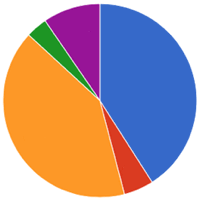
Some investors like to break down their portfolio into several different asset and sub-asset classes. One long-standing example of the “slice-and-dice” is the “Ultimate Buy-and-Hold Portfolio” recommended by Paul Merriman (see pie chart; expanded labels below). You don’t need to hold every one of these asset classes, but when held in combination they historically offer a higher return with lower volatility.

  • S&P 500 (US Large Cap Blend)
  • US Large Value
  • US Small
  • US Small Value
  • US REIT
  • International Large Cap Blend
  • International US Large Value
  • International Small
  • International Small Value
  • Emerging Markets
  • Short-term/Intermediate-term Bonds

For a long time, Dimensional Fund Advisors (DFA) offered some of the best lower-cost mutual funds tracking these types of sub-asset classes, but they also required you to invest through a DFA-affiliated financial advisor (and pay the accompanying management fees). Eventually, some former DFA executives and employees broke off and started Avantis ETFs, which are available to any investor with a brokerage accounts and offered a good DFA alternative. Avantis’ assets under management have been growing…

Lo and behold, DFA has just announced a big expansion of their DFA ETF lineup. Competition works!

Newly-listed DFA Bond ETFs

  • Dimensional Core Fixed Income ETF (DFCF)
  • Dimensional Short-Duration Fixed Income ETF (DFSD)
  • Dimensional National Municipal Bond ETF (DFNM)
  • Dimensional Inflation-Protected Securities ETF (DFIP)

Future DFA Equity ETFs

  • International Core Equity 2 ETF
  • Emerging Markets Core Equity 2 ETF
  • US Small Cap Value ETF
  • International Small Cap ETF
  • International Small Cap Value ETF
  • Emerging Markets Value ETF
  • US High Profitability ETF
  • International High Profitability ETF
  • Emerging Markets High Profitability ETF
  • US Real Estate ETF

Existing DFA ETFs

  • Dimensional US Core Equity Market ETF (DFAU)
  • Dimensional International Core Equity Market ETF (DFAI)
  • Dimensional Emerging Core Equity Market ETF (DFAE)
  • Dimensional US Core Equity 2 ETF (DFAC)
  • Dimensional US Equity ETF (DFUS)
  • Dimensional US Small Cap ETF (DFAS)
  • Dimensional US Targeted Value ETF (DFAT)
  • Dimensional International Value ETF (DFIV)
  • Dimensional World ex US Core Equity 2 ETF (DFAX)

Some of the confusing names are a result of these ETFs being conversions from the old mutual fund versions. Even though I try to keep things relatively simple and humble, I welcome these new investment options to the competitive marketplace along with their reasonably-low expense ratios. I may even switch my TIPS holdings to the DFA TIPS ETF (DFIP), as it is cheaper than the iShares TIPS Bond ETF (TIP).

I use Vanguard for my “core” index funds, but about 10% of my total portfolio is split between US Small Value and International/Emerging Small Value stocks. I recently bought/rebalanced into some of the new Avantis International Small Cap Value ETF (AVDV), but will keep an eye on the new DFA version. I suppose they could be a tax-loss harvesting ETF pair, but I have them inside a tax-sheltered account.

Best Interest Rates on Cash – November 2021 Update

via GIPHY

Here’s my monthly roundup of the best interest rates on cash as of November 2021, roughly sorted from shortest to longest maturities. I look for lesser-known opportunities earning more than most “high-yield” savings accounts and money market funds while still keeping your principal FDIC-insured or equivalent. Check out my Ultimate Rate-Chaser Calculator to see how much extra interest you’d earn by moving money between accounts. Rates listed are available to everyone nationwide. Rates checked as of 11/3/2021.

Fintech accounts
Available only to individual investors, fintech companies often pay higher-than-market rates in order to achieve fast short-term growth (often using venture capital). “Fintech” is usually a software layer using a different bank’s FDIC insurance. These do NOT require a certain number debit card purchases per month. Read about the types of due diligences you should do whenever opening a new bank account.

  • 3% APY on up to $100,000. The top rate is still 3% APY for October through December 2021 (can be 3.5% APY with their credit card), and they have not indicated any upcoming rate drop. HM Bradley requires a recurring direct deposit every month and a savings rate of at least 20%. Due to high demand, you must currently use a referral link to join. If you have any available to share (you get 3), please drop it in the comments of my HM Bradley review.
  • 3% APY on 10% of direct deposits + 1% APY on $25,000. One Finance lets you earn 3% APY on “auto-save” deposits (up to 10% of your direct deposit, up to $1,000 per month). Separately, they also pay 1% APY on up to another $25,000 with direct deposit. New customer $50 bonus via referral. See my One Finance review.
  • 3% APY on up to $15,000. Porte requires a one-time direct deposit of $1,000+ to open a savings account. New customer $50 bonus via referral. Important note: Porte is adding additional restrictions in January 2022. See my Porte review.
  • 1.20% APY on up to $50,000. You must maintain a $500 direct deposit each month for this balance cap, otherwise you’ll still earn 1.20% on up to $5,000. See my OnJuno review.

High-yield savings accounts
While the huge megabanks pay essentially no interest, I think every should have a separate, no-fee online savings account to accompany your existing checking account. The interest rates on savings accounts can drop at any time, so I list the top rates as well as competitive rates from banks with a history of competitive rates. Some banks will bait you with a temporary top rate and then lower the rates in the hopes that you are too lazy to leave.

  • T-Mobile Money is still at 1.00% APY with no minimum balance requirements. The main focus is on the 4% APY on your first $3,000 of balances as a qualifying T-mobile customer plus other hoops, but the lesser-known fact is that the 1% APY is available for everyone. Thanks to the readers who helped me understand this. Unfortunately, some readers have reported their applications being denied.
  • Evangelical Christian Credit Union (ECCU) is offering new members 1.01% APY on up to $25,000 when you bundle a High-Yield Money Market Account & Basic Checking. (Existing members can get 0.75% APY.) To join this credit union, you must attest to their statement of faith.
  • There are several other established high-yield savings accounts at closer to 0.50% APY. Marcus by Goldman Sachs is on that list, and if you open a new account with a Marcus referral link (that’s mine), they will give you and the referrer a 0.50% boost on top of the current interest rate for 3 months. You can then extend this by referring others to the same offer. Right now, Marcus is paying 0.50% APY, so with the offer you’d get 1.00% APY currently for your first 3 months.

Short-term guaranteed rates (1 year and under)
A common question is what to do with a big pile of cash that you’re waiting to deploy shortly (plan to buy a house soon, just sold your house, just sold your business, legal settlement, inheritance). My usual advice is to keep things simple and take your time. If not a savings account, then put it in a flexible short-term CD under the FDIC limits until you have a plan.

  • No Penalty CDs offer a fixed interest rate that can never go down, but you can still take out your money (once) without any fees if you want to use it elsewhere. CFG Bank has a 13-month No Penalty CD at 0.62% APY with a $500 minimum deposit. Ally Bank has a 11-month No Penalty CD at 0.50% APY for all balance tiers. Marcus has a 7-month No Penalty CD at 0.45% APY with a $500 minimum deposit. You may wish to open multiple CDs in smaller increments for more flexibility.
  • USALLIANCE Financial Credit Union has a 12-month CD at 0.85% APY ($500 minimum new money) with an early withdrawal penalty of 6 months interest. You must join the credit union first, but anyone can join via American Consumer Council (ACC).

Money market mutual funds + Ultra-short bond ETFs
Many brokerage firms that pay out very little interest on their default cash sweep funds (and keep the difference for themselves). Unfortunately, money market fund rates are very low across the board right now. Ultra-short bond funds are another possible alternative, but they are NOT FDIC-insured and may experience short-term losses at times. These numbers are just for reference, not a recommendation.

  • The default sweep option is the Vanguard Federal Money Market Fund which has an SEC yield of 0.01%. Vanguard Cash Reserves Federal Money Market Fund (formerly Prime Money Market) currently pays 0.01% SEC yield.
  • Vanguard Ultra-Short-Term Bond Fund currently pays 0.33% SEC yield ($3,000 min) and 0.43% SEC Yield ($50,000 min). The average duration is ~1 year, so your principal may vary a little bit.
  • The PIMCO Enhanced Short Maturity Active Bond ETF (MINT) has a 0.26% SEC yield and the iShares Short Maturity Bond ETF (NEAR) has a 0.40% SEC yield while holding a portfolio of investment-grade bonds with an average duration of ~6 months.

Treasury Bills and Ultra-short Treasury ETFs
Another option is to buy individual Treasury bills which come in a variety of maturities from 4-weeks to 52-weeks. You can also invest in ETFs that hold a rotating basket of short-term Treasury Bills for you, while charging a small management fee for doing so. T-bill interest is exempt from state and local income taxes. Right now, this section isn’t very interesting as T-Bills are yielding close to zero!

  • You can build your own T-Bill ladder at TreasuryDirect.gov or via a brokerage account with a bond desk like Vanguard and Fidelity. Here are the current Treasury Bill rates. As of 11/3/2021, a new 4-week T-Bill had the equivalent of 0.05% annualized interest and a 52-week T-Bill had the equivalent of 0.17% annualized interest.
  • The Goldman Sachs Access Treasury 0-1 Year ETF (GBIL) has a -0.07% SEC yield and the SPDR Bloomberg Barclays 1-3 Month T-Bill ETF (BIL) has a -0.09% (!) SEC yield. GBIL appears to have a slightly longer average maturity than BIL.

US Savings Bonds
Series I Savings Bonds offer rates that are linked to inflation and backed by the US government. You must hold them for at least a year. If you redeem them within 5 years there is a penalty of the last 3 months of interest. The annual purchase limit for electronic I bonds is $10,000 per Social Security Number, available online at TreasuryDirect.gov. You can also buy an additional $5,000 in paper I bonds using your tax refund with IRS Form 8888.

  • “I Bonds” bought between November 2021 and April 2022 will earn a 7.12% rate for the first six months. The rate of the subsequent 6-month period will be based on inflation again. Details here.
  • In mid-April 2022, the CPI will be announced and you will have a short period where you will have a very close estimate of the rate for the next 12 months. I will have another post up at that time.
  • See below about EE Bonds as a potential long-term bond alternative.

Prepaid Cards with Attached Savings Accounts
A small subset of prepaid debit cards have an “attached” FDIC-insured savings account with exceptionally high interest rates. The negatives are that balances are severely capped, and there are many fees that you must be careful to avoid (lest they eat up your interest). There is a long list of previous offers that have already disappeared with little notice. I don’t personally recommend nor use any of these anymore, as I feel the work required and risk of messing up exceeds any small potential benefit.

  • Mango Money pays 6% APY on up to $2,500, if you manage to jump through several hoops. Requirements include $1,500+ in “signature” purchases and a minimum balance of $25.00 at the end of the month.

Rewards checking accounts
These unique checking accounts pay above-average interest rates, but with unique risks. You have to jump through certain hoops which usually involve 10+ debit card purchases each cycle, a certain number of ACH/direct deposits, and/or a certain number of logins per month. If you make a mistake (or they judge that you did) you risk earning zero interest for that month. Some folks don’t mind the extra work and attention required, while others would rather not bother. Rates can also drop suddenly, leaving a “bait-and-switch” feeling.

  • Quontic Bank is offering 1.01% APY on balances up to $150,000. This is best for people who have high balances, as the rate is not as high as other rewards checking accounts. You need to make 10 debit card point of sale transactions of $10 or more per statement cycle required to earn this rate.
  • (Balance caps will drop as of 11/17/2021) The Bank of Denver pays 2.00% APY on up to $10,000 (down from $25,000 as of 11/17/21) if you make 12 debit card purchases of $5+ each, receive only online statements, and make at least 1 ACH credit or debit transaction per statement cycle. The rate recently dropped. If you meet those qualifications, you can also link a Kasasa savings account that pays 1.00% APY on up to $25k (down from $50k as of 11/17/21). Thanks to reader Bill for the updated info.
  • Presidential Bank pays 2.25% APY on balances up to $25,000, if you maintain a $500+ direct deposit and at least 7 electronic withdrawals per month (ATM, POS, ACH and Billpay counts).
  • Evansville Teachers Federal Credit Union pays 3.30% APY on up to $20,000. You’ll need at least 15 debit transactions and other requirements every month.
  • Lake Michigan Credit Union pays 3.00% APY on up to $15,000. You’ll need at least 10 debit transactions and other requirements every month.
  • Find a locally-restricted rewards checking account at DepositAccounts.

Certificates of deposit (greater than 1 year)
CDs offer higher rates, but come with an early withdrawal penalty. By finding a bank CD with a reasonable early withdrawal penalty, you can enjoy higher rates but maintain access in a true emergency. Alternatively, consider building a CD ladder of different maturity lengths (ex. 1/2/3/4/5-years) such that you have access to part of the ladder each year, but your blended interest rate is higher than a savings account. When one CD matures, use that money to buy another 5-year CD to keep the ladder going. Some CDs also offer “add-ons” where you can deposit more funds if rates drop.

  • Abound Credit Union has a 59-month Share Certificate at 1.35% APY ($500 min). Early withdrawal penalty is 1 year of interest (and only with the consent of the credit union, so be aware). Anyone can join this credit union via partner organization ($10 one-time fee).
  • NASA Federal Credit Union has a special 49-month Share Certificate at 1.60% APY ($10,000 min of new funds). Early withdrawal penalty is 1 year of interest. Anyone can join this credit union by joining the National Space Society (free). However, NASA FCU will perform a hard credit check as part of new member application.
  • Lafayette Federal Credit Union has a 5-year CD at 1.26% APY ($500 min). Early withdrawal penalty is 6 months of interest. Anyone can join this credit union via partner organization ($10 one-time fee).
  • You can buy certificates of deposit via the bond desks of Vanguard and Fidelity. You may need an account to see the rates. These “brokered CDs” offer FDIC insurance and easy laddering, but they don’t come with predictable early withdrawal penalties. Right now, I see a 5-year CD at 1.15% APY. Be wary of higher rates from callable CDs listed by Fidelity.

Longer-term Instruments
I’d use these with caution due to increased interest rate risk, but I still track them to see the rest of the current yield curve.

  • Willing to lock up your money for 10 years? You can buy long-term certificates of deposit via the bond desks of Vanguard and Fidelity. These “brokered CDs” offer FDIC insurance, but they don’t come with predictable early withdrawal penalties. You might find something that pays more than your other brokerage cash and Treasury options. Right now, I see a 10-year CD at 2.00% APY vs. 1.53% for a 10-year Treasury. Watch out for higher rates from callable CDs from Fidelity.
  • How about two decades? Series EE Savings Bonds are not indexed to inflation, but they have a unique guarantee that the value will double in value in 20 years, which equals a guaranteed return of 3.5% a year. However, if you don’t hold for that long, you’ll be stuck with the normal rate which is quite low (currently 0.10%). I view this as a huge early withdrawal penalty. But if holding for 20 years isn’t an issue, it can also serve as a hedge against prolonged deflation during that time. Purchase limit is $10,000 each calendar year for each Social Security Number. As of 11/3/2021, the 20-year Treasury Bond rate was 2.01%.

All rates were checked as of 11/3/2021.

Savings I Bonds November 2021 Interest Rate: 7.12% Inflation Rate

November 2021 rate confirmed at 7.12%. The variable inflation-indexed rate for I bonds bought from November 1, 2021 through April 30th, 2022 will indeed be 7.12% as predicted. Every single I bond will earn this rate eventually for 6 months, depending on the initial purchase month.

The fixed rate (real yield) is also 0% as predicted, but realize that the real yield on a 5-year TIPS right now is about negative 1.7%. There is significant demand for inflation protection right now. See you again in mid-April for the next early prediction for May 2022. Don’t forget that the purchase limits are based on calendar year, if you still wish to max out for 2021.

Original post 10/13/2021:

Savings I Bonds are a unique, low-risk investment backed by the US Treasury that pay out a variable interest rate linked to inflation. With a holding period from 12 months to 30 years, you could own them as an alternative to bank certificates of deposit (they are liquid after 12 months) or bonds in your portfolio.

New inflation numbers were just announced at BLS.gov, which allows us to make an early prediction of the November 2021 savings bond rates a couple of weeks before the official announcement on the 1st. This also allows the opportunity to know exactly what a October 2021 savings bond purchase will yield over the next 12 months, instead of just 6 months. You can then compare this against a November 2021 purchase.

New inflation rate prediction. March 2021 CPI-U was 264.877. September 2021 CPI-U was 274.310, for a semi-annual increase of 3.56%. Using the official formula, the variable component of interest rate for the next 6 month cycle will be 7.12%. You add the fixed and variable rates to get the total interest rate. If you have an older savings bond, your fixed rate may be up to 3.60%.

Tips on purchase and redemption. You can’t redeem until after 12 months of ownership, and any redemptions within 5 years incur an interest penalty of the last 3 months of interest. A simple “trick” with I-Bonds is that if you buy at the end of the month, you’ll still get all the interest for the entire month – same as if you bought it in the beginning of the month. It’s best to give yourself a few business days of buffer time. If you miss the cutoff, your effective purchase date will be bumped into the next month.

Buying in October 2021. If you buy before the end of October, the fixed rate portion of I-Bonds will be 0%. You will be guaranteed a total interest rate of 0.00 + 3.54 = 3.54% for the next 6 months. For the 6 months after that, the total rate will be 0.00 + 7.12 = 7.12%.

Let’s look at a worst-case scenario, where you hold for the minimum of one year and pay the 3-month interest penalty. If you theoretically buy on October 31st, 2021 and sell on October 1st, 2022, you’ll earn a ~3.87% annualized return for an 11-month holding period, for which the interest is also exempt from state income taxes. If you theoretically buy on October 31st, 2021 and sell on January 1, 2023, you’ll earn a ~4.57% annualized return for an 14-month holding period. Comparing with the best interest rates as of October 2021, you can see that this is much higher than a current top savings account rate or 12-month CD.

Buying in November 2021. If you buy in November 2021, you will get 7.12% plus a newly-set fixed rate for the first 6 months. The new fixed rate is officially unknown, but is loosely linked to the real yield of short-term TIPS, and is thus very, very, very likely to be 0%. Every six months after your purchase, your rate will adjust to your fixed rate (set at purchase) plus a variable rate based on inflation.

If you have an existing I-Bond, the rates reset every 6 months depending on your purchase month. Your bond rate = your specific fixed rate (set at purchase) + variable rate (total bond rate has a minimum floor of 0%). So if your fixed rate was 1%, you’ll be earning a 1.00 + 7.12 = 8.12% rate for six months.

Buy now or wait? Given that the current I bond rate is already much higher than the equivalent alternatives, I would personally buy in October to lock in the high rate for the longest possible time. Who knows what will happen on the next reset? Either way, it seems worthwhile to use up the purchase limit for 2021 either in October or November. You are also getting a much better “deal” than with TIPS, as the fixed rate is currently negative with short-term TIPS.

Unique features. I have a separate post on reasons to own Series I Savings Bonds, including inflation protection, tax deferral, exemption from state income taxes, and educational tax benefits.

Over the years, I have accumulated a nice pile of I-Bonds and consider it part of the inflation-linked bond allocation inside my long-term investment portfolio.

Annual purchase limits. The annual purchase limit is now $10,000 in online I-bonds per Social Security Number. For a couple, that’s $20,000 per year. You can only buy online at TreasuryDirect.gov, after making sure you’re okay with their security protocols and user-friendliness. You can also buy an additional $5,000 in paper I bonds using your tax refund with IRS Form 8888. If you have children, you may be able to buy additional savings bonds by using a minor’s Social Security Number.

Note: Opening a TreasuryDirect account can sometimes be a hassle as they may ask for a medallion signature guarantee which requires a visit to a physical bank or credit union and snail mail. Don’t expect to be able to open an account in 5 minutes on your phone.

Bottom line. Savings I bonds are a unique, low-risk investment that are linked to inflation and only available to individual investors. Right now, they promise to pay out a higher fixed rate above inflation than TIPS. You can only purchase them online at TreasuryDirect.gov, with the exception of paper bonds via tax refund. For more background, see the rest of my posts on savings bonds.

[Image: 1950 Savings Bond poster from US Treasury – source]

Best 529 College Savings Plan Rankings 2021 – Morningstar (+ My Top Pick)

Investment research firm Morningstar has released their annual 529 College Savings Plans gold/silver/bronze medalist ratings for 2021. While the full ratings and plan analysis for every individual plan are restricted to paid premium members, the vast majority are mediocre and can be ignored.

If you are among the 50% of the population who either don’t get an in-state tax break or have “tax parity” where you get the same tax break regardless of plan location, then you can open an account at any state plan across the nation. In my opinion, there are two ways to pick a good plan. You can pick the absolute top-rated one right now, or you can pick a consistent “Top 10” plan with a history of good behavior.

Here are the Gold-rated plans for 2021 (no particular order). Morningstar uses a Gold, Silver, or Bronze rating scale for the top plans and Neutral or Negative for the rest.

All three of these plans were also rated as Gold last year.

Here are the consistently top-rated plans from 2011-2021. I’ve been tracking these rankings roughly since my first child was born. The plans below have been rated either Gold or Silver (or equivalent) for every year the rankings were done from 2011 through 2021. No particular order.

  • T. Rowe Price College Savings Plan, Alaska
  • Maryland College Investment Plan
  • Vanguard 529 College Savings Plan, Nevada
  • CollegeAdvantage 529 Savings Plan, Ohio
  • My529, formerly the Utah Educational Savings Plan

The “Four P” criteria.

  • People. Who’s behind the plans? Who are the investment consultants picking the underlying investments?
  • Process. Are the asset-allocation glide paths and funds chosen for the age-based options based on solid research?
  • Parent. Does the state trustee and its partners put education savers first?
  • Price. How are the total fees relative to the competition?

State-specific tax benefits. Now, what if you are in the 50% who do have an in-state tax break that requires you to keep your money with the in-state provider? My general take is that your in-state plan is most likely decent enough these days that if you can max out the tax break, it’s worth it to stay. There may be some edge cases where if you keep a very large balance in a relatively expensive plan, then a cheaper plan might be worth going out-of-state.

Find details on your state-specific tax benefits via the tools from Morningstar, SavingForCollege, or Vanguard. Then compare the tax break benefit with how much better a gold plan is than your in-state plan.

If you change your mind later, you have the ability to roll over balances between different 529 plans. (Watch out for tax-benefit recapture rules if you got a tax break initially.)

My pick. I’ve simplified down to one single pick for my favorite 529 plan – the Utah My529. You’ll notice they are also the only plan on both of my lists above. They have everything that I look for: low costs, high-qualify investment options from Vanguard and DFA, reasonable automatic portfolios for those that want to set-and-forget, and highly-customizable glide paths for DIY investors.

I’ve rolled over all my other 529 holdings to Utah over the years. If you don’t have a tax break to keep you in-state, I recommend this plan. I don’t live in Utah myself, but Utah residents are lucky to get a tax break on top of having one of the top plans in the country. (No disclosure on this one, although I wish they had a referral program!)

Here is a chart showing how Utah keep lowering their fees over time. I like that the cost savings realized as they grow is being shared with customers, just like Vanguard.

M1 Finance Backdoor Roth IRA Instructions, How To w/ Screenshots

I recently completed a Backdoor Roth IRA contribution at M1 Finance (my review), so here is a detailed step-by-step walkthrough of the process along with screenshots based on my actual experience. M1 Finance currently has a new customer bonus offer up to $150 for new accounts, based on initial deposit amount. You can also add on the up to $2,500 transfer bonus for moving assets over from another brokerage firm. (Disclosure: I am now an affiliate of M1 Finance, and may be compensated if you click through my link and open a new account.)

Quick background. The Backdoor Roth IRA is a way for individuals to fund a Roth IRA even though their income (modified AGI) exceeds the phaseout limits set for a direct Roth IRA contribution. ($140,000 MAGI for individuals, $208,000 MAGI for married filing joint in 2021.) I won’t go deep into the details, but the general idea is:

  • An individual can contribute to a Traditional IRA without any income limits. However, the contribution is not tax-deductible if you exceed the income limits.
  • An individual can also convert a Traditional IRA to a Roth IRA, also without any income limits. You won’t owe any taxes on those non-deductible IRA contributions, because they are already after-tax.
  • Perform these two steps right after each other, and you have a “Backdoor” Roth IRA.

There are other considerations and details involved, so please do your own research before taking action. Roth conversions cannot be undone. This option may go away in 2022, so if you have any Traditional IRA balances that you have been considering to convert to a Roth IRA, you may want to make your decision before the end of 2021.

M1 Finance Backdoor Roth IRA walkthrough.

Open a new Traditional IRA account and fund it. If you already have an M1 account, click on the name of your portfolio in the top right area, and then click on “Add account”.

Choose “Retirement”, then “Traditional IRA”, then read and accept the terms. Next, you will have the option to select an investment “pie”, but since you are going to convert this quickly to a Roth IRA, it’s fine to just choose something close to cash. One option is the PIMCO Enhanced Short Maturity Active ETF (search for ticker MINT), add it your pie basket, and make it 100%. Finally, you must fund it, probably using your bank account numbers unless you have an existing M1 Finance account or other ideas.

Open a separate Roth IRA account, but do NOT fund it. M1 wants you to have the Roth IRA set up before any conversion request can be made. So start like above and open a new Retirement account, but this time pick Roth IRA. You can now pick your “real” investment portfolio pie, but again don’t fund it! Just think of it as an empty container for now.

Wait for a bit. It may take a few days for your Traditional IRA to get set up, funded, and invested into something. This step is still important. Some people even wait for the Traditional IRA to generate a full monthly account statement so they have paper documentation that they completed this step. Others just wait a day and then move on.

Find both your Traditional and Roth IRA account numbers. It’s conversion time. To find your account numbers, find your name in the top right corner. Click on that, and then click on “View Account Settings”. Then click on the subheading “Accounts”. You should end up with a list of your account nicknames, account numbers, and account types.

Request the conversion, sign and return documents. You can request the conversion via their automated chat bot, secure message, or phone number during business hours. I was able to complete the entire process via chat bot and email without having to use the phone. Here’s my chat transcript with personal details removed:

USER: roth conversion

BOT: M1 Invest can perform IRA conversions. Please keep in mind that due to high volumes, transfers can take 5-7 business days to complete. To get started with this process, please reply with the following information:

BOT: What is the M1 Invest account number of the traditional IRA you would like to convert out of?

USER: XXXXXXXX

BOT: What is the M1 Invest account number of the Roth IRA you would like to convert into?

USER: XXXXXXXX

BOT: What is the amount you would like to convert (if full account conversion, please simply confirm ‘full account’)?

USER: full account

BOT: What is the email address you use to login to M1?

USER: xx@xx.com

Within an hour, they emailed me a PDF form that I had to complete and sign. I uploaded the signed PDF into their secure drop box, and had confirmation that they had sent the request over to their clearing firm within another hour or so.

Jonathan,

We have submitted this conversion to our clearing firm. Both accounts will be paused for the duration of the transfer. We will notify you once the transfer is complete and you will see the funds placed in the correct account.

If you are transferring securities, please make sure the securities you are transferring are located in your Roth IRA portfolio.

This process can take 1-3 business days to complete.

Best,
Brokerage Operations
M1 Team

Once it shows in my M1 Invest dashboard that the funds have been moved into my Roth IRA account, then I’ll be done. I should be sent a form at tax time regarding the amount converted. If I contributed $6,000 to the non-deductible Traditional IRA and the value didn’t change at the time of conversion, then I won’t have any capital gains to pay taxes on. My $6,000 Backdoor Roth IRA contribution will be complete and now I can enjoy tax-free growth and tax-free withdrawals of all future gains. I hope you find this useful for informational purposes.

Charlie Munger: A Double Layer of Risk Protection

My current commute/workout/kid taxi listening is old Berkshire Hathaway shareholder meetings after finding them in podcast format. (I know, out of all the choices available, somehow I find these the most stimulating?!) Here is a educational excerpt from the 2008 BRK meeting (transcript and video available at CNBC) where Charlie Munger is discussing how Berkshire works to avoid low-probability problems that could destroy the company now and in the future.

CHARLIE MUNGER: Yeah. You can see how risk averse Berkshire is. In the first place, we try and behave in a way so that no rational person is going to worry about our credit.

And after we’ve done that, and done it for many years, we also behave in a way that, if the world suddenly didn’t like our credit, we wouldn’t even notice it for months, because we have such liquidity and are so unlikely to be — unable to be — pressured by anybody.

That double layering of protection against risk is like breathing around Berkshire. It’s just part of the culture.

[…]

We do not want to be dependent on anybody or anything else. And yet we want to keep doing things.

So, we’ve found a way to do it — we think we found a way — to do that. It may give up some of the — well, obviously gives up earning higher returns 99 percent of the time, and maybe 99.9 percent of the time.

Obviously, we could have run Berkshire with more leverage over the years than we have. But we wouldn’t have slept as well, and we wouldn’t feel comfortable — we’d have a lot of people in this room that have almost all their net worth in Berkshire, including me — and we wouldn’t feel comfortable running a business that way.

Why do it? I mean, it doesn’t — it just doesn’t make any sense to us to be exposed to ruin and disgrace and embarrassment and — for something that’s not that meaningful.

If we can earn a decent return on capital, you know, what’s an extra percentage point? It just isn’t that important.

Takeaways. The parallels for personal finance seem pretty straightforward:

  • Maintain an excellent credit reputation (score). Having a good credit score will help you borrow for a house, buy a car, lower your insurance premiums in many cases, and finance larger projects and transactions. However, that credit line may still disappear quickly in a crisis.
  • Maintain adequate liquidity separate from any credit lines. Imagine that you lose your job and can’t find a new one for six months. Can your household survive without major disruption? What if at the same time, your stocks also got a 50% haircut and everyone else is suffering as well? Do you have cash or liquid assets to tide you over?
  • Accept that this level of safety means you won’t earn the highest returns. You’ll do fine, but you may not do as well as someone else who bet it all (or more than all using leverage) what happened to be the right thing during the good times. That’s okay, because you won’t be exposed to ruin.

MMB Portfolio Update October 2021 (Q3): Dividend and Interest Income

dividendmono225While my 3rd Quarter 2021 portfolio asset allocation is designed for total return, I also track the income produced quarterly. Stock dividends are the portion of profits that businesses have decided they don’t need to reinvest into their business. The dividends may suffer some short-term drops, but over the long run they have grown faster than inflation.

I track the “TTM” or “12-Month Yield” from Morningstar, which is the sum of the trailing 12 months of interest and dividend payments divided by the last month’s ending share price (NAV) plus any capital gains distributed over the same period. (ETFs rarely have to distribute capital gains.) I prefer this measure because it is based on historical distributions and not a forecast. Below is a rough approximation of my portfolio (2/3rd stocks and 1/3rd bonds).

Asset Class / Fund % of Portfolio Trailing 12-Month Yield (Taken 10/17/21) Yield Contribution
US Total Stock
Vanguard Total Stock Market Fund (VTI, VTSAX)
25% 1.28% 0.32%
US Small Value
Vanguard Small-Cap Value ETF (VBR)
5% 1.67% 0.08%
International Total Stock
Vanguard Total International Stock Market Fund (VXUS, VTIAX)
25% 2.56% 0.64%
Emerging Markets
Vanguard Emerging Markets ETF (VWO)
5% 2.25% 0.11%
US Real Estate
Vanguard REIT Index Fund (VNQ, VGSLX)
6% 2.65% 0.16%
Intermediate-Term High Quality Bonds
Vanguard Intermediate-Term Treasury ETF (VGIT)
17% 1.18% 0.20%
Inflation-Linked Treasury Bonds
Vanguard Short-Term Inflation-Protected Securities ETF (VTIP)
17% 2.26% 0.38%
Totals 100% 1.89%


Trailing 12-month yield history. Here is a chart showing how this 12-month trailing income rate has varied since I started tracking it in 2014.

Maintaining perspective on portfolio value. One of the things I like about using this number is that when stock prices drop, this percentage metric usually goes up – which makes me feel better in a bear market. When stock prices go up, this percentage metric usually goes down, which keeps me from getting too euphoric during a bull market.

Here’s a related quote from Jack Bogle (source):

The true investor will do better if he forgets about the stock market and pays attention to his dividend returns and to the operating results of his companies.

Absolute dividend income. This quarter’s trailing income yield of 1.89% is still near the all-time lows since 2014. At the same time, both the portfolio value and the absolute income produced is higher than in 2014. If you retired back in 2014 and have been living off your stock/bond portfolio, you’ve been doing fine.

Here is the historical growth of the S&P 500 absolute dividend, updated as of Q3 2021 (source):

This means that if you owned enough of the S&P 500 to produce an annual dividend income of about $13,000 a year in 1999, then today those same shares would be worth a lot more AND your annual dividend income would have increased to over $50,000 a year, even if you had spent every penny of dividend income every year.

As a result, I prefer looking at absolute income produced rather than portfolio value or dividend yield percentages. Total income goes up much more gradually and consistently, encouraging me as I keep plowing more of my savings into more stock purchases. I imagine them as a factory that just churns out more dollar bills.

via GIPHY

Big picture and rules of thumb. If you are not close to retirement, there is not much use worrying about these decimal points. Your time is better spent focusing on earning potential via better career moves, improving in your skillset, and/or looking for entrepreneurial opportunities where you can have an ownership interest.

I support the common 4% or 3% rule of thumb, which equates to a target of accumulating roughly 25 to 30 times your annual expenses. I would lean towards a 3% withdrawal rate if you want to retire young (before age 50) and a 4% withdrawal rate if retiring at a more traditional age (closer to 65). Build in some spending flexibility to make your portfolio more resilient in the real world, and that’s perfectly good goal to put on your wall.

How we handle this income. Our dividends and interest income are not automatically reinvested. I treat this money as part of our “paycheck”. Then, as with a traditional paycheck, we can choose to either spend it or invest it again. Even if still working, you could use this money to cut back working hours, pursue new interests, start a new business, spend more time with your family and loved ones, travel, perform charity or volunteer work, and so on. This is your one life and it only lasts about 4,000 weeks.

MMB Portfolio Update October 2021 (Q3): Asset Allocation & Performance

portpie_blank200Here’s my quarterly update on my current investment holdings as of October 2021, including our 401k/403b/IRAs and taxable brokerage accounts but excluding our house, “emergency fund” cash reserves, and a side portfolio of self-directed investments. Following the concept of skin in the game, the following is not a recommendation, but just to share an actual, low-cost, diversified DIY portfolio complete with some real-world messiness. The goal of this portfolio is to create sustainable income that keeps up with inflation to cover our household expenses.

Actual Asset Allocation and Holdings
I use both Personal Capital and a custom Google Spreadsheet to track my investment holdings. The Personal Capital financial tracking app (free, my review) automatically logs into my different accounts, adds up my various balances, tracks my performance, and calculates my overall asset allocation. Once a quarter, I also update my manual Google Spreadsheet (free, instructions) because it helps me calculate how much I need in each asset class to rebalance back towards my target asset allocation.

Here are updated performance and asset allocation charts, per the “Allocation” and “Holdings” tabs of my Personal Capital account, respectively. (The blue line went flat for a while because the synchronization stopped and I don’t checked my performance constantly.)

Stock Holdings
Vanguard Total Stock Market (VTI, VTSAX)
Vanguard Total International Stock Market (VXUS, VTIAX)
Vanguard Small Value (VBR)
Vanguard Emerging Markets (VWO)
Avantis International Small Cap Value ETF (AVDV)
Cambria Emerging Shareholder Yield ETF (EYLD)
Vanguard REIT Index (VNQ, VGSLX)

Bond Holdings
Vanguard Limited-Term Tax-Exempt (VMLTX, VMLUX)
Vanguard Intermediate-Term Tax-Exempt (VWITX, VWIUX)
Vanguard Intermediate-Term Treasury (VFITX, VFIUX)
Vanguard Inflation-Protected Securities (VIPSX, VAIPX)
Fidelity Inflation-Protected Bond Index (FIPDX)
iShares Barclays TIPS Bond (TIP)
Individual TIPS bonds
U.S. Savings Bonds (Series I)

Target Asset Allocation. This “Humble Portfolio” does not rely on my ability to pick specific stocks, sectors, trends, or countries. I own broad, low-cost exposure to asset classes that will provide long-term returns above inflation, distribute income via dividends and interest, and finally offer some historical tendencies to balance each other out. I have faith in the long-term benefit of owning publicly-traded US and international shares of businesses, as well as high-quality US federal and municipal debt. My stock holdings roughly follow the total world market cap breakdown at roughly 60% US and 40% ex-US. I also own real estate through REITs.

I strongly believe in the importance of doing your own research. Every asset class will eventually have a low period, and you must have strong faith during these periods to truly make your money. You have to keep owning and buying more stocks through the stock market crashes. You have to maintain and even buy more rental properties during a housing crunch, etc. A good sign is that if prices drop, you’ll want to buy more of that asset instead of less.

I do not spend a lot of time backtesting various model portfolios, as I don’t think picking through the details of the recent past will necessarily create superior future returns. Usually, whatever model portfolio is popular in the moment just happens to hold the asset class that has been the hottest recently as well. I’ve also realized that I don’t have strong faith in the long-term results of commodities, gold, or bitcoin. I’ve tried many times to wrap my head around it, but have failed. I prefer things that send me checks while I sleep.

This is not the optimal, perfect, ideal anything. It’s just what I came up with, and it’s done the job. You may have different beliefs based on your own research and psychological leanings. Holding a good asset that you understand is better than owning and selling the highest-return asset when it is at its temporary low point.

Stocks Breakdown

  • 45% US Total Market
  • 7% US Small-Cap Value
  • 31% International Total Market
  • 7% International Small-Cap Value
  • 10% US Real Estate (REIT)

Bonds Breakdown

  • 66% High-Quality bonds, Municipal, US Treasury or FDIC-insured deposits
  • 33% US Treasury Inflation-Protected Bonds (or I Savings Bonds)

I have settled into a long-term target ratio of 67% stocks and 33% bonds (2:1 ratio) within our investment strategy of buy, hold, and occasionally rebalance. This is more conservative than most people my age, but I am settling into a more “perpetual portfolio” as opposed to the more common accumulate/decumulate portfolio. I use the dividends and interest to rebalance whenever possible in order to avoid taxable gains. I plan to only manually rebalance past that if the stock/bond ratio is still off by more than 5% (i.e. less than 62% stocks, greater than 72% stocks). With a self-managed, simple portfolio of low-cost funds, we can minimize management fees, commissions, and taxes.

Holdings commentary. The fact that I did research about Shiba Inu coins today is the latest evidence that there is too much money sloshing around chasing speculative investments. Somehow, I own 4,000,000 SHIB from a recent Voyager referral promotion! You really have to wonder how 2021 events will be described in 2030 or 2040. All I can do is listen to the late Jack Bogle and “stay the course”. I remain optimistic that capitalism, human ingenuity, human resilience, human compassion, and our system of laws will continue to improve things over time.

My thought for the quarter is that there is all this focus on tech/crypto/cloud but I hope we still invest enough in physical things like farming/energy/infrastructure.

Performance numbers. According to Personal Capital, my portfolio is up +11.4% for 2021 YTD. I rolled my own benchmark for my portfolio using 50% Vanguard LifeStrategy Growth Fund and 50% Vanguard LifeStrategy Moderate Growth Fund – one is 60/40 and the other is 80/20 so it also works out to 70% stocks and 30% bonds. That benchmark would have a total return of +10.1% for 2021 YTD as of 10/15/2021.

I’ll share about more about the income aspect in a separate post.

Best Interest Rates on Cash – October 2021 Update

via GIPHY

Here’s my monthly roundup of the best interest rates on cash as of October 2021, roughly sorted from shortest to longest maturities. I look for lesser-known opportunities earning at least double what most savings accounts and money market funds are earning while still keeping your principal FDIC-insured or equivalent. Check out my Ultimate Rate-Chaser Calculator to see how much extra interest you’d earn by moving money between accounts. Rates listed are available to everyone nationwide. Rates checked as of 10/6/2021.

Fintech accounts
Available only to individual investors, fintech companies often pay higher-than-market rates in order to achieve fast short-term growth (often using venture capital). I define “fintech” as a software layer on top of a different bank’s FDIC insurance. These do NOT require a certain number debit card purchases per month. Read about the types of due diligences you should do whenever opening a new bank account.

  • 3% APY on up to $100,000. The top rate is still 3% APY for October through December 2021 (can be 3.5% APY with their credit card), and they have not indicated any upcoming rate drop. HM Bradley requires a recurring direct deposit every month and a savings rate of at least 20%. Due to high demand, you must currently use a referral link to join. If you have any available to share (you get 3), please drop it in the comments of my HM Bradley review.
  • 3% APY on 10% of direct deposits + 1% APY on $25,000. One Finance lets you earn 3% APY on “auto-save” deposits (up to 10% of your direct deposit, up to $1,000 per month). Separately, they also pay 1% APY on up to another $25,000 with direct deposit. New customer $50 bonus via referral. See my One Finance review.
  • 3% APY on up to $15,000. Porte requires a one-time direct deposit of $1,000+ to open a savings account. New customer $50 bonus via referral. Important note: Porte is adding additional restrictions in January 2022. See my Porte review.
  • 1.20% APY on up to $50,000. OnJuno recently updated their rate tiers, while keeping existing customers on the grandfathered 2.15% APY rate. If you don’t maintain a $500 direct deposit each month, you’ll still earn 1.20% on up to $5k. See my updated OnJuno review.

High-yield savings accounts
While the huge megabanks pay essentially no interest, I think every should have a separate, no-fee online savings account to accompany your existing checking account. The interest rates on savings accounts can drop at any time, so I list the top rates as well as competitive rates from banks with a history of competitive rates. Some banks will bait you with a temporary top rate and then lower the rates in the hopes that you are too lazy to leave.

  • T-Mobile Money is still at 1.00% APY with no minimum balance requirements. The main focus is on the 4% APY on your first $3,000 of balances as a qualifying T-mobile customer plus other hoops, but the lesser-known fact is that the 1% APY is available for everyone. Thanks to the readers who helped me understand this. Unfortunately, some readers have reported their applications being denied.
  • Evangelical Christian Credit Union (ECCU) is offering new members 1.01% APY on up to $25,000 when you bundle a High-Yield Money Market Account & Basic Checking. (Existing members can get 0.75% APY.) To join this credit union, you must attest to their statement of faith.
  • There are several other established high-yield savings accounts at closer to 0.50% APY. Marcus by Goldman Sachs is on that list, and if you open a new account with a Marcus referral link (that’s mine), they will give you and the referrer a 0.50% boost on top of the current interest rate for 3 months. You can then extend this by referring others to the same offer. Right now, Marcus is paying 0.50% APY, so with the offer you’d get 1.00% APY currently for your first 3 months.

Short-term guaranteed rates (1 year and under)
A common question is what to do with a big pile of cash that you’re waiting to deploy shortly (plan to buy a house soon, just sold your house, just sold your business, legal settlement, inheritance). My usual advice is to keep things simple and take your time. If not a savings account, then put it in a flexible short-term CD under the FDIC limits until you have a plan.

  • No Penalty CDs offer a fixed interest rate that can never go down, but you can still take out your money (once) without any fees if you want to use it elsewhere. CFG Bank has a 13-month No Penalty CD at 0.62% APY with a $500 minimum deposit. Ally Bank has a 11-month No Penalty CD at 0.50% APY for all balance tiers. Marcus has a 7-month No Penalty CD at 0.45% APY with a $500 minimum deposit. You may wish to open multiple CDs in smaller increments for more flexibility.
  • Lafayette Federal Credit Union has a 12-month CD at 0.80% APY ($500 min). Early withdrawal penalty is 6 months of interest. Anyone can join this credit union via partner organization ($10 one-time fee).

Money market mutual funds + Ultra-short bond ETFs
Many brokerage firms that pay out very little interest on their default cash sweep funds (and keep the difference for themselves). Unfortunately, money market fund rates are very low across the board right now. Ultra-short bond funds are another possible alternative, but they are NOT FDIC-insured and may experience short-term losses at times. These numbers are just for reference, not a recommendation.

  • The default sweep option is the Vanguard Federal Money Market Fund which has an SEC yield of 0.01%. Vanguard Cash Reserves Federal Money Market Fund (formerly Prime Money Market) currently pays 0.01% SEC yield.
  • Vanguard Ultra-Short-Term Bond Fund currently pays 0.27% SEC yield ($3,000 min) and 0.37% SEC Yield ($50,000 min). The average duration is ~1 year, so your principal may vary a little bit.
  • The PIMCO Enhanced Short Maturity Active Bond ETF (MINT) has a 0.22% SEC yield and the iShares Short Maturity Bond ETF (NEAR) has a 0.34% SEC yield while holding a portfolio of investment-grade bonds with an average duration of ~6 months.

Treasury Bills and Ultra-short Treasury ETFs
Another option is to buy individual Treasury bills which come in a variety of maturities from 4-weeks to 52-weeks. You can also invest in ETFs that hold a rotating basket of short-term Treasury Bills for you, while charging a small management fee for doing so. T-bill interest is exempt from state and local income taxes. Right now, this section isn’t very interesting as T-Bills are yielding close to zero!

  • You can build your own T-Bill ladder at TreasuryDirect.gov or via a brokerage account with a bond desk like Vanguard and Fidelity. Here are the current Treasury Bill rates. As of 10/6/2021, a new 4-week T-Bill had the equivalent of 0.04% annualized interest and a 52-week T-Bill had the equivalent of 0.10% annualized interest.
  • The Goldman Sachs Access Treasury 0-1 Year ETF (GBIL) has a -0.06% SEC yield and the SPDR Bloomberg Barclays 1-3 Month T-Bill ETF (BIL) has a -0.09% (!) SEC yield. GBIL appears to have a slightly longer average maturity than BIL.

US Savings Bonds
Series I Savings Bonds offer rates that are linked to inflation and backed by the US government. You must hold them for at least a year. If you redeem them within 5 years there is a penalty of the last 3 months of interest. The annual purchase limit is $10,000 per Social Security Number, available online at TreasuryDirect.gov. You can also buy an additional $5,000 in paper I bonds using your tax refund with IRS Form 8888.

  • “I Bonds” bought between May 2021 and October 2021 will earn a 3.54% rate for the first six months. The rate of the subsequent 6-month period will be based on inflation again. More info here.
  • In mid-October 2021, the CPI will be announced and you will have a short period where you will have a very close estimate of the rate for the next 12 months. I will have another post up at that time, although we already know that it will be likely higher than 5%!
  • See below about EE Bonds as a potential long-term bond alternative.

Prepaid Cards with Attached Savings Accounts
A small subset of prepaid debit cards have an “attached” FDIC-insured savings account with exceptionally high interest rates. The negatives are that balances are severely capped, and there are many fees that you must be careful to avoid (lest they eat up your interest). There is a long list of previous offers that have already disappeared with little notice. I don’t personally recommend nor use any of these anymore, as I feel the work required and risk of messing up exceeds any small potential benefit.

  • Mango Money pays 6% APY on up to $2,500, if you manage to jump through several hoops. Requirements include $1,500+ in “signature” purchases and a minimum balance of $25.00 at the end of the month.

Rewards checking accounts
These unique checking accounts pay above-average interest rates, but with unique risks. You have to jump through certain hoops which usually involve 10+ debit card purchases each cycle, a certain number of ACH/direct deposits, and/or a certain number of logins per month. If you make a mistake (or they judge that you did) you risk earning zero interest for that month. Some folks don’t mind the extra work and attention required, while others would rather not bother. Rates can also drop suddenly, leaving a “bait-and-switch” feeling.

  • The Bank of Denver pays 2.00% APY on up to $25,000 if you make 12 debit card purchases of $5+ each, receive only online statements, and make at least 1 ACH credit or debit transaction per statement cycle. The rate recently dropped. If you meet those qualifications, you can also link a Kasasa savings account that pays 1.00% APY on up to $50k. Thanks to reader Bill for the updated info.
  • Presidential Bank pays 2.25% APY on balances up to $25,000, if you maintain a $500+ direct deposit and at least 7 electronic withdrawals per month (ATM, POS, ACH and Billpay counts).
  • Evansville Teachers Federal Credit Union pays 3.30% APY on up to $20,000. You’ll need at least 15 debit transactions and other requirements every month.
  • Lake Michigan Credit Union pays 3.00% APY on up to $15,000. You’ll need at least 10 debit transactions and other requirements every month.
  • Find a locally-restricted rewards checking account at DepositAccounts.

Certificates of deposit (greater than 1 year)
CDs offer higher rates, but come with an early withdrawal penalty. By finding a bank CD with a reasonable early withdrawal penalty, you can enjoy higher rates but maintain access in a true emergency. Alternatively, consider building a CD ladder of different maturity lengths (ex. 1/2/3/4/5-years) such that you have access to part of the ladder each year, but your blended interest rate is higher than a savings account. When one CD matures, use that money to buy another 5-year CD to keep the ladder going. Some CDs also offer “add-ons” where you can deposit more funds if rates drop.

  • Abound Credit Union has a 59-month Share Certificate at 1.35% APY ($500 min). Early withdrawal penalty is 1 year of interest (and only with the consent of the credit union, so be aware). Anyone can join this credit union via partner organization ($10 one-time fee).
  • NASA Federal Credit Union has a special 49-month Share Certificate at 1.35% APY ($10,000 min of new funds). Early withdrawal penalty is 1 year of interest. Anyone can join this credit union by joining the National Space Society (free). However, NASA FCU will perform a hard credit check as part of new member application.
  • Lafayette Federal Credit Union has a 5-year CD at 1.26% APY ($500 min). Early withdrawal penalty is 6 months of interest. Anyone can join this credit union via partner organization ($10 one-time fee).
  • You can buy certificates of deposit via the bond desks of Vanguard and Fidelity. You may need an account to see the rates. These “brokered CDs” offer FDIC insurance and easy laddering, but they don’t come with predictable early withdrawal penalties. Right now, I see a 5-year CD at 1.10% APY. Be wary of higher rates from callable CDs listed by Fidelity.

Longer-term Instruments
I’d use these with caution due to increased interest rate risk, but I still track them to see the rest of the current yield curve.

  • Willing to lock up your money for 10 years? You can buy long-term certificates of deposit via the bond desks of Vanguard and Fidelity. These “brokered CDs” offer FDIC insurance, but they don’t come with predictable early withdrawal penalties. You might find something that pays more than your other brokerage cash and Treasury options. Right now, I see a 10-year CD at 1.65% APY vs. 1.54% for a 10-year Treasury. Watch out for higher rates from callable CDs from Fidelity.
  • How about two decades? Series EE Savings Bonds are not indexed to inflation, but they have a unique guarantee that the value will double in value in 20 years, which equals a guaranteed return of 3.5% a year. However, if you don’t hold for that long, you’ll be stuck with the normal rate which is quite low (currently 0.10%). I view this as a huge early withdrawal penalty. But if holding for 20 years isn’t an issue, it can also serve as a hedge against prolonged deflation during that time. Purchase limit is $10,000 each calendar year for each Social Security Number. As of 10/6/2021, the 20-year Treasury Bond rate was 2.02%.

All rates were checked as of 9/7/2021.

Vanguard Target Retirement Funds Update: Big Expense Ratio Drop in Early 2022

I always keep track of the Vanguard Target Retirement 20XX Funds (TRFs) because:

  • They are a low-cost, broadly-diversified, “all-in-one” fund that I believe are a good starting point for both beginning investors and all investors that desire simple effectiveness along with professional management.
  • I have recommended them to my own immediate family, and some of them hold Vanguard TRFs as a significant chunk of their retirement portfolios. I feel a responsibility to make sure they remain solid investments.
  • I view them as an indicator of what Vanguard executives think is the optimal asset allocation mix for most people.

For a while now, one of the primary “cons” of Target Retirement Funds was that it would be much cheaper to buy the individual component ETFs yourself. You could build your own simple portfolio with only three ETFs – VTI (US stocks), VXUS (Global non-US stocks), and BND (US Bonds) at any brokerage firm. Your combined annual expense ratio would be about 0.05% (5 basis points). Yet, the Target Retirement Funds line-up currently charges between 0.12% and 0.15%. You could sign-up for the Vanguard Digital Advisor Services and and only pay 0.20% “all-in” (0.15% for the advice plus 0.05% from ETFs).

Vanguard recently announced they were “streamlining” the Target Retirement Fund line-up and lowering the expense ratio to 0.08% (8 basis points) for each TRF, with an estimated completion date of February 2022. That would be a 47% fee reduction for the stock-heavy TRFs, and a 33% cost reduction for the bond-heavy TRFs. Vanguard estimates $190 million in aggregate savings in 2022 alone as a result of this cost reduction.

As a result, Target Retirement Funds are again safely amongst the cheapest “advised” option for individual investors. By this, I mean that an individual investor decides how much money to put in and an algorithm makes the investment decisions. You don’t have to worry about picking the asset allocation, adjusting as you age, remembering to buy/sell different ETFs every month, enter limit orders, rebalance, and so on. You just send them $100, $500, whatever and it gets put to work. This is essentially the same idea as robo-advisors like Wealthfront, Betterment, and other “guided investing” services. Fidelity and Schwab now also have very low-cost index-based target-date funds.

(If you hold Vanguard TRFs in your 401k or other employer-sponsored tax-deferred account, you may own the institutional shares with an even lower expense ratio.)

There will also be a new fund option, called the Vanguard Target Retirement Income and Growth Fund/Trust. This is a fund designed for those in retirement but would like a higher (50%) stock allocation due to various reasons (greater desire for growth, less need for income). This new option would work well for wealthier investors that don’t need/expect to spend it all down and can thus take on more risk. The default Vanguard Target Retirement Income Fund/Trust will remain with its 30% stock allocation.

Here is the current glide path for Vanguard TRFs. For younger investors, TRFs hold 90% stocks and 10% bonds.

For reference, here is a brief history of the major tweaks to Vanguard Target Retirement fund portfolios:

  • 2003: Target Retirement 20XX Funds are first introduced.
  • 2006: Overall total stock exposure is increased slightly for various Target dates. Emerging markets stocks are added to certain Target dates with longer time horizons.
  • 2010: International stocks as percentage of total stock allocation is increased from 20% to 30%. Three of the underlying funds (European Stock Index, Pacific Stock Index, and Emerging Markets Stock Index) were replaced by a single fund, Vanguard Total International Stock Index Fund.
  • 2013: International bonds are added as 20% of the total bond allocation. Vanguard Short-Term Inflation-Protected Securities Index Fund replaced the Vanguard Inflation-Protected Securities Fund for certain Target dates with shorter time horizons.
  • 2015: International stocks as percentage of total stock allocation increased from 30% to 40%. International bonds as percentage of total bond allocation increased from 20% to 30%.