Weekend Listening: NPR Planet Money Summer School Investing Edition

In 2020, the NPR Planet Money podcast did a series called Summer School that focused on economics concepts. You can still listen to those, but the 2021 Summer School series is about investing. Hardcore personal finance geeks might come away bored, but I enjoy hearing how they try to simplify and and explain these complex topics in an approachable manner. If I remember, I plan to have my kids as teens listen to these episodes. Here are the podcasts so far, which include excerpts from earlier Planet Money episodes:

  • Planet Money Summer School 1: The Stock Market
  • Planet Money Summer School 2: Index Funds & The Bet
  • Planet Money Summer School 3: Smooth Spending & The 401K
  • Planet Money Summer School 4: Bonds & Becky With The Good Yield
  • Planet Money Summer School 5: Bubbles, Bikes, & Biases

The bubble episode has a good story about bicycles (not tulips!). When I’m in an efficient mood, I enjoy listening with the Overcast app (iOS only) at 1.25x speed with “Smart Speed” that skips over silences (and somehow speeds up even more during ads) to save time. I believe Pocket Casts also has similar features, is available on both iOS and Android, is free, and is apparently partially-owned by NPR recently sold to Automattic (parent of WordPress).

Myth: It Took 25 Years to Recover From 1929 Stock Market Crash

Sometimes, it pays to scratch a little beneath the surface. In 2012, well-known behavioral scientist Dan Ariely published a paper that found that when people signed an honesty declaration at the beginning of a form, rather than the end, they were less likely to lie. It since has been cited in more than 400 other academic papers. Nine years later, a group of anonymous researchers at Data Colada actually looked at the data and found it clearly fudged using copy-and-paste and a random number generator. (They have to be anonymous to avoid retribution.) Dan Ariely and the other authors have since retracted the paper and disavowed any prior knowledge of the fake data.

You may have heard that it took 25 years for the stock market to recover during the Great Depression. I’ve heard it and simply accepted it as truth, until today. It’s true that the Dow Jones Industrial Average (DJIA or just “Dow”) peaked at 381.17 on September 3rd, 1929. It is also true that the DJIA did not reach that level of 381.17 again until November 23rd, 1954. That is a span of over 25 years.

However, as this 2009 NY Times article by Mark Hulbert explains, that’s not the whole story when you dig a little deeper.

[…] a careful analysis of the record shows that the picture is more complex and, ultimately, far less daunting: An investor who invested a lump sum in the average stock at the market’s 1929 high would have been back to a break-even by late 1936 – less than four and a half years after the mid-1932 market low.

The truth is that it took about 7 years for an investor to recover (1929-1936), even if they invested all their money at the very peak. This came 4.5 years after the Dow hit its period low of 41.22 in the middle of 1932. Why?

  • Dividends. Back then, dividend yields were much higher. The absolute dividend payout did not drop nearly as severely as the prices. When the Dow hit a low of 41.22 on July 8, 1932 (that 90% drop you’ve read about), the dividend yield was close to 14%.
  • Deflation. “The Great Depression was a deflationary period. And because the Consumer Price Index in late 1936 was more than 18 percent lower than it was in the fall of 1929, stating market returns without accounting for deflation exaggerates the decline.” Every dollar actually bought significantly more in 1936 than in 1929.
  • Human misjudgment. The DJIA is composed of 30 stocks, which are picked by humans to represent the broad market. According to this article, a total of 18 companies were swapped in and out of the DJIA between 1929 to 1932. That was the highest number of changes to the Dow ever in such a short amount of time. This was a stressful time, and the Dow committee often “sold low” and “bought high” when picking companies to remove and add.

The Great Depression was still an extraordinarily painful time with minimal social safety nets, followed closely by World War II. I recommend reading The Great Depression: A Diary by Benjamin Roth for a vivid picture of what it felt like to live through the Great Depression.

In normal times the average professional man makes just a living and lives up to the limit of his income because he must dress well, etc. In times of depression he not only fails to make a living but has no surplus capital to buy stocks and real estate. I see now how important it is for the professional man to build up a surplus in normal times.

Even today, how many are prepared for the stock market to go down for 2.5 years and then take another 4.5 years to get back to even?

[5/9/1932] Those men who were wise enough to sell during the boom and then keep their funds liquid in the form of government bonds, etc. were not farsighted enough or patient enough to wait almost three years to re-invest. Most of them re-invested a year or more ago and now find stock prices have sagged to 1/3 of what they were when they thought they were buying bargains.

Still, 7 years is very different than 25 years. Imagine being 50 years old and your IRA contribution at 25 years old is still underwater! The worst time period for stock market returns was actually 1972-1982, when it took roughly 10 years to recover if you invested at the peak:

[…] according to a Hulbert Financial Digest study of down markets since 1900, the average recovery time is just over two years, when factors like inflation and dividends are taken into account. The longest was the recovery from the December 1974 low; it took more than eight years for the market to return to its previous peak, which was reached in late 1972.

None of this, of course, guarantees that stocks will have a quick recovery from the market decline that began in October 2007. But it suggests that the historical record isn’t as bleak as it looks.

Best Visual Explanation of the Convexity of Long-Term Bonds

Long-term US Treasury bonds are often considered a good asset class to own due to their historically low correlation with stocks. When stocks go down, long-term bonds tend to go up (and vice versa). While the 30-year is not specifically included here, you can infer this based on the Treasury bond data from this Morningstar table:

For example, here is an older 2015 chart with correlations agains the S&P 500:

5yearcorr

While doing some additional research on adding long-term US Treasuries to a portfolio, I came across the concept of bond convexity. It’s a relatively complicated topic… I mean here is the very first sentence of the Wikipedia entry:

In finance, bond convexity is a measure of the non-linear relationship of bond prices to changes in interest rates, the second derivative of the price of the bond with respect to interest rates (duration is the first derivative).

Yikes! Thankfully, the next sentence is easier to digest:

In general, the higher the duration, the more sensitive the bond price is to the change in interest rates.

Yet, if you truly want to understand convexity, that sentence is quite incomplete. This is especially the case in low-interest rate environments like we have now in 2021.

After reading through some seriously tedious explanations mixed with college calculus flashbacks, I thankfully found the article High Profits and Low Rates: The Benefits of Bond Convexity at PortfolioCharts.com. I recommend reading the full post for an approachable explanation with no greek letters. The prize at the end is this excellent graphic:

As of this writing 8/23/2021, the yield on the 30-year US Treasury is 1.87%. Let’s round this to 2%. Based on this graphic:

  • If interest rates were to drop by 1%, the 30-year bond would increase in value by roughly 27%.
  • If interest rates were to rise by 1%, the 30-year bond would decrease in value by roughly 18%.

You may have though that since rates are so low already, any changes at this point won’t matter much. Turns out, they matter more. Long-term bonds can still pack quite a diversifying “punch” even at these low rates, both on the upside and downside (though not symmetrical). Those are some wild swings for “safe bonds”. This is definitely an interesting asset class, but be sure you know what you are getting into before purchasing.

How Much of Historical Stock Returns Is Due To P/E Ratio Expansion?

According to Multpl.com, the P/E ratio of the S&P 500 is now 35, and the dividend yield is only 1.3%. The all-time low dividend yield was 1.11% back in August 2020. Even if you consider stock buybacks, the earnings yield is less than 3%! That means if corporations all distributed every penny of their profits as dividends, it still wouldn’t be higher than 3%. Before we go any further, I’m not advocating market timing, as people were saying that the S&P 500 was “overvalued” back in 2015 when the P/E ratio was 25 and the dividend yield was 2%. Nobody truly knows what will happen to prices in the short-term.

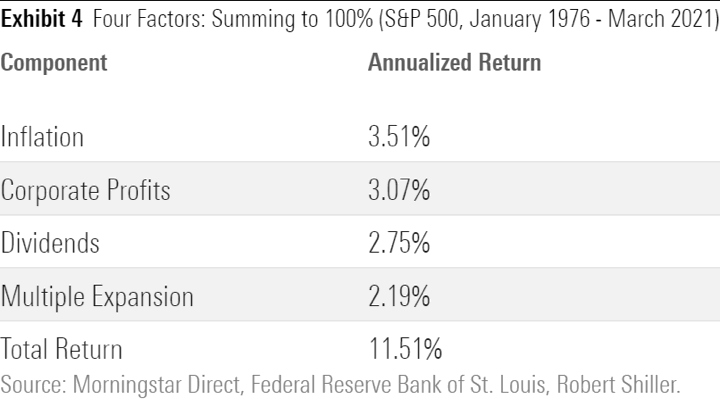
Even if the P/E ratio seems a lot higher now than the historical average, what has that actually meant? The Morningstar article How Much Has the Market Benefited from Investor Optimism? examines how much of the historical return of the S&P 500 from 1976 through March 2021 was from P/E expansion.

In January 1976, the P/E ratio was only 11.8. In March 2021, the P/E ratio was 31.5. That seems like a huge difference, and over that 45-year time period, it did add 2.2% to the overall historical average annual return. But we also got 3% from earning growth, and another 2.75% from dividends, for a total return of ~8% above inflation. 8% real return!

In a way, this is somewhat comforting, as if you look at the long-term, a shrinking P/E ratio won’t completely destroy your retirement by itself. Instead of adding 2%, it might subtract 2%.

Looking ahead, if you assume a generous 4% from earnings growth, 0% from a constant P/E ratio, and 1.3% from dividends, that’s roughly a 5% future real return. But if the P/E ratio goes back even partly back to historical averages, that will be closer to a 4% real return. The problem is that bonds are giving us 0% real return at best, so I’m sticking with owning productive businesses.

The numbers on my brokerage statements keep going up so perhaps I shouldn’t complain, but I sure hope the earnings start to catch up to the prices soon (as some predict). I like the idea of the P/E ratio going down due to higher earnings rather than lower prices!

Real-World Smoothing Effects of Regular Investments (Dollar Cost Averaging)

Most people must rely on the power of smaller, regular investments from work income to build up their retirement nest egg. In the latest Sound Investing email, Paul Merriman shared a new Lifetime Investment Calculator that helps you see how these gradual investments (dollar-cost averaging) would have added up during various periods, using actual historical returns from 1970 to 2020.

I’ve already tried to illustrate how regular investments of $250 or $500 a month can add up over time. But instead of having to manually gather performance numbers from a Vanguard Target Retirement fund in a spreadsheet, this fancier calculator lets you adjust many more variables. You can choose different asset allocations, stock/bond ratio, investment amounts, and so on. Importantly, the calculator uses actual historical returns, so you can see what would happen if you invested through the 2001 dot-com bust, 2008 financial crisis, and so on.

You can start the sequence of returns from any of the 51 years to replicate your financial picture as if your decisions were available in the past. For example, you could simulate the role of luck by starting or ending your journey in a bull or bear market. It is not a financial planning calculator per se, nor meant to be a complete planning tool, but it allows you to customize both growth (accumulation) and distribution phases based on your personal timeline and investments.

If you aren’t familiar with Paul Merriman, he is an advocate of adding a bit of complexity to index fund portfolios via additional exposure to smaller and value-oriented companies. For a test run, I went for the “Ultimate Buy and Hold Worldwide (70% US/30% International)” portfolio, alongside a simple S&P 500 portfolio.

Here is $10,000 invested every year for 15 years, with small ~3% increases each year with inflation (ideally corresponding with a higher paycheck), starting in 2005:

Here is $10,000 invested every year for 15 years, with small ~3% increases each year with inflation (ideally corresponding with a higher paycheck), starting in 2000:

Here is $10,000 invested every year for 15 years, with small ~3% increases each year with inflation (ideally corresponding with a higher paycheck), starting in 1995:

You can see that an internationally-diversified portfolio may not be the best in some periods, but it also may not be the worst in others. (I admit I am a bit confused as to why the performance numbers for any given year are slightly different for each test run, perhaps someone out there can explain that to me.)

Even in the 1995-2010 period that contained both the 2001 dot-com bust and the 2008 financial crisis, your ending balance would still have ended up much higher than your total contributions with the internationally-diversified portfolio.

Richer, Wiser, Happier: Notes From 40+ Super Investors NOT Named Warren Buffett

It was very telling that the first chapter of Richer, Wiser, Happier: How the World’s Greatest Investors Win in Markets and Life by William Green was a profile of Mohnish Pabrai. In other words, not Warren Buffett! If you aren’t a student of value investing, then you probably have never even heard of him before. He is best known for a being a “clone” investor.

“I’m a shameless copycat,” he says. “Everything in my life is cloned.… I have no original ideas.” Consciously, systematically, and with irrepressible delight, he has mined the minds of Buffett, Munger, and others not only for investment wisdom but for insights on how to manage his business, avoid mistakes, build his brand, give away money, approach relationships, structure his time, and construct a happy life.

That descriptor always seemed a bit derogatory, but after reading more about Pabrai in this book, I grew quite a lot of appreciation and respect for his approach. If you also like collecting outside wisdom (especially about investing) and incorporating into your life, you will likely enjoy this book as well. Green is an excellent writer and journalist that has managed to interview over 40 of the world’s greatest investors (many of which I’d never heard of until now), and this became the most heavily-highlighted book in my Kindle. Here are a fraction of them:

Mohnish Pabrai

Rule 1: Clone like crazy. Rule 2: Hang out with people who are better than you. Rule 3: Treat life as a game, not as a survival contest or a battle to the death. Rule 4: Be in alignment with who you are; don’t do what you don’t want to do or what’s not right for you. Rule 5: Live by an inner scorecard; don’t worry about what others think of you; don’t be defined by external validation.

Cloning Buffett, who once showed him the blank pages of his little black diary, Pabrai keeps his calendar virtually empty so he can spend most of his time reading and studying companies. On a typical day at the office, he schedules a grand total of zero meetings and zero phone calls. One of his favorite quotes is from the philosopher Blaise Pascal: “All of humanity’s problems stem from man’s inability to sit quietly in a room alone.” […] He says it helps that his investment staff consists of a single person: him. “The moment you have people on your team, they’re going to want to act and do things, and then you’re hosed.”

John Templeton

To his credit, Templeton was especially demanding of himself. Take his attitude toward saving and spending. “After my education, I had absolutely no money and neither did my bride,” he told me. “So we deliberately saved fifty cents out of every dollar we earned.”

Distrustful of debt, he always paid cash for his cars and homes. He also claimed that his wartime bet was the only time he ever borrowed money to invest. During the Great Depression he’d seen how easy it was for overextended people to come undone, and he regarded fiscal discipline as a moral virtue.

Howard Marks

“Look, luck is not enough,” he says. “But equally, intelligence is not enough, hard work is not enough, and even perseverance is not necessarily enough. You need some combination of all four.

He plans to work indefinitely because he finds it intellectually rewarding, not because he has an “unquenchable” thirst for money or status. He recalls his Japanese studies professor explaining a Buddhist teaching that “you have to break the chain of getting and wanting”—an aimless cycle of craving that leads inevitably to suffering.

Irving Kahn

Kahn became Graham’s teaching assistant at Columbia in the 1920s, and they remained friends for decades. I wanted to know what he’d learned from Graham that had helped him to prosper during his eighty-six years in the financial markets. Kahn’s answer: “Investing is about preserving more than anything. That must be your first thought, not looking for large gains. If you achieve only reasonable returns and suffer minimal losses, you will become a wealthy man and will surpass any gambler friends you may have. This is also a good way to cure your sleeping problems.”

Just think for a moment about those basic ingredients that helped to make for a richly rewarding life. Family, health, challenging and useful work, which involved serving his clients well by compounding their savings conservatively over decades. And learning—particularly from Graham, an investment prophet who, Kahn said, “taught me how to study companies and succeed through research as opposed to luck or happenstance.”

Joel Greenblatt

This raises an obvious but crucial question: Do you know how to value a business? There’s nothing admirable or shameful about your response. But you and I need to answer this question honestly, since self-delusion is a costly habit in extreme sports such as skydiving and stock picking. “It’s a very small fraction of people that can value businesses—and if you can’t do that, I don’t think you should be investing on your own,” says Greenblatt. “How can you invest intelligently if you can’t figure out what something is worth?”

These experiences have led him to an important revelation: “For most individuals, the best strategy is not the one that’s going to get you the highest return.” Rather, the ideal is “a good strategy that you can stick with” even “in bad times.”

Charlie Munger

Munger often preaches about the importance of avoiding behavior with marginal upside and devastating downside. He once observed, “Three things ruin people: drugs, liquor, and leverage.”

Asked for career advice, he opines: “You have to play in a game where you’ve got some unusual talents. If you’re five foot one, you don’t want to play basketball against some guy who’s eight foot three. It’s just too hard. So you’ve got to figure out a game where you have an advantage, and it has to be something that you’re deeply interested in.”

Survivorship bias! I would say that one of the dangers of this book is that it may make you want to be a stock picker. All of the people profiled are probably have a net worth of over $50 million if not much more. Many made a few bold bets, and they paid off big. I want an oceanfront house in Newport Beach, my own private jet, and a vintage car to drive across Asia too!

The rewards for investing intelligently are so extravagant that the business attracts many brilliant minds.

Beating the market means being different. Can you make “unconventional bets that the crowd would consider foolish”? Are you a good fit for the “bizarrely lucrative discipline of sitting alone in a room and occasionally buying a mispriced stock”? Do you have enough humility to make a good judgment, mixed with the self-confidence to bet big when you think you have an edge?

Even if you think you do, survivorship bias reminds us that there are many, many highly-intelligent, hard-working people who tried their best to apply these concepts, but did not succeed. They are missing from the pages of this book, and you’ll never read their stories.

The true goal is independence. The good news is that you don’t need be a great stock picker. Even if you just invest in low-cost index funds and can stick with it, you can do quite well and still achieve the ability to be independent and become in control of your time on Earth.

Buffett said, “If you’re even a slightly above average investor who spends less than you earn, over a lifetime you cannot help but get very wealthy.”

Howard Marks: “Most people should index most of their money.”

The pattern is clear. In their own ways, Greenblatt, Buffett, Bogle, Danoff, and Miller have all been seekers of simplicity. The rest of us should follow suit. We each need a simple and consistent investment strategy that works well over time—one that we understand and believe in strongly enough that we’ll adhere to it faithfully through good times and bad.

“You build capital and then you can do whatever you want because you’re independent.” For many of the most successful investors I’ve interviewed, that freedom to construct a life that aligns authentically with their passions and peculiarities may be the single greatest luxury that money can buy.

p.s. Here is a list of the people profiled in this book; I can’t guarantee I got all of them but it’s definitely close. A good source for additional research.

  • Sir John Templeton
  • Irving Kahn
  • Bill Ruane
  • Marty Whitman
  • Jack Bogle
  • Charlie Munger
  • Ed Thorp
  • Howard Marks
  • Joel Greenblatt
  • Bill Miller
  • Mohnish Pabrai
  • Tom Gayner
  • Guy Spier
  • Fred Martin
  • Ken Shubin Stein
  • Matthew McLennan
  • Jeffrey Gundlach
  • Francis Chou
  • Thyra Zerhusen
  • Thomas Russo
  • Chuck Akre
  • Li Lu
  • Peter Lynch
  • Pat Dorsey
  • Michael Price
  • Mason Hawkins
  • Bill Ackman
  • Jeff Vinik
  • Mario Gabelli
  • Laura Geritz
  • Brian McMahon
  • Henry Ellenbogen
  • Donald Yacktman
  • Bill Nygren
  • Paul Lountzis
  • Jason Karp
  • Will Danoff
  • François Rochon
  • John Spears
  • Joel Tillinghast
  • Qais Zakaria
  • Nick Sleep
  • Paul Isaac
  • Mike Zapata
  • Paul Yablon
  • Whitney Tilson
  • François-Marie Wojcik
  • Sarah Ketterer
  • Christopher Davis
  • Raamdeo Agrawal
  • Arnold Van Den Berg
  • Mariko Gordon
  • Jean-Marie Eveillard
  • Guy Spier

Turning Small Deals into a $100,000 Nest Egg

There is a story circulating about MIT students offered $100 in free Bitcoin back in 2014. A few quickly spent it on dinner at a local sushi restaurant. Some kept it all, now worth about $14,000. Some agreed to help fellow students set up a crypto wallet to hold their Bitcoin, in exchange for some of it. 1 BTC was worth about about $300 back then, and about $45,000 now. Those sushi dinners ended up being quite expensive, but can you really blame them? How many of us went out and backed the truck up on Bitcoin in 2014?

However, that got me thinking about the various deals that I post on this blog. I don’t know what you do for work, but I trust that you work hard and balance your levels of passion, income, and ability. I can’t help you much with your career, but these deals are a way to find common ground, as they are available to the great majority of readers. You may think of them as “free sushi dinners”, but they can equally be a powerful source of retirement savings and income.

1. Consider a target of $500 monthly profit coming from whatever deals are currently available. It could be higher interest on savings accounts, bank sign-up bonuses, credit card cash back, credit card sign-up bonuses, brokerage bonuses, US Mint purchases, savings on your normal everyday purchases, solo-business promotions, and so on. This is a relatively aggressive target, but if you consider everything together and average it out, it can add up quickly. I’ve been doing similar deals since I was 21 years old making $20,000 a year with $30,000 in student loans.

2. $500 a month = $6,000 a year = Maxed-out Roth IRA contribution. The 2021 contribution limit for Roth IRAs in $6,000 a year, with an additional $1,000 for those aged 50+. I always find this a very handy target to help me focus my profit from the “deals and offers” game. If you have a partner, going for $12,000 combined is an even better target. I’ve made every effort to do the max for 20 years now.

3. Invest in simple, transparent, productive assets. Some people are great with real estate, others reinvest in their own private small businesses. We should appreciate that anyone with $1,000 can open a IRA at Vanguard with minimal fees and invest in the all-in-one Vanguard Target Retirement Fund, which is a low-cost, diversified mix of global stocks and bonds. You don’t need to gamble on options at Robinhood, put too much in Bitcoin lottery tickets, or get insider access to a trendy “alternative/long/short/volatility-managed” hedge fund. Put it in, turn on automatic reinvestment of dividends, and walk away. Inside a Roth IRA, you don’t have to worry about taxes on dividends or capital gains distributions.

4. Repeat for 10 years. If you did this from 2011-2020, you’d have over $100,000. Every January, I show how regular, steady investments over time can end up with excellent results. Here is a table from What If You Invested $10,000 Every Year For the Last 10 Years? 2021 Edition:

Global stock markets are up even further in 2021 (VTIVX is up another 12% YTD as of this writing), but we can simply stick with these numbers. The chart assumes a $10,000 annual investment ($833 a month), but we can easily scale it down to our $6,000 annual investment.

If you invested $6,000 a year into the Vanguard Target Retirement 2045 Fund, every year for the past 10 years (2011-2020), you would have ended up with a total balance of $110,822. (If two people did this, they would have over $220,000!) These are real-world numbers based on $500 a month, not a theoretical result from a calculator. You can argue the details, but even with only $250 a month, you’d have ended up with over $50,000. (You would have done even better going all-in with an S&P 500 index fund as well, but this is an easy, set-and-forget choice including global stocks and bonds.)

I admit, I like to play the game of “winning” easy/free money. I find it much more enjoyable than any video game. I also try to only pick and choose those that offer a good payout/effort ratio, usually over the equivalent of $100 an hour. Now, these small deals will never replace a successful career, which can supercharge your savings into the realm of financial independence. However, this is yet another reminder that small amounts, however attained, can add up to a surprisingly big number over time when invested productively and left alone. I have the Vanguard IRA statements to prove it. 😀

Best Interest Rates on Cash – August 2021 Update

Here’s my monthly roundup of the best interest rates on cash as of August 2021, roughly sorted from shortest to longest maturities. I look for lesser-known opportunities to earn 3% APY and higher while still keeping your principal FDIC-insured or equivalent. Check out my Ultimate Rate-Chaser Calculator to see how much extra interest you’d earn by moving money between accounts. Rates listed are available to everyone nationwide. Rates checked as of 8/10/2021.

Fintech accounts
Available only to individual investors, fintech companies often pay higher-than-market rates in order to achieve fast short-term growth (often using venture capital). I define “fintech” as a software layer on top of a different bank’s FDIC insurance. These do NOT require a certain number debit card purchases per month. Read about the types of due diligences you should do whenever opening a new bank account.

  • 3% APY on up to $100,000. The top rate is still 3% APY for July through September 2021 (actually up to 3.5% APY with their credit card), and they have not indicated any upcoming rate drop. HM Bradley requires a recurring direct deposit every month and a savings rate of at least 20%. See my HM Bradley review.
  • 3% APY on 10% of direct deposits + 1% APY on $25,000. One Finance lets you earn 3% APY on “auto-save” deposits (up to 10% of your direct deposit, up to $1,000 per month). Separately, they also pay 1% APY on up to another $25,000 with direct deposit. New customer $50 bonus via referral. See my One Finance review.
  • 3% APY on up to $15,000. Porte requires a one-time direct deposit of $1,000+ to open a savings account. New customer $50 bonus via referral. See my Porte review.
  • 1.20% APY on up to $50,000. OnJuno recently updated their rate tiers, while keeping their promise to existing customers with a grandfathered rate. If you don’t maintain a $500 direct deposit each month, you’ll still earn 1.20% on up to $5k. See my updated OnJuno review.

High-yield savings accounts
While the huge megabanks pay essentially no interest, it’s easy to open a new “piggy-back” savings account and simply move some funds over from your existing checking account. The interest rates on savings accounts can drop at any time, so I list the top rates as well as competitive rates from banks with a history of competitive rates. Some banks will bait you with a temporary top rate and then lower the rates in the hopes that you are too lazy to leave.

  • T-Mobile Money is still at 1.00% APY with no minimum balance requirements. The main focus is on the 4% APY on your first $3,000 of balances as a qualifying T-mobile customer plus other hoops, but the lesser-known perk is the 1% APY for everyone. Thanks to the readers who helped me understand this. There are several other established high-yield savings accounts at closer to 0.50% APY.

Short-term guaranteed rates (1 year and under)
A common question is what to do with a big pile of cash that you’re waiting to deploy shortly (just sold your house, just sold your business, legal settlement, inheritance). My usual advice is to keep things simple and take your time. If not a savings account, then put it in a flexible short-term CD under the FDIC limits until you have a plan.

  • No Penalty CDs offer a fixed interest rate that can never go down, but you can still take out your money (once) without any fees if you want to use it elsewhere. Marcus has a 7-month No Penalty CD at 0.45% APY with a $500 minimum deposit. Ally Bank has a 11-month No Penalty CD at 0.50% APY for all balance tiers. CIT Bank has a 11-month No Penalty CD at 0.30% APY with a $1,000 minimum deposit. You may wish to open multiple CDs in smaller increments for more flexibility.
  • Lafayette Federal Credit Union has a 12-month CD at 0.80% APY ($500 min). Early withdrawal penalty is 6 months of interest. Anyone can join this credit union via partner organization ($10 one-time fee).

Money market mutual funds + Ultra-short bond ETFs
Many brokerage firms that pay out very little interest on their default cash sweep funds (and keep the difference for themselves). Unfortunately, money market fund rates are very low across the board right now. Ultra-short bond funds are another possible alternative, but they are NOT FDIC-insured and may experience short-term losses at times. These numbers are just for reference, not a recommendation.

  • The default sweep option is the Vanguard Federal Money Market Fund which has an SEC yield of 0.01%. Vanguard Cash Reserves Federal Money Market Fund (formerly Prime Money Market) currently pays 0.01% SEC yield.
  • Vanguard Ultra-Short-Term Bond Fund currently pays 0.27% SEC yield ($3,000 min) and 0.37% SEC Yield ($50,000 min). The average duration is ~1 year, so your principal may vary a little bit.
  • The PIMCO Enhanced Short Maturity Active Bond ETF (MINT) has a 0.22% SEC yield and the iShares Short Maturity Bond ETF (NEAR) has a 0.41% SEC yield while holding a portfolio of investment-grade bonds with an average duration of ~6 months.

Treasury Bills and Ultra-short Treasury ETFs
Another option is to buy individual Treasury bills which come in a variety of maturities from 4-weeks to 52-weeks. You can also invest in ETFs that hold a rotating basket of short-term Treasury Bills for you, while charging a small management fee for doing so. T-bill interest is exempt from state and local income taxes. Right now, this section isn’t very interesting as T-Bills are yielding close to zero!

  • You can build your own T-Bill ladder at TreasuryDirect.gov or via a brokerage account with a bond desk like Vanguard and Fidelity. Here are the current Treasury Bill rates. As of 8/10/2021, a new 4-week T-Bill had the equivalent of 0.05% annualized interest and a 52-week T-Bill had the equivalent of 0.08% annualized interest.
  • The Goldman Sachs Access Treasury 0-1 Year ETF (GBIL) has a -0.07% SEC yield and the SPDR Bloomberg Barclays 1-3 Month T-Bill ETF (BIL) has a -0.10% (!) SEC yield. GBIL appears to have a slightly longer average maturity than BIL.

US Savings Bonds
Series I Savings Bonds offer rates that are linked to inflation and backed by the US government. You must hold them for at least a year. If you redeem them within 5 years there is a penalty of the last 3 months of interest. The annual purchase limit is $10,000 per Social Security Number, available online at TreasuryDirect.gov. You can also buy an additional $5,000 in paper I bonds using your tax refund with IRS Form 8888.

  • “I Bonds” bought between May 2021 and October 2021 will earn a 3.54% rate for the first six months. The rate of the subsequent 6-month period will be based on inflation again. More info here.
  • In mid-October 2021, the CPI will be announced and you will have a short period where you will have a very close estimate of the rate for the next 12 months. I will have another post up at that time.
  • See below about EE Bonds as a potential long-term bond alternative.

Prepaid Cards with Attached Savings Accounts
A small subset of prepaid debit cards have an “attached” FDIC-insured savings account with exceptionally high interest rates. The negatives are that balances are severely capped, and there are many fees that you must be careful to avoid (lest they eat up your interest). There is a long list of previous offers that have already disappeared with little notice. I don’t personally recommend nor use any of these anymore, as I feel the work required and risk of messing up exceeds any small potential benefit.

  • Mango Money pays 6% APY on up to $2,500, if you manage to jump through several hoops. Requirements include $1,500+ in “signature” purchases and a minimum balance of $25.00 at the end of the month.

Rewards checking accounts
These unique checking accounts pay above-average interest rates, but with unique risks. You have to jump through certain hoops which usually involve 10+ debit card purchases each cycle, a certain number of ACH/direct deposits, and/or a certain number of logins per month. If you make a mistake (or they judge that you did) you risk earning zero interest for that month. Some folks don’t mind the extra work and attention required, while others would rather not bother. Rates can also drop suddenly, leaving a “bait-and-switch” feeling.

  • The Bank of Denver pays 2.00% APY on up to $25,000 if you make 12 debit card purchases of $5+ each, receive only online statements, and make at least 1 ACH credit or debit transaction per statement cycle. The rate recently dropped. If you meet those qualifications, you can also link a Kasasa savings account that pays 1.00% APY on up to $50k. Thanks to reader Bill for the updated info.
  • Devon Bank has a Kasasa Checking paying 2.50% APY on up to $10,000, plus a Kasasa savings account paying 2.50% APY on up to $10,000 (and 0.85% APY on up to $50,000). You’ll need at least 12 debit transactions of $3+ and other requirements every month.
  • Presidential Bank pays 2.25% APY on balances up to $25,000, if you maintain a $500+ direct deposit and at least 7 electronic withdrawals per month (ATM, POS, ACH and Billpay counts).
  • Evansville Teachers Federal Credit Union pays 3.30% APY on up to $20,000. You’ll need at least 15 debit transactions and other requirements every month.
  • Lake Michigan Credit Union pays 3.00% APY on up to $15,000. You’ll need at least 10 debit transactions and other requirements every month.
  • Find a locally-restricted rewards checking account at DepositAccounts.

Certificates of deposit (greater than 1 year)
CDs offer higher rates, but come with an early withdrawal penalty. By finding a bank CD with a reasonable early withdrawal penalty, you can enjoy higher rates but maintain access in a true emergency. Alternatively, consider building a CD ladder of different maturity lengths (ex. 1/2/3/4/5-years) such that you have access to part of the ladder each year, but your blended interest rate is higher than a savings account. When one CD matures, use that money to buy another 5-year CD to keep the ladder going. Some CDs also offer “add-ons” where you can deposit more funds if rates drop.

  • Abound Credit Union has a special 13-month Share Certificate at 0.80% APY ($500 min), a special 47-month Share Certificate at 1.45% APY ($500 min), and a 59-month Share Certificate at 1.35% APY ($500 min). Early withdrawal penalty is 1 year of interest (and only with the consent of the credit union, so be aware). Anyone can join this credit union via partner organization ($10 one-time fee).
  • NASA Federal Credit Union has a special 49-month Share Certificate at 1.15% APY ($10,000 min). Early withdrawal penalty is 1 year of interest. Anyone can join this credit union by joining the National Space Society (free). Note that NASA FCU may perform a hard credit check as part of new member application.
  • Lafayette Federal Credit Union has a 5-year CD at 1.26% APY ($500 min). Early withdrawal penalty is 6 months of interest. Anyone can join this credit union via partner organization ($10 one-time fee).
  • You can buy certificates of deposit via the bond desks of Vanguard and Fidelity. You may need an account to see the rates. These “brokered CDs” offer FDIC insurance and easy laddering, but they don’t come with predictable early withdrawal penalties. Right now, I see a 5-year CD at 1.05% APY. Be wary of higher rates from callable CDs listed by Fidelity.

Longer-term Instruments
I’d use these with caution due to increased interest rate risk, but I still track them to see the rest of the current yield curve.

  • Willing to lock up your money for 10 years? You can buy long-term certificates of deposit via the bond desks of Vanguard and Fidelity. These “brokered CDs” offer FDIC insurance, but they don’t come with predictable early withdrawal penalties. You might find something that pays more than your other brokerage cash and Treasury options. Right now, I see a 10-year CD at 1.55% APY vs. 1.45% for a 10-year Treasury. Watch out for higher rates from callable CDs from Fidelity.
  • How about two decades? Series EE Savings Bonds are not indexed to inflation, but they have a unique guarantee that the value will double in value in 20 years, which equals a guaranteed return of 3.5% a year. However, if you don’t hold for that long, you’ll be stuck with the normal rate which is quite low (currently 0.10%). I view this as a huge early withdrawal penalty. But if holding for 20 years isn’t an issue, it can also serve as a hedge against prolonged deflation during that time. Purchase limit is $10,000 each calendar year for each Social Security Number. As of 8/10/2021, the 20-year Treasury Bond rate was 1.90%.

All rates were checked as of 8/10/2021.

This Becky Quick Quote Sums Up the Buffett and Munger Partnership

After finishing up the 4-part CNBC Squawk Podcast containing the full “Wealth of Wisdom” interview with Warren Buffett and Charlie Munger, the journalist Becky Quick summed up the essence of their 60-year friendship and partnership (emphasis mine):

It’s not a complicated lesson, it’s probably just one we don’t sit on and reflect upon often enough. You should surround yourself with people who inspire you, and people you don’t want to disappoint. That’s what it’s all about, right? Making sure we are all our best selves. It’s such a universal truth. All of us can look at the relationships we’ve had over the years, and what inspires you to do better? It’s really those people who put faith in you, and wow, you don’t want to let them down.

Definitely something to reflect upon.

I enjoy all of these CNBC interviews with Becky Quick – you can see that she has a comfortable and respectful relationship with them, while still pressing them for clarity on certain issues. As soon as the interview officially ends, Becky Quick lets out a laugh and remarks:

You’d rather be in jail… than work at a corporation!?!”

Technically, Warren Buffet says he would rather be in jail with some interesting people and a good pile of books… rather than micro-managing the daily activities and hundred of employees of Berkshire subsidiaries. I get your point, Warren! 👍

Creating a 10-Year Backup Plan For (Post) Early Retirement

My contrarian thought of the day? I feel that the retirement planning industry downplays the role of luck. Life is not a as certain as the smooth exponential curves that they show you. Perhaps the statistically optimal bet is to jump a bit early and hope for the best, while having a backup plan for the worst. You might just win an extra 10 years of freedom.

If you tinker with portfolio survival calculators like FireCalc and cFIREsim that model hundreds of possible paths, you may notice that the “failure” paths usually happen when a bear market occurs soon after you retire. If you keep spending when a portfolio is down, it may never recover.

Even if you have the same portfolio size, same withdrawals, and the same average returns, having the bad years occur upfront can lead to failure while having the bad years at the end can lead to success. This is known as sequence of returns risk.

sor_risk

Retiring in 2000 with a 4% withdrawal rate: Warning! 🚨🚨🚨 In 2021, most people happily accept that the stock market just goes up and up. However, every so often there will be a “lost decade”. If you retired in 2000 with a portfolio invested in the S&P 500 and used a 4% withdrawal rate (increasing each year by 3% for inflation), here’s how that would have looked like (yellow line):

Retiring in 2010 with a 4% withdrawal rate: More money than you started with. 💰💰💰 If you have solid returns upfront, then you gained a decade of priceless freedom! For retirees of the “Class of 2011”, consider that their portfolio is likely larger today in 2021 even after a decade of withdrawals.

Retiring in 2021? Crystal ball is cloudy. If you are in the retirement “Class of 2021”, many predictions call for another lost decade. Yet, even if the next 10 years have poor returns, better times may be right around the corner. From this article by Davis Advisors:

Though frustrating, stretches of disappointing results for the market are not unprecedented. History shows however, that these difficult stretches have been followed by periods of recovery. Why? Because lower prices increase future returns. – Christopher Davis

This article was written in 2012, and it turns out that Davis was right. As of Q2 2021, the trailing 10-year annual return of the S&P 500 is over 12% annualized. Here is a chart showing the subsequent 10-year performance after each past “lost decade of stock returns”.

Surviving the first 10 years of retirement. The lesson here is to avoid taking out big withdrawals during a stock market slump drop during the first 10 years, so that it can benefit from the rebound of the next 10 years. At the same time, you don’t want give up the chance of 10 extra years of freedom. Therefore, perhaps the best bet is to retire when you have a reached your chosen savings target (for example, 25 times annual expenses), but also maintain a detailed backup plan during the first 10 years. Here are some things you might include in that plan:

  • Plan ahead for way that you can temporarily cut back on spending if you need to. Big to small. For example, plan to move to a lower-cost city, country, or housing option.
  • Identify non-essential assets that you will sell if you need to. Vacation property, etc.
  • Maintain employment opportunities in your current career field. Go back to part-time, freelance, consulting, etc.
  • Have alternative employment plans in a different career field to create supplemental income.

(By “plan”, I mean written out on a piece of paper. This improves the clarity of your thinking.)

The most powerful way to counter “sequence of returns risk” is variable withdrawals – a fancy term for the brilliant idea of not taking out as much money from your portfolio when it is getting beaten down. But the first 10 years is the most important, and the first 10 years is probably the easiest to go back to the workforce in a limited capacity.

Bottom line. Deciding when to stop working can be a difficult, personality-driven decision, but one option is to retiring with 95-98% odds of success with a practical backup plan, rather than waiting several more years and reaching 99.5% odds of success. Accept that luck matters (and also that you might have to go back to work). However, you also might gain extra priceless years of freedom. Life is never 100% certain anyway.

MMB Portfolio Update July 2021: Dividend and Interest Income

dividendmono225

While my July 2021 portfolio asset allocation is designed for total return, I also track the income produced quarterly. Stock dividends are the portion of profits that businesses have decided they don’t need to reinvest into their business. The dividends may suffer some short-term drops, but over the long run they have grown faster than inflation. Here is the historical growth of the S&P 500 absolute dividend, updated as of 2021 Q2 (source):

This means that if you owned enough of the S&P 500 to produce an annual dividend income of about $13,000 a year in 1999, then today those same shares would be worth a lot more AND your annual dividend income would have increased to $50,000 a year, even if you spent all that dividend income every year.

I track the “TTM” or “12-Month Yield” from Morningstar, which is the sum of the trailing 12 months of interest and dividend payments divided by the last month’s ending share price (NAV) plus any capital gains distributed over the same period. I prefer this measure because it is based on historical distributions and not a forecast. Below is a rough approximation of my portfolio (2/3rd stocks and 1/3rd bonds).

Asset Class / Fund % of Portfolio Trailing 12-Month Yield (Taken 7/19/21) Yield Contribution
US Total Stock
Vanguard Total Stock Market Fund (VTI, VTSAX)
25% 1.26% 0.36%
US Small Value
Vanguard Small-Cap Value ETF (VBR)
5% 1.60% 0.08%
International Total Stock
Vanguard Total International Stock Market Fund (VXUS, VTIAX)
25% 2.44% 0.53%
Emerging Markets
Vanguard Emerging Markets ETF (VWO)
5% 1.98% 0.09%
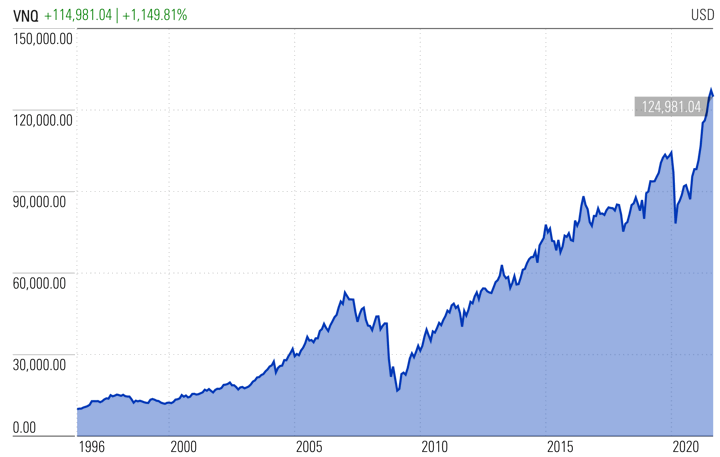
US Real Estate
Vanguard REIT Index Fund (VNQ, VGSLX)
6% 2.34% 0.24%
Intermediate-Term High Quality Bonds
Vanguard Intermediate-Term Treasury ETF (VGIT)
17% 1.26% 0.26%
Inflation-Linked Treasury Bonds
Vanguard Short-Term Inflation-Protected Securities ETF (VTIP)
17% 1.35% 0.20%
Totals 100% 1.69%


Trailing 12-month yield history. Here is a chart showing how this 12-month trailing income rate has varied since I started tracking it in 2014.

Portfolio value reality check. One of the things I like about using this number is that when stock prices drop, this percentage metric usually goes up – which makes me feel better in a bear market. When stock prices go up, this percentage metric usually goes down, which keeps me from getting too euphoric during a bull market.

Here’s a related quote from Jack Bogle (source):

The true investor… will do better if he forgets about the stock market and pays attention to his dividend returns and to the operating results of his companies.

Absolute dividend income history. It was more difficult to track the absolute income produced as I’d have to remove the effect of additional investments, reinvestment of dividends and interest, rebalancing, and capital gains distributions. To get a general idea, I looked at the Vanguard LifeStrategy Growth Fund (VASGX) to see what kind of income that $1 million back in 2014 would have generated up until today. This is not exactly my portfolio, but is somewhat close at a steady 80% stock/20% bond ratio with some international stock exposure. For example, it’s current 12-month yield is 1.59%.

During 2014, VASGX distributed about $0.61 of income per share, at an average price about $29 per share. That’s a yield of about 2.1%. So $1,000,000 of VASGX in 2014 would have distributed about $21,000 of annual income (about 34,482 shares).

Those same 34,482 shares would be worth about $1,510,000 currently (as of 7/16/2021 at $43.79 per share). In 2018, the income produced was roughly $27,500 a year (80 cents per share). In 2019, the income produced was $29,000 a year (84 cents per share). In 2020, the income produced was $23,000 a year (67 cents per share ).

Putting it all together. This quarter’s trailing income yield of 1.69% is the lowest ever since 2014. It is almost exactly 1% lower than what it was in late 2018. At the same time, both the portfolio value and the absolute income produced is higher than in 2014. If you retired back in 2014 and have been living off your stock/bond portfolio, you’ve been doing fine.

However, this is not necessarily good news going forward. There are countless articles debating this topic, but I historically support a 3% withdrawal rate as a reasonable target for planning purposes if you want to retire young (before age 50) and a 4% withdrawal rate as a reasonable target if retiring at a more traditional age (closer to 65). However, nobody is guaranteeing these numbers and flexibility may be required to make your portfolio reliably last a long time.

If you are not close to retirement, there is not much use worrying about these decimal points. Your time is better spent focusing on earning potential via better career moves, improving in your skillset, and/or looking for entrepreneurial opportunities where you can have an ownership interest.

How we handle this income. Our dividends and interest income are not automatically reinvested. I treat this money as part of our “paycheck”. Then, as with a traditional paycheck, we can choose to either spend it or invest it again. Even if still working, you could use this money to cut back working hours, pursue new interests, start a new business, travel, perform charity or volunteer work, and so on.

MMB Portfolio Update July 2021: Asset Allocation & Performance

portpie_blank200

Here’s my quarterly update on my current investment holdings as of July 2021, including our 401k/403b/IRAs, taxable brokerage accounts, and savings bonds but excluding our house, cash reserves, and a small portfolio of self-directed investments. Following the concept of skin in the game, the following is not a recommendation, but a real-world example of a mostly low-cost, diversified, simple DIY portfolio with a few customized tweaks. The goal of this portfolio is to create sustainable income that keeps up with inflation to cover our household expenses.

Actual Asset Allocation and Holdings
I use both Personal Capital and a custom Google Spreadsheet to track my investment holdings. The Personal Capital financial tracking app (free, my review) automatically logs into my different accounts, adds up my various balances, tracks my performance, and calculates my overall asset allocation. Once a quarter, I also update my manual Google Spreadsheet (free, instructions) because it helps me calculate how much I need in each asset class to rebalance back towards my target asset allocation.

Here are updated performance and asset allocation charts, per the “Allocation” and “Holdings” tabs of my Personal Capital account, respectively:

Stock Holdings
Vanguard Total Stock Market (VTI, VTSAX)
Vanguard Total International Stock Market (VXUS, VTIAX)
Vanguard Small Value (VBR)
Vanguard Emerging Markets (VWO)
Vanguard REIT Index (VNQ, VGSLX)

Bond Holdings
Vanguard Limited-Term Tax-Exempt (VMLTX, VMLUX)
Vanguard Intermediate-Term Tax-Exempt (VWITX, VWIUX)
Vanguard Intermediate-Term Treasury (VFITX, VFIUX)
Vanguard Inflation-Protected Securities (VIPSX, VAIPX)
Fidelity Inflation-Protected Bond Index (FIPDX)
iShares Barclays TIPS Bond (TIP)
Individual TIPS bonds
U.S. Savings Bonds (Series I)

Target Asset Allocation. I do not spend a lot of time backtesting various model portfolios, as I don’t think picking through the details of the recent past will necessarily create superior future returns. Usually, whatever model portfolio is popular in the moment just happens to hold the asset class that has been the hottest recently as well.

I believe in the importance of doing your own research and owning productive assets in which you have strong faith. Every asset class will eventually have a low period, and you must have strong faith during these periods to truly make your money. You have to keep owning and buying more stocks through the stock market crashes. You have to maintain and even buy more rental properties during a housing crunch, etc.

Personally, I try to own broad, low-cost exposure to asset classes that will provide long-term returns above inflation, distribute income via dividends and interest, and finally offer some historical tendencies to balance each other out. I have faith in the long-term benefit of owning publicly-traded US and international shares of businesses as well as high-quality US federal and municipal debt. I also own real estate through REITs.

Again, personally, I simply don’t have strong faith in the long-term results of commodities, gold, or bitcoin. I own my own house, but I choose not to participate in the higher potential gains but also higher potential risks (of both requiring more time and money) of rental real estate.

My US/international ratio floats with the total world market cap breakdown, currently at ~58% US and 42% ex-US. I’m fine with a slight home bias (owning more US stocks than the overall world market cap), but I want to avoid having an international bias.

Stocks Breakdown

  • 43% US Total Market
  • 7% US Small-Cap Value
  • 33% International Total Market
  • 7% Emerging Markets
  • 10% US Real Estate (REIT)

Bonds Breakdown

  • 33% High-Quality Nominal bonds, US Treasury or FDIC-insured
  • 33% High-Quality Municipal Bonds
  • 33% US Treasury Inflation-Protected Bonds

I have settled into a long-term target ratio of 67% stocks and 33% bonds (2:1 ratio) within our investment strategy of buy, hold, and occasionally rebalance. I use the dividends and interest to rebalance whenever possible in order to avoid taxable gains. I plan to only manually rebalance past that if the stock/bond ratio is still off by more than 5% (i.e. less than 62% stocks, greater than 72% stocks). With a self-managed, simple portfolio of low-cost funds, we can minimize management fees, commissions, and taxes.

Holdings commentary. The world seems to have stabilized since the March 2020 market drop and overall panic, but I try not to get too attached to these numbers. They seem too good to be true, even as things continue to open up. All I can do is listen to the late Jack Bogle and “stay the course”. I remain optimistic that capitalism, human ingenuity, human resilience, human compassion, and our system of laws will continue to improve things over time.

I would like to note that when few people were paying attention, TIPS have had a pretty good run for an insurance-like investment. The iShares TIPS ETF (TIP) went up 8.3% in 2019 and 10.9% in 2020. The 10-year breakeven inflation rate between TIPS and Treasury is currently about 2.3%. I’m still happy owning a chunk of my bonds as TIPS.

Performance numbers. According to Personal Capital, my portfolio is up +9.4% for 2021 YTD. I rolled my own benchmark for my portfolio using 50% Vanguard LifeStrategy Growth Fund and 50% Vanguard LifeStrategy Moderate Growth Fund – one is 60/40 and the other is 80/20 so it also works out to 70% stocks and 30% bonds. That benchmark would have a total return of +8.2% for 2021 YTD as of 7/18/2021.

I’ll share about more about the income aspect in a separate post.