High-Yield Crypto Accounts: 6% Interest in Bitcoin or 9% Interest on Stablecoin

This WSJ article is the first mainstream financial article that I’ve seen discuss the high interest rates paid on Bitcoin and stablecoin (cryptocurrency backed by a “stable” asset like the US dollar). I am (again) not a cryptocurrency expert, but it does seem appropriate to educate and warn other curious investors about the risks. Here’s my take:

  • The price of Bitcoin can vary a lot. It probably went up or down by a hundred dollars in the time you took to read this sentence.
  • Stablecoin prices tend to vary less because they promise to be backed by a stable asset. USDT (Tether) and USDC (USD Coin) are both currently trading exactly at US$1.00, so it appears that the market believes this claim. However, US dollar stablecoins are not affiliated with the US government or any central bank.
  • Brokers/exchanges where you can buy and sell these cryptocurrencies are not backed by government insurance. They are businesses – some will end up worth billions, some will get bought by a bigger competitor, and some will probably fail (likely because they were hacked). Even though they might be called “savings” or “interest” accounts, no cryptocurrency is held in an FDIC-insured bank, or even an SIPC-insured brokerage account. They will promise to keep your crypto safe and pay interest, but it is possible they may not live up to their end of the deal, AKA “counterparty risk”. Not every exchange is equal.
  • This potential risk is a big reason that they have to pay you 6% annual interest in your Bitcoin and/or 9% annual interest in your USDC stablecoin. They are lending out your assets and earning even more interest, because traditional banks won’t do so.
  • The result is two separate risks – the risk of the price of crypto itself, and counterparty risk of the place holding your crypto.

In the end, I agree with this part of the article (even with the mocking tone):

If you’re a risk-taker who relishes the ride when an asset soars and can laugh off the losses when it crashes, then maybe you should consider letting a broker borrow your cryptocurrency at a generous rate.

After all, if you aren’t troubled by the extraordinary volatility of virtual money, you might as well earn some interest on it.

I did buy some crypto a few years ago as a purely speculative investment and to promote my own learning. We are talking less than 1% of net worth, but it has become a 5-figure amount. I was very skeptical at first, but now I am partial to the theory that either BTC is worth zero, or it will eventually be worth at least on par with the market cap of gold (roughly $200,000). I accept that both scenarios are possible.

I bought Bitcoin using the Voyager app ($25 bonus, publicly-traded with $3 Billion market cap) and also opened an account with BlockFi ($250 bonus, just completed $350m Series D at $3B valuation). Both of these companies are worth well over a billion dollars and gone though various rounds of funding, which isn’t bulletproof but it means that smarter people than me have vetted their security protocols and business practices.

BlockFi pays me 6% interest on up to 2 BTC (8.6% on USDC) and Voyager pays 6.25% interest on BTC (9% on USDC). I reinvest the interest so that I own a little bit more BTC each month. However, I fully accept that I am getting paid this interest and getting the convenience of buying BTC with a few taps in exchange for the potential risk that they will go bust while losing all my BTC. There are other options like hardware wallets, but I am don’t want the inconvenience or to worry about forgetting my bitcoin passwords for my relatively small investment.

Bottom line. Sorry, you can’t earn a 9% “safe” interest rate on your cryptocurrency, even if it is a US-dollar backed stablecoin. At a minimum, you still have counterparty risk. This is a business lending out your assets, charging interest, and giving you a cut. They can go bust, and not all exchanges are the same. Perform your own due diligence when picking a broker/exchange to buy from. I picked what I think are among the safest, but it’s still risky.

Even though the interest rates are quite low, I keep my “safe” cash in FDIC-insured bank accounts and similar.

The Most Popular Ages When People Actually Claim Social Security

Although I’m still decades away from Social Security, I see a constant stream of articles about the “best” time to start taking benefits. Often, you are told to delay claiming until age 70, as you will receive a more valuable, inflation-adjusted, government-guaranteed payout for the rest of your life. But if you have a spouse, it may be better for one of them to claim as early as possible, at age 62. There are many calculators out there – here is one free tool for Optimal Social Security Claiming Strategy.

Apart from the theoretically optimal, when do people actually start taking Social Security? Here is a chart from this Morningstar article (which otherwise includes a lot of speculation):

The three most popular times are:

  • Age 62: As early as possible. Many people feel that they have little choice but to ask for the money the moment it is available. Some have health issues which change the odds against waiting. Some just want the bird in the hand now. Finally, this may be the mathematically optimal strategy for one member of a couple. Together, this makes ASAP the most popular choice by far.
  • Age 66: “Full” retirement. Although there is nothing technically magical about the age 66, it is called “full retirement age” for people retiring in 2019. This is when you’ll get “100%” of your “full” benefits, and anything less is called a “benefit reduction” and anything more is called an “benefit increase”. I wonder if behavior would change if they changed their wording? They could, for example, also just call 62 the base age and call everything after that a benefit increase.
  • Age 70: As late as possible. In order to decline “free” money from the government for 8 years, you must believe in your odds of having an average/above-average life expectancy and have enough financial assets to pay for your expenses during the wait. Less than 10% of people go this route. Your reward is a monthly benefit that is 33% higher than claiming at age 66, and 76% more than claiming at age 62. This increased income will also increase with inflation each year, and inflation-adjusted annuities are only sold by a few insurance companies and are quite expensive.

This matches my anecdotal experience from family and friends. Most people don’t consult a complicated calculator. They either take it as soon as they can for whatever reason, or they “follow the rules” and take it at the “full” retirement age. I’ll probably cough up the money for a calculator when the time comes.

Gold as a Hedge Against Bonds During Low Interest Rates

Perhaps it is because I somehow ended up buying $5,000 in gold coins a couple weeks ago, but I’ve been doing some reading about gold again. The stock market is at higher and higher valuations, while the Fed promises that interest rates will stay low for a long time. The real yield on TIPS remains negative, meaning that it is highly unlikely that any high-quality investment-grade bonds will beat inflation over the next decade. Is there really no alternative?

This Compound Advisors article does a great job exploring why gold is not an ideal hedge against inflation. The comparison chart below of performance since 1975 summarizes things in one picture. Over the 50 years since the US came off the gold standard, gold has only barely kept up with inflation while stocks and REITs… well, just look:

Here is the price of gold over the last decade (FRED).

Okay, so maybe I’m not interested in holding a huge chunk of gold as a long-term asset. But what about a little bit during this strange period of negative real yields? Movement Capital points out in the chart below that gold prices are “tethered” to real interest rates. Gold prices seem to go up when bonds stop keeping up with inflation.

If you own bonds, it is quite possible that your return this year has been negative. I peeked and the Vanguard Total Bond ETF (BND) is down 4% YTD (as of 3/19/21). Gold seems to perform best when bonds perform their worst, as highlighted below:

Therefore, if bonds are supposed to keep your portfolio safe, but right now they are in the vulnerable position of paying out less interest than inflation, gold might be a good complement. Even if gold just matches inflation, you would still come out ahead. Of course, gold often feels so volatile that it is hard to rely on the price for anything specific.

I’ve said before that I simply don’t have the proper faith in gold to own it long-term, and I’m still in that place. I suppose my primary observation is that low interest rates have made nearly everything go up in price (stocks, bonds, real estate, Bitcoin), but gold seems to be mostly ignored.

TIPS Inflation Bonds Performance: Breakeven vs. Actual Inflation Rates

I own inflation-linked bonds as part of my investment portfolio. Specifically, Treasury Inflation-Protected Securities (TIPS) make up about 1/3rd of the bond portion, or 10% of my total portfolio. I go into more detail in my post Reasons To Own TIPS, but essentially they pay interest based on a fixed real yield plus ongoing inflation. To simplify: if the real yield is 1% and inflation is 3%, they pay 4%.

Traditional “nominal” Treasury bonds simply pay a flat interest rate that doesn’t change with inflation (i.e. 3%). The difference between the TIPS real yield and the nominal Treasury yield is at any given time is what inflation would have to be for them to pay out the exact same total yield, called the “breakeven inflation rate”. If the real yield on TIPS is 1% while the nominal rate is 3% at the same moment, then the breakeven rate is 2%. You could call it a market-based prediction of future inflation.

It turns out that 10-year TIPS bonds that matured over the last several years mostly underpeformed regular nominal Treasuries, as the actual inflation turned out to be less than the breakeven inflation rate. David Enna of TIPS Watch created the interesting chart below comparing the final performance of TIPS vs. nominal Treasury bonds maturing over the last several years, where green means that TIPS “won” and red means TIPS “lost” in terms of total return. I removed some columns and highlighted the initial breakeven rate (the market-based guess) and the actual inflation rate.

Enna states:

Still, the market-determined inflation breakeven rate measures sentiment and should not be viewed as an accurate prediction. In fact, the market often does a lousy job of predicting future inflation. The fact is, over the last decade, investors have been betting on higher inflation than actually resulted, and that has led to TIPS (in general) under-performing nominal Treasuries of the same term.

I have read some articles suggesting that you could adjust your TIPS holdings based on the real yield, but perhaps another way is to adjust your holdings based on inflation breakeven rate instead. You can track the 5-year and 10-year breakeven inflation rates at FRED. As of this writing in March 2021, the breakeven inflation rate has been rising very quickly since dropping quickly in early 2020.

The last time that the breakeven inflation rate dropped so drastically was in 2009. As with stocks, it can pay off to buy when everyone else is afraid. I was lucky to buy a chunk of long-term TIPS in 2009, but I didn’t buy much in 2020 since the real yields were still quite low.

I hold Treasuries, TIPS, and FDIC/NCUA-insured CDs because I like my “safe” assets to be of the highest quality, with no worries about getting both my principal and interest. In addition, TIPS also serves as a hedge against higher-than-expected inflation. However, that also means I might suffer if there is lower-than-expected inflation. My “insurance” didn’t pay out over the last 10 years, but that’s okay. I’m also fine if my don’t make a claim on my auto insurance, homeowners insurance, (and definitely life insurance!).

p.s. If you want to buy TIPS, these days you should consider buying Series I Savings Bonds first these days (up to the purchase limits). Their 0% real yield is better than the negative real yields on nearly all TIPS right now.

Best Interest Rates on Cash – March 2021

Here’s my monthly roundup of the best interest rates on “safe” cash as of March 2021, roughly sorted from shortest to longest maturities. I keep 12 months of expenses as part of my semi-retirement cashflow planning, and there are many lesser-known opportunities to improve your yield while still being FDIC-insured or equivalent. Check out my Ultimate Rate-Chaser Calculator to see how much extra interest you’d earn by moving money between accounts. Rates listed are available to everyone nationwide. Rates checked as of 3/8/2021.

Fintech accounts
Available only to individual investors, fintech accounts oftentimes pay higher-than-market rates in order to achieve high short-term growth (i.e. higher interest via venture capital). I define “fintech” as a software layer on top of a different bank’s FDIC insurance. Although I have open accounts with the ones listed below after doing my own due diligence, read about the Beam app for potential pitfalls and best practices.

  • 3% APY on up to $100,000. The top rate is 3% APY for January through March 2021, and they have not indicated any upcoming rate drop. Sign up now and complete a direct deposit to get the highest tier in April. HM Bradley requires a recurring direct deposit every month and a savings rate of at least 20%. See my HM Bradley review.
  • 3% APY on 10% of direct deposits + 1% APY on $5,000. One Finance lets you earn 3% APY on “auto-save” deposits (up to 10% of your direct deposit, up to $1,000 per month). Separately, they also pay 1% APY on up to another $25,000 with direct deposit. New $50 bonus via referral. See my One Finance review.
  • 3% APY on up to $15,000. Porte requires a one-time direct deposit of $1,000+ to open a savings account. $50 bonus via referral. See my Porte review.
  • 2.15% APY on up to $5k/$30k. Limited-time offer of free membership to their higher balance tier for 6 months with direct deposit. See my OnJuno review.

High-yield savings accounts
While the huge megabanks pay essentially no interest, it’s easy to open a new “piggy-back” savings account and simply move some funds over from your existing checking account. The interest rates on savings accounts can drop at any time, so I list the top rates as well as competitive rates from banks with a history of competitive rates. Some banks will bait you with a temporary top rate and then lower the rates in the hopes that you are too lazy to leave.

  • T-Mobile Money has the top rate at the moment at 1.00% APY with no minimum balance requirements. The main focus is on the 4% APY on your first $3,000 of balances as a qualifying T-mobile customer plus other hoops, but the lesser-known perk is the 1% APY for everyone. Thanks to the readers who helped me understand this. There are several other established high-yield savings accounts at closer to 0.50% APY.

Short-term guaranteed rates (1 year and under)
A common question is what to do with a big pile of cash that you’re waiting to deploy shortly (just sold your house, just sold your business, legal settlement, inheritance). My usual advice is to keep things simple and take your time. If not a savings account, then put it in a flexible short-term CD under the FDIC limits until you have a plan.

  • No Penalty CDs offer a fixed interest rate that can never go down, but you can still take out your money (once) without any fees if you want to use it elsewhere. Marcus has a 7-month No Penalty CD at 0.45% APY with a $500 minimum deposit. AARP members can get an 8-month CD at 0.55% APY. Ally Bank has a 11-month No Penalty CD at 0.50% APY for all balance tiers. CIT Bank has a 11-month No Penalty CD at 0.30% APY with a $1,000 minimum deposit. You may wish to open multiple CDs in smaller increments for more flexibility.
  • Lafayette Federal Credit Union has a 12-month CD at 0.80% APY ($500 min). Early withdrawal penalty is 6 months of interest. Anyone can join this credit union via partner organization ($10 one-time fee).

Money market mutual funds + Ultra-short bond ETFs
Normally, I would say to watch out for brokerage firms that pay out very little interest on their default cash sweep funds (and keep the difference for themselves). However, money market fund rates are very low across the board right now. Ultra-short bond funds are another possible alternative, but they are NOT FDIC-insured and may experience short-term losses in extreme cases. I personally don’t think the risk is worth the tiny yield at this time.

  • The default sweep option is the Vanguard Federal Money Market Fund which has an SEC yield of 0.01%. Vanguard Cash Reserves Federal Money Market Fund (formerly Prime Money Market) currently pays 0.01% SEC yield.
  • Vanguard Ultra-Short-Term Bond Fund currently pays 0.38% SEC yield ($3,000 min) and 0.48% SEC Yield ($50,000 min). The average duration is ~1 year, so there is more interest rate risk.
  • The PIMCO Enhanced Short Maturity Active Bond ETF (MINT) has a 0.24% SEC yield and the iShares Short Maturity Bond ETF (NEAR) has a 0.38% SEC yield while holding a portfolio of investment-grade bonds with an average duration of ~6 months.

Treasury Bills and Ultra-short Treasury ETFs
Another option is to buy individual Treasury bills which come in a variety of maturities from 4-weeks to 52-weeks. You can also invest in ETFs that hold a rotating basket of short-term Treasury Bills for you, while charging a small management fee for doing so. T-bill interest is exempt from state and local income taxes. Right now, this section isn’t very interesting as T-Bills are yielding close to zero!

  • You can build your own T-Bill ladder at TreasuryDirect.gov or via a brokerage account with a bond desk like Vanguard and Fidelity. Here are the current Treasury Bill rates. As of 3/5/2020, a new 4-week T-Bill had the equivalent of 0.04% annualized interest and a 52-week T-Bill had the equivalent of 0.08% annualized interest.
  • The Goldman Sachs Access Treasury 0-1 Year ETF (GBIL) has a -0.01% SEC yield and the SPDR Bloomberg Barclays 1-3 Month T-Bill ETF (BIL) has a -0.08% (!) SEC yield. GBIL appears to have a slightly longer average maturity than BIL.

US Savings Bonds
Series I Savings Bonds offer rates that are linked to inflation and backed by the US government. You must hold them for at least a year. If you redeem them within 5 years there is a penalty of the last 3 months of interest. The annual purchase limit is $10,000 per Social Security Number, available online at TreasuryDirect.gov. You can also buy an additional $5,000 in paper I bonds using your tax refund with IRS Form 8888.

  • “I Bonds” bought between November 2020 and April 2021 will earn a 1.68% rate for the first six months. The rate of the subsequent 6-month period will be based on inflation again. More info here.
  • In mid-April 2021, the CPI will be announced and you will have a short period where you will have a very close estimate of the rate for the next 12 months. I will have another post up at that time.
  • See below about EE Bonds as a potential long-term bond alternative.

Prepaid Cards with Attached Savings Accounts
A small subset of prepaid debit cards have an “attached” FDIC-insured savings account with exceptionally high interest rates. The negatives are that balances are severely capped, and there are many fees that you must be careful to avoid (lest they eat up your interest). Some folks don’t mind the extra work and attention required, while others do. There is a long list of previous offers that have already disappeared with little notice. I don’t personally recommend nor use any of these anymore.

  • One of the few notable cards left in this category is Mango Money at 6% APY on up to $2,500, along with several hoops to jump through. Requirements include $1,500+ in “signature” purchases and a minimum balance of $25.00 at the end of the month.

Rewards checking accounts
These unique checking accounts pay above-average interest rates, but with unique risks. You have to jump through certain hoops which usually involve 10+ debit card purchases each cycle, a certain number of ACH/direct deposits, and a certain number of logins per month. If you make a mistake (or they judge that you did) you risk earning zero interest for that month. Some folks don’t mind the extra work and attention required, while others would rather not bother. Rates can also drop suddenly, leaving a “bait-and-switch” feeling.

  • The Bank of Denver pays 2.00% APY on up to $25,000 if you make 12 debit card purchases of $5+ each, receive only online statements, and make at least 1 ACH credit or debit transaction per statement cycle. The rate recently dropped. If you meet those qualifications, you can also link a Kasasa savings account that pays 1.00% APY on up to $50k. Thanks to reader Bill for the updated info.
  • Devon Bank has a Kasasa Checking paying 2.50% APY on up to $10,000, plus a Kasasa savings account paying 2.50% APY on up to $10,000 (and 0.85% APY on up to $50,000). You’ll need at least 12 debit transactions of $3+ and other requirements every month. The rate recently dropped.
  • Presidential Bank pays 2.25% APY on balances up to $25,000, with fewer hoops than some others.
  • Evansville Teachers Federal Credit Union pays 3.30% APY on up to $20,000. You’ll need at least 15 debit transactions and other requirements every month.
  • Lake Michigan Credit Union pays 3.00% APY on up to $15,000. You’ll need at least 10 debit transactions and other requirements every month.
  • Find a locally-restricted rewards checking account at DepositAccounts.

Certificates of deposit (greater than 1 year)
CDs offer higher rates, but come with an early withdrawal penalty. By finding a bank CD with a reasonable early withdrawal penalty, you can enjoy higher rates but maintain access in a true emergency. Alternatively, consider building a CD ladder of different maturity lengths (ex. 1/2/3/4/5-years) such that you have access to part of the ladder each year, but your blended interest rate is higher than a savings account. When one CD matures, use that money to buy another 5-year CD to keep the ladder going. Some CDs also offer “add-ons” where you can deposit more funds if rates drop.

  • Wings Financial Federal Credit Union has a 5-year CD from 1.26% APY ($500 min)up to 1.41% APY ($250,000 min) . Early withdrawal penalty is big – 2 years of interest! Anyone can join this credit union via partner organization for as little as $5 (Wings Financial Foundation).
  • Affinity Plus Federal Credit Union has a 5-year certificate at 1.25% APY ($500 minimum). Early withdrawal penalty is 1 year of interest. 4-year at 1.05% APY, and 3-year at 0.95% APY ($500 minimum). Anyone can join this credit union via partner organization ($25 one-time fee).
  • You can buy certificates of deposit via the bond desks of Vanguard and Fidelity. You may need an account to see the rates. These “brokered CDs” offer FDIC insurance and easy laddering, but they don’t come with predictable early withdrawal penalties. I see a 5-year CD at 0.90% APY right now, which might still pay more than the other options at your brokerage. Be wary of higher rates from callable CDs listed by Fidelity.

Longer-term Instruments
I’d use these with caution due to increased interest rate risk, but I still track them to see the rest of the current yield curve.

  • Willing to lock up your money for 10 years? You can buy long-term certificates of deposit via the bond desks of Vanguard and Fidelity. These “brokered CDs” offer FDIC insurance, but they don’t come with predictable early withdrawal penalties. You might find something that pays more than your other brokerage cash and Treasury options. Right now, I see a 10-year at Vanguard for 1.80% APY. Watch out for higher rates from callable CDs from Fidelity.
  • How about two decades? Series EE Savings Bonds are not indexed to inflation, but they have a unique guarantee that the value will double in value in 20 years, which equals a guaranteed return of 3.5% a year. However, if you don’t hold for that long, you’ll be stuck with the normal rate which is quite low (currently 0.10%). I view this as a huge early withdrawal penalty. But if holding for 20 years isn’t an issue, it can also serve as a hedge against prolonged deflation during that time. Purchase limit is $10,000 each calendar year for each Social Security Number. As of 3/8/2021, the 20-year Treasury Bond rate was 2.18%.

All rates were checked as of 3/8/2021.

Standardized Personal Finance Advice: Reddit Flowchart Version

funny flowchart exampleWhen creating financial statements, there are “generally accepted accounting principles” (GAAP) so that all companies follow the same standardized set of rules. After reading 100+ books on personal finance, you could also create what I would call “generally accepted personal finance principles” (GAPFP?), as organized into a flowchart below by u/atlasvoid in the r/personalfinance subreddit. Hat tip to the NYT article So You Saved a Little Money This Past Year. Now What?. (Click to see full version. Might be hard to read on mobile.)

There are also additional versions for Canada, Australia, European Union, Ireland, New Zealand, and the United Kingdom.

I view this as the next step up in detail from personal advice on a 3×5 index card, while still trying to maximize the amount useful information in the given space. You might have some minor quibbles with the ordering or want to add some exceptions, but it still provides a good place to start additional research.

Berkshire Hathaway 2020 Annual Letter by Warren Buffett

Berkshire Hathaway (BRK) released its 2020 Letter to Shareholders over the weekend. If you also found reading this letter and Charlie Munger’s Daily Journal transcript an enjoyable way to spend your weekend… you might be an investing geek! As usual, the letter is not long at 15 pages. Here are my personal highlights.

I found the overall theme to be “Here’s a reminder of the many ways that Berkshire Hathaway is different than other companies”. For example, Buffett and Munger both started out with partnerships, where they invested nearly all their own net worth alongside their partners. They treated the investments as carefully as if it was their own money, because it was! I want to take the same care in writing this blog. I want to write things that I would want to read myself, and make recommendations that I would want to see being made to my own family and friends.

A minor surprise was that Buffett’s biggest purchase was $25 billion of BRK’s own shares in 2020 – roughly 5% of all outstanding shares! In other words, they though BRK itself was one of the best investments available in 2020. I guess I should have bought more BRKB when it was lingering at $165 a share.

Last year we demonstrated our enthusiasm for Berkshire’s spread of properties by repurchasing the equivalent of 80,998 “A” shares, spending $24.7 billion in the process. That action increased your ownership in all of Berkshire’s businesses by 5.2% without requiring you to so much as touch your wallet.

He also bought shares of a few big companies like Chevron ($8.6 billion) and Verizon ($4.1 billion), but it would seem that he thinks that most public and all available privately-held businesses are overpriced right now.

While Buffett indirectly pointed out that his Apple shares have gained nearly $90 billion for shareholders ($120B current value minus $31B cost basis), he also admitted a mistake in the price he paid for Precision Castparts:

The final component in our GAAP figure – that ugly $11 billion write-down – is almost entirely the quantification of a mistake I made in 2016. That year, Berkshire purchased Precision Castparts (“PCC”), and I paid too much for the company.

High prices for a stock can be a temporary illusion:

Investing illusions can continue for a surprisingly long time. Wall Street loves the fees that deal-making generates, and the press loves the stories that colorful promoters provide. At a point, also, the soaring price of a promoted stock can itself become the “proof” that an illusion is reality.

But, we should still appreciate our ability to own shares of wonderful businesses by buying shares with just a few clicks:

It took me a while to wise up. But Charlie – and also my 20-year struggle with the textile operation I inherited at Berkshire – finally convinced me that owning a non-controlling portion of a wonderful business is more profitable, more enjoyable and far less work than struggling with 100% of a marginal enterprise.

Be realistic about your expectations for bonds:

And bonds are not the place to be these days. Can you believe that the income recently available from a 10-year U.S. Treasury bond – the yield was 0.93% at yearend – had fallen 94% from the 15.8% yield available in September 1981? In certain large and important countries, such as Germany and Japan, investors earn a negative return on trillions of dollars of sovereign debt. Fixed-income investors worldwide – whether pension funds, insurance companies or retirees – face a bleak future.

Don’t take on unknown risk to chase higher yields:

Some insurers, as well as other bond investors, may try to juice the pathetic returns now available by shifting their purchases to obligations backed by shaky borrowers. Risky loans, however, are not the answer to inadequate interest rates. Three decades ago, the once-mighty savings and loan industry destroyed itself, partly by ignoring that maxim.

Buffett shared some historical profiles of Berkshire-owned companies that started out only as an idea from a single person or couple with limited funds. Through many years of hard work, determination, and taking advantage of the opportunities available in America, these turned into huge businesses. You may recognize the names: GEICO, See’s Candies, Clayton Homes, and Pilot Travel Centers.

Our unwavering conclusion: Never bet against America.

On the creation of wealth (reminds me of this):

Productive assets such as farms, real estate and, yes, business ownership produce wealth – lots of it. Most owners of such properties will be rewarded. All that’s required is the passage of time, an inner calm, ample diversification and a minimization of transactions and fees. Still, investors must never forget that their expenses are Wall Street’s income.

Past shareholder letters.

  • 1977-2020 are free on the Berkshire Hathaway website (PDF). 1965-2019 are $2.99 at Amazon (Kindle). Three bucks seems pretty reasonable for a permanent copy with the ability to search text and maintain highlights.
  • 2018 Letter discussed why BRK will continue to do fine without Warren Buffett around.
  • 2018 Letter discussed using debt very sparingly and the importance of holding productive assets over a long time.
  • 2017 Letter discussed patience, risk, and why they have so much cash.
  • 2016 Letter touched on the rarity of skilled-stock pickers and some insight on his own stock-picking practices.
  • 2015 Letter discussed his optimism in America and his “Big 4” stock holdings.
  • 2014 Letter discussed the power of owning shares of productive businesses (and not just bonds).
  • 2013 Letter included Buffett’s Simple Investment Advice to Wife After His Death.

The annual shareholder meeting will be virtual again this year, but at least it will include Charlie Munger! Yahoo Finance will livestream it on May 1st at 1pm EDT. I will probably wait to listen in the car via the Yahoo Finance podcast version.

Charlie Munger Daily Journal Annual Meeting 2021 Full Video, Full Transcript, and Highlights

It seems that every year, Charlie Munger and the Daily Journal Annual Shareholder Meeting gets more and more media attention. Which is great, as Munger is now 97 years old. Yahoo Finance livestreamed the event, and you can view the full two-hour recording on YouTube. It’s much faster to read the entire transcript, kindly provided at sites like Latticework Investing and Junto Investments. Munger covered a lot of ground, and it’s nice to see he hasn’t lost his edge. I’ve edited things down to my personal highlights below.

On the popularity of the short-term trading of stocks like Gamestop. It is nothing fancier than gambling.

…that’s the kind of thing that can happen when you get a whole lot of people who are using liquid stock markets to gamble the way they would in betting on racehorses. And that’s what we have going in the in the stock market. And the frenzy is fed by people who are getting commissions and other revenues out of this new bunch of gamblers.

A few shots at Robinhood.

I have a very simple idea on the subject. I think you should try and make your money in this world by selling other people things that are good for them. And if you’re selling them gambling services where you make profits off of the top, like many of these new brokers who specialize in luring the amateurs in, I think it’s a dirty way to make money. And I think that we’re crazy to allow it. […] Well, it’s most egregious in the momentum trading by novice investors lured in by new types of brokerage operations like Robinhood. I think all of this activity is regrettable. I think civilization would do better without it.

Nope, Robinhood is not free.

Robinhood trades are not free. When you pay for order flow, you’re probably charging your customers more and pretending to be free. It’s a very dishonorable low-grade way to talk. Nobody should believe that Robinhood’s trades are free.

On SPACs:

Well, I don’t participate at all. And I think the world would be better off without them. I think this kind of crazy speculation in enterprises not even found or picked out yet is a sign of an irritating bubble. It’s just that the investment banking profession will sell shit as long as shit can be sold.

On Treasury bonds, government stimulus, and low rates:

Well no, I don’t think we have a bubble in Treasury securities. I think they’re a bad investment when interest rates are this low. I never buy any and neither does Daily Journal. But, no, I don’t think Treasury securities are a big problem.

I do think that we don’t know what these artificially low interest rates are going to do or how the economy is going to work in the future as governments print all this extra money. The only opinion I have there is that I don’t think anybody knows what’s going to happen for sure. Larry Summers has recently been quoted as being worried that we’re having too much stimulus. And I don’t know whether he’s right or not.

On higher stock prices due to low rates:

I think everybody is willing to hold stocks at higher price-earnings multiples when interest rates are as low as they are now. And so I don’t think it’s necessarily crazy that good companies sell at way higher multiples than they used to.

On the other hand, as you say, I didn’t get rich by buying stocks at high price-earnings multiples in the midst of crazy speculative booms. I’m not going to change. I am more willing to hold stocks at high multiples than I would be if interest rates were a lot lower. Everybody is.

On why DJCO kept its Wells Fargo shares when Berkshire Hathaway sold them all off:

Well, I don’t think it’s required that we be exactly the same on everything. We have different tax considerations. […] So, you can understand why Warren got disenchanted with Wells Fargo. I think I’m a little more lenient. I expect less out of bankers than he does.

On Bitcoin:

So, I don’t think Bitcoin is going to end up as the medium of exchange for the world. It’s too volatile to serve well as a medium of exchange. It’s really kind of an artificial substitute for gold, and since I never buy any gold, I never buy any Bitcoin. I recommend that other people follow my practice.

On Costco. Munger has said in the past that 1/3rd of his net worth is in Costco.

Costco I do think has one thing that Amazon does not. People really trust Costco will be delivering enormous value. And that is why Costco presents some danger to Amazon. They’ve got a better reputation for providing value than practically anybody, including Amazon.

How do you know you really understand something? Avoid confirmation bias.

Well, I do have a tip. At times in my life, I have put myself to a standard that I think has helped me: I think I’m not really equipped to comment on this subject until I can state the arguments against my conclusion better than the people on the other side. If you do that all the time; if you’re looking for disconfirming evidence and putting yourself on a grill, that’s a good way to help remove ignorance.

Can anyone become a great investor? Bad news.

I think people have the theory that any intelligent hardworking person can get to be a great investor. I think any intelligent person can get to be pretty good as an investor and avoid certain obvious traps. But I don’t think everybody can be a great investor or a great chess player. […] I don’t think it’s easy for ordinary people to become great investors.

What does Munger advise his charitable institutions to hold as assets? Munger also has 1/3rd of his assets run by Li Lu, and the final 1/3rd is Berkshire Hathaway shares.

Well, the one charitable institution where I have had some influence for a very long time has a whole bunch of hotshot financiers in every branch of wealth management there is on the board. And that institution has two assets in its endowment account. One is a big interest in Li Lu’s China fund, which is a limited partnership, and the other is a Vanguard index fund. As a result of holding those two positions, we have a lower cost than anybody else and we make more money than practically everybody else. So you now know what I do in charitable institutions.

Most people have “happiness thermostats”:

I think most people who are assuming tolerable success in life are about as happy as they were ordained to be. They wouldn’t be a lot happier if they were richer or a lot less happy if they’d been poor. I think most people are born with a happystat. That happystat has more to do with their happiness and their outcomes in life.

More on happiness:

The first rule of a happy life is low expectations. That’s one you can easily arrange. If you have unrealistic expectations, you’re going to be miserable all your life. I was good at having low expectations and that helped me.

On choosing a spouse:

A little wisdom in spouse selection is very desirable. You can hardly think of a decision that matters more to human felicity than who you marry. […] Well, you know, I had a failed marriage, so I don’t think I’m in the perfect position to advise the young about marriage.

Here are last year’s 2020 Daily Journal meeting video, transcript, and notes. Here are links to past Daily Journal meeting transcripts and lots of additional Munger material.

Scott Galloway’s Algebra of Wealth (or: How To Become Rich)

Scott Galloway shares in The Algebra of Wealth his thoughts on how to achieve financial security (be rich). You should read the entire thing, but the ingredients in his formula are Focus, Stoicism, Time, and Diversification. I’m only including a few notes and personal interpretations here.

Focus. If you want to get rich, you have consciously take action to make it happen. It rarely happens by accident. Look for a good wave to ride when you are young. Look carefully for the right life partner.

Successful people often unwittingly head fake young people with the humblebrags of “follow your passion” and “don’t think about money.” This is (mostly) bullshit. Achieving economic security requires hard work, talent, and a tremendous amount of focus on . . . money. Yes, some people’s genius will be a tsunami that overwhelms a lack of focus and discipline. Assume you are not that person.

Stoicism. Develop some self-discipline and character. Be generous and helpful to others. This will help you spend less money.

Determine what you can and can’t control. You can control your reactions to temptation — a lack of discipline is the antichrist to economic security. Our society of superabundance makes this difficult. Billions of dollars are spent every year on schemes to manipulate our natural impulses into spending more money, consuming more fat, and believing everyone around us is more successful than we are. The upgrade from economy to premium to business to first class to private jet can seem like an investment in yourself — it’s not. The most powerful forward-looking indicator of your financial freedom is not how much you earn, but how much you save.

Time. Steady improvements over time can supercharge your results. Don’t focus only on the short-term. As the saying goes, “Time in the market is more important than timing the market.”

Compounding is not just a financial thing. The most important returns in life come from the compounded effects of our investments over time, whether in our finances, careers, hobbies, or relationships.

Diversification. Never expose yourself to a fully catastrophic loss. Make sure you can walk away to fight another day. If you do it right, you only need to get rich once.

Diversification is the kevlar that protects you — with it, bad decisions will still hurt, but they won’t prove fatal. Diversification, in other words, is your bulletproof vest. […] That doesn’t mean I don’t look for opportunities that offer asymmetric upside — I do. I just don’t ever take off my kevlar. You don’t need to be a hero to get to economic security.

There is no simple step-by-step plan to become financially independent, otherwise everyone would be rich. Luck matters too, but working on all of these factors helps maintain maximum exposure to good luck.

Vanguard – How The Boring, Long-Term Focused Part of America Invests

Vanguard recently released a report on “How America Invests”, based on the 5 million households with Vanguard retail accounts (taxable and IRAs, not 401ks). It looked at investor behavior from 2015 through 2019, along with the first quarter of 2020, when there was a sharp market decline due to the COVID-19 pandemic. There is a lot of information packed inside, but here are a few quick takeaways.

The average portfolio of a Vanguard household. The averages seem reasonable, but I was a bit surprised that 16% of households are 100% bonds. Even if I was extremely conservative, I would still own something like 20% stocks to hedge against the risk of inflation and rising rates.

The typical Vanguard household holds a long-term, risk-taking portfolio that’s both diversified and balanced. The average portfolio consists of 63% equities (stocks), 16% fixed income (bonds), and 21% cash (short-term reserves). However, there are substantial differences in risk-taking across investors, with equity risk ranging from conservative to aggressive for investors with otherwise similar asset levels or ages. At the extremes, 16% of households hold no equities, while 22% hold very risky portfolios containing at least 98% equities.

Self-directed investor glide path vs. what Vanguard thinks is best. It is interesting to see what people actually own when they are self-directed, as compared to what Vanguard recommends in their Target-date Retirement Fund and their Vanguard Personal Advisory Services (VPAS) that charges an 0.30% annual fee.

This chart compares the asset allocation (% in stocks) of self-directed investors (blue line is median) against that of Vanguard target-date funds (red line). We see that there is a lot of variation amongst self-directed investors, but overall they do decrease their exposure over time like nearly all target-date funds. However, they don’t decrease it nearly as much as Vanguard’s target-date funds past the age of 65. (Click to enlarge.)

This chart compares the asset allocation (% in stocks) of self-directed investors (dark beige is median) against that of those being advised by Vanguard Personal Advisory Services (light blue line is median). Here, the recommended median asset allocation is much closer to that of the self-directed median. Comparing with the chart above, we see a gap betwewn VPAS and their own Target Retirement funds. Why are their target-date funds so much more conservative? (Click to enlarge.)

Mutual funds are still the most popular, but ETFs are gaining. Only 13% of Vanguard households hold any ETFs at all as of 2019, but that number is double that of 2015.

Younger investors tend to own index funds, while older investors still hold a lot of actively-managed funds. This chart tracks the usage of index funds/actively-managed funds/cash vs. age. I’m actually a little surprised at how much actively-managed funds are held by the older cohorts. Contrast this with the fact that roughly 2/3rd of Vanguard’s global assets under management are in their index funds/ETFs. (Click to enlarge.)

Vanguard account owners are not active traders! Over 75% of Vanguard households place zero trades per year. The Vanguard stereotype would probably be the polar opposite of the Robinhood stereotype. (As someone with the majority of their assets at Vanguard and only a small percentage in trading apps, I’m quite fine with that!) Check out this quote (emphasis mine):

Fewer than one-quarter of Vanguard households trade in any given year, and those that do typically only trade twice. Most traders’ behavior is consistent with rebalancing or is professionally advised.

During the COVID-19 market volatility, Vanguard households stayed boring and long-term focused. The quote below essentially says “they did nothing different”.

Twenty-two percent of households traded in the first half of 2020—a rate typical of trading for a full calendar year. Despite the increase in trading, less than 1% of households abandoned equities completely during the downturn, while just over 1% traded to extremely aggressive portfolios. The net result of the portfolio and market changes was a modest reduction in the average household equity allocation, from 63% to 62%.

Peerstreet Case Study #4: The Perpetually-Late $10M Beverly Hills Estate

I’ve invested over $50,000 of my “alternative” money into PeerStreet real estate notes because of the ability to diversify into 50+ different high-interest loans backed by physical real estate. Here is a case study of a $10 million mansion that bounced in and out of late status for years, only to suddenly get paid back in full. You can find additional case study links and the most recent update to my overall portfolio performance in my Peerstreet review.

I called this property “90210” as it was located in a prime spot in Beverly Hills. The loan photo on the Peerstreet listing was quite drab:

Here’s what it looked like on the MLS page when they listed it for over $10 million:

Initial investment details.

  • Property: Single-family residential property in California.
  • Target Net Investor Rate/Term: 8.25% APR for 31 months.
  • Appraised at $8.75M = 60% LTV.
  • Cash-out/Bridge loan secured by the property in first position.
  • Loan originator retained 13% “skin in the game”.

Timeline.

  • June 2018. Loan originated. Original maturity date was January 2020.
  • June 2019. Payments are now late.
  • August to September 2019. Payments are still late. Demand letters are sent.
  • October 2019 to January 2020. Intermittent payments are made, but still behind and late.
  • February 2020. Peerstreet approves a loan extension to April 2020.
  • April 2020. Late again.
  • May 2020. Loan brought current!
  • July 2020. Guess whose late again?
  • August 2020. Another extension is approved, but does it really matter?
  • September 2020 to January 2021. Still… late.
  • February 2021. Loan is suddenly paid off in full.

Final numbers. As the loan was paid off in full, I earned the full promised 8.25% annualized return but for 31 months instead of the original 18 months. I guess that worked out to my benefit, given the current low interest rate environment. My overall annualized return across my entire Peerstreet portfolio is currently 6.9%. These numbers are net of all PeerStreet fees.

My commentary. This loan is an example where for nearly three years, I stared at the same loan that with a late/default status every time I logged into Peerstreet. It spent more time late than current, yet one day it suddenly became paid off in full and actually improved my overall return numbers. The originator appears to be juggling many different loans, but the property remained valuable enough that they really had to eventually pay off this loan despite having to pay me 8.25% interest while I waited.

It was good to see (and rare these days) to see the originator keep an interest in the loan, as that is usually taken as a sign of confidence. I wish I could only invest in loans with such “skin in the game”, but the reality is that Peerstreet inventory is currently in such great demand that nearly all of their notes sell out instantly to automated investors.

Again, the lesson is to diversify, ignore the late status, and invest money with which you can be patient. Let Peerstreet do the due diligence and manage the late payments and possibly the foreclosure process.

Bottom line. At the moment, out of the $50,000+ I’ve now invested into 66 loans at PeerStreet over 4+ years, 55 were paid back, 8 are current, and 3 are late. However, many of those paid-off loans were late at some point in time. This is one example of a single-family residential loan that was constantly late for years, but ended up being paid in full. The annualized return for this loan was 8.25%, while my overall annualized return across my entire portfolio is 6.9%.

If you are interested, you can sign up and browse investments at PeerStreet for free before depositing any funds or making any investments. You must qualify as an accredited investor (either via income or net worth) to invest. If you already invest with them, they now sync with Mint.com.

Asset Class Correlations Infographic: Large Cap vs. Small Cap Stocks, Stocks vs. Bonds

When talking about constructing an investment portfolio, you’ll often hear about diversification and buying low-correlation or non-correlated assets.
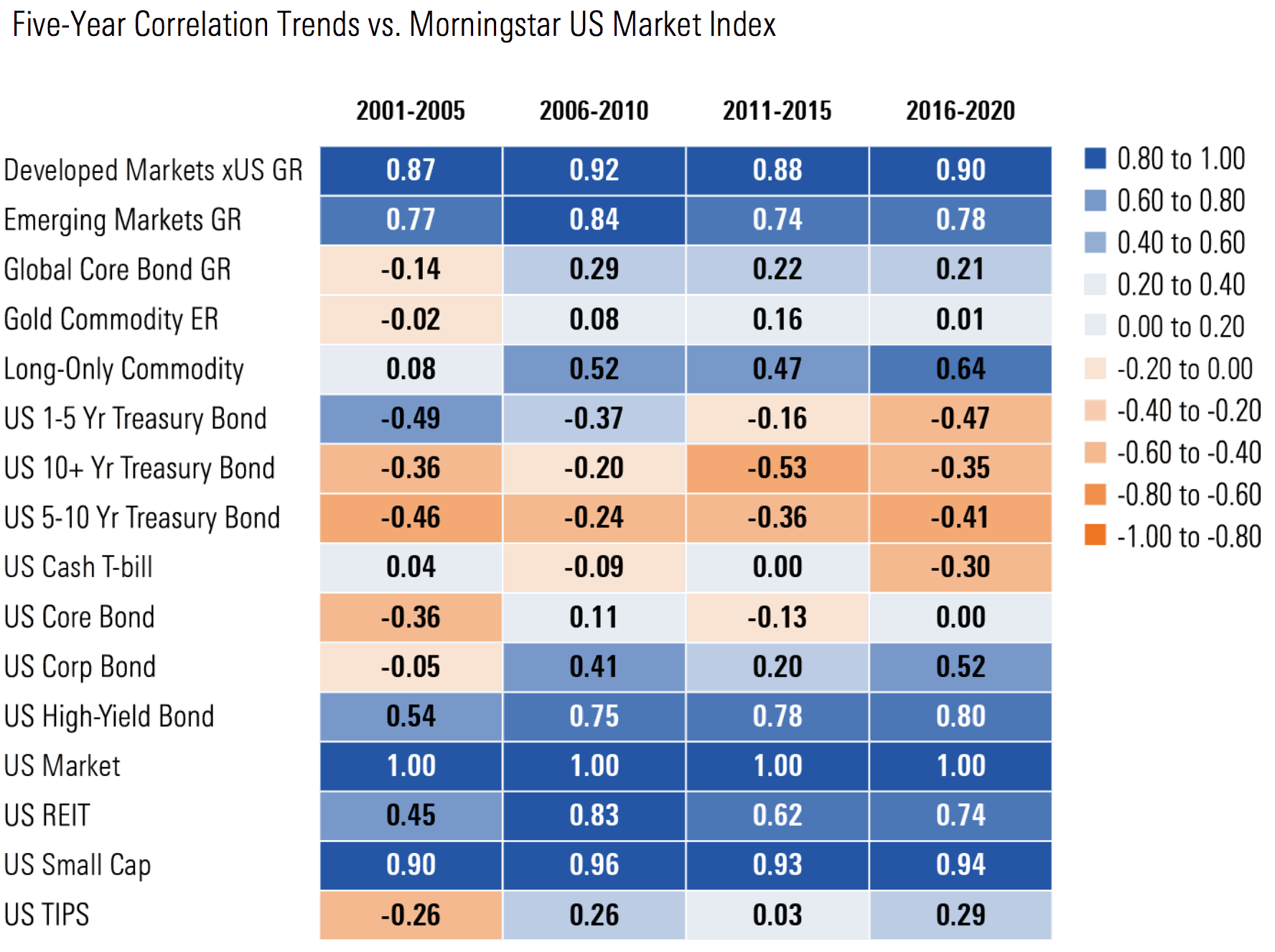
  • A positive correlation means that the assets tended to move in the same direction. A value of 1 is perfect positive correlation.
  • A negative correlation means that they tended to move in opposite directions. A value of -1 is perfect negative correlation.
  • A zero correlation means that they had no relationship.

Visual Capitalist has a nice infographic of a few asset class correlation combinations from the last 25 Years (1996-2020). Specifically, they charted the 1-year correlation based on monthly returns.

We see that US Large Cap and US Small Cap stocks are highly correlated historically, as are Developed and Emerging Market stocks. Even though each basket may contain completely different businesses doing different things and even located in different parts of the world, they still contain businesses and thus tend to move together in the same direction. Of course, a Nobel Prize-winning discovery was that as long as assets aren’t perfectly correlated (a value of 1), you still get some amount of diversification benefit from owning different asset classes. For example, owning both US and International stocks still helps diversify your portfolio even if they tend to go up or down together.

Meanwhile, the relationship between US stocks and US bonds have a low correlation. Although it’s not always negative, it has been negative 14 out of the last 25 years. As stocks and bonds don’t reliably move together, this offers a more impactful diversification benefit to your portfolio. In addition, investment-grade bonds tend not to move as much in general and thus can serve as a stable ballast to your portfolio. (Note that the last chart is Gold vs. US dollar, not US stocks.)

Here is another post on asset class correlations with data from Morningstar.