 Some folks don’t like it when I write about investments that aren’t low-cost index funds. The thing is, when I find something intriguing, I like to dig deeper and then keep a record my findings. That way I can look back later and see how things turned out and compare with my opinions at the time. Just because I write about something doesn’t mean I recommend it, you have to read the entire post.
SolarCity is a company that installs and finances solar panels on commercial and residential properties. Back in October 2014, they started to allow individual investors to buy senior, unsecured corporate bonds directly from them online. You could invest as little as $1,000 in these SolarCity SolarBonds and pay no trade commissions or fees. The critical feature is that these “solar bonds” were backed only by the claims-paying abilities of the issuing company. If SolarCity fails, then you could lose your entire principal as well as any interest owed.
In general, the more confident you are that you’ll be paid back, the lower the interest rate the borrower has to pay. Other factors will come into play, such as the overall interest rate environment. With this in mind, check out the history of these bonds:
- In 2014, SolarCity was issuing 7-year bonds paying a 4% annual interest rate.
- In mid-2015, SolarCity was issuing 5-year bonds paying a 5% annual interest rate.
- Currently in August 2016, SolarCity is offering a 18-month bond paying 6.5% annual interest rate. Ends August 30, 2016.

Supposedly, SolarCity is passing on the savings of doing things in-house and not having to pay investment banker fees. I still declined to write about these SolarCity bonds in the past because the yield and term lengths were not good enough to grab my interest. But 6.5% in 18 months? Okay, you’ve at least gotten my attention.
Consider that as of 8/24/16, an 18-month Treasury bill yields approximately 0.70%. The highest 18-month FDIC-insured CD pays roughly 1.35%. Investment-grade (A) corporate bonds are averaging ~1.15% for a 2 year maturity. Even a junk bond ETF like JNK may have a 6.5% yield but an average maturity of over 6 years.
What’s happening? Well, SolarCity is struggling in several areas. It’s been losing money reliably, every year. Here’s the stock price chart:

Perhaps more importantly, it has some big bills that are coming due soon. According to this TheStreet article, SolarCity has $3.25 billion in debt, with $1.23 billion due by the end of 2017. Note that date. At the same time, Tesla has offered to buy SolarCity in an all-stock deal.
Obviously Elon Musk and his SolarCity co-founder cousins want it to happen, as it has been widely-reported that they bought a big chunk of these bonds on their own. See Fortune, WSJ, and MarketWatch.
Why would they buy these bonds? My wild-guess opinion is that it looks like SolarCity is trying to extend its debt long enough so that Tesla can safely buy the company and then refinance things on better terms. I would say that if the deal closes, then these 6.5% bonds will pay off. I believe that Tesla will still be around in 18 months. However, if the deal doesn’t close for some reason, then SolarCity might be in big trouble.
Are these 6.5% bonds worth the risk? Given that Elon Musk and his cousins are a big shareholder in both companies and just bought $100 million of these bonds, that would seem to place your interest in line with theirs at this point. I’d actually rather hold these bonds for 18 months than be a shareholder for 18 months. However, you are still faced with the chance that the deal will hit some unforeseen obstacle, so it all depends on your confidence level. For me, the reward just isn’t high enough to justify the risk of permanent principal loss (I’d rather have a house as collateral), so I am going to pass and wait to see how it turns out.
 While the number of real estate crowdfunding sites keeps growing, most marketplaces still require you to be an accredited investor with high income and/or net worth requirements. However, options for non-accredited investors should improve shortly due to the expanded
  We’ve all heard that you should keep an emergency fund in case of unexpected expenses or unemployment. But what if you don’t have the cash? Personal finance author Jonathan Clements presents a mathematical argument for using your 401(k) as an emergency fund in his recent article
  The following chart taken from

 Here’s a


 I like the idea of living off dividend and interest income. Who doesn’t? The problem is that you can’t just buy stocks with the absolute highest dividend yields and junk bonds with the highest interest rates without giving up something in return. There are many bad investments lurking out there for desperate retirees looking only at income. My goal is to generate portfolio income that will keep up with inflation.
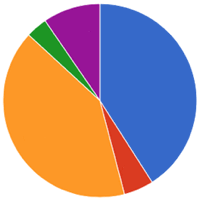 Here is a roughly mid-year 2016 update on my investment portfolio holdings. This includes tax-deferred accounts like 401ks, IRAs, and taxable brokerage holdings, but excludes things like our primary home and cash reserves (emergency fund). The purpose of this portfolio is to create enough income to cover household expenses.



 The Best Credit Card Bonus Offers – 2026
 Big List of Free Stocks from Brokerage Apps
 Best Interest Rates on Cash - 2026
 Free Credit Scores x 3 + Free Credit Monitoring
 Best No Fee 0% APR Balance Transfer Offers
 Little-Known Cellular Data Plans That Can Save Big Money
 How To Haggle Your Cable or Direct TV Bill
 Big List of Free Consumer Data Reports (Credit, Rent, Work)