TradeKing Advisors Review: Managed Core and Momentum ETF Portfolios

tkalogoAnother online ETF portfolio advisor joins the mix. Discount brokerage TradeKing, possibly best known for their $4.95 stock trades, announced a new subsidiary called TradeKing Advisors which will directly manage ETF portfolios for retail customers. Details:

  • Portfolio asset allocation designed and monitored by Ibbotson Associates. There will be Core and Momentum portfolios.
  • The portfolio will be determined by an 8 question risk questionnaire.
  • TradeKing Advisors will manage and rebalance portfolio as needed to stay on target. Assets will be held at TradeKing brokerage.
  • Management fee of 0.75% of account balance annually for Core portfolios, minimum initial investment of $10,000. For Momentum portfolios, 1% management fee and $25k minimum account size. For account balances over $250,000, the fees for each portfolio are reduced to 0.50% annually.

Per their website, their “strategies include a diversified allocation of up to 20 asset classes – including fixed income, equities, real estate and foreign investments – implemented cost-effectively with ETFs.” I could not find any specific information about the asset allocation of these ETF portfolios or the ticker symbols used.

But that’s okay, as I pretty much stopped listening when the fees were listed at 0.75% for a basic index ETF portfolio. It may be less than what E*Trade charges but in my opinion that’s still too much to pay for any ETF portfolio, and much more than many other services like Betterment and Wealthfront that do pretty much the same thing also with a slick user interface. Supposedly TradeKing will differentiate themselves with their “exceptional customer service”. As a TradeKing brokerage customer, I found their customer service fine and Live Chat is nice but not worth another 0.40% to 0.50% annually as you don’t even get assigned a Certified Financial Planner or CFA. So far it just sounds like an expensive robo-advisor. In that case, I will pass.

Net Worth Breakdown: Saved Income vs. Investment Returns 2004-2014

I’ve talked about the importance of savings rate, but remember that investing that savings prudently is also part of the process. Here’s a question – What percentage of your current net worth is saved income, and what is investment growth? This can be a tricky question, as most people invest their money gradually over time and only look at the total balance on their statements. However, as times go by your investment growth should be significant.

For example, I spent the first few years of working paying down my $30,000 in student loans. I finally started investing in 2004, which means I have been regularly saving for about 10 years now. As a rough proxy for my portfolio, I will use the Vanguard LifeStrategy Growth Fund (VASGX) which holds a static 80% stock and 20% bond portfolio consisting of diversified, low-cost index funds. It’s pretty darn close, especially considering all the options out there.

The 10-year historical return of VASGX is roughly 7.03%. Put another way, $100,000 invested back in 1/1/2004 would be $205,497 today. But I didn’t invest all my money at once, I had to wait for each paycheck or any side business profit to come in first.

vasgx2004

A better simulation would be investing $10,000 each year from 2004 to 2013, for a total of $100,000 spread out over that decade. I don’t have any fancy software that will run the numbers for me, so I made a rough estimate using VASGX and Morningstar’s handy-dandy “Growth of $10k” charts. I calculate that:

$10,000 invested on 1/1/2004 would be $20,550 as of 7/5/2014.
$10,000 invested on 1/1/2005 would be $18,254 as of 7/5/2014.
$10,000 invested on 1/1/2006 would be $17,078 as of 7/5/2014.
$10,000 invested on 1/1/2007 would be $14,706 as of 7/5/2014.
$10,000 invested on 1/1/2008 would be $13,686 as of 7/5/2014.
$10,000 invested on 1/1/2009 would be $20,861 as of 7/5/2014.
$10,000 invested on 1/1/2010 would be $16,689 as of 7/5/2014.
$10,000 invested on 1/1/2011 would be $14,505 as of 7/5/2014.
$10,000 invested on 1/1/2012 would be $14,843 as of 7/5/2014.
$10,000 invested on 1/1/2013 would be $12,977 as of 7/5/2014.

As you can see, investment returns varied widely based on initial investment date. $10,000 invested in 2008 did only slightly better than $10,000 invested in 2013. However the total present value is now $164,149. So those ten investments of $10,000 would only be $100,000 if stuck under my mattress, but is now worth over $160,000. I calculated the internal rate of return as 8.1%.

My actual contributions were higher and not quite as constant, but it remains that roughly 60% of my portfolio size today is from saved income, and 40% is from investment growth.* This was not a product of honed skill, excellent timing, or high intelligence. It was just saving regularly, investing in low-cost diversified funds, and not panicking.

This reminds me of this Jack Bogle quote:

Own the stock market, own the bond market, as modified to meet your needs, and don’t peek. One of the greatest rules for investing ever made. […] Don’t even peek at your account; don’t open those 401(k) statements. If you don’t look at your 401(k) statement–this sounds outrageous, but it’s true–for 45 years … you start when you’re 20 and you don’t open a single statement for the next 45 years, when you open that statement the day you retire, you are going to go into a dead faint of amazement about how much money you’ve accumulated.

The hardest part of investing is not doing anything stupid.

To summarize, looking back on my last 10 years, I must say that both savings rate and investment return are important. If I didn’t save, I wouldn’t have anything to invest. But if I didn’t invest it prudently, I’d also have a lot less than I do now. Start as soon as possible, learn about investing basics, learn about managing risk and emotions, and the combination will be quite powerful over time.

* Side note: I ran the numbers the same way for Vanguard LifeStrategy Moderate Growth Fund (VSMGX) which is a static 60% stocks and 40% bonds, and the results were still very similar. My $100,000 spread out over the last 10 years would have grown to $156,000, working out to 36% of the final portfolio being investment gains.

Why Vanguard VNQ is the Best REIT ETF

Real estate investment trusts (REITs) offer the ability to invest in commercial real estate within the comfort of your brokerage account. ETFs in turn offer the ability to invest in a diversified basket of REITs. The Morningstar article This REIT ETF Remains Prettiest on the Block by Abby Woodham offers up reasons why the Vanguard REIT ETF (VNQ) is the optimal choice, including comparisons with similar products. Highlights:

  • Low expense ratio. VNQ expense ratio is 0.10%.
  • Low tracking error. VNQ’s historical performance only lags its benchmark index by 0.03%, a number even lower than its expense ratio.
  • Large, mid, and small-cap exposure. VNQ’s holdings include smaller REITs that other ETFs often exclude.
  • Exclusions. VNQ excludes mortgage REITs and non-real-estate specialty REITs (timber, prisons). This could be considered good or bad, as these will act differently than traditional REITs. I kind of like timber REITs, though.
  • Schwab US REIT ETF (SCHH) is slightly cheaper (0.07% e.r.) but lacks small-cap exposure.
  • iShares US Real Estate ETF (IYR) includes Mortgage and Specialty REITs but is more expensive (0.46% e.r.)

I agree with most of the points made; I use VNQ for my REIT exposure. It’s good to learn more about the competition as well. The same underlying holdings of VNQ are also available in mutual fund form:

  • Vanguard REIT Index Fund Investor Shares (VGSIX) – $3,000 minimum
  • Vanguard REIT Index Fund Admiral Shares (VGSLX) – $10,000 minimum

Do You Need International Bonds In Your Portfolio?

Bonds are supposed to provide both income and stability in your portfolio. International bonds, especially Emerging Markets bonds, are becoming more popular. But do you need them in your portfolio? Respected author/money manager William Bernstein doesn’t think so. From an ETF.com interview:

ETF.com: One thing that puzzled me is that among your recommendations, I don’t see an international bond fund as part of the allocation—even one that’s currency-hedged. Why?

Bernstein: Well, first, there is absolutely no way any rational investor would want an unhedged international bond fund in their portfolio for a very simple reason: Your bonds are your “safe” assets. They are what you are defeasing your retirement with; they are what enables you to sleep at night; they are your liquidity for when you lose your job or for when you want to buy cheap equities or the corner lot from your neighbor who got caught in a liquidity squeeze.

And the unhedged currency exposure with unhedged international bonds is very risky. All you have to do is look to what happened to the euro and the yen in the last crisis—they cratered. That’s a risk you simply don’t want to take.

Now, when you have hedged currency risk as opposed to unhedged currency risk in a bond fund, you’ve got a smaller problem, but it’s still a problem. And that’s when you take foreign sovereign bonds and hedge them back to the dollar—you’ve basically got U.S. bonds.

Maybe you get a tiny bit of extra diversification, but it’s a trivial amount—plus you’re paying higher expenses and higher transactional costs to deal with foreign bonds.

On the other hand, the Vanguard Group apparently does believe that holding international bonds is a worthwhile way to add diversification to your portfolio, as in 2013 they added international bonds to their Target Date Retirement and LifeStrategy all-in-one mutual funds (currently 20% of the total bond allocation). The Vanguard Total International Bond ETF (BNDX) has an expense ratio of 0.20%, while the domestic Vanguard Total Bond Market ETF (BND) has an expense ratio of 0.08%.

As Bernstein puts it, “owning a currency-hedged bond international fund is just basically getting into slightly more expensive U.S. bond exposure.”

Personally, I’m also not convinced that international bonds offers something necessary. Maybe someday that will change. Whenever I’m not convinced, I choose simplicity. Thus, I have never and currently do not own any foreign bonds.

Prosper vs. LendingClub Investor Returns 19.5 Month Update

lcvspr_clipoIn November 2012, I invested $10,000 into person-to-person loans split evenly between Prosper Lending and Lending Club, looking for high returns from a new asset class. After diligently reinvesting my earned interest into new loans, I stopped my after one year (see updates here and here) and started just collecting the interest and waiting see how my final numbers would turn out at the end of the 3-year terms.
My last update was 4 months ago, so here’s what things look like after 19.5 months.

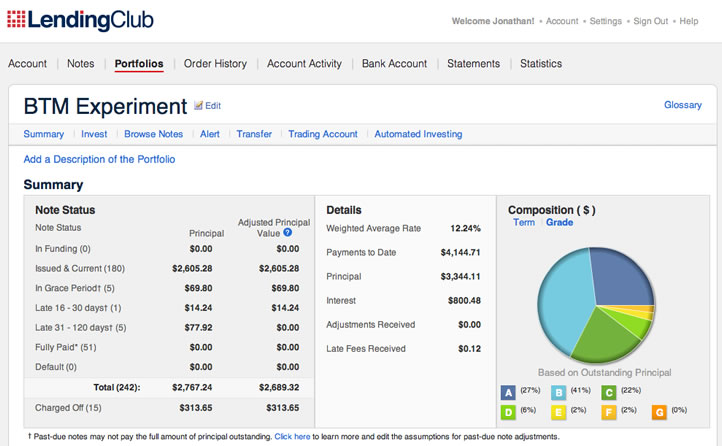
$5,000 LendingClub Portfolio. As of June 15, 2014, the LendingClub portfolio had 180 current and active loans. 51 loans were paid off early and 15 have been charged-off ($314 in principal). 6 loans are between 1-30 days late. 5 loans are between 31-120 days late, which I will assume to be unrecoverable. $2,679 in uninvested cash (early payments and interest). Total adjusted balance is $5,368.

1406_lc

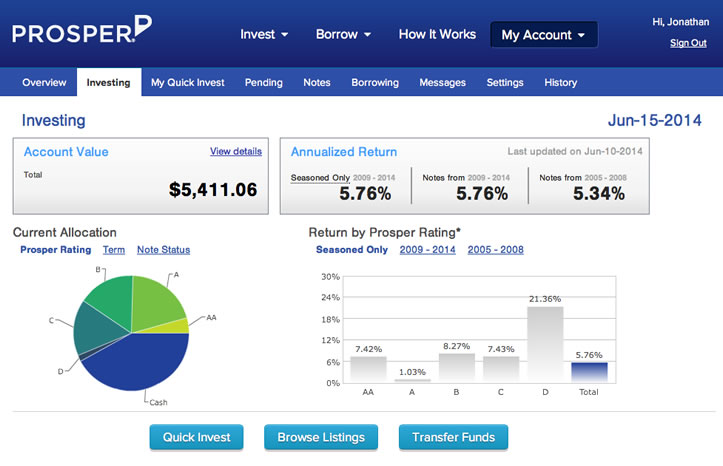
$5,000 Prosper Portfolio. My Prosper portfolio now has 157 current and active loans, 78 loans paid off early, 23 charged-off. 6 loans are between 1-30 days late. 6 are over 30 days late, which to be conservative I am also going to write off completely (~$89). $2,434 in uninvested cash (early payments and interest). Total adjusted balance is $5,322.

1406_prosper

Recap and Thoughts

  • The fact that institutional investors are buying a significant portion of Prosper and LendingClub loan inventory would seem to prove that the concept is successful. If I were to invest all over again, I would do it within an IRA to avoid tax headaches. I would also buy at least 100 loans x $25, which also happens to be the $2,500 minimum for free auto-investment at LendingClub (no minimum at Prosper). But simply put, I am not in love with P2P loans enough to allocate my precious IRA space to them.
  • My total adjusted balance is $10,690, which actually shows a slight recovery from my last update in which my total balances were actually dropping. At least I’m still headed to a final balance higher than a savings account. My idle cash is starting to pile up though, so I will take $2,500 out of each account soon and put it elsewhere.
  • Prosper says my annualized returns are actually 5.76%. But just 4 months ago, they said I was earning 7.55%. The lesson here is that your returns will continue to vary and likely deteriorate as your loans age, so don’t assume your returns will always stay the same as they are in the beginning (your returns will look good for a long time if you keep reinvesting into new loans). LendingClub says my annualized returns are now 5.94% (5.24% if you assume all loans 30+ days late will be total losses). Not awful return numbers so far in this low-interest rate environment, but less than I would have hoped for.
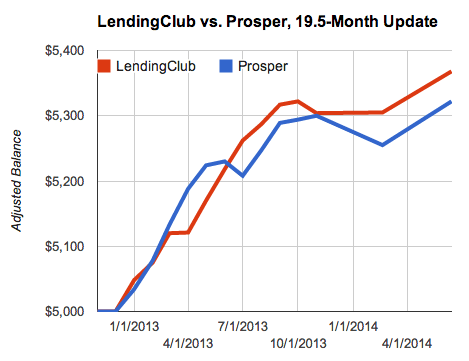
  • Prosper is still doing worse relatively than LendingClub. This could change again in the future. Here’s an updated chart tracking the LendingClub and Prosper adjusted balances over these past 15.5 months:
    1406_prvslc

How Often Should I Rebalance My Investment Portfolio? Less Than You Might Think

An important tenet of portfolio construction is rebalancing your portfolio to maintain your desired risk profile and also provide the best risk-adjusted returns. The next question is usually – Okay, so how often do I rebalance? Well, this Vanguard article targeted at financial advisors answers that question (found via Abnormal Returns).

Longer answer:

Our 2010 study looked at the performance of portfolios that used rebalancing strategies based on various time intervals, allocation thresholds, and combinations of both. The time-based portfolios were rebalanced monthly, quarterly, or annually, while the threshold categories were rebalanced when allocations deviated by a predetermined minimum (in this case 1%, 5%, or 10%) from their target allocations. The “time-and-threshold” strategy combined periodic monitoring with predetermined minimum rebalancing thresholds. […] We found that no one approach produced significantly superior results over another. However, all strategies resulted in more favorable risk-adjusted portfolio returns when compared with returns for portfolios that were never rebalanced.

vgrebal

Short answer: It doesn’t matter, as long as you do it regularly and without emotion. Rebalancing every month was no better than rebalancing just once a year.

Personally, I try to rebalance whenever I make my monthly share purchases by buying underweight asset classes, but I will only sell and create a taxable event once a year if things are really out of whack. The more common problem is that you are afraid to rebalance because that usually means buying whatever has been getting crushed and selling what has been rising. If you haven’t done it recently, that probably involves selling some stocks and buying some bonds. Like the shoe company says, just do it!

Early Retirement Portfolio Update – June 2014 Income

There is an ongoing investing debate as to whether you should focus on income or total return. I personally believe that you should focus on total return but realize that income is a critical part of that total return. If you want to live off the income produced by your portfolio, you should make sure it is stable and will grow with inflation. Reaching for yield via riskier stocks or lower-quality bonds is dangerous.

A quick and dirty way to see how much income (dividends and interest) your portfolio is generating is to take the “TTM Yield” or “12 Mo. Yield” from Morningstar quote pages. Trailing 12 Month Yield is the sum of a fund’s total trailing 12-month interest and dividend payments divided by the last month’s ending share price (NAV) plus any capital gains distributed over the same period. SEC yield is another alternative, but I like TTM because it is based on actual distributions (SEC vs. TTM yield article).

Below is a close approximation of my most recent portfolio update. I have changed my asset allocation slightly to 60% stocks and 40% bonds because I believe that will be my permanent allocation upon early retirement.

Asset Class / Fund % of Portfolio Trailing 12-Month Yield (6/5/14) Yield Contribution
US Total Stock
Vanguard Total Stock Market Fund (VTI, VTSAX)
24% 1.74% 0.42%
US Small Value
WisdomTree SmallCap Dividend ETF (DES)
3% 2.48% 0.07%
International Total Stock
Vanguard Total International Stock Market Fund (VXUS, VTIAX)
24% 3.08% 0.74%
Emerging Markets Small Value
WisdomTree Emerging Markets SmallCap Dividend ETF (DGS)
3% 3.39% 0.10%
US Real Estate
Vanguard REIT Index Fund (VNQ, VGSLX)
6% 2.72% 0.16%
Intermediate-Term High Quality Bonds
Vanguard Limited-Term Tax-Exempt Fund (VMLUX)
20% 3.25% 0.65%
Inflation-Linked Treasury Bonds
Vanguard Inflation-Protected Securities Fund (VAIPX)
20% 1.74% 0.35%
Totals 100% 2.49%


As you can see, the overall weighted yield is roughly 2.5%. This means that if I had a $1,000,000 portfolio balance today, it would have generated $25,000 in interest and dividends over the last 12 months. Now, 2.5% is lower than the 4% withdrawal rate often recommended for 65-year-old retirees with 30-year spending horizons, and is also lower than the 3% withdrawal that I prefer as a rough benchmark for early retirement. My ideal situation is to get by with just spending this 2.5% in income every year. The paranoid part of me likes the idea of just spending the dividends and interest while not reaching too far for yield. That way, theoretically if I owned say 1% of GE or ExxonMobil, if I never sold shares I’d keep owning 1%.

So how am I doing? Using my 3% benchmark, the combination of ongoing savings and recent market gains have us at 85% of the way to matching our annual household spending target. Using the 2.5% number, I am only 71% of the way there. We’ll have to see how much full retirement appeals to me once I reach my goal at a 3% withdrawal rate. I’m not opposed to working part-time if the work is interesting to me, so I’m keeping my options open.

Early Retirement Portfolio Update – June 2014 Asset Allocation

I want to get back to doing quarterly updates to our investment portfolio, which includes both tax-deferred accounts like 401(k)s and taxable brokerage holdings. Other stuff like cash reserves (emergency fund) are excluded. The purpose of this portfolio is to create enough income on its own to cover all daily expenses well before we hit the standard retirement age.

Target Asset Allocation

aa_updated2013_bigger

I try to pick asset classes that will provide long-term returns above inflation, regular income via dividends and interest, and finally offer some historical tendencies to balance each other out. I don’t hold commodities futures or gold as they don’t provide any income and I don’t believe they’ll outpace inflation significantly. In addition, I am not confident in them enough to know that I will hold them through an extended period of underperformance (and if you don’t do that, there’s no point).

Our current ratio is about 70% stocks and 30% bonds within our investment strategy of buy, hold, and rebalance. With low expense ratios and low turnover, we minimize our costs in terms of paying fees, commissions, and taxes.

Actual Asset Allocation and Holdings

1406_actualaa

Stock Holdings
Vanguard Total Stock Market Fund (VTI, VTSMX, VTSAX)
Vanguard Total International Stock Market Fund (VXUS, VGTSX, VTIAX)
WisdomTree SmallCap Dividend ETF (DES)
WisdomTree Emerging Markets SmallCap Dividend ETF (DGS)
Vanguard REIT Index Fund (VNQ, VGSIX, VGSLX)

Bond Holdings
Vanguard Limited-Term Tax-Exempt Fund (VMLTX, VMLUX)
Vanguard High-Yield Tax-Exempt Fund (VWAHX, VWALX)
Stable Value Fund* (2.6% yield, net of fees)
Vanguard Inflation-Protected Securities Fund (VIPSX, VAIPX)
iShares Barclays TIPS Bond ETF (TIP)
Individual TIPS securities
US Savings Bonds

Changes
I joined the exodus out of PIMCO Total Return fund earlier this year after their recent management shake-up. It actually coincided with my 401(k) allowing a self-directed brokerage “window” with Charles Schwab that allows me to buy Vanguard mutual funds, albeit with a $50 transaction fee. But my 401k assets are finally large enough that the $50 is worth the ongoing lower expense ratios. I’m buying more REITs and TIPS in order to take advantage of this newly-flexible tax-deferred space. I’m still holding onto my stable value fund, but I may sell that position as well in the future.

I think I mentioned this elsewhere, but I am now accounting for my Series I US Savings Bonds as part the TIPS asset class inside my retirement portfolio. Before, they were considered part of my emergency fund. They offer great tax-deferral benefits as I don’t have to pay taxes until they are redeemed. I don’t plan on selling any of them for a long time, at least until my tax rate is much lower in early retirement.

Why Non-Traded REITs Are a Horrible Investment

housemoneyJust as important as finding a good investment is knowing what investments to avoid at all costs. If you simply manage to avoid putting any money into financial sinkholes, you’ll come out ahead. I’ve already mentioned the common mistake of cashing out your 401(k) when moving jobs.

Joshua Brown of The Reformed Broker has some great insights into the sales-driven world of products peddled to us retail investors. He talks about non-traded REITs (real estate investment trusts) as opposed to publicly-traded REITS that you can buy via a low-cost, diversified fund like the Vanguard REIT Index Fund (VNQ or VGSIX). Non-traded REITs have been increasingly popular in the current low interest environment as they are structured to look like they provide a solid income stream.

In this recent post, he shares a hilarious fictional conversation that would happen if the broker was abnormally honest about the fees involved. Read the whole thing, but here’s a snippet:

With your portfolio size and risk tolerance I would recommend a $100,000 investment. Given that amount let’s first go over the fees. If you invest $100,000 I will be paid a commission of $7,000. My firm is going to get $1,500 – $2,000 in revenue share. My wholesaler, the salesman that works for the investment’s sponsor company, will get $1,000. He is a great guy, buys me dinner all of the time and takes me golfing. The sponsor company is going to get around $3,000 to pay for some of the costs they incurred in setting up the investment. So all in on Day 1 there will be around $87,000 left over to actually invest. I bet you are getting excited.

You hand over $100,000, and after everyone has gotten their cut, there is only $87,000 actually left over to invest in anything. It doesn’t matter what property they buy, the odds are completely stacked against you already. Studies have shown that publicly-traded REITs have higher historical returns than non-traded REITs. On top of that, non-traded REITs have poor liquidity and you may be locked in for 5 years or more. Despite all this, over $20 billion of non-traded REITs were sold in 2013.

Here’s a Reuters article by James Saft that goes into more detail about the many disadvantages of non-traded REITs. Amongst the more amusing excerpts:

When a financial advisor tried to sell my sister a fee heavy non-traded REIT last year, pitching it as an alternative to fixed income, I told her she ought to fire him. […]

The Financial Industry Regulatory Authority, an industry funded oversight body, went so far as to issue an “investor alert” about non-traded REITs in May of last year, warning about inaccurate and mis-leading marketing of the vehicles as well as other risks. Just to give a flavor of the company in which non-traded REITs are traveling, the most recent FINRA investor alert was about marijuana stock scams.

Bottom line: Avoid non-traded REITs. If you want commercial real estate exposure, buy a low-cost fund like VNQ or VGSIX.

Recommended Reading List for Young Investors

ifyoucanbookI just finished reading If You Can: How Millennials Can Get Rich Slowly, a free starter book on personal finance by respected author William Bernstein. As the PDF was only 16 pages long, you could probably finish it during a lunch hour or commute. I recommend it, but even Bernstein notes that his “inexpensive, small booklet” is more of a map than a complete book. Included were several book assignments to address specific topics. The idea is a young person could read all of these books over the span of a year or two and round out their financial education. In the meantime, start saving 15% of your income!

Here is the recommended reading list:

Bernstein thinks it tacky to recommend his own books, so let me do it. Back when I was a young lad with no investing knowledge (2004), my favorite introductory book was Four Pillars of Investing by William Bernstein. (The new edition is really just the old edition though, so buy a used copy of the old edition and save some money.) However, more recently I have heard good things about Investor’s Manifesto which supposedly has less math-y stuff.

I’ve read all but two of these books and agree that they were all excellent building blocks of knowledge. Most if not all of these books have been around for a while and should be readily available for free at your local library. Even if you pay for them, the return will be well worth the investment. I added a new copy of all seven books to my cart and it came to under $100 at Amazon ($91.48 to be exact). Good graduation gift ideas?

Vanguard Personal Advisor Services (VPAS) Review – Low Cost Managed Portfolio and Guidance

vglogoMany people hire a financial advisor because they aren’t comfortable investing on their own, and they appreciate having an experienced person to talk to whenever they have any questions. However, this has traditionally meant paying at least 1% of your portfolio assets every year to that person. Especially given the current low interest rate environment, 1% is a huge number and could eat up a large percentage of your future returns.

Vanguard has a newer product called Vanguard Personal Advisor Services (PAS) where someone will work with you to create a financial plan, implement your portfolio for you, and be available to update and discuss that plan as needed. The minimum asset size has been lowered to $50,000 and the cost is 0.30% of assets annually, which is much lower than the industry standard. As a DIY investor, I was interested in this service for my spouse in case I am somehow incapacitated one day. Here are my findings based on calling in as a customer to three different Vanguard reps and various online sources. Anything quoted below is taken directly from this detailed Vanguard brochure [pdf].

Qualifications. You must have a minimum of $50,000 of investable cash or securities. Eligible accounts include individual accounts (including IRAs), joint accounts, and certain trust accounts. Note that 401(k) plan assets are not included.

Fees and costs. Vanguard PAS will charge you 30 basis points (0.30%) annually. Fees will be calculated quarterly and based on your average daily balance the prior calendar quarter. The fee will be calculated across all securities in the portfolio, with the exception of money market fund positions. This does not include the underlying expense ratios of any mutual funds or ETFs that you may own in the portfolio.

Annual Financial Plan and Personal Review. First, Vanguard will gather information from you via an online questionnaire (and telephone discussion if needed) in order to “understand your financial objectives, such as your age, specific financial goals, investment time horizon, current investments, tax status, other assets and sources of income, investment preferences, planned spending from the Portfolio, and your willingness to assume risk with the cash and securities being invested in the Portfolio.” They will focus on your specific goals, which can include planning for college, saving for a home, establishing a rainy-day fund, or saving for retirement. They will take into account things like Social Security, pensions, IRAs, 401(k) plans, and other investment accounts held outside of Vanguard.

Vanguard PAS will then create a draft financial plan for you based on this information, which you will discuss with a Certified Financial Planner (CFP) to finalize and approve. At least annually, your advisor will schedule another phone conference with you to see if there have been any changes in your “financial situation, other assets or sources of income, investment time horizon, investment objectives, planned spending from the Portfolio, or desired reasonable restrictions” that may require a new Financial Plan to be approved.

Portfolio construction and Investment methodology. Their investment methodology incorporates Vanguard’s company values of advocating low costs, diversification, and indexing. As a result, recommended portfolios will mostly include Vanguard’s broad index funds and/or ETFs. They can and will take into account your existing positions or special requests, as long as they meet certain standards. Taken from their brochure:

The recommendations made by VAI in connection with the Service will normally be limited to allocations in Vanguard Funds and will generally not include recommendations to invest in individual securities or bonds, CDs, options, derivatives, annuities, third-party mutual funds, closed-end funds, unit investment trusts, partnerships, or other non-Vanguard securities, although you may be able to impose reasonable restrictions upon our investment strategy.

They will work to maximize after-tax return. They will not attempt to “predict which investments will provide superior performance at any given time”. No market timing here.

Quarterly portfolio review and rebalancing. Each quarter (with timing determined by your contract anniversary date), they will review your portfolio. If your portfolio asset allocation deviates from the target asset allocation by more than 5% in any asset class, they will rebalance your portfolio by buying and selling the appropriate funds. There is a prescribed fund hierarchy in order to do this will minimal tax impact.

Ongoing contact and advice. At any time, you can contact a Vanguard PAS advisor to talk about your financial plan. There are no set limits on how many times you can contact them. I was told that if you have under $500,000 in assets, you will be directed to a team pool of CFP advisors. If you have 500k or higher, you will be assigned a specific person to be “your advisor”. Of course that person may change from time to time if they switch jobs, etc.

No DIY Trading! You are not allowed to make any trades yourself in any portfolio managed by VPAS. You must call your Vanguard advisor and discuss and proposed changes for them to execute. Online trading will be disabled in your account. This may be weird for long-time DIY investors.

In your Service Agreement, you’ll agree not to purchase or sell securities in your Portfolio while enrolled in the Service, and you’ll be blocked from such activity until you terminate the Service. You’ll also be prohibited from establishing or maintaining other services on any accounts in the Portfolio, including but not limited to checkwriting and automatic trading services (such as automatic investment/withdrawal/exchange) and setting required minimum distribution (RMD) payments. Other account transactions or services may be restricted or unavailable through the web experience, but can be processed or enabled with the assistance of your advisor.

Recap and Commentary

This is a managed portfolio product. That means that they will determine a low-cost portfolio of Vanguard funds (mostly Vanguard index funds and ETFs) based on your specific needs, implement it for you, and provide ongoing advice and adjustments as needed. You will not be able to make buy or sell decisions as with a self-directed brokerage account. Such guidance will ideally help you handle your emotions when it comes to investing, as there will be someone to help you keep following your plan during both up and down markets. There will be someone to talk with whenever you have any life changes or additional questions.

0.30% of $100,000 works out to $300 a year, making this quite a bargain at that level. At much higher asset sizes, I would explore switching to a flat-fee human advisor that fits your investing style and personality. For example, $3 million times 0.30% is $9,000 a year. You might find a flat-fee advisor for $3,000 a year. On the other end, I would say that if you have under $50,000, don’t fret and just buy a Vanguard Target Retirement Fund as that is essentially a simple managed portfolio.

Is P2P Lending So Successful That It Doesn’t Need You Anymore?

lcvsprBeing a peer-to-peer lender been a bumpy ride. Prosper Marketplace was first, but if you were an early investor/lender you’d have been lucky to have gotten back what you put in as most people had negative returns. Then came LendingClub with stricter credit standards and preset interest rates. Both companies operate with similar structures now and appear to have created a viable business model. In fact, LendingClub is planning an IPO with their last funding valuation at $3.8 billion. That’s pretty rosy considering they made just $7 million of profit in 2013, their first year of profitability in 7 years.

I’m not a big lender but I have invested over $15,000 of my own money into P2P loans. In the beginning, I would read every single loan listing as it usually included a story about what the borrower was going to do with the money (pay down debt, start a new business, buy a 200 sf tiny house). After a while, I started using automated software to match with loans, but it still felt like individuals lending money to other individuals. Today, a significant portion of loans are sold to institutional investors like hedge funds, pension funds, and even banks according to the New York Times article “Loans That Avoid Banks? Maybe Not“:

At Prosper, which has been courting institutional lenders over the past year, more than 80 percent of the loans issued in March went to those firms. More than a dozen investment funds have been formed with the sole purpose of investing in peer-to-peer loans. […] Santander Consumer USA, the United States arm of the Spanish bank, has an agreement to buy up to 25 percent of Lending Club’s loans.

I spoke to a LendingClub representative, and they stated that their investor base is currently “about 1/3 direct retail investors, 1/3 high-net-worth investors, and 1/3 institutional investors.”

Here’s a thought experiment: If somebody like Chase Bank goes to a P2P lender and buys a bunch of unsecured loans made to individuals, is that really much different than that same person just carrying a balance on a Chase credit card?

It used to be individuals who took the risk of lending and reaped any rewards of higher interest. The P2P company just cares about volume as it takes a fee from every loan. But if that volume comes from big financial firms that want first dibs, does that mean the individual investors will only get left with the scraps?

The loans not taken by these sophisticated investors go back to a fractional lending pool that is open to both individual investors and institutions. That doesn’t sit well with some. “The institutional investors are snapping up all the worthwhile loans,” one investor wrote on Prosper’s blog, echoing many comments. […] “By cherry-picking, almost by definition what they leave behind is not as good,” says Giles Andrews, founder and chief executive of Zopa, a British peer-to-peer lender that so far has dealt only with individual lenders.

Perhaps the best sign that P2P lending sites have become a legitimately good investment is that Wall Street and other professional investors are now crowding us out?