Updated. I’ve gotten a few tax-filing questions regarding P2P lenders Prosper Lending and Lending Club. For tax year 2013, LendingClub provided individual investors extra guidance with their Tax Guide for Retail Investors [pdf]. Using this information, I have updated this post.
Don’t file too early. My first recommendation is to not print out or download any of your 1099s until mid-March. Both Prosper and LendingClub seem to regularly issue corrected and/or amended 1099 forms with new numbers late in February. If you already printed them out earlier, go back and make sure they haven’t been changed. After having to file an amended return a few years ago, I always wait until after mid-March to gather all my tax documents.
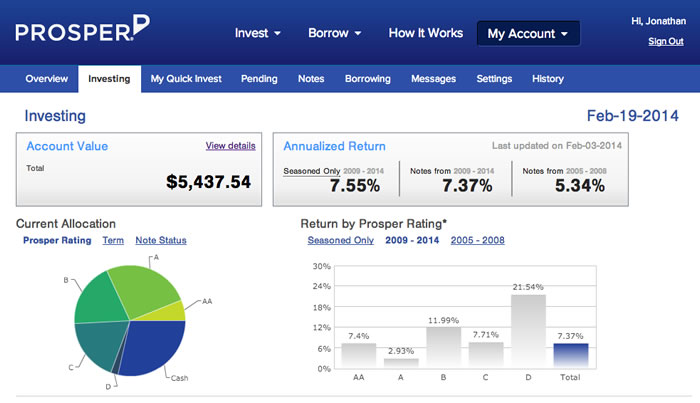
Where to find your tax documents. I don’t think either Prosper or Lendingclub sends you 1099 forms in the mail. The easiest way for me to direct you to these documents is for you to cut-and-paste the following URLs into your web browser and then log into your accounts. Here are screenshots of what the pages should look like for Prosper and LendingClub.
https://www.prosper.com/secure/account/common/statements.aspx
https://www.lendingclub.com/account/taxDocuments.action
Tax disclaimer. I am not a tax professional. The following is based on my best attempt at understanding the fuzzy world of P2P lending taxes. I am simply sharing how I’m going to do my personal tax return, but you should consult a tax professional for an expert opinion. You may not get all or most of these forms.
LendingClub
LendingClub 1099-OID. OID stands for original issue discount. The total of Box 1 is basically what LendingClub is reporting as the interest earned on your loans, net of fees. This interest should be reported on Schedule B and taxed as ordinary interest income (similar to interest from bank accounts).
LendingClub 1099-B (Recoveries for Charge-offs). If you had any loans charged-off*, but they still recovered some money later on, that will be reported here. It should be broken down into either short-term or long-term capital gains. Because it already tells me short-term or long-term, I will simply report the totals with acquisition and sell date(s) as “various”.
LendingClub 1099-B (Folio secondary market). If you sold any loans on the secondary Folio market, then the sales should be reported here. It should also be broken down into either short-term or long-term gains or losses. I will simply report the totals on Schedule D, using my acquisition and sell date(s) as “various”.
LendingClub 1099-MISC. I would just type this form into TurboTax box-by-box or submit directly to your accountant, usually under “Other Income”. Box 7 amounts will be subject to self-employment taxes, Box 3 amounts will not.
Prosper Lending
Prosper 1099-OID. Similar story to the LendingClub 1099-OID above, except they just give you the total from all your loans. Again, I have all zeros except for Box 1, which I will report as ordinary interest income on Schedule B.
Prosper 1099-B (Recoveries for Charge-offs). Again, anything listed here should be broken down into either short-term or long-term capital gains/losses and recorded on Schedule D. Prosper includes loan charge-offs on this form.
Prosper 1099-B (Folio secondary market). Again, anything listed here should also be broken down into either short-term or long-term gains or losses.
Prosper 1099-MISC. I would just type this form into TurboTax box-by-box or submit directly to your accountant, and it should be pretty straightforward. Box 7 amounts will be subject to self-employment taxes, Box 3 amounts will not.
*Reporting Charge-offs
If you have loans that were charged-off in 2013 (loan is very late and attempts to collect have failed, so they give up), you can write them off as a non-business bad debt. You can find these in either your year-end statements (LendingClub) or your 1099-B form (Prosper). These are all treated as short-term capital losses, which you can use to offset short-term capital gains from other investments or you can deduct against up to $3,000 in ordinary income per year (with the balance carrying forward to the next year).
More resources: Let me also recommend Peter Renton’s post at LendAcademy, the follow-up comments on that post, and this forum post by AmCap as good references for an intelligent discussion on the topic. Also see the LendingClub and Prosper tax pages, even though they aren’t especially helpful.
 After posting the 1-year update (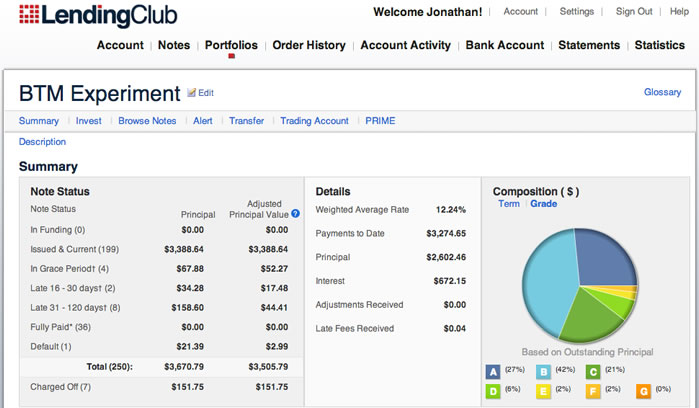
 Updated. In my post
 Carol Loomis of Fortune has just posted the 6-year update in Fortune of the $1,000,000 index fund vs. hedge fund bet between Warren Buffett and a successful hedge fund manager. The hedge funds were in the lead early on, but started lagging behind last year. Over 2013, the index fund lead widened further. 60% of the way through the 10-year bet (1/1/08 to 12/31/17), the Vanguard S&P 500 index fund backed by Buffett is up by 43.8%. The group of hedge funds hand-picked by Protégé Partners are up by 12.5%, a gap of over 30%.
 At a major ETF industry conference, Vanguard CIO Tim Buckley shared a preview of an upcoming report from by Vanguard Research. The general idea is that a good financial advisor should be able to affect the performance of client’s portfolio by three full percentage points. That’s a really big number, and I’m sure it has many advisors excited. Here’s how that 3% breaks down:


 The Best Credit Card Bonus Offers – 2026
 Big List of Free Stocks from Brokerage Apps
 Best Interest Rates on Cash - 2026
 Free Credit Scores x 3 + Free Credit Monitoring
 Best No Fee 0% APR Balance Transfer Offers
 Little-Known Cellular Data Plans That Can Save Big Money
 How To Haggle Your Cable or Direct TV Bill
 Big List of Free Consumer Data Reports (Credit, Rent, Work)