Mortgage Rates Still Dropping: Good Time To Switch From 30-Year to 15-Year?

In case you haven’t been paying attention, mortgage rates are still dropping to new lows. Here’s a chart of the historical mortgage rate averages since I bought my house in late 2007, courtesy of HSH.com. It includes the 30-year fixed, 15-year fixed, and the 5/1 30-year adjustable.

From looking up some quotes (see below), 30-year fixed rates are ~3.125% now (~3.5% with no closing costs), and 15-year fixed rates are ~2.5% (~2.875% with no closing costs). Can you honestly say that you would have expected this 10 years ago? Another example of the difficulty of predicting the future.

If you haven’t refinanced in a while, it is definitely worth a try to see how much you could save a month. But what are you going to do with that savings? Buy more stuff that you don’t need? Buy more house that you don’t need? Why not consider refinancing into a 15-year mortgage and have that house paid off much sooner? From this CNN Money article using recent average rates:

Homeowners current paying off 30-year loans with rates of 4% spend about $1,098 a month in mortgage payments on a $200,000 balance, paying a total interest cost of $143,739. Refinancing at 2.63% for 15 years would cost them about $250 a month more, but they would wind up paying just $42,250 in total interest and their payments would end years earlier. Refinancing into another 30-year loan at 3.31% would cost homeowners only $877 a month, saving $221 from the existing loan.

If were to give advice to my future kids, it would be to determine home affordability only using the 15-year mortgage. Just forget the 30-year exists. You’ll be forced to budget properly and if you buy a house at age 30 you’ll be mortgage-free by 45! I think they would thank me in the end. I can still tell them their old man paid his off at 35, of course. 😉

Compare with rate quotes from:

I hear that Costco provides a mortgage refinance referral service now as well – any real-world experience with them from readers?

Recent mortgage refinance articles:
Beating the Market: Investment Skill, or Luck?

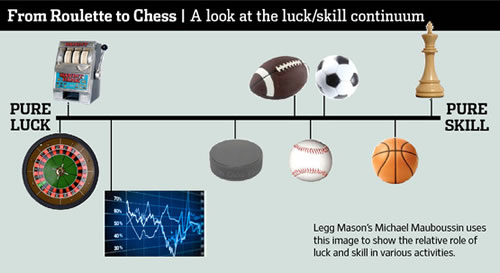
One of the eternal questions in investing is whether performance results are due to skill or luck. We’ll probably never get a universally-accepted answer, but Michael Mauboussin (chief investment strategist at Legg Mason Capital Management) explores the subject in his new book The Success Equation: Untangling Skill and Luck in Business, Sports, and Investing.

I haven’t read the book, but in a WSJ interview the author shares a graphic illustrating where he views investing on the skill-to-luck continuum. At the extremes are the pure luck of roulette and the overwhelming dominance of skill in chess.

Mauboussin is quick to explain that the luck factor comes into play because making money is a hugely powerful motivator and thus draws in the smartest people in the world. This leads to competition at such a high level that differences in results are mostly luck, especially in the short-term.

This reminds me of another famous skill vs. luck argument by Warren Buffett called The Superinvestors of Graham-and-Doddsville (Wikipedia). You can feel his annoyance at the academics suggesting that his mentors were simply statistical anomalies.

For the record, I don’t believe in the academic definition of the efficient market hypothesis either. But as the graphic above suggests, market efficiency is not a yes/no situation but a matter of degree. Even Buffett has repeatedly stated that most investors would be better off in low cost index funds, and even wagered $1 million that the Vanguard S&P 500 index fund would outperform a basket of hedge funds over a decade. The bet started in 2008, and as of March 2012 the index fund is ahead. Of course, no matter who wins, was it skill… or luck?

Prosper: Best Search Filters for Automated Quick Invest

(This post is for investors and lenders. If you need a loan or debt consolidation, check out my LendingClub vs. Prosper comparison for borrowers.)

As part of my new Beat-the-Market Experiment, I have dedicated $5,000 to Prosper. As a quick recap, Prosper.com securitizes person-to-person loans so that you can lend money to other people in $25 increments and earn interest. The idea is to replace banks and credit cards as the middlemen. Since their mid-2009 re-launch after SEC registration, there have been a full cycle of 3-year Prosper “2.0” loans fully maturing with an average net return of over 8% annualized. However, this is still unsecured lending which means no car or home as collateral, and thus there is a risk of loss (which can be mitigated by diversifying in multiple loans).

Prosper looks at the credit history of prospective borrowers and charges them an interest rate based on a Prosper Rating of AA, A, B, C, D, E, or HR (high risk). (The ratings are relative; the minimum credit score is 640.) Now, if Prosper’s grading system was perfect, life would be simple. The interest rate charged would be high enough to cover any defaults plus a little extra for the added heartburn. Ideally, after defaults and fees are accounted for, perhaps AA loans would earn 6%, C loans would earn 8%, and E loans would earn 10%.

However, things aren’t quite that neat. Prosper publicly shares all its loan information, and smart folks have made tools to analyze that data. Currently, the best place to go is Prosper Stats. If you take all the loans, we see that AA loans have a net return (after estimating losses from late loans and actual losses from defaults) of ~6%, C loans had a net return of ~11%, but E loans only returned ~9%. Hmm. Look further and you’ll see other small inconsistencies. For example, loans to people with 2 or less open credit lines actually have a measly 3% net return, while loans to folks with 18+ open credit lines open have net annualized returns of over 11%?!

As a result, many investors avoid investing in Prosper loans blindly and instead use specific search filters. Indeed, Prosper makes it easy with their “Automated Quick Invest” service which automatically invests in loans that satisfy your custom search rules. There’s no need to spend time every day looking for loans. So, what are some possible criteria?

[Read more…]

Ask the Readers: Portfolio Advice for a World Traveler

One of my online friends, Nomadic Matt, approached me for some investing advice. Matt changed his career path and now travels around the world and writes about it for a living. Not a bad gig, eh?

Matt and I had a short chat about his goals and situation, which he agreed to open up to outside advice as he has some specific investment ideas and leanings that he’d like to explore. I believe he is single in his late 20s or early 30s, and he also has an MBA so he’s not starting from scratch.

MMB: So roughly how much money are we talking about here? How is it currently invested and in what types of accounts (bank, IRA, brokerage, etc)?

Matt: I have a small five figure sum invested in a SEP IRA.

MMB: What is your timeline and goals for this money? Are you looking to save for retirement, a house, or something else? Would you want access part of it if needed? If retirement, are we talking at age 40 or 65?

Matt: It’s in an IRA, so retirement. I just want it to grow. I wouldn’t need to before 65.

MMB: Approximately how much additional money are you going to be able to contribute in the future?
[Read more…]

Recent Investment Returns By Asset Class – October 2012

Here is my monthly update of the trailing total returns for the major asset classes that I find useful. I am using passive ETFs to track asset classes, as they represent “real” investments that you can buy and sell. Return data was taken after market close at the end of October 2012.

Asset Class
Representative ETF
Benchmark Index
1-Mo 1-Year 5-Year 10-Year
Broad US Stock Market
Vanguard Total Stock Market (VTI)
MSCI US Broad Market Index
-1.75% 14.75% 1.57% 8.73%
Broad International Stock Market
Vanguard Total International Stock (VXUS)
MSCI All Country World ex USA Investable Market Index
0.56% 5.43% -5.49% 8.90%
Emerging Markets
Vanguard Emerging Markets ETF (VWO)
MSCI Emerging Markets Index
-0.41% 3.47% -3.94% 15.80%
REIT (Real Estate)
Vanguard REIT ETF (VNQ)
MSCI US REIT Index
-0.82% 14.72% 2.26% 11.89%
Broad US Bond Market
Vanguard Total Bond Market ETF (BND)
Barclays U.S. Aggregate Float Adj. Bond Index
0.11% 4.99% 6.35% 5.39%
US Treasury Bonds – Short-Term
iShares 1-3 Year Treasury Bond ETF (SHY)
Barclays U.S. 1-3 Year Treasury Bond Index
-0.06% 0.30% 2.58% 2.66%
US Treasury Bonds – Long-Term
iShares 20+ Year Treasury Bond ETF (TLT)
Barclays U.S. 20+ Year Treasury Bond Index
-0.12% 10.97% 10.82% 8.21%
TIPS / Inflation-Linked Bonds
iShares TIPS Bond ETF (TIP)
Barclays U.S. TIPS Index
0.83% 7.85% 7.72% n/a
Gold
SPDR Gold Shares (GLD)
Price of Gold Bullion
-3.25% -0.57% 16.38% n/a

Here is a chart of the 1-year trailing returns for the major asset classes above, which I use for rebalancing. Note that I do not necessarily invest in all the listed asset classes, see my personal portfolio for more details.

I’ve barely been investing for a decade, but this month I notice that all the 10-year returns look pretty good for all the asset classes. (The 2001 dot-com crash is now left out.) Is this why everyone seems to be pretty happy with the market right now? I wonder if the good times will last.

[Read more…]

Beat The Market Experiment: My Money Blog Play Portfolio Breakdown

Update: Check out the monthly updates on this experiment.

Do you think you’re a below-average driver? Of course not. Everyone thinks they’re above-average. This is why I’m a big proponent of the “Core and Explore” or “Play” portfolio. You should set aside a small percentage of your portfolio and try your best to beat a passive benchmark. If you track things carefully, chances are that after a few years you’ll discover you really aren’t so good and hopefully end up settling into the slight-but-guaranteed outperformance of low-cost, passive investing. Or, you’ll find you’re meant to be a rich and successful hedge fund manager. Win-win!

I’ve been running a little side portfolio for years, but I haven’t been following my own advice about tracking my relative performance. I think it’s time. I’m taking $30,000 and using it for my “Beat the Market” experiment. This is less than 5% of my actual portfolio, which is still overwhelmingly in low-cost index funds rebalanced to a target asset allocation. I’ll track the balances monthly with actual screenshots starting today, November 1st, 2012. Here’s how I’m breaking it down.

$10,000 “Good Boy” Passive ETF Benchmark Portfolio

My real portfolio is held primarily at Vanguard and Fidelity but also includes non-index funds due to limited 401k choices. To create a separate benchmark, I opened a new account at TD Ameritrade as they offer 100 of the most popular ETFs commission-free, including the Vanguard and iShares ETFs that I use. My benchmark portfolio will be based on my usual target asset allocation, except fully-invested in 100% stocks (details coming). As the portfolio will consist of commission-free ETFs and there are no maintenance or service fees, the overall cost drag should be very, very low.

I will not make any deposits or withdrawals to this account, and will report the total balance on a monthly basis. I suppose I could also track after-tax efficiency, but that sounds like too much work and most people invest predominantly in 401k’s and IRAs anyway.


(I know, it has $15,000 in it right now, I already submitted a withdrawal request for $5,000.)

$10,000 “Bad Boy” Beat-the-Benchmark Portfolio

In this account, I’ll be able to buy whatever: individuals stocks, ETFs, options, and even short stocks as needed in my attempts to crush the Benchmark portfolio above. I liquidated the holdings in my existing TradeKing account and left $10,000 in there. This will serve as a low-cost, no-fee brokerage account with $4.95 trades and 65 cent options contracts. (TD Ameritrade standard pricing is $9.99 a trade.)

[Read more…]

Top 529 Plans: SavingForCollege 5-Cap Ratings List 2012

Savingforcollege.com is a popular privately-run site for researching and comparing 529 college savings plans. In June 2012, they updated their rating system which represents their “opinion of the overall usefulness of a state’s 529 plan based on many considerations.” The judgement criteria include:

  • Performance. They selected similar “apples-to-apples” portfolios with 7 different asset allocations from each plan and rated them based on historical performance. Rankings are updated each quarter.
  • Costs. Total average asset-based expense ratios among plans are compared, in addition to separately considering program manager fees, administrator fees, and annual account maintenance fees.
  • Features. This includes other factors that affect participants, including the ability of the plan change their investment options quickly if called for; creditor protection under the sponsoring state’s laws; availability of FDIC-insured options; minimum and maximum contribution restrictions.
  • Reliability. The appears to measure the likelihood of a good plan staying a good plan. Do they have experienced program managers? Does the plan have a good amount of assets? What is the quality of the documentation and reporting? How restrictive are the withdrawal and rollover processes?

Here is the full list of 5-Cap Ratings for each state, on a scale of 0 to 5 Caps. Note that there are separate ratings for in-state and out-of-state residents. Out of the 100+ different plans they rated, here are the 8 programs available directly to the public that attained the top 5-Cap Rating for out-of-state residents (alphabetical order):

  • California: The ScholarShare College Savings Plan
  • Maine NextGen College Investing Plan – Direct Plan
  • New York’s College Savings Program – Direct Plan
  • Ohio CollegeAdvantage 529 Savings Plan

The following plans received a 5-Cap Rating for in-state residents:

  • California: The ScholarShare College Savings Plan
  • Colorado: Direct Portfolio College Savings Plan
  • Colorado: Scholars Choice College Savings Program – Advisor Plan
  • Illinois: Bright Start College Savings Program – Direct Plan
  • Iowa: College Savings Iowa
  • Maine: NextGen College Investing Plan – Direct Plan
  • Maine: NextGen College Investing Plan – Advisor Plan
  • Michigan: Michigan Education Savings Program
  • Nebraska: Nebraska Education Savings Trust – Advisor Plan
  • Nebraska: Nebraska Education Savings Trust – Direct Plan
  • New York: New York’s College Savings Program – Direct Plan
  • Ohio: Ohio CollegeAdvantage 529 Savings Plan
  • Rhode Island: CollegeBoundfund – Direct Plan
  • South Carolina: Future Scholar 529 College Savings Plan – Advisor Plan
  • South Carolina: Future Scholar 529 College Savings Plan – Direct Plan
  • Utah: Utah Educational Savings Plan (USEP)
  • West Virginia: SMART529 WV Direct College Savings Plan
  • Wisconsin: Edvest

The SavingForCollege Top-rated 5-Cap plans are slightly different than the Morningstar Top-rated Gold plans. However, in general the top 20 or so plans are pretty much the same. Remember to consider your in-state plan first for potential tax advantages.

Calculating Portfolio Yield From Dividend and Interest Income

As I’m about 2/3rds of the way to having theoretically enough money to cover our living expenses, I wanted to take a closer look at the actual mechanics of living off of my investment portfolio.

I’m using a 3% withdrawal rate, which means that for each $100,000 I have, I’m expecting it to grow such that I can withdraw $3,000 a year, adjusted for inflation, for 40+ years (essentially forever). A conservative way to take withdrawals from an investment portfolio is to spend only the dividends and interest while leaving the principal untouched. This is assuming you don’t go reaching for yield by buying things like troubled, high-dividend stocks and high-yield junk bonds. As a baseline, I wanted to see how much income my passive portfolio would create with my current target asset allocation:

There are many different yield definitions to choose from, but I decided to go with trailing 12 month (TTM) yield as it’s based on a year of past distributions. Specifically, the Morningstar yield is found by dividing the sum of the fund’s income distributions for the past 12 months by the previous month’s NAV (net asset value). Only interest distributions from bond funds and dividends from stock funds are included.

Model Portfolio Yield Breakdown:

[Read more…]

Basics of ETF Tax Loss Harvesting

Tax-loss harvesting (TLH) is a technique used to minimize taxes on your taxable investments – without altering them significantly – by “harvesting” capital losses during market declines. There are many lengthy articles about TLH out there, but Wealthfront recently released a brief video about tax-loss harvesting that is a good intro to the subject:

Wealthfront is now including tax-loss harvesting in their 0.25% advisory fee for clients with taxable accounts of $100,000 or more. (Advisory fee is on top of ETF and/or mutual fund expense ratios.) I think it’s great that they are offering tax-loss harvesting at a reasonable price, but I don’t know about their contention that tax-loss harvesting is “traditionally only available to accounts in excess of $10 million”. Respectable portfolio managers, include low-cost passive portfolio managers, have been providing tax-loss harvesting to all their clients for a long time. It is true that other online portfolio managers like Betterment currently don’t offer this, however.

(I’m also skeptical about their finding that TLH boosted returns by a full percentage point, I’d be worried about data mining. I mean, sure, if you harvested losses perfectly during every little decline, maybe, but 1% is a lot.)

Indeed, if you’re a DIY investor with a portfolio of a 2-6 index ETFs, you can harvest losses on your own. Here’s an tax-loss harvesting example with ETFs from an old blog post. Wealthfront’s materials suggest that their own method is to sell a primary ETF (ex. Vanguard/VEA) when it’s down and buy the low-priced secondary ETF equivalent (ex. Schwab/SCHF) to replace it. Then, you sell the secondary ETF again after 30 days to get your Vanguard ETF back with a lower basis while avoiding IRS wash sale rules. They believe that their pairings satisfy the IRS requirement that the ETFs can’t be “substantially identical”. You’ll have to decide for yourself if you want to do those extra two trades to swap things back (and paying extra commisions) every time you TLH, or if you should just keep holding the secondary ETF until the next time you want to sell for whatever reason.

Update: I received the following message from Wealthfront:

I wanted to point out when reading your post is that we offer continuous tax-loss harvesting as opposed to year end tax-loss harvesting. We agree with you that the expected benefits on year end tax-loss harvesting is not 1% a year but rather that is for continuous tax-loss harvesting where you are continually harvesting throughout the year.

Here is their whitepaper on the subject, although I should note that the 1% alpha is based on the assumption that you are in the highest 35% tax bracket (while long-term gains are at 15% tax rate). The continuous algorithm deciding when to harvest is interesting, being based partially on “each ETF’s volatility parameter estimated over a rolling time window.”

Market Timing Prediction + House Payoff Focus

As you probably know, I’m not an advocate of market timing. Jumping in and out of stocks is usually based on fear – either fear of missing out on hot returns or fear of more losses. However, if you’re going to do it, I figure you should announce your move beforehand, as opposed to making self-congratulatory pronouncements afterwards. “I sold all my stocks and my houses in 2007, right before the crisis hit as I knew something was fishy.” You never hear “I sold most of my stocks in 2009 and missed the potential doubling of my money since then.”

This is the predicament where I am today. I don’t think the stock market is very attractively priced. I don’t think locking up 2% yields for 10 years is a very good option either. Everything seems to be up, and our investments have swollen significantly. So while I’m not complaining, from what I can tell none of the things that were previously broken in the world have actually been fixed.

In addition to me being “meh” about the current investment outlook, having a new child has refocused us on shifting into part-time work as opposed to going all-out towards a full early retirement. Having the house paid off will free up our cashflow needs significantly, as our mortgage remains over 50% of our total spending. Once that is taken care of, it’ll be much easier to shift into part-time work as we want avoid using daycare as much as possible.

So for the rest of the year and probably into 2013, I am going to focus on putting new money towards paying down the mortgage. (Our 401ks and IRAs are maxed for 2012, and our current portfolio will stay invested.) This will effectively gain us a yield of 3.25% (our mortgage rate) for however long it takes to pay it off completely. Yes, we just refinanced this year, but we actually netted a thousand dollars from that refi due to negative points. Today, the S&P 500 Index is at about 1,435 and the 10-Year Treasury yield is 1.66%. Let’s see how wrong I can be. 🙂

What’s Inside the Vanguard Total Bond Index Fund?

The Vanguard Total Bond Market Index Fund is designed to track the entire spectrum of US bonds (well, those that are publicly-traded, taxable, and investment-grade). It is the second-largest bond fund out there, with $160 billion in assets and behind only the PIMCO Total Return Fund. It is available to retail investors as a mutual fund (VBMFX/VBTLX) or ETF (BND). If you own a Vanguard Target Retirement or LifeStrategy fund, you own some version of this fund. Let’s take a closer look.

Vanguard founder Jack Bogle wrote an article called The Bond Index Fund which talks about how the Vanguard Total Bond Index fund got started and its subsequent performance:

It’s now 25-year lifetime rate of annual return averaged 6.9 percent, a nice margin of 1.2 percentage points over the average 5.7 percent rate of return of its taxable peers. That superiority comes despite the Fund’s assuming far less credit risk, for the fund (and the bond market index itself) typically hold more than 70 percent of assets in securities backed by the U.S. Treasury and its agencies, including mortgage pass-through certificates. Compounded, the appreciation of a $10,000 investment made at the close of 1986 was remarkable: average actively-managed bond fund $29,900; Vanguard’s passively-managed bond index fund, $42,600—an enhancement in profit of more than 40 percent. This stunning advantage once again reaffirms the timeless truism: Never forget either the magic of long-term compounding of returns, nor the tyranny of long-term compounding of costs.

You have to admit, this historical growth chart looks pretty good:

So, what’s inside this bond juggernaut? For that, we look at the popular benchmark Barclays US Aggregate index, which started in 1986. As it is a market-cap weighted index, the composition shifts constantly over time. The iShares blog has an illustrative chart:

What do all those acronyms mean?

[Read more…]

Recent Investment Returns By Asset Class – September 2012

Here is my monthly update of the trailing total returns for the major asset classes that I find useful. I am using passive ETFs to track asset classes, as they represent “real” investments that you can buy and sell. See August 2012 asset class returns for additional background and comparison.

Asset Class
Representative ETF
Benchmark Index
1-Mo 1-Year 5-Year 10-Year
Broad US Stock Market
Vanguard Total Stock Market (VTI)
MSCI US Broad Market Index
2.58% 30.26% 1.57% 8.73%
Broad International Stock Market
Vanguard Total International Stock (VXUS)
MSCI All Country World ex USA Investable Market Index
1.93% 13.58% -4.52% 9.44%
Emerging Markets
Vanguard Emerging Markets ETF (VWO)
MSCI Emerging Markets Index
5.32% 17.74% -1.73 16.58
REIT (Real Estate)
Vanguard REIT ETF (VNQ)
MSCI US REIT Index
-1.84% 32.32% 2.68% 11.42%
Broad US Bond Market
Vanguard Total Bond Market ETF (BND)
Barclays U.S. Aggregate Float Adj. Bond Index
0.09% 5.00% 6.52% 5.31%
US Treasury Bonds – Short-Term
iShares 1-3 Year Treasury Bond ETF (SHY)
Barclays U.S. 1-3 Year Treasury Bond Index
0.02% 0.40% 2.69% 2.69%
US Treasury Bonds – Long-Term
iShares 20+ Year Treasury Bond ETF (TLT)
Barclays U.S. 20+ Year Treasury Bond Index
-2.32% 6.10% 11.19% 7.82%
TIPS / Inflation-Linked Bonds
iShares TIPS Bond ETF (TIP)
Barclays U.S. TIPS Index
0.50% 8.87% 7.79% n/a
Gold
SPDR Gold Shares (GLD)
Price of Gold Bullion
7.70% 9.20% 18.57% n/a

Here is a chart of the 1-year trailing returns for the major asset classes above, which I use for rebalancing. Note that I do not necessarily invest in all the listed asset classes, see my personal portfolio for more details.

Looks like nearly all asset classes are up from a year ago. Indeed, the US stock market is up over 30% from a year ago… find a guru or economist that predicted that! Over the past 10 years, the US stock market had an a 8.59% annualized return. The hyped “lost decade” looks a lot different once you simply move your timeframe a few years. The longer I invest, the less I pay attention to short-term market predictions from anyone.

[Read more…]