Monthly Net Worth & Goals Update – December 2009

Net Worth Chart 2009

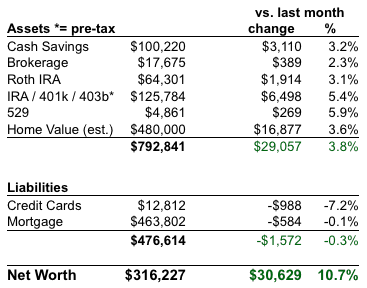
Wow, December already…

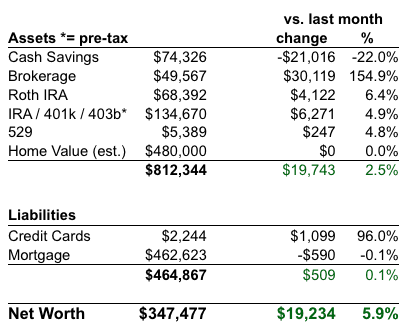
Credit Card Debt
Up until now, I have taken money from credit cards at 0% APR and placed it into online savings accounts, bank CDs, or savings bonds that earn up to 4-5% interest (less recently), and keeping the difference as profit. However, given the current lack of good no fee 0% APR balance transfer offers , I am no longer playing this “game”. The balance that you do see is either before the end of the statement or during the grace period, where I’m also not paying any interest.

Retirement and Brokerage accounts
Mrs. MMB and I have both maxed out our 401k salary deferrals for 2009. We have also started to invest in regular taxable accounts by investing $30,000 that was previously being held as cash. I’ll outline the trade activity in an upcoming portfolio update.

Our total retirement portfolio is now $231,368 or on an estimated after-tax basis, $191,475. At a theoretical 4% withdrawal rate, this would provide $638 per month in after-tax retirement income, which brings me to 26% of my long-term goal of $2,500 per month.

We are also getting ready for a Traditional-to-Roth conversion once the income limits are removed in 2010. We’ll need to gather up some information in order to see how much tax we owe on any gains. More details on this to come.

Cash Savings and Emergency Funds
We keep a year’s worth of expenses in our emergency fund. Potential large expenses include $10,000 for home improvement projects (minor roof repair and solar water heating), as well as $15,000-$20,000 on a new car to replace our 1995 Nissan. Hope it can last us 15 years as well!

Home Value
I am no longer using any internet home valuation tools to track home value. Some people have suggested using my tax assessed value, but I also think that is too high. I simply picked what I felt is a conservative number based on recent comparables, $480,000, and keep it for at least 6 months if not a year. (Currently on month 3 out of 6.) For the most part I am concerned about mortgage payoff, which I still plan to accomplish in 20 years at most.

You can view previous net worth updates here.

Human Capital: Are You a Stock or a Bond?

Over at Bogleheads there was an interesting thread which explored how finance professor Moshe Milevsky has been pushing the concept of human capital as an additional variable to the traditional ideas of net worth, portfolio construction, and asset allocation. These are explored in this this trade magazine article for financial advisors, this draft academic paper, and also in his book Are You a Stock or a Bond?.

Human Capital
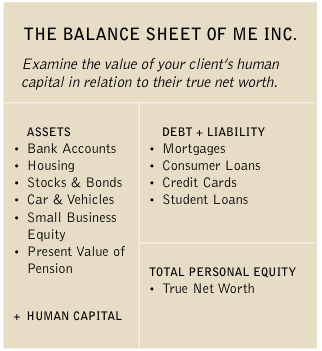
There are some differing definitions, but below is a brief explanation (taken from the magazine article above) of what is meant by human capital here:

Human capital is a measure of the present value of your client’s future wages, income and salary (net of any future income taxes and expenses). For example, if she is a doctor, lawyer, engineer or even a professor, she has probably invested an enormous amount of time, effort and money to finance her education. That investment will hopefully pay off over many future years of productive labour income in the form of job dividends over the next 10, 20 or even 30 years. Sure, clients can’t really touch, feel or see human capital, but like an oil reserve deep under the sands of Alberta, it will eventually be extracted and so it’s definitely worth something now.

Milevsky likes to talk about people as businesses and thus includes human capital on the balance sheet of “Me, Inc.”:

When you’re young, your human capital may very well dwarf your 401k balance. With this in mind, it may make you feel better about any short-term losses.

Your human capital can be viewed as a hedge against the losses in your financial capital. So, as a 50-, 40-, or especially 30-year old, you should be willing to take more chances with your total portfolio, perhaps even borrow to invest or leverage into the stock market, because you have the ability to mine more human capital if needed.

Am I a Stock or a Bond?
One characteristic of your human capital to think about is if it tends to act like a stock or a bond. As a tenured university professor, Milevsky offers himself up as a good example of a bond that offers a reliable and steady coupon (paycheck). However, an small business owner, investment banker, or even a car salesman would have an income that is much more correlated with current economic conditions – much like a stock would.

A common piece of advice that relates to this is when people are told not to hold too much of their employer’s company’s stock (often in 401k plans). Since your salary is already tied to that company, it would be wise to add some diversification so that all your eggs aren’t in one basket.

Along the same diversification argument, if you are a “bond” then you may be able to take more equity risk in your retirement portfolio. On the other hand, if you are a “stock” then you may want to reduce your exposure to stock market swings. “Your invested assets should zig when your salary zags… tilt your financial portfolio away from your human capital.”

Thoughts
Unfortunately, rarely are things so simple. Human capital is at best a guess of the future, and you could be really far off. And just because your income isn’t tied to the stock market, doesn’t necessarily mean you can stomach the swings of a highly risky portfolio. If you’re the type to panic and sell at the bottom, perhaps increasing stocks would only hurt your long-term investment returns.

I like to imagine a good financial couple as one that pairs up a stock and bond. Perhaps one person holds a steady government job with a pension and healthcare benefits into retirement, while the other is an entrepreneur that takes some risks and tries to strike it big.

Also, what if I don’t want take advantage of all my human capital? Sure I could work for another 35 years and consider a big chunk of human capital in my net worth, but I’d really rather not. 🙂

What do you think of this concept?

MicroPlace: Buy a $20 Gift Certificate, Get One Free

Just got an e-mail from MicroPlace that they are running a gift certificate promotion where if you buy a $20 GC, you get another $20 GC free. The gift recipient can then lend out the money to a poor entrepreneur and receive interest + $20 back later. Since the person actually gets the money back (or at least most of it assuming some defaults), and thus isn’t the same as a “$XX has been donated in your name” gift, I think it’s a cool twist on gift cards.

Give a Gift that Keeps on Giving
Give a unique and special gift this holiday season. It is a gift of connection, a gift of hope, and a gift that believes that poor people can use their ingenuity and hard work to break out of the cycle of poverty.

Your gift can help fund loans to poor people who could start a business, save, and work their way out of poverty. And when you purchase a gift certificate of $20 or more on MicroPlace, we’ll give you a free gift certificate of $20 to send to someone else on your shopping list!

To learn more about Microplace check out these posts, including my last microlending update.

Monthly Net Worth & Goals Update – November 2009

Net Worth Chart 2009

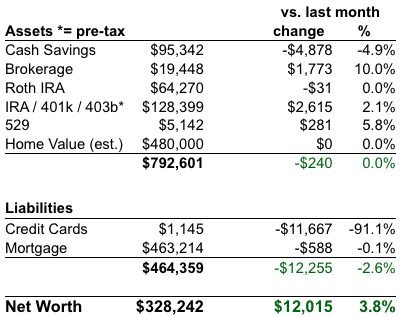
Credit Card Debt
In the past, I have taken money from credit cards at 0% APR and placed it into online savings accounts, bank CDs, or savings bonds that earn 4-5% interest (much less recently), and keeping the difference as profit. I even put together a series of step-by-step posts on how to make money off of credit cards in this way.

However, given the current lack of great no fee 0% APR balance transfer offers, I am no longer playing this “game” and have just paid off my last 0% offer for now. This makes the net worth chart a bit funny, but it should clear up next month.

Retirement and Brokerage accounts
Our total investment portfolio increased by a few thousand dollars since last month. DW’s 401k was already maxed out at $16,500. I made another $1,000 contribution to my Solo 401k, for a total of $16,500 contributed in 2009 as well. (I forgot the limit was $16,500 and not $15,500 last month…) This makes us done with our goal of maxing out both our 401k salary contributions for 2009.

I am starting to build up too much cash, and have started investing for retirement in a taxable brokerage account as well. In the interest of tax efficiency, I’ll have to move around some investments in order to keep bonds in the tax-advantaged IRAs/401k and the “extra” stocks in taxable. I expect to finish investing $20,000 this week.

Taking that additional 20k into account, our total retirement portfolio is now $211,095, or on an estimated after-tax basis, $170,047. At a 4% withdrawal rate, this would provide $567 per month in tax-free retirement income, which brings me to 23% of my long-term goal of $2,500 per month.

Cash Savings and Emergency Funds
We keep a year’s worth of expenses in our emergency fund. Another $10,000 is earmarked for upcoming home improvement projects that I keep putting off (minor roof repair and solar water heating).

Home Value
I am no longer using any internet home valuation tools to track home value. Some people have suggested using my tax assessed value, but I also think that is too high. I simply picked what I felt is a conservative number based on recent comparables, $480,000, and keep it for at least 6 months if not a year. (Currently on month 2 out of 6.) For the most part I am concerned about mortgage payoff, which I still plan to accomplish in 20 years at most.

You can view previous net worth updates here.

Reader Question: What If My 401k Has Horrible Investment Options?

Here’s another good reader question about crappy 401k plans. Reader Robert saves enough to max out his 401k each year if he wanted to, in addition to maxing out his Roth IRA every year which he already does. However, his 401k plan is filled with expensive actively-managed mutual funds. He has no company match. Should he contribute to his 401k anyway, or invest outside in a taxable account?

Factor #1: How Long Will You Keep Your Job?
Even if you have a bad 401k plan, remember that as soon as you leave that company, you can roll over those tax-advantaged funds into a Rollover IRA at the company of your choice! You may or may not have a good idea of how long you’ll stay there, but the fact is most of my friends have not worked at any company longer than 5 years or so.

(A few plans offer what is called in-service withdrawals, where you can roll over your 401k fund into a IRA without leaving your employer. These are rare, but it’s worth asking about.)

Factor #2: Can You Help Your HR Department Make A Change?
The reason why expensive 401k plans exist is because they tend to be cheap for the employer. Essentially, the administrative costs for running the plan are shifted to the employees. Big companies tend to have better plans because they offer enough assets for companies like Vanguard to jump in.

Still, you might be able to enact some change. Print out some material about how high plan expenses can really hurt performance and thus people’s retirements. Talk to your co-workers, and make it an worker attraction/retention issue. You may not need to switch providers, but perhaps they’ll at least offer a better option or two. I’ve even read about Congress considering a law requiring all 401k plan administrators offering at least one index fund option.

Factor #3: How Expensive Is It?
Unfortunately for Robert, he shared his available investment options along with their annual expense ratios, and they are the worst I’ve seen yet:

Blackrock Fundamental Growth C MCFGX 1.94%
Blackrock Global Allocation C MCLOX 1.88%
Blackrock Government Income Portfolio C1 BGIEX 1.53%
Blackrock International Value C MCIVX 2.60%
Blackrock Large Cap Core C MCLRX 1.97%
Blackrock Large Cap Value C MCLVX 2.00%
Blackrock Value Opportunities C MCSPX 2.34%
Davis New York Venture C NYVCX 1.71%
Evergreen Core Bond C ESBCX 1.45%
J P Morgan Dynamic Small Cap Growth C VSCCX 2.12%
Mfs Total Return C MTRCX 1.52%

It may be tempting to think “well, no matter how bad the plan is, it will still be better than a taxable account, right?” Wrong. Actually, given current tax rates, it can be better to keep your money in a taxable brokerage account than in a 401(k) plan if the options are expensive enough. Here are some quick and dirty examples.

Let’s say you put in $10,000 in a taxable account. You invest in an index fund with 0.20% expense ratio. The broad US stock market earns 8% per year. Since you get the gains minus expenses, you get 7.8% per year. You get a 15% tax hit at the end for long-term capital gains. Your final after-tax balance after 30 years is $80,906. (Yes, I’m ignoring the annual taxation of dividends for now.)

10,000 x 1.078^30 x 0.85 = $80,906

Let’s say you put in $10,000 of after-tax money in a Roth 401(k). You buy a Blackrock fund with 2% expense ratio. Again, on average, all mutual funds that invest in the broad US stock market will earn the market returns (8%) minus expenses (2%), giving you a 6% return per year. However, you have no tax hit at the end since it is a Roth. (You’d get the same result with pre-tax money in a Traditional 401k.) Your final after-tax balance is only $57,434.

10,000 x 1.06^30 = $57,434

The above is a very simplified comparison, but the point is that the gradual annual hit of a high expense ratio can overcome the tax break advantage. Usually this takes an expense ratio above 1% and a long time horizon.

Recap / WWMMBD
If you think that your current plan options will continue to be this bad for the next 10 years or more, and you don’t think you’ll leave your company before then, then it may indeed be better to just invest outside a 401k plan. (Keep up the IRA contributions!) However, I think that soon 401k plans will be more tightly regulated, and the trend is for plans to at least offer a few low-cost options. I know my plan seems to get a little better every year. If it were me, I’d probably suck it up and still tuck money away in the 401k in the hopes of a brighter future.

Will Replacing 401(k) Plans With Portable Pensions Fix Retirement Planning?

stool
Traditional Three Legged Stool of Retirement
(post, image via Michigan.gov)

Over the weekend, I finally got around to reading this Time magazine article about Why It’s Time to Retire the 401(k) which has been getting some buzz. The author promotes bringing back what I call “portable pensions” to replace the employee-controlled 401(k) plan, which would guarantee say 50% of your last year’s salary for the rest of your life. Sounds nice, but how will it work, and who’ll pay for it?

Take the Mr. Shively in the article, who is still working at 68. About 25 years ago, his employer dropped the pension and replaced it with a 401(k). Over those two and a half decades, he has managed to save $70,000 in a 401(k). Yet it is suggested that if only his company kept the pension, he would be getting $1,308 per month, or $15,700 a year. Such a lifetime of cashflow from age 65 would cost at least $200,000 according to ImmediateAnnuities.com ($250,000 if joint, covering a spouse also age 65). Where did the $130,000-$180,000 difference come from?

Pensions are more expensive to run than 401(k) plans. Let’s say you have average employees making $50,000 a year and you match 100% up to 5%. That costs $2,500 a year – bang, you’re done, and you don’t have to worry about investing the money to meet future liabilities. Where does the savings go? Either Shively got paid more (through higher salary or matching contributions) and didn’t save it, or his employer pocketed the savings, or likely a little of both.

This brings us to the other problems of the 401(k) system are, which were explored in this 2001 Barron’s article by William Bernstein after the last stock market crash. “The 401(k) is likely to turn out to be a defined-chaos
retirement plan.”

Employees are not saving enough. Will this be fixed by a portable pension? Only if employers are willing to pay higher total compensation, which is unlikely. Otherwise, will people really be okay with forced savings like an additional mandatory 5-10% contribution? Folks tend to see that as a tax, like Social Security.

Investors are depending on future market returns which will likely not be as high as in the past. The idea of gaining 8% per year, 5% after inflation, sounds nice but may not happen in the future. Current P/E ratios are still above average current. This means people will need to save even more than they thought. Again, where will this money come from?

401(k) expenses are too high, which reduces returns even further. Having a guaranteed income for life requires insurance companies. Which means instead of mutual fund expenses, you’ll have hidden insurance fees and guaranteed returns that will have to be significantly less that market returns. If more transparency and direct competition existed, perhaps the costs could be minimized.

Investors have poor investing knowledge. This is kind of an unsaid reason of why 401(k)s are bad, because there will always be those invested poorly. My concern is related to this recency bias. 401ks got traction initially because markets were hot at the time. Talk of pensions increase now because the recent performance was awful. What happens when the markets get hot again? Will people be happy with their 6% steady increases when others are gaining 30% in year?

I’d like to see what happens with this “portable pension” idea, but the practical realities concern me.

Strong 2009 Market Returns So Far: Time To Rebalance?

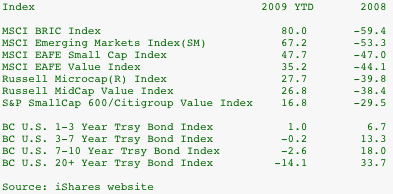
If you haven’t noticed already through your portfolio statements – the stock markets are doing well in 2009. The broad US stock market and the broad developed international markets are up 22% and 29%, respectively. Some funds are doing especially well, such as the Vanguard Emerging Markets Stock Index Fund (VEIEX) which is up +62.6% year-to-date.

Vanguard recently sent me a newsletter with a link to an article titled Strong 2009 performance warrants yellow flag, which states in part:

While it may be gratifying to see these robust gains lift the balances of your funds, the markets have “come a long way in a hurry,” as the saying goes. At this point, it may be wise to ensure that your asset allocation is in line with your long-term goals.

A discussion thread on this article at Bogleheads had member Robert T pointing out the following comparisons in 2008 and 2009 YTD performance data:

Many of the asset classes that got hit the worst in 2008, have made the largest comebacks. Of course, we can’t know for sure if this surge will continue or if we’re headed back down again. But I think Vanguard’s advice is sound, to make sure our asset allocations are on target. If you had the guts to rebalance at the end of 2008, then buying more stocks “low” would have paid off nicely. Right now, you’ll want to make sure you’re not overweight in stocks.

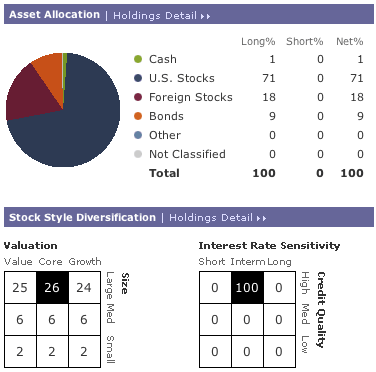
I have been using my ongoing investments to balance out my asset allocation through the year, but as my latest portfolio snapshot shows, I am still overweight in Emerging Markets and underweight in bonds.

Is your asset allocation where you want it to be?

Monthly Net Worth & Goals Update – October 2009

Net Worth Chart 2009

Credit Card Debt
For newer readers, I have taken money from credit cards at 0% APR and placed it into online savings accounts, bank CDs, or savings bonds that earn 4-5% interest (much less recently), and keeping the difference as profit. I even put together a series of step-by-step posts on how to make money off of credit cards in this way. However, given the current lack of great no fee 0% APR balance transfer offers, I am mostly waiting on existing offers to end.

Retirement and Brokerage accounts
Wife’s 401k was already maxed out at $16,500 for 2009. I made another $5,500 contribution to my Solo 401k, for a total of $15,000 contributed in 2009. This makes us about 95% done with our goal of maxing out both our 401k salary contributions for 2009.

Our total retirement portfolio is now $190,085, or on an estimated after-tax basis, $152,349. At a 4% withdrawal rate, this would provide $508 per month in tax-free retirement income, which brings me to 20% of my long-term goal of $2,500 per month.

Cash Savings and Emergency Funds
We still have a little over a year’s worth of expenses in our emergency fund. Part of the cash is earmarked for some smaller home improvement projects.

The next step is to put future funds into buying ETFs in a taxable brokerage account since I no longer have room in tax-sheltered accounts. I’ll probably use TradeKing or Scottrade as my buy-and-hold ETF broker, and keep Zecco as my “play money” account.

Home Value
I am no longer using any internet home valuation tools to track home value. If I still did, it would have been $572,000. Some people have suggested using my tax assessed value, but I also think that is too high. I am simply picked what I felt is a conservative number based on recent comparables, $480,000, and keep it for at least 6 months if not a year. This way, I just focus on the mortgage payoff, which I still plan to accomplish in 20 years at most.

You can view previous net worth updates here.

2009 Q3 Investment Portfolio Update – 9/21/09

2009 Q3 Portfolio Breakdown
 
Retirement Portfolio Actual Target
Asset Class / Fund % %
Broad US Stock Market ($64,794) 33.8% 34%
VTSMX – Vanguard Total Stock Market Index Fund
DISFX – Diversified Stock Index Institutional Fund*
FSEMX – Fidelity Spartan Extended Market Index Fund*
US Small-Cap Value ($17,554) 9.1% 8.5%
VISVX – Vanguard Small Cap Value Index Fund
Real Estate (REITs) $18,004 9.4% 8.5%
VGSIX – Vanguard REIT Index Fund
Broad International Developed $46,820 24.4% 25.5%
FSIIX – Fidelity Spartan International Index Fund*
International Emerging Markets $21,678 11.3% 8.5%
VEIEX – Vanguard Emerging Markets Stock Index Fund
Bonds – Short-Term $4,484 2.3% 3.8%
VFISX – Vanguard Short-Term Treasury Fund
Bonds – Inflation-Indexed $18,568 9.7% 11.3%
VIPSX – Vanguard Inflation-Protected Securities Fund
Total Portfolio Value $191,902
* denotes 401(k) holding given limited investment options.

Like many others, for most of this year I’ve just been trying to keep my head down, make my regular stock contributions like a good boy, and not looking at my statement balances too much! There’s been a lot of “wow, my portfolio isn’t so bad anymore” talk due to the recent market run, so I figured it was time for a checkup. You know of course, that this also means the market will tank today… 🙂

Contribution Details
So far in 2009, we have made the following contributions:

  • $5,000 x 2 for 2008 non-deductible IRA contributions
  • $5,000 x 2 for 2009 IRA contributions
  • $33,052 for both of our 401k contributions, including salary deferral and company match. One is maxed out, the other has a little left to go.

2009 Performance
In my last update back in April, I had found our year-to-date performance to be about -15%. According to my spreadsheet, the 2009 year-to-date dollar-weighted performance of our personal portfolio is now 41% YTD.

For reference, the Vanguard S&P 500 Fund (VFINX) has returned 20.52% YTD, their FTSE All World Ex-US fund (VFWIX) has returned 35.72% YTD, and their Total Bond Index fund (VBMFX) is 5.11% YTD as of 9/18/09. The Vanguard Target 2045 Fund (VTIVX) has returned 23.4% YTD, which as a similar stock/bond breakdown to our portfolio, but less international exposure. Part of the good relative performance (which was previously relatively poor) is also likely due due to the timing of my large lump-sum investments.

Investment Changes
We have used our new contributions to keep us close to our asset allocation target, with a 85% stocks/15% bonds split. Right now, we are not too far off. The target percentages for each asset class are shown above as well. Currently, with the run-up in equities, we are a bit underweight in bonds.

You can view all my previous portfolio snapshots here.

Monthly Net Worth Update – September 2009

Net Worth Chart 2009

Credit Card Debt
For newer readers, I have taken money from credit cards at 0% APR and placed it into online savings accounts, bank CDs, or savings bonds that earn 4-5% interest (much less recently), and keeping the difference as profit. I even put together a series of step-by-step posts on how to make money off of credit cards in this way. However, given the current lack of great no fee 0% APR balance transfer offers, I am mostly waiting on existing offers to end.

Retirement and Brokerage accounts
Not much stock market movement this past month. Wife’s 401k was already maxed out at $16,500 for 2009. I made another $5,000 contribution to my Solo 401k, for a total of $10,000 contributed in 2009. This makes us about 80% done with our goal of maxing out both our 401k salary contributions for 2009.

Our total retirement portfolio is now $181,673, or on an estimated after-tax basis, $145,887. At a 4% withdrawal rate, this would provide $486 per month in tax-free retirement income, which brings me to 22% of my long-term goal of $2,500 per month.

Cash Savings and Emergency Funds
I did pay an additional $6,000 towards my mortgage this month, which ate up a lot of cash. This is roughly two extra mortgage payments, which if I do this every year will put me on track to shorten my 30 year mortgage to 20 years. Depending on interest rates, future contributions may be invested into municipal or government bonds.

We still have a little over a year’s worth of expenses in our emergency fund.

Home Value
Using four different internet valuation tools – Zillow, Cyberhomes, Coldwell Banker, and Bank of America (old version) – I again took the average and took off 5% to be conservative and 6% for real estate agent commissions. This ended up giving me a 6% value increase this month, which again makes my home value movements dwarf all other activity for this net worth measurement.

I’ve been using these internet tools for 10 months now, and while I like being able to track the overall trend in home values, the wide swings in estimates make me very skeptical of their accuracy. I expect to do this for another 2 months so that I have an entire year of data, but after that I will switch to another less volatile method.

You can view previous net worth updates here.

Should You Keep Your Emergency Fund In Your 401k?

Before you jump to an answer or nasty comment, please give me a chance to elaborate. 🙂 Recently, I ran across an interesting article in the Bogleheads Wiki titled Placing Cash Needs in a Tax-Advantaged Account. Essentially, because of the way the U.S. tax code works it can often be better to keep certain asset classes like cash inside tax-advantaged accounts like IRAs and 401ks. Therefore, if your emergency fund is cash, why not put it inside as well?

I’ll use the example given. Let’s say you have a 401(k) with a balance of $10k and also taxable assets of $10k, for $20,000 total. You choose to have $10k in stocks, $5k in bonds, and $5k in cash for your emergency account. The “traditional” placement for an emergency fund is in your regular taxable account, perhaps in a bank savings account. The rest of the assets are distributed according to this tax-efficient placement chart.

However, in this scenario all your interest earned on your cash will be taxed at your marginal ordinary income tax rate, which can be as high as 35%. See table of 2009 Marginal Tax Rate Brackets. Meanwhile, your stocks will mostly give off dividends, which are taxed at a current maximum rate of 15%, and possibly quite less. So why not put the cash into the 401k?

Emergency!

You may wonder what happens if you do need access to that $5,000. You would simply sell $5,000 of the stocks in your taxable account, and simultaneously buy $5,000 of stocks in your 401k plan. This way, your final asset allocation will look exactly the same as if you just spent your cash from the traditional setup:

If you happen to sell your stocks at a loss, then you may be able to deduct a loss if you avoid a wash sale. You can do this by not purchasing a “substantially identical” security within 30 days, but you can buy something very similar. For example, you might buy the S&P 500 ETF (IVV) and sell the Russell 1000 ETF (IWB). They are very strongly correlated, as shown in this chart. This may or may not be worth the hassle depending on how big a loss you’re looking at.

If you happen to sell your stocks at a long-term gain, then you’ll again only paid long-term capital gains taxes of at most 15%. If you sell at a short-term gain (held less than a year), then you’ll have to pay ordinary taxes on the gain. So it might be good to wait a year to institute this new setup.

The Catch
So there you have it, there is an argument for some people to put their emergency funds into their 401ks! However, for most people I don’t think this idea is very practical. For one, most people have relatively small emergency funds, so the difference in taxation scenarios won’t be very high. This is especially true in the current low-interest rate environment. The highest potential tax savings would go to those with large 401k balances and high income tax brackets.

Finally, besides a few stable value funds that I’ve seen, the yields on money market funds found inside retirement plans are rarely the best available. I can usually find much higher interest rates outside my 401k, usually by at least 2% APY or more.

Fidelity Offers Index Fund-Based Target Retirement Funds

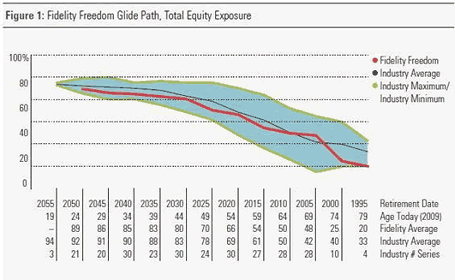
Here’s some good news for the many 401(k) participants with Fidelity as their plan provider. Fidelity announced that they plan to launch a series of Fidelity Freedom Index Funds to complement their current Freedom Funds as soon as September. From this WSJ Article*:

Fidelity Investments, for example, plans to launch the Fidelity Freedom Index Funds, a series of target-date index funds in five-year increments, from 2000 to 2050, in September. Strategic Advisers Inc. will invest each of the target-date funds in a combination of Fidelity index funds. Fidelity wants to provide some of its group retirement plan customers with an index alternative to its Freedom Funds, a spokeswoman said.

Jonathan Kreider, a fiduciary research analyst at Lipper Inc., said, “Especially with the market downturn over the past year, expenses are really starting to be a selling point for a lot of investors.”

It’s good to see that mutual fund companies are feeling the pressure to provide low-cost fund options to the common investor. Costs matter! Fidelity would not have done this unless they felt they were losing significant market share to Vanguard.

For comparison, check out how many funds are in their Fidelity Freedom 2040 Fund (FFFFX) below (with percentages). I just looks messy and unfocused to me, with a high probability of style overlap. The expense ratio ends up at 0.79%.

Fidelity Disciplined Equity 12.09%
Fidelity Series Large Cap Value 10.86%
Fidelity Growth Company 10.1%
Fidelity Equity-Income 10.05%
Fidelity Series All-Sector Equity 9.43%
Fidelity Series 100 Index 8.07%
Fidelity Diversified International 5.72%
Fidelity Overseas 5.7%
Fidelity High Income 4.64%
Fidelity Capital & Income 4.63%
Fidelity Series Investment Grade Bond 4.14%
Fidelity Blue Chip Growth 3.03%
Fidelity Europe 3.01%
Fidelity Small Cap Opportunities 1.69%
Fidelity Strategic Real Return 1.29%
Fidelity Series Emerging Markets 1.19%
Fidelity Total Bond 1.16%
Fidelity Small Cap Growth 1.01%
Fidelity Small Cap Value 1.01%
Fidelity Japan 0.94%
Fidelity Southeast Asia 0.25%

(I laughed at the name Fidelity Disciplined Equity. There’s Value vs. Growth, Large vs. Small, but who’d invest in Fidelity Undisciplined Equity?)

This is only an educated guess based on their new 529 portfolios, but their Fidelity Freedom Index 2040 Fund holdings might look like this, with a combined expense ratio of ~0.14%:

Fidelity Spartan Total Market Index Fund 67%
Fidelity Spartan International Index Fund 17%
Fidelity US Bond Index Fund 16%

Fidelity 529 Plan Also Add Indexed Age-Based Portfolios
The reason I found out about this change was actually via my Fidelity 529 Plan (California). Previously, they had an age-based actively managed portfolio for a total annual expense ratio of 0.50%. However, sometime in the last year or so they added an extra age-based portfolio using index funds. This is good, but I never heard it publicized (my fault probably for missing out on some fine print) and this gave them the ability to jack up the price on the actively-managed portfolio to over twice the original amount, with me paying 1.07% in fees annually. Check your statements!

* WSJ requires a paid subscription to view certain articles, but you can usually view them for free if you come from Google. If you’re not seeing the entire article, bisit this link and click on the appropriate article title.