A Quick & Dirty Plan To Reach Financial Freedom

Despite the current financial funk, I still desire financial freedom. The general idea is simple; I need to generate enough income from my assets to pay for my expenses. Here is how I’ve been framing the problem in my mind recently. I’m 30 now, let’s say I want to be “retired” by age 50.

Part 1: Accumulate 30 times annual (non-housing) expenses

There are numerous studies about the “safe withdrawal rate” from a portfolio, and they usually end up at around 3% to 4%. This usually means that with $1,000,000 dollars, you have a high (say 99%) chance of being able to produce $30,000 to $40,000 of income each year plus inflation adjustments for a long period of time (30+ years).

This is the same as saying you need to save 25 to 33 times your annual expenses.. If you’re conservative (or young), I’d go with a higher number, so I picked 30. Multiply your annual expenses by 30. You need that much money to retire. All of these are based on historical numbers, so this is only an estimate.

Right now I’d estimate our annual non-housing expenses at about $24,000 per year ($2,000 per month). Previously I’ve found that we spend about $18,000 per year, but that neglects a few things like health insurance and car deprecation. (Again, health insurance for those that retirement very early and are not healthy might be a bogey.)

$24,000 x 30 = $720,000.

At about $200,000 in non-housing assets right now, that leave me $520k left. Divided by 20 years and assuming no investment return, that would require $25k per year (not inflation-adjusted). At a 3% annual real return, I’d still need to save nearly $20k per year.

Remarks
With this part, you can see the power of frugal living, or the damage done by lifestyle inflation. $500 a month is $6k per year. $6k x 30 = $180,000.

So if I could cut $500 a month in my expenses, I’d need to save $180,000 less. On the other hand, if I grow some bad habits and start spending $500 more a month, I’d need to save $180,000 more. Either way, that’s a big number! This is why I still need to complete my line-by-line examination of expenses.

Part 2: Own my house / Pay off mortgage

I currently have 29 years left on a 30-year fixed mortgage. For us, that would mean another ~$470,000 in mortgage principal, but more when you count in all that interest.

According to this mortgage calculator, if we make one extra monthly payment per year (simulating a bi-weekly acceleration plan), that’d give us about 24 years before we’re done. If I made two extra monthly payments per year, it’d be shaved down to 20 years, which has the house paid off at age 50. Lots of other considerations, but I’m strongly leaning towards it.

Remarks
I know that you could easily roll up “housing” costs into Part 1 above, but I didn’t for a few reasons. For one, housing is one of the few expense areas where you can essentially “buy” all future costs. For example, you can’t pay a lump sum in exchange for all the electricity you’ll consume in your lifetime. Same thing for your grocery bill, or even a car since you’ll have to replace it. But if you own your house, you’ve basically cut out rent forever (just left with maintenance and property taxes). It also reduces the danger of inflation eating up your spending power.

The second reason is lower taxes. Owning your own house not only saves you from have to pay a housing payment, but also keeps you from having to earn the gross income needed to generate that after-tax amount. Ignoring house, I saw above that I only need to generate $24,000 of income per year total. The income taxes on that amount is very, very small. Using current numbers it might be less than 5% overall, with my marginal tax bracket at a mere 10% after taking out the personal exemptions and standard deductions.

But if I need to generate another $24,000 of income to cover housing ($2k per month in rent), then that additional $24k would be taxed at much higher rate of 15%. With state tax, the difference might be another 5%.

Try out this method with your own numbers, and see what happens. When I run the numbers like this, I know that I could retire much earlier if I moved to a cheaper place upon retirement. But is it worth it? It’s all about priorities…

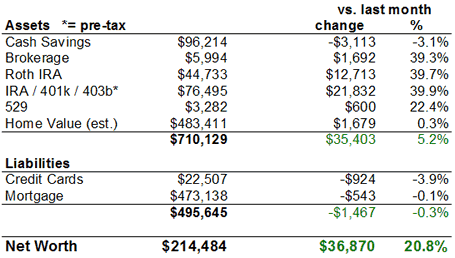
April 2009 Financial Status / Net Worth Update

Net Worth Chart 2009

Finally a bit of green!

Credit Card Debt
For newer readers, don’t worry. In the past, I have been taking money from credit cards at 0% APR and immediately placing it into high-yield savings accounts or similar safe investments that earn 5% interest or more, and keeping the difference as profit. I even put together a series of step-by-step posts on how to make money off of credit cards this way. However, given the current lack of good no fee 0% APR balance transfer offers, I am just waiting to pay off my existing balances.

Retirement and Brokerage accounts
March was a rebound month for the stock market, and our balances went up accordingly. We contributed $10,000 into IRAs, and $12,969 in 401(k) salary deferral and company match. A chunk of that was a true-up contribution from 2008. Score! See my 2009 Q1 portfolio update for more details.

Cash Savings and Emergency Funds
Our cash savings did drop due to the IRA contributions, but we still have over a years worth of expenses set aside. I want to keep one year of expenses for our emergency fund, and start looking for places to invest the rest.

Home Equity
I used the same internet valuation tools as before – Zillow, Cyberhomes, Coldwell Banker, and Bank of America (old version). The magical elves have decided that my home is worth a tiny bit more this month. The number shown is after another 11% reduction to be more conservative.

It’s been about a year that I’ve had this mortgage, and I am wondering if I should commit some cash towards paying down the mortgage principal too. If I make an extra mortgage payment each year, I replicate a biweekly accelerated payment plan, and can shave around 5 years off my 30-year mortgage.

2009 Q1 Investment Portfolio Update – April 6th, 2009

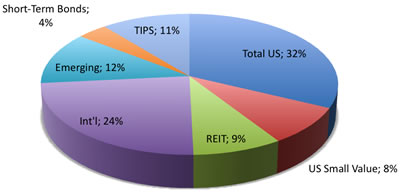
2009 Q1 Portfolio Breakdown
 
Retirement Portfolio Actual Target
Asset Class / Fund % %
Broad US Stock Market 32.2% 34%
VTSMX – Vanguard Total Stock Market Index Fund
DISFX – Diversified Stock Index Institutional Fund*
FSEMX – Fidelity Spartan Extended Market Index Fund*
US Small-Cap Value 8.7% 8.9%
VISVX – Vanguard Small Cap Value Index Fund
Real Estate (REITs) 8.7% 8.5%
VGSIX – Vanguard REIT Index Fund
Broad International Developed 23.8% 25.5%
FSIIX – Fidelity Spartan International Index Fund*
International Emerging Markets 12.1% 8.5%
VEIEX – Vanguard Emerging Markets Stock Index Fund
Bonds – Short-Term 3.7% 3.8%
VFISX – Vanguard Short-Term Treasury Fund
Bonds – Inflation-Indexed 10.8% 11.3%
VIPSX – Vanguard Inflation-Protected Securities Fund
Total Portfolio Value $120,016
* denotes 401(k) holding given limited investment options.

2009 is already over one-fourth over, so I think it’s a good time to check on the ole’ battered portfolio.

Contribution Details
In early 2009, we each made a $5,000 contribution towards our non-deductible IRAs for the 2008 tax year, for a total of $10,000. We have also contributed $12,969 so far into our 401ks through regular salary deferrals and the company match. We haven’t made any after-tax investments in our portfolio yet.

YTD Performance
According to my spreadsheet, the 2009 year-to-date time-weighted performance of our personal portfolio is -15.5% YTD.

For reference, the Vanguard S&P 500 Fund has returned -6% YTD, their FTSE All World Ex-US fund has returned –6.36% YTD, and their Total Bond Index fund is -0.13% YTD as of 12/8/08. The Vanguard Target 2045 Fund has returned -4.70% YTD. Part of the poor relative performance is probably due to the timing of my large lump-sum investments.

Investment Changes
We have used our new contributions to bring us closer to our asset allocation target, with a 85% stocks/15% bonds split.

You can view all my previous portfolio snapshots here.

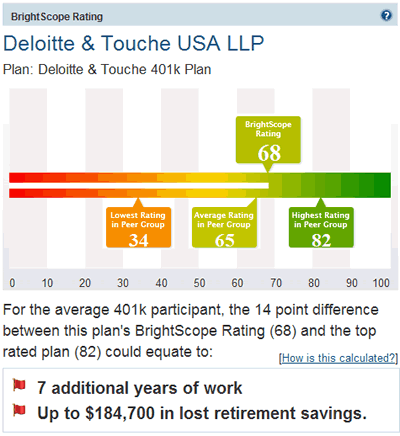
Brightscope: How Does Your Company’s 401k Plan Compare?

Even though most people I know are too scared to even look at their 401(k) statements right now, have you ever thought about how well your company’s plan stacks up to other similar companies? The problem is that 401(k) plans lack transparency. What if every company had to publish their company match, fees, revenue sharing (*cough* kickbacks), investment choices, and vesting schedules? That would certainly produce competition and peer pressure to make better plans.

This is what the website Brightscope is trying to change. Just type in your company name and see an overall rating based on the components I listed above, also some other interesting details like average account balance. As they point out, a poorly designed plan could be costing you hundreds of thousands of dollars over time – or put another way the equivalent of an extra decade of work!

According to their site, BrightScope is the only 401k analytics firm that is truly independent and does not accept compensation in the form of revenue sharing from mutual fund companies or plan providers. This should make them objective. Found via Capital Ideas.

A related site is 401khelp.com, which covers less companies but does offer more insights and opinions on the plans it does cover. Not sure how often it is updated, though.

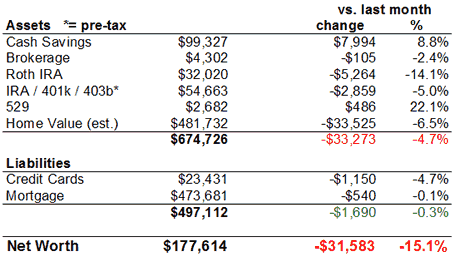
March 2009 Financial Status / Net Worth Update

Net Worth Chart 2009

Time for another super-happy-fun net worth update…

Credit Card Debt
For newer readers, don’t worry. In the past, I have been taking money from credit cards at 0% APR and immediately placing it into high-yield savings accounts or similar safe investments that earn 5% interest or more, and keeping the difference as profit. I even put together a series of step-by-step posts on how to make money off of credit cards this way. However, given the current lack of good no fee 0% APR balance transfer offers, I am just waiting to pay off my existing balances.

Retirement and Brokerage accounts
Unless you’ve been completely devoid of human contact for the last few weeks, you know the market is in the dumps. I really don’t have much market commentary to make, besides the fact that I still intend to keep investing. I’ve been trying to cut back on the CNN/CNBC-types of financial news actually and focus more on things I can change, which as a result has helped keep me a bit more optimistic.

Cash Savings and Emergency Funds
Our emergency fund has increased a bit, but this snapshot was taken before we each put $5,000 into our 2008 IRA contribution. So really it remains at about a year of our current expenses.

Home Equity
This is where most of this month’s drop comes from. I used the same internet valuation tools as before – Zillow, Cyberhomes, Coldwell Banker, and Bank of America (old version) – but while most of them continued their gradual decline, the Coldwell Banker estimate dropped by over $140,000 in one month! After taking off 5% to be conservative and 6% for expected real estate agent commissions (11% total), the overall average estimate dropped by $34k. Well look at that, I am nearly “underwater” on my house despite putting 20% down a year ago. Oops.

2008/2009 NonDeductible IRA Contribution Decisions

With the market in another funk this week, I was reminded that I had until April 15th to make my IRA contributions for 2008. It could get worse before then, or it might bounce up again, I have no predictive powers either way. I don’t like to be wishy-washy, so we went ahead and each invested $5,000 to a non-deductible IRA today.

Background
A nondeductible IRA is the same as a Traditional IRA, except that your income is too high so you can’t deduct the contribution. If you haven’t maxed out all your other options like a deductible Traditional IRA, Roth IRA, 401(k), or 403(b) plan, you should put your money towards those first. This option is mostly for those with no other better options.

Why?
So if you don’t get the tax deduction, what’s the point? The most appealing is that in 2010, unless the law is changed, you can start rolling over your non-deductible IRA into a Roth IRA with no income restrictions. I am starting to like my chances, since we are only ten months away from 2010 (I plan to convert right away) and I’m sure with the current deficit the government would like to collect all the tax revenue it can now instead of later. If it looks good, I’ll probably make my 2009 contribution in December (after making sure we don’t otherwise qualify) and convert that to a Roth too.

The second reason is that the after-tax returns might be higher if you invested in tax-inefficient products like bonds, commodities, or REITs.

Contribution Limits
The contribution limits are $5,000 for both 2008 and 2009. If you are age 50 or older, you can contribute another $1,000 that year.

What Did I Buy?
My portfolio is getting out of whack right now, so I bought what I need to bring it back into my desired asset allocation. I purchased $3,000 of an REIT fund (VGSIX), $2,000 of a US Small Value fund (VISVX), and $5,000 of an Emerging Market fund (VEIEX). We’re still making regular contributions to our 401ks, which contain our US and International “Total Market” funds.

401(k) Failures: Over Last 20 Years, The Average Investor Did Worse Than Cash

These days, not too many people are singing the praises of their 401(k) plans. They have been called failures, with many having hidden fees and poor investment choices. But I was reading a Scott Burns article that had an different take on things: 401(k) plans are a miserable failure because most of us make bad choices.

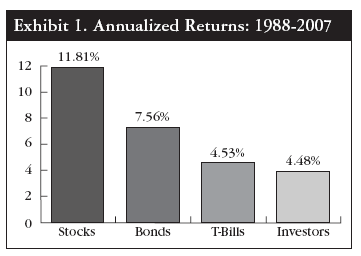
Here the evidence: For the 20-year period from 1988-2007, the S&P 500 had annualized returns of 11.81%, while investment-grade bonds returned 7.56%. But what did the average mutual fund investor return? Only 4.48 percent. That’s worse than super-safe Treasury bills, which managed 4.53% annually!

This data is actually pulled from the “DALBAR study”, which I have seen referenced before. DALBAR is a research firm that provides research for financial professionals about investor behavior. Each year, they publish a report called the Quantitative Analysis of Investor Behavior where it compares the returns from average individual investors to various benchmarks. The news is not encouraging…

For years, mutual fund companies have been marketing their products using the long-term results of a lump-sum investment. The results typically show that the funds’ annualized returns have outpaced their designated benchmarks and inflation, implying that if investors purchase fund shares and hold them for similar time periods, they may achieve similar results.

Reality, however, is quite different from this scenario – and it’s not the fault of the fund companies. In this year’s Quantitative Analysis of Investor Behavior, DALBAR illustrates how investors are often their own worst enemies. By examining actual fund inflows and outflows during the 20-year period ended December 31, 2007, the analysis finds that investors often buy and sell at the worst possible times – and achieve commensurate returns.

As Burns quips, investors as a whole do seem have a great skill for “methodically buying equities when they were up and selling when they were down.” 🙁 This sentence summarizes it best:

Investment return is far more dependent on investor behavior than on fund performance. Mutual fund investors who hold their investments typically earn higher returns over time than those who time the market.

Added: I’m not really trying to bag on 401ks, I’m trying to focus on the fact that tying to time the market has been very destructive for investors. For a related parable, read their story of Quincy and Caroline.

February 2009 Financial Status / Net Worth Update

Net Worth Chart 2008

I pretty much have a general feeling of malaise right now. Hiring freeze at one job, big group meeting about how “we don’t have to worry about layoffs… right now” at the other. And now it’s time to look at my incredibly shrinking net worth… I know I have it really good in general, but let’s just make this quick. 😉

Credit Card Debt
I do not carry consumer debt. In the past, I have been taking money from credit cards at 0% APR and immediately placing it into high-yield savings accounts or similar safe investments that earn 5% interest or more, and keeping the difference as profit. I even put together a series of step-by-step posts on how I make money off of credit cards this way. However, given the current lack of good no fee 0% APR credit card offers, I am just waiting to pay off my existing balances.

Retirement and Brokerage accounts
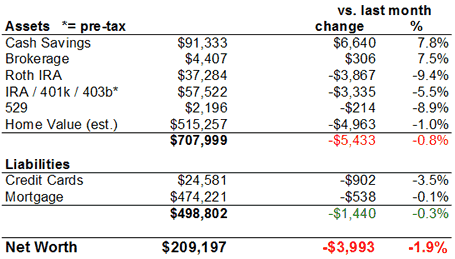
The media has pronounced last month as the “Worst January Ever” for the Dow (-8.8%) and the S&P (-8.6%). The value of our passively-managed portfolio shrank accordingly. Our 401(k) contributions for the month and new company match got swallowed up instantly by losses. Same old, same old.

Cash Savings and Emergency Funds
Our net cash balance (aka emergency fund) increased a bit, and remains more than 12 months of our total monthly expenses. Let’s hope we don’t need it.

I intend to contribute again to a non-deductible Traditional IRA for 2008. My reasons are basically the same as last year: Should I contribute to a non-deductible IRA? The limits for Roth conversions are removed in 2010, which is just around the corner.

Home Equity
I continue to estimate our home value using internet tools, starting with the average estimates provided by Zillow, Cyberhomes, Coldwell Banker, and Bank of America. After taking off 5% to be conservative and 6% for expected real estate agent commissions (11% total), I am left with $515,257.

I need to work out the last few kinks in my new long-term goals, in order to regain some focus. You can see our previous net worth updates here.

What’s Inside Your Target Date or LifeCycle Retirement Fund?

I ran across a BusinessWeek article today about retirement plans in 2008 from top 401(k) provider Fidelity Investments. It stated that although the average retirement account balance fell a whopping 27% to $50,200 last year, people actually contributed slightly more in 2008 than in 2007.

This quote also caught my eye:

Are investors making a lot of changes within their retirement accounts?
Some 60% of plans administered by Fidelity in 2008 utilized a lifecycle fund as a default investment option, that’s up from 38% in 2007. What happens in a time of short-term volatility is that investors in these funds are not switching. Only 1% lifecycle fund investors made a change compared to the overall average to 6.1%.

Makes sense overall. Investors in these types of funds want all-in-one simplicity. However, almost every company these days offer a lifecycle retirement fund. And most 401(k) investors can only invest in the one that happens to be in their plan. Check out this Money magazine example of the possible extremes out there for a mutual fund designed for a worker retiring in 2010:

On the aggressive side, the Oppenheimer Transition 2010 Fund (OTTAX) has 65% in stocks for someone on the verge of retirement, resulting in a 46% loss in 2008. On the conservative end, this AP article has an even better example – The DWS Target 2010 Fund (KRFAX) only has 18.1% in stocks and only had a 3.6% loss in 2008. The rest was in cash and bonds. (Of course, it also had a fat front-end load and is closed to new investors.)

That is some pretty stark contrast. Do you know what is inside your target-date fund? Dig up the ticker symbol, plug it into Morningstar, and scroll down to “asset allocation”.

What about the big boys like Vanguard?
Even the most highly-rated mutual fund companies don’t agree on the asset allocation for each time horizon. See how Vanguard, Fidelity, and T. Rowe Price differ in their target-date retirement funds.

Strategies For Maxing Out Your 401k/403b and Company Match, True-Up Contributions

Why the interest in 401k limits? Well, we found out that my wife now gets a company match to her 403b retirement plan. Score! I then wanted to explore how to maximize both our $16,500 401k limits and the company match.

Example: Maxing Out But Missing Out Too

You make $120,000 per year and get a full 3% company match during each pay period. Let’s just say you get paid $10,000 gross monthly. However, you are a really motivated saver and can defer 20% of your income each month into the 401k.

For the first 8 months of the year, you put away $2,000 (20% of $10,000) and the company matches $300 (3% of $10,000). That’s brings you to $16,000 in salary deferrals. On the 9th month you can only contribute $500, which the company also matches $300 again. On the remaining 3 months of the year, you can’t contribute at all, so there is nothing to match! Even though you contributed significantly more than 3% of your salary, you’ll miss out on $300 x 3 = $900 of free money.

Solutions and Potential Problems
The solution is usually given to space out your salary deferrals evenly throughout the remainder of the year. For the above example, you would divide $16,500 by 12 = $1375 each month. If you can only set percentages, you’d set aside 13.75% each month ($1,375 / $10,000).

The problem with this is that for those people who earn hourly wages, overtime, or bonuses, it can be hard to synchronize. Get paid too much, and you’ll lose match again. Get paid too little, and you might max out your match, but not fully reach the $16,500 limit. Also, if you quit or are laid off before the end of the year, you might not be able to reach the limits either.

My tweaked solution. I would vary the percentage so that you always contribute at least 3% each pay period the entire year, but otherwise front-load contributions early on. Again with the example, you could set aside the $2,000 per month for 6 months, and then put in $750 per month for 6 months. Percentage-wise, this is 20% for first half the year, and then 7.5% for the last half. This way, you are balancing getting your annual limit maxed out as closely as possible, along with getting all the available match.

True-Up Contributions

But before going too far, you should ask your benefits administrator whether they offer what is called “true-up” contributions. What this does is compare your year-to-date (YTD) contributions to your YTD salary. If you contributed at least 3% of your YTD salary, but did not receive a 3% company match, then they will send in an additional contribution to “true-up” the numbers.

Some companies perform this true-up calculation after every pay period, while others wait until the end of each year. If they true-up every pay period, then it would seem to be a good idea to contribute as much as you can as early as you can – you’ll get the full year’s match early this way.

Our company does one true-up after the end of the year, and the credit doesn’t show up until March. However, I was also told that if you aren’t employed in March, you won’t get this credit. So again, the front-load with minimum method might be the best idea to get your match as it comes available.

As I write this, I realize that I really overthink some of this stuff. What can I say, I’m excited about our new match, and I just can’t help myself!

2009 401k/403b Maximum Salary Contribution Limits

The 2009 inflation-adjusted limits for 401(k) and 403(b) defined-contribution plans are as follows:

  • The 401(k) elective deferral limit goes to $16,500, up from $15,500.
  • The “catch-up” amount allowed for those age 50 years and up increases to $5,500, up from $5,000.
  • The overall annual defined-contribution plan limit goes to $49,000, up from $46,000. This usually comes into play when you have additional employer contributions.
  • These numbers apply for both Traditional pre-tax and Roth after-tax contributions.

Maxing out pre-tax 401(k) contributions
$16,500 annually works out to $1375 per month. If you get paid bi-weekly that’s $635 per paycheck. But since this is gross income, if you are using pre-tax contributions (not the Roth 401k option*) your actual reduction in take-home pay will be less.

According to the calculators at PayCheckCity, if you are single with one allowance, earn a gross annual income of $60,000 per year ($5,000/month), and you live in a state with no income taxes, this works out to a reduction in your monthly take-home pay of $1,031. (It would go from $3,804 down to $2,773.)

You can also get to the same number by first finding your 2009 marginal tax rate. Since a such a person would be in the 25% bracket, taking 75% of $1375 is $1,031.

* If I were in the 15% tax bracket or lower, I would go with the Roth option (if available) because historically that is a low rate. Pay the low rates now, so you can avoid paying them later! For higher tax brackets, it depends on some personal variables like how much taxable income you expect to generate when withdrawing for retirement.

Add More Money Your Roth IRA – Undo and Redo Contributions After Losses?

So you listened to the financial experts and dutifully contributed $5,000 to your Roth IRA in early 2008. Unfortunately, stuff hit the fan and now you’re left with a lot less. Wouldn’t it be nice to be able to find some silver lining and shield another ~$1,000 plus earnings from taxes forever?

Well, here’s a slightly controversial idea that I ran across in this Boglehead Forum thread that might help you do just that. I think the easiest way to explain it is to continue with an imaginary scenario. Note that this leaves some variables in exchange for simplicity.

Example Scenario
Sometime in early 2008 you contributed $5,000 to your Roth IRA for the 2008 tax year. At the time, your IRA was worth $20,000 in total after the contribution. Now, in January 2009, the entire IRA is now worth $15,000.

You first “undo” your 2008 $5,000 contribution by following the same steps as someone who ended up being ineligible for a Roth IRA due to too much income*. Because your entire IRA account dropped by 25%, your $5,000 contribution is considered to have dropped by the same amount. You end up receiving a check for $3,750. You have received a return of your contribution, and have now technically contributed nothing to your 2008 Roth IRA.

Soon afterward, you simply open up a new IRA either at a new broker, or at your current broker if they are on the ball and have your 2008 total contributions as zero. (Otherwise they might throw a fit…) You can now throw in another $1,250 and contribute $5,000 again to your Roth IRA for the 2008 tax year before April 15th, 2009. Even if you just reinvest the $3,750 the same way as you did before, by using this strategy you have allowed another $1,250 to grow shielded from taxes, forever.

Is This Legal?
This is somewhat similar to the Traditional-to-Roth IRA reconversion method to save taxes. I read some skeptical posts in the BH thread as to the legitimacy of this action, but none were really backed by any evidence. I don’t see why both methods aren’t equally legal.

As another example, you might have made two separate $5,000 contributions by accident, and need to undo one of them. If everything is accounted for correctly by your IRA custodian, the IRS shouldn’t blink an eye. Here is another educated discussion in support of this idea. Other tax pros please add your thoughts in the comments below.

We ended up not being eligible for a Roth IRA this year, but if I was a candidate I think I would take advantage of this idea. In the long run, even stuffing another $1,000 in a Roth could save a lot of money in taxes.

* More information on correcting excess contributions in this Investopedia article. It must be done by the owner’s tax-filing deadline, which usually April 15, 2009 unless you file for an extension. Note that this is not the same as taking a distribution.