University of the People: Tuition-Free, Accredited Online Degrees in Computer Science, Business Administration (MBA), Education (M.Ed.)

Did you know that there exists a tuition-free, accredited, online university where you can obtain an Bachelor’s degree in Computers Science, MBA, or Masters in Education for a tiny fraction of the cost of traditional universities? The University of the People was recently profiled by the NYT in How Can This University Charge Nothing for Tuition? (gift article).

Is is really free? Not quite, but I think the structure is very fair as it charges a small fee only when you are ready to earn course credit. From the NYT article:

The University of the People, which he founded in 2009, is an online-only institution that charges nothing for tuition. Students don’t have to pay for textbooks because all the educational material is made available for free online, and there’s no room and board because there’s no campus. They do have to pay $120 for each final exam, which they must pass to earn credits. For 40 courses, that adds up to $4,800 for a bachelor’s degree — although for students who face severe financial hardship, even the exam fees can be waived.

Here are the total approximate costs (not per year!) to earn a UoPeople degree:

Associate Degree: $2,460
Bachelor’s Degree: $4,860
Master of Business Administration (MBA): $2,940
Master of Education (M.Ed.): $3,180
Master of Science in Information Technology (MSIT): $3,660

To put this in context, if you assume four years for the BS/BA, that’s $100 a month. That’s less than the average monthly cable and internet bill.

The extra $60 is from the $60 application fee. You can also obtain transfer credit from your previous coursework and/or other free and low-cost educational sites like Saylor Academy, Sophia.org and Coursera to both speed up your progress and lower your total cost even further.

How is this possible?

How is it possible to make a degree so cheap? The instructors and many of the administrators, including Reshef, work for no pay. The chair of the President’s Council is John Sexton, president emeritus of New York University. Professors from top universities volunteer as deans. The instructors tend to be retired professors or recently minted Ph.D.s who are looking for teaching experience. Foundations and individual benefactors have also chipped in. “The amount of people who are willing to do good for the world is shockingly high,” Reshef told me recently.

This reminds of the intro for book Drive: The Surprising Truth About What Motivates Us by Daniel Pink (same author as Power of Regret), where the author reminds us that in 1996 there would two options for an encyclopedia:

  • Microsoft Encarta, run by a huge and profitable company and written by paid experts.
  • Wikipedia, run by a lean non-profit and written entirely by unpaid volunteers.

Today, I probably check Wikipedia once a day and Encarta has been gone for over a decade. People are not solely motivated by money. We like to be part of a greater purpose. (Although I have tried to contribute to Wikipedia and gotten deleted unceremoniously.)

UoPeople won’t work for everyone, but I find it very fascinating. I wonder if they incorporate volunteer tutors or “TAs” as well to help the students along.

See also: 2020 follow-up article on Georgia Tech Online Master in Computer Science, first mentioned in 2013. Total tuition about $7,000.

Gemini Exchange: Bitcoin Bonus

(Update: After a incorrect trademark infringement claim and takedown request, Gemini has followed up and taken it back. I’ve brought back an edited version of the original post.)

Gemini is a crypto exchange offering a $150 bonus in Bitcoin if you open a new account and invest $1,000+ in crypto within the first 30 days. Buying the Gemini dollar (GUSD) stablecoin worked for me.

To find it, enter “gemini $150 bitcoin bonus” into Google.com. It should be the first result. I am not affiliated with this promotion. If you open a Gemini account through this promotion, I get nothing.

Here were the overall steps that I took:

  • Use the promo link above to start your application as a new customer. You may need to submit a driver’s license photo.
  • Link a bank account via Plaid.
  • Fund Gemini account via ACH. The daily max is $1,000.
  • Purchase $1,000 in crypto. The most conservative choice is GUSD, which is a stablecoin that is (supposed to be) backed 1:1 with US dollars and trades at a stable $1.00 value.
  • This should trigger the bonus, which arrived within 24 hours for me. You get $150 in Bitcoin, which can quickly go up or down in value.
  • I have kept my BTC and GUSD for now, but you can sell it for USD if you want. There are some transaction fees, roughly $3 for a $150 trade with the basic trading structure but possibly less with their ActiveTrader option.

Best Interest Rates on Cash – February 2022 Update

Here’s my monthly roundup of the best interest rates on cash as of January 2022, roughly sorted from shortest to longest maturities. I look for lesser-known opportunities earning more than most “high-yield” savings accounts and money market funds while still keeping your principal FDIC-insured or equivalent. Check out my Ultimate Rate-Chaser Calculator to see how much extra interest you’d earn by moving money between accounts. Rates listed are available to everyone nationwide. Rates checked as of 2/6/2022.

Significant changes since last month: 7.12% Savings I Bonds still a good idea if you haven’t done it yet, $100 Marcus new deposit bonus is a good deal (details), HM Bradley 3% APY requirements relaxed a bit, new LFCU 2% APY account opening review. In general, there doesn’t seem to be much upside to locking in a 5-year CD at 1.50% when there are so many short-term options nearly as good (or better) while waiting to see how much rates rise in 2022.

Fintech accounts
Available only to individual investors, fintech companies often pay higher-than-market rates in order to achieve fast short-term growth (often using venture capital). “Fintech” is usually a software layer on top of a partner bank’s FDIC insurance.

  • 4% APY on $2,000/$6,000. Current offers 4% APY on up to $2,000 on each of their “savings pods”. Free users get 1 savings pod, while premium users get 3 savings pods. Potential promos include $50 bonus and “Premium free for life”. Please see my Current app review for details.
  • 3% APY on up to $100,000, but requires direct deposit and credit card spend. HM Bradley pay 3% APY if you open both a checking and credit card with them, and maintain $1,500 in total direct deposit each month and $100 in credit card purchases each month. Please see my updated HM Bradley review for details.
  • 3% APY on 10% of direct deposits + 1% APY on $25,000. One Finance lets you earn 3% APY on “auto-save” deposits (up to 10% of your direct deposit, up to $1,000 per month). Separately, they also pay 1% APY on up to another $25,000 with direct deposit. New customer $50 bonus via referral. See my One Finance review.
  • 3% APY on up to $15,000, requires direct deposit and credit card transactions. Porte requires a one-time direct deposit of $1,000+ to open a savings account. Porte then requires $3,000 in direct deposits and 15 debit card purchases per quarter (average $1,000 direct deposit and 5 debit purchases per month) to receive 3% APY on up to $15,000. New customer bonus via referral. See my Porte review.
  • 1.20% APY on up to $50,000. You must maintain a $500 direct deposit each month for this balance cap, otherwise you’ll still earn 1.20% on up to $5,000. They also pay 4% on USDC stablecoin, but I avoid this as it is not FDIC-insured (and you can get higher rates elsewhere if you did want to hold USDC.) New customer $50 bonus via referral. See my OnJuno review.

High-yield savings accounts
Since the huge megabanks pay essentially no interest, I think every should have a separate, no-fee online savings account to accompany your existing checking account. The interest rates on savings accounts can drop at any time, so I list the top rates as well as competitive rates from banks with a history of competitive rates. Some banks will bait you with a temporary top rate and then lower the rates in the hopes that you are too lazy to leave.

  • T-Mobile Money is still at 1.00% APY with no minimum balance requirements. The main focus is on the 4% APY on your first $3,000 of balances as a qualifying T-mobile customer plus other hoops, but the lesser-known fact is that the 1% APY is available for everyone. Thanks to the readers who helped me understand this. Unfortunately, some readers have reported their applications being denied.
  • Evangelical Christian Credit Union (ECCU) is offering new members 1.01% APY on up to $25,000 when you bundle a High-Yield Money Market Account & Basic Checking. (Existing members can get 0.75% APY.) To join this credit union, you must attest to their statement of faith.
  • There are several other established high-yield savings accounts at closer to 0.50% APY. Marcus by Goldman Sachs is on that list, and if you open a new account with a Marcus referral link (that’s mine), they will give you and the referrer a 1.00% APY for your first 3 months (a 0.50% boost). You can then extend this by referring others to the same offer. They are also offering a $100 new deposit bonus if you move over $10,000 in new money.

Short-term guaranteed rates (1 year and under)
A common question is what to do with a big pile of cash that you’re waiting to deploy shortly (plan to buy a house soon, just sold your house, just sold your business, legal settlement, inheritance). My usual advice is to keep things simple and take your time. If not a savings account, then put it in a flexible short-term CD under the FDIC limits until you have a plan.

  • No Penalty CDs offer a fixed interest rate that can never go down, but you can still take out your money (once) without any fees if you want to use it elsewhere. CFG Bank has a 13-month No Penalty CD at 0.62% APY with a $500 minimum deposit. Ally Bank has a 11-month No Penalty CD at 0.50% APY for all balance tiers. Marcus has a 7-month No Penalty CD at 0.45% APY with a $500 minimum deposit. You may wish to open multiple CDs in smaller increments for more flexibility.
  • Poppy Bank has a 1-year CD at 1.00% APY ($1,000 min). According to DepositAccounts, early withdrawal penalty is 90 days of interest.

Money market mutual funds + Ultra-short bond ETFs
Many brokerage firms that pay out very little interest on their default cash sweep funds (and keep the difference for themselves). Unfortunately, money market fund rates are very low across the board right now. Ultra-short bond funds are another possible alternative, but they are NOT FDIC-insured and may experience short-term losses at times. These numbers are just for reference, not a recommendation.

  • The default sweep option is the Vanguard Federal Money Market Fund which has an SEC yield of 0.01%.
  • Vanguard Ultra-Short-Term Bond Fund currently pays 0.68% SEC yield ($3,000 min) and 0.78% SEC Yield ($50,000 min). The average duration is ~1 year, so your principal may vary a little bit.
  • The PIMCO Enhanced Short Maturity Active Bond ETF (MINT) has a 0.60% SEC yield and the iShares Short Maturity Bond ETF (NEAR) has a 0.64% SEC yield while holding a portfolio of investment-grade bonds with an average duration of ~6 months.

Treasury Bills and Ultra-short Treasury ETFs
Another option is to buy individual Treasury bills which come in a variety of maturities from 4-weeks to 52-weeks. You can also invest in ETFs that hold a rotating basket of short-term Treasury Bills for you, while charging a small management fee for doing so. T-bill interest is exempt from state and local income taxes. Right now, this section isn’t very interesting as T-Bills are yielding close to zero!

  • You can build your own T-Bill ladder at TreasuryDirect.gov or via a brokerage account with a bond desk like Vanguard and Fidelity. Here are the current Treasury Bill rates. As of 2/4/2022, a new 4-week T-Bill had the equivalent of 0.05% annualized interest and a 52-week T-Bill had the equivalent of 0.88% annualized interest.
  • The Goldman Sachs Access Treasury 0-1 Year ETF (GBIL) has a -0.02% SEC yield and the SPDR Bloomberg Barclays 1-3 Month T-Bill ETF (BIL) has a -0.09% (!) SEC yield. GBIL appears to have a slightly longer average maturity than BIL.

US Savings Bonds
Series I Savings Bonds offer rates that are linked to inflation and backed by the US government. You must hold them for at least a year. If you redeem them within 5 years there is a penalty of the last 3 months of interest. The annual purchase limit for electronic I bonds is $10,000 per Social Security Number, available online at TreasuryDirect.gov. You can also buy an additional $5,000 in paper I bonds using your tax refund with IRS Form 8888.

  • “I Bonds” bought between November 2021 and April 2022 will earn a 7.12% rate for the first six months. The rate of the subsequent 6-month period will be based on inflation again. More on Savings Bonds here.
  • In mid-April 2022, the CPI will be announced and you will have a short period where you will have a very close estimate of the rate for the next 12 months. I will have another post up at that time.
  • See below about EE Bonds as a potential long-term bond alternative.

Prepaid Cards with Attached Savings Accounts
A small subset of prepaid debit cards have an “attached” FDIC-insured savings account with exceptionally high interest rates. The negatives are that balances are severely capped, and there are many fees that you must be careful to avoid (lest they eat up your interest). There is a long list of previous offers that have already disappeared with little notice. I don’t personally recommend nor use any of these anymore, as I feel the work required and risk of messing up exceeds any small potential benefit.

  • Mango Money pays 6% APY on up to $2,500, if you manage to jump through several hoops. Requirements include $1,500+ in “signature” purchases and a minimum balance of $25.00 at the end of the month.

Rewards checking accounts
These unique checking accounts pay above-average interest rates, but with unique risks. You have to jump through certain hoops which usually involve 10+ debit card purchases each cycle, a certain number of ACH/direct deposits, and/or a certain number of logins per month. If you make a mistake (or they judge that you did) you risk earning zero interest for that month. Some folks don’t mind the extra work and attention required, while others would rather not bother. Rates can also drop suddenly, leaving a “bait-and-switch” feeling.

  • Lafayette Federal Credit Union is offering 2.02% APY on balances up to $25,000 with a $500 minimum monthly direct deposit to their checking account. No debit transaction requirement. They are also offering new members a $100 bonus with certain requirements. Anyone can join this credit union via partner organization ($10 one-time fee).
  • Quontic Bank is offering 1.01% APY on balances up to $150,000. May be useful for those with high balances. You need to make 10 debit card point of sale transactions of $10 or more per statement cycle required to earn this rate.
  • The Bank of Denver pays 2.00% APY on up to $10,000 if you make 12 debit card purchases of $5+ each, receive only online statements, and make at least 1 ACH credit or debit transaction per statement cycle. If you meet those qualifications, you can also link a Kasasa savings account that pays 1.00% APY on up to $25k. Thanks to reader Bill for the updated info.
  • Presidential Bank pays 2.25% APY on balances between $500 and up to $25,000, if you maintain a $500+ direct deposit and at least 7 electronic withdrawals per month (ATM, POS, ACH and Billpay counts).
  • Evansville Teachers Federal Credit Union pays 3.30% APY on up to $20,000. You’ll need at least 15 debit transactions and other requirements every month.
  • Lake Michigan Credit Union pays 3.00% APY on up to $15,000. You’ll need at least 10 debit transactions and other requirements every month.
  • Find a locally-restricted rewards checking account at DepositAccounts.

Certificates of deposit (greater than 1 year)
CDs offer higher rates, but come with an early withdrawal penalty. By finding a bank CD with a reasonable early withdrawal penalty, you can enjoy higher rates but maintain access in a true emergency. Alternatively, consider building a CD ladder of different maturity lengths (ex. 1/2/3/4/5-years) such that you have access to part of the ladder each year, but your blended interest rate is higher than a savings account. When one CD matures, use that money to buy another 5-year CD to keep the ladder going. Some CDs also offer “add-ons” where you can deposit more funds if rates drop.

  • NASA Federal Credit Union has a special 49-month Share Certificate at 1.70% APY ($10,000 min of new funds). Early withdrawal penalty is 1 year of interest. They also have a 15-month special at 1.05% APY and 9-month at 0.80% APY.
    Anyone can join this credit union by joining the National Space Society (free). However, NASA FCU will perform a hard credit check as part of new member application.
  • American Heritage Credit Union has a 5-year CD at 1.50% APY ($1,000 min). Early withdrawal penalty is 12 months of interest. Anyone can join this credit union via partner organization (free).
  • You can buy certificates of deposit via the bond desks of Vanguard and Fidelity. You may need an account to see the rates. These “brokered CDs” offer FDIC insurance and easy laddering, but they don’t come with predictable early withdrawal penalties. Right now, I see a 5-year CD at 1.70% APY. Be wary of higher rates from callable CDs listed by Fidelity.

Longer-term Instruments
I’d use these with caution due to increased interest rate risk, but I still track them to see the rest of the current yield curve.

  • Willing to lock up your money for 10 years? You can buy long-term certificates of deposit via the bond desks of Vanguard and Fidelity. These “brokered CDs” offer FDIC insurance, but they don’t come with predictable early withdrawal penalties. You might find something that pays more than your other brokerage cash and Treasury options. Right now, I see a 10-year CD at 2.10% APY vs. 1.87% for a 10-year Treasury. Watch out for higher rates from callable CDs from Fidelity.
  • How about two decades? Series EE Savings Bonds are not indexed to inflation, but they have a unique guarantee that the value will double in value in 20 years, which equals a guaranteed return of 3.5% a year. However, if you don’t hold for that long, you’ll be stuck with the normal rate which is quite low (currently 0.10%). I view this as a huge early withdrawal penalty. But if holding for 20 years isn’t an issue, it can also serve as a hedge against prolonged deflation during that time. Purchase limit is $10,000 each calendar year for each Social Security Number. As of 2/4/2022, the 20-year Treasury Bond rate was 2.29%.

All rates were checked as of 2/6/2022.

Amazon Prime Price Hike 2022: Save Money With Gift of Prime Membership

amazon200Amazon Prime has announced the following price increases (note that some links will show up if you are viewing this via e-mail newsletter, please read online):

  • Starting February 18th, 2022, new members will be charged $139/year for an annual Prime membership and $69/year for an annual Prime Student membership.
  • Starting March 25th, 2022, existing Prime members with an annual membership will renew at a rate of $139/year. Prime Student members with an annual membership will renew at a rate of $69/year.

You can still buy a Gift of Prime Membership for $119 (plus applicable taxes). It is unknown when this will increase in price. Here’s the rundown.

  • You can cancel the auto-renewal of your Amazon Prime membership in your account. You may have to go through a lot of “Are you sure?” prompts. They make it feel like you’re canceling your membership right then and there, but again you’re just canceling your auto-renewal. Your Prime membership will still continue through your anniversary date.
  • Buy a Gift of Prime Membership for $119 (plus applicable taxes) and send it to yourself or alternative e-mail. Note that if you try to apply the Amazon Gift of Prime when you have an active membership, it won’t work. You just get the exact value paid (including any taxes) in the form of an Amazon gift card. The goods news it that you can’t ever lose any value.
  • Set a calendar reminder of when your Amazon Prime year expires, and keep that e-mail with the gift membership link (perhaps in a special folder). If you apply the Amazon Gift of Prime the day after your current membership expires, then it will renew you with one year of Amazon Prime. You don’t need to start a new Amazon account or change your e-mail, everything will carry over from before. You’ll simply not have Prime for a day or less. Easy.

You can also choose to buy multiple years of Gift of Prime membership. Again, the worst case it that you redeem it for Amazon credit in the exact amount paid initially.

I also did this when Amazon hiked the price of Prime in 2018:

az_gift

Note that if you have an older grandfathered Amazon Prime that lets you have 5 household members share the benefits, you may not want that to expire.

Amazon Prime has a bunch of features beyond the faster shipping that are useful to me, including the Amazon Video and Amazon Music apps. There are also Prime-only deals throughout the year that try to take advantage of in order to offset the annual membership cost. On the other hand, it has been almost too easy at times to buy things on impulse.

Lafayette Federal Credit Union Review: 2.02% APY on $25,000, $100 Bonus

Update: $100 bonus is expired. Wanted to report that I am had a bad experience with LFCU after being locked out of my account for over a week. Phone hold times were very long, I got routed to a service that promised to call me back, and then never called me back. E-mails also went unreturned. Maybe it’s just me.

Original post, may be outdated:

Lafayette Federal Credit Union (LFCU) has a respectable history of offering competitively-priced banking products. I recently joined and here is a quick review of their current promotions and the application process. Highlights:
  • 2.02% APY Checking account on up to $25,000 balance (details below).
  • $100 bonus for new members (details below)
  • Competitive CD rates: 7-month at 0.70% APY, 3-year at 1.01% APY, 5-year at 1.26% APY

Membership eligibility. You can view your membership eligibility options here, including working/living in the Washington, DC area. Anyone nationwide can join LFCU by joining the Home Ownership Financial Literacy Council (HOFLC) for a one-time $10 fee.

Account opening process. I went to the HOFLC.org website and paid my $10 to join. (I hope to spend more time exploring their resources later.) I had to attach a screenshot of my membership approval e-mail as part of my LFCU application. The LFCU application was finished completely online. I also had to upload a photo scan of my drivers license. My application was approved after a couple of days.

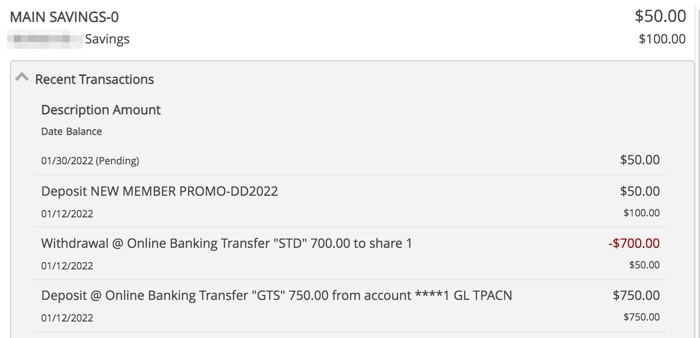
During the application, I was able to charge my initial opening deposit up to $750. This was classified as a purchase on my credit card (worth $15 at 2% cash back). Note that you must keep $50 that is “untouchable” in your Share Savings account as long as you are a member, which is a bit higher than that of other credit unions (usually around $10 to $25).

I applied through this $100 bonus page which includes promo code DD2022. (Update: I honestly can’t remember where I entered the code. You can however secure online message them directly through the membership application portal and confirm that you are signed up for this promotion. I received such a confirmation message promptly.) I must open a checking account and set up a $500+ direct deposit, and I can’t close the account within the first 6 months. Details:

Members who open a checking account and initiate a qualified direct deposit to Lafayette Federal Credit Union will receive a $50 deposit to their savings account. An additional $50 will be awarded after first direct deposit which must be deposited no later than 45 days after account opening. Cannot be combined with any other new member offers. Qualified direct deposit is a recurring direct deposit of a paycheck, pension, Social Security or other periodic payment of at least $500 into a checking account on a month-to-month basis made by an outside organization or agency. Must be eligible for membership. If account is closed within first 6 months, initial $50 promotional deposit will be deducted from account.

The first $50 showed up quickly:

Checking account 2.02% APY details. With the Checking account, they have “2% for ’22” promotion which pays 2.02% APY with a qualified monthly direct deposit of $500 or more on balances up to $25,000. The checking account otherwise has no minimum balance requirements or monthly maintenance fees.

To earn the 2.02% APY3 bonus rate, member must maintain at least one (1) qualified direct deposit of at least $500 per month. 2Qualified direct deposit is a recurring direct deposit of a paycheck, pension, or Social Security periodic payment of at least $500 into a checking account on a month-to-month basis made by an outside organization or agency.

If I keep $25,000 in there at 2% APY, that’s $500 of interest over a year. That’s also $275 more than it would earn in a 0.5% APY savings account. You can use that metric to judge if it is worth your additional efforts. That rough calculation also assumes both those rates stay constant over the next year.

So far, LFCU has been pleasant to work with and my questions were answered quickly and courteously. I hope that they continue to be aggressive in their banking products.

Health Insurance Required to Cover Free At-Home COVID Tests Starting 1/15

If you’ve been facing the prospect of spending hundreds of dollars on at-home COVID tests so that you and/or your kids can go back to work/school after an exposure event, please note that starting Saturday, January 15th, health insurance companies will be required to cover 8 free At-Home COVID tests per person, per month. From NPR:

Insurance companies and health plans will be required to cover eight free over-the-counter at-home tests per covered individual per month, according to White House officials. For instance, a family of four all on the same plan would be able to get up to 32 of these tests covered by their health plan per month.

There is more information in this CMS.gov FAQ.

Starting January 15, most people with a health plan can go online, or to a pharmacy or store to purchase an at-home over-the-counter COVID-19 diagnostic test authorized by the U.S. Food and Drug Administration (FDA) at no cost, either through reimbursement or free of charge through their insurance. This applies whether you purchased your health plan on your own or whether you get health insurance through your job.

The test will either be free directly at the point of sale, if your health plan provides for direct coverage, or by reimbursement if you are charged for your test. Be sure to keep your receipt if you need to submit a claim to your insurance company for reimbursement. If your plan has set up a network of preferred providers at which you can obtain a test with no out-of-pocket expense, you can still obtain tests from other retailers outside that network. Insurance companies are required to reimburse you at a rate of up to $12 per individual test (or the cost of the test, if less than $12).

The actionable advice here is to perhaps not stock up on these COVID tests until January 15th. At that time, hopefully you’ll just be able to pick them up for free at the local pharmacy or health provider, but at the minimum you should save your receipts to be reimbursed. Given how much hassle reimbursement usually is, I’ll probably try to wait until I can have the pharmacy to deal with the insurance paperwork.

I say wait until 1/15 if you can, because of this:

Plans and insurers are required to cover at-home over-the-counter COVID-19 tests purchased on or after January 15, 2022. Plans or issuers may, but are not required by federal law to, provide such coverage for at-home over-the-counter COVID-19 tests purchased before January 15. Contact your health plan to inquire about getting reimbursed for tests purchased before January 15, 2022. Some states may have existing requirements related to coverage of at-home over-the-counter COVID-19 tests.

I’ve already bought several of these iHealth Antigen Rapid Tests (FDA-authorized) from Amazon and they have come a little faster than promised.

Chase Freedom Flex® Credit Card Review: $200 Bonus, 5% Rotating Categories, 3% Back on Dining Out, No Annual Fee

The Chase Freedom Flex® Card is the new 5% cash back rotating category card for Chase, with the notable addition of 3% cash back on dining out and drugstore purchases. All of the popular features from the old Freedom remain as well: Up to 5% cash back on select categories throughout the year, no annual fee, and the ability to earn Ultimate Rewards points (useful in combination with Chase Sapphire cards). Highlights:

  • $200 cash bonus (20,000 Ultimate Rewards points) after $500 in purchases in your first 3 months.
  • 0% Intro APR for 15 months from account opening on purchases and balance transfers. 3% intro balance transfer fee when you transfer a balance during the first 60 days your account is open, with a minimum of $5. After that, the fee for future balance transfers is 5% of the amount transferred, with a minimum of $5.

Here are the ongoing features of the Freedom Flex:

  • 5X points (5% cash back) on up to $1,500 in combined purchases in rotating categories each quarter you activate.
  • 5X points (5% cash back) on travel purchased through Chase Ultimate Rewards(R).
  • 3X points on dining out, take-out, and eligible delivery services.
  • 3X points on drugstore purchases.
  • 1X points on all other purchases.
  • Cell phone insurance is one of the noteworthy World Elite Mastercard benefits. “Up to $800 per claim and $1,000 per year in cell phone protection against theft or damage for phones listed on cardmembers’ monthly bill.”
  • No annual fee.

Enroll after logging into your online account (look on the right-hand side). 5% rewards won’t apply until after you activate your rewards, so it is best to activate now before you forget. No annual fee.

Remember that these cards earn Ultimate Rewards (UR) points, which can then be redeemed for cash at 1 UR point = $0.01. Therefore, you can either view a category as 3X points per dollar points, or 3% cash back. When UR points are transferred to a Chase Sapphire Preferred or Chase Sapphire Reserve card, they can become much more valuable when converted to frequent flier miles or hotel points. For example, if you have the Chase Sapphire Reserve, 5x points = 5 United miles per dollar spent, 5 Hyatt points per dollar spent, or 7.5% value back towards travel redeemed at the Chase Ultimate Rewards travel portal.

This is a new card (different than the regular Chase Freedom Visa), so everyone should be eligible for the bonus, but Chase does have an unofficial rule that they will automatically deny approval on new credit cards if you have 5 or more new credit cards from any issuer on your credit report within the past 2 years (aka the 5/24 rule). This rule is designed to discourage folks that apply for high numbers of sign-up bonuses. This rule applies on a per-person basis, so in our household one applies to Chase while the other applies at other card issuers.

If you have an existing Chase card like the original Freedom card, you may be able to convert to this card by calling them directly. You won’t get the sign-up offer, but you will get the new ongoing features.

Bottom line. The Chase Freedom Flex® Card is a unique rewards card that lets you earn 5% cash back on select categories each quarter, in addition to a constant 3% cash back on dining out and drugstore purchases. If you have a Chase Sapphire card, this card is a great way to earn Ultimate Rewards points while using the additional redemption options of the Sapphire (hotel points, airline miles, and travel redemptions).

The information for the Chase Freedom Flex® Credit Card has been collected independently by My Money Blog. The card details on this page have not been reviewed or provided by the card issuer.

PSA: Ask For Extension/Credit on Expired Free Hotel Night Certificates

Many hotel rewards programs offer free night and upgrade certificates as a perk, and many of them were set to expire on December 31st. However, many programs are offering a courtesy extension and/or points credit. Some may have quietly extended it automatically, but you may have to ask directly for this courtesy. Here are credit cards that offer free night certificates:

For example, I just received 10,000 Hyatt points for my Cat 1-4 Free Night Award that expired December 31, 2021. I logged into my World of Hyatt account and asked politely via their Live Chat feature. It only took about 5 or 10 minutes, while 10,000 Hyatt points are worth at least $100 to me. If I didn’t ask, the award would have simply expired worthless. Definitely worth the effort. If you are logged out due to inactivity, just log back in and the chat history should be preserved.

I also have a free IHG night certificate with an expiration date that was extended from mid-2022 until the end of 2022 (without asking). You may wish to call in to ask about certificates that expired in 2021.

Hilton also extended many of their free nights certificates, so I’d check that too.

Best Interest Rates on Cash – January 2022 Update

Here’s my monthly roundup of the best interest rates on cash as of January 2022, roughly sorted from shortest to longest maturities. Significant changes since last month: 7.12% Savings I Bonds annual purchase limit reset for 2022, new 2% APY LFCU checking, few other minor rate changes. I plan on buying I Bonds in late January. You could choose to wait until mid-April to see the next rate, but you’d likely be earning less interest in the meantime.

I look for lesser-known opportunities earning more than most “high-yield” savings accounts and money market funds while still keeping your principal FDIC-insured or equivalent. Check out my Ultimate Rate-Chaser Calculator to see how much extra interest you’d earn by moving money between accounts. Rates listed are available to everyone nationwide. Rates checked as of 1/9/2022.

Fintech accounts
Available only to individual investors, fintech companies often pay higher-than-market rates in order to achieve fast short-term growth (often using venture capital). “Fintech” is usually a software layer on top of a partner bank’s FDIC insurance.

  • 3% APY on up to $100,000, but more hoops coming next month. The top rate will be 3% APY for January 2022 (source), but 1% APY starting February 2022 unless you have their credit card and satisfy both a spending and direct deposit requirement. Please see my updated HM Bradley review for details. I’m sticking with them as already have the credit card, but the only real upside for new customers is that they will remove the waitlist in February 2022.
  • 3% APY on 10% of direct deposits + 1% APY on $25,000. One Finance lets you earn 3% APY on “auto-save” deposits (up to 10% of your direct deposit, up to $1,000 per month). Separately, they also pay 1% APY on up to another $25,000 with direct deposit. New customer $50 bonus via referral. See my One Finance review.
  • 3% APY on up to $15,000. Porte requires a one-time direct deposit of $1,000+ to open a savings account. Starting January 2022, Porte requires $3,000 in direct deposits and 15 debit card purchases per quarter (average $1,000 direct deposit and 5 debit purchases per month) to receive 3% APY on up to $15,000. New customer $100 bonus via referral. See my Porte review.
  • 1.20% APY on up to $50,000. You must maintain a $500 direct deposit each month for this balance cap, otherwise you’ll still earn 1.20% on up to $5,000. New customer $50 bonus via referral. See my OnJuno review.

High-yield savings accounts
Since the huge megabanks pay essentially no interest, I think every should have a separate, no-fee online savings account to accompany your existing checking account. The interest rates on savings accounts can drop at any time, so I list the top rates as well as competitive rates from banks with a history of competitive rates. Some banks will bait you with a temporary top rate and then lower the rates in the hopes that you are too lazy to leave.

  • T-Mobile Money is still at 1.00% APY with no minimum balance requirements. The main focus is on the 4% APY on your first $3,000 of balances as a qualifying T-mobile customer plus other hoops, but the lesser-known fact is that the 1% APY is available for everyone. Thanks to the readers who helped me understand this. Unfortunately, some readers have reported their applications being denied.
  • Evangelical Christian Credit Union (ECCU) is offering new members 1.01% APY on up to $25,000 when you bundle a High-Yield Money Market Account & Basic Checking. (Existing members can get 0.75% APY.) To join this credit union, you must attest to their statement of faith.
  • There are several other established high-yield savings accounts at closer to 0.50% APY. Marcus by Goldman Sachs is on that list, and if you open a new account with a Marcus referral link (that’s mine), they will give you and the referrer a 1.00% APY for your first 3 months (a 0.50% boost). You can then extend this by referring others to the same offer.

Short-term guaranteed rates (1 year and under)
A common question is what to do with a big pile of cash that you’re waiting to deploy shortly (plan to buy a house soon, just sold your house, just sold your business, legal settlement, inheritance). My usual advice is to keep things simple and take your time. If not a savings account, then put it in a flexible short-term CD under the FDIC limits until you have a plan.

  • No Penalty CDs offer a fixed interest rate that can never go down, but you can still take out your money (once) without any fees if you want to use it elsewhere. CFG Bank has a 13-month No Penalty CD at 0.62% APY with a $500 minimum deposit. Ally Bank has a 11-month No Penalty CD at 0.50% APY for all balance tiers. Marcus has a 7-month No Penalty CD at 0.45% APY with a $500 minimum deposit. You may wish to open multiple CDs in smaller increments for more flexibility.
  • Poppy Bank has a 1-year CD at 1.00% APY ($1,000 min). According to DepositAccounts, early withdrawal penalty is 90 days of interest.

Money market mutual funds + Ultra-short bond ETFs
Many brokerage firms that pay out very little interest on their default cash sweep funds (and keep the difference for themselves). Unfortunately, money market fund rates are very low across the board right now. Ultra-short bond funds are another possible alternative, but they are NOT FDIC-insured and may experience short-term losses at times. These numbers are just for reference, not a recommendation.

  • The default sweep option is the Vanguard Federal Money Market Fund which has an SEC yield of 0.01%.
  • Vanguard Ultra-Short-Term Bond Fund currently pays 0.55% SEC yield ($3,000 min) and 0.65% SEC Yield ($50,000 min). The average duration is ~1 year, so your principal may vary a little bit.
  • The PIMCO Enhanced Short Maturity Active Bond ETF (MINT) has a 0.44% SEC yield and the iShares Short Maturity Bond ETF (NEAR) has a 0.56% SEC yield while holding a portfolio of investment-grade bonds with an average duration of ~6 months.

Treasury Bills and Ultra-short Treasury ETFs
Another option is to buy individual Treasury bills which come in a variety of maturities from 4-weeks to 52-weeks. You can also invest in ETFs that hold a rotating basket of short-term Treasury Bills for you, while charging a small management fee for doing so. T-bill interest is exempt from state and local income taxes. Right now, this section isn’t very interesting as T-Bills are yielding close to zero!

  • You can build your own T-Bill ladder at TreasuryDirect.gov or via a brokerage account with a bond desk like Vanguard and Fidelity. Here are the current Treasury Bill rates. As of 1/7/2022, a new 4-week T-Bill had the equivalent of 0.05% annualized interest and a 52-week T-Bill had the equivalent of 0.42% annualized interest.
  • The Goldman Sachs Access Treasury 0-1 Year ETF (GBIL) has a -0.06% SEC yield and the SPDR Bloomberg Barclays 1-3 Month T-Bill ETF (BIL) has a -0.09% (!) SEC yield. GBIL appears to have a slightly longer average maturity than BIL.

US Savings Bonds
Series I Savings Bonds offer rates that are linked to inflation and backed by the US government. You must hold them for at least a year. If you redeem them within 5 years there is a penalty of the last 3 months of interest. The annual purchase limit for electronic I bonds is $10,000 per Social Security Number, available online at TreasuryDirect.gov. You can also buy an additional $5,000 in paper I bonds using your tax refund with IRS Form 8888.

  • “I Bonds” bought between November 2021 and April 2022 will earn a 7.12% rate for the first six months. The rate of the subsequent 6-month period will be based on inflation again. More on Savings Bonds here.
  • In mid-April 2022, the CPI will be announced and you will have a short period where you will have a very close estimate of the rate for the next 12 months. I will have another post up at that time.
  • See below about EE Bonds as a potential long-term bond alternative.

Prepaid Cards with Attached Savings Accounts
A small subset of prepaid debit cards have an “attached” FDIC-insured savings account with exceptionally high interest rates. The negatives are that balances are severely capped, and there are many fees that you must be careful to avoid (lest they eat up your interest). There is a long list of previous offers that have already disappeared with little notice. I don’t personally recommend nor use any of these anymore, as I feel the work required and risk of messing up exceeds any small potential benefit.

  • Mango Money pays 6% APY on up to $2,500, if you manage to jump through several hoops. Requirements include $1,500+ in “signature” purchases and a minimum balance of $25.00 at the end of the month.

Rewards checking accounts
These unique checking accounts pay above-average interest rates, but with unique risks. You have to jump through certain hoops which usually involve 10+ debit card purchases each cycle, a certain number of ACH/direct deposits, and/or a certain number of logins per month. If you make a mistake (or they judge that you did) you risk earning zero interest for that month. Some folks don’t mind the extra work and attention required, while others would rather not bother. Rates can also drop suddenly, leaving a “bait-and-switch” feeling.

  • Lafayette Federal Credit Union is offering 2.02% APY on balances up to $25,000 with a $500 minimum monthly direct deposit to their checking account. They are also offering new members a $100 bonus with certain requirements. Anyone can join this credit union via partner organization ($10 one-time fee).
  • Quontic Bank is offering 1.01% APY on balances up to $150,000. This is best for people who have high balances, as the rate is not as high as other rewards checking accounts. You need to make 10 debit card point of sale transactions of $10 or more per statement cycle required to earn this rate.
  • The Bank of Denver pays 2.00% APY on up to $10,000 if you make 12 debit card purchases of $5+ each, receive only online statements, and make at least 1 ACH credit or debit transaction per statement cycle. If you meet those qualifications, you can also link a Kasasa savings account that pays 1.00% APY on up to $25k. Thanks to reader Bill for the updated info.
  • Presidential Bank pays 2.25% APY on balances between $500 and up to $25,000, if you maintain a $500+ direct deposit and at least 7 electronic withdrawals per month (ATM, POS, ACH and Billpay counts).
  • Evansville Teachers Federal Credit Union pays 3.30% APY on up to $20,000. You’ll need at least 15 debit transactions and other requirements every month.
  • Lake Michigan Credit Union pays 3.00% APY on up to $15,000. You’ll need at least 10 debit transactions and other requirements every month.
  • Find a locally-restricted rewards checking account at DepositAccounts.

Certificates of deposit (greater than 1 year)
CDs offer higher rates, but come with an early withdrawal penalty. By finding a bank CD with a reasonable early withdrawal penalty, you can enjoy higher rates but maintain access in a true emergency. Alternatively, consider building a CD ladder of different maturity lengths (ex. 1/2/3/4/5-years) such that you have access to part of the ladder each year, but your blended interest rate is higher than a savings account. When one CD matures, use that money to buy another 5-year CD to keep the ladder going. Some CDs also offer “add-ons” where you can deposit more funds if rates drop.

  • NASA Federal Credit Union has a special 49-month Share Certificate at 1.70% APY ($10,000 min of new funds). Early withdrawal penalty is 1 year of interest. They also have a 15-month special at 1.05% APY and 9-month at 0.80% APY.
    Anyone can join this credit union by joining the National Space Society (free). However, NASA FCU will perform a hard credit check as part of new member application.
  • Lafayette Federal Credit Union has a 5-year CD at 1.26% APY ($500 min). Early withdrawal penalty is 6 months of interest. Anyone can join this credit union via partner organization ($10 one-time fee).
  • You can buy certificates of deposit via the bond desks of Vanguard and Fidelity. You may need an account to see the rates. These “brokered CDs” offer FDIC insurance and easy laddering, but they don’t come with predictable early withdrawal penalties. Right now, I see a 5-year CD at 1.60% APY. Be wary of higher rates from callable CDs listed by Fidelity.

Longer-term Instruments
I’d use these with caution due to increased interest rate risk, but I still track them to see the rest of the current yield curve.

  • Willing to lock up your money for 10 years? You can buy long-term certificates of deposit via the bond desks of Vanguard and Fidelity. These “brokered CDs” offer FDIC insurance, but they don’t come with predictable early withdrawal penalties. You might find something that pays more than your other brokerage cash and Treasury options. Right now, I see a 10-year CD at 2.00% APY vs. 1.69% for a 10-year Treasury. Watch out for higher rates from callable CDs from Fidelity.
  • How about two decades? Series EE Savings Bonds are not indexed to inflation, but they have a unique guarantee that the value will double in value in 20 years, which equals a guaranteed return of 3.5% a year. However, if you don’t hold for that long, you’ll be stuck with the normal rate which is quite low (currently 0.10%). I view this as a huge early withdrawal penalty. But if holding for 20 years isn’t an issue, it can also serve as a hedge against prolonged deflation during that time. Purchase limit is $10,000 each calendar year for each Social Security Number. As of 1/7/2022, the 20-year Treasury Bond rate was 2.15%.

All rates were checked as of 1/9/2022.

$6,000 IRA Contribution Goal 2021 Final Results:: $5,592 in Bonuses, $2500+ in Extra Interest

2021 end-of-year update. I have an informal goal each year of earning the equivalent of the maximum annual IRA contribution limit of $6,000 using the profits from various promotions alone. If you had put $6,000 into your IRA every year for the last 10 years (2011-2020) and invested in a simple Target Date retirement fund, you would have turned small deals into a $100,000+ nest egg.

Example. I was recently approved for the new Capital One Venture X card, and I was hoping the $1,000+ value would put me over the $6,000 threshold. I’m very confident that I’ll get at least $1,000 out of this card, as (1) we have multiple upcoming trips planned, (2) are renewing Global Entry for $100, and (2) this is the rare card that lets us gain lounge access for a family of 5. Each cardholder is free plus 2 guests, but additional cardholders are free 😉. I will offset $1,000 in travel expenses I would have incurred anyway, and invest it instead.

The ground rules: Real-world results for one person only. As following with My Money Blog tradition, this will track my personal, real-world results. It would be quite easy to list a bunch of random promotions that add up to $6,000, but these will be promotions that I personally sign up for and complete the requirements (even though I’ve already opened so many bank accounts, credit cards, and brokerage accounts over the years). I will track my individual results only, although my partner does also participate on a more selective basis. I quickly ran through all posts in the Deals and Offers category, Top 10 credit cards list, and brokerage bonus list:

2021 bonuses and promotions

Total from one-time bonuses: $5,592

For 2021, I made it 93% of the way to $6,000 annual IRA contribution limit from one-time bonuses alone. Not bad. In general, this is based on the human tendency to not like change. Most people open a bank account at age 18 and never switch again. Companies have to offer you money to incentivize you to switch your bank or credit cards.

This ignores higher bank interest or ongoing credit card purchase rewards like 2% back on all credit purchases and 5% cash back on specific categories. I did multiple US Mint coin deals this year, but also much fewer credit card applications than in a normal year. My wife and I were thinking of trying to get dual Southwest Companion passes, but we decided not to go for it yet.

Bank interest accounts. With a simple direct deposit change, I earned between 3% and 3.5% APY on $100,000 at HM Bradley for all of 2021, FDIC-insured and with no interest rate risk. (I have the HM Bradley credit card as well.) This is money that could have sat 0.01% at BofA/Chase/Wells Fargo or in a Fidelity/Vanguard/Schwab cash sweep account, or 0.50% at a “high yield” savings account. Deals will come and deals will go, that’s just part of the game, but the fact is that it helped me earn an extra $2,500 this year.

If you follow my monthly best interest rate updates, you know that US Savings bonds are paying 7.12% interest currently. If you maxed out in 2021, you can buy more in January 2022. I view this is a legitimate form of “profit”, but the value is dependent on the size your cash/bond holdings. Thus, I’ve kept it separate.

Total from higher bank interest: $2,500

I don’t like to waste my time either, so I attempt to curate and include the ones that offer a good return based on the time commitment required. I avoid things that involve driving to store where things may or may not be “in stock”. The deals that I post usually last at least a few days, but it’s a bit like value investing where you have to be ready to take advantage of an opening when it shows up, because they won’t last forever. I’m sure that 2022 will offer its own share of opportunities.

Total for 2021: $8,092

My Favorite Things: High-Quality 2021 Edition

Here are a few of my favorite things, sorted roughly with the most recent purchases on top. I enjoy reading about other folks’ favorite things much more than those generic gift guides. These are my answer to the question “If all your possessions disappeared, which high-quality things would you buy again?” If something comes to mind, that means the price was worth and you probably use it all the time. (Note: If you are reading this in an email/RSS reader, I am not allowed to include any Amazon affiliate links in e-mails, so they have been removed. Please click on the post title above to view the links in a browser. Thanks!)

High-quality, AA/14500 LED Pocket flashlight – $20

I am not a flashlight geek, but I have been slowly accumulating these little, powerful flashlights. I used to love those hefty Maglite flashlights, but the 4 D-cell version only put out 151 lumens, with even the baton-like 6 D-cell version putting out 178 lumens. This Lumintop pocket flashlight puts out 270 lumens with a single AA battery and up to a 650 lumens with a 14500 Li-ion battery (you can swap them out as they are the same size). It costs a little under $20 and there are other high-quality brands out there, but I think $20 is a good price point. (For under $30 you get a rechargeable 14500 w/ built-in charging port included.) I don’t want to depend on a low-quality $2 LED flashlight in an emergency situation. I use this multiple times a day – when taking out the dog, looking for lost toys underneath furniture, and so on.

Lodge Enameled Cast Iron Skillet – $80

Confession time… after writing many compliments to my Lodge cast-iron skillet, but it’s now a rusty mess. We used it 3x as much during 2020/2021, but despite a couple of re-seasoning stints in the oven, eventually our sub-par maintenance willpower got the better of us. We started using our Le Creuset and Staub enameled cast-iron pots as a substitute, and eventually decided we wanted something the shape of our old black skillet, but with the enamel finish. This lodge “casserole dish” works perfectly in that regard, as it can go on the stove and straight to the oven. (We love one-dish dinners.) For about $80, we can finally use dish soap on this daily driver.

Dyson V8/V10/V11 Cordless Stick Vacuum – $300+

We have owned one of the earlier heavy-duty, corded Dyson vacuums for over 10 years now and it has worked wonderfully. I had been eyeing these cordless versions for a while, but finally bought one when I saw refurbished ones at a discount at the Dyson Official eBay Store. Although refurbished, it came well-packaged directly from Dyson and I could not tell that it wasn’t brand new. This thing lives in our kitchen/dining area and the convenience and power is amazing, much to our dog’s dismay. I don’t know all off the differences between all the flavors; I bought the V10 because it was powerful while only a bit more expensive than the V8 at that time, but the pricing and inventory varies.

Thermapen food thermometer by Thermoworks – $80 to $100

There are many imitators, but as someone who has wasted money buying cheaper stuff, the frequent home cook should just go straight to Thermworks.com. They don’t sell anywhere on Amazon, so don’t look there. Thermoworks has clearly thought obsessively about how to make a precise, reliable, easy-to-use food thermometer. I expect it to last 10 years easy. It turns on when you need it, it turns off when you don’t, and simply feels high quality. It just makes home cooking easier and more foolproof. I have the classic Thermapen, which apparently was so good that they still sell it (at nearly zero discount) despite creating this newer improved version. However, I also suspect that most people (including myself) could get away with the $35 Thermopop.

Osprey Packs Farpoint 40 Travel Backpack – $160

After doing a lot of research on travel/hiking backpacks, I went with an Osprey Pack. They have an All Mighty Guarantee that will repair any damage for any reason free of charge, no matter when you bought it. So far, I have not been disappointed. Quality materials and construction. Just wish I could have used it more… it still looks far too new!

zeroll

Zeroll Original Ice Cream Scoop – $20

If you walk into an ice cream parlor, this is probably the brand that they use. Once you try it, you will wonder why all the other ice cream scoops in the world are so bad in comparison. Made of aluminum plus a conductive fluid inside that makes it easier to get through rock-hard ice cream. It creates the perfect ball shape for placing on cones. The 2-ounce size makes a small/medium scoop (good for kids) but other sizes are available. We go though a lot of ice cream in my house. Aluminum won’t rust and there are no moving parts, so it should last forever. Why not own the best ice cream scoop in the world for $20?

Patagonia Houdini Jacket – Men’s and Women’s – $100

This ultra-lightweight jacket (3.4-3.7 oz) packs into it’s own chest pocket (so there’s no extra bag to lose). This means you can throw it anywhere, from your cargo shorts pocket to your purse to your travel carry-on. It’s good for wind and light rain (not fully waterproof though) and just those times when you’re a bit chilly. It’s relatively expensive but the quality is high and it has traveled with me everywhere for several years.

Darn Tough Full Cushion Wool Socks – Men’s and Women’s – $25+

You wouldn’t think socks would come with an unconditional lifetime warranty, but they do from Darn Tough. If you wear a a hole in them a decade later, they will still replace them for free. Made in Vermont and comes in different thicknesses for use in both the heat and cold. High-quality wool keeps your feet dry and comfortable (and doesn’t stink). I also have decent wool socks from Costco, but I always pick these first. These are pricey, but I am slowly collecting them as part of my minimalist wardrobe.

KitchenAid Artisan 5-Quart Stand Mixer – $400

This was bought shortly after we got married, and we’ve been using it regularly without any issues for now 15 years. We use it to beat eggs and knead dough for pizza, pasta, cookies, and bread. It’s got some “character” now (dings and scratches), but is definitely something where the cost is amortized over decades.

Wusthof Classic/Gourmet Knives – 16-pc set for $450

These were on our wedding registry. I was amazed someone actually bought them at the time, but we proceeded to use them nearly every day for over 15 years! (Yup, I’m old.) They have been professionally sharpened a couple of times (less often than recommended), but they still work perfectly with no chips or rust spots. I bought a $40 Asian cleaver from a shop in Chinatown a couple years ago, and it only lasted a few months before large rust spots appeared. My mom told me I didn’t treat it right. Probably. I told her I’d rather spend $100 on a knife and have it last decades even after not treating it right. So I bought this Henckels version and never regretted it. Good knives are worth it.

The American Express Blue Business Cash(TM) Card Review: 2% Cash Back on First $50k in Purchases, No Annual Fee

card_name

card_name is a small business rewards card that earns a solid cash back rate with no complicated categories. There is also generous welcome offer for new applicants, which is great for a “keeper” business card. Here the highlights:

  • Earn a $250 statement credit after you make $3,000 in purchases on your Card in your first 3 months.
  • Earn 2% cash back on all eligible purchases on up to $50,000 per calendar year, then 1%. Cash back earned is automatically credited to your statement.
  • 0% intro APR on purchases for 12 months from the date of account opening, then reg_apr,reg_apr_type, based on your creditworthiness and other factors as determined at the time of account opening. APRs will not exceed 29.99%.
  • No annual fee. (See Rates and Fees)
  • Terms Apply.

This is a solid offer for small business owners who want a simple-yet-competitive rewards credit card. If your business purchases don’t exceed $50,000 within each calendar year, this card provides flat 2% cash back. In addition, your cash back is automatically credited to your statement as a statement credit, so you don’t have to remember to redeem anything.

My primary small business card for day-to-day spending is the sibling Blue Business® Plus Credit Card from American Express (my review), which offers 2X Membership Rewards points on the first $50,000 in purchases each year and 1 point per dollar thereafter. I prefer earning the double Membership Rewards points per dollar over 2% cash back because I regularly redeem each MR point for more than 1 cent per point of value. I happen to enjoy the flexibility of having some Membership Rewards in my back pocket to convert to airlines miles and hotel points, and this card also helps keep them active.

If you don’t expect to get at least 1 cent per mile value by converting to airline miles or hotel points, then this card is better. Many people will prefer the simplicity of cash.

Business credit card eligibility. Many people aren’t aware that they can apply for business credit cards, even if they are not a corporation or LLC. Any individual can be a small business. Perhaps you sell items on eBay, Craiglist, or Etsy. Maybe you do some graphic design, web design, freelancing and/or consulting. If you received a 1099-MISC tax form and filled out a Schedule C, that means you have business income, you pay self-employment taxes, and you’re a sole proprietorship. This is the simplest business entity, but it is fully legit and recognized by the IRS. On a business credit card application, you should use your own legal name as the business name, and your Social Security Number as the Tax ID.

This card will require you to personally guarantee that you’ll pay them back what you charge on the card, which means they’ll check your personal credit score like any other consumer card. However, as the card is a business card, American Express won’t have it show up on your personal credit report, so it won’t change things like your credit limits, average account age, or credit utilization ratio.

Bottom line. card_name is a small business rewards card that earns a flat 2% cash back on purchases up to $50,000 per calendar year with no annual fee. This is a high cash back percentage, and your rewards are automatically credited on the next monthly statement, so you don’t have to remember to redeem anything. (See Rates and Fees)