Best Interest Rates on Cash – June 2019

Here’s my monthly roundup of the best interest rates on cash for June 2019, roughly sorted from shortest to longest maturities. Things are pretty dull this month – mostly small rate drops on CDs due to the inverted yield curve. Check out my Ultimate Rate-Chaser Calculator to get an idea of how much extra interest you’d earn if you are moving money between accounts. Rates listed are available to everyone nationwide. Rates checked as of 6/2/19.

High-yield savings accounts
While the huge megabanks like to get away with 0.01% APY, it’s easy to open a new “piggy-back” savings account and simply move some funds over from your existing checking account. The interest rates on savings accounts can drop at any time, so I prioritize banks with a history of competitive rates. Some banks will bait you and then lower the rates in the hopes that you are too lazy to leave.

Short-term guaranteed rates (1 year and under)
A common question is what to do with a big pile of cash that you’re waiting to deploy shortly (just sold your house, just sold your business, legal settlement, inheritance). My usual advice is to keep things simple and take your time. If not a savings account, then put it in a flexible short-term CD under the FDIC limits until you have a plan.

  • No Penalty CDs offer a fixed interest rate that can never go down, but you can still take out your money (once) without any fees if you want to use it elsewhere. Purepoint Financial has a 13-month No Penalty CD at 2.50% APY with a $10,000 minimum deposit. Marcus Bank 13-month No Penalty CD at 2.35% APY with a $500 minimum deposit. You may wish to open multiple CDs in smaller increments for more flexibility.
  • Comenity Direct has a 12-month CD at 2.86% APY ($1,500 minimum) with an early withdrawal penalty of 6 months of interest. If you have a military relationship, Navy Federal Credit Union has a 10-month special at 2.75% APY with add-on option.

Money market mutual funds + Ultra-short bond ETFs
If you like to keep cash in a brokerage account, beware that many brokers pay out very little interest on their default cash sweep funds (and keep the difference for themselves). The following money market and ultra-short bond funds are not FDIC-insured, but may be a good option if you have idle cash and cheap/free commissions.

  • Vanguard Prime Money Market Fund currently pays an 2.40% SEC yield. The default sweep option is the Vanguard Federal Money Market Fund, which has an SEC yield of 2.33%. You can manually move the money over to Prime if you meet the $3,000 minimum investment.
  • Vanguard Ultra-Short-Term Bond Fund currently pays 2.61% SEC yield ($3,000 min) and 2.71% SEC Yield ($50,000 min). The average duration is ~1 year, so there is more interest rate risk.
  • The PIMCO Enhanced Short Maturity Active Bond ETF (MINT) has a 2.71% SEC yield and the iShares Short Maturity Bond ETF (NEAR) has a 2.69% SEC yield while holding a portfolio of investment-grade bonds with an average duration of ~6 months.

Treasury Bills and Ultra-short Treasury ETFs
Another option is to buy individual Treasury bills which come in a variety of maturities from 4-weeks to 52-weeks. You can also invest in ETFs that hold a rotating basket of short-term Treasury Bills for you, while charging a small management fee for doing so. T-bill interest is exempt from state and local income taxes.

  • You can build your own T-Bill ladder at TreasuryDirect.gov or via a brokerage account with a bond desk like Vanguard and Fidelity. Here are the current Treasury Bill rates. As of 6/1/19, a 4-week T-Bill had the equivalent of 2.35% annualized interest and a 52-week T-Bill had the equivalent of 2.22% annualized interest.
  • The Goldman Sachs Access Treasury 0-1 Year ETF (GBIL) has a 2.30% SEC yield and the SPDR Bloomberg Barclays 1-3 Month T-Bill ETF (BIL) has a 2.24% SEC yield. GBIL appears to have a slightly longer average maturity than BIL.

US Savings Bonds
Series I Savings Bonds offer rates that are linked to inflation and backed by the US government. You must hold them for at least a year. There are annual purchase limits. If you redeem them within 5 years there is a penalty of the last 3 months of interest.

  • “I Bonds” bought between May 2019 and October 2019 will earn a 1.90% rate for the first six months. The rate of the subsequent 6-month period will be based on inflation again. More info here.
  • In mid-October 2019, the CPI will be announced and you will have a short period where you will have a very close estimate of the rate for the next 12 months. I will have another post up at that time.

Prepaid Cards with Attached Savings Accounts
A small subset of prepaid debit cards have an “attached” FDIC-insured savings account with exceptionally high interest rates. The negatives are that balances are capped, and there are many fees that you must be careful to avoid (lest they eat up your interest). Some folks don’t mind the extra work and attention required, while others do. There is a long list of previous offers that have already disappeared with little notice. I don’t personally recommend or use any of these anymore.

  • The only notable card left in this category is Mango Money at 6% APY on up to $2,500, but there are many hoops to jump through. Requirements include $1,500+ in “signature” purchases and a minimum balance of $25.00 at the end of the month.

Rewards checking accounts
These unique checking accounts pay above-average interest rates, but with unique risks. You have to jump through certain hoops, and if you make a mistake you won’t earn any interest for that month. Some folks don’t mind the extra work and attention required, while others do. Rates can also drop to near-zero quickly, leaving a “bait-and-switch” feeling. I don’t use any of these anymore, either.

  • The best one right now is Orion FCU Premium Checking at 4.00% APY on balances up to $30,000 if you meet make $500+ in direct deposits and 8 debit card “signature” purchases each month. The APY goes down to 0.05% APY and they charge you a $5 monthly fee if you miss out on the requirements. There is also the TAB Bank 4% APY Checking, which I don’t like due its vague terms. Find a local rewards checking account at DepositAccounts.
  • If you’re looking for a high-interest checking account without debit card transaction requirements then the rate won’t be as high, but take a look at MemoryBank at 1.60% APY.

Certificates of deposit (greater than 1 year)
CDs offer higher rates, but come with an early withdrawal penalty. By finding a bank CD with a reasonable early withdrawal penalty, you can enjoy higher rates but maintain access in a true emergency. Alternatively, consider building a CD ladder of different maturity lengths (ex. 1/2/3/4/5-years) such that you have access to part of the ladder each year, but your blended interest rate is higher than a savings account. When one CD matures, use that money to buy another 5-year CD to keep the ladder going.

  • Hanscom Federal Credit Union has a 19-month CD special at 3.00% APY ($1,000 minimum) with an early withdrawal penalty of 6 months of interest. WebBank has a 3-year CD at 3.00% APY ($2,500 minimum) with an early withdrawal penalty of 9 months of interest.
  • 5-year CD rates have been dropping at many banks and credit unions, following the overall interest rate curve. A good rate is now about 3.25% APY, with Connexus Credit Union offering 3.40% APY ($5,000 minimum) on a 5-year CD with an early withdrawal penalty of 12 months of interest. Anyone can join this credit union by joining a partner organization for a $5 fee.
  • You can buy certificates of deposit via the bond desks of Vanguard and Fidelity. You must now log in to see the rates. These “brokered CDs” offer FDIC insurance and easy laddering, but they don’t come with predictable fixed early withdrawal penalties. Nothing special right now. As of this writing, Vanguard is showing a 2-year non-callable CD at 2.50% APY and a 5-year non-callable CD at 2.70% APY. Watch out for higher rates from callable CDs listed by Fidelity.

Longer-term Instruments
I’d use these with caution due to increased interest rate risk, but I still track them to see the rest of the current yield curve.

  • Willing to lock up your money for 10+ years? You can buy long-term certificates of deposit via the bond desks of Vanguard and Fidelity. These “brokered CDs” offer FDIC insurance, but they don’t come with predictable fixed early withdrawal penalties. As of this writing, Vanguard not showing any available 10-year CDs. Watch out for higher rates from callable CDs from Fidelity. Matching the overall yield curve, current CD rates do not rise much higher as you extend beyond a 5-year maturity.
  • How about two decades? Series EE Savings Bonds are not indexed to inflation, but they have a guarantee that the value will double in value in 20 years, which equals a guaranteed return of 3.5% a year. However, if you don’t hold for that long, you’ll be stuck with the normal rate which is quite low (currently a sad 0.10% rate). I view this as a huge early withdrawal penalty. You could also view it as long-term bond and thus a hedge against deflation, but only if you can hold on for 20 years. As of 6/1/19, the 20-year Treasury Bond rate was 2.39%.

All rates were checked as of 6/2/19.


Barclaycard Arrival Plus World Elite Review: $700 Towards Any Travel + Annual Fee Waived First Year

This offer has expired.

AFB_ARF_card_rRGB_ArrivalPlus_Fee_WE (1)The Barclaycard Arrival Plus World Elite MasterCard® is a travel rewards card that has just increased their sign-up bonus to 70,000 points (worth $700 towards any travel), and the annual fee is also waived for the first year ($89 annual fee after that). This is the highest total incentive ever for this card. Here are the highlights:

  • Enjoy 70,000 bonus miles after spending $5,000 on purchases in the first 90 days.
  • Earn unlimited 2X miles on every purchase
  • NEW – Control Your Card – Instantly secure your accounts by locking your cards with Barclays SecurHold™, plus set transaction limits and block certain purchase categories for you or your authorized users. Available only on the Barclays mobile app.
  • Book travel your way—no airline, seat or hotel restrictions—and redeem your miles for travel statement credits
  • Get 5% miles back to use toward your next redemption, every time you redeem
  • No foreign transaction fees
  • International Chip and PIN for use at self-service chip terminals around the world
  • Miles don’t expire as long as your account is open, active and in good standing
  • Annual fee waived for the first year ($89 annual fee after that).

Rewards program details. With this card, you earn 2 miles per $1 spent on all purchases. There are no special categories. These miles (easier to think of them as points, really) are then redeemable towards travel booked from any merchant or retailer classified as Airlines, Travel Agencies & Tour Operators, Hotels, Motels & Resorts, Cruise Lines, Passenger Railways and Car Rental Agencies. You can redeem towards any airline on any date.

To redeem, visit any booking site (Delta.com, AA.com, Southwest.com, Expedia.com, Travelocity.com, Hilton.com, Hotels.com, etc) and buy a ticket with this credit card. You don’t need to use any specific portal. Let’s say you buy an airplane ticket for $250. Then, you visit your Barclaycard account website and you’ll offset your purchase. You’ll redeem 25,000 “miles” and see a $250 statement credit on your statement. I’ve done this multiple times, and it always went smoothly with no issues.

Travel statement credit redemptions start at 10,000 miles for $100 toward a qualifying travel purchase of $100 or more made within the last 120 days. For example, you could use 10,000 points for a $100 credit towards a $200 plane ticket, if you wished.

On top of that, the card gives you a 5% miles rebate when you redeem for any travel. So if you redeemed 50,000 miles, you would get 2,500 back in your account after about a week. Although this is more complicated than just spending less points, you can calculate that getting $500 of value out of 47,500 miles at 2X miles/$ spent works out to 2.11% cash back towards any travel. Everything else (gift cards, merchandise) offers a significantly worse redemption ratio, so I wouldn’t bother.

During the first year, the $89 annual fee is waived. However, in future years it comes back. So I would take the first year and see how you like it. You would have to put over $80,000 in purchases on this card annually in order to get the 0.11% advantage to offset the $89 annual fee (after the 1st-year waiver) when compared to a 2% cash back card. That’s a big number.

Another option is that you are allowed to use 8,900 miles to offset the $89 annual fee. (Minimum increment is 2,500 points for $25 against annual fee.) Finally, you can also ask them to downgrade your card into the “plain” Arrival card with no annual fee (and no 2X miles).

Bottom line. The Barclaycard Arrival Plus World Elite MasterCard is a travel rewards card that earns double miles on all purchases (even more with the 5% rebate). The sign-up bonus has been raised to 70,000 points – worth $700 in travel statement credits – the highest ever for this card. The $89 annual fee is waived for the first year, but applies in subsequent years. This is a very strong offer as there is a $700 net value over the first year.

Applying for this card can cover a huge chunk of your annual vacation travel budget. I have added this offer to my list of Top 10 Best Credit Card Bonus Offers.

Chase Freedom Card Review: 5% Cash Back on Quarterly Categories + $150 Sign Up Bonus

The Chase Freedom Card is a popular cash back rewards credit card. What makes it unique is the combination having no annual fee and the ability to get 5% Cash Back on up to $1,500 in combined purchases in bonus categories each quarter. Here are the highlights:

  • $150 cash bonus after $500 in purchases within your first 3 months.
  • 5% cash back on up to $1,500 in combined purchases in bonus categories each quarter you activate.
  • New 5% categories every 3 months like Gas Stations, Restaurants, and Select Grocery Stores
  • Unlimited 1% cash back on all other purchases.
  • Cash Back rewards do not expire as long as your account is open and there is no minimum to redeem for cash back.
  • 0% Intro APR for 15 months from account opening on purchases and balance transfers. 3% intro balance transfer fee when you transfer a balance during the first 60 days your account is open, with a minimum of $5.
  • Free credit score, updated weekly with Credit JourneySM
  • No annual fee.

Note the following text regarding the sign-up bonus eligibility:

This product is available to you if you do not have this card and have not received a new cardmember bonus for this card in the past 24 months.

2020 5% Cash Back Category Calendar

From July 1st through September 30th, 2020 you can earn 5% cash back on up to $1,500 spent in the following categories:

  • Amazon.com
  • Whole Foods Market

Activate each quarter at ChaseBonus.com, via your online account page, or call the number on the back of the card.  The categories usually include at least one big-spending area, and seem to go with the seasons (home improvement for spring, gas and travel for the summer). This is another “keeper” card for me, as I can keep it around and use it when the bonus categories fit my spending needs.

If you’d rather have “set it and forget it” rewards, compare with the Chase Freedom Unlimited Card, which offers a flat 1.5% cash back on everything (no special 5% categories) and no annual fee.

Synergy with Chase Sapphire Preferred and Chase Sapphire Reserve. Technically, you earn Ultimate Rewards points which can also be converted to airline miles or hotel points instead of cash if you have a Chase Sapphire Preferred or Chase Sapphire Reserve card.

This turns the 5% cash back categories into 5X Ultimate Rewards categories. That’s like earning 5 United miles per dollar spent, or 5 Hyatt points per dollar spent. With the Sapphire Reserve, 5X Ultimate Rewards = 7.5% back towards travel (flights, hotels) booked through the Chase travel portal.

Bottom line. The Chase Freedom Card is a unique cash back rewards card that lets you earn 5% cash back on select categories each quarter. It’s a little extra work to keep track of things, but it allows me to earn hundreds of dollars in extra cash each year without buying extra stuff I don’t need.

Keep Your Hilton Honors Points From Expiring with a $1 Amazon Purchase

hiltonhonors0Updated with alternative method. My relative lack of travel these days means that I am constantly keeping miles and points from expiring. Here’s the official policy of Hilton Honors point expiration:
Hilton Honors Points do not expire as long as Members remain active in the program. To keep an account active, Members can stay at one of Hilton’s hotels, or earn or redeem Hilton Honors Points within 12 months. [For Hilton Honors credit card holders, Hilton Honors Points will not expire as long as the Member is a cardholder in good standing.]

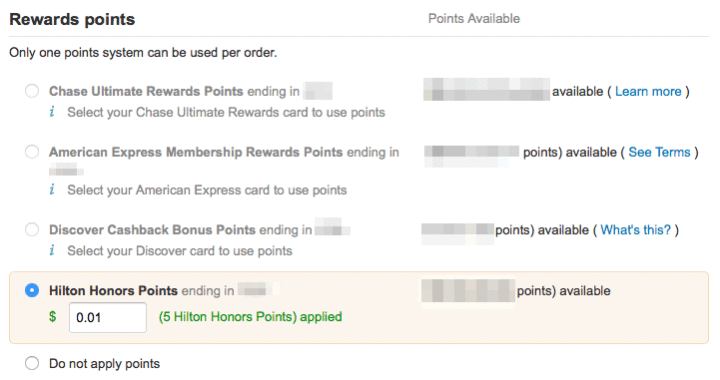
You need to earn or spend Hilton points every 12 months, which is on the short side. My usual strategy is to use Hilton Honors Dining to earn a few points at my neighborhood burger joint, but I was running short on time. I found that you can redeem Hilton points at Amazon through their Shop with Points program. The redemption ratio is 500 Hilton Honors points = $1 on Amazon.

First, link your Hilton Honors account to Amazon.

az_hilton

Next simply use as little as 5 Hilton Honors points to offset $0.01 of any purchase. If you were planing on buying something for $25, just pay for $0.01 with Hilton points, and $24.99 on your credit card. You used to be able to simply buy a $1 Amazon gift code for 500 points and call it a day, but that is no longer an option. If you have Amazon Prime and no other needs, you can still buy one of the following items that cost only $1 or less:

Checkout and choose to pay with Hilton Points, where you can specify to only use as little as 5 points ($0.01). You would want to make sure that it is in stock, so they charge you immediately.

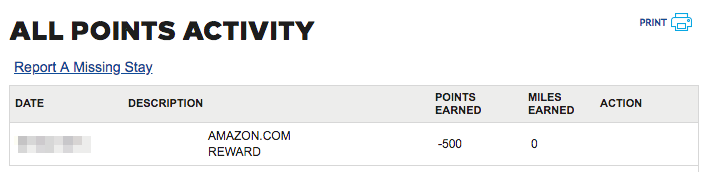
Check for the activity to show up in your Hilton.com account the same day as it is shipped:

az_hilton2

Bottom line. If you have Hilton points expiring soon, you can redeem as little as 5 Hilton points for $0.01 off any Amazon purchase and create qualifying activity that posts the same day. If you have Amazon Prime, I share some $1 ideas. Hilton points are more valuable when redeemed for a free hotel night, but in this case it can be worth sacrificing a few to keep the rest alive and active.

Firstrade Free Trades on Stocks, ETFs, Options, Even Mutual Funds

Firstrade.com has announced free online trades on stocks, exchange-traded funds (ETFs), options and mutual funds. All of them. As a more traditional online broker, Firstrade includes access to all stocks, ETFs, options and mutual funds currently available in the U.S. There are no limits on the number of trades allowed, no minimum holding periods, and no minimum account requirements.

Pricing comparison. Here’s their updated pricing chart, including a side-by-side comparison with TD Ameritrade, Fidelity, E*Trade, and Schwab. Note that each competitor does offer their own selected list of commission-free ETFs.

Customer service. Since they are offering free trades, you might be worried that it would be hard to get assistance. They actually offer a lot of help options including live chat and free call-back phone service:

Are they legit? Yes, Firstrade Securities has been around since 1985, and I actually have an idle account with them from an old promotion. They have been a competitive discount online broker for a while, with their only physical branch in Flushing, New York. They are unique in that they offer special service to Chinese-speaking customers by providing a Chinese language version of their site (Simplified and Traditional) and also Chinese-speaking customer service reps (Mandarin and Cantonese). But other than a few Chinese character links on their site, you wouldn’t otherwise notice.

iOS and Android apps. Both iPhone and Android apps are available. Touch ID/Face ID supported on iOS. In May 2019, they released a redesigned 3.0 version of their iOS app, which now looks more like the other app-first brokerages. Screenshot:

Up to $200 rebate of transfer fees if you switch. They will rebate up to $200 in transfer fees if you move your assets over to them from another broker. Here’s the fine print:

Firstrade will rebate the account transfer fee (ACATS only) up to $200 charged by another brokerage firm when completing a Full Account Transfer for $2500 or more (excluding mutual funds & fixed income products). The rebate will be based solely on the actual transfer fee charged by the firm you are transferring from. To receive transfer rebate, please submit (upload, fax or email) a copy of your most recent statement from your previous broker with evidence of transfer charge. Submissions must be received within 60 days of transfer date. Credit will be deposited to your account within 30 days of receipt of evidence of charge. This offer applies to Firstrade regular investment accounts and IRAs (Traditional IRA, Roth IRA, and Rollover IRA), excluding Partnership, Corporate, Investment Club, ESA Education Planning Account, and Custodial Accounts. The account must remain open for 12 months with the minimum funding or assets required for participating in the offer — if your account assets fall below $2,500 due to withdrawals or outgoing transfers, Firstrade may reverse the transfer rebate at the time of withdrawal. Offer valid from 09/19/2017 to 08/31/2018.

Firstrade is kind of stuck in the middle between the huge mega-brokers and slick startups, so this is a big move for them to get some attention. The big financial names – Fidelity, Schwab, Vanguard all have some commission-free ETFs but not all stock trades. Robinhood and WeBull are new start-ups that have free stock/ETF trades, but not free mutual fund trades.

Bottom line. Firstrade is a discount broker with real human customer service that is moving to the new world of app-centric trading, offering free online trades on all stocks, exchange-traded funds (ETFs), options and mutual funds. No minimum account requirements.

Capital One Savor Cash Rewards Credit Card Review – $200 Bonus + 3% Cash Back at Restaurants and Grocery Stores (no Walmart/Target)

card_name

Capital One has refreshed their card_name with a sign-up bonus, no annual fee, and unlimited 3% cash back at both restaurants and grocery stores (no Walmart/Target Superstores). Here are the highlights:

  • One-time $200 cash bonus once you spend $500 on purchases within the first 3 months from account opening
  • 3% cash back at grocery stores (excluding superstores like Walmart® and Target®). No spending cap.
  • 3% cash back on dining, entertainment and popular streaming services.
  • 1% cash back on all other purchases.
  • 8% cash back on Capital One Entertainment purchases.
  • 5% cash back on hotels and rental cars booked through Capital One Travel, where you’ll get Capital One’s best prices on thousands of trip options. Terms apply.
  • No rotating categories or sign-ups needed to earn cash rewards; plus cash back won’t expire for the life of the account and there’s no limit to how much you can earn.
  • 0% intro APR on purchases and balance transfers for 15 months; reg_apr,reg_apr_type after that; balance transfer fee applies.
  • No foreign transaction fees.
  • No annual fee.

The application page provides some direct clarifications on the rewards structure.

What counts as dining?
Purchases at restaurants, cafes, bars, lounges, fast-food chains and bakeries.

What counts as entertainment?
Buying tickets to a movie, play, concert, sporting event, tourist attraction, theme park, aquarium, zoo, dance club, pool hall or bowling alley. Also, making purchases at record store and video rental locations. This excludes non-industry entertainment merchant codes like cable, digital streaming, and subscription services.

What counts as a grocery store?
A supermarket, meat locker, freezer, dairy product store and specialty market. Excludes superstores like Walmart® and Target®.

The rewards on this card are nice and simple. You earn cash, which can be redeemed as a statement credit or a mailed check. There are other options, but none are especially interesting or more valuable than cash.

Bottom line. The card_name has a $200 sign-up bonus, no annual fee, and unlimited 3% cash back at both restaurants and grocery stores (no Walmart/Target Superstores).

Also see: Top 10 Best Credit Card Bonus Offers.

Best Interest Rates on Cash – May 2019

Here’s my monthly roundup of the best interest rates on cash for May 2019, roughly sorted from shortest to longest maturities. There hasn’t been much movement recently, and the rate curve is still pretty flat with long-term rates only slightly higher than short-term ones. Check out my Ultimate Rate-Chaser Calculator to get an idea of how much extra interest you’d earn if you are moving money between accounts. Rates listed are available to everyone nationwide. Rates checked as of 5/1/19.

High-yield savings accounts
While the huge megabanks like to get away with 0.01% APY, it’s easy to open a new “piggy-back” savings account and simply move some funds over from your existing checking account. The interest rates on savings accounts can drop at any time, so I prioritize banks with a history of competitive rates. Some banks will bait you and then lower the rates in the hopes that you are too lazy to leave.

Short-term guaranteed rates (1 year and under)
A common question is what to do with a big pile of cash that you’re waiting to deploy shortly (just sold your house, just sold your business, legal settlement, inheritance). My usual advice is to keep things simple and take your time. If not a savings account, then put it in a flexible short-term CD under the FDIC limits until you have a plan.

  • No Penalty CDs offer a fixed interest rate that can never go down, but you can still take out your money (once) without any fees if you want to use it elsewhere. Purepoint Financial has a 13-month No Penalty CD at 2.50% APY with a $10,000 minimum deposit. Marcus Bank 13-month No Penalty CD at 2.35% APY with a $500 minimum deposit. You may wish to open multiple CDs in smaller increments for more flexibility.
  • CD Bank has a 12-month CD at 3.00% APY ($10,000 minimum) but with a big early withdrawal penalty of 12 months of interest. If you have a military relationship, Navy Federal Credit Union has a 10-month special at 2.75% APY with add-on option.

Money market mutual funds + Ultra-short bond ETFs
If you like to keep cash in a brokerage account, beware that many brokers pay out very little interest on their default cash sweep funds (and keep the difference for themselves). The following money market and ultra-short bond funds are not FDIC-insured, but may be a good option if you have idle cash and cheap/free commissions.

  • Vanguard Prime Money Market Fund currently pays an 2.44% SEC yield. The default sweep option is the Vanguard Federal Money Market Fund, which has an SEC yield of 2.36%. You can manually move the money over to Prime if you meet the $3,000 minimum investment.
  • Vanguard Ultra-Short-Term Bond Fund currently pays 2.64% SEC Yield ($3,000 min) and 2.74% SEC Yield ($50,000 min). The average duration is ~1 year, so there is more interest rate risk.
  • The PIMCO Enhanced Short Maturity Active Bond ETF (MINT) has a 2.74% SEC yield and the iShares Short Maturity Bond ETF (NEAR) has a 2.75% SEC yield while holding a portfolio of investment-grade bonds with an average duration of ~6 months.

Treasury Bills and Ultra-short Treasury ETFs
Another option is to buy individual Treasury bills which come in a variety of maturities from 4-weeks to 52-weeks. You can also invest in ETFs that hold a rotating basket of short-term Treasury Bills for you, while charging a small management fee for doing so. T-bill interest is exempt from state and local income taxes.

  • You can build your own T-Bill ladder at TreasuryDirect.gov or via a brokerage account with a bond desk like Vanguard and Fidelity. Here are the current Treasury Bill rates. As of 5/1/19, a 4-week T-Bill had the equivalent of 2.42% annualized interest and a 52-week T-Bill had the equivalent of 2.39% annualized interest.
  • The Goldman Sachs Access Treasury 0-1 Year ETF (GBIL) has a 2.30% SEC yield and the SPDR Bloomberg Barclays 1-3 Month T-Bill ETF (BIL) has a 2.24% SEC yield. GBIL appears to have a slightly longer average maturity than BIL.

US Savings Bonds
Series I Savings Bonds offer rates that are linked to inflation and backed by the US government. You must hold them for at least a year. There are annual purchase limits. If you redeem them within 5 years there is a penalty of the last 3 months of interest.

  • “I Bonds” bought between May 2019 and October 2019 will earn a 1.90% rate for the first six months. The rate of the subsequent 6-month period will be based on inflation again. More info here.
  • In mid-October 2019, the CPI will be announced and you will have a short period where you will have a very close estimate of the rate for the next 12 months. I will have another post up at that time.

Prepaid Cards with Attached Savings Accounts
A small subset of prepaid debit cards have an “attached” FDIC-insured savings account with exceptionally high interest rates. The negatives are that balances are capped, and there are many fees that you must be careful to avoid (lest they eat up your interest). Some folks don’t mind the extra work and attention required, while others do. There is a long list of previous offers that have already disappeared with little notice. I don’t personally recommend or use any of these anymore.

  • The only notable card left in this category is Mango Money at 6% APY on up to $2,500, but there are many hoops to jump through. Requirements include $1,500+ in “signature” purchases and a minimum balance of $25.00 at the end of the month.

Rewards checking accounts
These unique checking accounts pay above-average interest rates, but with unique risks. You have to jump through certain hoops, and if you make a mistake you won’t earn any interest for that month. Some folks don’t mind the extra work and attention required, while others do. Rates can also drop to near-zero quickly, leaving a “bait-and-switch” feeling. I don’t use any of these anymore, either.

  • The best one right now is Orion FCU Premium Checking at 4.00% APY on balances up to $30,000 if you meet make $500+ in direct deposits and 8 debit card “signature” purchases each month. The APY goes down to 0.05% APY and they charge you a $5 monthly fee if you miss out on the requirements. There is also the TAB Bank 4% APY Checking, which I don’t like due its vague terms. Find a local rewards checking account at DepositAccounts.
  • If you’re looking for a high-interest checking account without debit card transaction requirements then the rate won’t be as high, but take a look at MemoryBank at 1.60% APY.

Certificates of deposit (greater than 1 year)
CDs offer higher rates, but come with an early withdrawal penalty. By finding a bank CD with a reasonable early withdrawal penalty, you can enjoy higher rates but maintain access in a true emergency. Alternatively, consider building a CD ladder of different maturity lengths (ex. 1/2/3/4/5-years) such that you have access to part of the ladder each year, but your blended interest rate is higher than a savings account. When one CD matures, use that money to buy another 5-year CD to keep the ladder going.

  • CD Bank has an 18-month CD at 3.10% APY ($10,000 minimum) but with a big early withdrawal penalty of 12 months of interest. Hanscom Federal Credit UnionBank has a 19-month CD special at 3.00% APY ($1,000 minimum) with an early withdrawal penalty of 6 months of interest.
  • 5-year CD rates have been dropping at many banks and credit unions, following the overall interest rate curve. A good rate is now about 3.25% APY, with First National Bank of America offering 3.35% APY on a 5-year CD with an early withdrawal penalty of 1.5 years (!) of interest..
  • You can buy certificates of deposit via the bond desks of Vanguard and Fidelity. These “brokered CDs” offer FDIC insurance and easy laddering, but they don’t come with predictable fixed early withdrawal penalties. Nothing special right now. As of this writing, Vanguard is showing a 2-year non-callable CD at 2.45% APY and a 5-year non-callable CD at 2.75% APY. Watch out for higher rates from callable CDs listed by Fidelity.

Longer-term Instruments
I’d use these with caution due to increased interest rate risk, but I still track them to see the rest of the current yield curve.

  • Willing to lock up your money for 10+ years? You can buy long-term certificates of deposit via the bond desks of Vanguard and Fidelity. These “brokered CDs” offer FDIC insurance, but they don’t come with predictable fixed early withdrawal penalties. As of this writing, Vanguard is showing a 10-year non-callable CD at 3.00% APY. Watch out for higher rates from callable CDs from Fidelity. Matching the overall yield curve, current CD rates do not rise much higher as you extend beyond a 5-year maturity.
  • How about two decades? Series EE Savings Bonds are not indexed to inflation, but they have a guarantee that the value will double in value in 20 years, which equals a guaranteed return of 3.5% a year. However, if you don’t hold for that long, you’ll be stuck with the normal rate which is quite low (currently a sad 0.10% rate). I view this as a huge early withdrawal penalty. You could also view it as long-term bond and thus a hedge against deflation, but only if you can hold on for 20 years. As of 5/1/19, the 20-year Treasury Bond rate was 2.74%.

All rates were checked as of 5/1/19.


TAB Bank Kasasa Cash Checking Review: 4% APY (Up to $50k) w/ Activity Requirements

Update late January 2019: Reader Steve shares that “TAB Bank is no longer offering Kasasa Cash Checking. But for those already having an account, no changes are planned.”

Original post:

TAB Bank has a Kasasa Cash Checking account that offers 4% APY on balances up to $50,000 if you meet certain deposit activity and debit card transaction requirements. However, they include some vague language that lets them withhold your interest based on their subjective opinion. Details below.

FDIC confirmation and eligibility. I was able to find TAB Bank at FDIC.gov under “Transportation Alliance Bank, Inc. D/B/a Tab Bank” with FDIC certificate #34781 and domain tabbank.com. Since this isn’t a credit union, you don’t need to worry about joining a member organization or maintain a share savings account. Anyone nationwide can apply online and fund using ACH transfer. They also say that they won’t perform a credit inquiry for a checking account.

Monthly requirements. To qualify for the 4% APY on balances up to $50,000 and up to $15 in ATM fee rebates per month, you must have the following during each monthly qualification cycle:

  • At least 1 direct deposit, ACH payment, or bill pay transaction.
  • At least 15 debit card purchases, and each must be $5 or more. When using your card, choose the credit option and bypass using your PIN.

If you don’t meet these requirements, there is no monthly fee but you lose the ATM rebates and your interest rate is only 0.05% APY.

Potential catch? Vague fine print. If you read through their Truth-in-Savings disclosure [pdf], you will find the following vague assertions:

Purpose and expected use of accounts – The Kasasa Cash account is intended to be the accountholder’s primary checking account in which payroll transactions and day-to-day spending activities including but not limited to grocery, gasoline, apparel, shopping, dining, sporting and entertainment transactions are posted and settled.

[…] You will automatically qualify for the account’s rewards during your account’s first statement cycle. If the account is closed before rewards are credited, you will forfeit the rewards.

[…] Commensurate with the spending activities identified above, we expect the account’s debit card to be used frequently throughout each month and for transaction amounts to reflect a wide dollar range. Small debit card transactions conducted on the same day at a single merchant and/or multiple transactions made during a condensed time period particularly near the end of a Monthly Qualification Cycle are not considered normal, day-to-day spending behavior. These types of transactions appear to be conducted with the sole purpose of qualifying for the account’s rewards and thus will be deemed inappropriate transactions and will not count toward earning the account’s rewards.

[…] TAB Bank reserves the right to determine if the Kasasa Cash account is being maintained for a purpose other than day-to-day, primary use. Accountholders who persist in making debit card transactions in a calculated and limited fashion in order to meet their monthly qualifications may have their accounts converted to a different checking account or closed altogether.

Basically, they reserve the right to change up the requirements to whatever they want. We know that banks make money when we use your debit card. However, if you want your customers to use it more, then just make your requirements higher. You already added the $5 minimum per transaction. Just say you want 15 transactions with a combined total of $1,000 or similar. Make the rules fair, clear, and transparent.

Good deal? The interest rate is good, but the vague rules make this account not worth the bother. They are allowed to judge what I am “supposed” to buy on a day-to-day basis as a “normal” person? Pass! If you put in a sizable balance, that’s $100+ of monthly interest that they can withhold for no solid reason (and are actually incentivized to do so as it saves them money).

For now, I would compare with the Orion FCU 4% APY checking account, which doesn’t play such games, is more upfront and understandable. If they make the rules transparent (even if more restrictive), I would reconsider.

Bottom line. TAB Bank has a rewards checking account called Kasasa Cash Checking that offers 4% APY on balances up to $50,000 if you meet certain deposit activity and debit card transaction requirements. However, they hide in the fine print that they can withhold your interest based on their subjective opinion. If they judge you ineligible, you will earn virtually no interest (0.05% APY).

Here are the rest of the Best Interest Rates on Cash.

Schwab Commission-Free ETF List Review (Updated 2019)

ETFs are surpassing mutual funds as the standard building blocks of stock and bond portfolios. Here’s a closer look at the latest updates to the Charles Schwab commission-free ETF list. While the commercials often focus on quantity instead of quality, I will do the opposite. Here are the factors that I think are important:

  • Total Assets. This is a measure of popularity and reputation. A more popular ETF will have a smaller bid/ask spread and won’t have to liquidate in a bear market. A more reputably ETF manager will have lower index tracking error. However, ETF size isn’t everything.
  • Index/Asset Class. What index does it track? Does that index cover an asset class that I want to include??
  • Cost. What is the expense ratio? Low costs are important.

Schwab Commission-Free ETF full list. This Schwab ETF OneSource page includes a full list of their 503 commission-free ETFs.

Brief history of changes. In early February 2019, Schwab announced that it would increase the number of commission-free ETFs on their list to 503 as of March 1st, 2019, including no early redemption fees (no minimum holding period). Here is the list of 246 added ETFs, including 90 iShares ETFs.

Schwab’s ETF OneSource started in February 2013 with 103 commission-free ETFs including many in-house ETFs. Schwab has become very competitive with Vanguard and iShares by developing their own brand of low-cost, index ETFs. Outside providers now include: Aberdeen Standard Investments, ALPS Advisors, DWS Group, Direxion, Global X ETFs, IndexIQ, Invesco, iShares ETFs, John Hancock Investments, J.P. Morgan Asset Management, OppenheimerFunds, PIMCO, State Street Global Advisors SPDR® ETFs, USCF, WisdomTree and Charles Schwab Investment Management.

In March 2017, Schwab dropped their standard stock commission to $4.95 per trade + $0.65 per options contract. In addition, expenses for the Schwab market cap-weighted index mutual funds were lowered to match their Schwab ETF equivalents. Schwab Index mutual funds now have no investment minimum.

Largest ETFs on Schwab Commission-Free ETF list. Here are the top 20 most popular ETFs on their list, sorted by largest total assets. Also listed are the asset class and expense ratios.

ETF Name (Ticker) Asset Class Expense Ratio
iShares Core U.S. Aggregate Bond ETF (AGG) US Total Bond 0.05%
iShares iBoxx $ Investment Grade Corporate Bond ETF (LQD) US Corporate Bonds 0.15%
iShares Edge MSCI Min Vol USA ETF (USMV) US Low Volatility 0.15%
iShares TIPS Bond ETF (TIP) US Inflation-Protected Bond 0.19%
iShares 1-3 Year Treasury Bond ETF (SHY) Short-Term Treasury Bond 0.15%
iShares J.P. Morgan USD Emerging Markets Bond ETF (EMB) Emerging Markets Bond 0.39%
Schwab International Equity ETF (SCHF) International Developed 0.06%
iShares MBS ETF (MBB) US Mortage-Backed Bonds 0.09%
iShares MSCI Japan ETF (EWJ) International Country Stock 0.47%
iShares iBoxx $ High Yield Corporate Bond ETF (HYG) US High-Yield Corporate Bond 0.49%
Invesco S&P 500® Equal Weight ETF (RSP) US Large-Capk 0.20%
Schwab U.S. Large-Cap ETF (SCHX) US Large Cap Blend 0.03%
Schwab U.S. Broad Market ETF (SCHB) US Total Stock 0.03%
iShares 7-10 Year Treasury Bond ETF (IEF) Interm-Term Treasury Bond 0.15%
iShares National AMT-Free Muni Bond ETF (MUB) Municipal Bond 0.07%
iShares 20+ Year Treasury Bond ETF (TLT) Long-Term Treasury Bond 0.15%
iShares Edge MSCI Min Vol EAFE ETF (EFAV) International Developed Stock 0.20%
iShares Short-Term Corporate Bond ETF (IGSB) US Short-Term Corporate Bond 0.06%
Invesco S&P 500® Low Volatility ETF (SPLV) US Large-Cap Stock 0.25%
iShares Edge MSCI USA Quality Factor ETF (QUAL) US Large-Cap Stock 0.15%


Lowest Expense Ratio ETFs on Schwab Commission-Free ETF list. Here are the top 20 cheapest ETFs on their list, sorted by lowest expense ratio.

ETF Name (Ticker) Asset Class Expense Ratio
Schwab U.S. Broad Market ETF (SCHB) US Total Stock 0.03%
Schwab U.S. Large-Cap ETF (SCHX) US Large Cap Blend 0.03%
SPDR Portfolio Large Cap ETF (SPLG) US Large Cap Blend 0.03%
SPDR Portfolio Total Stock Market ETF (SPTM) US Total Stock 0.03%
SPDR Portfolio Developed World ex-US ETF (SPDW) International Developed Stock 0.04%
Schwab U.S. Aggregate Bond ETF (SCHZ) International Developed Large Cap Blend 0.04%
SPDR Portfolio Aggregate Bond ETF (SPAB) US Total Bond 0.04%
Schwab U.S. Large-Cap Growth ETF (SCHG) US Large-Cap Growth 0.04%
SPDR Portfolio S&P 500 Growth ETF (SPYG) US Large-Cap Growth 0.04%
Schwab U.S. Large-Cap Value ETF (SCHV) US Large-Cap Value 0.04%
SPDR Portfolio S&P 500 Value ETF (SPYV) US Large-Cap Value 0.04%
Schwab U.S. Mid-Cap ETF (SCHM) US Mid-Cap 0.04%
Schwab U.S. Small-Cap ETF (SCHA) US Small-Cap 0.04%
Schwab U.S. TIPS ETF (SCHP) US Inflation-Protected Bond 0.05%
Schwab 1000 Index ETF (SCHK) US Large-Cap Blend 0.05%
SPDR Portfolio Mid Cap ETF (SPMD) US Mid-Cap 0.05%
SPDR Portfolio Small Cap ETF (SPSM) US Small-Cap 0.05%
SPDR Bloomberg Barclays Corporate Bond ETF (CBND) US Corporate Bond 0.06%
Schwab International Equity ETF (SCHF) International Developed 0.06%
Schwab Intermediate-Term U.S. Treasury (SCHR) US Treasury Bond 0.06%


Commentary. Overall, Schwab’s OneSource ETF list does include a good mix of Schwab ETFs with good management, low costs, and low bid/ask spreads. There are also a few good iShares and SPDR ETFs that could be potential ETF pairs for tax-loss harvesting. A DIY investor should find it easy create a diversified portfolio of ETFs according to their desired asset allocation, if you know what you are looking for. With 500+ ETFs, many will be short-lived duds, while still others are ETFs that track a very similar index but are much more expensive than the competition.

Best Interest Rates on Cash – April 2019

Here’s my monthly roundup of the best interest rates on cash for April 2019, roughly sorted from shortest to longest maturities. The big news is that we are starting to see some slight rate drops in CDs! Folks who locked in at 4% APY may end up pleased they did. Check out my Ultimate Rate-Chaser Calculator to get an idea of how much extra interest you’d earn if you are moving money between accounts. Rates listed are available to everyone nationwide. Rates checked as of 4/3/19.

High-yield savings accounts
While the huge megabanks like to get away with 0.01% APY, it’s easy to open a new “piggy-back” savings account and simply move some funds over from your existing checking account. The interest rates on savings accounts can drop at any time, so I prioritize banks with a history of competitive rates. Some banks will bait you and then lower the rates in the hopes that you are too lazy to leave.

Short-term guaranteed rates (1 year and under)
A common question is what to do with a big pile of cash that you’re waiting to deploy shortly (just sold your house, just sold your business, legal settlement, inheritance). My usual advice is to keep things simple and take your time. If not a savings account, then put it in a flexible short-term CD under the FDIC limits until you have a plan.

  • No Penalty CDs offer a fixed interest rate that can never go down, but you can still take out your money (once) without any fees if you want to use it elsewhere. Purepoint Financial has a 13-month No Penalty CD at 2.50% APY with a $10,000 minimum deposit. Marcus Bank 13-month No Penalty CD at 2.35% APY with a $500 minimum deposit, Ally Bank 11-month No Penalty CD at 2.30% APY with a $25k+ minimum, and CIT Bank 11-month No Penalty CD at 2.05% APY with a $1,000 minimum. You may wish to open multiple CDs in smaller increments for more flexibility.
  • Colorado Federal Savings Bank has a 12-month CD at 2.86% APY ($5,000 minimum) with an early withdrawal penalty of 3 months of interest.

Money market mutual funds + Ultra-short bond ETFs
If you like to keep cash in a brokerage account, beware that many brokers pay out very little interest on their default cash sweep funds (and keep the difference for themselves). The following money market and ultra-short bond funds are not FDIC-insured, but may be a good option if you have idle cash and cheap/free commissions.

  • Vanguard Prime Money Market Fund currently pays an 2.46% SEC yield. The default sweep option is the Vanguard Federal Money Market Fund, which has an SEC yield of 2.36%. You can manually move the money over to Prime if you meet the $3,000 minimum investment.
  • Vanguard Ultra-Short-Term Bond Fund currently pays 2.71% SEC Yield ($3,000 min) and 2.81% SEC Yield ($50,000 min). The average duration is ~1 year, so there is more interest rate risk.
  • The PIMCO Enhanced Short Maturity Active Bond ETF (MINT) has a 2.84% SEC yield and the iShares Short Maturity Bond ETF (NEAR) has a 2.80% SEC yield while holding a portfolio of investment-grade bonds with an average duration of ~6 months.

Treasury Bills and Ultra-short Treasury ETFs
Another option is to buy individual Treasury bills which come in a variety of maturities from 4-weeks to 52-weeks. You can also invest in ETFs that hold a rotating basket of short-term Treasury Bills for you, while charging a small management fee for doing so. T-bill interest is exempt from state and local income taxes.

  • You can build your own T-Bill ladder at TreasuryDirect.gov or via a brokerage account with a bond desk like Vanguard and Fidelity. Here are the current Treasury Bill rates. As of 4/3/19, a 4-week T-Bill had the equivalent of 2.42% annualized interest and a 52-week T-Bill had the equivalent of 2.41% annualized interest.
  • The Goldman Sachs Access Treasury 0-1 Year ETF (GBIL) has a 2.30% SEC yield and the SPDR Bloomberg Barclays 1-3 Month T-Bill ETF (BIL) has a 2.25% SEC yield. GBIL appears to have a slightly longer average maturity than BIL.

US Savings Bonds
Series I Savings Bonds offer rates that are linked to inflation and backed by the US government. You must hold them for at least a year. There are annual purchase limits. If you redeem them within 5 years there is a penalty of the last 3 months of interest.

  • “I Bonds” bought between November 2018 and April 2019 will earn a 2.82% rate for the first six months. The rate of the subsequent 6-month period will be based on inflation again. More info here.
  • In mid-April 2019, the CPI will be announced and you will have a short period where you will have a very close estimate of the rate for the next 12 months. I will have another post up at that time.

Prepaid Cards with Attached Savings Accounts
A small subset of prepaid debit cards have an “attached” FDIC-insured savings account with exceptionally high interest rates. The negatives are that balances are capped, and there are many fees that you must be careful to avoid (lest they eat up your interest). Some folks don’t mind the extra work and attention required, while others do. There is a long list of previous offers that have already disappeared with little notice. I don’t personally recommend or use any of these anymore.

  • The only notable card left in this category is Mango Money at 6% APY on up to $2,500, but there are many hoops to jump through. Requirements include $1,500+ in “signature” purchases and a minimum balance of $25.00 at the end of the month.

Rewards checking accounts
These unique checking accounts pay above-average interest rates, but with unique risks. You have to jump through certain hoops, and if you make a mistake you won’t earn any interest for that month. Some folks don’t mind the extra work and attention required, while others do. Rates can also drop to near-zero quickly, leaving a “bait-and-switch” feeling. I don’t use any of these anymore, either.

  • The best one right now is Orion FCU Premium Checking at 4.00% APY on balances up to $30,000 if you meet make $500+ in direct deposits and 8 debit card “signature” purchases each month. The APY goes down to 0.05% APY and they charge you a $5 monthly fee if you miss out on the requirements. Find a local rewards checking account at DepositAccounts.
  • If you’re looking for a high-interest checking account without debit card transaction requirements then the rate won’t be as high, but take a look at MemoryBank at 1.60% APY.

Certificates of deposit (greater than 1 year)
CDs offer higher rates, but come with an early withdrawal penalty. By finding a bank CD with a reasonable early withdrawal penalty, you can enjoy higher rates but maintain access in a true emergency. Alternatively, consider building a CD ladder of different maturity lengths (ex. 1/2/3/4/5-years) such that you have access to part of the ladder each year, but your blended interest rate is higher than a savings account. When one CD matures, use that money to buy another 5-year CD to keep the ladder going.

  • Hanscom Federal Credit UnionBank has a 19-month CD special at 3.00% APY ($1,000 minimum) with an early withdrawal penalty of 6 months of interest. If you have a military relationship, Navy Federal Credit Union has a 6-month special at 3.00% APY and 17-month special at 3.25% APY.
  • 5-year CD rates have been dropping at many banks and credit unions, following the overall interest rate curve. A good rate is now about 3.25% APY, with The Federal Savings Bank offering 3.30% APY on a 5-year CD.
  • You can buy certificates of deposit via the bond desks of Vanguard and Fidelity. These “brokered CDs” offer FDIC insurance and easy laddering, but they don’t come with predictable fixed early withdrawal penalties. As of this writing, Vanguard is showing a 2-year non-callable CD at 2.45% APY and a 5-year non-callable CD at 2.80% APY. Watch out for higher rates from callable CDs listed by Fidelity.

Longer-term Instruments
I’d use these with caution due to increased interest rate risk, but I still track them to see the rest of the current yield curve.

  • Willing to lock up your money for 10+ years? You can buy long-term certificates of deposit via the bond desks of Vanguard and Fidelity. These “brokered CDs” offer FDIC insurance, but they don’t come with predictable fixed early withdrawal penalties. As of this writing, Vanguard is showing a 10-year non-callable CD at 3.10% APY. Watch out for higher rates from callable CDs from Fidelity. Matching the overall yield curve, current CD rates do not rise much higher as you extend beyond a 5-year maturity.
  • How about two decades? Series EE Savings Bonds are not indexed to inflation, but they have a guarantee that the value will double in value in 20 years, which equals a guaranteed return of 3.5% a year. However, if you don’t hold for that long, you’ll be stuck with the normal rate which is quite low (currently a sad 0.10% rate). I view this as a huge early withdrawal penalty. You could also view it as long-term bond and thus a hedge against deflation, but only if you can hold on for 20 years. As of 4/3/19, the 20-year Treasury Bond rate was 2.75%.

All rates were checked as of 4/3/19.


Barron’s Best Online Broker Rankings 2019

Each year, Barron’s releases their list of top online brokers. I like read and share it, hoping to find deeper insights into industry trends and specific broker features. However, this year their 2019 rankings article is firmly behind a paywall. That is certainly their right, but it also discourages sharing and discussion. (I am a paying subscriber to the NY Times, WSJ, and Bloomberg Businessweek, but not Barron’s.)

However, hidden in a Merill Edge press release, I found that Merrill paid for a full article reprint which lets anyone read the main article for free. I could not find a way to view the their secondary rankings, i.e. “Top 5 for Long-Term Investors” or “Top 5 for Occasional Traders”.

Their rankings only include 14 brokers this year, which means several are being left out. Firstrade and Vanguard were mentioned only to state that they both declined to participate. Robinhood wasn’t ranked, just quickly dismissed with an offhand “they take payment for order flow”, even though many other brokers on their list like E-Trade and TD Ameritrade also take payment for order flow. I mean, TD Ameritrade made $320 million from order flow in 2017 alone! WeBull wasn’t even mentioned.

Commentary. Here is my own list of brokers that I think are worth considering, along with their pros and cons. If a family or friend asked me what I thought were the best online brokers, this would be my reply.

Interactive Brokers

  • Pros: Best for active traders. Low average commissions for active traders. Best trading interface for active traders. Proof: Their average account makes ~500 trades a year. Good interest rate on cash sweep.
  • Cons: Minimum commission of $10 a month for accounts under $100,000, or a minimum commission of $20/month under $2,000. This means you must pay them $120/$240 a year no matter what. Not set up for newbies.

Fidelity

  • Pros: Good all-around broker. Best customer service in my experience. Free ETF list. No more mutual fund minimums. Good index fund selection.
  • Cons: $4.95/trade for stocks and ETFs not on their list. Average cash sweep options.

Vanguard

  • Pros: The classic broker for low-cost index fund lovers. $0 trades on all ETFs, both Vanguard and non-Vanguard (iShares, Schwab, etc). Free trades on Vanguard index and active mutual funds. Excellent index fund selection. Excellent cash sweep options. No direct profit motive.
  • Cons: Not good for active traders. They’ve had some struggles with customer service due to their huge growth.

Merrill Edge

  • Pros: Best for those with a Bank of America checking account. 30+ free trades/month when you move over $50,000+ in assets across Bank of America and Merrill (Preferred Rewards program), even if just moving over a bunch of low-cost ETFs. Good customer service.
  • Cons: Below-average cash sweep options. $6.95 trades without Preferred Rewards relationship.

M1 Finance

  • Pros: My favorite amongst the new crowd of app-centric brokers and robo-advisors. Free stock and ETF trades. Fractional share ownership means full investment of any dollar amount. You can fully customize an asset allocation “pie” using stocks or ETFs, and it will automatically rebalance for free with no management fees. Basically a free robo-advisor that is fully-customizable.
  • Cons: Newer startup. If you really want to add banking features, that will cost extra. (I’d just skip it.)

Disclosure: I am now an affiliate of M1 Finance and TD Ameritrade, and may be compensated if you click through my referral link and open a new account. I am not an affiliate of Interactive Brokers, Fidelity, Merrill Edge, or Vanguard.

Schwab Intelligent Portfolios Premium Feature Review: $30 a Month For Unlimited CFP Access

Schwab has revamped their Intelligent Portfolios “robo-advisor” service, renaming the upper tier to Schwab Intelligent Portfolios Premium and adding an in-depth financial plan and unlimited advice from a Certified Financial Planner for an additional upfront fee of $300 plus an ongoing $30 a month. Bloomberg compares this to a Netflix subscription:

Current users won’t have to pay the $300 fee, and they’ll be transitioned to the new pricing model as early as Thursday, but only once they have enough assets to make it more cost-efficient for them, at around the $125,000 level. The free version of the service, Schwab Intelligent Portfolios, which automatically builds and rebalances exchange-traded fund portfolios as well as offering more limited guidance, will continue charging no advisory fee.

Feature comparison. The base Intelligent Portfolios product including the following features:

  • Design and choose an appropriate asset allocation.
  • Construct and maintain (rebalance) portfolio using ETFs.
  • Tax-loss harvesting.
  • No advisory fee*.
  • No commissions.
  • $5,000 minimum balance.

* You might see this referred to as a “free” (as it is by Bloomberg above) in that it charges no advisory fee on top of the underlying fees of the portfolio components. I’ll argue below that is it not really “free”.

Schwab Intelligent Portfolios Premium adds the following:

  • Unlimited 1:1 guidance from a Certified Financial Planner (CFP).
  • Personalized Action Plan and portfolio review with a CFP® professional.
  • One-time $300 initial planning fee and $30/month for unlimited guidance.
  • $25,000 minimum balance.

I agree that is a big shift in the portfolio management industry. A major player now offers unlimited access to a CFP for a flat fee of $30/month. CFP access is becoming a commodity. If you pay $15 a month for Netflix and $50 a month for unlimited cell phone data, why not pony up $30 a month for unlimited financial advice? I have pointed out previously that an overlooked feature of Blooom 401k advisory services was that they include unlimited CFP access in their $10/month fee.

I really like the idea of paying a flat fee instead of an asset-based fee for financial advice. I think this move from a big name like Schwab will attract some large portfolios from DIY investors. If you had a $500,000 portfolio, this would only be 0.07% of assets annually. I really hope Vanguard comes out with a flat-fee pricing option while still keeping their ability to work with your existing portfolio. Most robo-advisors, including Schwab Intelligent Portfolios, make you sell out of all your current positions and rebuy using their model portfolios. I have a lot of capital gains already such that selling would cause tax issues.

Schwab Intelligent Portfolios still has the same “catch” in their fine print, however. Every Schwab Intelligent Portfolios client is forced to hold a cash position of about 8% of the total portfolio in cash. More importantly, you also don’t have a choice in how they define “cash”. Here’s the fine print:

The portfolios include a cash allocation to a deposit account at Schwab Bank. Our affiliated bank earns income on the deposits, and earns more the larger the cash allocation is. The lower the interest rate Schwab Bank pays on the cash, the lower the yield. Some cash alternatives outside of Schwab Intelligent Portfolios Solutions pay a higher yield.

My primary concern is NOT that holding 8% cash is bad. It’s that the Schwab cash component that they force you to use is bad. As of 3/31/19, Schwab cash pays only 0.70% APY while the Vanguard Prime Money Market fund earns 2.46% SEC yield and a one-month Treasury Bill has a 2.43% yield. This gap may narrow or widen in the future.

If you assume a 1.50% drag on a 8% cash allocation, that’s the equivalent paying a 0.12% fee because you are losing that much in potential interest. As you grow older and/or become more conservative, the cash allocation grows as well. It is a guaranteed profit source for Schwab, and thus a guaranteed loss for you (not free!). This loss is not “cash drag”. If you wanted to argue that the return on cash is worse than a bond fund, “cash drag” would be an additional cost on top of this issue.

This is the equivalent of them making you hold an S&P 500 ETF with a 1.50% expense ratio instead of an equally-available S&P 500 ETF with an 0.03% expense ratio. People would be up in arms about that, so why not put up a fuss about this? The net fee may be still be a reasonable size, but this is not the type of behavior I am looking for in a service that I am supposed to entrust with my life savings. Just be upfront and charge me a fee. If Schwab replaces their cash component with a competitive money market fund or a simple allocation to Treasury Bills (make your own ETF, Schwab!) then I would get much more excited about this product.

Bottom line. Schwab is adding the ability to get unlimited human advice from a Certified Financial Planner (CFP) for $300 upfront + a flat $30 a month. I think this is a bold move that will affect the overall industry, but I still have concerns about their overall robo-advisor product that includes a low-interest cash component.