Fidelity Commission-Free ETF List Review (Updated 2019)

ETFs are surpassing mutual funds as the standard building blocks of stock and bond portfolios. Therefore, I’m taking a closer look at the latest commission-free ETF lists from the major brokers. Unfortunately, the marketing often focuses on quantity instead of quality. Who cares if they offer 500+ ETFs, if I only need six good ones? Here are the factors that I think are important:

  • Total Assets. This is a measure of popularity and reputation. A more popular ETF will have a smaller bid/ask spread and won’t have to liquidate in a bear market. A more reputably ETF manager will have lower index tracking error. However, ETF size isn’t everything.
  • Index/Asset Class. What index does it track? Does that index cover an asset class that I want to include?
  • Cost. What is the expense ratio? Low costs are important.

Fidelity Commission-Free ETF full list. The main Fidelity ETF page currently advertises 357 commission-free ETFs (28 from Fidelity and 329 from iShares). The full list requires a log-in. Here is an outdated PDF which lists the 240 iShares ETFs (89 more have since been added). There are several good, low-cost options from the iShares Core Series of ETFs.

Recent changes. In early February 2019, Fidelity announced that it would match Schwab and increase the number of commission-free ETFs on their list to “more than 500” by the end of the month. However, in late February 2019 they announced that they added a few new Fidelity ETFs and 89 additional iShares ETFs (formerly 240) as part of a “first phase”.

In February 2017, Fidelity lowered the standard commission on online stock and ETF trades to $4.95 per trade, down from $7.95 previously. In August 2018, Fidelity announced a part of zero-expense ratio mutual funds, eliminated many account minimums, and cut a bunch of mutual fund expense ratios by getting rid of share classes.

Largest ETFs on Fidelity Commission-Free ETF list. Here are the top 20 most popular ETFs on their list, sorted by largest total assets. I have added in the asset class (index) and expense ratio.

ETF Name (Ticker) Asset Class Expense Ratio
iShares Core S&P 500 ETF (IVV) US Large Cap Blend 0.04%
iShares MSCI EAFE ETF (EFA) International Large Cap Blend 0.31%
iShares Core MSCI EAFE ETF (IEFA) International Large Cap Blend 0.08%
iShares Core U.S. Aggregate Bond ETF (AGG) US Total Bond 0.05%
iShares Core MSCI Emerging Markets ETF (IEMG) Emerging Markets Stock 0.14%
iShares Core S&P Mid-Cap ETF (IJH) US Mid Cap Blend 0.07%
iShares Russell 2000 ETF (IWM) US Small Cap Blend 0.19%
iShares Core S&P Small-Cap ETF (IJR) US Mid Cap Blend 0.07%
iShares Russell 1000 Growth ETF (IWF) US Large Cap Growth 0.20%
iShares Russell 1000 Value ETF (IWD) US Large Cap Value 0.20%
iShares MSCI Emerging Markets ETF (EEM) Emerging Markets Stock 0.67%
iShares iBoxx $ Investment Grade Corporate Bond ETF (LQD) US Corporate Bonds 0.15%
iShares Edge MSCI Min Vol USA ETF (USMV) US Low Volatility 0.15%
iShares S&P 500 Growth ETF (IVW) US Large Cap Growth 0.18%
iShares TIPS Bond ETF (TIP) US Inflation-Protected Bond 0.19%
iShares 1-3 Year Treasury Bond ETF (SHY) Short-Term Treasury Bond 0.15%
iShares Short Treasury Bond ETF (SHV) Short-Term Treasury Bond 0.15%
iShares Russell 1000 ETF (IWB) US Large Cap Blend 0.15%
iShares Core S&P Total U.S. Stock Market ETF (ITOT) US Total Stock 0.03%
iShares Russell Midcap ETF (IWR) US Total Stock 0.20%


Lowest Expense Ratio ETFs on Fidelity Commission-Free ETF list. Here are the top 20 cheapest ETFs on their list, sorted by lowest expense ratio.

ETF Name (Ticker) Asset Class Expense Ratio
iShares Core S&P Total U.S. Stock Market ETF (ITOT) US Total Stock 0.03%
iShares Core S&P 500 ETF (IVV) US Large Cap Blend 0.04%
iShares Core S&P U.S. Value ETF (IUSV) US Large Cap Value 0.04%
iShares Core S&P U.S. Growth ETF (IUSG) US Large Cap Growth 0.04%
iShares Core U.S. Aggregate Bond ETF (AGG) US Total Bond 0.05%
iShares Core MSCI International Developed Markets ETF (IDEV) International Developed Large Cap Blend 0.07%
iShares Short-Term Corporate Bond ETF (IGSB) US Short-Term Corporate Bond 0.06%
iShares Intermediate-Term Corporate Bond ETF (IGIB) US Interm-Term Corporate Bond 0.06%
iShares Broad USD Investment Grade Corporate Bond ETF (USIG) US Total Corporate Bond 0.06%
iShares 0-5 Year TIPS Bond ETF (STIP) US Inflation-Protected Bond 0.06%
iShares Core 1-5 Year USD Bond ETF (ISTB) US Short-Term Bond 0.06%
iShares 0-5 Year Investment Grade Corporate Bond ETF (SLQD) US Short-Term Corporate Bond 0.06%
iShares Core Total USD Bond Market ETF (IUSB) US Total Bond 0.06%
iShares Core S&P Mid-Cap ETF (IJH) US Mid Cap Blend 0.07%
iShares Core S&P Small-Cap ETF (IJR) US Mid Cap Blend 0.07%
iShares National AMT-Free Muni Bond ETF (MUB) Municipal Bond 0.07%
iShares S&P Short Term National AMT-Free Bond ETF (SUB) Short-Term Municipal Bond 0.07%
iShares Core U.S. REIT ETF (USRT) US Real Estate 0.08%
iShares Core High Dividend ETF (HDV) US High Dividend Stock 0.08%
iShares Core MSCI EAFE ETF (IEAFA) International Developed Large Stock 0.08%


Commentary. Fidelity’s list includes a good mix of iShares Core ETFs with good management, low costs, and low bid/ask spreads. An individual investor can easily create a diversified portfolio of ETFs according to their desired asset allocation. However, in their latest round of additions, they added a bunch of older iShares ETFs which were mostly more popular for professional traders and options buyers, not for long-term investors. For example, why would you buy EEM when you could buy IEMG with a much lower expense ratio? DIY investors need to choose carefully.

Sprint Free Year of Unlimited Data Promo Expired: Now $25/Month Kickstart With No Expiration

Update: Sprint has replaced this offer with their Sprint Kickstart plan, which offers unlimited talk, text, and unlimited data for $25/month and does NOT go up in price after the first year. You also don’t have to port-in from a postpaid carrier – simply bring over any phone that works with the Sprint network.

Below is the original post about the expired Free Year offer:

Sprint has an EXPIRED promotion (no TV, radio, newspaper ads, not even mentioned on front page of website) that is only available online to new customers who use the right link. If you sign up at their special link, bring over your own eligible smartphone, and port-in your phone number, Sprint will give you a free year of unlimited talk, text, and data. There is no requirement to continue service past that. I did have to pay approximately $3 to $4 a month in taxes and fees per line.

My experience.

  • Sprint will perform a hard credit check. They will check your credit, so be aware. It was worth it to me for the several hundred dollars in savings.
  • My total cost for two SIMs was $15.98 + sales tax ($2.99 each + $10 flat shipping). If you order by 2pm EST, they will send the SIM cards that same day by UPS Next Day Air.
  • Activation was quick and easy. The activation process was done 100% online, and it took under 20 minutes to swap SIM cards and port the existing numbers over. To complete activation after you get the SIM cards, you will need your SIM card #, phone IMEI/MEID #, and current carrier’s account number and PIN.
  • Some people have been successful switching from prepaid service, especially Verizon, AT&T, and T-Mobile Prepaid. However, they do state that they require port-in from a postpaid plan. Use the phone compatibility checker tool after you click “Get Started” here. Another tactic is to first move to T-Mobile’s cheapest prepaid $3/month plan ($10 minimum load) and then immediately port over to Sprint.
  • My total monthly bill always ranged from $6.xx to $7.xx including all taxes and fees for 2 lines. This matches with the online reports of monthly bills in the $3 to $4 range (per line) including everything.
  • No surprise fees or charges. We got what was promised for all 12 months with no funny business. I recommend their online Live Chat if you have any questions.
  • Sprint coverage is worse than my previous carrier (Verizon), but it’s acceptable. I primarily notice this in terms of slower data speeds. Sprint is definitely slower than Verizon, AT&T, and T-Mobile in my area. I get fewer bars of 4G LTE and occasionally I can only get 3G. I am not a heavy data user, so I feel the inconvenience is worth the $100 a month in savings. I haven’t had any problems with dropped calls or a complete lack of coverage. Check OpenSignal for a better coverage comparison in your specific zip code.

Important requirements and fine print:

  • You must bring over a phone that is already unlocked and compatible with Sprint (so that you just need to switch SIM cards). If you have AT&T or T-Mobile you may need to call them up and ask to unlock your phone. See list below, but be sure to use the phone compatibility checker tool after you click “Get Started” here.
  • You must own the phone(s) you’re bringing to Sprint. (Not on a lease plan.)
  • You must port-in a phone number.
  • You must still pay a small monthly fee: “standard $1.99 admin fee, $0.40 regulatory fee and other taxes and fees apply.”
  • The $30 activation fee is waived as part of this promotion. The fee will appear on your first bill and a credit will appear within 2 bills.
  • Requires a Sprint SIM card ($2.99 each + $10 shipping), paperless statements and Sprint AutoPay ($5/mo./line discount applied within two invoices). If AutoPay and eBill are removed, a $7.99/mo. charge will apply.
  • This deal is not available in any stores, you must sign up online through the special link above.
  • According to the terms, you must port-in from another postpaid carrier. Sprint requires a hard credit check on all new postpaid customers, including this offer.
  • If you keep the service past the first year, you will then start to pay $60/mo. for line 1, $40/mo. for line 2 & $30/mo./line for lines 3-5.
  • This plan also comes with Sprint Global Roaming, which includes “data up to 2G speeds and text messaging in any of our 165+ Global Roaming countries at no charge, plus calling for just $0.20 a minute.”

Details about the Sprint Unlimited Plan:

  • Unlimited talk, text, and 4G LTE data subject to the following limits below. Data deprioritization applies during congestion after 23 GB.
  • Stream video at up to 480p (DVD quality), music at up to 1.5mbps, gaming at up to 8mbps.

Here are select eligible phones. (Not the entire list! Use the checker tool to be sure.)

  • Apple iPhone 5c (Verizon only)
  • Apple iPhone 5s (Verizon only)
  • Apple iPhone 6
  • Apple iPhone 6 Plus
  • Apple iPhone 6s
  • Apple iPhone 6s Plus
  • Apple iPhone 7 (Verizon only)
  • Apple iPhone 7 Plus (Verizon only)
  • Apple iPhone 8 (Verizon only)
  • Apple iPhone 8 Plus (Verizon only)
  • Apple iPhone SE
  • Apple iPhone X (Verizon only)
  • BLU S1/VIVO S
  • Essential Phone
  • Google Nexus 5 (16 & 32 GB – black/white/red) (Verizon only)
  • Google Nexus 5X (all versions)
  • Google Nexus 6 (32 & 64 GB – black/white)
  • Google Nexus 6P (all versions)
  • Google Pixel
  • Google Pixel XL
  • Google Pixel 2
  • Google Pixel XL 2
  • HTC One A9 (Sprint Version only)
  • LG X Charge
  • moto e4
  • moto e4 plus
  • moto g4
  • moto g4 play
  • moto g4 plus
  • moto g5 plus
  • moto g5s plus special edition
  • moto x pure edition
  • moto x4
  • moto z2 play
  • Orbic Wonder
  • Samsung Galaxy Note8 Special Edition
  • Samsung Galaxy S7 edge Special Edition
  • Samsung Galaxy S7 Special Edition
  • Samsung Galaxy S8 (Verizon, AT&T and T-Mobile)
  • Samsung Galaxy S8+ (Verizon, AT&T and T-Mobile)
  • Samsung Galaxy S8 Special Edition
  • Samsung Galaxy S8+ Special Edition
  • Samsung Galaxy S9 Special Edition
  • Samsung Galaxy S9+ Special Edition
  • Samsung Galaxy Note9 Special Edition

If you don’t have one of the phones above, you could probably buy a new Android model for under $300 or a used one for under $100. If you prefer Apple iPhones, on the cheap end you could get a used iPhone 6S 64GB from $230 or used iPhone 7 for $305 and then get a brand new battery for $30, which should last you a while. Alternatively, you could just take the hundreds of dollars in savings and buy a new phone with it.

Bottom line. Sprint WAS offering an unadvertised promotion of unlimited talk/text/data FREE for an entire year if you bring over your own phone and port in a phone number. My wife and I were able to save $1,000 over a year with this promotion. The coverage wasn’t as good as Verizon in our area, but the savings was worth it. All we had to pay was about $3 to $4 a month in taxes/fees per line. There were no surprise charges.

Sprint NOW offers a “barebones” but still unlimited talk, text, and unlimited data for $25/month via their Sprint Kickstart plan that doesn’t go up on price after the first year. You can bring over any compatible phone (check with them) from any carrier.

Domino’s App: 10 Points Free Per Week = Eventual Free Pizza

I find it interesting how Domino’s Pizza rescued themselves from oblivion by (1) improving the taste of their pizzas so they don’t remind you of cardboard and (2) fully embracing mobile (lazy) ordering. Their smartphone app lets you apply coupons easily, order quickly, and tracks your order in real-time. There have so many business articles about this turnaround that they created a website to track them all at PizzaTurnaround.com.

The Domino’s rewards program requires 60 points for a free Medium 2-topping pizza. Their new Points for Pie promotion will give you 10 free points a week with no purchase required. You must simply take a picture of any pizza* using their app. This works for up to 6 weeks for 60 points total, enough for a free pizza. Points expire 6 months after earning.

Bottom line. Free pizza. If you already had some points in this program like me, this promo can get you put you over the top.

* Hint: If you simply have picture of pizza on your computer and take a picture of that, digital pizza works. Just run an image search for “pizza”.

Amazon Prime Reading: Free $3 Amazon Credit w/ First Book

Amazon Prime reading has been around since 2016, offering “unlimited reading” from a rotating selection of books, magazines, and comics – all free for Amazon Prime subscribers. Right now Amazon is offering a free $3 Amazon credit when you borrow your first Prime Reading ebook. Easy few bucks if you’re a Prime member. Offer expires April 19, 2019.

The Prime Reading library consists of roughly 1,000 titles, which are basically a rotating sample of the bigger Kindle Unlimited library which costs $10 a month. But hey, free is free. It looks like they swap things out once a month. Here are some business and finance-related titles that caught my eye:

Besides a Kindle or Fire tablet, you can read using the Kindle app for iOS/Android, Kindle desktop app for PC/Mac, or simply use the Kindle Cloud Reader in a computer browser.

Marcus Bank $100 Bonus: Both New and Existing Customers

Update: This offer has expired.

I’m never really sure what to call it, but Marcus (formerly Goldman Sachs Bank) is offering a $100 bonus if you deposit $10,000+ in new funds into their online savings account within 10 days of enrollment at this special offer page. You must enroll by 11:59pm EST on 3/18/19 and maintain the new $10,000+ deposit for 90 days. They will deposit $100 into your account within 14 days, after those 90 days (got it?). Both new and existing customers are eligible, which is nice.

Offer available to new and existing customers. Each customer is limited to one bonus offer, which can only be applied to a single account. For eligibility purposes, each joint owner will be treated as a separate customer. For example, if you apply the bonus offer to a joint account, the remaining joint owner(s) may apply this offer to another account they own if they have not done so already. Offer not available to customers who are currently enrolled in a different bonus offer on an existing savings account. […] The bonus will be treated as interest for tax reporting purposes.

Basically a 1% bonus on $10,000 if you keep it there for 90 days, which makes it roughly 4% APY annualized. The bonus is on top of the standard interest rate, currently 2.25% APY as of 3/10/19. This combination makes it a great 3-month rate at that balance size when compared to my last monthly update of best interest rates.

Free Morningstar Premium Mutual Fund Reports via Public Library Card

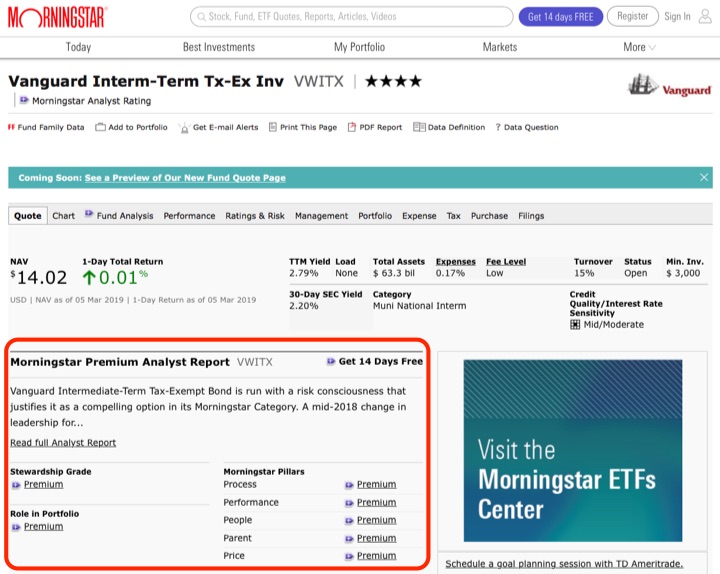
Updated 2019. Let’s say you are a DIY investor and doing some research on some mutual funds. You decide to learn more about the Vanguard Intermediate-Term Tax-Exempt Fund. You pull up the Morningstar quote pages (ticker VWITX and VWIUX) and find some useful numbers, plus an analyst report hidden to the public as a “premium” feature.
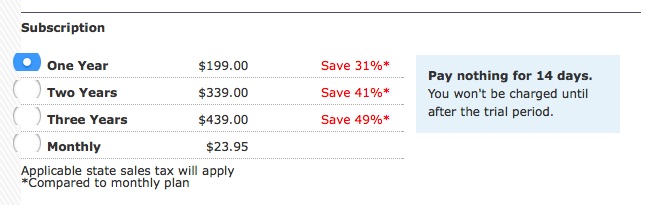
You see a 14-day free trial and after some more clicking around, you discover that a premium membership to Morningstar costs $199 a year or $24 a month.

mstar_premium2

Now, I’d like to read the rest of that analyst report, but I’m not sure if it is worth the fee. Well, you may already have access to those analyst reports through your payment of local and state taxes. Yup, the good ole’ public library!

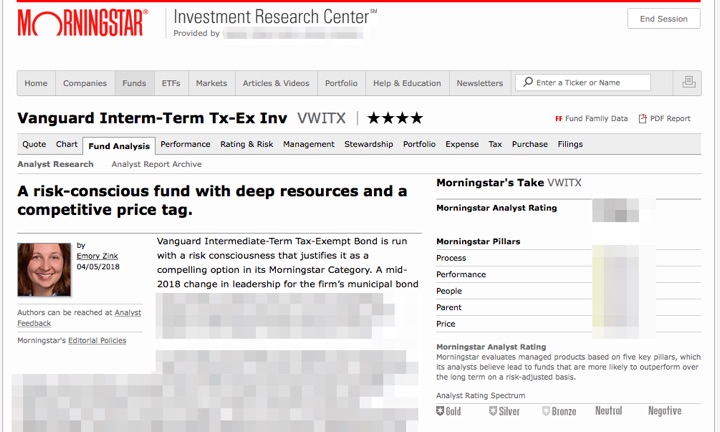
Many public libraries have a subscription to what is called the Morningstar Investment Research Center database. Most offer instant, online access via your library card number and PIN. You should look under the “Databases” or “Resources” section. Some only have a limited amount of offsite licenses, so you’ll have to either ask for a password or you’ll have to read them in a branch. Here’s a screenshot of my free report accessed from the comfort of my home, with all the good stuff blurred out of course:

I was also able to access their analyst reports for stocks, mutual funds, and ETFs, as well as the premium version of tools like Portfolio X-Ray.

Now, if your local library system doesn’t provide this access, you can also look at state libraries, university libraries, or other libraries in the region for which you are eligible. Finally, there are some public libraries that offer library cards to non-residents for an annual fee. For example, the Charlotte-Mecklenburg Library in North Carolina offers library cards by mail for $45 a year (Seniors 62+, $35 a year).

Non-residents of Mecklenburg County can obtain a Charlotte Mecklenburg Library card for an annual fee of $45.00. This amount is approximately equal to the annual property tax a Mecklenburg County resident pays to support the Library. A non-resident library card entitles you to the full services of the Library at all locations.

According to their website, they also offer access to the Morningstar database. $45 a year is still significantly less than $199 a year, and there are other library benefits like access to Libby/Overdrive eBooks and RB Digital magazines. However, I would call them to confirm before you plunk down $45 as the services they offer can change at any time.

That is just one example. Here are some more libraries with non-resident borrowing privileges, although I haven’t checked again in 2019 as to whether they offer M* access.

Bottom line. If you want to access reports and information from the Morningstar Premium section, check your local and state libraries to see if you can access it for free with your library card. Some public libraries also offer library cards to non-residents for an annual fee. However, if you are signing up for a specific service like Morningstar, I would call them up first and confirm that they are still offering it for non-resident cardholders before you pay any fees.

Best Interest Rates on Cash – March 2019

Here’s my monthly roundup of the best interest rates on cash for March 2019, roughly sorted from shortest to longest maturities. Check out my Ultimate Rate-Chaser Calculator to get an idea of how much extra interest you’d earn if you are moving money between accounts. Rates listed are available to everyone nationwide. Rates checked as of 3/4/19.

High-yield savings accounts
While the huge megabanks like to get away with 0.01% APY, it’s easy to open a new “piggy-back” savings account and simply move some funds over from your existing checking account. The interest rates on savings accounts can drop at any time, so I prioritize banks with a history of competitive rates. Some banks will bait you and then lower the rates in the hopes that you are too lazy to leave.

  • Redneck Bank offers 2.50% APY on balances up to $50,000. CIT Bank Savings Builder is now up to 2.45% APY with a $100 monthly deposit (with no balance limit). There are several other established high-yield savings accounts at 2% APY and up.
  • Got a lot of friends or followers? You can 4.30% APY on up to $50,000 for 30 days via the Empower app, plus another 30 days for each friend that you refer to the. First month is free + 11 referrals = 4.30% APY for a year.

Short-term guaranteed rates (1 year and under)
A common question is what to do with a big pile of cash that you’re waiting to deploy shortly (just sold your house, just sold your business, legal settlement, inheritance). My usual advice is to keep things simple and take your time. If not a savings account, then put it in a flexible short-term CD under the FDIC limits until you have a plan.

  • Purepoint Financial has a 13-month No Penalty CD at 2.60% APY with a $500 minimum deposit. Marcus Bank 13-month No Penalty CD at 2.35% APY with a $500 minimum deposit, Ally Bank 11-month No Penalty CD at 2.30% APY with a $25k+ minimum, and CIT Bank 11-month No Penalty CD at 2.05% APY with a $1,000 minimum. No Penalty CDs offer a fixed interest rate that can never go down, but you can still take out your money (once) without any fees if you want to use it elsewhere. You may wish to open multiple CDs in smaller increments for more flexibility.
  • Hyperion Bank has a 13-month CD at 3.20% APY ($500 minimum) with an early withdrawal penalty of 3 months of interest.

Money market mutual funds + Ultra-short bond ETFs
If you like to keep cash in a brokerage account, beware that many brokers pay out very little interest on their default cash sweep funds (and keep the money for themselves). The following money market and ultra-short bond funds are not FDIC-insured, but may be a good option if you have idle cash and cheap/free commissions.

  • Vanguard Prime Money Market Fund currently pays an 2.46% SEC yield. The default sweep option is the Vanguard Federal Money Market Fund, which has an SEC yield of 2.34%. You can manually move the money over to Prime if you meet the $3,000 minimum investment.
  • Vanguard Ultra-Short-Term Bond Fund currently pays 2.71% SEC Yield ($3,000 min) and 2.81% SEC Yield ($50,000 min). The average duration is ~1 year, so there is more interest rate risk.
  • The PIMCO Enhanced Short Maturity Active Bond ETF (MINT) has a 2.87% SEC yield and the iShares Short Maturity Bond ETF (NEAR) has a 2.93% SEC yield while holding a portfolio of investment-grade bonds with an average duration of ~6 months.

Treasury Bills and Ultra-short Treasury ETFs
Another option is to buy individual Treasury bills which come in a variety of maturities from 4-weeks to 52-weeks. You can also invest in ETFs that hold a rotating basket of short-term Treasury Bills for you, while charging a small management fee for doing so. T-bill interest is exempt from state and local income taxes.

  • You can build your own T-Bill ladder at TreasuryDirect.gov or via a brokerage account with a bond desk like Vanguard and Fidelity. Here are the current Treasury Bill rates. As of 3/4/19, a 4-week T-Bill had the equivalent of 2.44% annualized interest and a 52-week T-Bill had the equivalent of 2.54% annualized interest.
  • The Goldman Sachs Access Treasury 0-1 Year ETF (GBIL) has a 2.30% SEC yield and the SPDR Bloomberg Barclays 1-3 Month T-Bill ETF (BIL) has a 2.21% SEC yield. GBIL appears to have a slightly longer average maturity than BIL.

US Savings Bonds
Series I Savings Bonds offer rates that are linked to inflation and backed by the US government. You must hold them for at least a year. There are annual purchase limits. If you redeem them within 5 years there is a penalty of the last 3 months of interest.

  • “I Bonds” bought between November 2018 and April 2019 will earn a 2.82% rate for the first six months. The rate of the subsequent 6-month period will be based on inflation again. More info here.
  • In mid-April 2019, the CPI will be announced and you will have a short period where you will have a very close estimate of the rate for the next 12 months. I will have another post up at that time.

Prepaid Cards with Attached Savings Accounts
A small subset of prepaid debit cards have an “attached” FDIC-insured savings account with exceptionally high interest rates. The negatives are that balances are capped, and there are many fees that you must be careful to avoid (lest they eat up your interest). Some folks don’t mind the extra work and attention required, while others do. There is a long list of previous offers that have already disappeared with little notice. I don’t personally recommend or use any of these anymore.

  • The only notable card left in this category is Mango Money at 6% APY on up to $2,500, but there are many hoops to jump through. Requirements include $1,500+ in “signature” purchases and a minimum balance of $25.00 at the end of the month.

Rewards checking accounts
These unique checking accounts pay above-average interest rates, but with unique risks. You have to jump through certain hoops, and if you make a mistake you won’t earn any interest for that month. Some folks don’t mind the extra work and attention required, while others do. Rates can also drop to near-zero quickly, leaving a “bait-and-switch” feeling. I don’t use any of these anymore, either.

  • The best one right now is Orion FCU Premium Checking at 4.00% APY on balances up to $30,000 if you meet make $500+ in direct deposits and 8 debit card “signature” purchases each month. The APY goes down to 0.05% APY and they charge you a $5 monthly fee if you miss out on the requirements. Find a local rewards checking account at DepositAccounts.
  • If you’re looking for a high-interest checking account without debit card transaction requirements then the rate won’t be as high, but take a look at MemoryBank at 1.60% APY.

Certificates of deposit (greater than 1 year)
CDs offer higher rates, but come with an early withdrawal penalty. By finding a bank CD with a reasonable early withdrawal penalty, you can enjoy higher rates but maintain access in a true emergency. Alternatively, consider building a CD ladder of different maturity lengths (ex. 1/2/3/4/5-years) such that you have access to part of the ladder each year, but your blended interest rate is higher than a savings account. When one CD matures, use that money to buy another 5-year CD to keep the ladder going.

  • Hyperion Bank has a 19-month CD at 3.50% APY ($500 minimum) with an early withdrawal penalty of 6 months of interest.
  • Mountain America Credit Union has the following certificate rate: 2-year at 3.25% APY 3-year at 3.35% APY, 4-year at 3.25% APY, 5-year at 3.51% APY ($500 minimum deposit). MACU can be joined via a partner organization for a one-time $5 fee, usually right on the online application. Note: The 2-year and 3-year certificates have an early withdrawal penalty of 180 days of interest, and the 4-year and 5-year certificates have an early withdrawal penalty of a full year (!) of interest.
  • You can buy certificates of deposit via the bond desks of Vanguard and Fidelity. These “brokered CDs” offer FDIC insurance and easy laddering, but they don’t come with predictable fixed early withdrawal penalties. As of this writing, Vanguard is showing a 2-year non-callable CD at 2.60% APY and a 5-year non-callable CD at 3.00% APY. Watch out for higher rates from callable CDs listed by Fidelity.

Longer-term Instruments
I’d use these with caution due to increased interest rate risk, but I still track them to see the rest of the current yield curve.

  • Willing to lock up your money for 10+ years? You can buy long-term certificates of deposit via the bond desks of Vanguard and Fidelity. These “brokered CDs” offer FDIC insurance, but they don’t come with predictable fixed early withdrawal penalties. As of this writing, Vanguard is showing a 10-year non-callable CD at 3.25% APY. Watch out for higher rates from callable CDs from Fidelity. Matching the overall yield curve, current CD rates do not rise much higher as you extend beyond a 5-year maturity.
  • How about two decades? Series EE Savings Bonds are not indexed to inflation, but they have a guarantee that the value will double in value in 20 years, which equals a guaranteed return of 3.5% a year. However, if you don’t hold for that long, you’ll be stuck with the normal rate which is quite low (currently a sad 0.10% rate). I view this as a huge early withdrawal penalty. You could also view it as long-term bond and thus a hedge against deflation, but only if you can hold on for 20 years. As of 3/4/19, the 20-year Treasury Bond rate was 2.93%.

All rates were checked as of 3/4/19.


Discount Mags Employee Discount Sale

DiscountMags.com is running their Employee Discount Sale through Monday, March 4th at 11:59pm ET. These sales usually only run for a few days and are good for gifts or locking in a low price for a few years. Here are some sample magazine prices during the sale.

  • Consumer Reports Magazine. 1 year 13 issues for $18.75 ($1.44/issue)
  • Outside Magazine. 1 year, 12 issues for $4.66 ($0.58/issue)
  • ESPN. 1 year 12 issues for $4.54 ($0.38/issue)
  • Women’s Health. 1 year 12 issues for 4.84 ($0.48/issue)
  • Men’s Health. 1 year 12 issues for 9.56 ($0.96/issue)

Importantly, DiscountMags does NOT require auto-renewal, where they charge your credit card automatically at the end of the subscription period at a higher price. I have used them in the past. This mean you never have to call in to cancel, and makes it easier to shop for another deal later. No sales tax either.

Free Magazine Subscriptions: Money, Time, Fortune, & More

Mercury Magazines offers free subscriptions if you fill out their professional profile. If you provide accurate information, they will present trade publications that are applicable to your field, which is partially how they fund these offers. I have also read that sometimes magazines will offer deep discounts in order to improve their circulation numbers (which in turns make them able to charge advertisers more money). Availability will go in and out of stock.

Thanks to reader Hannah and SD. In my experience, this company is legit and I have gotten free magazines from them in the past. You should not have to enter a credit card (consider using an alias and temporary email as well). You will get a renewal “bill” when the subscription ends, but you can either ignore it or send it back with “cancel” written on the invoice. I would just make sure you actually want to read them, otherwise it’s a lot of wasted paper that piles up.

Andrews Federal Credit Union CD Specials: 6-Month CD at 3.25% APY

afcu_logoAndrews Federal Credit Union has a few share certificate specials that may be of interest. Thanks to reader Mark for the tip.

Each individual member limited to one Special 6-Month Certificate during the promotional period. Must be funded with new money OR the member must have a checking account, debit card, and direct deposit of $750 or more per month. All special share certificates have a $1,000 minimum opening deposit and $250,000 maximum balance. Early withdrawal penalty is 90 days of interest.

Military or federal agency affiliation is not required to become a member or open a certificate. Anyone can join via the American Consumer Council. Check out my Andrews Federal Credit Union Application and Account Opening Review for details.

H&R Block Tax Software 2018: Federal w/ e-File + State $18 (2/19 Only)

Update: This deal is back for one day again – February 19th, 2019.

The benefit of “old-school” desktop tax software is that it doesn’t require your Social Security Number and financial details to be stored in the “cloud”, a fancy word for a third-party server where it can be copied or hacked. Here’s a limited-time deal on H&R Block Tax Software 2018 (PC/Mac download or physical CD).

Amazon has H&R Block Deluxe Federal + State for $18 (list price $45), the lowest price of the year per CamelCamelCamel. This is a 24-hour “Deal of of the Day” (sorry I don’t get advance notice) and matches the lowest price ever for the 2017 version ($17.99). Download or disc. If it is out of stock, you can still buy it and lock in the price. In past years, it has gone on sale for only a few 24-hour periods at this low of a price.

H&R Block Deluxe includes guidance for stock gains and losses, home mortgage interest deduction, and other itemized deductions. Compare that against TurboTax Deluxe Download which makes you upgrade to TurboTax Premier to get guidance for stock sales and dividends. H&R Block Premium includes rental properties and self-employment. All flavors include “Refund Bonus” where you can a 5% bonus if you take your refund in the form of an Amazon gift card.

Keep in mind that for these products 5 Federal e-Files are included but State e-File is extra ($19.95 per state). I would personally just print the (usually shorter) state return out and snail mail it in if you don’t have a free State e-File option.

Start Audible Trial via Amazon Echo, Get 4 Free Audiobooks

If you have any Amazon Echo device, you can start an Audible trial by simply saying “Alexa, start my Audible trial”. This will start a 30-day free trial, but through February 8th, 2019 at 4pm PT, signing up in this voice manner will get your 4 free Audiobook credits, not the usual two. Even better, I have been an Audible trial member before, and I was still eligible for this promotion. Here are the promotion details.

Offer valid from 2/1/2019 at 12:00 a.m. PT until 2/8/2019 at 4:00 p.m. PT or while supplies last. Offer available only to new Audible customers who sign up for an Audible trial on an Alexa-enabled device through voice sign-up. You will receive a 1-month Audible free trial that includes 2 credits as well as an additional 2 bonus credits (for a total of 4 credits). At the end of the free trial, your membership will continue until cancelled at the then current full price (currently $14.95 per month) with your designated credit card or another available card on file. Cancel anytime by visiting the Account Details page.

I just signed up and saw the 4 free credits in my account online immediately. I believe that you need an active account to redeem credits, so I would recommend redeeming them all in the next 30 days if you don’t wish to keep up the membership (purchased audiobooks stay in your account forever, no matter what).

I used to buy personal finance and business books on Audible, but I disliked how I couldn’t make highlights and take notes while listening. Nowadays, I mostly listen to biographies and memoirs. My most recent purchases were The Magnolia Story by Chip and Joanna Gaines (Fixer Upper) and The Last Black Unicorn by Tiffany Haddish.