Places To Open A Foreign Bank Account To Store Gold

After my post about the Permanent Portfolio which included physical gold, a reader asked me where he could open up a foreign bank account to store gold. Well, in the Appendix of the book Fail-Safe Investing, the author did list specific banks that allow U.S. investors to open account and buy gold within them. Here they are:

Anglo-Irish Bank [Austria]
Phone: 011-431 406-6161
URL: http://www.angloirishbank.ie/

Anker Bank / BDGE Group [Switzerland]
Phone: 011-4121 321-0707
URL: http://www.bcge.ch

Canadian Imperial Bank of Commerce [Switzerland]
Phone: 011-4121 215-6087
URL: http://www.cibc.com/

UeberseeBank / AIG Private Bank
Phone: 011-411 267-5555
URL: http://www.ueberseebank.ch/

Browne makes it sound that opening an account at one of these places is as simple as opening an online account with no physical branch near you. He also states that these are either Swiss or Austrian banks, which are bound by the laws of those countries, not the countries of their parent companies. Now, I can’t attest to the accuracy of this list, as the book was last updated around 2001 and I have no personal experience with any of them. Please perform your own due diligence.

The reasons for buying gold in a foreign bank account are primarily to provide a safe store of assets in case of very unlikely (but still possible) situations like war, government collapse/confiscating of assets, or other crisis. I’m not going to participate myself as I see the risks outweigh the benefits – cost, complexity, chance of fraud or loss, etc. – but if you read some of the stories from Argentina’s economic collapse it can get scary.

As for legality, it would seem to be perfect legit. You are simply storing physical gold there. Gold does not produce dividends or interest, so you’d only be liable for taxes if you sold them at a profit.
Brightscope: How Does Your Company’s 401k Plan Compare?

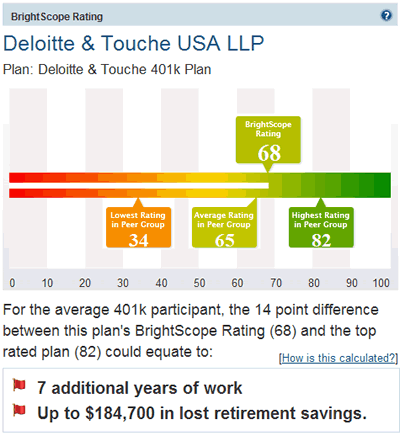
Even though most people I know are too scared to even look at their 401(k) statements right now, have you ever thought about how well your company’s plan stacks up to other similar companies? The problem is that 401(k) plans lack transparency. What if every company had to publish their company match, fees, revenue sharing (*cough* kickbacks), investment choices, and vesting schedules? That would certainly produce competition and peer pressure to make better plans.

This is what the website Brightscope is trying to change. Just type in your company name and see an overall rating based on the components I listed above, also some other interesting details like average account balance. As they point out, a poorly designed plan could be costing you hundreds of thousands of dollars over time – or put another way the equivalent of an extra decade of work!

According to their site, BrightScope is the only 401k analytics firm that is truly independent and does not accept compensation in the form of revenue sharing from mutual fund companies or plan providers. This should make them objective. Found via Capital Ideas.

A related site is 401khelp.com, which covers less companies but does offer more insights and opinions on the plans it does cover. Not sure how often it is updated, though.

Is Your State Prepaid Tuition 529 Plan Really Safe?

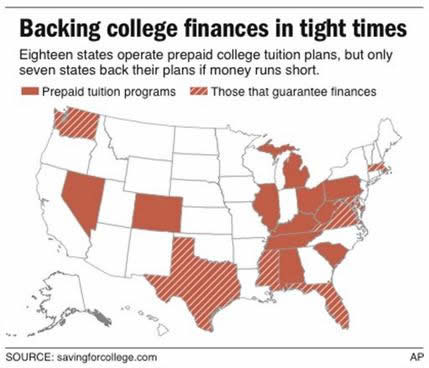
I have thought about signing up for a prepaid tuition plan, as I am leaning towards conservative investments for college savings. Lock-in tuition now, and don’t worry about future hikes. However, it appears that even though 18 states have pre-paid tuition plans, only seven of them actually guarantee them – Florida, Maryland, Massachusetts, Mississippi, Texas, Virginia and Washington. (The image below says six, but the article was corrected later to add Virginia.)

Currently, the plan hurting the most publicly is from Alabama, called the Prepaid Affordable College Tuition Plan (PACT). The plan’s asset value dropped from $899 million in September 2007 to $463 million at the end of January, nearly a 50% drop. Why? Because they invested over 70% of their assets in stocks, and also assumed a consistently high rate of return:

According to an actuarial report on the fund filed by the state in January 2008, the fund’s managers then as­sumed a rate of return of about 8 percent until 2013, and 8.5 percent after that. That report also found that the fund’s liabilities exceeded its assets by about $20 mil­lion.

According to fund docu­ments, 42 percent of its assets, as of March 2008, were invested in large market capi­talization domestic stocks, 9 percent in small market capi­talization domestic stocks, 21 percent in international stocks, 26 percent in domestic fixed-income securities and 2 percent in cash.

48,000 families who were invested in the plan got letters earlier this month that the plan may have trouble meeting its future obligations. To make things worse, their brochures actually once stated that it was guaranteed by the state of Alabama, until later on it was found that wasn’t possible due to state law.

I don’t know about you, but isn’t a guaranteed return the entire point of prepaid tuition plans? I commit money now in order to know that I can afford tuition for my child in the future. I give up the chance for higher returns elsewhere. Otherwise, it’s like heads they win, tails you lose. High returns, they keep the difference. Low returns, they say “oops we got no money”.

Also reported to be in trouble are the programs in Tennessee, South Carolina, West Virginia and Washington. Finally, I also found this article which stated that although guaranteed, the Texas plan had a projected shortfall of $206 million.

Jim Cramer Sputters On The Daily Show

The entire Jim Cramer interview with Jon Stewart last night are now up on TheDailyShow.com. It’s split up into a few parts, here is the first one:

It was kind of fun to see Cramer squirm a little bit (deny everything!), but I think most experienced investors would find very little surprising out of it. Making fun of CNBC and Cramer is like shooting fish in a barrel. Cramer should have known they would dig up this video of him mocking the SEC. I’m surprised he showed up at all. He definitely took one for the CNBC team.

Even Stewart admits Cramer isn’t the real problem, which is that the purpose of 99% of the financial industry is not to make you rich. It’s too extract money from you, while you think they might make you rich. From brokers to hedge funds to bloated 401(k) plans. Cramer was worth millions before starting Mad Money, guess where that money came from? And CNBC is part of that machine. Hopefully more people realized it after tonight.

CNBC is financial porn. It’s air-brushed to look better than reality, and is scripted for your entertainment. Do people really want to watch responsible reporting on CNBC? Invest in index funds. Don’t trade too much. Don’t look at the Dow ticker every five minutes. I’m not so sure that would sell. Still, will TDS kill Mad Money like they nuked Crossfire? That would be impressive.

MicroPlace Review: Earn a 5% Return and Help Fight Poverty Too?

“A billion people around the world work hard every day to lift themselves out of poverty. They don’t want your charity. They want your investment. Invest today, earn a return, provide them with a livelihood.” – Microplace.com homepage.

Sounds pretty good, huh? Microplace is owned by Ebay, and is an SEC-registered broker of microfinance securities to individual investors. Loans are classified by level of poverty, financial return, length of investment, and geographical location. Recently, they got my attention by offering a 2-year loan with a promised interest rate of 5% per year, and a 4-year loan at 6%.

What is microfinance?
Microfinance is the supply of loans, savings, insurance and other basic financial services to low-income households and businesses, usually in areas where people don’t have access to formal banks. Microcredit is the extension of very small loans (microloans) to these poor entrepreneurs. A big name in this arena is the Grameen Foundation.

Tell me more about this 5% return…
Here is the loan listing page, and here is a link to the long 63-page prospectus for these Global Poverty Alleviation Notes (how’s that for an investment title?). I have looked through it, but haven’t digested it all. They are offered by Micro Credit Enterprises (MCE), a 501(c)(3) nonprofit organization. MCE seems to focus on women entrepreneurs, which have made up about 90% of their borrowers. They seem to participate in a variety of countries on 4 continents, from Armenia to Bolivia to Cambodia.

These notes are not a mutual fund, and is not FDIC or SIPC insured. These are unsecured debt obligations, with partial backing of “philanthropic guarantors”. Basically, wealthy individuals and/or groups promise to repay parts of this loan if there are enough defaults. The details are a bit vague, but there seems to be a networked agreement across multiple guarantors. However, risks definitely remain.

The actual interest charged to local microfinance institutions (MFIs) are stated to be from 8-10%. The rates paid by actual individuals are not stated, but can be as high as 30%. But these are often short-term loans to people with no collateral and few alternatives. The historical repayment rate is listed to be 96%.

What about MicroPlace vs. Kiva.org?
Kiva.org also lends small amounts to low-income entrepreneurs in the developing world. However, Kiva currently does not offer interest to lenders since it is a non-profit organization and is not registered with the SEC. Also, it has more of a person-to-person lending structure where you can choose the specific person you wish to lend to. However, I have read that Kiva is trying to offer interest in the near future.

Are you going to invest?
I’ve put some money to “work” at Kiva already, and my personal repayment rate on my completed loans from Kiva has been 98% so far. Given that I am still not very familiar with these investments, I still can’t treat the 5% Microplace note as a reliable investment. However, I am still leaning towards putting a chunk of money into it, because I do think significant principal loss is unlikely, and I want to give them a chance. If it works out, I think microfinance would really take off if there was also a financial benefit to investors.

Chart: Historical Stock Market Comebacks After Crashes

Here’s another chart to ponder, found as part of an Emergency Physicians Monthly article about investing during recessions. It shows what has happened in the past to the S&P 500 five years after a significant market decline.

Or course, you should also remember that if you experienced a 50% drop, mathematically you’ll need a 100% increase to get back to your original point. But your money invested after and during the drop will have done much better.

From the conclusion of the article:

While it’s tempting to shift your portfolio during economic crises, the noise in the data, the lag time between the beginning of a recession and its announcement, the potential false signals, and the historical market returns during recessions suggest that it’s difficult to time the market successfully. With some historical knowledge, we can sail through future stormy markets a bit easier.

Via EmergDoc at Bogleheads.

The Permanent Portfolio Asset Allocation: Fail-Safe Investing by Harry Browne

Another non-mainstream book that I’ve been reading is Fail-Safe Investing by the late Harry Browne. His conservative investing philosophies appear to have initially been in vogue during the 1980s, a period of high inflation. These days, with stocks earning basically nothing over a decade, it seems to be making a comeback. In the book, he recommends having two portfolios. For money that you will need for things like retirement, you should create a Permanent Portfolio. For money that you won’t need, you can keep a separate Variable Portfolio that you can speculate with.

The Permanent Portfolio
In general, Browne does not believe it is possible to predict the future, and trying to do so is futile. Therefore, he went out to design a Permanent Portfolio that maintains your purchasing power over all time horizons, both long and short, and also independent of future market conditions.

Here are the four asset classes he believes in, which correspond with four possible modes of the market:

The idea is that no matter what is happening, at least one of the four areas will be doing well, and probably well enough to create a positive total return. For example, in extreme inflation both stocks and bonds might be doing bad, but gold will likely be doing great. His proposed asset allocation is simply an even split between them:

From 1970-2003, according to his website, this mix of asset classes has earned about 9.5% annualized, with a lot less volatility than I would have guessed. This is before expenses.

Permanent Portfolio Mutual Fund (PRPFX)
There is also a managed mutual fund that follows this strategy, although not exactly. It is run by the Permanent Portfolio Family of Funds and the ticker symbol is PRPFX.

Very recently it hasn’t been doing as well. The one-year trailing return is -20.60%, while the Vanguard S&P 500 Index fund has a trailing return of -47.50%, and the Vanguard Target Retirement Income fund has a trailing return of -16.90%. But over the last 5 and 10 years, the fund has beaten out most balanced mutual funds of stocks/bonds.

Food For Thought
I’m not advocating this approach by any means, but I found it intriguing for a variety of reasons. First, it still somewhat follows modern portfolio construction techniques by diversifying across multiple asset classes that are not strongly correlated with each other. Most portfolios these days are only split between stocks and bonds. The stocks part may be split many ways (small cap, international, etc.), but with correlations increasing across the board, that hasn’t really helped add much diversification. Maybe we all need more cash and direct inflation protection.

Second, the Permanent Portfolio is still a passive investment style that does not try to predict the future, time movements in and out of the market, or pick the best mutual fund or hedge fund manager. No stock newsletter or trading systems. You just rebalance across the four broad asset classes if they get lopsided.

There are some extreme notes of caution in his writing as well. For example, the gold is recommended to be kept in physical form, and outside of the United States. The idea being that if our dollar (fiat currency) fails, the U.S. government may also be in trouble. Gold and other property might be confiscated. Browne thinks everyone should have a foreign bank account. (My biggest hurdle is buying gold, personally. I’d rather invest in a commodity like oil or even rice than a shiny soft metal.)

More Information
There is some good discussion on this topic in this Bogleheads post, and the Crawling Road blog has several posts exploring this as well.

March 2009 Financial Status / Net Worth Update

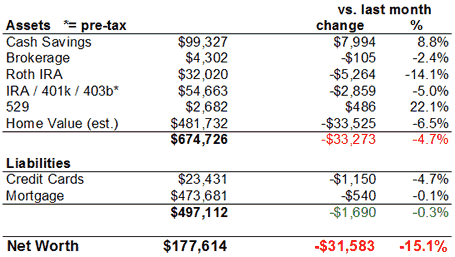
Net Worth Chart 2009

Time for another super-happy-fun net worth update…

Credit Card Debt
For newer readers, don’t worry. In the past, I have been taking money from credit cards at 0% APR and immediately placing it into high-yield savings accounts or similar safe investments that earn 5% interest or more, and keeping the difference as profit. I even put together a series of step-by-step posts on how to make money off of credit cards this way. However, given the current lack of good no fee 0% APR balance transfer offers, I am just waiting to pay off my existing balances.

Retirement and Brokerage accounts
Unless you’ve been completely devoid of human contact for the last few weeks, you know the market is in the dumps. I really don’t have much market commentary to make, besides the fact that I still intend to keep investing. I’ve been trying to cut back on the CNN/CNBC-types of financial news actually and focus more on things I can change, which as a result has helped keep me a bit more optimistic.

Cash Savings and Emergency Funds
Our emergency fund has increased a bit, but this snapshot was taken before we each put $5,000 into our 2008 IRA contribution. So really it remains at about a year of our current expenses.

Home Equity
This is where most of this month’s drop comes from. I used the same internet valuation tools as before – Zillow, Cyberhomes, Coldwell Banker, and Bank of America (old version) – but while most of them continued their gradual decline, the Coldwell Banker estimate dropped by over $140,000 in one month! After taking off 5% to be conservative and 6% for expected real estate agent commissions (11% total), the overall average estimate dropped by $34k. Well look at that, I am nearly “underwater” on my house despite putting 20% down a year ago. Oops.

2008/2009 NonDeductible IRA Contribution Decisions

With the market in another funk this week, I was reminded that I had until April 15th to make my IRA contributions for 2008. It could get worse before then, or it might bounce up again, I have no predictive powers either way. I don’t like to be wishy-washy, so we went ahead and each invested $5,000 to a non-deductible IRA today.

Background
A nondeductible IRA is the same as a Traditional IRA, except that your income is too high so you can’t deduct the contribution. If you haven’t maxed out all your other options like a deductible Traditional IRA, Roth IRA, 401(k), or 403(b) plan, you should put your money towards those first. This option is mostly for those with no other better options.

Why?
So if you don’t get the tax deduction, what’s the point? The most appealing is that in 2010, unless the law is changed, you can start rolling over your non-deductible IRA into a Roth IRA with no income restrictions. I am starting to like my chances, since we are only ten months away from 2010 (I plan to convert right away) and I’m sure with the current deficit the government would like to collect all the tax revenue it can now instead of later. If it looks good, I’ll probably make my 2009 contribution in December (after making sure we don’t otherwise qualify) and convert that to a Roth too.

The second reason is that the after-tax returns might be higher if you invested in tax-inefficient products like bonds, commodities, or REITs.

Contribution Limits
The contribution limits are $5,000 for both 2008 and 2009. If you are age 50 or older, you can contribute another $1,000 that year.

What Did I Buy?
My portfolio is getting out of whack right now, so I bought what I need to bring it back into my desired asset allocation. I purchased $3,000 of an REIT fund (VGSIX), $2,000 of a US Small Value fund (VISVX), and $5,000 of an Emerging Market fund (VEIEX). We’re still making regular contributions to our 401ks, which contain our US and International “Total Market” funds.

Conservative 529 Options: CollegeSure Tuition-Indexed CDs vs. Inflation-Protected Bonds (TIPS)

Recently, I have been exploring the “safe” options inside various 529 plans. This would be a good choice for those who want to feel like they are making continuous gradual progress and avoid the swings of the stock market, similar to what is offered in pre-paid tuition plans in certain states like Florida. The problems with those plans are that they are usually limited to residents only, and your kid often has to go to one of the in-state schools to get the guaranteed tuition benefit. One unique pre-paid type of plan is the Independent 529 plan, but it is also restricted to certain schools (mostly private liberal arts colleges).

Next, there are plans with guaranteed-return funds backed by insurance companies, or certificates of deposit from banks. However, these types of investments are still subject to inflation risk. If a period of high inflation occurs, your returns could be squashed. Even with current deflation concerns, given current government policy I think high inflation in the future is still a potential concern.

So what’s left?

CollegeSure Tuition-Indexed CDs

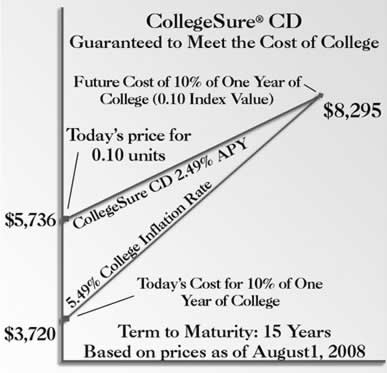
Offered by the College Savings Bank, these are FDIC-insured certificates of deposit which offer an interest rate linked to college tuition levels. The CollegeSure CD earns an annual percentage yield (APY) over the life of the investment that is 3.00% less than the college inflation rate. (For a while, this margin was only 1.5%.) These are only available through either the Montana or Arizona 529 plans, but you can use the proceeds towards a school in any state.

The CDs are available in maturities ranging from 1 to 22 years, so you are basically pre-paying tuition at a fixed premium. Here’s an illustration from their site:

Changes in costs are tracked by the Independent College 500 Index (IC500), which is derived from the average tuition plus housing costs of 500 private colleges. Over the last 10 years, the college inflation rate has been 5.4% annualized, Over the last 20 years, it was 5.7% annualized. Of course, this is just an average and it both excludes public universities and ignores the average aid packages given out, but it seems to be a reasonable index.

Treasury Inflation-Protected Bonds

Treasury Inflation-Protected Securities (TIPS) are bonds that promise you a total return that adjusts with the CPI index for inflation. Very generally, it works like this: if the stated real yield is 2% and inflation ends up at 4%, your return would be 6%. TIPS are issued and backed by full faith of the U.S. government. Right now, they are only available in 529 plans in the form of mutual funds like the Vanguard Inflation Indexed Bond Fund. Some plans offer them as part of their age-based investment mixes, but a few offer them as standalone investment options. The Ohio 529 plan ($25 bonus) looks to offer the cheapest option, with an annual expense ratio of 0.32%.

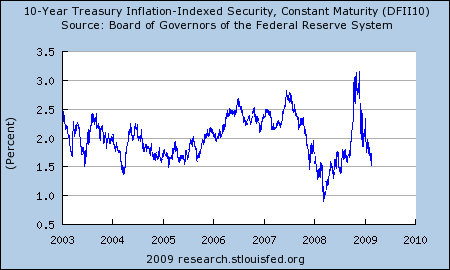
The actual real yield you get varies, but here is some historical market data for a maturity of 10-years, which is close to the average mutual of the Vanguard fund:

To make a rough estimate, I’d say you average about 2% real before fees. After about 0.3% in fees, you’d end up with 1.7% + inflation.

Inflation is tracked here by the CPI-U (Consumer Price Index for All Urban Consumers), a number tracking the price of a wide basket of goods and services. From January 1999 to January 2009, the annualized inflation rate was about 2.5%. Over the last 20 years, it has been about 3.0%.

It does not focus on college tuition, or even include it explicitly as far as I know. However, there should be some correlation to college tuition.

So which is better?

Would you rather have:

Overall Inflation plus 1.7% or College Inflation minus 3%

If we use the average numbers from the last 10 years, the CollegeSure CD would have earned roughly 2.4% annually and the TIPS fund would have earned roughly 4.2% annually. This would seem to tilt in favor of TIPS, but there are two problems:

  • Unlike with the CollegeSure CD, you can’t match the maturity of the TIPS fund with your goals. It’s more or less fixed at 10 years forever. For example, if you only have 2 years left until college, you might want to start moving money out because you can still lose principal in the short-term due to interest rate fluctations.
  • If the rate of college tuition rises significantly higher than overall inflation by greater than 4.7% a year, then the TIPS fund would fall short.

One could always split money between the two as well, but for not I’m just investing in the TIPS. College inflation may continue to outpace overall inflation (or it may not), but I doubt it will do so by more than 4.7% a year for an extended period. Also, I believe that investment options in 529s will only improve with time. One day, I expect to be able to buy individual TIPS to more closely match maturities with our time horizon.

This is not to say I’ll necessarily be 100% TIPS – I’ll most likely throw a bit of stocks in there – but I think it’ll be a big component of our plan.

Ohio CollegeAdvantage 529 Plan: Free $25 Opening Bonus

The Ohio CollegeAdvantage 529 Savings Plan is again offering a $25 refer-a-friend bonus if you open an account and deposit at least $25 by May 31, 2009. You can be a resident of any state, and there are no application or annual fees.

First Impressions
My own account with them has been open for a few months, and so far I am quite impressed with the Ohio plan. The website itself is functional and fast, there are a variety of investment choices (cash, index funds, active funds), they are upfront with the fees, and the expenses are very competitive – either the lowest or near the lowest in the nation. The only bad thing I can think of is that every time I make a purchase I get a snail-mail confirmation with no paperless option, which seems wasteful. A more detailed review is upcoming.

I have gotten the $25 bonuses plus several referrals, with no complaints from the people I referred. I have also started an auto-debit from my checking account for $50 a month. Right now, half of my 529 is in the Vanguard inflation-protected bond fund. This is an investment option that is unavailable in most state plans. I feel that since college is only at most 18 years away with a big lump-sum payment, I would prefer less volatility while marching towards that goal. This is in contrast to saving for retirement, where I currently have 35 years until I turn 65, and hopefully another 20 years after that as well.

Referral Bonus Instructions
Both the referred and referree get $25, and I’d love for you to help fund my kid’s college dreams. 😀 Here’s how:

  1. You can enroll online or via mail. The online process was quick and easy, and I didn’t have to mail in anything.
  2. The first step is to input your personal info and choose a login/password. Next, you’ll verify your e-mail and complete the application.
  3. After that, you’ll choose your funding amount and select an investment fund. Your initial deposit must be a least $25, and is funded using the account/routing numbers of your bank account. At the bottom, you will need to enter a referral code to get the bonus. Enter *.
  4. In 1-3 days, your initial deposit will be sucked out, and in 5-7 business days you will get your $25 bonus. The $25 will be deposited directly into the 529 account, and will be invested in the same thing as your initial deposit.

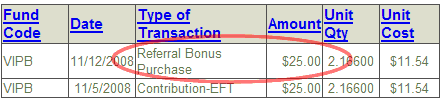
I opened the account back in November and got my $25 bonus successfully and as promised:

* Javascript is required. If you can’t see any numbers, please use 2439350.

Don’t Be Stupid When Chasing Higher Yields

One of my biggest financial pet peeves is when people refuse to realize the connection between return and risk. Whenever you see an investment that offers a “guaranteed safe” or “insured” return that is significantly above what an FDIC-insured bank can offer, it’s safe to assume that your risk has gone up.

The latest example is the Stanford Investment Group, which the SEC accuses of massive investment fraud:

SIB has sold approximately $8 billion of so-called “certificates of deposit” to investors by promising improbable and unsubstantiated high interest rates. These rates were supposedly earned through SIB’s unique investment strategy, which purportedly allowed the bank to achieve double-digit returns on its investments for the past 15 years.

Do the math, people! Double-digit returns + a bank based offshore in Antigua + no FDIC-insurance = Either fraud or risk to principal. And remember, in schemes like these the interest is always very reliable, coming every single month like clockwork…. until one day it doesn’t. Been that way since the real Ponzi.

And there are plenty more to replace SIG, just Google “high yield CD”. Back in 2005, there was American Business Financial Services, which imploded. Now there is Millennium Bank (based in St. Vincent), Zannett Notes, and CPS Notes. All offer well over 8% interest.

Now, I am not accusing any of these companies of fraud. There is a difference between fraud and plain old credit risk. In both bases, you might manage to cash out before things fall apart, but there’s also a real chance you might never see your money again.

But especially in times of low interest rates, people start to look for just a bit more yield. Even SmartMoney magazine has gotten caught up in the act. Check out their cover this month.

A sure 7%? What, from buying shares of stocks with temporarily jacked-up yields like Altria or Vodafone? How about a highly speculative 7%? Bank of America had a really nice dividend yield as well once upon a time… before it got cut to a penny. Dow Chemical just cut its dividend for the first time in 100 years. Add in the fact that your share price could drop as well, and I’d keep your emergency fund far away from these stocks.