Chart Comparing Historical Bear Market Periods

Via Calculated Risk, Doug Short has a series of charts comparing the movements of various bear markets. The one below compares the Dow starting in 1929 (Great Depression), the S&P 500 in 1973 (Oil Crisis), S&P in 2000 (Tech Crash), and the current bear market starting in 2007 (do we have a moniker yet?).

Click on image for larger version.

I wouldn’t read too much into them, although I do have a thing for pretty charts. 😉 If anything, I suppose we should be prepared for at least another year of fun:

Reinhart and Rogoff mention a three-and-a-half-year average peak to trough decline in equities for past financial crises. As of today, the market peak of October 9, 2007 was about 16 months ago — which would put us well shy of the half-way mark for the average crisis.

Reader Questions: Lending Club Peer-to-Peer Lending Q&A

Back in December, I wrote a detailed review of the “new” LendingClub, a site which lets individuals lend money directly to other individuals and earn 7-20% interest (depending on credit scores). Many of you sent additional questions about LendingClub, and Rob Garcia, Director of Product Strategy, was gracious enough to answer them. I want to thank Rob for his time and candidness, as some of the questions were quite blunt. 🙂

Some of my readers are concerned about your company being in its early stages. What would happen if Lending Club goes bankrupt? What would happen to our notes in that scenario? Would we be unsecured creditors of LC?
Yes the notes are unsecured obligations of Lending Club. That being said, we’ve structured the program in a way that makes it as “bankruptcy remote” as possible: all lender funds are kept in a trust account that is not part of Lending Club assets, and therefore would be off-limit to other Lending Club’s creditors. We also have a back-up servicing agreement in place with Portfolio Financial Servicing Corporation (www.pfsc.com), one of the largest loan servicer in the country, who will service the loans should Lending Club be unable to do so.

Any insight to why the income and net worth requirements are somewhat restrictive for lenders?
This comes from state regulations; most states impose financial eligibility requirements for clearing new types of securities offerings. We are hoping that some of these requirements will be lifted as the program continues to build its track record. As pointed out in a recent Javelin study, the average annual return for Lending Club lenders has been 9.05% over the last 18 months, with little volatility. If we continue showing that sort of track record over a long period of time, we hoping the financial eligibility requirements will become unnecessary.

Do you expect to add more eligible states soon?
Yes. We are actively pursuing registration in states where the offering has not yet been cleared. Note that residents of most states who haven’t been cleared for the main offering can already buy notes on the Note Trading Platform from FOLIOfn.

Can I just take the current $25 bonus and run? [See below]
You certainly can, although we’d love you to try Lending Club.

Is there plans to fund via PayPal or some other more instant form of funding? I saw a loan I wanted last week, but had to wait 4 days for my bank deposit to clear and missed it.
We do offer this capability, but only to lenders who do not have a linked bank account. Once a bank account has been linked, it is a lot more cost-efficiently (although admittedly longer) to move funds by ACH.

Any plans to pay interest on idle cash?
Not immediately. Believe it or not, there are lots of regulatory challenges for a non-“deposit taking institution” like Lending Club (basically not a bank) to pay interests on idle funds. It is in our interest to do so to attract more lenders, so we are looking for a way around (along the same vein as what PayPal is doing) and are confident it will come through.

I have several old loans from Lending Club still in repayment. However, after the new regulations, I am no longer eligible to lend due to both my state of residency and income. Any idea what might happen to my loans? I don’t want to ask Lending Club in case they close my account…
No worries; we’re not closing anybody’s account! All “old” loans continue to be serviced and all lenders get their monthly payments credited to their account irrespective of their state of residence. The new restrictions only restrict the ability to buy new notes.

— End of Interview —

Follow-up Updates and Comments
Here is a excerpt from the Executive Summary of the noted Javelin study, which notes both pros and cons:

If an individual had invested $10,000 on June 1st, 2007 in a representative group of loans on the site, the value of that individual’s account at Lending Club would have grown to $11,594 by November 2008 (assuming reinvestment of payments received). That return would have outpaced other common investments or indexes such as the Standard & Poor’s 500 Index ($6,289), the Nasdaq Composite Index ($6,605), 1-year CDs ($10,678) and 6-month Treasury bills ($10,501). This comparison factors in Lending Club’s 1% service charge but does not include fees and other transaction costs for the other investments. This comparison does not factor in differences in liquidity between Lending Club notes and the other investments or indexes. Notably, Lending Club notes can only be sold through the Note Trading Platform that was made available recently (on October 14, 2008) and there is no assurance that liquidity will develop on that platform.

Over the last few months, we have seen credit card companies canceling inactive cards, reducing credit limits, and raising rates on lots of borrowers. As a result, I have definitely seen a rise in loan volume at LendingClub.

As a lender, I’ve tried to take advantage by slowly investing in lots of small $25 loans to folks with squeaky-clean credit histories and good job histories, and now have about $1,000 lent out. I understand there is risk involved, and will report my results. I do wish the PayPal funding option was always available, as the convenience would be great. Also, another reader pointed out that if they accepted PayPal, one could fund with a credit card for the rewards.

If you are interested in lending, you can still use this special $25 lender sign-up link to get a free $25 to try it out with no future obligation. There is no credit check and you don’t have to deposit anything. After you are approved, the $25 should show up in your account balance, and you can lend it out immediately.

401(k) Failures: Over Last 20 Years, The Average Investor Did Worse Than Cash

These days, not too many people are singing the praises of their 401(k) plans. They have been called failures, with many having hidden fees and poor investment choices. But I was reading a Scott Burns article that had an different take on things: 401(k) plans are a miserable failure because most of us make bad choices.

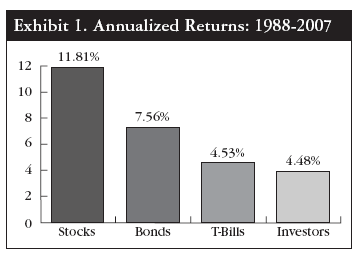
Here the evidence: For the 20-year period from 1988-2007, the S&P 500 had annualized returns of 11.81%, while investment-grade bonds returned 7.56%. But what did the average mutual fund investor return? Only 4.48 percent. That’s worse than super-safe Treasury bills, which managed 4.53% annually!

This data is actually pulled from the “DALBAR study”, which I have seen referenced before. DALBAR is a research firm that provides research for financial professionals about investor behavior. Each year, they publish a report called the Quantitative Analysis of Investor Behavior where it compares the returns from average individual investors to various benchmarks. The news is not encouraging…

For years, mutual fund companies have been marketing their products using the long-term results of a lump-sum investment. The results typically show that the funds’ annualized returns have outpaced their designated benchmarks and inflation, implying that if investors purchase fund shares and hold them for similar time periods, they may achieve similar results.

Reality, however, is quite different from this scenario – and it’s not the fault of the fund companies. In this year’s Quantitative Analysis of Investor Behavior, DALBAR illustrates how investors are often their own worst enemies. By examining actual fund inflows and outflows during the 20-year period ended December 31, 2007, the analysis finds that investors often buy and sell at the worst possible times – and achieve commensurate returns.

As Burns quips, investors as a whole do seem have a great skill for “methodically buying equities when they were up and selling when they were down.” 🙁 This sentence summarizes it best:

Investment return is far more dependent on investor behavior than on fund performance. Mutual fund investors who hold their investments typically earn higher returns over time than those who time the market.

Added: I’m not really trying to bag on 401ks, I’m trying to focus on the fact that tying to time the market has been very destructive for investors. For a related parable, read their story of Quincy and Caroline.

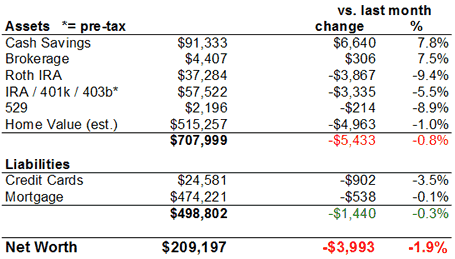
February 2009 Financial Status / Net Worth Update

Net Worth Chart 2008

I pretty much have a general feeling of malaise right now. Hiring freeze at one job, big group meeting about how “we don’t have to worry about layoffs… right now” at the other. And now it’s time to look at my incredibly shrinking net worth… I know I have it really good in general, but let’s just make this quick. 😉

Credit Card Debt
I do not carry consumer debt. In the past, I have been taking money from credit cards at 0% APR and immediately placing it into high-yield savings accounts or similar safe investments that earn 5% interest or more, and keeping the difference as profit. I even put together a series of step-by-step posts on how I make money off of credit cards this way. However, given the current lack of good no fee 0% APR credit card offers, I am just waiting to pay off my existing balances.

Retirement and Brokerage accounts
The media has pronounced last month as the “Worst January Ever” for the Dow (-8.8%) and the S&P (-8.6%). The value of our passively-managed portfolio shrank accordingly. Our 401(k) contributions for the month and new company match got swallowed up instantly by losses. Same old, same old.

Cash Savings and Emergency Funds
Our net cash balance (aka emergency fund) increased a bit, and remains more than 12 months of our total monthly expenses. Let’s hope we don’t need it.

I intend to contribute again to a non-deductible Traditional IRA for 2008. My reasons are basically the same as last year: Should I contribute to a non-deductible IRA? The limits for Roth conversions are removed in 2010, which is just around the corner.

Home Equity
I continue to estimate our home value using internet tools, starting with the average estimates provided by Zillow, Cyberhomes, Coldwell Banker, and Bank of America. After taking off 5% to be conservative and 6% for expected real estate agent commissions (11% total), I am left with $515,257.

I need to work out the last few kinks in my new long-term goals, in order to regain some focus. You can see our previous net worth updates here.

Zecco Brokerage Raises Minimum Requirements For Free Trades

Zecco Trading announced on Friday via e-mail that they will be raising the minimum requirements to receive free trades on their accounts starting next month. Thanks to everyone who also alerted me.
Dear Zecco Trading client,

I’m writing to tell you that as of March 1st, 2009, we’re increasing the minimum level of assets needed to earn 10 free trades per month to $25,000. We’re also adding a new way to get free trades: customers who make at least 25 total trades per month will also qualify for 10 free stock trades per month.

Bummer! The change is blamed on current economic conditions, which is understandable, but also I fear for their community model. Their vibe up until now has seemed to include a lot of younger investors who are just starting out. $25,000 is a pretty high hurdle.

The upside is that since their last fee schedule change, their customer service and website has indeed improved over time. I just feel like they are split between customers like me who just want a bare-bones free system, and those who want “the kitchen sink” and free trades. I guess the latter isn’t realistic.

So now what?

Exploring Staying With Zecco

Small balances. If you trade less than 25 times per month, you pay $4.50 per trade. Still small, but not free. 🙁 If you make 25 trades per month at $4.50, but get 10 of them free, that works out to an average of $2.70 per trades. This isn’t the worse deal out there, but at this price point there are closer competitors now (see below).

Move assets over. The $25,000 applies to net assets. So if you have $25,000 in ETFs or other stocks in another brokerage that are idle, you could move it over and just leave it at Zecco to qualify for the free trades. One possible idea is to invest in a short-term bond ETF like PVI to maintain the minimum.

Exit Plan Options

Liquidate and close out your zero balance account. To avoid the $50 ACAT transfer-out fee for moving your entire Zecco portfolio somewhere else, you can sell all your positions, transfer out the cash, and then have them close the account. During February you’ll still get 10 free trades if you reach a $2,500 net asset balance anytime during the month. You may have to worry about realized tax gains and/or losses with this method.

Transfer to another brokerage with fee rebates. Several other brokers offer a rebate of the ACAT transfer fee if you move enough assets to their brokerage. Unfortunately, most brokers that I have found set the minimum transfer amount to be of $25,000 in assets (FirsTrade, SogoTrade, Scottrade).

However, TradeKing brokerage will credit your transfer fees if you move just $2,500+ over to them. They offer $4.95 trades with no minimum balance requirement. For more details, see my TradeKing review here.

TradeKing will credit your account transfer fees up to $150 charged by another brokerage firm when completing an account transfer for $2,500 or more. Offer applies to new non retirement accounts funding for the first time.

Other Deep Discount Alternatives
Here are some more brokers with rock-bottom commissions. Rates are for non-IRA accounts.

Wellstrade, the brokerage arm of Wells Fargo, offers 100 free trades per year if you have a net asset balance of $25,000. However, you’ll have to open up a PMA checking account and keep some activity going in their every month or so. If you don’t, they’ll close the checking account and you’ll lose the 100 free trades.

Just2Trade offers $2.50 trades with a $2,500 minimum account balance. It is targeted at “experienced investors”. To get approved for an account, you need to state that you have 2+ years of investing experience and know how to use margin, amongst other things. Electronic statements are free, paper ones are $5 per month.

SogoTrade has $3 trades with a $500 minimum. Electronic statements are free, paper ones are $5 per month.

Of course, low commissions shouldn’t be the only consideration for a brokerage firm, it just depends on what you are looking for. I may need to move my “fun money” account elsewhere now.

What’s Inside Your Target Date or LifeCycle Retirement Fund?

I ran across a BusinessWeek article today about retirement plans in 2008 from top 401(k) provider Fidelity Investments. It stated that although the average retirement account balance fell a whopping 27% to $50,200 last year, people actually contributed slightly more in 2008 than in 2007.

This quote also caught my eye:

Are investors making a lot of changes within their retirement accounts?
Some 60% of plans administered by Fidelity in 2008 utilized a lifecycle fund as a default investment option, that’s up from 38% in 2007. What happens in a time of short-term volatility is that investors in these funds are not switching. Only 1% lifecycle fund investors made a change compared to the overall average to 6.1%.

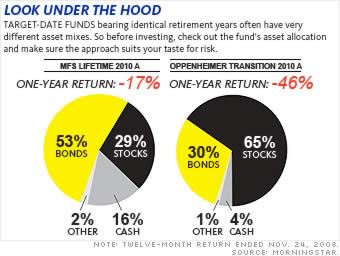
Makes sense overall. Investors in these types of funds want all-in-one simplicity. However, almost every company these days offer a lifecycle retirement fund. And most 401(k) investors can only invest in the one that happens to be in their plan. Check out this Money magazine example of the possible extremes out there for a mutual fund designed for a worker retiring in 2010:

On the aggressive side, the Oppenheimer Transition 2010 Fund (OTTAX) has 65% in stocks for someone on the verge of retirement, resulting in a 46% loss in 2008. On the conservative end, this AP article has an even better example – The DWS Target 2010 Fund (KRFAX) only has 18.1% in stocks and only had a 3.6% loss in 2008. The rest was in cash and bonds. (Of course, it also had a fat front-end load and is closed to new investors.)

That is some pretty stark contrast. Do you know what is inside your target-date fund? Dig up the ticker symbol, plug it into Morningstar, and scroll down to “asset allocation”.

What about the big boys like Vanguard?
Even the most highly-rated mutual fund companies don’t agree on the asset allocation for each time horizon. See how Vanguard, Fidelity, and T. Rowe Price differ in their target-date retirement funds.

2009 401k/403b Maximum Salary Contribution Limits

The 2009 inflation-adjusted limits for 401(k) and 403(b) defined-contribution plans are as follows:

  • The 401(k) elective deferral limit goes to $16,500, up from $15,500.
  • The “catch-up” amount allowed for those age 50 years and up increases to $5,500, up from $5,000.
  • The overall annual defined-contribution plan limit goes to $49,000, up from $46,000. This usually comes into play when you have additional employer contributions.
  • These numbers apply for both Traditional pre-tax and Roth after-tax contributions.

Maxing out pre-tax 401(k) contributions
$16,500 annually works out to $1375 per month. If you get paid bi-weekly that’s $635 per paycheck. But since this is gross income, if you are using pre-tax contributions (not the Roth 401k option*) your actual reduction in take-home pay will be less.

According to the calculators at PayCheckCity, if you are single with one allowance, earn a gross annual income of $60,000 per year ($5,000/month), and you live in a state with no income taxes, this works out to a reduction in your monthly take-home pay of $1,031. (It would go from $3,804 down to $2,773.)

You can also get to the same number by first finding your 2009 marginal tax rate. Since a such a person would be in the 25% bracket, taking 75% of $1375 is $1,031.

* If I were in the 15% tax bracket or lower, I would go with the Roth option (if available) because historically that is a low rate. Pay the low rates now, so you can avoid paying them later! For higher tax brackets, it depends on some personal variables like how much taxable income you expect to generate when withdrawing for retirement.

Stock Market Performance During Recessions

Stumbled across another interesting chart from Fidelity Investments showing stock market performance during and after previous recessions:

Found via the Financial Philosopher, who stated:

Now that we are “officially” in a Recession, what does that mean for stocks going forward?

Of course, no one really knows the answer to that question, and I certainly will not attempt to do so here. What some of you may not know, however, is that, once the “recession call” is made, stocks have historically been quite close to a significant march upward.

The reason for this is that economists look backward and investors look forward.

I have no idea if this will hold true, but according to the National Bureau of Economic Research, this current recession began in December 2007.

January 2009 Financial Status / Net Worth Update

Net Worth Chart 2008

Credit Card Debt
I have no actual consumer debt. In the past, I have been taking money from credit cards at 0% APR and immediately placing it into high-yield savings accounts or similar safe investments that earn 5% interest or more, and keeping the difference as profit. I even put together a series of step-by-step posts on how I make money off of credit cards this way. However, given the current lack of no fee 0% APR credit card offers, I haven’t been as active with this recently.

Retirement and Brokerage accounts
The value of our passively-managed portfolio bounced back by about 10% compared to last month. There were no new contributions. As noted, we did manage to max out both of our 401(k)s this year, and plan on making 2008 IRA contributions by the April deadline.

Cash Savings and Emergency Funds
Our emergency fund balance is nearly at 12 months of our total monthly expenses. So theoretically both my wife and I could be laid off and we would be okay for 12 months without having to sell any longer-term investments. I am very happy with this cash cushion.

Where is it? I suppose you could say I “actively manage” my cash, putting it in various places to maximize yield while maintaining the highest possible safety. For example, I have some in a previous WT Direct promo at over 6% annualized interest, some in Series I Savings Bonds at over 6%, and a chunk at a WaMu 12-month CD paying 5% APY with about 10 months remaining.

Compare this to the piddly 0.14% for 90-day T-Bills and 0.43% on 1-year Treasuries! If you didn’t get in on any or all of these, keep reading or subscribe to updates for new deals as they come up.

Home Equity
I continue to estimate our home value using internet tools, starting with the average estimates provided by Zillow, Cyberhomes, Coldwell Banker, and Bank of America. This left me with $584,516. Then, I shave off 5% to be conservative and subtract 6% for expected real estate agent commissions (11% total) to reach my final estimate. Fortunately, we bought as prices were falling already, and the area where we live has not been hit nearly as bad as other major metropolitan areas.

Looking ahead, I am working on new goals for 2009, and also better metrics for measuring our financial progress. You can see our previous net worth updates here.

More Lessons From The 2008 Financial Markets

Larry Swedroe, principal of an asset management company and investment book author, also posted his Lessons That 2008 Taught Us In 2008 on SeekingAlpha. It was a nice compilation that covered a variety of topics from active management to Madoff to your “Plan B”.

Here are some excerpts of a few lessons involving investing and your portfolio:

Don’t forget that companies that managed money themselves were often the victims this year!

Lesson 1: Neither investment banks nor other active managers (including hedge funds) can protect investors from bear markets. […]

If their money managers could protect you, why did firms like Lehman Brothers and Bear Stearns go belly up and Merrill Lynch have to be rescued by Bank of America? It is in the best interest of these firms to manage their risks well. Yet, they have clearly demonstrated that they cannot. As evidence of their lack of ability to forecast events consider that in 2008 Lehman spent $751 million buying back its own stock at an average price of $49.60 and Merrill Lynch spent $5.27 billion buying back its stock in 2007 at an average price of $84.88.(2)

Lots of other historically renowned and recommended active managers had a bad year as well.

Lesson 6: One of the more persistent myths is that active managers can protect you from bear markets. In 2008, the hardest hit sector was financial stocks. Financials comprise a significant portion of the asset class of value stocks. As benchmarks for the active managers we can use the Vanguard Small Value Index Fund that lost 32.1 percent and the Vanguard (Large) Value Fund that lost 36.0 percent.

The following is a list of the returns of some of the actively managed mutual funds with superstar value managers, four of whom were named by Morningstar in June 2008 as their recommendations to run value superstars, their recommendations (those are noted with *): Legg Mason Value Trust lost 55.1 percent; *Dodge & Cox lost 44.3 percent; Dreman Concentrated Value lost 49.5 percent; *Weitz Value lost 40.7 percent; *Schneider Value lost 55.0 percent; and *Columbia Value and Restructuring lost 47.6 percent.

Of course, some actively managed value funds beat those benchmarks. However, how would you have known ahead of time which ones they would be?

Some did guess this would happen. But was it luck or skill?

Lesson 9: There is a great likelihood that each time there is a crisis, some guru will have forecasted it with amazing accuracy. But that ignores two important facts. The first problem is that even blind squirrels occasionally will find acorns. In other words, there are tens of thousands of gurus making forecasts all the time.

2008 Investment Portfolio Review: Numbers and Lessons

Vacation is over, bring on 2009! Time for a quick look back. Instead of accounting for all my various cashflows, I decided to first review how the individual mutual funds in my investment portfolio did during 2008. (Data taken from Morningstar.) Here are the numbers along with the breakdown by asset class:

 
Holding % Asset Class 2008 Total Return
34% Broad US Stock Market -37%
VTSMX – Vanguard Total Stock Market Index Fund
8.9% US Small-Cap Value -32.1%
VISVX – Vanguard Small Cap Value Index Fund
8.5% Real Estate (REITs) -37.1%
VGSIX – Vanguard REIT Index Fund
25.5% Broad International Developed -41.4%
FSIIX – Fidelity Spartan International Index Fund*
8.5% International Emerging Markets -52.8%
VEIEX – Vanguard Emerging Markets Stock Index Fund
3.8% Bonds – Short-Term +6.7%
VFISX – Vanguard Short-Term Treasury Fund
11.3% Bonds – Inflation-Indexed -2.9%
VIPSX – Vanguard Inflation-Protected Securities Fund
Total Portfolio Weighted Return -33.2%
 

Just about every asset class related to equities was in the toilet, especially emerging markets. The bonds held their ground overall. I had a relatively aggressive mix of 85% stocks and 15% bonds, with an overall weighted return of -33.2%.

As a reference, the total return of the Vanguard S&P 500 Index Fund (VFINX) was -37% while the Vanguard Total Bond Market Index Fund (VBMFX) was up 5.1%. The Vanguard Target Retirement 2045 Fund (what I used to own) had a 34.6% drop.

Did I hold too much in stocks? I don’t think so. I’m only 30 years old right now, and if I’m lucky I’ll have potentially another 55 years in the market.

On the other hand, I do think that some retirees and near-retirees held too much stocks. “You need at least 60% in stocks at all time?” *Cringe*. Take the Vanguard Target Retirement Income Fund (VTINX), which is an all-in-one fund with an “asset allocation strategy designed for investors currently in retirement.” For 2008 it dropped only 10.9% with an asset allocation of 5% cash, 30% stocks, and 65% bonds. This is probably more appropriate for people in the withdrawal stage – something to sleep well with!

So, I am stuck trying to resolve two somewhat conflicting feelings. The volatility didn’t really worry me that much this year, and am happy to take some risk right now. But I also know that I don’t want to take risk later. I may need to shift my asset allocation towards more bonds faster than 1% per year, especially if I am going to retire early.

Tax-Loss Harvesting For Buy & Hold Mutual Funds and ETFs

Always the procrastinator, I finally sold some shares of my punished mutual funds and ETFs in order to do some tax-loss harvesting. There are only two days left in 2008!

What is Tax-Loss Harvesting?
The main idea of this tactic is to legally pay less taxes by taking advantage of the fact that losses are taxed at potentially different percentages than gains are.

The IRS lets you claim a deduction for investment losses against your ordinary income, up to $3,000 each year. (If your net capital loss is more than this limit, you can carry the loss forward to later years.) For example, if you lose $3,000 on an investment, and you realize that capital loss by selling the stock or fund that incurred the loss without realizing any capital gains in the same year, you can claim a $3,000 deduction on your income tax return. This means you won’t have to pay income tax of up to 35% on $3,000 of your income that you would’ve had to pay otherwise.

On the other hand, a realized capital gain of $3,000 which you held for at least a year would only be taxed at a maximum of 15%. Therefore, although losses are still undesirable, if we plan on holding the investment for at least another year, we should “harvest” all the losses we can get.

Expanded Example

Taken and edited slightly from a older post:

Scenario #1: You are in the 28% tax bracket. Say this year you bought $10,000 of IVV, an ETF that tracks the S&P 500. In 2006 it drops to $9,000, and in 2007 it rebounds to $11,000 and you sell. You’d have a long-term gain of $1,000 from your original $10k, so you pay 15% in taxes ($150), and end up with $10,850 in your pocket. Net gain of $850.

taxloss.gif

Scenario #2: Same 28% tax bracket, same start period. You buy $10,000 of IVV, and in a year (2006) you sell at $9,000, and the very same day you buy IWB, an ETF that tracks the Russell 1000 Index, but is very similar (but not identical) to the S&P 500. Since it tracks very closely, your $9,000 of IWB in 2006 will also rise back to $11,000 in 2007. After a year and a day, you sell your IWB for $11,000.

Now in 2006, you had a capital loss of $1,000 from your IVV. So you deduct $1,000 from your ordinary income taxed at 28% and save $280 in taxes. That’s $280 in your pocket. Then, in 2007 you realized a long term capital gain of $2,000. You pay your 15% tax ($300) and you end up with $11,000 – $300 = $10,700. Add in your $280 from the last year, and you end up with $10,980.

This time, even though you had basically the same level of market risk, you obtained a net gain of $980.

Substantially Identical?
Note that you must do this with similar, but not “substantially identical” investments. For example, you can’t buy IVV back again right after selling it and try this. That would be called a ‘wash sale‘ by the IRS.