Warren Buffett’s Thanksgiving Letter 2025

Warren Buffett will step down as CEO of Berkshire Hathaway at the end of 2025, which also means he will no longer write the Annual Shareholder Letter and take questions at the Annual Shareholder’s Meeting which have become so famous. Instead, he is transitioning to an annual “Thanksgiving Letter”, of which the first one just came out. I am happy that he has found another way to communicate with Berkshire Shareholders.

As always, I recommend reading it directly as his writing style is unique and also (relatively) concise. Mostly, the highlights below are a personal exercise to process and help internalize the wisdom shared.

In the first part of the letter, he reminisces about his long life and shows gratitude for the many lucky events that broke his way, starting with an emergency appendectomy as a child.

As he has reminded us in past letters, nearly everyone reading his writing has had multiple lucky breaks already. Buffett notes that he was “born in 1930 healthy, reasonably intelligent, white, male and in America.” Think about each of those individually. We have no control over them. Imagine being born with an incurable genetic disease or in a struggling country constantly ravaged by war.

In the second part, he talks about accelerating his charitable giving plans so that his children can put it to good use. I always find it interesting how Buffett hasn’t been more active at directing his enormous donations towards specific purposes, even though it’s also a way of “investing” his money. I wonder if it is because it’s so hard to measure the true impact of giving. There is no clear, numerical scorecard like share price or annualized return.

In the third part, he addresses the future of Berkshire Hathaway. From what I can see, Buffett has done a careful and thorough job of making sure his life’s “painting” is in good hands. Greg Abel looks to have all the right talents and skills to be the new boss. Ajit Jain and the rest look to be good fits and not in search of fame or power.

As a company, Berkshire remains designed to provide a very high chance of solid returns, a low chance of amazingly-high returns, and the lowest-possible chance of disaster (if BRK falls, nothing else is standing either). I plan to hold my Berkshire shares through this transition, and I hope the culture remains.

Finally, he concludes with some timeless life advice: don’t dwell on your mistakes, keep trying to improve yourself, be kind to others.

529 Plan Asset Allocation: Default Glide Path vs. Custom?

My last post on treating your kids’ 529 plans as the equivalent of Roth IRAs had me thinking again about asset allocation.

  • If you plan on spending your 529 assets when your child is age 18-21, then your time horizon starts to get very short, very quickly.
  • If instead you plan on your 529 assets to be eventually rolled over into a Roth IRA, then your time horizon is several decades! In that case, why not 100% equities and let it ride?

If you use the Rule of 72 and assume very roughly that it will double every 10 years, then after 60 years you will have 64 times (!) what you put in initially. Of course with inflation that won’t be as impressive, but still.

Most 529 owners use the age-based or target-enrollment portfolios from their plan provider. Some only offer one flavor, while others split it into “conservative, moderate, and aggressive” versions. Morningstar analyzed them all in their 529 landscape report and found that they start on average with ~90% stocks and “glide” down to ~16% stocks when the beneficiary turns age 18. Up top is their graphic of average glide path.

I’ve always found this to be a pretty fast descent. If you look carefully, that means that 20% of the stocks you bought when your kid was age 1 might be sold by the time they are age 6 and 50% sold by age 11. That’s not a very long holding period.

Instead, I decided to start out 100% stocks with the idea that I wanted a long 15 year period of holding stocks for any wobbles to even out, and the plan is to reduce the stock exposure rapidly around high school (10% a year stocks to bonds over the last 5 years or so). I’ve been very fortunate with the high overall stock returns for the last 10+ years. Perhaps I’m pushing my luck now and should cut back sooner to be more in line with these institutionally-approved glide paths. But maybe if stocks tank right before age 18, I’ll just leave some in for a future Roth IRA?

Morningstar also recently updated their Top 5 plans and they mention that Utah (the one I use) remains the only top option that offers a custom glide path option where you can plan it out once and it will follow it for you. For the rest, you’d have to manually make the changes as most plan allow you to change the asset allocation at least once a year.

Savings I Bonds November 2025: 0.90% Fixed Rate, 3.13% Inflation Rate (4.03% Total for First 6 Months)

Update: Savings I Bonds bought from November 1, 2025 to April 30, 2026 will have a fixed rate of 0.90% and inflation rate of 3.13%, for a total composite rate of 4.03% for the first 6 months. Compare the total rate with the current short-term Treasury yields (1-year @ ~3.7%), and compare the fixed rate with the short-term TIPS real yields (5-year @ ~1.3%).

Every existing I Bond will earn this inflation rate of ~3.13% eventually for 6 months; you will need to add your own fixed rate that was set based the initial purchase month. See you again in mid-April for the next early prediction for May 2026.

Original post from 4/11/25:

Savings I Bonds are a unique, low-risk investment backed by the US Treasury that pay out a variable interest rate linked to inflation. With a holding period from 12 months to 30 years, you could own them as an alternative to bank certificates of deposit (they are liquid after 12 months) or bonds in your portfolio.

New inflation numbers were announced (late due to the government shutdown) at BLS.gov, which allows us to make an early prediction of the November 2025 savings bond rates just before the official announcement on the 1st. This also allows the opportunity to know exactly what an October 2025 savings bond purchase will yield over the next 12 months, instead of just 6 months. You can then compare this against a November 2025 purchase.

New inflation rate prediction. May 2025 CPI-U was 319.799. September 2025 CPI-U was 324.800, for a semi-annual inflation rate of 1.56%. Using the official composite rate formula:

Composite rate formula: [Fixed rate + (2 x semiannual inflation rate) + (fixed rate x semiannual inflation rate)]

This results in the variable component of interest rate for the next 6 month cycle being ~3.12 to 3.13%, depending on the fixed rate.

Tips on purchase and redemption. You can’t redeem until after 12 months of ownership, and any redemptions within 5 years incur an interest penalty of the last 3 months of interest. A simple “trick” with I-Bonds is that if you buy at the end of the month, you’ll still get all the interest for the entire month – same as if you bought it in the beginning of the month. It’s best to give yourself a few business days of buffer time. If you miss the cutoff, your effective purchase date will be bumped into the next month. (You should always sell at the very beginning of the month.)

Buying in October 2025. If you buy before the end of October, the fixed rate portion of I-Bonds will be 1.10%. You will be guaranteed a total interest rate of 1.10 + 2.88 = 3.98% for the next 6 months. For the 6 months after that, the total rate will be 1.10 + 3.12 = 4.22%.

Buying in November 2025. If you buy in November 2025, you will get ~3.12% plus a newly-set fixed rate for the first 6 months. The new fixed rate is officially unknown, but is loosely linked to the real yield of short-term TIPS with some reductions. In the previous 10 days, 5-year TIPS real rates have ranged from 1.19% to 1.30%. If I had to guess, I’d put a new fixed rate somewhere between 0.8 to 1.0%, for a total rate of about 4%. Every six months after your purchase, your rate will adjust to your fixed rate (set at purchase) plus a variable rate based on inflation.

If you have an existing I-Bond, the rates reset every 6 months depending on your specific purchase month. Everyone will eventually get this variable rate. Your bond rate = your specific fixed rate (based on purchase month, look it up here) + variable rate (total bond rate has a minimum floor of 0%).

Buy now or wait? Between those two options, if you are a long-term holder, you might grab the 1.1% fixed rate “bird in the hand” in October as the fixed rate will likely be lower in November. If you’re in it for the short-term, you may want to buy in November in case inflation shoots up.

Unique features and benefits! There are definitely reasons to own Series I Savings Bonds, including inflation protection, tax deferral, exemption from state income taxes, and potential tax benefits if used toward qualified educational expenses.

Unique drawbacks! You can only buy new savings bonds through TreasuryDirect.gov, which is limited in its customer service resources and features. There is also no option for paper tax forms nor statements (or even online monthly statements), so your heirs may never know they exist! If they do find it, it may take them several months and a lot of effort to close out all the estate paperwork. If you forget your password, it may take weeks or longer to unlock your account.

If you become a victim to theft or fraudulent activity, they will not replace any lost or stolen savings bonds. They explicitly accept no liability:

§ 363.17 Who is liable if someone else accesses my TreasuryDirect ® account using my password?

You are solely responsible for the confidentiality and use of your account number, password, and any other form(s) of authentication we may require. We will treat any transactions conducted using your password as having been authorized by you. We are not liable for any loss, liability, cost, or expense that you may incur as a result of transactions made using your password.

The juice may not be worth the squeeze when you can own individual Treasury bonds or TIPS within any full-service brokerage account.

I also used to believe that the government would not tamper or attempt to politically influence these BLS CPI statistics that are at the core of many important functions, including Social Security inflation adjustments, TIPS, and these I Savings Bonds. Now I’m not so sure.

Personally, I sold all my savings bonds in 2024 and do not plan to buy any more. I’m older now and I feel the small potential benefit just doesn’t outweigh the small possibility that I could lose the entire amount due to estate-handling mistakes or online hack. I’d rather own TIPS and US Treasuries directly in a full-service brokerage account.

Annual purchase limits. The annual purchase limit is now $10,000 in online I-bonds per Social Security Number. For a couple, that’s $20,000 per year. As of 2025, you can only buy online at TreasuryDirect.gov, after making sure you’re okay with their poor service. (No more tax refund savings bonds.) Technically, the purchase limits are per Social Security Number or Employer Identification Number. For those looking for another way to expand their purchasing power, that means you can also buy for a child, grandchild, LLC, or a trust.

Bottom line. Savings I bonds are a unique, low-risk investment that are linked to inflation and only available to individual investors. You can now only purchase them online at TreasuryDirect.gov. They have both unique benefit and drawbacks. For more background, see the rest of my posts on savings bonds.

[Image: 1942 US Savings Bond poster – source]

FT Profile of Fidelity Investments: Culture, History, and Future Prospects as Primary Brokerage

The Financial Times (a British newspaper) has a rare profile of Fidelity Investments (paywall, archive) with the title “Can Fidelity keep its grip on America’s investments?”. Fidelity is privately-held (49% by the founding Johnson family now in its third generation, 51% by employees) and they don’t seek the limelight. They didn’t grant an interview for this article, and they seem to only disclose the absolute minimum financial information about their company as required by law. I can respect that, but at the same time, I like to better understand the custodian of a big share of my net worth, so I read the article with interest. Here are my takeaways.

Fidelity’s longevity is at least partially due to its willingness to pivot with the times. They were once best known for their actively-managed mutual funds like Magellan, then became a 401(k) behemoth managing trillions, accepted low-cost passive investing options, and even today are more open to crypto than other big companies (a Fidelity stablecoin is coming). They don’t move crazy fast, but they do move thoughtfully.

They are willing to be different things to different people. They have some of the largest companies in the world as their customer through 401(k) plans, they are the home to very power financial advisors and their billionaire clients, and they also count tiny individuals like myself as clients who trade less than 10 times a year and only mostly low-cost (non-Fidelity) ETFs. They’ve somehow figured out how to balance all these activities and profit from them all:

Astute fee management has also played a part. “Fidelity is a full-fee, full-cost player, not a discounter like Vanguard,” the former employee says. “Abby [Johnson] has masterfully priced her services across asset classes, products and channels.”

Fidelity’s mutual fund fees are competitive. According to Morningstar Direct, the average asset-weighted cost of an active equity fund in the US is 0.59 per cent a year, compared with Fidelity’s 0.43 per cent. Among passive products the average is 0.10 per cent and Fidelity’s is 0.03 per cent.

Fidelity is able to take a longer-term view.

Even in the face of such challenges, its advocates say Fidelity has another important string to its bow. As a private, family-controlled company — Edward and Ned each ran it for over three decades — it is not subject to the demands of quarterly reporting and managing shareholder expectations, helping management to focus on longer-term strategy and innovation.

“I would say this is the secret sauce of the Johnson family,” the former employee says. “They think about 25-year periods. I’m sure [Abby’s] father was petrified about: how do I keep this thing going so that my daughter can take over?”
“As they prepare for the generation coming up behind Abby, they will be thinking about where the next 50mn [customers] are going to come from.

Overall, Fidelity has the vibe of the sober adult in the room. Not the crypto teenager that can take huge risks since they have nothing to lose. Not the young adult Robinhood trying to break things first and ask for forgiveness later. However, they are also not the old man who complains about everything new and refuses to change their habits out of stubbornness. Based on the new stuff I learned in this article, I still see Fidelity as a good long-term home for my investments.

Longleaf Partners Fund: Beating the Market Is Harder Than You Think

One of the early books that heavily impacted my investing philosophy was Unconventional Success: A Fundamental Approach to Personal Investment by David Swensen. As a very successful (active!) manager of the Yale Endowment, he offered common-sense explanations of why low costs are good and which core asset classes make the most sense to own.

In addition, he pointed out the characteristics to look for in successful active management:

  • Hold a limited number of stocks. Bet boldly on fewer companies (high “active share”), as opposed to being a “closet index fund”.
  • High rate of internal investment. The managers should have a high percentage of their own net worth in the same funds that they ask you to invest in. They should “eat their own cooking.”
  • Limit assets under management. If there is more money flowing in than they can invest efficiently, they should close the fund to avoid asset bloat. This is hard to do, as it requires them to turn down more money! 😮
  • Reasonable management fees. Costs still matter, and the lower the expense ratio, the lower the hurdle to overcome and the more “alpha” ends up in your pocket.

Back in 2005, Swensen specifically named Southeastern Asset Management and their flagship Longleaf Partners Fund (LLPFX) as an example of a company that most clearly displayed all of these characteristics, but also added an important caveat at the end:

Southeastern Asset Management (sponsor of the Longleaf Partners mutual-fund family) exemplifies every fundamentally important, investor-friendly characteristic conducive to active-management success. Portfolio managers exhibit the courage to hold concentrated portfolios, to commit substantial funds side by side with shareholders, to limit assets under management, to show sensitivity to tax consequence, to set fees at reasonable levels, and to shut down funds in the face of diminished investment opportunity.

Even though all the signs point in the right direction, investors still face a host of uncertainties regarding Southeastern’s future active-management success.

So for the last 18 years (!), I have kept up with their quarterly and annual shareholder letters. (You can register for free e-mail updates, even if you don’t own their funds.)

Unfortunately, the performance of the Longleaf Partners Fund for most of that time has been rather dismal. LLPFX is the blue line, while the (no cost) index benchmark (Morningstar US Mid Broad Value TR USD) is yellow, and the category of peers (Mid-Cap Value) is red.

Here are the latest return numbers after Q3 2025:

This fund started out in 1987 and had some great outperformance all the way up through the early 2000s, which is how they became well-known. However, you’ll notice that even including its early success, over the long run it has lagged it’s Large Value index benchmark by very close to its expense ratio. (Costs matter.) If you exclude that part and invested after its early outperformance (or after you read this famous book), then you did much worse.

I am not trying to pick on this fund to be mean. I track them because they showed all the good things to look for in an active manager. They even closed the fund to new money in 2017, which means they gave up easy money when they didn’t have enough things to buy. That’s really rare! I would be happy to see them succeed.

I have access to Morningstar reports via my library, and even today, M* acknowledges that the managers of Longleaf Partners own over $1 million of the fund themselves (“eat their own cooking”), have below-average costs (for an active fund), and have a long average manager tenure (48 years). But yet their “Parent” rating is low because of their poor past performance? In the end, despite all the supposedly different factors they examine, it seems that Morningstar ratings are still primarily about past performance. LLPFX currently has 1 sad star.

For all that I can see, the managers of Longleaf Partners continue to try and do things the “right” way. They are experienced value-investing managers that showed skill and invested only in high-conviction picks. They had early success and the freedom to invest however they chose. They have shown patience and the willingness to avoid asset bloat. But even with all that they did not beat the S&P 500 or even the majority of their fund peers over the last decade.

Bottom line. Finding what has performed well recently by looking backward is easy. Actually beating a low-cost index fund for a 10 to 20+ year period in the future by picking stocks or picking a manager today is very hard, in my opinion much harder than most people like to think. I always try to remember this when I think about investing in something new that I just read about…

Most Boring Investment Plan Ever Continues: Buy, Hold, and Rebalance

I rarely share any market commentary, as I mostly believe that waiting around and doing nothing is the best course of action. However, I also have about 89 browser tabs open, and writing helps me organize my thinking, so here are some thoughts.

Recent AI news seems to have kicked off both even more AI optimism and AI skepticism. Here’s a Bloomberg article (paywall) outlining some of the circular deals:

Matt Levine has the funniest parody of this situation with tech CEOs whispering “omniscient robots” to each other and then saying “yesssssss”. From here on out, this is what I’ll visualize when a new deal is announced.

The financing tool is, you go to Broadcom and you put your arm around their shoulder and you gesture sweepingly in the distance and whisper “omniscient robots” and they whisper “yesssss” and you say “we’ll need a few hundred billions dollars of chips and equipment from you” and they say “of course” and you say “good” and they say “do you have hundreds of billions of dollars” and you whisper “omniscient robots” again and they are enlightened. And then you announce the deal and Broadcom’s stock adds $150 billion of market capitalization and you’re like “see” and they’re like “yes” and you’re like “omniscient robots” and they’re like “I know right.” That is the financing tool!

I mean, if OpenAI wants to buy $500 billion of NVDA chips, but doesn’t actually have $500 billion, but instead signs a promise that it will buy $500 billion of chips, and then NVDA goes up by $500 billion in market cap in response, and now agrees to either invest or lend $500B to OpenAI… is that pioneering genius? Or is it a bubble?

Of course, I have no idea. Heck, all the things that happened yesterday are a huge shock to me. How could I possibly predict the future?

I do know that if I sold every time I saw a chart warning me about high P/E ratios, I’d have been in cash for more than a decade and my portfolio would be much, much smaller. Instead, let’s look at some updated relative valuations to better measure the “crazy”. One thing is the earnings yield, which is the inverse of the price/earning ratio. So if the earning yield is 5%, then if the price is $100 then it reports $5 a year in earnings. If you own the S&P 500, it might be reasonable to assume that over the long-term, your earnings will grow at least with inflation.

Here are the historical earnings of the S&P 500 on a log scale, showing how they in fact tend to increase faster than inflation over the long run. (Source: Yardeni)

Then we also have TIPS, which offer a guaranteed real yield above inflation. Instead of traditional Treasury bonds, you could use this TIPS real yield as a base “risk-free rate”.

Here is a chart that compares the historical S&P 500 earnings yield and the TIPS real yield. Sources: FRED and Multpl. As you can see, the gap between the two is still positive, but it’s definitely shrinking and close to the narrowest it’s been during the last 15 years (right now about 1%).

The problem is that trying to time this stuff is not a good idea. It’s one of the those enduring lessons about investing. I can’t predict the top. I can’t predict the bottom.

One key feature of bubbles is seeing someone else get rich doing something stupid/risky, not being able to handle it, and then deciding you have to play along too. There is definitely a lot of the “getting rich doing something risky” going on. But then again, there are also a lot of people who went to zero but are quiet about it. All the money that went into the GraniteShares 3x Short AMD ETP… already went to zero.

At the same time, another one of the most important lessons of building wealth is that you must always avoid “blowing up”. If you multiply by zero, it doesn’t matter what your historical returns are. Never stop the compounding. Consider the scenario of (1) the stocks in your portfolio going down by 50%, (2) losing your job for 6 months, and (3) other people panicking. Those three things tend to happen at the same time.

As Howard Marks said in 2001 in one of the memos that made him famous: “You Can’t Predict. You Can Prepare.” Source: Humble Dollar. Now is a good time to check if you are prepared by checking the risk levels of your portfolio, your cash reserves, your job stability, and all of the other psychological intangibles.

I like to think that I am prepared. Portfolio-wise, I continue to buy, hold, and rebalance. Buying with ongoing IRA/401k contributions. Holding and not selling anything. Rebalancing by investing all incoming funds and dividends into Treasury bonds because I am overweight in US and international stocks. I’m keeping an eye on the cash cushion and planning for large expenses – we did some home repairs recently and probably have more on the horizon. I don’t require much liquidity in the near future, and I don’t own any private assets with potential liquidity concerns.

Best Interest Rates Survey: Bank Accounts, Treasury Bills, Money Markets, ETFs – October 2025

Here’s my monthly survey of the best interest rates on cash as of October 2025, roughly sorted from shortest to longest maturities. Banks and brokerages love taking advantage of our idle cash, and you can often earning more money while keeping the same level of safety by moving to another FDIC-insured bank or NCUA-insured credit union. Check out my Ultimate Rate-Chaser Calculator to see how much extra interest you could earn from switching. Rates listed are available to everyone nationwide. Rates checked as of 10/13/2025.

TL;DR: Savings account interest rates have dropped slightly overall. You can get 4.6% and 4.5% APY if you accept some hoops/restrictions. Short-term T-Bill rates have fallen slightly, now ~4.1%. Top 5-year CD rates are ~4.3% APY, while 5-year Treasury rate is ~3.6%.

High-yield savings accounts*
Since the huge megabanks still pay essentially no interest, everyone should at least have a separate, no-fee online savings account to piggy-back onto your existing checking account. The interest rates on savings accounts can drop at any time, so I list the top rates as well as competitive rates from banks with a history of competitive rates and solid user experience. Some banks will bait you with a temporary top rate and then lower the rates in the hopes that you are too lazy to leave.

  • The top saving rate at the moment: Pibank at 4.60% APY (no min), but they have some weird restrictions; like you can only use wire/Plaid to deposit and wire transfers to withdraw funds?! Presidential Bank has a 4.50% APY savings account that requires an Advantage Checking account. You’ll have to decide if the hoops are worth it. CIT Platinum Savings is now at 3.85% APY with $5,000+ balance and is offering an up to $300 deposit bonus which increases your effective APY for a while. There are many banks in between.
  • SoFi Bank is at 3.80% APY + up to 4.50% APY for 6 months + $325 new account bonus with qualifying direct deposit. You must maintain a direct deposit of any amount (even $1) each month for the higher APY. SoFi has historically competitive rates and full banking features.
  • Here is a limited survey of high-yield savings accounts. They aren’t the top rates, but a group that have historically kept it relatively competitive such that I like to track their history. I call this the “okay/good” zone of 3.40%+.

Short-term guaranteed rates (1 year and under)
A common question is what to do with a big pile of cash that you’re waiting to deploy shortly (plan to buy a house soon, just sold your house, just sold your business, legal settlement, inheritance). My usual advice is to keep things simple and take your time. If not a savings account, then put it in a flexible short-term CD under the FDIC limits until you have a plan.

  • No Penalty CDs offer a fixed interest rate that can never go down, but you can still take out your money (once) without any fees if you want to use it elsewhere. Marcus has a 13-month No Penalty CD at 3.95% APY ($500 minimum deposit). Farmer’s Insurance FCU has a 9-month No Penalty CD at 4.00% APY ($1,000 minimum deposit). USA USALLIANCE Financial CU has a 11-month No Penalty CD at 3.90% APY ($500 minimum deposit).
  • Abound Credit Union has a 10-month certificate at 4.30% APY ($500 min). Early withdrawal penalty is 90 days of interest. Anyone can join this credit union via $10 membership fee to join partner organization.

Money market mutual funds
Many brokerage firms that pay out very little interest on their default cash sweep funds (and keep the difference for themselves). Note: Money market mutual funds are highly-regulated, but ultimately not FDIC-insured, so I would still stick with highly reputable firms.

  • Vanguard Federal Money Market Fund (VMFXX) is the default sweep option for Vanguard brokerage accounts, which has a 7-day SEC yield of 4.04% (changes daily, but also works out to a compound yield of 4.12%, which is better for comparing against APY). Odds are this is much higher than your own broker’s default cash sweep interest rate.
  • Vanguard Treasury Money Market Fund (VUSXX) is an alternative money market fund which you must manually purchase, but the interest will be mostly (100% for 2024 tax year) exempt from state and local income taxes because it comes from qualifying US government obligations. Current 7-day SEC yield of 4.04% (compound yield of 4.12%).

Treasury Bills and Ultra-short Treasury ETFs
Another option is to buy individual Treasury bills which come in a variety of maturities from 4-weeks to 52-weeks and are fully backed by the US government. You can also invest in ETFs that hold a rotating basket of short-term Treasury Bills for you, while charging a small management fee for doing so. T-bill interest is exempt from state and local income taxes, which can make a significant difference in your effective yield.

  • You can build your own T-Bill ladder at TreasuryDirect.gov or via a brokerage account with a bond desk like Vanguard and Fidelity. Here are the current Treasury Bill rates. As of 10/10/25, a new 4-week T-Bill had the equivalent of 4.09% annualized interest and a 52-week T-Bill had the equivalent of 3.61% annualized interest.
  • The iShares 0-3 Month Treasury Bond ETF (SGOV) has a 4.12% 30-day SEC yield (0.09% expense ratio) and effective duration of 0.10 years. SPDR Bloomberg Barclays 1-3 Month T-Bill ETF (BIL) has a 4.02% 30-day SEC yield (0.136% expense ratio) and effective duration of 0.15 years. The new Vanguard 0-3 Month Treasury Bill ETF (VBIL) has a 4.12% 30-day SEC yield (0.07% expense ratio) and effective duration of 0.10 years.

US Savings Bonds
Series I Savings Bonds offer rates that are linked to inflation and backed by the US government. You must hold them for at least a year. If you redeem them within 5 years there is a penalty of the last 3 months of interest. The annual purchase limit for electronic I bonds is $10,000 per Social Security Number, available online at TreasuryDirect.gov.

  • “I Bonds” bought between May 2025 and October 2025 will earn a 3.98% rate for the first six months. The rate of the subsequent 6-month period will be based on inflation again. More on Savings Bonds here.
  • In mid-October 2025, the CPI will be announced and you will have a short period where you will have a very close estimate of the rate for the next 12 months. I will post another update at that time.

Rewards checking accounts
These unique checking accounts pay above-average interest rates, but with unique risks. You have to jump through certain hoops which usually involve 10+ debit card purchases each cycle, a certain number of ACH/direct deposits, and/or a certain number of logins per month. If you make a mistake (or they judge that you did) you risk earning zero interest for that month. Some folks don’t mind the extra work and attention required, while others would rather not bother. Rates can also drop suddenly, leaving a “bait-and-switch” feeling.

  • OnPath Federal Credit Union (my review) pays 7.00% APY on up to $10,000 if you make 15 debit card purchases, opt into online statements, and login to online or mobile banking once per statement cycle. Anyone can join this credit union via $5 membership fee to join partner organization. You can also get a $150 Visa Reward card when you open a new account and make qualifying transactions.
  • Genisys Credit Union pays 6.75% APY on up to $7,500 if you make 10 debit card purchases of $5+ each per statement cycle, and opt into online statements. Anyone can join this credit union via $5 membership fee to join partner organization.
  • Oklahoma Central Credit Union pays 6.00% APY on up to $10,000 if you make 15 debit card purchases (non-ATM) per statement cycle. Anyone can join this credit union if they are “affiliated with another credit union”.
  • La Capitol Federal Credit Union pays 5.75% APY on up to $10,000 if you make 15 debit card purchases of at least $5 each per statement cycle. Anyone can join this credit union via partner organization, Louisiana Association for Personal Financial Achievement ($20).
  • First Southern Bank pays 5.50% APY on up to $25,000 if you make at least 15 debit card purchases, 1 ACH credit or payment transaction, and enroll in online statements.
  • Credit Union of New Jersey pays 6.00% APY on up to $25,000 if you make 12 debit card purchases, opt into online statements, and make at least 1 direct deposit, online bill payment, or automatic payment (ACH) per statement cycle. Anyone can join this credit union via $5 membership fee to join partner organization.
  • Andrews Federal Credit Union pays 5.50% APY (down from 6%) on up to $25,000 if you make 15 debit card purchases, opt into online statements, and make at least 1 direct deposit or ACH transaction per statement cycle. Anyone can join this credit union via partner organization.
  • Find a locally-restricted rewards checking account at DepositAccounts.

Certificates of deposit (greater than 1 year)
CDs offer higher rates, but come with an early withdrawal penalty. By finding a bank CD with a reasonable early withdrawal penalty, you can enjoy higher rates but maintain access in a true emergency. Alternatively, consider building a CD ladder of different maturity lengths (ex. 1/2/3/4/5-years) such that you have access to part of the ladder each year, but your blended interest rate is higher than a savings account. When one CD matures, use that money to buy another 5-year CD to keep the ladder going. Some CDs also offer “add-ons” where you can deposit more funds if rates drop.

  • United Fidelity Bank has a 5-year certificate at 4.30% APY ($1,000 minimum), 4-year at 4.25% APY, 3-year at 4.20% APY, 2-year at 4.20% APY, and 1.5-year at 4.25% APY. Early withdrawal penalties are not disclosed clearly online.
  • Mountain America Credit Union (MACU) has a 5-year certificate at 4.00% APY ($500 minimum), 4-year at 4.00% APY, 3-year at 4.00% APY, 2-year at 4.25% APY, and 1-year at 4.00% APY. Early withdrawal penalty for the 4-year and 5-year is 365 days of interest. Anyone can join this credit union via partner organization American Consumer Council for a one-time $5 fee (or try promo code “consumer”).
  • Lafayette Federal Credit Union (LFCU) has a 5-year certificate at 3.97% APY ($500 minimum), 4-year at 3.97% APY, 3-year at 3.97% APY, 2-year at 4.02% APY, and 1-year at 4.02% APY. Slightly higher rates with jumbo $100,000+ balances. Note that the early withdrawal penalty for the 5-year is a relatively large 600 days of interest. Anyone nationwide can join LFCU by joining the Home Ownership Financial Literacy Council (HOFLC) for a one-time $10 fee.
  • You can buy certificates of deposit via the bond desks of Vanguard and Fidelity. You may need an account to see the rates. These “brokered CDs” offer FDIC insurance and easy laddering, but they don’t come with predictable early withdrawal penalties. Right now, I see a 5-year non-callable brokered CD at 3.75% APY (callable: no, call protection: yes). Be warned that both Vanguard and Fidelity will list higher rates from callable CDs, which importantly means they can (and will!) call back your CD if rates drop significantly later.

Longer-term Instruments
I’d use these with caution due to increased interest rate risk (tbh, I don’t use them at all), but I still track them to see the rest of the current yield curve.

  • Willing to lock up your money for 10 years? You can buy long-term certificates of deposit via the bond desks of Vanguard and Fidelity. These “brokered CDs” offer FDIC insurance, but they don’t come with predictable early withdrawal penalties. You might find something that pays more than your other brokerage cash and Treasury options. Right now, I see a 10-year CDs at [n/a] (non-callable) vs. 4.05% for a 10-year Treasury. Watch out for higher rates from callable CDs where they can call your CD back if interest rates drop.

All rates were checked as of 10/13/25.

* I no longer recommend fintech companies due to the possibility of significant loss due to poor recordkeeping and the lack of government protection in such scenarios. The point of cash is absolute safety of principal.

Photo by Giorgio Trovato on Unsplash

MMB Portfolio Dividend & Interest Income – October 2025 Q3 Update

Here’s my 2025 Q3 income update as a companion post to my 2025 Q3 asset allocation & performance update. Even though I don’t focus on high-dividend stocks or covered-call income strategies – I still track the income from my portfolio as an alternative metric to price performance. The total income goes up much more gradually and consistently than the number shown on brokerage statements, which helps encourage consistent investing. Here’s a related quote from Jack Bogle (source):

The true investor will do better if he forgets about the stock market and pays attention to his dividend returns and to the operating results of his companies. – Jack Bogle

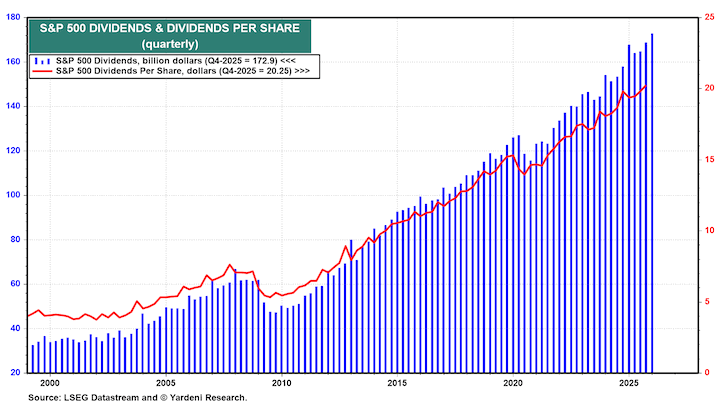
Stock dividends are a portion of profits that businesses have decided to distribute directly to shareholders, as opposed to reinvesting into their business, paying back debt, or buying back shares. They have explicitly decided that they don’t need this money to improve their business, and that it would be better to distribute it to shareholders. The dividends may suffer some short-term drops, but over the long run they have grown faster than inflation.

Here is the historical growth of the S&P 500 total dividend, which tracks roughly the largest 500 stocks in the US, updated as of 2025 Q3 (via Yardeni Research):

Tracking the income from my portfolio. Three of the primary income “trees” that produce income “fruit” in my portfolio are Vanguard Total US Stock ETF (VTI), Vanguard Total International Stock ETF (VXUS), and Vanguard Real Estate Index ETF (VNQ).

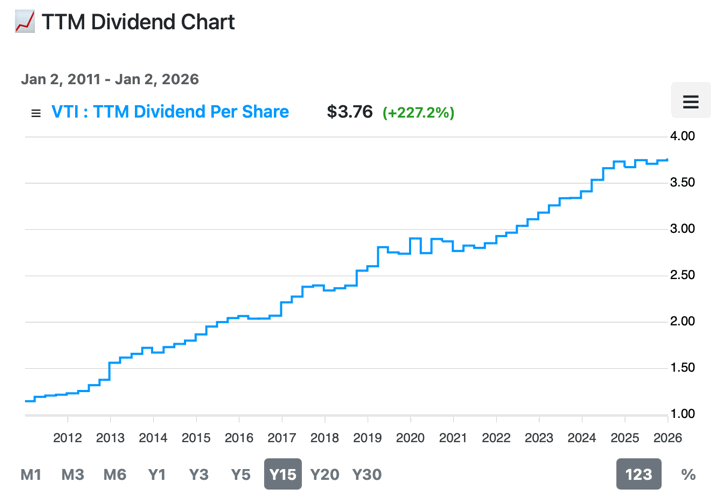
In the US, the dividend culture is somewhat conservative in that shareholders expect dividends to be stable and only go up. Thus the starting yield is lower, but grows more steadily with smaller cuts during hard times. Companies do buybacks as well, often because they are easier to discontinue. Here is an updated chart of the trailing 12-month (ttm) dividend per share over the last 15 years paid by the Vanguard Total US Stock ETF (VTI) via WallStNumbers.com.

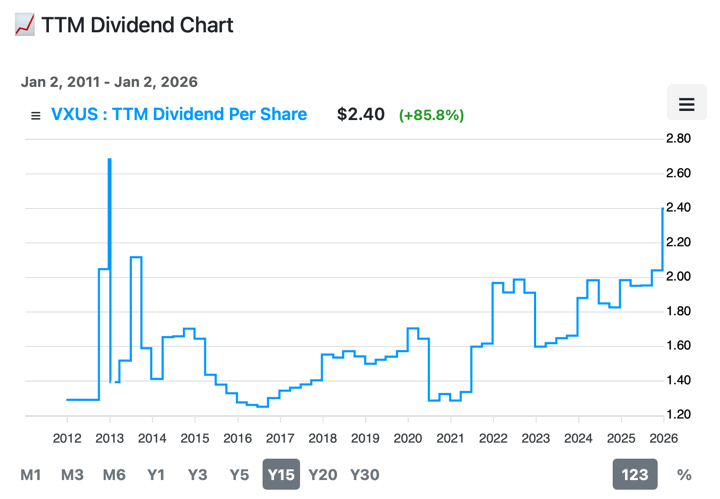
European corporate culture tends to encourage paying out a higher (sometimes even fixed) percentage of earnings as dividends, but that also means the dividends move up and down with earnings. The starting yield is currently higher but may not grow as reliably. Here is an updated chart of the trailing 12-month (ttm) dividend per share over the last 15 years paid by the Vanguard Total International Stock ETF (VXUS).

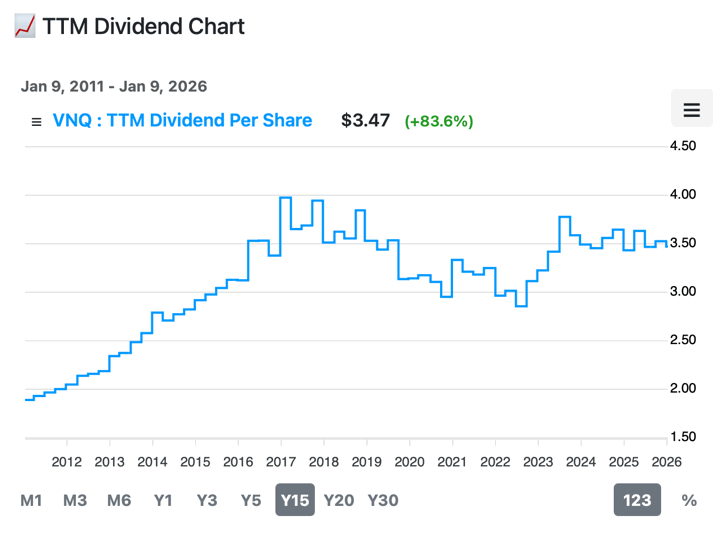
In the case of Real Estate Investment Trusts (REITs), they are legally required to distribute at least 90 percent of their taxable income to shareholders as dividends. Historically, about half of the total return from REITs is from this dividend income. Here is an updated chart of the trailing 12-month (ttm) dividend per share over the last 15 years paid by the Vanguard Real Estate Index ETF (VNQ).

The dividend yield (dividends divided by price) also serve as a rough valuation metric. When stock prices drop, this percentage metric usually goes up – which makes me feel better in a bear market. When stock prices go up, this percentage metric usually goes down, which keeps me from getting too euphoric during a bull market.

Finally, the last income component of my portfolio comes from interest from bonds and cash. Vanguard Short-Term Treasury ETF (VGSH) and Schwab US TIPS ETF (SCHP) are example holdings, with the actual amount varying with the prevailing interest rates, the real rates on TIPS, and the current rate of inflation.

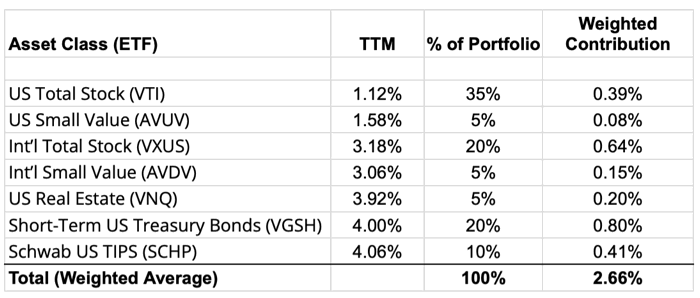
Dividend and interest income yield. To estimate the income from my portfolio, I use the weighted “TTM” or “12-Month Yield” from Morningstar (checked 10/6/24), which is the sum of the trailing 12 months of interest and dividend payments divided by the last month’s ending share price (NAV) plus any capital gains distributed (usually zero for index funds) over the same period. My TTM portfolio yield is now roughly 2.53%.

In dividend investing circles, there is a metric called yield on cost, which is calculated by dividing the current dividend by the original purchase price. In other words, while my portfolio yield today is 2.53%, that is because the current market price is also a lot higher. My yield based on my portfolio value from 10 years ago (October 2015) is over 5%.

What about the 4% rule? For big-picture purposes, I support the simple 4% or 3% rule of thumb, which equates to a target of accumulating roughly 25 to 33 times your annual expenses. I would lean towards a 3% withdrawal rate if you want to retire young (closer to age 50) and a 4% withdrawal rate if retiring at a more traditional age (closer to 65). I don’t enjoy debating this number. It’s just a quick and dirty target to get you started, not a number sent down from the heavens!

During the accumulation stage, your time is better spent focusing on earning potential via better career moves, improving your skillset, networking, and/or looking for asymmetrical (unlimited upside, limited downside) entrepreneurial opportunities where you have an ownership interest.

Our dividends and interest income are not automatically reinvested. They are simply another “paycheck”. As with our other variable paychecks, we can choose to either spend it or invest it again to compound things more quickly. You could use this money to cut back working hours, pursue a different career path, start a new business, take a sabbatical, perform charity or volunteer work, and so on. You don’t have to wait until you hit a magic number. Our life path has been very different because of this philosophy. FIRE is Life!

Kraken Crypto/Brokerage: Up to 2% Deposit Bonus w/ 12-Month Hold

Kraken is offering up to a 2% deposit bonus in October for any customer that deposits $1,000+ in cash or crypto during October. The deposit bonus will vary from 1% to 2% depending on total deposits across all customers, with the strange rule that when $500 million in total aggregate deposits are made and the full 2% deposit is triggered, the entire promo ends immediately, so you need to have participated by then. The bonus will then be paid within 14 days after the promo ends, in their USDG stablecoin.

Net deposits are calculated by total cash and crypto deposited, minus withdrawals during the promotion period. Your deposits earn a 1% match rate, which can boost up to 2% based on community progress. The final rate is set based on the total community net deposit value at the end of the promo (Oct 31 or when $500M is reached).

You must keep your net deposits at Kraken through November 1st, 2026. You can trade your deposit, and market fluctuations are okay as long as you don’t withdraw any funds. Full terms here.

Kraken is best known as a crypto exchange, but as of early 2025 they now offer US stock trading under Kraken Securities through a partnership with Alpaca (press release). The terms say that you can trade your deposits, so technically I don’t see why you couldn’t move your cash to Kraken, buy a T-Bill ETF like SGOV or VBIL (current SEC yields ~4.11% and 4.12%), and basically earn up to an additional 2% APY on your cash for a year.

A 2% deposit bonus for a 12-month hold is a pretty good deal. For me, the main catch is that you have to trust the US regulatory agencies that manage SIPC insurance in case Kraken Securities fails during the next year. ETFs held in an SIPC brokerage account are definitely better than an uninsured crypto account, but I just worry it could be messy, so I’d probably size my risk (deposit amount) accordingly.

If you haven’t already, you should also grab Kraken’s $75 new crypto account bonus and 30 days of free money spins, where I earned almost $20 in random crypto like DOGE and PEPE:

MMB Portfolio Asset Allocation & Performance – 2025 Q3 Update

Here is my 2025 3rd Quarter portfolio update that includes all our combined 401k/403b/IRAs and taxable brokerage accounts but excludes our house and small side portfolio of self-directed investments. Following the concept of skin in the game, the following is not a recommendation, but a sharing of our actual, imperfect DIY portfolio.

“Never ask anyone for their opinion, forecast, or recommendation. Just ask them what they have in their portfolio.” – Nassim Taleb

How I Track My Portfolio
Here’s how I track my portfolio across multiple brokers and account types:

  • The Empower Personal Dashboard real-time portfolio tracking tools (free) automatically logs into my different accounts, adds up my various balances, tracks my performance, and calculates my overall asset allocation daily. Formerly known as Personal Capital.
  • Once a quarter, I also update my manual Google Spreadsheet (free to copy, instructions) because it helps me calculate how much I need in each asset class to rebalance back towards my target asset allocation. I also create a new sheet each quarter, so I have a personal archive of my portfolio dating back many years.

2025 Q3 Asset Allocation and YTD Performance
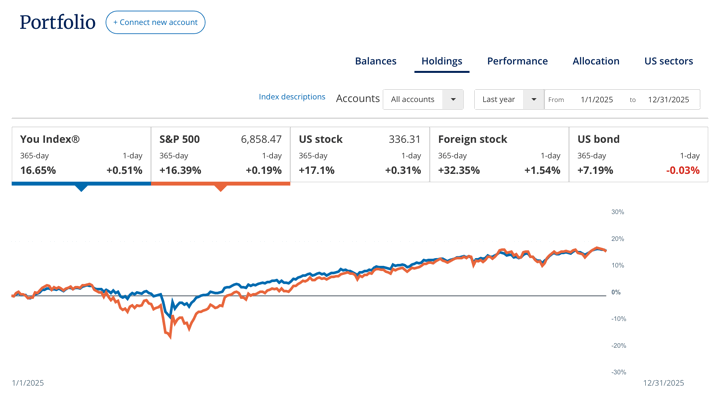
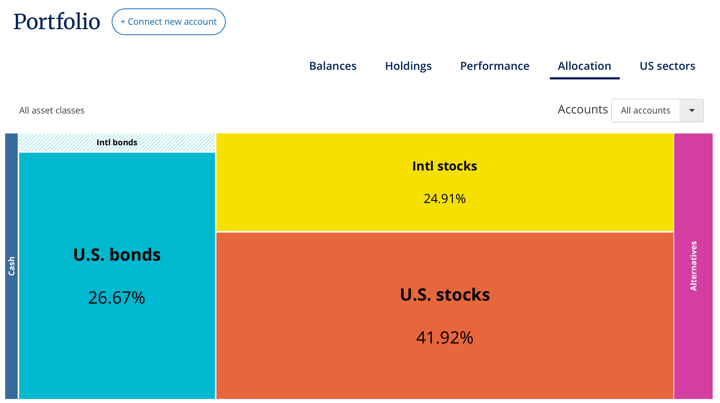
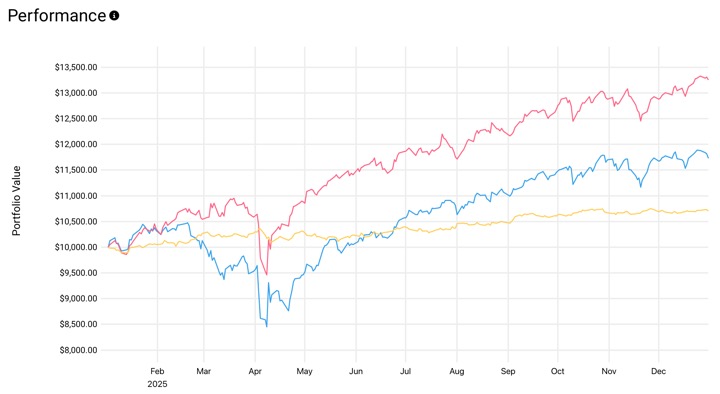
Here and at the top of this post are updated performance and asset allocation charts, per the “Holdings” and “Allocation” tabs of my Empower Personal Dashboard.

The major components of my portfolio are broad index ETFs. I do mix it up a bit around the edges, but not very much. Here is a model version of my target asset allocation with sample ETF holdings for each asset class.

  • 35% US Total Market (VTI)
  • 5% US Small-Cap Value (AVUV)
  • 20% International Total Market (VXUS)
  • 5% International Small-Cap Value (AVDV)
  • 5% US Real Estate (REIT) (VNQ)
  • 20% US “Regular” Treasury Bonds and/or FDIC-insured deposits (VGSH)
  • 10% US Treasury Inflation-Protected Bonds (SCHP)

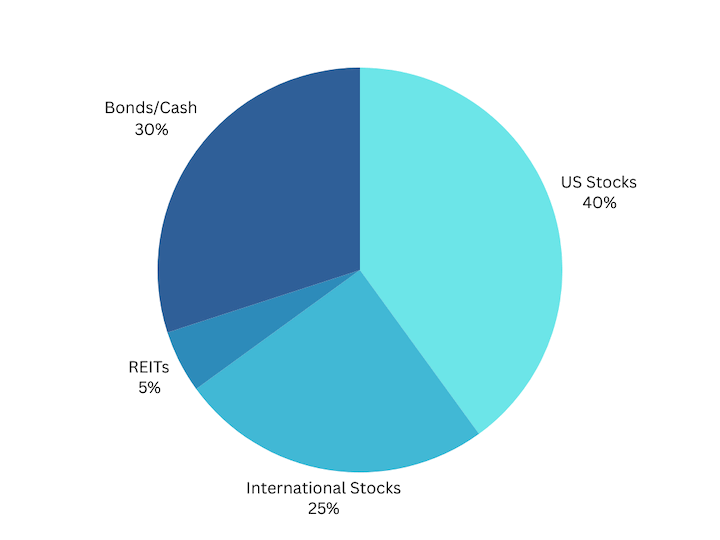
Big picture, it is 70% businesses and 30% very safe bonds/cash:

By paying minimal costs including management fees, transaction spreads, and tax drag, I am trying to essentially guarantee myself above-average net performance over time.

I do not spend a lot of time backtesting various model portfolios. You’ll usually find that whatever model portfolio is popular at the moment just happens to hold the asset class that has been the hottest recently.

The portfolio that you can hold onto through the tough times is the best one for you. I’ve been pretty much holding this same portfolio for 20 years. Check out these ancient posts from 2004 and 2005. Every asset class will eventually have a low period, and you must have strong faith during these periods to earn those historically high returns. You have to keep owning and buying more stocks through the stock market crashes. You have to maintain and even buy more rental properties during a housing crunch, etc. A good sign is that if prices drop, you’ll want to buy more of that asset instead of less. I don’t have strong faith in the long-term results of commodities, gold, or bitcoin – so I don’t own them.

Performance details. According to Empower, the S&P 500 keeps reaching toward all-time highs (+14% YTD) and foreign stocks continued their relative outperformance this year (+27% YTD). I wonder how long this will last?

Here’s an updated YTD Growth of $10,000 chart courtesy of Testfolio for some of the major ETFs that shows the difference in performance in the broad indexes:

My portfolio is getting a bit too stock-heavy (a good sign overall I suppose) so I am reinvesting excess income and dividends into bonds. I will stay invested for sure, but will rebalance around the edges. I’ll share about more about the income aspect in a separate post.

What Belongs in Your Portfolio? Six Criteria for Asset Class Selection

Elm Wealth has a new article on asset classes that introduces their six criteria for whether to include it inside their client portfolios. I found how they explicitly outlined this structure very useful. Here are the six criteria:

  • Low cost
  • Expectation of risk premium
  • Ability to systematically estimate expected return
  • Non-zero-sum
  • Liquid
  • Tax-efficient

Here is a partial excerpt of selected asset classes, outlining how each one performed under each individual criteria. Find the full chart with all of the asset classes in their article.

Here are the asset classes that passed all six criteria.

Risk Assets

  • Broad US Public Market Equities
  • Broad Non-US Public Market Equities
  • Public Market REITS

Safe Assets

  • US Treasury Bills
  • Treasury Inflation-Protected Securities (TIPS)
  • US Treasury and investment grade nominal bonds (small allocation)
  • High grade municipal bonds (small allocation in taxable)

This pretty much matches my portfolio. I know this list is incredible “boring”, and they don’t include any of the trendy ones right now – private equity, aggressive covered call options, crypto, etc. Sometimes, I am also pulled by the desire to seem skilled and sophisticated. But I think it’s an important message that these readily-available asset classes are all you need to achieve financial independence.

Remember, these are the same authors of the book titled “Missing Billionaires”. Permanent capital loss is the real danger! Relentless and reliable compounding wins.

Kraken Brokerage: 2% ACAT Transfer Bonus on Stocks & ETFs

Kraken is best known as a crypto exchange, but as of early 2025 they now offer US stock trading under Kraken Securities through a partnership with Alpaca (press release). They’ve got that VC money and an IPO coming up, so you know that means a high cash burn rate to show high growth! I already saw that with their $75 new crypto account bonus and 30 days of free money spins, where I earned almost $20 in random crypto like DOGE and PEPE:

Until 9/30, Kraken is also offering a 2% ACAT transfer bonus, paid in USDG stablecoin with no cap and 1-year minimum hold period. That’s a pretty solid bonus, with the main concerns being that Kraken is a crypto-first company and there may be some headaches even with SIPC insurance and all that. I’m thinking of moving my US Bank SGOV assets over since they nuked my Smartly 4% card, but I’m a little wary of this brand new brokerage that seems to have been put together by duct tape. In any case, here are the promo highlights.

  • 2% bonus on ACAT transfers of stocks/ETFs. No cap. Offer expires 9/30/25. 1-year minimum hold period after 10/1/25.
  • The terms indicate you must be Kraken+ subscriber (costs $5 a month or $50 a year) when the bonus is calculated after 1 year, but I’m not sure if they will want you to be a subscriber for the entire year hold period. The language states “Kraken+ subscribers are eligible for a 2% bonus.”, so to be safe I’d probably keep it the entire time.
  • Bonus is paid in USDG in , which is Kraken’s dollar stablecoin. If you don’t want to be paid in crypto, it looks like you can sell it to trade, but you can’t withdraw it from the platform until the year is done. I’m not sure how this works in terms of 1099s at the end of the year.
  • Kraken Securities will reimburse you for any outbound ACAT fees from your originating broker.

Here’s how I would approach this bonus:

  • If I didn’t have a Kraken crypto account yet, I’d open one first and grab this $75 referral bonus.
  • For the next 30 days, I’d set a reminder and make sure I open my app and do my daily spin for all 30 days and see if I get a luck $1,000 payout, but probably closer to $15-$30 total.
  • In the meantime, I’d sign-up for the 30-day free trial of Kraken+ to sell whatever crypto I didn’t want to keep with much lower transaction fees as a Kraken+ subscriber. This would also prep me for this ACAT bonus.
  • I would then quickly transfer whatever I wanted for the this bonus by 9/30. Even if it was just safe SGOV or other T-Bill ETFs, I’d still be getting 2% on top. If I moved $50,000, 2% would be $1,000. Kraken would get nice shiny numbers for their IPO decks. I’d hold for 1 year, making sure I still had Kraken+ on 10/1/26 and then move it to the next bonus.
  • Most importantly, I would avoid speculating money on crypto. 2% is a solid guaranteed bonus on top of existing buy and hold assets, but you can easily lose 2% on crypto in a single day and then some!

Here are important excerpts from the fine print:

What is this promotion?
A limited-time incentive offering for eligible U.S. users, providing up to a 2% bonus for qualified transfers of stocks/ETFs into Kraken Securities via ACATS. Kraken+ subscribers are eligible for a 2% bonus. Non Kraken+ users will receive a 1% bonus.

Who is eligible?
U.S. residents only, excluding New York and Maine. Users must be fully verified and approved to trade equities. Users must have opened and been approved for a Kraken Securities account.

What do I receive if my ACAT qualifies?
You receive up to a 2% bonus (2% for Kraken+ users, 1% for non-Kraken+ users) in USDG based on the value of stocks and ETFs you transfer into Kraken Securities via ACATS during the promo window. The value of the transferred assets is determined at the time the qualified ACAT transfer is successfully completed. The bonus is credited after the promotion period ends and placed on hold for one year (usable for trading but not withdrawable until the hold is lifted).

When does the hold period end and how is the hold lifted?
At the end of the one year holding period, which starts on October 1st 2025, the bonus will become eligible for withdrawal provided that the client’s total net transfers into eligible equities remain equal to or greater than the initial value upon which the bonus was calculated.

Is there a maximum reward amount I can receive?
No.

In what currency will the bonus be paid?
Global Dollar (USDG)

Does Kraken reimburse the sender ACATS fees?
Yes. Kraken Securities will reimburse you for any outbound ACAT fees your sending broker may charge you. This reimbursement is not dependent on this promotion and does not have a minimum value requirement to be eligible for reimbursement.