Worried About Unused 529 Funds? New 529 to Roth IRA Rollover Option

One of the concerns about contributing to 529 plan for college savings is that you won’t end up using all the money and end up being hit with additional taxes (at ordinary income rates) and penalties on an non-qualified withdrawal. The funds potentially would have been better off simply invested in a taxable brokerage account (and long-term capital gains rates).

This was partially addressed within the SECURE 2.0 Act of 2022, part of the Consolidated Appropriations Act (CAA) of 2023. Specifically, Section 126 [PDF link], “Special Rules for Certain Distributions from Long-term Qualified Tuition Programs to Roth IRAs”, which adds the ability to roll your 529 funds into a Roth IRA both tax-free and penalty-free starting in 2024. Kitces.com covers many of the major points. Here is a quick summary of the rollover requirements:

  • The Roth IRA receiving the rollover money must be owned by the beneficiary of the 529 plan. (Unless the beneficiary is also the owner, the money can’t go to the owner’s Roth IRA.)
  • The 529 plan must have been open for at least 15 years.
  • The rollover amount must have been in the 529 account for at least 5 years before your distribution date (contributions and attached earnings).
  • The annual rollover amount is limited to annual IRA contribution limits, and is reduced by any “regular” Roth IRA contributions made during the tax year. (You are not able to exceed the usual max contribution limits. However, the income (MAGI) limits that usually lower the contribution limits due to high income do not apply.)
  • The Roth IRA owner still needs to earn taxable income, at least equal to the amount of the rollover.
  • The maximum lifetime amount that can be moved from a 529 plan to a Roth IRA is $35,000 per person. (This may not be as much in 15+ years if they don’t increase it with inflation.)

In general, this seems like a reasonable way to alleviate the over-contribution concerns, although the money must still technically go to the beneficiary (usually the kid) and not the owner (usually the parent or grandparent). Previously, options for leftover money included graduate school, changing the beneficiary to another family member or future grandchild, or paying back up to $10,000 in qualified student loans.

There are a few interesting, potential wrinkles that a few readers have pointed out:

  • Making yourself both owner and beneficiary to fund future Roth IRA contributions for yourself (even with no kids). As you aren’t really increasing the total amount you are able to stuff into a Roth IRA in the future, the primary benefit is basically to access the tax-deferral benefit early. For example, you could put in $2,000 today and expect to roll over $6,000 in 15 years (7.6% annualized return). The exception may be if you expect not to be able to do Roth IRA contributions in the future because your income is too high AND the Backdoor Roth IRA method is not available to you. Still, 15 years is a long time to wait, and the law may change in the future to restrict this type of move. In such a case, it may backfire and subject you to taxes and penalties.
  • Planning to change the beneficiary from kid to yourself later on. Maybe you don’t want your kid to have the unspent funds, and plan to simply change the beneficiary to yourself later on. However, it’s not 100% clear if beneficiary changes will reset the 15-year clock or otherwise affect rollover eligibility. The law specifically restricted the rollover
  • Contributing extra money for the specific purpose of early funding for your children’s Roth IRAs. This might spur higher-income parents to put even more money into their 529s on purpose, as you are essentially indirectly able to fund a Roth IRA with tax-deferred growth for your kid way before they have earned income. When they eventually do have any form of earned income from a part-time or entry-level job in their teens or early 20s, the money can just roll into their Roth IRA officially (up to the limits).

I don’t have any immediate plans to take advantage of any of these potential scenarios, but taken together it does make me feel better about the 529 contributions that I have already made. Which I suppose is the overall idea?

In terms of other actionable advice, it may be worth it to start a 529 for each child immediately or as soon as possible, even if only putting in $25 or whatever is the minimum amount, just to start the 15 year clock in case you do want to take advantage of this feature down the road. There are countless examples out there of the benefit of starting the compounding early, especially when it can keep growing tax-free forever.

Best Interest Rates on Cash – May 2023

Here’s my monthly roundup of the best interest rates on cash as of May 2023, roughly sorted from shortest to longest maturities. We all need some safe assets for cash reserves or portfolio stability, and there are often lesser-known opportunities available to individual investors. Check out my Ultimate Rate-Chaser Calculator to see how much extra interest you could earn. Rates listed are available to everyone nationwide. Rates checked as of 5/1/2023.

TL;DR: 5% APY available on liquid savings. 5% APY available on multiple short-term CDs. Compare against Treasury bills and bonds at every maturity.

Fintech accounts
Available only to individual investors, fintech companies often pay higher-than-market rates in order to achieve fast short-term growth (often using venture capital). “Fintech” is usually a software layer on top of a partner bank’s FDIC insurance.

  • 5.05% APY ($1 minimum). SaveBetter lets you switch between different FDIC-insured banks and NCUA-insured credit unions easily without opening a new account every time, and their liquid savings rates currently top out at 5.05% APY. See my SaveBetter review for details. SaveBetter does not charge a fee to switch between banks.
  • 5.10% APY (before fees). MaxMyInterest is another service that allows you to access and switch between different FDIC-insured banks. You can view their current banks and APYs here. As of 5/1/23, the highest rate is from Customers Bank at 5.10% APY. However, note that they charge a membership fee of 0.04% per quarter, or 0.16% per year (subject to $20 minimum per quarter, or $80 per year). That means if you have a $10,000 balance, then $80 a year = 0.80% per year. You are allowed to cancel the service and keep the bank accounts, but then you may lose their specially-negotiated rates and cannot switch between banks anymore.
  • 5% on up to $25,000, then 4% up to $250k. Juno now pays 5% on all cash deposits up to $25,000 and 4% on cash deposits from $25,001 up to $250,000. No direct deposits required. This fintech has crypto exposure, please see my Juno review for details.

High-yield savings accounts
Since the huge megabanks STILL pay essentially no interest, everyone should have a separate, no-fee online savings account to piggy-back onto your existing checking account. The interest rates on savings accounts can drop at any time, so I list the top rates as well as competitive rates from banks with a history of competitive rates. Some banks will bait you with a temporary top rate and then lower the rates in the hopes that you are too lazy to leave.

  • The leapfrogging to be the temporary “top” rate continues. Newtek Bank at 5.00% APY. Notice that last month’s leader, UFD Direct, has since dropped down to 4.81% APY. CIT Platinum Savings at 4.75% APY with $5,000+ balance.
  • SoFi Bank is now up to 4.20% APY + up to $275 new account bonus with direct deposit. You must maintain a direct deposit of any amount each month for the higher APY. SoFi has their own bank charter now so no longer a fintech by my definition. See details at $25 + $250 SoFi Money new account and deposit bonus.
  • There are several other established high-yield savings accounts at 3.75%+ APY that aren’t the absolute top rate, but historically do keep it relatively competitive for those that don’t want to keep switching banks.

Short-term guaranteed rates (1 year and under)
A common question is what to do with a big pile of cash that you’re waiting to deploy shortly (plan to buy a house soon, just sold your house, just sold your business, legal settlement, inheritance). My usual advice is to keep things simple and take your time. If not a savings account, then put it in a flexible short-term CD under the FDIC limits until you have a plan.

  • No Penalty CDs offer a fixed interest rate that can never go down, but you can still take out your money (once) without any fees if you want to use it elsewhere. CIT Bank has a 11-month No Penalty CD at 4.80% APY with a $1,000 minimum deposit. Ally Bank has a 11-month No Penalty CD at 4.25% APY for all balance tiers. Marcus has a 13-month No Penalty CD at 4.15% APY with a $500 minimum deposit. You may wish to open multiple CDs in smaller increments for more flexibility.
  • Blue FCU via SaveBetter has a 9-month No Penalty CD at 5.00% APY. Minimum opening deposit is $1. No early withdrawal penalty. Withdrawals may be made 30 days after opening.
  • BrioDirect has a 12-month certificate at 5.25% APY. $500 minimum. Early withdrawal penalty is 90 days of interest.

Money market mutual funds + Ultra-short bond ETFs*
Many brokerage firms that pay out very little interest on their default cash sweep funds (and keep the difference for themselves). * Money market mutual funds are regulated, but ultimately not FDIC-insured, so I would still stick with highly reputable firms. I am including a few ultra-short bond ETFs as they may be your best cash alternative in a brokerage account, but they may experience losses.

  • Vanguard Federal Money Market Fund is the default sweep option for Vanguard brokerage accounts, which has an SEC yield of 4.78%. Odds are this is much higher than your own broker’s default cash sweep interest rate.
  • The PIMCO Enhanced Short Maturity Active Bond ETF (MINT) has a 5.17% SEC yield and the iShares Short Maturity Bond ETF (NEAR) has a 5.12% SEC yield while holding a portfolio of investment-grade bonds with an average duration of ~6 months.

Treasury Bills and Ultra-short Treasury ETFs
Another option is to buy individual Treasury bills which come in a variety of maturities from 4-weeks to 52-weeks and are fully backed by the US government. You can also invest in ETFs that hold a rotating basket of short-term Treasury Bills for you, while charging a small management fee for doing so. T-bill interest is exempt from state and local income taxes.

  • You can build your own T-Bill ladder at TreasuryDirect.gov or via a brokerage account with a bond desk like Vanguard and Fidelity. Here are the current Treasury Bill rates. As of 5/1/23, a new 4-week T-Bill had the equivalent of 4.41% annualized interest and a 52-week T-Bill had the equivalent of 4.87% annualized interest.
  • The iShares 0-3 Month Treasury Bond ETF (SGOV) has a 4.69% SEC yield and effective duration of 0.10 years. SPDR Bloomberg Barclays 1-3 Month T-Bill ETF (BIL) has a 4.55% SEC yield and effective duration of 0.08 years.

US Savings Bonds
Series I Savings Bonds offer rates that are linked to inflation and backed by the US government. You must hold them for at least a year. If you redeem them within 5 years there is a penalty of the last 3 months of interest. The annual purchase limit for electronic I bonds is $10,000 per Social Security Number, available online at TreasuryDirect.gov. You can also buy an additional $5,000 in paper I bonds using your tax refund with IRS Form 8888.

  • “I Bonds” bought between May 2023 and October 2023 will earn a 4.30% rate for the first six months. The rate of the subsequent 6-month period will be based on inflation again. More on Savings Bonds here.
  • In mid-October 2023, the CPI will be announced and you will have a short period where you will have a very close estimate of the rate for the next 12 months. I will have another post up at that time.
  • See below about EE Bonds as a potential long-term bond alternative.

Rewards checking accounts
These unique checking accounts pay above-average interest rates, but with unique risks. You have to jump through certain hoops which usually involve 10+ debit card purchases each cycle, a certain number of ACH/direct deposits, and/or a certain number of logins per month. If you make a mistake (or they judge that you did) you risk earning zero interest for that month. Some folks don’t mind the extra work and attention required, while others would rather not bother. Rates can also drop suddenly, leaving a “bait-and-switch” feeling.

  • Genisys Credit Union pays 5.25% APY on up to $7,500 if you make 10 debit card purchases of $5+ each, and opt into receive only online statements. Anyone can join this credit union via $5 membership fee to join partner organization.
  • Pelican State Credit Union pays 5.50% APY on up to $10,000 if you make 15 debit card purchases, opt into online statements, and make at least 1 direct deposit, online bill payment, or automatic payment (ACH) per statement cycle. Anyone can join this credit union via partner organization membership.
  • The Bank of Denver pays 5.00% APY on up to $15,000 if you make 12 debit card purchases of $5+ each, receive only online statements, and make at least 1 ACH credit or debit transaction per statement cycle. Thanks to reader Bill for the updated info.
  • All America/Redneck Bank pays 5.05% APY on up to $15,000 if you make 10 debit card purchases each monthly cycle with online statements.
  • Presidential Bank pays 4.625% APY on balances between $500 and up to $25,000 (3.625% APY above that) if you maintain a $500+ direct deposit and at least 7 electronic withdrawals per month (ATM, POS, ACH and Billpay counts).
  • Find a locally-restricted rewards checking account at DepositAccounts.

Certificates of deposit (greater than 1 year)
CDs offer higher rates, but come with an early withdrawal penalty. By finding a bank CD with a reasonable early withdrawal penalty, you can enjoy higher rates but maintain access in a true emergency. Alternatively, consider building a CD ladder of different maturity lengths (ex. 1/2/3/4/5-years) such that you have access to part of the ladder each year, but your blended interest rate is higher than a savings account. When one CD matures, use that money to buy another 5-year CD to keep the ladder going. Some CDs also offer “add-ons” where you can deposit more funds if rates drop.

  • Sallie Mae Bank via SaveBetter has a 27-month CD at 5.15% APY. $1 minimum. Early withdrawal penalty is 180 days of simple interest.
  • Credit Human has 18- to 23-month CDs at 5.15% APY and 24 to 35-month CDs at 4.90% APY. $500 minimum to open. The early withdrawal penalty is 270 days of interest for 12- to 35-month terms. Anyone can join this credit union via partner organization (no fee).
  • Lafayette Federal Credit Union has a 5-year certificate at 4.68% APY ($500 min), 4-year at 4.73% APY, 3-year at 4.84% APY, 2-year at 4.89% APY, and 1-year at 4.99% APY. They also have jumbo certificates with $100,000 minimums at even higher rates. The early withdrawal penalty for the 5-year is very high at 600 days of interest. Anyone can join this credit union via partner organization ($10 one-time fee).
  • You can buy certificates of deposit via the bond desks of Vanguard and Fidelity. You may need an account to see the rates. These “brokered CDs” offer FDIC insurance and easy laddering, but they don’t come with predictable early withdrawal penalties. Right now, I see a 5-year non-callable CD at 4.40% APY (callable: no, call protection: yes). Both Vanguard and Fidelity will list higher rates from callable CDs, which importantly means they can call back your CD if rates drop later.

Longer-term Instruments
I’d use these with caution due to increased interest rate risk, but I still track them to see the rest of the current yield curve.

  • Willing to lock up your money for 10 years? You can buy long-term certificates of deposit via the bond desks of Vanguard and Fidelity. These “brokered CDs” offer FDIC insurance, but they don’t come with predictable early withdrawal penalties. You might find something that pays more than your other brokerage cash and Treasury options. Right now, I see a 10-year CDs at (none available, non-callable) vs. 3.57% for a 10-year Treasury. Watch out for higher rates from callable CDs where they can call your CD back if interest rates drop.
  • How about two decades? Series EE Savings Bonds are not indexed to inflation, but they have a unique guarantee that the value will double in value in 20 years, which equals a guaranteed return of 3.5% a year. However, if you don’t hold for that long, you’ll be stuck with the normal rate, currently 2.50% for EE bonds issued from May 2023 to October 2023. As of 5/1/23, the 20-year Treasury Bond rate was 3.95%.

All rates were checked as of 5/1/2023.

Savings I Bonds May 2023 Inflation Rate: 0.90% Fixed, 4.30% Total Composite Rates

May 2023 fixed rate will be 0.90%, total composite rate is 4.30% for next 6 months. For Savings I bonds bought from May 1, 2023 through October 31, 2023, the fixed rate will be 0.90% and the total composite rate will be 4.30%. The semi-annual inflation rate is 1.69% as predicted (3.38% annually), but the full composite rate is dependent on the fixed rate for each specific savings bond and so it is a little bit higher.

Every single I bond will earn this inflation rate of ~3.40% eventually for 6 months, depending on the initial purchase month. The fixed rate was higher than I predicted, although still a bit lower than short-term TIPS yields. You may wish to wait until October if you don’t like what you see right now. See you again in mid-October for the next early prediction for November 2022.

Original post from 4/12/23:

Savings I Bonds are a unique, low-risk investment backed by the US Treasury that pay out a variable interest rate linked to inflation. With a holding period from 12 months to 30 years, you could own them as an alternative to bank certificates of deposit (they are liquid after 12 months) or bonds in your portfolio.

New inflation numbers were just announced at BLS.gov, which allows us to make an early prediction of the May 2023 savings bond rates a couple of weeks before the official announcement on the 1st. This also allows the opportunity to know exactly what a April 2023 savings bond purchase will yield over the next 12 months, instead of just 6 months. You can then compare this against a May 2023 purchase.

New inflation rate prediction. September 2022 CPI-U was 296.808. March 2023 CPI-U was 301.836, for a semi-annual increase of 1.69%. Using the official formula, the variable component of interest rate for the next 6 month cycle will be ~3.38%. You add the fixed and variable rates to get the total interest rate. The fixed rate hasn’t been above 0.50% in over a decade, but if you have an older savings bond, your fixed rate may be up to 3.60%.

Tips on purchase and redemption. You can’t redeem until after 12 months of ownership, and any redemptions within 5 years incur an interest penalty of the last 3 months of interest. A simple “trick” with I-Bonds is that if you buy at the end of the month, you’ll still get all the interest for the entire month – same as if you bought it in the beginning of the month. It’s best to give yourself a few business days of buffer time. If you miss the cutoff, your effective purchase date will be bumped into the next month.

Buying in April 2023. If you buy before the end of April, the fixed rate portion of I-Bonds will be 0.40%. You will be guaranteed a total interest rate of 0.40 + 6.49 = 6.89% for the next 6 months. For the 6 months after that, the total rate will be 0.40 + 3.39 = 3.79%.

Let’s look at a worst-case scenario, where you hold for the minimum of one year and pay the 3-month interest penalty. If you theoretically buy on April 30th, 2023 and sell on April 1st, 2024, I estimate that you’ll earn a ~4.48% annualized return for an 11-month holding period, for which the interest is also exempt from state income taxes. If you theoretically buy on April 30th, 2023 and sell on July 1, 2024, you’ll earn a ~5.07% annualized return for an 14-month holding period. Comparing with the best interest rates as of April 2023, these short-term rates are roughly on par on what is available via regular nominal Treasury bonds and other deposit accounts.

Buying in May 2023. If you buy in May 2023, you will get 3.38% plus a newly-set fixed rate for the first 6 months. The new fixed rate is officially unknown, but is loosely linked to the real yield of short-term TIPS. My rough guess is somewhere between 0.2% and 0.5%. The current real yield on short-term TIPS is lower than it was during the last reset, when the fixed rate was set at 0.4%. Every six months after your purchase, your rate will adjust to your fixed rate (set at purchase) plus a variable rate based on inflation.

If you have an existing I-Bond, the rates reset every 6 months depending on your purchase month. Your bond rate = your specific fixed rate (based on purchase month, look it up here) + variable rate (total bond rate has a minimum floor of 0%). So if your fixed rate was 1%, you’ll be earning a 1.00 + 3.38 = 4.38% rate for six months.

Buy now or wait? If you buy in April, you will get the remnants of the last period of higher inflation, and a fixed rate that won’t change much for May. If you wait until May, there may be a small possibility that the fixed rate might go up, but even if it does, it will take a while for that to breakeven due to the lower initial inflation rate. Therefore, my opinion is that I would purchase now in April. Note that the real yields on TIPS are currently about 1.2% for a 5-year term, higher than the fixed rate for I bonds.

Unique features. I have a separate post on reasons to own Series I Savings Bonds, including inflation protection, tax deferral, exemption from state income taxes, and educational tax benefits.

Over the years, I have accumulated a nice pile of I-Bonds and consider it part of the inflation-linked bond allocation inside my long-term investment portfolio.

Annual purchase limits. The annual purchase limit is now $10,000 in online I-bonds per Social Security Number. For a couple, that’s $20,000 per year. You can only buy online at TreasuryDirect.gov, after making sure you’re okay with their security protocols and user-friendliness. You can also buy an additional $5,000 in paper I bonds using your tax refund with IRS Form 8888. If you have children, you may be able to buy additional savings bonds by using a minor’s Social Security Number. TheFinanceBuff has a nice post on gifting options if you are a couple and want to frontload your purchases now. TreasuryDirect also allows trust accounts to purchase savings bonds.

Note: Opening a TreasuryDirect account can sometimes be a hassle as they may ask for a medallion signature guarantee which requires a visit to a physical bank or credit union and snail mail. This doesn’t apply to everyone and seems to have gotten better recently, but the takeaway is don’t wait until the last minute.

Bottom line. Savings I bonds are a unique, low-risk investment that are linked to inflation and only available to individual investors. You can only purchase them online at TreasuryDirect.gov, with the exception of paper bonds via tax refund. For more background, see the rest of my posts on savings bonds.

[Image: 1950 Savings Bond poster from US Treasury – source]

Charlie Munger Fireside Chat with Todd Combs (April 2022): Full Recording and Transcript

Charlie Munger held a fireside chat with Todd Combs back in April 2022 as part of a Singleton Prize for CEO Excellence event, and more recently a full audio recording and full text transcript has been made available. The talk covered a variety of different topics, which fans of Berkshire Hathaway/Buffett/Munger-style wisdom will likely value. Found via Neckar and Kingswell (both excellent substacks on value investing topics).

I enjoyed this quote about the power of combining internal motivation and long attention span:

Warren was around me and he used to say, “You really don’t need to be very smart to be a very successful investor.” And I think Warren was right. It’s a field where the temperament is, it’s good to have the extra mental horsepower that Henry Singleton had. That is helpful, but it’s perfectly possible to do splendidly well if you have the right temperament. Just go at it over a long time. You talked about me. I’m not a polymath. What I am is a guy who has been able to take moderate obsession and a long attention span and turn them into pretty good results. Of course, a long attention span will help you a lot, if you’re reasonably smart.

[…] I don’t know how to fix [inaudible]. I’d love to be able to wave my hand and solve that problem, but I don’t think that’s given to man, to fix some of those problems. So I just stay away from the problems that can’t be fixed and pick the ones that can – I don’t like unlimited failure. I don’t want to fish forever and never catch a fish. I have to have some reinforcement. And so I pick some things that can be done and do them. But I do think that if you’re reasonably obsessed with something, even if it’s intermittent, and you have a long attention span, you keep working over the serious problems, that you’ll stumble into an answer. That’s half the secret of life.

However, I also noticed he added in a point about picking the right problem to solve. I’ve previously shared this Venn diagram by Bud Caddell:

caddell620

You do need to pick something where you have a natural “obsession” or “passion” because it will help you keep at it and not give up. However, most mortals should add in a bit of practicality and pick an area for which you at least have a little bit of talent and that isn’t completely impossible or saturated with competition.

Plynk Investing App User Bonuses (Expired)

Update April 2025: The following bonuses are now EXPIRED.

Update April 2023: Plynk has rolled out a new Recurring Deposit Match promotion for existing users worth up to another $100. You just have to set up recurring deposits of at least $10 and Plynk will match the match the second recurring deposit (or the lesser of the two if they differ), up to a maximum of $100. I received this offer via email, but it is listed on their promotion page and does not appear targeted. Sounds like another $100 in my pocket. New users should pick up the other bonuses below first.

The Recurring Deposit Match promotion (the “Recurring Match”) is effective March 9, 2023, through May 18, 2023 (“Offer Date”) for Plynk brokerage customers in good standing. Make two consecutive Recurring Net Deposits into your account and Plynk will match the second Recurring Deposit, or the lesser of the two if they differ, up to a maximum of $100. For purposes of this offer, “Recurring Net Deposit” shall mean cash transfer made using the recurring deposit feature from an external source that remains in your account for at least 30 calendar days. Recurring Match is only available for Plynk customers with a Plynk account in good order. Deposits totaling less than $10 do not qualify as Recurring Net Deposits.

Updated original post with new user bonus info:

Plynk is a stock and crypto brokerage app meant for beginner investors. Right now, new users can earn $60 or more in bonuses: a $10 sign-up bonus and a $50 bonus after $25 deposit and you can also go through Swagbucks and earn more (bonus value varies with user; I see 3500 points worth ~$35). New Swagbucks users should first grab the $10 new user bonus via referral.

$10 sign-up bonus details. From the fine print:

The $10 Sign-Up Bonus program (the “$10 Sign-Up Bonus”) is effective April 1, 2022, for qualifying new brokerage customers. To be eligible for the $10 Sign-Up Bonus, you must be a new Plynk customer and (i) download the Plynk app, (ii) sign up, and (iii) link an eligible bank account. Plynk will deposit $10 USD into your Plynk account within 30 days of your satisfying these conditions and Plynk accepting your account. Whether a qualifying customer is eligible for the $10 Sign-Up Bonus is a determination made in the sole discretion of Plynk.

$50 Promotion details.

The $50 promotion (the “$50 promotion”) is effective March 9, 2023, through May 18, 2023 (“Offer Date”) for qualifying brokerage customers. Plynk will deposit $50 (“Bonus Award”) into the accounts of customers who link a new eligible bank account and make a minimum Net Deposit of $25 in their account. For purposes of this offer, “Net Deposit” shall mean total cash transfers from an external source minus assets withdrawn or transferred out your brokerage account made within 15 calendar day of linking an eligible bank account (“Qualification Period”). Customers who have already opened a Plynk account and linked a bank account as well as any customer who does not make a Net Deposit totaling at least $25 during the Qualification period are not eligible for the $50 Promotion.

Note that Plynk plans on charging a $2 monthly fee at some point, but apparently they are waiving it for an undetermined amount of time. From their fee schedule:

Monthly app fee: $2. At our discretion, DBS will temporarily waive this monthly fee, in the form of a free trial or otherwise, and will provide notice upon reinstatement of this monthly fee or general changes to our fees. This monthly fee is currently waived for all customers.

This app appears to be a quiet spin-off or separate subsidiary of Fidelity Investments. The cash sweep option money market fund is the same as for Fidelity. Seems like they are experimenting to see what works with beginner investors, as Plynk offers lots of educational aspects and encourages you to invest as little as $1 at a time.

Warren Buffett CNBC Interview April 2023: Video & Full Transcript

Becky Quick had another CNBC interview with the Warren Buffett and Greg Abel of Berkshire Hathaway, likely as a preview to the annual shareholder meeting that is coming up soon in May. You can watch a replay of the interview via this CNBC YouTube playlist and/or read the full text transcript. I appreciate that CNBC provides the transcripts, and they are the most efficient way for me to digest the information and take notes. Below are a few highlights (bolded emphasis is mine).

With higher interest rates upon us, Buffett reminds us that those 30-year fixed rate mortgages at 3% or 4% were and are a great deal for the borrowers, but not great for the banks (or investors in those mortgages). This is one of the reasons I don’t own mortgage-backed securities (MBS) or a Total US Bond index fund, which many people don’t know consist of roughly 25% mortgage-backed securities.

WARREN BUFFETT: I think that they that there will be problems when and, you know, people had anybody that’s got a fixed rate in, locked in for a while when the fixed rate goes away and they gotta reprice it now has got a problem. And the holder of a 30-year Freddie Mac or Fannie, they’ve got the best deal in the world. And they should. I love the program. But—

BECKY QUICK: You mean somebody who has their 30-year mortgage—

WARREN BUFFETT: Yeah, who has the mortgage. But the reason it’s for the very fact that it’s very advantageous. The person who has the mortgage means it’s a very dumb holding for banks. But I also believe in the system that produces I think net the country is better off because it but I don’t wanna hold any 30-year mortgages myself. And the idea that if you’ve got a 30-year mortgage, you personally, you can call off the deal 10 minutes later, and if, and if the banks got a bad deal they’re stuck with it for 30 years. Berkshire cannot make the deal with our credit than you can make if you qualify for making a Freddie or Fannie Mae. I think that’s a good thing for society. I don’t think it’s a very good investment for banks.

Regarding FDIC insurance, Buffett is willing to bet anyone a million dollars that not a single US depositor will lose a penny of money within the next year due a bank failure. The media likes to stoke the fear. Buffett is realistic and is willing to put his money where his mouth is. I don’t lose sleep about my cash in any bank with FDIC insurance that is under the $250k limits ($500k for a joint account, by the way).

WARREN BUFFETT: But I will be glad to put a million dollars of my own money in the bank that or any place else actually that anybody takes a differing view takes and have them put a million dollars in, and at the end of the year from when we do it if any American depositor has lost money from a bank failure, the other fellow gets to name where the $2 million goes to what charity.

In many ways, the world is better today than it was for previous generations. It’s trendier to complain the other way, but that is human nature.

I think I was very, very, very lucky that Berkshire happened to be in America and I happened to be an American. And I was born in 1930 and I’ve been in a golden age ever since I was born. The GDP per capita’s up, like, six-fold or seven-fold. In one person’s lifetime there’s never been anything like that in the history of mankind. And so and, you know, we love to complain about wherever we are, but, you know, most people don’t work on Saturdays and don’t work on Sundays and when I was a kid everybody worked on Saturdays. And I mean, it the world has changed so much for the better in terms of, you know, how well off people are compared to any other time in history. If I’d been born 150 years ago and I went to the dentist, I mean, you know, they’d pour whiskey down me and all kinds of things. There’s just all kinds of improvements. And but it’s man nature to be dissatisfied. And politics does stir that up. And you’ve gotta say, if you’re out of power, that the other guy’s screwing up and you could do better. And that’s just built into the system. But that was the case when I was a kid, and it’s the case today.

Ignore economic forecasts and interest rate predictions. I’m always amused when Warren Buffett sits there and says “I ignore the noise” and all around him on the screen is all this… noise. S&P 500 up 5 points since 10 minutes ago! DOW down 10 points! 5-year yield up 8 points!

WARREN BUFFETT: I would say that I’ve been in business, running Berkshire for 58 years, and I’ve never opined an economic forecast of any use to the company. And all you have to do is keep running every business as well as we can, and we got to keep plenty of cash on hand so that people are going to keep making intelligent decisions, rather than those forced upon them. And that’s all we know how to do. And if I depended in my life on economic forecasts, you know, I don’t think we’d make any money. I don’t know how to do it. And, you know, people want to get them, so they get them. But it has no utility.

And but we haven’t changed our course, you know, in 58 years. And we just wanna buy good businesses run by people we like and trust and at a decent price. And we’ll keep doing that. And we’ll keep buying Treasury bills every Monday, and we haven’t missed a Monday yet. And we keep all our money short. We keep it in Treasuries.

And we were getting four basis points, which was $40 million on $100 billion worth. And now we get almost 5%, which is $5 billion. So we’ve got 100 times the earnings. But it doesn’t make any difference. I mean, that is there to be the strongest company you can imagine. And also, to take opportunities when they come along.

Warren Buffett buys US Treasuries because they are the absolute safest and most liquid instrument available to him. Notice he has never kept Berkshire Hathaway’s cash in a bank, even a huge megabank like Bank of America or Chase (and certainly not Silicon Valley Bank), because he KNOWS he is not covered by FDIC insurance. As an individual investor, I also KNOW that I am different that I am covered by FDIC insurance up to clear limits. Buffett cares about the interest earned on his cash, but not at the expense of safety. There is a big gap between safe 99% of the time and safe 100% of the time. Any time you have to multiply by zero, you get zero. It sounds stupidly simple, but zero happens.

William Bernstein on Holding Both Treasury Bonds and TIPS (or Savings I Bonds)

sb_posterWilliam Bernstein has a new article titled Riskless at Age 104 in which he outlines why he just bought some 30-year Treasury Inflation-Protected Securities (TIPS) that won’t mature until he is 104 years old. Despite that distracting headline, the article is more about the reasons why you might want to hold both traditional US Treasury bonds that pay a stated rate and TIPS that pay a stated rate above inflation.

Here’s a quote that is nearly the answer to a riddle: What is risky in the short run but riskless in the long run? What is the opposite?

A TIPS is risky in the short term and riskless in the long run, which is precisely the opposite of, and complementary to, a T-bill, which is riskless in the short term but, because of reinvestment rate volatility, risky in the long run.

In the end, Dr. Bernstein recommends holding both:

To summarize, TIPS and T-bills are complementary assets. The former appeals to our System 2’s inner Spock, who first and foremost wants to secure our future consumption, while the latter assuages our System 1’s inner Daffy Duck, who wants us to bail at the worst possible time and violate Charlie Munger’s first rule of compounding, which is to never interrupt it.

The prudent retiree holds a goodly pile of both.

I also split the bond portion of my portfolio between safe traditional bonds (and cash and CDs) and safe inflation-protected bonds. My take:

  • Cash, which can be held in the form of short-term Treasury Bills or cash deposits in an FDIC-insured bank account, satisfies our System 1 “reptile brain”. It’s simple, reliable, and easy to understand. It may not keep up with inflation perfectly, but it also moves around a lot less.
  • TIPS and I Savings Bonds, which allow you to remove the variable of unexpectedly high inflation over long period of time (up to 30 years out), satisfies our System 2 “rational brain”. As a long-time holder, I can attest that it fluctuates in unpredictable ways and is not that much fun to hold. It’s actually like stocks in that price seem to drop in times of crisis. You have to really understand the inner workings, but if you do then it becomes a form of long-term insurance against unexpectedly high inflation.

This is also why I’m still buying Savings I Bonds every year even though the headline rates are not as crazy anymore. I don’t buy them as a substitute for short-term cash, but as a form of long-term insurance policy. When inflation spiked up to 8%+, it wasn’t just $10k of I Savings Bonds that I bought in 2022 that went up 8%+. My entire stash of I Savings Bonds slowly accumulated over a decade or more went up 8%+. I will admit, it felt nice that something went up in 2022. Savings I Bonds also never go down in value (unlike TIPS), so in a way they are the least stressful way to hold inflation-protected bonds.

Investment Asset Classes: What Do You Really Need?

The Morningstar article Why Investment Complexity Is Not Your Friend points out that out of the thousands of available ETFs and mutuals available, most of them are so narrowly-focused that you really don’t even need to consider them.

What asset classes do you really need to own? Here is their no-nonsense list broken down by “definitely need”, “probably need”, and “don’t need”.

Agree? Disagree? I do believe you can still do quite well over the long run even if keeping things very simple.

Best Interest Rates on Cash – April 2023

Here’s my monthly roundup of the best interest rates on cash as of April 2023, roughly sorted from shortest to longest maturities. We all need some safe assets for cash reserves or portfolio stability, and there are often lesser-known opportunities available to individual investors. Check out my Ultimate Rate-Chaser Calculator to see how much extra interest you could earn. Rates listed are available to everyone nationwide. Rates checked as of 4/5/2023.

TL;DR: 5% APY available on liquid savings, with some wrinkles. 5% APY available on multiple short-term CDs. Compare against Treasury bills and bonds at every maturity. 6.89% Savings I Bonds can be bought with 2023 annual limits now.

Fintech accounts
Available only to individual investors, fintech companies often pay higher-than-market rates in order to achieve fast short-term growth (often using venture capital). “Fintech” is usually a software layer on top of a partner bank’s FDIC insurance.

  • 4.85% APY ($1 minimum). SaveBetter lets you switch between different FDIC-insured banks and NCUA-insured credit unions easily without opening a new account every time, and their liquid savings rates currently top out at 4.85%. This fintech makes it easier for you to maintain a top rate even if one bank decides to drop out of the “rate race”. 😉 SaveBetter does not charge a fee to switch between banks.
  • 5% APY (before fees). MaxMyInterest is another service that allows you to access and switch between different FDIC-insured banks. You can view their current banks and APYs here. As of 4/5/23, the highest rate is from BrioDirect (Webster Bank) at 5.06% APY. However, note that they charge a membership fee of 0.04% per quarter, or 0.16% per year (subject to $20 minimum per quarter, or $80 per year). That means if you have a $10,000 balance, then $80 a year = 0.80% per year. You are allowed to cancel the service and keep the bank accounts, but then you may lose their specially-negotiated rates and cannot switch between banks anymore.
  • 5% on up to $25,000, then 4% up to $250k. Juno now pays 5% on all cash deposits up to $25,000 and 4% on cash deposits from $25,001 up to $250,000. No direct deposits required. This fintech has crypto exposure, please see my Juno review for details.
  • 4.00% APY on $6,000. Current offers 4% APY on up to $6,000 total ($2,000 each on three savings pods). Must maintain a direct deposit of $200+ every 35 days. $50 referral bonus for new members with $200+ direct deposit with promo code JONATHAP228. Please see my Current app review for details.

High-yield savings accounts
Since the huge megabanks STILL pay essentially no interest, everyone should have a separate, no-fee online savings account to piggy-back onto your existing checking account. The interest rates on savings accounts can drop at any time, so I list the top rates as well as competitive rates from banks with a history of competitive rates. Some banks will bait you with a temporary top rate and then lower the rates in the hopes that you are too lazy to leave.

  • The leapfrogging to be the temporary “top” rate continues. UFB Direct at 5.02% APY, although note their incoming ACH hold times. CIT Platinum Savings at 4.75% APY with $5,000+ balance.
  • SoFi Bank is now up to 4.00% APY + up to $275 new account bonus with direct deposit. You must maintain a direct deposit of any amount each month for the higher APY. SoFi has their own bank charter now so no longer a fintech by my definition. See details at $25 + $250 SoFi Money new account and deposit bonus.
  • There are several other established high-yield savings accounts at 3.75%+ APY that aren’t the absolute top rate, but historically do keep it relatively competitive for those that don’t want to keep switching banks.

Short-term guaranteed rates (1 year and under)
A common question is what to do with a big pile of cash that you’re waiting to deploy shortly (plan to buy a house soon, just sold your house, just sold your business, legal settlement, inheritance). My usual advice is to keep things simple and take your time. If not a savings account, then put it in a flexible short-term CD under the FDIC limits until you have a plan.

  • No Penalty CDs offer a fixed interest rate that can never go down, but you can still take out your money (once) without any fees if you want to use it elsewhere. CIT Bank has a 11-month No Penalty CD at 4.80% APY with a $1,000 minimum deposit. Ally Bank has a 11-month No Penalty CD at 4.35% APY for all balance tiers. Marcus has a 13-month No Penalty CD at 3.85% APY with a $500 minimum deposit. You may wish to open multiple CDs in smaller increments for more flexibility.
  • Marcus has a special 10-month CD at 5.05% APY with a $500 minimum deposit. Early withdrawal penalty is 90 days of interest.
  • BrioDirect has a 12-month certificate at 5.25% APY. $500 minimum. Early withdrawal penalty is 90 days of interest.
  • Western Alliance Bank via SaveBetter has a 12-month certificate at 5.01% APY. $1 minimum. Early withdrawal penalty is 270 days of interest.

Money market mutual funds + Ultra-short bond ETFs*
Many brokerage firms that pay out very little interest on their default cash sweep funds (and keep the difference for themselves). * Money market mutual funds are regulated, but ultimately not FDIC-insured, so I would still stick with highly reputable firms. I am including a few ultra-short bond ETFs as they may be your best cash alternative in a brokerage account, but they may experience losses.

  • Vanguard Federal Money Market Fund is the default sweep option for Vanguard brokerage accounts, which has an SEC yield of 4.77%. Odds are this is much higher than your own broker’s default cash sweep interest rate.
  • Vanguard Ultra-Short-Term Bond Fund currently pays 4.72% SEC yield ($3,000 min) and 4.82% SEC Yield ($50,000 min). The average duration is ~1 year, so there is some term interest rate risk.
  • The PIMCO Enhanced Short Maturity Active Bond ETF (MINT) has a 5.00% SEC yield and the iShares Short Maturity Bond ETF (NEAR) has a 4.98% SEC yield while holding a portfolio of investment-grade bonds with an average duration of ~6 months.

Treasury Bills and Ultra-short Treasury ETFs
Another option is to buy individual Treasury bills which come in a variety of maturities from 4-weeks to 52-weeks and are fully backed by the US government. You can also invest in ETFs that hold a rotating basket of short-term Treasury Bills for you, while charging a small management fee for doing so. T-bill interest is exempt from state and local income taxes.

  • You can build your own T-Bill ladder at TreasuryDirect.gov or via a brokerage account with a bond desk like Vanguard and Fidelity. Here are the current Treasury Bill rates. As of 4/5/23, a new 4-week T-Bill had the equivalent of 4.61% annualized interest and a 52-week T-Bill had the equivalent of 4.53% annualized interest.
  • The iShares 0-3 Month Treasury Bond ETF (SGOV) has a 4.60% SEC yield and effective duration of 0.10 years. SPDR Bloomberg Barclays 1-3 Month T-Bill ETF (BIL) has a 4.52% SEC yield and effective duration of 0.08 years.

US Savings Bonds
Series I Savings Bonds offer rates that are linked to inflation and backed by the US government. You must hold them for at least a year. If you redeem them within 5 years there is a penalty of the last 3 months of interest. The annual purchase limit for electronic I bonds is $10,000 per Social Security Number, available online at TreasuryDirect.gov. You can also buy an additional $5,000 in paper I bonds using your tax refund with IRS Form 8888.

  • “I Bonds” bought between November 2022 and April 2023 will earn a 6.89% rate for the first six months. The rate of the subsequent 6-month period will be based on inflation again. More on Savings Bonds here.
  • In mid-April 2023, the CPI will be announced and you will have a short period where you will have a very close estimate of the rate for the next 12 months. I will have another post up at that time.
  • See below about EE Bonds as a potential long-term bond alternative.

Rewards checking accounts
These unique checking accounts pay above-average interest rates, but with unique risks. You have to jump through certain hoops which usually involve 10+ debit card purchases each cycle, a certain number of ACH/direct deposits, and/or a certain number of logins per month. If you make a mistake (or they judge that you did) you risk earning zero interest for that month. Some folks don’t mind the extra work and attention required, while others would rather not bother. Rates can also drop suddenly, leaving a “bait-and-switch” feeling.

  • Genisys Credit Union pays 5.25% APY on up to $7,500 if you make 10 debit card purchases of $5+ each, and opt into receive only online statements. Anyone can join this credit union via $5 membership fee to join partner organization.
  • Pelican State Credit Union pays 5.11% APY on up to $10,000 if you make 15 debit card purchases, opt into receive only online statements, and make at least 1 direct deposit, online bill payment, or automatic payment (ACH) per statement cycle. Anyone can join this credit union via partner organization membership.
  • The Bank of Denver pays 5.00% APY on up to $15,000 if you make 12 debit card purchases of $5+ each, receive only online statements, and make at least 1 ACH credit or debit transaction per statement cycle. Thanks to reader Bill for the updated info.
  • All America/Redneck Bank pays 4.80% APY on up to $15,000 if you make 10 debit card purchases each monthly cycle with online statements.
  • Presidential Bank pays 4.625% APY on balances between $500 and up to $25,000 (3.625% APY above that) if you maintain a $500+ direct deposit and at least 7 electronic withdrawals per month (ATM, POS, ACH and Billpay counts).
  • Find a locally-restricted rewards checking account at DepositAccounts.

Certificates of deposit (greater than 1 year)
CDs offer higher rates, but come with an early withdrawal penalty. By finding a bank CD with a reasonable early withdrawal penalty, you can enjoy higher rates but maintain access in a true emergency. Alternatively, consider building a CD ladder of different maturity lengths (ex. 1/2/3/4/5-years) such that you have access to part of the ladder each year, but your blended interest rate is higher than a savings account. When one CD matures, use that money to buy another 5-year CD to keep the ladder going. Some CDs also offer “add-ons” where you can deposit more funds if rates drop.

  • Credit Human has 24-month to 35-month CDs at 5.50% APY. $500 minimum to open. The early withdrawal penalty is 365 days of interest. Anyone can join this credit union via partner organization (no fee).
  • Sallie Mae Bank via SaveBetter has a 27-month CD at 5.15% APY. $1 minimum. Early withdrawal penalty is 180 days of simple interest.
  • Lafayette Federal Credit Union has a 5-year certificate at 4.68% APY ($500 min), 4-year at 4.73% APY, 3-year at 4.84% APY, 2-year at 4.89% APY, and 1-year at 4.99% APY. They also have jumbo certificates with $100,000 minimums at even higher rates. The early withdrawal penalty for the 5-year is very high at 600 days of interest. Anyone can join this credit union via partner organization ($10 one-time fee).
  • You can buy certificates of deposit via the bond desks of Vanguard and Fidelity. You may need an account to see the rates. These “brokered CDs” offer FDIC insurance and easy laddering, but they don’t come with predictable early withdrawal penalties. Right now, I see a 5-year non-callable CD at 4.40% APY (callable: no, call protection: yes). Be wary of higher rates from callable CDs, which means they can call back your CD if rates drop later.

Longer-term Instruments
I’d use these with caution due to increased interest rate risk, but I still track them to see the rest of the current yield curve.

  • Willing to lock up your money for 10 years? You can buy long-term certificates of deposit via the bond desks of Vanguard and Fidelity. These “brokered CDs” offer FDIC insurance, but they don’t come with predictable early withdrawal penalties. You might find something that pays more than your other brokerage cash and Treasury options. Right now, I see a 10-year CDs at (none available, non-callable) vs. 3.67% for a 10-year Treasury. Watch out for higher rates from callable CDs where they can call your CD back if interest rates drop.
  • How about two decades? Series EE Savings Bonds are not indexed to inflation, but they have a unique guarantee that the value will double in value in 20 years, which equals a guaranteed return of 3.5% a year. However, if you don’t hold for that long, you’ll be stuck with the normal rate, currently 2.10% for EE bonds issued November 1, 2022 to April 30, 2023. As of 4/5/23, the 20-year Treasury Bond rate was 3.72%.

All rates were checked as of 4/5/2023.

MMB Portfolio 2023 First Quarter Update: Dividend & Interest Income

Here’s my 2023 Q1 income update for my Humble Portfolio. I prefer to track the income produced as an alternative metric for performance. The total income goes up much more gradually and consistently than the number shown on brokerage statements (price), which helps encourage consistent investing. I imagine my portfolio as a factory that churns out dollar bills, a tree that gives dividend fruit.

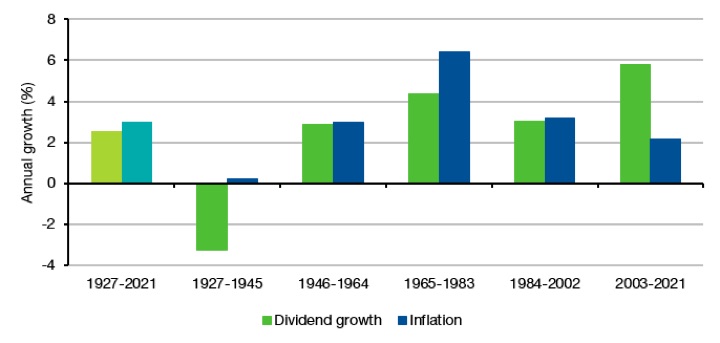
Background about why I track dividends. Stock dividends are a portion of profits that businesses have decided to distribute directly to shareholders, as opposed to reinvesting into their business, paying back debt, or buying back shares. The dividends may suffer some short-term drops, but over the long run they have grown faster than inflation.

In the US, the dividend culture is somewhat conservative in that shareholders expect dividends to be stable and only go up. Thus the starting yield is lower, but grows more steadily with smaller cuts during hard times. Here is the historical growth of the trailing 12-month (ttm) dividend paid by the Vanguard Total US Stock ETF (VTI), courtesy of StockAnalysis.com.

European corporate culture tends to encourage paying out a higher (sometimes fixed) percentage of earnings as dividends, but that also means the dividends move up and down with earnings. Thus the starting yield is higher but may not grow as reliably. Here is the historical growth of the trailing 12-month (ttm) dividend paid by the Vanguard Total International Stock ETF (VXUS).

The dividend yield (dividends divided by price) also serve as a rough valuation metric. When stock prices drop, this percentage metric usually goes up – which makes me feel better in a bear market. When stock prices go up, this percentage metric usually goes down, which keeps me from getting too euphoric during a bull market. Here’s a related quote from Jack Bogle (source):

The true investor will do better if he forgets about the stock market and pays attention to his dividend returns and to the operating results of his companies. – Jack Bogle

My personal portfolio income history. I started tracking the income from my portfolio in 2014. Here’s what the annual distributions from my portfolio look like over time:

  • $1,000,000 invested in my portfolio as of January 2014 would started out paying ~$24,000 in annual income over the previous 12 months. (2.4% starting yield)
  • If I reinvested the dividends/interest every quarter but added no other contributions, as of April 2023 it would have generated ~$52,000 in annual income over the previous 12 months.
  • Even if I SPENT all the dividends/interest every quarter and added no other contributions, as of April 2023 it would have generated ~$40,000 in annual income over the previous 12 months.

This chart shows how the annual income generated by my portfolio has increased over time and with dividend reinvestment.

I’m using simple numbers to illustrate things, but isn’t that a nicer, gentler way to track your progress?

TTM income yield. To estimate the income from my portfolio, I use the weighted “TTM” or “12-Month Yield” from Morningstar (checked 4/2/23), which is the sum of the trailing 12 months of interest and dividend payments divided by the last month’s ending share price (NAV) plus any capital gains distributed (usually zero for index funds) over the same period. The trailing income yield for this quarter was 3.33%, as calculated below. Then I multiply by the current balance from my brokerage statements to get the total income.

Asset Class / Fund % of Portfolio Trailing 12-Month Yield Yield Contribution
US Total Stock (VTI) 30% 1.60% 0.48%
US Small Value (VBR) 5% 2.20% 0.11%
Int’l Total Stock (VXUS) 20% 2.94% 0.59%
Int’l Small Value (AVDV/EYLD) 5% 4.23% 0.21%
US Real Estate (VNQ) 10% 4.11% 0.41%
Inter-Term US Treasury Bonds (VGIT) 15% 1.89% 0.28%
Inflation-Linked Treasury Bonds (TIP) 15% 6.12% 0.92%
Totals 100% 3.00%


My ttm portfolio yield is now roughly 3.00%, a bit lower than last quarter’s value. That means if my portfolio had a value of $1,000,000 today, I would have received $30,000 in dividends and interest over the last 12 months. (This is not the same as the dividend yield commonly reported in stock quotes, which just multiplies the last quarterly dividend by four.) US dividend rate went down a bit, international dividend rate went down a bit, Treasury bond yield is catching up, TIPS yield is still high from tracking CPI inflation.

What about the 4% rule? For goal planning purposes, I support the simple 4% or 3% rule of thumb, which equates to a target of accumulating roughly 25 to 33 times your annual expenses. I would lean towards a 3% withdrawal rate if you want to retire young (closer to age 50) and a 4% withdrawal rate if retiring at a more traditional age (closer to 65). It’s just a quick and dirty target, not a number sent down from the heavens. During the accumulation stage, your time is better spent focusing on earning potential via better career moves, improving in your skillset, and/or looking for entrepreneurial opportunities where you can have an ownership interest.

As a semi-retired investor that has been partially supported by portfolio income for a while, I find that tracking income makes more tangible sense in my mind and is more useful for those who aren’t looking for a traditional retirement. Our dividends and interest income are not automatically reinvested. They are another “paycheck”. Then, as with a traditional paycheck, we can choose to either spend it or invest it again to compound things more quickly. Even if we spend the dividends, this portfolio paycheck will still grow over time (see real numbers above). You could use this money to cut back working hours, pursue a different career path, start a new business, take a sabbatical, perform charity or volunteer work, and so on.

Right now, I am trying to fully appreciate the “my kids still think I’m cool and want to spend time with me” period of my life. It won’t last much longer. I am consciously choosing to work when they are at school but also consciously turning down work that doesn’t fit my priorities and goals. This portfolio income helps me do that.

MMB Humble Portfolio 2023 First Quarter Update: Asset Allocation & Performance

Here’s my quarterly update on my current investment holdings at the end of 2023 Q1, including our 401k/403b/IRAs and taxable brokerage accounts but excluding our residence and side portfolio of self-directed investments. Following the concept of skin in the game, the following is not a recommendation, but a sharing of our real, imperfect, low-cost, diversified DIY portfolio. Wouldn’t it be nice if everyone else did the same? (Many people do track the 13F filings of well-known investors.)

“Never ask anyone for their opinion, forecast, or recommendation. Just ask them what they have in their portfolio.” – Nassim Taleb

How I Track My Portfolio
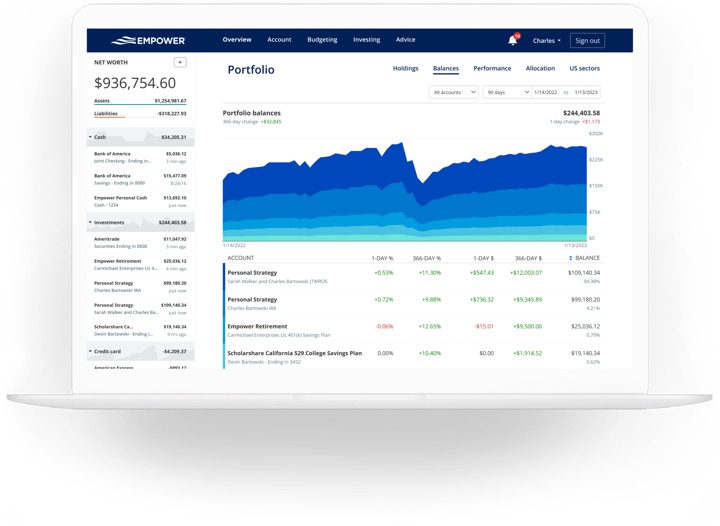
Here’s how I track my portfolio across multiple brokers and account types. There are limited free options after Morningstar discontinued free access to their portfolio tracker. I use both Empower Personal Dashboard and a custom Google Spreadsheet to track my investment holdings:

  • The Empower Personal Dashboard real-time portfolio tracking tools (free) automatically logs into my different accounts, adds up my various balances, tracks my performance, and calculates my overall asset allocation daily.
  • Once a quarter, I also update my manual Google Spreadsheet (free to copy, instructions) because it helps me calculate how much I need in each asset class to rebalance back towards my target asset allocation. I also create a new tab each quarter, so I have an archive of my holdings dating back many years.

2023 Q1 Asset Allocation and YTD Performance
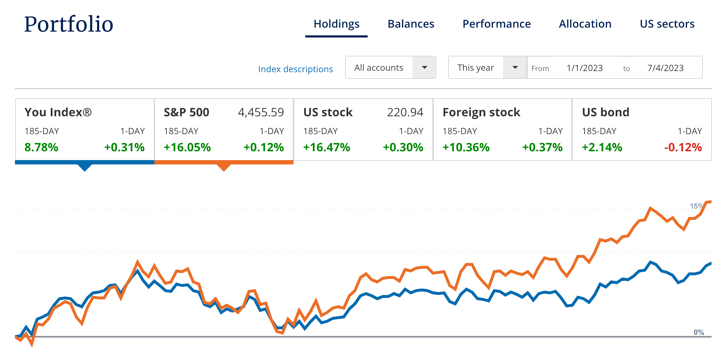
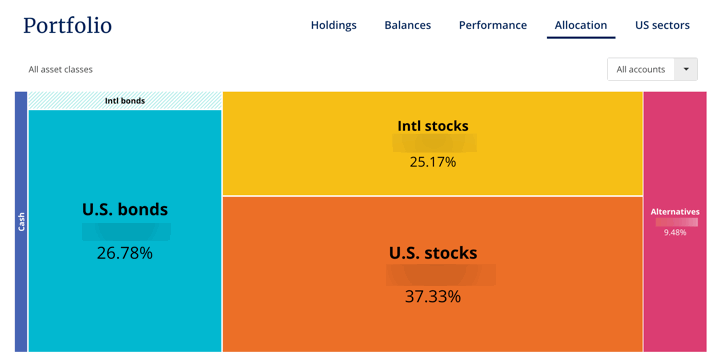
Here are updated performance and asset allocation charts, per the “Allocation” and “Holdings” tabs of my Personal Capital account.

Humble Portfolio Background. I call this my “Humble Portfolio” because it accepts the repeated findings that individuals cannot reliably time the market, and that persistence in above-average stock-picking and/or sector-picking is exceedingly rare. Charlie Munger believes that only 5% of professional money managers have the skill required to consistently beat the index averages after costs.

Costs matter and nearly everyone who sells outperformance, for some reason keeps charging even if they provide zero outperformance! By paying minimal costs including management fees, transaction spreads, and tax drag, you can essentially guarantee yourself above-average net performance over time.

I own broad, low-cost exposure to productive assets that will provide long-term returns above inflation, distribute income via dividends and interest, and finally offer some historical tendencies to balance each other out. I have faith in the long-term benefit of owning businesses worldwide, as well as the stability of high-quality US Treasury debt. My stock holdings roughly follow the total world market cap breakdown at roughly 60% US and 40% ex-US. I add just a little “spice” to the vanilla funds with the inclusion of “small value” ETFs for US, Developed International, and Emerging Markets stocks as well as additional real estate exposure through US REITs.

I strongly believe in the importance of knowing WHY you own something. Every asset class will eventually have a low period, and you must have strong faith during these periods to truly make your money. You have to keep owning and buying more stocks through the stock market crashes. You have to maintain and even buy more rental properties during a housing crunch, etc. A good sign is that if prices drop, you’ll want to buy more of that asset instead of less. I don’t have strong faith in the long-term results of commodities, gold, or bitcoin – so I don’t own them.

I do not spend a lot of time backtesting various model portfolios, as I don’t think picking through the details of the recent past will necessarily create superior future returns. You’ll find that whatever model portfolio is popular in the moment just happens to hold the asset class that has been the hottest recently as well.

Find productive assets that you believe in and understand, and just keep buying them through the ups and downs. Mine may be different than yours.

I have settled into a long-term target ratio of roughly 70% stocks and 30% bonds (or 2:1 ratio) within our investment strategy of buy, hold, and occasionally rebalance. My goal is more “perpetual income portfolio” as opposed to the more common “build up a big stash and hope it lasts until I die” portfolio. My target withdrawal rate is 3% or less. Here is a round-number breakdown of my target asset allocation.

  • 30% US Total Market
  • 5% US Small-Cap Value
  • 20% International Total Market
  • 5% International Small-Cap Value
  • 10% US Real Estate (REIT)
  • 15% US Treasury Nominal Bonds or FDIC-insured deposits
  • 15% US Treasury Inflation-Protected Bonds (or I Savings Bonds)

Commentary. The goal of this “Humble Portfolio” is to create sustainable income that keeps up with inflation to cover our household expenses. According to Empower, my portfolio went up about 4.9% YTD to 4/3/2023. There was only minor rebalancing with cashflows done this quarter.

Due to the rising real yield on TIPS and rising yields on nominal Treasuries and CDs, there is more incentive to micro-managed the bond side a little bit. When the real yields on individual long-term TIPS go above 1.5% and I have cash to reinvest into bonds, that is what I am buying. As usual, I am trying to maintain high yields across a 1 to 5 year ladder horizon by picking between savings accounts, no-penalty CD, longer-term 5-year CDs, and longer-term Treasuries. However, I am also balancing between the extra yield from opening a new account or just staying with an existing bank where I already have a relationship.

I’ll share about more about the income aspect in a separate post.
Credit Suisse Global Investment Returns Yearbook 2023: The Equity Premium

The 15th edition of the Credit Suisse Global Investment Returns Yearbook is available for free download in a 54-page PDF Summary Edition version on the Credit Suisse website. This publication provides a nice “big picture” overview of the long-term performance of global financial assets:

The Credit Suisse Global Investment Returns Yearbook is based on a unique database that offers a historical record of the real returns from equities, bonds, cash and currencies for 35 countries. The data spans developed and emerging markets, and stretches back to 1900. As well as being an important source of rich data on long-term investment returns, the 2023 edition contains analysis on topical issues that investors face today.

(You may be more familiar with the collapse of Credit Suisse and it’s government-brokered rescue and takeover, but this is more of a collaboration with market historians than investment bankers. I do hope that they keep publishing it in the future.)

I recommend scrolling through just to look at the cool charts with data from 1900. Here are just a few quick examples. Here is a chart that tracks the relative market capitalizations of world equity markets since 1900.

Then there the differences in the historical annualized real returns for equities, long-term government bonds, and US Treasury bills (very short-term government bonds).

Here are the annualized real returns of those three asset classes over three different periods for the United States:

Here are the annualized real returns (in USD) of those three asset classes over three different periods for the rest of the world (World ex-US):

You can see that the “equity premium” is very significant (on average) worldwide over the history that we have available, and of course that is why most of us invest at least partially in stocks today.