Bonds Are a Not a Hedge Against Stock Market Crashes (But Own Them Anyway)

Per Wikipedia, a financial “hedge” is an investment position intended to offset potential losses or gains that may be incurred by a companion investment. Wouldn’t be nice if for every Investment A, there was another Investment B that would always move in the opposite direction? Unfortunately, things aren’t so easy.

Here a reader e-mail that I definitely empathize with:

While I understand the dangers of performance-chasing, I’m getting more and more annoyed that bonds don’t do their jobs at stabilizing my portfolio. Last few years, they seem to have a positive correlation with stocks.

Things I’d love to better understand:
– say an ETF like BND, wouldn’t the fact that we know interests will be high for some foreseeable future already baked in the price of BND?
– Moving away from bonds at this point seems “late to the party” and market-timing…but like I said, I’m getting increasingly annoyed
– What could be good alternatives? What about dividend stocks such as the VIG ETF or some REITs?

Here’s a related excerpt from the Institutional Investor article Here’s Proof That Stocks Were Never an Inflation Hedge (emphasis mine):

Years of outsize returns also lulled investors on the correlation between stocks and bonds. Fixed income has historically acted as a portfolio stabilizer when markets are declining. When stocks tank, bonds have done well. But that correlation has changed over time.

From 1900-1949, Marsh explained, Credit Suisse found that the average correlation between stocks and bonds globally was 0.45, while from 1950 to 1999, the relationship had a correlation of 0.34.

As the authors wrote in the report: “The recent fortunes of 60/40 equity/bond strategies are a painful example of this, having trusted too heavily in the recent negative correlations between the two assets rather than properly consulting the history books.”

Here’s a direct quote from the Credit Suisse Global Investment Returns Yearbook 2023 (emphasis mine):

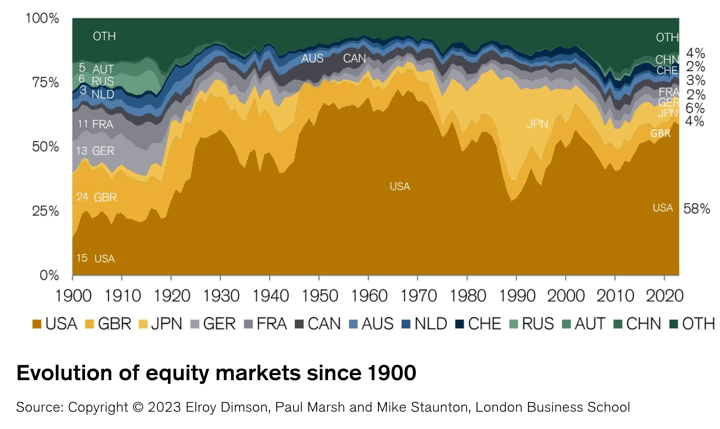
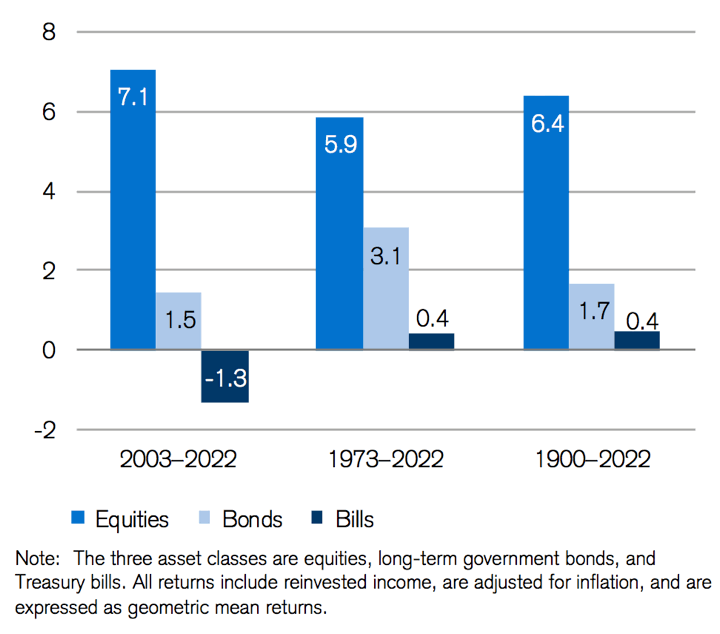
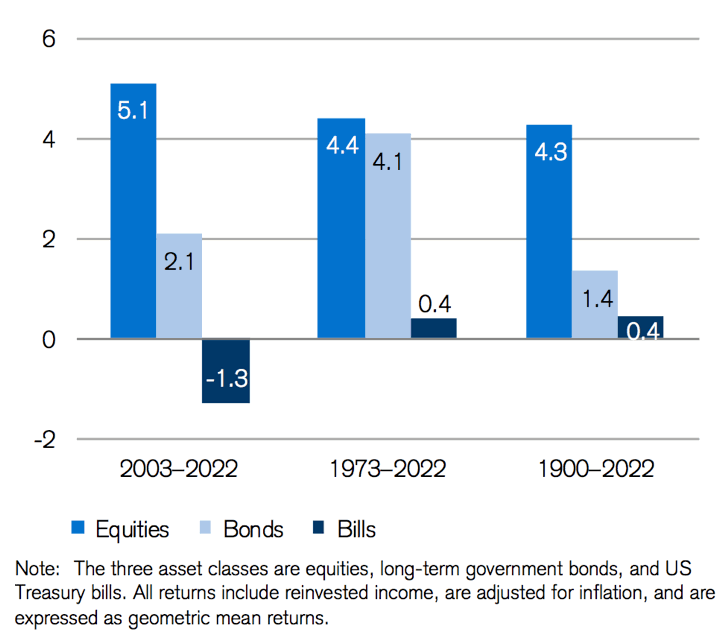
Many investors were caught off balance by the simultaneous fall in stocks and bonds and the poor performance of a classic 60:40 equity-bond portfolio (see Chapter 4). Over the previous two decades, investors had grown used to stocks and bonds providing a hedge for each other. However, we cautioned last year that this had been exceptional in the context of history. The negative correlation had been associated with a period of falling real interest rates, mostly accommodative monetary policy and generally low inflation, and we pointed out that “change was in the air.”

While bonds have had short periods of negative correlation with stocks, unfortunately the long term correlation is still moderately positive. In other words, bonds still tend to move in the same direction as stocks, just not as much. Bonds do have a stabilizing effect, but aren’t always an offsetting hedge to stock market drops.

I like to keep in mind that as interest rates rise, that means that the Fed has more room to cut rates quickly if a true recession occurs again and inflation cools. The Vanguard Total Bond ETF (BND) covers nearly the entire taxable bond universe and thus includes lots of different maturities with an average effective duration of about 6.5 years.

A useful rule of thumb is that for every 1% change in interest rates, the value of the bond will either increase or decrease by the same amount as its duration. So a 1% rate hike and it will go down 6.5%, and a 1% rate cut and it will go up 6.5%. If you want things more chill, you may want to pick a short duration and accept the lower returns.

If you zoom out on the Growth of $10,000 chart for the Vanguard Total Bond ETF, you can see it going up from the rate cuts and back down with the rate hikes. $10,000 invested in 2013 is worth about $11,000 today. That’s not a great rate of return but the ride was smooth compared to other asset classes, and with shorter-term bonds, it would have been even milder.

Higher yields also mean higher future returns. You may want to reconsider bailing out of bonds now. The Morningstar article The Return of the Bond Market summarizes the dynamic well:

Bonds have been painful and frustrating and have required a ton of patience.

But now the market has recalibrated, and yields have reset higher. Higher yields mean higher future returns. And for the first time in a while, you can make the argument that bonds provide true competition to stocks.

But a key aspect of the bond market is interest rates adjusting higher from zero, hurting most at the beginning. An increase in rates from 4% to 5% will be much less dramatic than the move from 1% to 2%, for the simple fact that if you’re getting paid a coupon of 4% to 5% and you reinvest, it has a tremendous compounding effect that isn’t replicated with 1%–2% yields.

In the end, I can’t predict future interest rates. If you want less sensitivity to interest rates, you should own shorter-term bonds or even just money market funds. Just know that if/when rates go down again, then BND will go back up a lot more than the money market fund. I personally hold a mix of cash/money market, short-term, and intermediate-term US Treasury bonds, CDs, and cash. I keep my overall average duration to less than 5 years. My overall yield is now close to 4%, rather than than 2%. These particular assets have a job in my portfolio as stabilizers, and I see them as still doing their job despite the losses when rates go up.

Passive Income via Fidelity Securities Lending: Expectation vs. Reality

I just experienced my own version of the “Expectation vs. Reality” meme when I looked at my monthly report from my Fidelity Investments securities lending activities, where I lend out my stock shares and get paid interest. I had been getting a lot of transaction notifications where all my shares of Paramount (PARA) were being lend out to somebody (most likely to short it).

Expectation. I previously wrote about earning some extra income via Fully Paid Lending Programs in general, including that from Fidelity. In December 2021, Fidelity was showing this as an example scenario:

As of March 2023, the example scenario on the official Fidelity page shows a significantly lower income rate:

Still, over $400 a month of extra income from a $100,000 balance? I have a six-figure taxable Fidelity account, so I figured I was leaving money on the table! Let’s go!

Reality. Out of all my stock holdings, the only one to garner any lending interest was Paramount. This mostly makes sense in retrospect, as I tend to buy larger, high-quality companies when they are temporarily out of fashion. You don’t really see a lot of people shorting Berkshire Hathaway. Paramount is more of a value/cheap P/E and/or dividend play. (Although, Berkshire does own 10% or so of Paramount…)

Here are my real-world stats on Paramount:

Shares on loan: 582

Market price: ~$23

Market value: ~$13,386

Annualized lending interest rate: 0.25%

Daily accrual: ~$0.10 a day.

Monthly pro-rated income: $2.79

Actual income: $1.91 (only borrowed for 19 days)

So… basically I was making 10 cents a day lending out my $13,000 of Paramount shares. At that rate, even if I had $100,000 worth of Paramount, I’d be making roughly 77 cents a day, or $23 a month. Nowhere near the $479 a month example.

Add in the fact that PARA is the only security being lent out in my entire portolio, and my securities lending income is currently working out to a pro-rate amount of less than 0.0004%, or 0.04 basis points.

Stocks Are Not an Inflation Hedge (But Own Them Anyway)

Per Wikipedia, a financial “hedge” is an investment position intended to offset potential losses or gains that may be incurred by a companion investment. Wouldn’t be nice if for every Investment A, there was another Investment B that would always move in the opposite direction? Unfortunately, things aren’t so easy.

A common question: Should we own stocks as a hedge against inflation? The Institutional Investor article Here’s Proof That Stocks Were Never an Inflation Hedge provides a little of clarification:

“Equities are not an inflation hedge. When inflation is high, they tend to do poorly. But in the long run, they have beaten inflation, so a lot of people claim they’re an inflation hedge, but [that claim is the result of confusion]. In the long run, stocks beat inflation, but they do it because of the equity risk premium. They are not an inflation hedge. They have a negative correlation with inflation,” said Marsh.

Historically, stocks actually tend to go down when inflation goes up.

Here’s a chart of the correlations between inflation and various asset classes over the last 120+ years from the Credit Suisse Global Investment Returns Yearbook 2023:

Here is Warren Buffett in his 2022 Berkshire Shareholder letter (emphasis mine):

During the decade ending in 2021, the United States Treasury received about $32.3 trillion in taxes while it spent $43.9 trillion.

Though economists, politicians and many of the public have opinions about the consequences of that huge imbalance, Charlie and I plead ignorance and firmly believe that near-term economic and market forecasts are worse than useless. Our job is to manage Berkshire’s operations and finances in a manner that will achieve an acceptable result over time and that will preserve the company’s unmatched staying power when financial panics or severe worldwide recessions occur. Berkshire also offers some modest protection from runaway inflation, but this attribute is far from perfect. Huge and entrenched fiscal deficits have consequences.

We can’t predict inflation, and we can’t expect stocks to go up when inflation does hit. However, we depend on businesses as a whole to continuously adapt (raising prices, lowering input costs, switching to alternative products, etc), so our best choice is to hold stocks and hope they continue to adapt through capitalism. If we only hold cash, we can only expect to break even after inflation at best, and usually go negative after taxes.

How To Destroy Your Wealth

Charlie Munger and his principle of inversion tells us that sometimes the easiest way to achieve something is to flip it and consider the best ways to accomplish exactly what you are trying to avoid. Accordingly, check out this slide deck about Avoiding Financial Disasters by Barry Ritholtz (full 1-hour video presentation here).

If you would like to destroy your wealth, here are the top 10 ways to do so:

This may sound overly simple, but nearly every single wealthy person who has gone broke has used one of these methods. Obviously some of these are harder to avoid than others, but most are clearly identifiable and avoidable. Give them a wide berth. For example, if you had most of your net worth in shares of Silicon Valley Bank or Signature Bank, you may have made big gains for a while, but in the end be left with nothing. You should only have to get rich once.

Also see: How To Make Your Life Completely Miserable

(Top photo credit to Jp Valery on Unsplash)

Best Interest Rates on Cash – March 2023

Here’s my monthly roundup of the best interest rates on cash as of March 2023, roughly sorted from shortest to longest maturities. We all need some safe assets for cash reserves or portfolio stability, and there are often lesser-known opportunities available to individual investors. Check out my Ultimate Rate-Chaser Calculator to see how much extra interest you could earn. Rates listed are available to everyone nationwide. Rates checked as of 3/7/2023.
TL;DR: 5% (fintech only) or 4.55% APY available on liquid savings. 5% APY available on multiple short-term CDs. Compare against Treasury bills and bonds at every maturity (12-month now above 5%). 6.89% Savings I Bonds can be bought with 2023 annual limits now.

Fintech accounts
Available only to individual investors, fintech companies often pay higher-than-market rates in order to achieve fast short-term growth (often using venture capital). “Fintech” is usually a software layer on top of a partner bank’s FDIC insurance.

  • 4.45% APY ($1 minimum). SaveBetter lets you switch between different FDIC-insured banks and NCUA-insured credit unions easily without opening a new account every time, and their liquid savings rates currently top out at 4.45%. This system makes it easier for you to maintain a top rate even if one bank decides to drop out of the “rate race”. 😉 There is usually another bank waiting in the wings that is still looking for deposits.
  • 5% on up to $25,000, then 4% up to $250k. Juno now pays 5% on all cash deposits up to $25,000 and 4% on cash deposits from $25,001 up to $250,000. No direct deposits required. $10 referral bonus. Please see my Juno review for details.
  • 4.00% APY on $6,000. Current offers 4% APY on up to $6,000 total ($2,000 each on three savings pods). Must maintain a direct deposit of $200+ every 35 days. $50 referral bonus for new members with $200+ direct deposit with promo code JENNIFEP185. Please see my Current app review for details.

High-yield savings accounts
Since the huge megabanks STILL pay essentially no interest, everyone should have a separate, no-fee online savings account to piggy-back onto your existing checking account. The interest rates on savings accounts can drop at any time, so I list the top rates as well as competitive rates from banks with a history of competitive rates. Some banks will bait you with a temporary top rate and then lower the rates in the hopes that you are too lazy to leave.

  • The leapfrogging to be the temporary “top” rate continues. UFB Direct at 4.55% APY. All America/Redneck Bank is at 4.25% APY for balances up to $75,000 ($500 to open, no min balance). Primis Bank dropped their rate, but grandfathered existing customers for the time being.
  • SoFi Bank is now up to 3.75% APY + up to $275 new account bonus with direct deposit. You must maintain a direct deposit of any amount each month for the higher APY. SoFi has their own bank charter now so no longer a fintech by my definition. See details at $25 + $250 SoFi Money new account and deposit bonus.
  • There are several other established high-yield savings accounts at 3.40%+ APY that aren’t the absolute top rate, but historically do keep it relatively competitive for those that don’t want to keep switching banks.

Short-term guaranteed rates (1 year and under)
A common question is what to do with a big pile of cash that you’re waiting to deploy shortly (plan to buy a house soon, just sold your house, just sold your business, legal settlement, inheritance). My usual advice is to keep things simple and take your time. If not a savings account, then put it in a flexible short-term CD under the FDIC limits until you have a plan.

  • No Penalty CDs offer a fixed interest rate that can never go down, but you can still take out your money (once) without any fees if you want to use it elsewhere. CIT Bank has a 11-month No Penalty CD at 4.10% APY with a $1,000 minimum deposit. Ally Bank has a 11-month No Penalty CD at 4.00% APY for all balance tiers. Marcus has a 13-month No Penalty CD at 3.85% APY with a $500 minimum deposit. You may wish to open multiple CDs in smaller increments for more flexibility.
  • Western Alliance Bank via SaveBetter has a 12-month certificate at 5.01% APY. $1 minimum. Early withdrawal penalty is 270 days of interest.
  • BMO Harris has a 12-month certificate at 5.00% APY. $1,000 minimum. Early withdrawal penalty is 180 days of interest.
  • Capital One Bank has a special 11-month certificate at 5.00% APY. Offer ends 3/14/23. No minimum deposit, early withdrawal penalty of 3 months of interest.

Money market mutual funds + Ultra-short bond ETFs*
Many brokerage firms that pay out very little interest on their default cash sweep funds (and keep the difference for themselves). * Money market mutual funds are regulated, but ultimately not FDIC-insured, so I would still stick with highly reputable firms. I am including a few ultra-short bond ETFs as they may be your best cash alternative in a brokerage account, but they may experience losses.

  • Vanguard Federal Money Market Fund is the default sweep option for Vanguard brokerage accounts, which has an SEC yield of 4.51%. Odds are this is much higher than your own broker’s default cash sweep interest rate.
  • Vanguard Ultra-Short-Term Bond Fund currently pays 4.54% SEC yield ($3,000 min) and 4.64% SEC Yield ($50,000 min). The average duration is ~1 year, so there is some term interest rate risk.
  • The PIMCO Enhanced Short Maturity Active Bond ETF (MINT) has a 4.71% SEC yield and the iShares Short Maturity Bond ETF (NEAR) has a 4.79% SEC yield while holding a portfolio of investment-grade bonds with an average duration of ~6 months.

Treasury Bills and Ultra-short Treasury ETFs
Another option is to buy individual Treasury bills which come in a variety of maturities from 4-weeks to 52-weeks and are fully backed by the US government. You can also invest in ETFs that hold a rotating basket of short-term Treasury Bills for you, while charging a small management fee for doing so. T-bill interest is exempt from state and local income taxes.

  • You can build your own T-Bill ladder at TreasuryDirect.gov or via a brokerage account with a bond desk like Vanguard and Fidelity. Here are the current Treasury Bill rates. As of 3/6/23, a new 4-week T-Bill had the equivalent of 4.68% annualized interest and a 52-week T-Bill had the equivalent of 5.06% annualized interest.
  • The iShares 0-3 Month Treasury Bond ETF (SGOV) has a 4.41% SEC yield and effective duration of 0.10 years. SPDR Bloomberg Barclays 1-3 Month T-Bill ETF (BIL) has a 4.34% SEC yield and effective duration of 0.08 years.

US Savings Bonds
Series I Savings Bonds offer rates that are linked to inflation and backed by the US government. You must hold them for at least a year. If you redeem them within 5 years there is a penalty of the last 3 months of interest. The annual purchase limit for electronic I bonds is $10,000 per Social Security Number, available online at TreasuryDirect.gov. You can also buy an additional $5,000 in paper I bonds using your tax refund with IRS Form 8888.

  • “I Bonds” bought between November 2022 and April 2023 will earn a 6.89% rate for the first six months. The rate of the subsequent 6-month period will be based on inflation again. More on Savings Bonds here.
  • In mid-April 2023, the CPI will be announced and you will have a short period where you will have a very close estimate of the rate for the next 12 months. I will have another post up at that time.
  • See below about EE Bonds as a potential long-term bond alternative.

Rewards checking accounts
These unique checking accounts pay above-average interest rates, but with unique risks. You have to jump through certain hoops which usually involve 10+ debit card purchases each cycle, a certain number of ACH/direct deposits, and/or a certain number of logins per month. If you make a mistake (or they judge that you did) you risk earning zero interest for that month. Some folks don’t mind the extra work and attention required, while others would rather not bother. Rates can also drop suddenly, leaving a “bait-and-switch” feeling.

  • Genisys Credit Union pays 5.25% APY on up to $7,500 if you make 10 debit card purchases of $5+ each, and opt into receive only online statements. Anyone can join this credit union via $5 membership fee to join partner organization.
  • Pelican State Credit Union pays 5.11% APY on up to $10,000 if you make 15 debit card purchases, opt into receive only online statements, and make at least 1 direct deposit, online bill payment, or automatic payment (ACH) per statement cycle. Anyone can join this credit union via partner organization membership.
  • The Bank of Denver pays 5.00% APY on up to $15,000 if you make 12 debit card purchases of $5+ each, receive only online statements, and make at least 1 ACH credit or debit transaction per statement cycle. Thanks to reader Bill for the updated info.
  • All America/Redneck Bank pays 4.50% APY on up to $15,000 if you make 10 debit card purchases each monthly cycle with online statements.
  • Presidential Bank pays 4.625% APY on balances between $500 and up to $25,000 (3.625% APY above that) if you maintain a $500+ direct deposit and at least 7 electronic withdrawals per month (ATM, POS, ACH and Billpay counts).
  • Find a locally-restricted rewards checking account at DepositAccounts.

Certificates of deposit (greater than 1 year)
CDs offer higher rates, but come with an early withdrawal penalty. By finding a bank CD with a reasonable early withdrawal penalty, you can enjoy higher rates but maintain access in a true emergency. Alternatively, consider building a CD ladder of different maturity lengths (ex. 1/2/3/4/5-years) such that you have access to part of the ladder each year, but your blended interest rate is higher than a savings account. When one CD matures, use that money to buy another 5-year CD to keep the ladder going. Some CDs also offer “add-ons” where you can deposit more funds if rates drop.

  • Credit Human has 24-month to 35-month CDs at 5.50% APY. $500 minimum to open. The early withdrawal penalty is 365 days of interest. Anyone can join this credit union via partner organization (no fee).
  • Sallie Mae Bank via SaveBetter has a 27-month CD at 4.85% APY. $1 minimum. Early withdrawal penalty is 180 days of simple interest.
  • Seattle Bank has a 5-year certificate at 4.70% APY ($1,000 min), 4-year at 4.65% APY, 3-year at 4.60% APY, 2-year at 4.55% APY, and 1-year at 4.50% APY. The early withdrawal penalty for the 5-year is a very reasonable 180 days of interest.
  • Lafayette Federal Credit Union has a 5-year certificate at 4.63% APY ($500 min), 4-year at 4.58% APY, 3-year at 4.52% APY, 2-year at 4.47% APY, and 1-year at 4.42% APY. They also have jumbo certificates with $100,000 minimums at even higher rates. The early withdrawal penalty for the 5-year is very high at 600 days of interest. Anyone can join this credit union via partner organization ($10 one-time fee).
  • You can buy certificates of deposit via the bond desks of Vanguard and Fidelity. You may need an account to see the rates. These “brokered CDs” offer FDIC insurance and easy laddering, but they don’t come with predictable early withdrawal penalties. Right now, I don’t see any competitive 5-year non-callable CDs. Be wary of higher rates from callable CDs, which means they can call back your CD if rates drop later.

Longer-term Instruments
I’d use these with caution due to increased interest rate risk, but I still track them to see the rest of the current yield curve.

  • Willing to lock up your money for 10 years? You can buy long-term certificates of deposit via the bond desks of Vanguard and Fidelity. These “brokered CDs” offer FDIC insurance, but they don’t come with predictable early withdrawal penalties. You might find something that pays more than your other brokerage cash and Treasury options. Right now, I see a 10-year CDs at (none available, non-callable) vs. 3.80% for a 10-year Treasury. Watch out for higher rates from callable CDs where they can call your CD back if interest rates drop.
  • How about two decades? Series EE Savings Bonds are not indexed to inflation, but they have a unique guarantee that the value will double in value in 20 years, which equals a guaranteed return of 3.5% a year. However, if you don’t hold for that long, you’ll be stuck with the normal rate, currently 2.10% for EE bonds issued November 1, 2022 to April 30, 2023. As of 3/6/23, the 20-year Treasury Bond rate was 4.14%.

All rates were checked as of 3/7/2023.

Berkshire Hathaway 2022 Annual Shareholder Letter by Warren Buffett Notes

Berkshire Hathaway (BRK) released its 2022 Letter to Shareholders, which is how Warren Buffett updates his fellow shareholders annually on the status of the business. Direct ownership of Berkshire Hathaway shares was one of my first “self-directed” investments (above index fund holdings) for both educational and profit purposes. The reason that people like me always mention Warren Buffett is not because he is smart, but because he is an excellent teacher that cuts through the fog of complex subjects. He writes this letter with his sister in mind. This year’s letter is only 9 pages long, so I recommend reading it for yourself.

This year, the letter covered a lot of familiar ground. That’s the thing about investing and personal finance though, most of it is just sticking with a few simple yet critical ideas for years and years. Build the habit to act honorably and rationally every day, and keep avoiding risks where you can lose everything. Here are my personal highlights.

Berkshire shareholders are different.

We believe Berkshire’s individual holders largely to be of the once-a-saver, always-a-saver variety. Though these people live well, they eventually dispense most of their funds to philanthropic organizations. These, in turn, redistribute the funds by expenditures intended to improve the lives of a great many people who are unrelated to the original benefactor. Sometimes, the results have been spectacular.

Berkshire owns both businesses in their entirety and pieces through publicly-traded stock shares. They take the long-term view with both:

Our goal in both forms of ownership is to make meaningful investments in businesses with both long-lasting favorable economic characteristics and trustworthy managers. Please note particularly that we own publicly-traded stocks based on our expectations about their long-term business performance, not because we view them as vehicles for adroit purchases and sales. That point is crucial: Charlie and I are not stock-pickers; we are business-pickers.

As investors, don’t cut the flowers and water the weeds. Hold onto those flowers. This applies to index fund investing as well. If you buy the entire haystack, you are guaranteed to own the needles (flowers).

The lesson for investors: The weeds wither away in significance as the flowers bloom. Over time, it takes just a few winners to work wonders. And, yes, it helps to start early and live into your 90s as well.

The pillars: continuous saving, the power of compounding, avoiding catastrophic failures, and the American Tailwind.

Thus began our journey to 2023, a bumpy road involving a combination of continuous savings by our owners (that is, by their retaining earnings), the power of compounding, our avoidance of major mistakes and – most important of all – the American Tailwind. America would have done fine without Berkshire. The reverse is not true.

More on the importance of risk management and having skin in the game. What do you do? “I own a boatload of cash and a wide array of businesses.” Sounds perfect. 😁

As for the future, Berkshire will always hold a boatload of cash and U.S. Treasury bills along with a wide array of businesses. We will also avoid behavior that could result in any uncomfortable cash needs at inconvenient times, including financial panics and unprecedented insurance losses. Our CEO will always be the Chief Risk Officer – a task it is irresponsible to delegate. Additionally, our future CEOs will have a significant part of their net worth in Berkshire shares, bought with their own money.

Don’t count on Berkshire being broken apart or starting to distribute dividends anytime soon:

And yes, our shareholders will continue to save and prosper by retaining earnings.

At Berkshire, there will be no finish line.

The letter ends with a bunch of wise quotes from Charlie Munger. Here’s just one.

There is no such thing as a 100% sure thing when investing. Thus, the use of leverage is dangerous. A string of wonderful numbers times zero will always equal zero. Don’t count on getting rich twice.

Past shareholder letter notes.

The 2024 annual shareholder meeting will be in Omaha on Saturday, May 4th. CNBC will most likely livestream it again.

Vanguard: 401(k) Balances Dropped by 20% in 2022, But Few Panicked

Vanguard has released some preview numbers from its 2023 America Saves report, which covers the nearly 5 million 401k, 403b, and other retirement plans that Vanguard administrates. More stats in this CNBC article.

Even though the average balance dropped by 20% in 2022, there wasn’t widespread panic or account changes. In fact, nearly 40% increased their deferral rate:

While average account balances decreased by 20% in 2022, primarily driven by negative market performance, participant behaviors mostly remained positive. Nearly 4 in 10 participants increased their deferral rate (either on their own or as part of an automatic annual increase), in line with previous years.

[…] And against a challenging market environment with increased volatility, only 6% of nonadvised participants traded, the lowest point in 20 years.

The table below goes into more detail. 50% of people kept their deferral rate the same, 24% of people allowed the auto-escalate feature to kick in, 15% manually increased their deferral rate, and 11% either manually decreased their deferral rate or set it to zero.

That means 89% of people kept their deferral rate the same or higher. 11% decreased. That 11% number is only a couple percentage points higher than in past years when the stock market went up.

Charlie Munger Daily Journal Annual Meeting 2023 Video, Transcript, and Highlights

Charlie Munger is now 99 years old and still answering blind questions on the fly at the 2023 Daily Journal Annual Shareholder Meeting. CNBC has posted the full 2+ hour interview with Becky Quick on YouTube. You’ll miss out on his snarky tone, but you may prefer to read the transcript, kindly provided at Steady Compounding (looks to be computer-generated… psst – the name is Rick Guerin!).

Munger remains refreshing in that he doesn’t filter everything into bland nothingness. He’s not afraid to offend with his opinions. I’ve included a few of my personal highlights below.

Only 5% of money managers have the skill required to consistently beat the index averages after costs.

And if you want an example of how denial is affecting things, take the world of investment management. How many managers are going to beat the indexes? All costs considered, I would say maybe 5% could consistently meet the averages.

Everybody else is living in the state of extreme denial. They’re used to charging big fees and so forth for stuff that isn’t doing their clients any good. It’s a deep moral depravity. If some widow comes to you with $500,000 and you charge her 1 point a year for, and you could put her in the indexes, but you need the 1 point. And so people just charge somewhat a considerable fee for worthless advice. And the whole profession is full of that kind of denial. It’s everywhere.

Crypto is (still) crap.

…when you’re dealing with something as awful as crypto sh*t, it’s just unspeakable. It’s an absolute horror. And I’m ashamed of my country that so many people believe in this kind of crap and the government allows it to exist is totally, absolutely crazy, stupid gambling with enormous house odds for the people on the other side.

And they cheat — in addition to cheating and like betting, it’s just crazy. So that is something. There’s only one correct answer for intelligent people there, just totally avoid it and avoid all the people that are promoting it.

Charles Munger is a billionaire, but rarely ever gambles in a casino or at a sports book. In terms of percent of net worth, Munger has bet the equivalent of the average person betting less than 5 bucks in their entire life.

Q: How do you feel about the gambling that took place at the Super Bowl and surrounding that and the legalized gambling taking place in this country at this point?

A: Well, it’s not as bad as crypto s***. I don’t think there’s much harm in betting a modest amount you can afford on a Super Bowl game. That strikes me as a pretty — thing if you do it with a friend and not with a bookie. So I don’t have the same feeling — I obviously don’t think you should have a gambling impulse around betting against odds. If you take all the money that I have bet against odds in my whole life, I don’t think it’s more than a few thousand dollars.

I’m all in favor betting with the odds.

Big picture thoughts on the future long-term performance of Berkshire and stocks in general:

Everybody that bought Berkshire and held it for 20 years has done well. I think that will be true for those who buy at the current price. I don’t think it will be as good in the future as it was in the past, but it will be okay considering how poorly everything else is going to do. Because the valuations start higher now and because government is so hostile to business.

I would say it will fluctuate naturally between administrations and so on. But I think basically, the culture of the world will become more and more anti-business in the big democracies. And I think taxes will go up, not down. So I think the investment world is going to get harder for everybody. And — but it’s been almost too easy in the past for the investment class. It’s natural that it would have a period of getting harder. I don’t worry about it much because I’m going to be dead.

The Daily Journal’s employee 401(k) plan has only one investment option: index funds.

…look at the Daily Journal Corporation. We just put in a 401(k) plan. What are the investment options for the people at work? Zero. It’s all index funds.

What percentage of American 401(k)s have our plan, index funds required? About zero. Am I right or am I wrong? Of course, I’m right. It’s a logical thing to do.

If you can afford to self-insure, you should do so. Insurance protects you against catastrophe, but there many extra costs built into the premiums (fraud, commissions, etc). Medical insurance is an exception because the insurance-negotiated cost is often much lower than the direct-consumer-pay cost.

In my own life, I’m a big self-insured and so is Warren. It’s ridiculous for me to carry fire insurance on my house because I could easily rebuild a house if burned down. So why would I want to bother fooling around with the claims process and all kinds of things.

So if insurance — you should insure against things you can’t afford to pay for yourself. But if you can afford to take the bumps, so unusual expense coming along doesn’t really hurt you that much. Why would you want to fool around with some insurance company. If your house burned down, I would just write a check and rebuild it. And all intelligent people do that way. I don’t say all, but — maybe I should say, all intelligent people should do it my way.

There should be way more self-insurance in life. There’s a lot of waste. You’re paying when you buy insurance for the other fellows frauds, and there’s a lot of fraud in life. And you can afford to take the risk yourself and not fool around with claims and this and that and commissions and time. Of course, you self insure, it’s simpler and so forth.

Think of what I’ve saved in my life. I narrowed it. I don’t care. I never carried — never. I think once — but with one exception, I never carried collision insurance on a car. And once I got rich, I stopped carrying fire insurance on houses. I just self insure.

Past years:

Sports Betting vs. Investing: Slight Edges Adding Up in Very Different Ways

According to CNBC, over 100 million bets were placed over Super Bowl weekend. Sports gambling is becoming more and more accepted as a casual part of the entertainment, but right now people are hiding from their spouses and partners the fact that they lost hundreds, thousands, or more. They are already planning their next bets to “just break even” and “just get back to zero” whereupon they promise themselves they will stop. But the more they bet, the deeper the hole gets.

A quick lesson on sports gambling odds. The standard odds on a basic spread bet are -110. Let’s take Super Bowl 54 as an example, where the betting line is Chiefs favored to win by 1.5 points over the 49ers. You can either bet on the Chiefs to win by 2 or more points (since 1.5 is impossible), or the 49ers to either win outright or lose by 1 point or fewer. Simple bet, only two outcomes. However, you must bet $110 in order to win $100. If you lose, you lose the entire $110. Feels very similar to a coin flip. However, the slight house edge is actually quite enormous over time.

Let’s say two people bet. $110 on one side, and $110 on the other side. One winning side will win, so they end up with $110 + $100 = $210. The other losing side ends up with nothing. The sports casino took zero risk and gets $10. $10 out of $220 is 4.5%. The casino got 4.5% of the total amount bet with essentially zero risk (the line moves to equalize both sides).

This “small” ~5% edge happens every single time, grinding you down to zero at a fast pace. If you bet $100 each time and lost $4.54 on average every bet, you’d have lost the entire $100 in 22 bets. In reality, the spread of possibilities is much wider, but with each bet, you are that much farther away from ever “breaking even” again. You keep playing, and the only inevitable result is broke. The only way to avoid catastrophe is to stop and accept the loss.

I am always disappointed when intelligent investing and gambling are confused. Here’s a timely tweet from @QCompounding:

Too many people focus on the first row above. 60% win and 40% lose? It looks too much like a coin flip. I put in money and my balance is lower after a year. Why bother?! Investing is the same as gambling, right? No! Over time, the fundamentals will win out. Investing directly in a basket of profitable companies with growing earnings is betting with the odds in your favor. Similarly, if you consistently buy real estate with conservative cashflow numbers, the odds are in your favor.

Investing with the edge in your favor adds up in a good way. The current price/earning ratio for companies in the S&P 500 index is about 20. That means if you buy $100 worth an S&P 500 ETF, that basket is earning $5 of profit every year. That $5 may be sent to you as a dividend check or used to reinvest into the business for future profits. It is a different “5%” edge”, but one that makes me excited instead as those earnings tend to keeping growing bigger over time. As you can see above, that edge adds up and will eventually overwhelm short-term market swings.

I recently read in a Warren Buffett biography that he once bought a slot machine and installed it in his house. He allowed his children to play with it, hoping that they would quickly learn a valuable lesson once their allowance kept disappearing into the machine. I wonder if that really worked.

I used to read up on various gambling strategies, but I have since personally decided to never bet on sporting events or casino games in the hopes that my children will never find interest in it. I want them to think – Why would I ever waste my time on things that virtually guarantee me to lose my hard-earned money? Instead, I hope to teach them to be excited when they see a good investment with positive expected returns.

Ally Invest and Ally Bank: Access High-Yield Vanguard and Fidelity Money Market Funds

Ally Invest is the self-directed brokerage arm of Ally Financial, and you may have an account from previous TradeKing and/or Zecco mergers. Ally Invest just removed their $9.95 mutual fund transaction fee, including for money market funds:

At Ally, we’re all about doing the right thing for our customers. That’s why we’re excited to share that as of February 9, 2023, we’ve eliminated our $9.95 mutual fund transaction fee.

You can access more than 17,000 mutual funds when you log in to your Ally Invest Self-Directed Trading account. Please note, other fees may still apply.

First of all, the default cash sweep for Ally Invest pays zero interest. In addition, this change may be of interest to customers who also use Ally Bank, given that their online savings account only pays 3.40% APY (as of 2/15/23). Meanwhile, here are the 7-day SEC yields (as of 2/14/23) of top money market funds:

  • Vanguard Cash Reserves Federal Money Market Fund Admiral Shares (VMRXX) – 4.51% ($3,000 min)
  • Vanguard Federal Money Market Fund (VMFXX) – 4.50% ($3,000 min)
  • Vanguard Municipal Money Market Fund (VMSXX) – 3.43% ($3,000 min)
  • Gabelli U.S. Treasury Money Market Fund (GABXX) – 4.43% ($10,000 min)
  • Fidelity Government Money Market Fund (SPAXX) – 4.19% ($100 min*)

* The Fidelity fund does not have a minimum itself, but Ally has a $100 minimum order size for online mutual fund orders.

I have gone into my Ally Invest account and manually tested all of the money market mutual funds listed above, and it let me put in the order at the minimum amounts shown. Ally Invest also does not charge a short-term redemption fee. I was able to make an instant transfer of funds from my Ally Bank deposit accounts to my Ally Invest brokerage account. Therefore, if you have an Ally Bank account and don’t want to look too far elsewhere, you may consider this option to increase the yield on your cash holdings.

Best Interest Rates on Cash – February 2023

Here’s my monthly roundup of the best interest rates on cash as of February 2023, roughly sorted from shortest to longest maturities. We all need some safe assets for cash reserves or portfolio stability, and there are often lesser-known opportunities available to individual investors. Check out my Ultimate Rate-Chaser Calculator to see how much extra interest you’d earn by moving money between accounts. Rates listed are available to everyone nationwide. Rates checked as of 2/12/2023.

TL;DR: 5% APY available on liquid savings. 5% APY available on multiple short-term CDs. Compare against Treasury bills and bonds at every maturity (12-month near 4.89%). 6.89% Savings I Bonds can be bought with 2023 annual limits now.

Fintech accounts
Available only to individual investors, fintech companies often pay higher-than-market rates in order to achieve fast short-term growth (often using venture capital). “Fintech” is usually a software layer on top of a partner bank’s FDIC insurance.

  • 5% on up to $25,000, then 4% up to $250k. Juno now pays 5% on all cash deposits up to $25,000 and 4% on cash deposits from $25,001 up to $250,000. No direct deposits required. $10 referral bonus. Please see my Juno review for details.
  • 4.00% APY on $6,000. Current offers 4% APY on up to $6,000 total ($2,000 each on three savings pods). Must maintain a direct deposit of $200+ every 35 days. $50 referral bonus for new members with $200+ direct deposit with promo code JENNIFEP185. Please see my Current app review for details.

High-yield savings accounts
Since the huge megabanks STILL pay essentially no interest, I think every should have a separate, no-fee online savings account to accompany your existing checking account. The interest rates on savings accounts can drop at any time, so I list the top rates as well as competitive rates from banks with a history of competitive rates. Some banks will bait you with a temporary top rate and then lower the rates in the hopes that you are too lazy to leave.

  • The leapfrogging to be the temporary “top” rate continues. Primis Bank at 5.03% APY for both checking and savings. All America/Redneck Bank is at 4.25% APY for balances up to $75,000 ($500 to open, no min balance).
  • SoFi Bank is now up to 3.75% APY + up to $275 new account bonus with direct deposit. You must maintain a direct deposit of any amount each month for the higher APY. SoFi has their own bank charter now so no longer a fintech by my definition. See details at $25 + $250 SoFi Money new account and deposit bonus.
  • There are several other established high-yield savings accounts at 3.40%+ APY that aren’t the absolute top rate, but historically do keep it relatively competitive for those that don’t want to keep switching banks.

Short-term guaranteed rates (1 year and under)
A common question is what to do with a big pile of cash that you’re waiting to deploy shortly (plan to buy a house soon, just sold your house, just sold your business, legal settlement, inheritance). My usual advice is to keep things simple and take your time. If not a savings account, then put it in a flexible short-term CD under the FDIC limits until you have a plan.

  • No Penalty CDs offer a fixed interest rate that can never go down, but you can still take out your money (once) without any fees if you want to use it elsewhere. CIT Bank has a 11-month No Penalty CD at 4.10% APY with a $1,000 minimum deposit. Ally Bank has a 11-month No Penalty CD at 3.85% APY for all balance tiers. Marcus has a 13-month No Penalty CD at 3.85% APY with a $500 minimum deposit. You may wish to open multiple CDs in smaller increments for more flexibility.
  • BMO Harris has a 12-month certificate at 5.00% APY. $1,000 minimum. Early withdrawal penalty is 180 days of interest.
  • Capital One Bank has a special 11-month certificate at 5.00% APY. No minimum deposit, early withdrawal penalty of 3 months of interest.

Money market mutual funds + Ultra-short bond ETFs*
Many brokerage firms that pay out very little interest on their default cash sweep funds (and keep the difference for themselves). * Money market mutual funds are regulated, but ultimately not FDIC-insured, so I would still stick with highly reputable firms. I am including a few ultra-short bond ETFs as they may be your best cash alternative in a brokerage account, but they may experience short-term losses.

  • Vanguard Federal Money Market Fund is the default sweep option for Vanguard brokerage accounts, which has an SEC yield of 4.50%. Odds are this is much higher than your own broker’s default cash sweep interest rate.
  • Vanguard Ultra-Short-Term Bond Fund currently pays 4.33% SEC yield ($3,000 min) and 4.43% SEC Yield ($50,000 min). The average duration is ~1 year, so there is some term interest rate risk.
  • The PIMCO Enhanced Short Maturity Active Bond ETF (MINT) has a 4.62% SEC yield and the iShares Short Maturity Bond ETF (NEAR) has a 4.62% SEC yield while holding a portfolio of investment-grade bonds with an average duration of ~6 months.

Treasury Bills and Ultra-short Treasury ETFs
Another option is to buy individual Treasury bills which come in a variety of maturities from 4-weeks to 52-weeks and are fully backed by the US government. You can also invest in ETFs that hold a rotating basket of short-term Treasury Bills for you, while charging a small management fee for doing so. T-bill interest is exempt from state and local income taxes.

  • You can build your own T-Bill ladder at TreasuryDirect.gov or via a brokerage account with a bond desk like Vanguard and Fidelity. Here are the current Treasury Bill rates. As of 2/10/23, a new 4-week T-Bill had the equivalent of 4.61% annualized interest and a 52-week T-Bill had the equivalent of 4.89% annualized interest.
  • The iShares 0-3 Month Treasury Bond ETF (SGOV) has a 4.18% SEC yield and effective duration of 0.10 years. SPDR Bloomberg Barclays 1-3 Month T-Bill ETF (BIL) has a 4.11% SEC yield and effective duration of 0.08 years.

US Savings Bonds
Series I Savings Bonds offer rates that are linked to inflation and backed by the US government. You must hold them for at least a year. If you redeem them within 5 years there is a penalty of the last 3 months of interest. The annual purchase limit for electronic I bonds is $10,000 per Social Security Number, available online at TreasuryDirect.gov. You can also buy an additional $5,000 in paper I bonds using your tax refund with IRS Form 8888.

  • “I Bonds” bought between November 2022 and April 2023 will earn a 6.89% rate for the first six months. The rate of the subsequent 6-month period will be based on inflation again. More on Savings Bonds here.
  • In mid-April 2023, the CPI will be announced and you will have a short period where you will have a very close estimate of the rate for the next 12 months. I will have another post up at that time.
  • See below about EE Bonds as a potential long-term bond alternative.

Prepaid Cards with Attached Savings Accounts
A small subset of prepaid debit cards have an “attached” FDIC-insured savings account with exceptionally high interest rates. The negatives are that balances are severely capped, and there are many fees that you must be careful to avoid (lest they eat up your interest). There is a long list of previous offers that have already disappeared with little notice. I don’t personally recommend nor use any of these anymore, as I feel the work required and the fees charged if you mess up exceeds any small potential benefit.

  • Mango Money pays 6% APY on up to $2,500, if you manage to jump through several hoops. Requirements include $1,500+ in “signature” purchases and a minimum balance of $25.00 at the end of the month.
  • NetSpend Prepaid pays 5% APY on up to $1,000 but be warned that there is also a $5.95 monthly maintenance fee if you don’t maintain regular monthly activity.

Rewards checking accounts
These unique checking accounts pay above-average interest rates, but with unique risks. You have to jump through certain hoops which usually involve 10+ debit card purchases each cycle, a certain number of ACH/direct deposits, and/or a certain number of logins per month. If you make a mistake (or they judge that you did) you risk earning zero interest for that month. Some folks don’t mind the extra work and attention required, while others would rather not bother. Rates can also drop suddenly, leaving a “bait-and-switch” feeling.

  • Genisys Credit Union pays 5.25% APY on up to $7,500 if you make 10 debit card purchases of $5+ each, and opt into receive only online statements. Anyone can join this credit union via $5 membership fee to join partner organization.
  • Pelican State Credit Union pays 5.11% APY on up to $10,000 if you make 15 debit card purchases, opt into receive only online statements, and make at least 1 direct deposit, online bill payment, or automatic payment (ACH) per statement cycle. Anyone can join this credit union via partner organization membership.
  • The Bank of Denver pays 5.00% APY on up to $15,000 if you make 12 debit card purchases of $5+ each, receive only online statements, and make at least 1 ACH credit or debit transaction per statement cycle. Thanks to reader Bill for the updated info.
  • All America/Redneck Bank pays 4.50% APY on up to $15,000 if you make 10 debit card purchases each monthly cycle with online statements.
  • Presidential Bank pays 4.25% APY on balances between $500 and up to $25,000 (3.00% APY above that) if you maintain a $500+ direct deposit and at least 7 electronic withdrawals per month (ATM, POS, ACH and Billpay counts).
  • Find a locally-restricted rewards checking account at DepositAccounts.

Certificates of deposit (greater than 1 year)
CDs offer higher rates, but come with an early withdrawal penalty. By finding a bank CD with a reasonable early withdrawal penalty, you can enjoy higher rates but maintain access in a true emergency. Alternatively, consider building a CD ladder of different maturity lengths (ex. 1/2/3/4/5-years) such that you have access to part of the ladder each year, but your blended interest rate is higher than a savings account. When one CD matures, use that money to buy another 5-year CD to keep the ladder going. Some CDs also offer “add-ons” where you can deposit more funds if rates drop.

  • Navy Federal Credit Union has a special 15-month CD at 5% APY. Open now with just $50, but you can still add on more deposits later. You must have a military relationship to join NavyFed.
  • Sallie Mae Bank via SaveBetter has a 27-month CD at 4.85% APY. $1 minimum. Early withdrawal penalty is 180 days of simple interest.
  • Seattle Bank has a 5-year certificate at 4.70% APY ($1,000 min), 4-year at 4.65% APY, 3-year at 4.60% APY, 2-year at 4.55% APY, and 1-year at 4.50% APY. The early withdrawal penalty for the 5-year is a very reasonable 180 days of interest.
  • Lafayette Federal Credit Union has a 5-year certificate at 4.63% APY ($500 min), 4-year at 4.58% APY, 3-year at 4.52% APY, 2-year at 4.47% APY, and 1-year at 4.42% APY. They also have jumbo certificates with $100,000 minimums at even higher rates. The early withdrawal penalty for the 5-year is very high at 600 days of interest. Anyone can join this credit union via partner organization ($10 one-time fee).
  • You can buy certificates of deposit via the bond desks of Vanguard and Fidelity. You may need an account to see the rates. These “brokered CDs” offer FDIC insurance and easy laddering, but they don’t come with predictable early withdrawal penalties. Right now, I don’t see any competitive 5-year non-callable CDs. Be wary of higher rates from callable CDs, which means they can call back your CD if rates drop later.

Longer-term Instruments
I’d use these with caution due to increased interest rate risk, but I still track them to see the rest of the current yield curve.

  • Willing to lock up your money for 10 years? You can buy long-term certificates of deposit via the bond desks of Vanguard and Fidelity. These “brokered CDs” offer FDIC insurance, but they don’t come with predictable early withdrawal penalties. You might find something that pays more than your other brokerage cash and Treasury options. Right now, I see a 10-year CDs at (none available, non-callable) vs. 3.80% for a 10-year Treasury. Watch out for higher rates from callable CDs where they can call your CD back if interest rates drop.
  • How about two decades? Series EE Savings Bonds are not indexed to inflation, but they have a unique guarantee that the value will double in value in 20 years, which equals a guaranteed return of 3.5% a year. However, if you don’t hold for that long, you’ll be stuck with the normal rate, currently 2.10% for EE bonds issued November 1, 2022 to April 30, 2023. As of 2/10/23, the 20-year Treasury Bond rate was 3.96%.

All rates were checked as of 2/12/2023.

Tiicker: Shareholder Perks: New $100 Amazon GC Offer

Update: Tiicker has added a few new Perks for Real Good Foods, the most direct one being a $100 Amazon gift card for holding 50 shares of RGF with no minimum holding period. There are also other bigger perks for holding a lot more shares for at least a week. The bid/ask spread was about 10 cents, so it cost about $5 to buy/sell 50 shares quickly. You can get this even if you already got the previous $50 gift card from owning RGF (now expired). Limited quantities.

Original post:

TiiCKER is a new app that helps promote certain brands and companies by encouraging people to become shareholders and investors. (They say “ii” stands for individual investor.) In the past, Wrigley used to give out free packs of gum to shareholders, Dial used to give out soap coupons, Colgate-Palmolive gave out discounts on toothpaste, and so on. Shareholder perks are still somewhat popular in Japan, from baseball tickets to bags of rice. Found via DoC. Here are the perks currently available:

  • Link a brokerage with $100 worth of ANY stocks held inside, get $11 Amazon gift card or Visa virtual prepaid debit card.
  • (EXPIRED?) Link a brokerage with $50 worth of Amazon (AMZN) stock held inside (partial shares allowed), get $10 Amazon gift card or Visa virtual prepaid debit card.
  • (EXPIRED) Link a brokerage with $50 worth of Real Good Foods (RGF) held inside, get $50 Instacart gift card. Limited quantities.
  • (There are other perks available, please see Tiicker site for current list.)

Sometimes they require a minimum holding period, but the perks above currently do not. A few screenshots of an expired perk:

In order to prove your ownership, you must link your existing brokerage account via the Plaid service. Plaid says it does not save nor share your username and passwords with anyone, and with many brokerages, you now log in directly on your brokerage website for authentication.

I can report that I was able to sign-up, link my account via Plaid, and grab the first two bonuses in under 5 minutes. Since this is not a brokerage account, no SSN was required. Gift card redemption was instant and easy. You may need to refresh or unlink/relink your brokerage account after buying the shares for it to recognize a new purchase, or possibly wait up to 24 hours. In many cases, the perk is quite valuable compared the cost of buying and selling the shares, although this can get tricky when the holding period is longer. In addition, I have noticed this “RealGood” brand at Whole Foods and may try it now, so hey, this marketing may actually work…

Tiicker has a referral program, although the reward is vague: “Spread the word and help others discover investor perks. Refer 5 friends and receive a free TiiCKER perk!” If you wish, you can use my my referral link. Thanks if you do.