Vanguard Adds $20 Annual Paper Statement Fee For Accounts Under $1 Million

If you have brokerage accounts with Vanguard, you may have received an email with the somewhat vague subject line “The fee policy is changing for brokerage accounts”. Whenever fees goes down, the subject line is usually “WE SAVED YOU MONEY BY DROPPING THIS FEE!! 🎉🎉🎉” Whenever fees goes up, it’s “btw we made some changes”. So you can guess what this means.

The new policy is that all Vanguard brokerage accounts have a $20 annual fee, unless you have any one of the following:

  • You have elected e-delivery of statements and the annual privacy policy notice; confirmations; reports, prospectuses, and proxy materials; and notices, amendments, and other important account updates,
  • Your brokerage accounts are enrolled in an advisory program serviced by an affiliate of Vanguard,
  • You have at least $1 million in qualifying Vanguard assets, or
  • You are a client who has an organization or a trust account registered under an employee identification number (EIN).

To my knowledge, the $20 annual fee used to be waived for accounts with at least $10,000 in assets. Basically, Vanguard has effectively added a paper statement fee to anyone with less than $1,000,000 in assets. That’s quite a big change in the number of affected customers. You can still elect to receive paper tax forms for no fee.

I don’t mind stopping monthly paper statements, especially since Vanguard does a good job of collecting everything from the past quarter onto their quarterly statements (and past year on their end-of-year statements). The March statement contains all the transactions for January through March, and so on. I’m also happy to receive electronic versions of prospectuses and such, those thick booklets add up to a lot of paper.

However, I do like having an annual paper statement and it would be nice if they still offered that option for free for those with $10,000+ in assets. That’s already reducing the amount of paper mailings by over 90%. Having dealt with estate issues, it’s just nice to have any sort of physical paper trail when searching for accounts. I always say that I’ll collect my monthly e-statements and manually print out a year-end for every single financial account for physical storage, but in reality I don’t.

Note: This fee is for Vanguard brokerage accounts. Vanguard mutual fund accounts also have their own new $20 fee, which is $20 for EACH Vanguard mutual fund (waived with at least $1 million in qualifying Vanguard assets). Vanguard really wants to you convert your mutual fund accounts to a brokerage account. (My opinion is that the conversion wasn’t that bad at all, but these days anything that might force a customer service interaction with Vanguard means a possible 1-hour phone hold time. 👎)

Citi Self Invest Brokerage: Up to $500 New Deposit or ACAT Transfer Bonus

Citi has started their own self-directed brokerage arm called Citi Self Invest, joining $0 commission bank competitors like Chase, BofA, and Wells Fargo. They are also running a promotion for existing Citi banking or credit card customers to gather new deposits and ACAT transfers, with the current bonus worth up to $500, depending the value of assets that you move over:

  • $100 with $10,000-$49,999 in qualifying new money
  • $200 with $50,000–$199,999 in qualifying new money
  • $500 with $200,000+ in qualifying new money

Here are the steps:

  1. Fund a new or existing Citi Self Invest Account between 3/1/22 and 10/31/22. You must also have an eligible individual Citibank checking or Savings account or an eligible Citi Card account with digital access through Citibank Online.
  2. Fund the Citi Self Invest Account with a minimum of $10,000 in New-To-Citi funds within the Account Funding Period shown below (see below for New-To-Citi funds).
  3. Maintain the New-To Citi funds in your Citi Self Invest account through the Maintain Funds deadline shown below based on month of account opening.
  4. During the account opening process, allow for eDelivery of statements and confirmations,

Here is the deadline calendar:

Here’s their terms on what “new to Citi” funds means:

New-to-Citi Funds are cash that must come from an external, non-Citi, source through a standard transfer method (e.g., a standard Transfer of Assets form, check, electronic funds transfer, ADM deposit). New-to-Citi Funds are: 1) funds deposited from external accounts or payees other than Citibank, N.A. and its affiliates and 2) must be deposited using domestic ACH transfer, Direct Deposit, checks drawn on banks other than Citibank, N.A. wire transfer, trustee to trustee transfer, or ACAT securities transfers.

Update: A rep for Citi reached out to me to say:

To clarify, the value of marketable securities like stocks and ETFS that are transferred via ACAT are included in the definition of “new to Citi funds” and are eligible for the bonus.

This is good news and makes it easier to satisfy the higher tier requirements if you already have a portfolio of ETFs or individuals stocks to move over.

Even if you move over cash, according to the calendar, your minimum holding period is as little as a month. For example, open in August, fund by 9/30, and hold until 10/31 to qualify. The $100 bonus on $10,000 is earning 1% in a month, or the equivalent of 12% APY when annualized. Unfortunately, you have to wait until 1/31/23 to get the bonus, but at least this is a no fee, no minimum balance, no commission brokerage account.

If you keep your cash in there for longer than the minimum of one month, you should also take into account the potential lost interest if you are only using their default cash sweep account. You might consider investing your funds into ultra-short bond ETFs like MINT or Treasury Bill ETFs like GBIL (still possible to lose value). I’m not sure if Citi Self Invest will let you buy Treasury bills directly.

Citi also has an alternative bonus for their Citi Personal Wealth Management account, with better bonus ratios for new deposits of $50,000 and up, and total bonuses worth up to $5,000. However, I’m not sure about the fee structure for the Personal Wealth Management accounts which involve a “dedicated Citi Personal Wealth Management Financial Advisor who can provide personalized planning and investment guidance” with a vague “pricing varies based on investments selected”. Seems like it might be more work if you don’t want their financial advice, but might be worth a phone call to the number in the link if you have $50,000+ as the minimum holding period is still one month.

JP Morgan Guide to Retirement 2022: Personal Finance Charts and Graphics

The JP Morgan Guide to Retirement slide deck is provided to its advisors to discuss retirement planning with clients. Updated annually, they kindly share this document publicly and it contains many useful charts and graphs, like the one above that reminds us to focus on what you can control, and to not waste time and energy on what you can’t. Below are a few more highlights from the 52-page 2022 edition that I found most helpful.

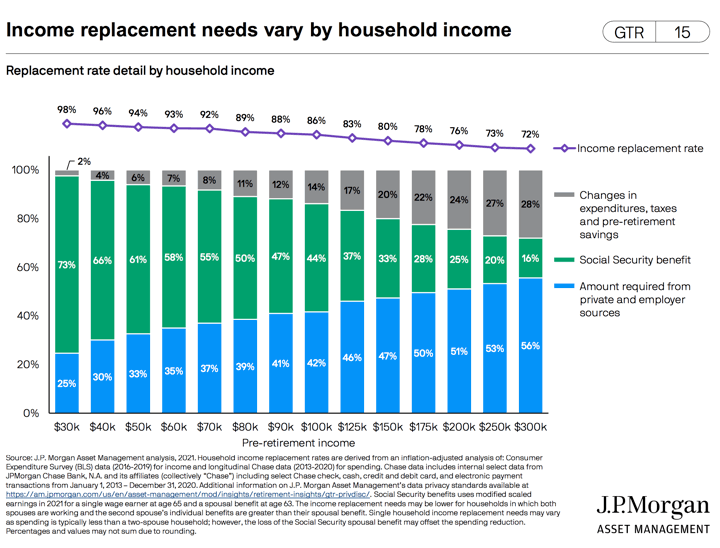
How does everyone else manage given all the news of low savings balances? Well, the reason it is called “Social Security” is because without it, there would be widespread poverty amongst seniors. The higher your spending, the more you must rely on your other assets to replace your current income in retirement.

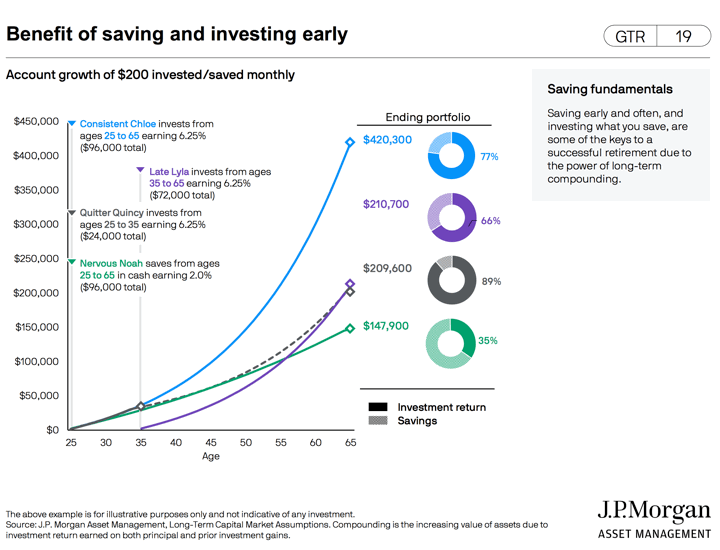
You may have seen variations of this chart elsewhere, where “Quitter Quincy” who starts early but completely stops after only 10 years ends up at the same place as “Late Lyla” who starts late but contributes for another 30 years (triple the time).

How the average household spending changes by age (amongst relatively well-off households).

How to prioritize your savings.

Look how “Escalating Ethan” does nearly as well by allowing a 1% auto-escalation once a year.

You might think that because you pay 401k loans back into the original account plus interest that it won’t hurt your final retirement balance, but the missed compounding growth can really impact things.

Robinhood New Account Deposit Bonus (Up to $600)

Robinhood brokerage app has up to a $600 bonus for new customers that deposit a certain amount of money. Here are the highlights:
  • New customers must sign up for Robinhood using the promotion page and get approved by August 17, 2022.
  • Link your bank account to your Robinhood brokerage account. (ACAT transfers also count.)
  • Deposit money into your account by September 16, 2022 and keep deposits in your account through October 16, 2022 to earn up to $600. You can earn $25 for depositing $1,000 – $9,999, $100 for $10,000 – $49,999, $300 for $50,000 – $99,999, or $600 for $100,000+.
  • Rewards will be delivered by October 21, 2022. If you receive a reward, you’ll have 30 days to claim it. Once claimed, you can use it to invest right away, but you can’t withdraw the cash value for 30 days.

See full terms.

This is a pretty good reward (if you have the cash) due to the short required holding period of just one month, plus the bonus is supposed to post within 5 days after the month is over.

Vanguard Cash Deposit Program: New Cash Sweep Option (Currently Invitation Only)

Vanguard has been gradually rolling out a new option for the cash settlement sweep in your Vanguard Brokerage Account. The Vanguard Cash Deposit is FDIC-insured via partner banks and is currently available to select customers on an invitation-only basis:

Currently, enrollment in the Vanguard Cash Deposit program is by invitation only to existing clients who have at least one Vanguard Brokerage Account. Mutual fund accounts, 529s, or other accounts are not eligible for Vanguard Cash Deposit.

Here is a quick comparison of the interest rates from the two available options:

Banking Partners (as of 8/10/2022)

  • Valley National Bank (FDIC cert. 9396)
  • NexBank (FDIC cert. 29209)
  • Synovus Bank (FDIC cert. 873)
  • Bank of Baroda (FDIC cert. 33681) (coming soon)
  • Synchrony Bank (FDIC cert. 27314) (coming soon)

Commentary. Vanguard’s existing cash sweep fund, the Vanguard Federal Money Market Fund (VMFXX), already invests “at least 99.5% of its total assets in cash, U.S. government securities, and/or repurchase agreements that are collateralized solely by U.S. government securities or cash (collectively, government securities).” In other words, everything inside is also fully backed by the US government. I am a big fan of FDIC insurance, but even I don’t lose any sleep at all about the safety of VMFXX, not to mention I’ve found VMFXX historically tracks short-term interest rates quite well. As of this writing (8/10/22), VMFXX is yielding about 35 basis points more than the Cash Deposit sweep.

I don’t know if this new cash sweep option is in response to consumer demand, or if it will serve as a profit source for Vanguard. I’m sure that some people out there will prefer having FDIC insurance, even it means less interest income. (Be sure not to exceed the FDIC limits at any of the partner banks, such as having separate account held there.) For now, I’ll pass. If the Cash Deposit sweep does start earning a lot more, I would consider switching.

If you wish to opt in to this option, you can try to check if you are “invited” by visiting the product page, clicking on “Choose Vanguard Cash Deposit”, and logging into your Vanguard brokerage account. I was also repeatedly greeted by a pop-up window upon login.

How Do Your 401(k) Stats Compare? Vanguard How America Saves 2022

Vanguard recently released the 2022 edition of their annual How America Saves report, a 110-page report targeted at industry insiders which looks at the nearly 5 million 401k, 403b, and other defined-contribution retirement plans. If you wish to geek out on 401k stats, there is a great deal of information in this report. Here are a few highlights based on 2021 data:

Employee contributions. The average/median employee contribution rate amongst participants was 7.3%/6.1% in 2021. Median means that half of people were saving more, while half were saving less. Average is weighted more by absolute dollar savings. (Click to enlarge.)

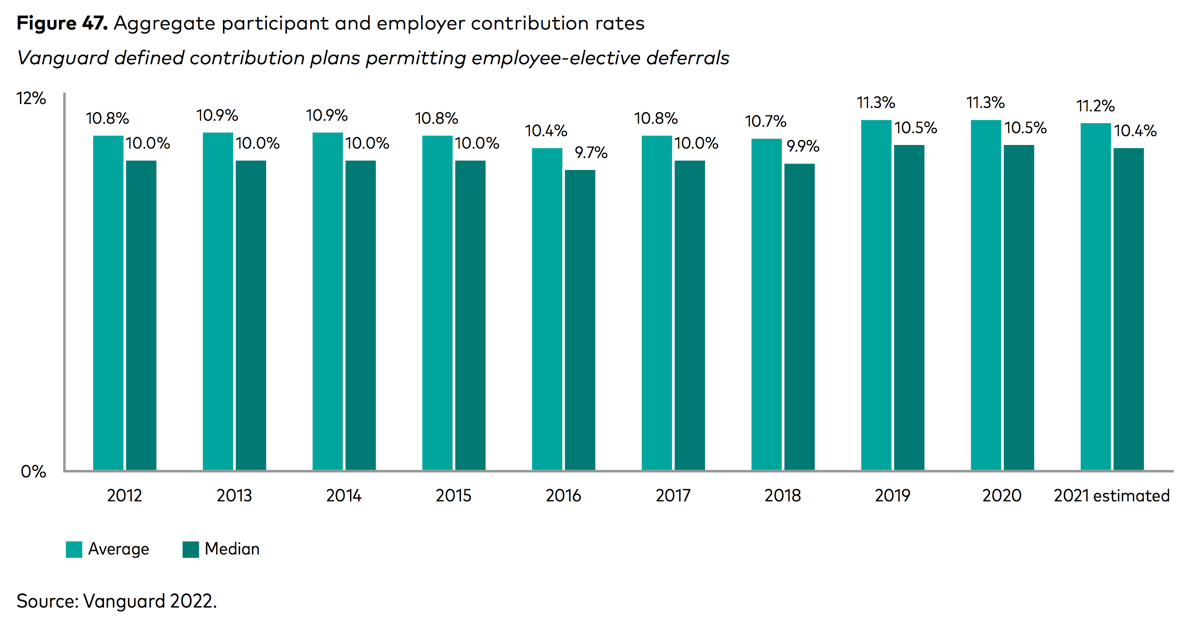
Employer contributions (company match). The total average/median contributions by year was 11.2%/10.3% (employer and employee combined). This means that the average/median employer/company contribution was about 4%. (Click to enlarge.)

How much does Vanguard think we should be saving? I found this quote noteworthy:

We believe participants need to reach a total saving rate of 12% to 15% or more to meet their retirement goals.

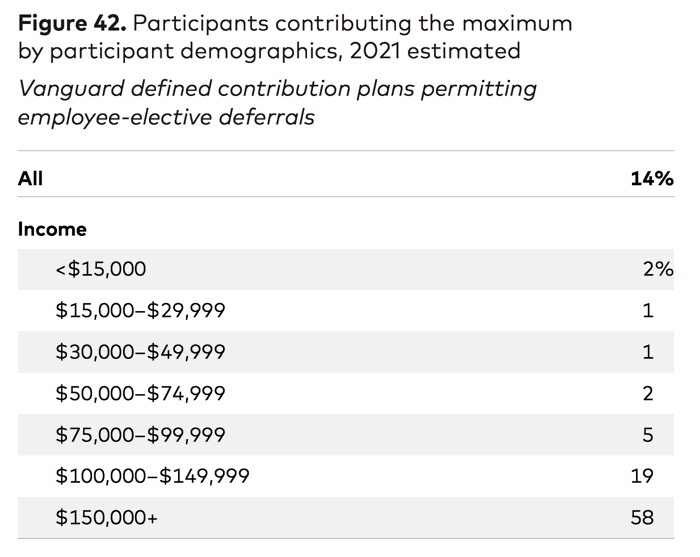
Maxing it out! Overall, 14% of participants saved the maximum annual amount of $19,500 ($26,000 age 50+) for 2021. However, 58% of those with incomes of $150,000+ maxed out their contributions. Here is the full breakdown by income:

(Not really sure how the folks earning under $15k per year are doing it… maybe these income numbers are after subtracting the contributions?)

How are people investing? Asset allocation. This chart shows the trends in asset allocation as the participants age. The increased use of Target-date funds and other professional management options has changed it so that young people are less likely to hold cash. (Click to enlarge.)

Account balances. The average account balance was $141,542 for 2021; the median balance was $35,345. This disparity means that a small number of plans with very high balances skews this often-quoted average upward. (Click to enlarge.)

I don’t pay much attention to this stat because the average includes workers across different age groups, income levels, job tenures, and so on. If I just switched jobs and rolled over my old 401k into an IRA, technically my balance is zero no matter what.

Retirement Income Green vs. Red Zones from Jim Otar

Jim Otar is a retired engineer-turned-financial-planner who has written many books and articles about retirement income. I recently found an old bookmark and reread his article Lifetime Retirement Income: The Zone Strategy from RetirementOptimizer.com. One core principle of his retirement advice that you don’t plan using averages:

The averages don’t cut it. For proper retirement planning, you must base your retirement solutions and strategies on adverse outcomes and not average outcomes.

For example, you don’t plan for average life expectancy. You plan for reaching age 95 for both you and your spouse/partner if applicable.

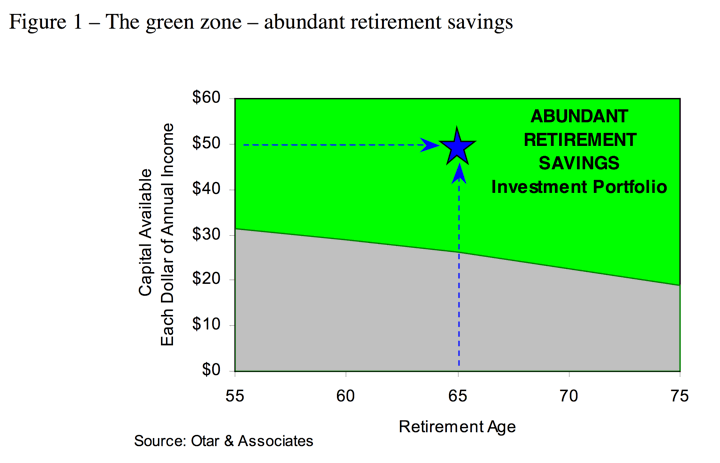
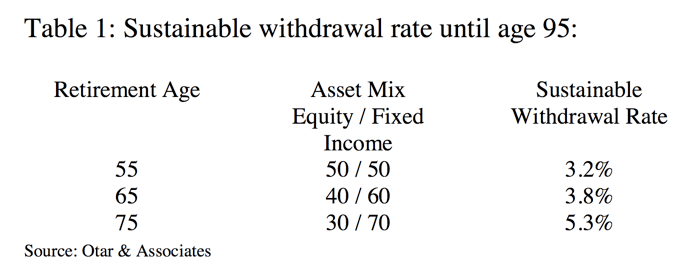
Green Zone: You have enough money that you can simply live off a balanced portfolio of stocks and bonds, even if returns are on the unlucky side of history and much lower than average. Here are the numbers for his calculated sustainable withdrawal rate until age 95:

For example, if you are 65 years old and need $40,000 of annual income from your portfolio (above Social Security and other income sources), then you would need a portfolio balance of $40,000 divided by 3.8% = $1,052,631. (Alternatively, multiply $40,000 by 26.3.) If you have more than this, you are in the green zone. You’ll have enough money even after a market run that is bad historically, and you’ll probably end up leaving a decent estate or be able to spend more later on.

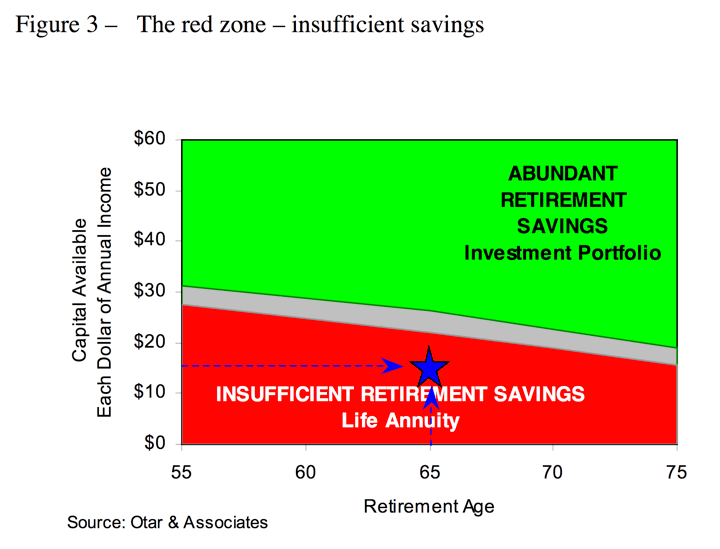
Red Zone: You need guaranteed income. You don’t have enough to live off of a portfolio of stocks without a decent chance of running completely out of money. The most prudent advice is to buy annuities that will provide a guaranteed level of income and stretch your limited assets for the rest of your lifetime, no matter how long that is.

The advice is then to use your money to buy a single premium immediate life annuity with payments that are indexed to inflation (CPI). At the time of writing, such an inflation-indexed SPIA would pay more that the sustainable rate above. The effective “safe withdrawal rate” for the same 65-year-old above would be 4.5% to 4.9%. Unfortunately, this article was written back in 2007 and as of 2022 there are zero insurance companies that offer inflation-indexed immediate annuities.

However, the same overall concept still applies. The Red Zone means you need to take critical action. You should see how much guaranteed lifetime income you can receive from a single premium immediate annuity (SPIA), perhaps with an escalation rider that increases your payout 1%-3% every year. You will need to consider reducing expenses somehow (downsize home, relocate to lower cost-of-living area). You may need to find additional income (keep working, rent out property). You might need to do all three.

Grey Zone used to mean that you were between the 3.8% withdrawal rate of the Green Zone and the 4.5% withdrawal rate of the Red Zone. Today, I assume it simply means you are close to green, but not quite. You should take some of those Red Zone actions listed above.

I found the Green/Grey/Red Zone concept to be an interesting retirement planning framework to consider. If you don’t have enough, you shouldn’t just wing it with stocks and hope for the best. SPIAs can help you stretch your money for a more secure retirement. I believe that SPIAs aren’t discussed enough in personal finance, and if there were more demand, perhaps the competition would create better and higher-yielding SPIA products. The problem is that non-transparent products like indexed annuities that promise things like “market-linked returns with no downside risk” are both better sellers and offer higher commissions to most insurance salespeople.

Maxing Out the 401k Company Match: How Many Actually Do It?

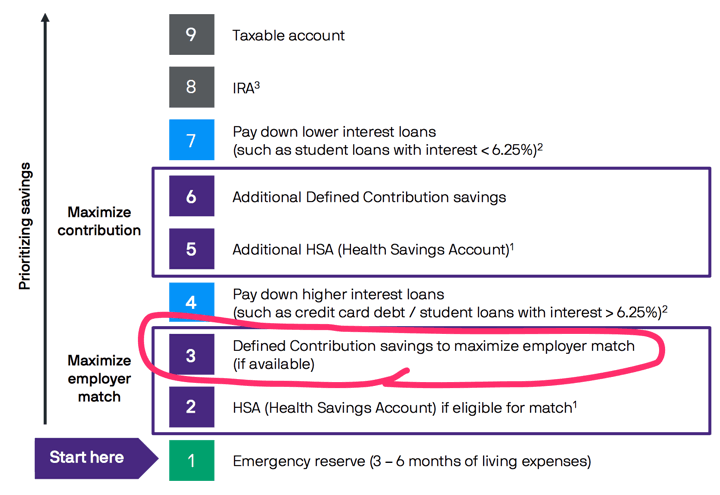
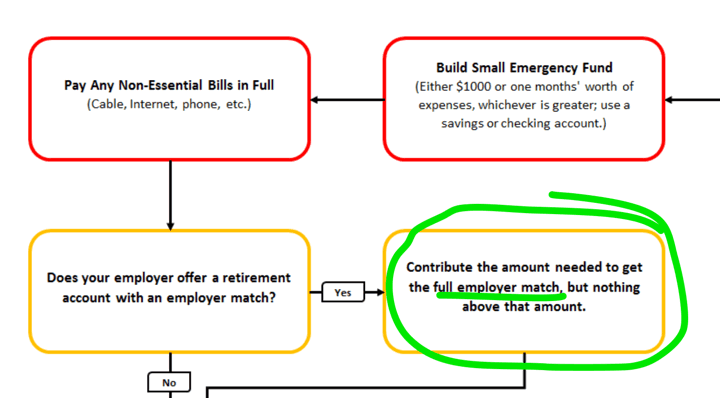
At the top of many personal finance “To-do Lists” is to max out the employer match offered in your 401k/403b retirement plan. It’s usually the first “savings” step after paying down high-interest debt and keeping up with your bills. Here’s a screenshot from the Standardized Personal Finance Advice Flowchart via Reddit:

And here it is again from JP Morgan Asset Management, right after building up an emergency fund:

I’ve read this advice so many times, but how many people even complete this Top 3 item on the list? To be clear, this is just contributing enough to maximize your employer match contribution, not maxing out your allowable employee contribution. (That’s on the list of standardized advice as well, but at a slightly lower priority level.)

Vanguard recently released its How America Saves 2022 report with tons of data about the retirement accounts that they help manage. Let’s see what they found.

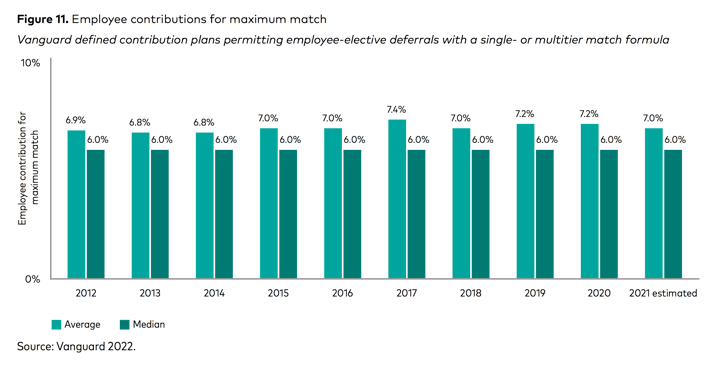
First of all, what does it take to max out your 401k company match? Roughly a 6% contribution rate over the years.

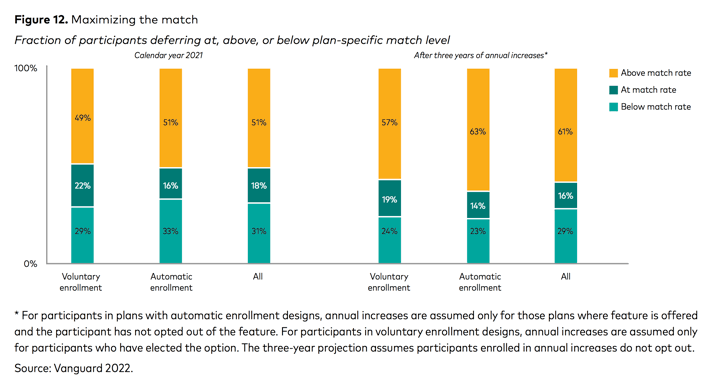
So… how many people actually max out their 401k company match? Roughly 70% of participants contributed at least the max match rate in 2021. For participants in plan with an auto-increase feature, this number goes up to 77% overall after three years.

If you aren’t at least maxing out the company match and getting your “free money”, hopefully this stat provides some peer pressure. Over 2/3rds are doing it! You don’t want to be below-average, do you?? 😱

Best Interest Rates on Cash – August 2022 Update

Here’s my monthly roundup of the best interest rates on cash as of August 2022, roughly sorted from shortest to longest maturities. We all need some safe assets for cash reserves or portfolio stability, and there are often lesser-known opportunities available to individual investors. Check out my Ultimate Rate-Chaser Calculator to see how much extra interest you’d earn by moving money between accounts. Rates listed are available to everyone nationwide. Rates checked as of 8/2/2022.
TL;DR: 4% APY on up to $6,000 for liquid savings at Current with no direct deposit requirement. MyBankingDirect 2.20% APY liquid savings. 1-year CD 3% APY. 5-year CD 3.65% APY. Compare against Treasury bills and bonds at every maturity. 9.62% Savings I Bonds still available if you haven’t done it yet.

Fintech accounts
Available only to individual investors, fintech companies often pay higher-than-market rates in order to achieve fast short-term growth (often using venture capital). “Fintech” is usually a software layer on top of a partner bank’s FDIC insurance.

  • 4% APY on $6,000. Current offers 4% APY on up to $6,000 total ($2,000 each on three savings pods). No direct deposit required. $50 referral bonus for new members with $200+ direct deposit with promo code JENNIFEP185. Please see my Current app review for details.
  • 3% APY on up to $100,000, but requires direct deposit and credit card spend. HM Bradley pays up to 3% APY if you open both a checking and credit card with them, and maintain $1,500 in total direct deposit each month and make $100 in credit card purchases each month. Please see my updated HM Bradley review for details.

High-yield savings accounts
Since the huge megabanks pay essentially no interest, I think every should have a separate, no-fee online savings account to accompany your existing checking account. The interest rates on savings accounts can drop at any time, so I list the top rates as well as competitive rates from banks with a history of competitive rates. Some banks will bait you with a temporary top rate and then lower the rates in the hopes that you are too lazy to leave.

  • MyBankingDirect is up to 2.20% APY with no minimum balance requirements ($500 minimum to open).
  • SoFi is now offering 1.80% APY + up to $325 new account bonus with direct deposit. You must maintain a direct deposit each month of any amount for the higher APY. SoFi now has their own bank charter so no longer a fintech by my definition. See details at $25 + $300 SoFi Money new account and deposit bonus.
  • There are several other established high-yield savings accounts at closer to 1.50% APY. Marcus by Goldman Sachs is on that list, and if you open a new account with a Marcus referral link (from reader Paul) you now can get an extra 1.00% APY for your first 3 months.

Short-term guaranteed rates (1 year and under)
A common question is what to do with a big pile of cash that you’re waiting to deploy shortly (plan to buy a house soon, just sold your house, just sold your business, legal settlement, inheritance). My usual advice is to keep things simple and take your time. If not a savings account, then put it in a flexible short-term CD under the FDIC limits until you have a plan.

  • No Penalty CDs offer a fixed interest rate that can never go down, but you can still take out your money (once) without any fees if you want to use it elsewhere. CIT Bank has a 11-month No Penalty CD at 2.00% APY with a $1,000 minimum deposit. Ally Bank has a 11-month No Penalty CD at 1.40% APY for all balance tiers. Marcus has a 13-month No Penalty CD at 1.55% APY with a $500 minimum deposit. You may wish to open multiple CDs in smaller increments for more flexibility.
  • Bread Financial has a 12-month certificate at 3.00% APY. Early withdrawal penalty is 180 days of interest.

Money market mutual funds + Ultra-short bond ETFs*
Many brokerage firms that pay out very little interest on their default cash sweep funds (and keep the difference for themselves). * Money market mutual funds are regulated, but ultimately not FDIC-insured, so I would still stick with highly reputable firms. I am including a few ultra-short bond ETFs as they may be your best cash alternative in a brokerage account, but they may experience short-term losses.

  • Vanguard Federal Money Market Fund is the default sweep option for Vanguard brokerage accounts, which has an SEC yield of 1.92%. Compare with the Fidelity Government Money Market Fund (SPAXX), Fido’s sweep option which charges a higher expense ratio and thus only offers a 1.42% SEC yield.
  • Vanguard Ultra-Short-Term Bond Fund currently pays 2.40% SEC yield ($3,000 min) and 2.50% SEC Yield ($50,000 min). The average duration is ~1 year, so your principal may vary a little bit.
  • The PIMCO Enhanced Short Maturity Active Bond ETF (MINT) has a 2.37% SEC yield and the iShares Short Maturity Bond ETF (NEAR) has a 2.55% SEC yield while holding a portfolio of investment-grade bonds with an average duration of ~6 months.

Treasury Bills and Ultra-short Treasury ETFs
Another option is to buy individual Treasury bills which come in a variety of maturities from 4-weeks to 52-weeks and are fully backed by the US government. You can also invest in ETFs that hold a rotating basket of short-term Treasury Bills for you, while charging a small management fee for doing so. T-bill interest is exempt from state and local income taxes.

  • You can build your own T-Bill ladder at TreasuryDirect.gov or via a brokerage account with a bond desk like Vanguard and Fidelity. Here are the current Treasury Bill rates. As of 8/2/2022, a new 4-week T-Bill had the equivalent of 2.18% annualized interest and a 52-week T-Bill had the equivalent of 3.09% annualized interest.
  • The Goldman Sachs Access Treasury 0-1 Year ETF (GBIL) has a 1.38% SEC yield and the SPDR Bloomberg Barclays 1-3 Month T-Bill ETF (BIL) has a 1.18% SEC yield. GBIL appears to have a slightly longer average maturity than BIL.

US Savings Bonds
Series I Savings Bonds offer rates that are linked to inflation and backed by the US government. You must hold them for at least a year. If you redeem them within 5 years there is a penalty of the last 3 months of interest. The annual purchase limit for electronic I bonds is $10,000 per Social Security Number, available online at TreasuryDirect.gov. You can also buy an additional $5,000 in paper I bonds using your tax refund with IRS Form 8888.

  • “I Bonds” bought between May 2022 and October 2022 will earn a 9.62% rate for the first six months. The rate of the subsequent 6-month period will be based on inflation again. More on Savings Bonds here.
  • In mid-October 2022, the CPI will be announced and you will have a short period where you will have a very close estimate of the rate for the next 12 months. I will have another post up at that time.
  • See below about EE Bonds as a potential long-term bond alternative.

Prepaid Cards with Attached Savings Accounts
A small subset of prepaid debit cards have an “attached” FDIC-insured savings account with exceptionally high interest rates. The negatives are that balances are severely capped, and there are many fees that you must be careful to avoid (lest they eat up your interest). There is a long list of previous offers that have already disappeared with little notice. I don’t personally recommend nor use any of these anymore, as I feel the work required and the fees charged if you mess up exceeds any small potential benefit.

  • Mango Money pays 6% APY on up to $2,500, if you manage to jump through several hoops. Requirements include $1,500+ in “signature” purchases and a minimum balance of $25.00 at the end of the month.
  • NetSpend Prepaid pays 5% APY on up to $1,000 but be warned that there is also a $5.95 monthly maintenance fee if you don’t maintain regular monthly activity.

Rewards checking accounts
These unique checking accounts pay above-average interest rates, but with unique risks. You have to jump through certain hoops which usually involve 10+ debit card purchases each cycle, a certain number of ACH/direct deposits, and/or a certain number of logins per month. If you make a mistake (or they judge that you did) you risk earning zero interest for that month. Some folks don’t mind the extra work and attention required, while others would rather not bother. Rates can also drop suddenly, leaving a “bait-and-switch” feeling.

  • Porte fintech app requires a one-time direct deposit of $1,000+ to open a savings account. Porte then requires $3,000 in direct deposits and 15 debit card purchases per quarter (average $1,000 direct deposit and 5 debit purchases per month) to receive 3% APY on up to $15,000. New customer bonus via referral.
  • The Bank of Denver pays 2.00% APY on up to $10,000 if you make 12 debit card purchases of $5+ each, receive only online statements, and make at least 1 ACH credit or debit transaction per statement cycle. If you meet those qualifications, you can also link a Kasasa savings account that pays 1.00% APY on up to $25k. Thanks to reader Bill for the updated info.
  • Presidential Bank pays 2.25% APY on balances between $500 and up to $25,000, if you maintain a $500+ direct deposit and at least 7 electronic withdrawals per month (ATM, POS, ACH and Billpay counts).
  • Evansville Teachers Federal Credit Union (soon Liberty FCU) pays 3.30% APY on up to $20,000. You’ll need at least 15 debit transactions and other requirements every month.
  • Lake Michigan Credit Union pays 3.00% APY on up to $15,000. You’ll need at least 10 debit transactions and other requirements every month.
  • (I’ve had a poor customer service experience with this CU, but the rate is still good.) Lafayette Federal Credit Union is offering 2.02% APY on balances up to $25,000 with a $500 minimum monthly direct deposit to their checking account. No debit transaction requirement. They are also offering new members a $100 bonus with certain requirements. Anyone can join this credit union via partner organization ($10 one-time fee).
  • Find a locally-restricted rewards checking account at DepositAccounts.

Certificates of deposit (greater than 1 year)
CDs offer higher rates, but come with an early withdrawal penalty. By finding a bank CD with a reasonable early withdrawal penalty, you can enjoy higher rates but maintain access in a true emergency. Alternatively, consider building a CD ladder of different maturity lengths (ex. 1/2/3/4/5-years) such that you have access to part of the ladder each year, but your blended interest rate is higher than a savings account. When one CD matures, use that money to buy another 5-year CD to keep the ladder going. Some CDs also offer “add-ons” where you can deposit more funds if rates drop.

  • CFG Bank has a 5-year certificate at 3.65% APY ($500 min), 3-year at 3.55% APY, and 1-year at 2.75% APY. The early withdrawal penalty for the 5-year is 180 days of interest.
  • You can buy certificates of deposit via the bond desks of Vanguard and Fidelity. You may need an account to see the rates. These “brokered CDs” offer FDIC insurance and easy laddering, but they don’t come with predictable early withdrawal penalties. Right now, I see a 5-year CD at 3.55% APY. Be wary of higher rates from callable CDs listed by Fidelity.

Longer-term Instruments
I’d use these with caution due to increased interest rate risk, but I still track them to see the rest of the current yield curve.

  • Willing to lock up your money for 10 years? You can buy long-term certificates of deposit via the bond desks of Vanguard and Fidelity. These “brokered CDs” offer FDIC insurance, but they don’t come with predictable early withdrawal penalties. You might find something that pays more than your other brokerage cash and Treasury options. Right now, I don’t see any 10-year CDs available vs. 2.76% for a 10-year Treasury. Watch out for higher rates from callable CDs where they can call your CD back if interest rates rise.
  • How about two decades? Series EE Savings Bonds are not indexed to inflation, but they have a unique guarantee that the value will double in value in 20 years, which equals a guaranteed return of 3.5% a year. However, if you don’t hold for that long, you’ll be stuck with the normal rate which is quite low (currently 0.10%). I view this as a huge early withdrawal penalty. But if holding for 20 years isn’t an issue, it can also serve as a hedge against prolonged deflation during that time. Purchase limit is $10,000 each calendar year for each Social Security Number. As of 7/5/2022, the 20-year Treasury Bond rate was 3.22%.

All rates were checked as of 8/2/2022.

S&P 500 Bear Market Time to Recovery? Average vs. Worst-Case Scenario

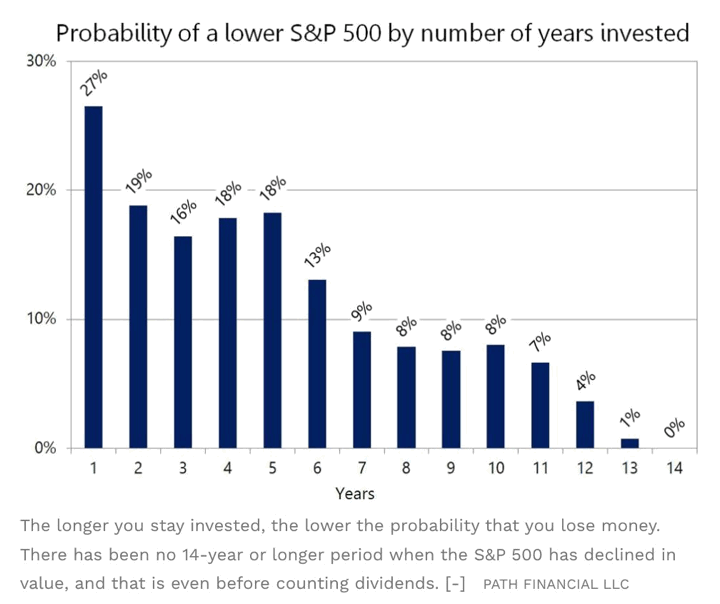
How long will this bear market last? What is the longest that the S&P 500 index number we always see on TV (which doesn’t include dividends) stayed below its initial value? Here is an interesting chart “Probability of a lower S&P 500 by number of years invested” via @GRDecter:

The text below the chart is a bit small, but it reads:

The longer you stay invested, the lower the probability that you lose money. There has been no 14-year or longer period when the S&P 500 has declined in value, and that is even before counting dividends.

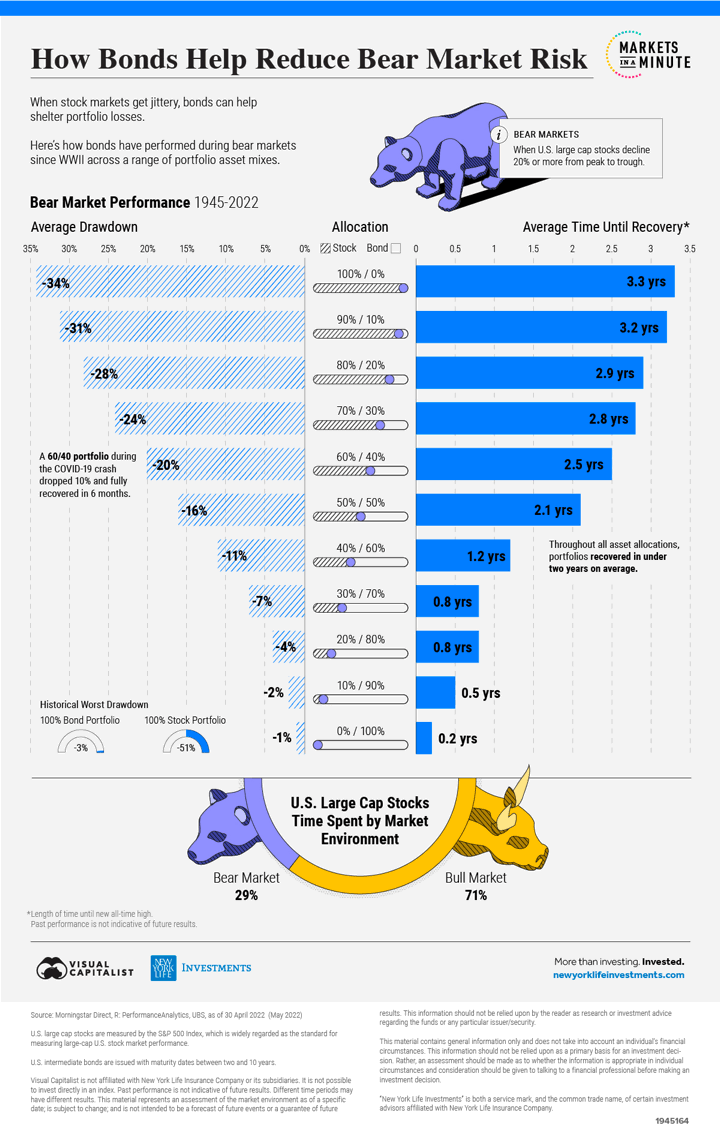
While that suggests this chart supports the idea of owning stocks long-term, it is also an important education for managing expectations; This information might actually make stock ownership worse than you initially thought. If you asked the average stock investor how long before their stocks recover from a bear market, I’d guess the average answer would be 1-3 years. This can be supported in graphics like this from Visual Capitalist. See the “Average time to recovery” for 100% stocks (click to see full image at source).

This is the difference between average (3 years to recovery) and historical worst-case scenario (10+ years), not to mention the future could be even worse. It’s tough to design a portfolio around both these parameters. Do you have enough faith in your investing plan to withstand a 10+ year period of just S&P 500 dividends and no capital appreciation?

Reader Question: Buying Individual Corporate Bonds on Secondary Market At 6% APY?

Here’s a good question from reader Elizabeth in response to yesterday’s post about buying Treasury bonds on the open secondary market:

One thing I’m interested in is on that same table you shared – Corporate bonds rated BBB are around 6% for 5 years. Can you write about this? What are the pros and cons?

Here’s my thought process. Yes, us “retail” investors can also buy individual corporate bonds via major brokers with a fixed income desk like Fidelity. (Bond trading is rare on newer trading apps like Robinhood.) The bonds are judged by various rating agencies and usually separated by their grading. Right now, I see a Moody’s BAA3-rated corporate bond with 5 years left until maturity paying 6.78% interest (click to enlarge):

However, corporate bonds are not within my circle of knowledge. The special thing about every single US Treasury bond is that they are all fully-backed by the US government. Same with an FDIC-insured bank CD or NCUA-insured credit union certificate. It’s like comparing all 16 oz. jars of JIF brand peanut butter; I know all of them are the same, so I can just buy on price.

Once you venture into the world of corporate bonds, things get a lot more complicated. There is wide range of potential credit risk from the issuing company. If the company fails, you may not receive your initial principal back. There is call risk from callable bonds where the issuer can redeem your bond early (to their benefit), not to mention several other early redemption wrinkles like “make whole call”, “sinking fund protection”, and “special optional redemptions”.

Baa3 and BBB- rated bonds are still technically “investment-grade”, but they are just one notch above “below investment-grade”, aka “junk”, aka “high-yield” bonds. Here is a quick table of bond ratings from Investopedia:

If take a closer look at the available bonds above, you’ll see that only one bond is paying over 6.7% and it doesn’t even have an S&P rating, which means there might be something funny going on. The rates quickly go back down to the 5.XX% range.

Do I know why one bond has to pay 6.7% interest rate to entice a buyer, while another one only has to offer 4.8%? I must admit that I really have no idea.

Bonds are for safety. In addition, I should remember my reason for holding bonds. They are my safety blanket. They are my next 10 years of expenses that are guaranteed to be there even if bad things happens. What if Russia bombed a NATO country tomorrow? The US would be obligated to go to war. China might then feel that it has to back Russia. Who knows. Hope for the best. Prepare for the worst.

My goal with bonds is to maximize yield without sacrificing safety.

Stocks are for growth and upside potential. Let’s take the bottom bond highlighted – an Ally Financial corporate bond paying 5.6% yield for the next 5 years. Ally Bank is familiar to me, and I am a longtime customer. Why not buy that bond? Well, if I bought that bond, the most that it will ever pay me back is the bond face value and interest. Worst case is still that Ally goes bankrupt and I lose all or most of my entire investment and end up with zero. This has happened, and to much larger companies than Ally.

Up to 6 days before their eventual collapse, Lehman Brothers had an A investment grade rating. The eventual recovery on their bonds was 21 cents on the dollar.

However, I could also buy Ally Financial stock (ticker ALLY). Right now, it is trading at only a 4.72 P/E ratio and is even paying a dividend yield of 3.54%. Five years from now, I could be sitting on a +50% or +100% or +200% total return. In other words, if you want to take on risk for a higher return, you are competing with stocks. There is ongoing debate about the inclusion of high-yield bonds in a portfolio, but I prefer to take risks with stocks and keep my bonds as safe as possible.

Consider a low-cost, diversified mutual fund or ETF. The benefit of holding riskier corporate bonds inside a mutual fund/ETF is that any one corporate bankruptcy won’t wipe you out. You can be diversified across hundreds of companies. Now, you can’t control the maturity as tightly, you’ll still lose some yield to management costs, and you’re still subject to interest rate risk. If you own the Vanguard Total Bond Market ETF (BND) or any Vanguard Target Retirement Fund, you already own corporate bonds inside a fund.

If I had to buy corporate bonds and wanted a stream of higher income without a reckless amount of credit risk, I would consider the Vanguard High-Yield Corporate Fund Investor Shares (VWEHX, $3k min) or Vanguard High-Yield Corporate Fund Admiral Shares (VWEAX, $50k min). VWEHX has a 0.23% expense ratio and a 30-day SEC yield of 6.71% as of 07/18/2022. VWEAX has a 0.13% expense ratio and a 30-day SEC yield of 6.81% as of 07/18/2022.

You are buying a basket of nearly 700 bonds that straddle the line between investment-grade and below investment-grade. This is a bond fund that I would own for the income stream, not if I needed the entire amount in cash soon as it can drop quite a lot during times of market stress. The expense ratio on this Vanguard fund is much lower than the industry average. Just a suggestion for further research. I don’t own this fund. In fact, I don’t own any corporate bonds at all.

Hope that helps!

[Step-by-Step Guide] How To Buy Treasury Bonds on Secondary Market From Fidelity Brokerage

Fidelity fixed income page screenshot

Here is quick walkthrough from buying a (roughly) 1-year Treasury bond on the secondary market via my Fidelity brokerage account. Please note that I am not a professional bond trader nor a tax professional, and I won’t be able to cover every detail. I maintain part of my portfolio bond allocation in roughly a 5-year bond/CD ladder, comparing and buying the top rate amongst US Treasuries, bank CDs, and credit union certificates across the country as they are all fully-backed by the US government. This guarantees that every year, at least 20% of it is liquid and available in adverse conditions like job loss.

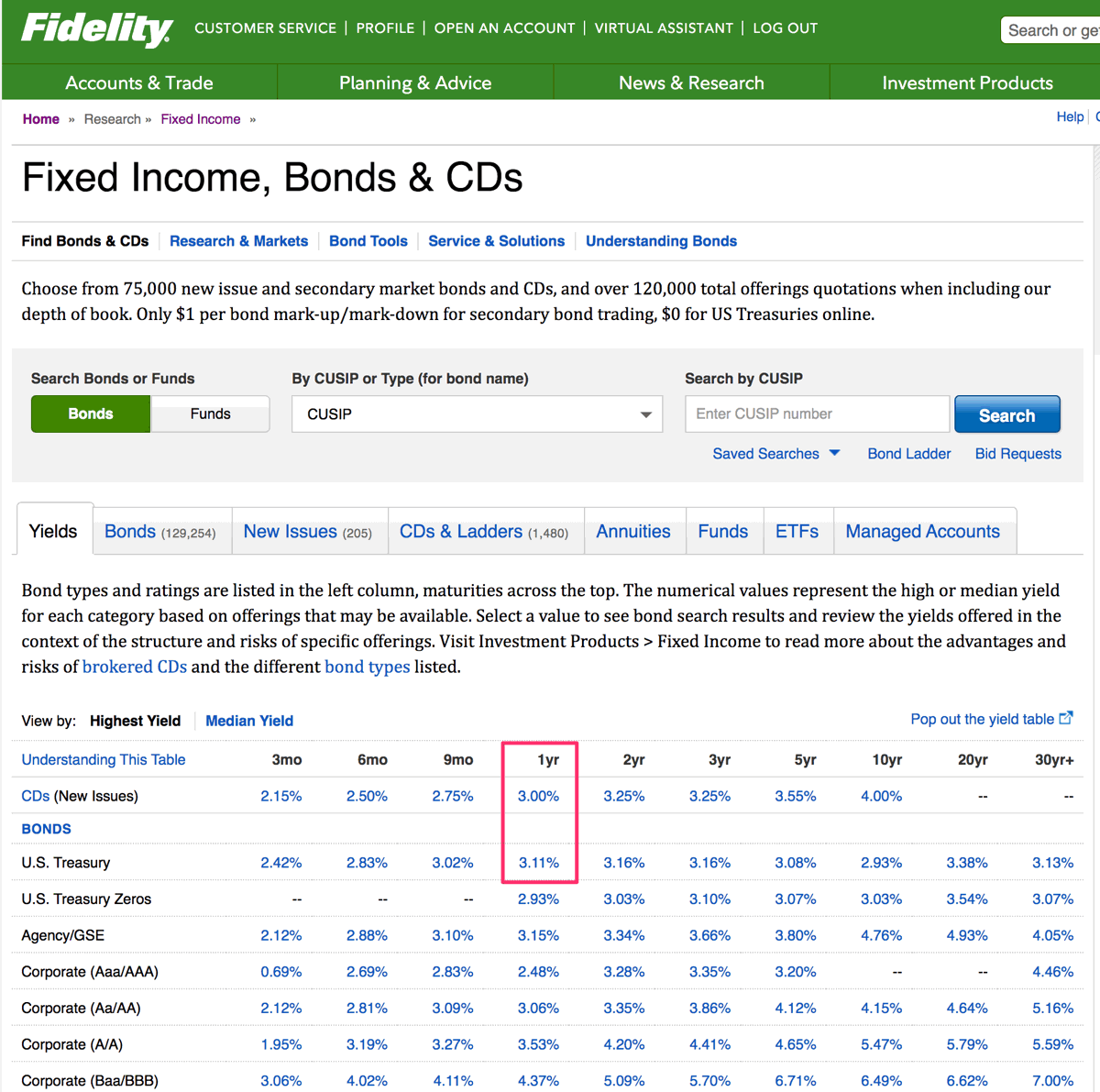
Treasury bonds vs. certificates of deposit. First, you’ll want to compare your Treasury bond effective yield against bank CD rates. At the time of this writing, 1-year Treasury was at ~3.10% while the top brokered 1-year CD was at 3% APY. Due to my local/state tax situation, the after-tax Treasury bond rate was comparable to a 1-year bank CD paying ~3.50%. Right now, the Treasury bond safely wins if held inside a taxable account.

New issue available? For example, if today was 7/15/2022 and I wanted to buy a new 52-week T-Bill from TreasuryDirect or Fidelity, I would look at the official auction schedule see that the next available date for a 52-week T-Bill is on Thursday 8/4/2022 to place an order, 8/9/2022 auction date, and 8/11/2022 settlement date. I have no idea what interest rates will be like then, and for my purposes I wanted to lock in now.

Buying secondary Treasuries on Fidelity. To buy bonds on Fidelity, you must log into your brokerage account and navigate to the “Fixed Income” section, where they will show a quick overview of current rates across roughly 75,000 fixed income investments from brokered CDs to high-yield corporate bonds. (See image at top of post. Click to enlarge.)

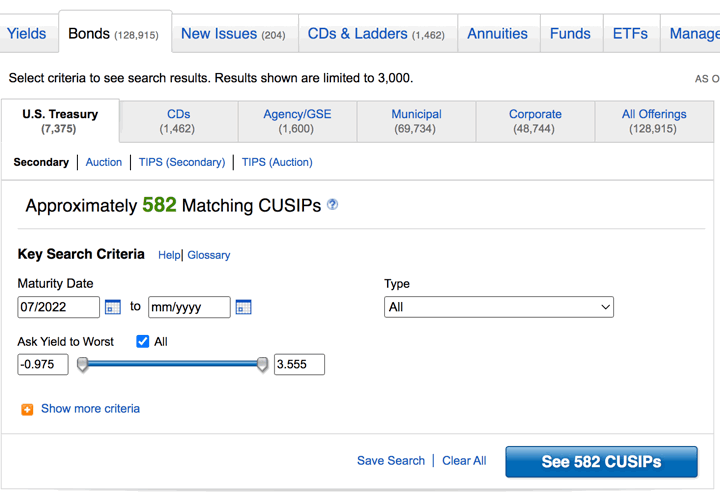
Next, click on the “Bonds” tab > US Treasury bonds > Secondary market. This narrows it down to about 578 bond CUSIPs. This search and trade was completed 7/15/2022.

Since I want a Treasury bond with only one year left until maturity, I set the filter for a maturity date between July 2023 and July 2023. That should narrow it down to only 5 bond CUSIPS. Let’s take a look at them (click to enlarge):

These are all “used” bonds that have already been issued and been paying someone else interest at their own rate. The market will adjust the price of these secondary bonds so that everything with a similar maturity ends up paying relatively close to a current “market” rate. Most of these started out paying really low interest rates, so right now you’ll often be buying them at a discount to their face value. (When interest rates go up, prices for existing bond go down since their interest payouts are lower.)

If you hold two bonds with the same “yield to maturity” all the way until it matures and pays you back the principal, you should end up with the same amount of gain at the end even if it is split differently between interest income and capital gain. (If you buy at a discount and have years left until maturity, a pro-rated portion of the discount is reported as income every year until maturity.)

Note that these price quotes are separated into “bid” and “ask”. Bid is what folks are offering to pay, and ask is the price at which folks are offering to sell. There is a spread between them because if there wasn’t, they would have matched up and sold. For example, someone might offer to sell at an effective 3.09% yield, with another offering to buy at 3.14% effective yield.

I’m a small fry, so I just pay attention to the “Ask” and the minimum quantity. Sometimes the offered price looks good but requires you to buy $500,000 of it! (1 bond = $1,000 face value.) Also, the prices are like stocks and fluctuate constantly, so don’t anchor yourself to any specific number. I might wish I could get that 3.20% I saw the day before, but that rate may or may not come back during my buying window.

When you’re ready, you can place a limit order. This lets you set a maximum price you’ll be willing to pay (and thus minimum yield). For example, I chose this Treasury bond that began life as a 5-year bond on 7/31/2018 and matures on 7/31/2023 with an annual coupon of 2.75%. I offered a price of 99.652 each, which guarantees me a minimum effective yield of 3.09% (exempt from state and local taxes). I recommend always using a limit order, just in case.

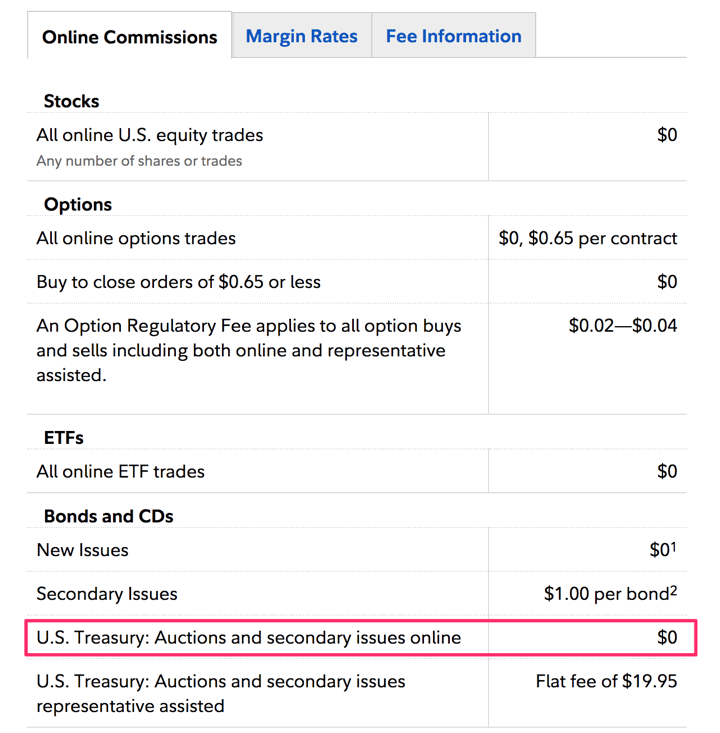
A note on commissions. Fidelity does not charge a commission (or mark-up) on secondary US Treasury bond purchases if performed online. There is still the indirect cost of the bid/ask spread, but that is more of a concern if I was to sell. I believe that Fidelity has close enough to the best order fill available to an individual investor. I haven’t compared them in detail, but be aware that others may charge a mark-up.

My order was successfully filled at $99.652, which means for 10 bonds with $10,000 face value, I paid $9,965.20 for the bonds plus a little more for any accrued interest. US Treasury bonds are not callable and the interest is paid semi-annually. My next interest payments (at the old bond’s lower 2.75% rate) will be on 7/31/2022, 1/31/2023 and 7/31/2023 with the full return of $10,000 face value at maturity. Again, based on my local/state tax situation, my after-tax interest will be comparable to a 1-year bank CD paying 3.50% APY. This compares well to the best available rates on cash right now.