Best Interest Rates on Cash – June 2022 Update

Here’s my monthly roundup of the best interest rates on cash as of June 2022, roughly sorted from shortest to longest maturities. We all need some safe assets for cash reserves or portfolio stability, and there are often lesser-known opportunities available to individual investors. Check out my Ultimate Rate-Chaser Calculator to see how much extra interest you’d earn by moving money between accounts. Rates listed are available to everyone nationwide. Rates checked as of 6/6/2022.
Significant changes since last month: Rates moving up a little. 4% APY on up to $6,000 for liquid savings at Current with no direct deposit requirement. Liquid savings 1.25% APY w/ no cap + up $325 bonuses on SoFi w/ direct deposit. Brokered CDs and US Treasury bonds now slightly above 3% for 5 years. 1-year CDs and Treasuries slightly over 2%. 9.62% Savings I Bonds still available if you haven’t done it yet.

Fintech accounts
Available only to individual investors, fintech companies often pay higher-than-market rates in order to achieve fast short-term growth (often using venture capital). “Fintech” is usually a software layer on top of a partner bank’s FDIC insurance.

  • 4% APY on $6,000. Current offers 4% APY on up to $6,000 total ($2,000 each on three savings pods). No direct deposit required. $50 referral bonus for new members with $200+ direct deposit with promo code JENNIFEP185. Please see my Current app review for details.
  • 3% APY on up to $100,000, but requires direct deposit and credit card spend. HM Bradley pays up to 3% APY if you open both a checking and credit card with them, and maintain $1,500 in total direct deposit each month and make $100 in credit card purchases each month. Please see my updated HM Bradley review for details.
  • 3% APY on 10% of direct deposits + 1% APY on $25,000. One Finance lets you earn 3% APY on “auto-save” deposits (up to 10% of your direct deposit, up to $1,000 per month). Separately, they also pay 1% APY on up to another $25,000 with direct deposit. New customer $50 bonus via referral. See my One Finance review.
  • 3% APY on up to $15,000, requires direct deposit and credit card transactions. Porte requires a one-time direct deposit of $1,000+ to open a savings account. Porte then requires $3,000 in direct deposits and 15 debit card purchases per quarter (average $1,000 direct deposit and 5 debit purchases per month) to receive 3% APY on up to $15,000. New customer bonus via referral. See my Porte review.

High-yield savings accounts
Since the huge megabanks pay essentially no interest, I think every should have a separate, no-fee online savings account to accompany your existing checking account. The interest rates on savings accounts can drop at any time, so I list the top rates as well as competitive rates from banks with a history of competitive rates. Some banks will bait you with a temporary top rate and then lower the rates in the hopes that you are too lazy to leave.

  • SoFi is now offering 1.25% APY + up to $325 new account bonus with direct deposit. You must maintain a direct deposit each month of any amount. Convenient if you already have a relationship with them. SoFi now has their own bank charter so no longer a fintech by my definition. See details at $25 + $300 SoFi Money new account and deposit bonus.
  • Bask Bank is up to 1.25% APY with no minimum balance requirements.
  • TAB Bank is up to 1.26% APY with no minimum balance requirements.
  • There are several other established high-yield savings accounts at closer to 0.80% APY. Marcus by Goldman Sachs is on that list, and if you open a new account with a Marcus referral link (that’s mine), they will give 0.50% extra for 3 months, or 1.35% APY for your first 3 months (add 0.10% with AARP membership). You can then extend this by referring others.

Short-term guaranteed rates (1 year and under)
A common question is what to do with a big pile of cash that you’re waiting to deploy shortly (plan to buy a house soon, just sold your house, just sold your business, legal settlement, inheritance). My usual advice is to keep things simple and take your time. If not a savings account, then put it in a flexible short-term CD under the FDIC limits until you have a plan.

  • No Penalty CDs offer a fixed interest rate that can never go down, but you can still take out your money (once) without any fees if you want to use it elsewhere. CFG Bank has a 13-month No Penalty CD at 1.22% APY with a $500 minimum deposit. Ally Bank has a 11-month No Penalty CD at 0.85% APY for all balance tiers. Marcus has a 13-month No Penalty CD at 0.90% APY with a $500 minimum deposit. You may wish to open multiple CDs in smaller increments for more flexibility.
  • Connexus Credit Union has a 12-month certificate at 2.26% APY Note that the early withdrawal penalty is 90 days of interest. Anyone can join this credit union via partner organization for a one-time $5 fee.

Money market mutual funds + Ultra-short bond ETFs
Many brokerage firms that pay out very little interest on their default cash sweep funds (and keep the difference for themselves). Unfortunately, money market fund rates are very low across the board right now. Ultra-short bond funds are another possible alternative, but they are NOT FDIC-insured and may experience short-term losses at times. These numbers are just for reference, not a recommendation.

  • The default sweep option is the Vanguard Federal Money Market Fund which has an SEC yield of 0.71%.
  • Vanguard Ultra-Short-Term Bond Fund currently pays 1.91% SEC yield ($3,000 min) and 2.01% SEC Yield ($50,000 min). The average duration is ~1 year, so your principal may vary a little bit.
  • The PIMCO Enhanced Short Maturity Active Bond ETF (MINT) has a 1.80% SEC yield and the iShares Short Maturity Bond ETF (NEAR) has a 1.61% SEC yield while holding a portfolio of investment-grade bonds with an average duration of ~6 months.

Treasury Bills and Ultra-short Treasury ETFs
Another option is to buy individual Treasury bills which come in a variety of maturities from 4-weeks to 52-weeks. You can also invest in ETFs that hold a rotating basket of short-term Treasury Bills for you, while charging a small management fee for doing so. T-bill interest is exempt from state and local income taxes. Right now, this section isn’t very interesting as T-Bills are yielding close to zero!

  • You can build your own T-Bill ladder at TreasuryDirect.gov or via a brokerage account with a bond desk like Vanguard and Fidelity. Here are the current Treasury Bill rates. As of 6/6/2022, a new 4-week T-Bill had the equivalent of 0.88% annualized interest and a 52-week T-Bill had the equivalent of 2.20% annualized interest.
  • The Goldman Sachs Access Treasury 0-1 Year ETF (GBIL) has a 0.67% SEC yield and the SPDR Bloomberg Barclays 1-3 Month T-Bill ETF (BIL) has a 0.45% SEC yield. GBIL appears to have a slightly longer average maturity than BIL.

US Savings Bonds
Series I Savings Bonds offer rates that are linked to inflation and backed by the US government. You must hold them for at least a year. If you redeem them within 5 years there is a penalty of the last 3 months of interest. The annual purchase limit for electronic I bonds is $10,000 per Social Security Number, available online at TreasuryDirect.gov. You can also buy an additional $5,000 in paper I bonds using your tax refund with IRS Form 8888.

  • “I Bonds” bought between May 2022 and October 2022 will earn a 9.62% rate for the first six months. The rate of the subsequent 6-month period will be based on inflation again. More on Savings Bonds here.
  • In mid-October 2022, the CPI will be announced and you will have a short period where you will have a very close estimate of the rate for the next 12 months. I will have another post up at that time.
  • See below about EE Bonds as a potential long-term bond alternative.

Prepaid Cards with Attached Savings Accounts
A small subset of prepaid debit cards have an “attached” FDIC-insured savings account with exceptionally high interest rates. The negatives are that balances are severely capped, and there are many fees that you must be careful to avoid (lest they eat up your interest). There is a long list of previous offers that have already disappeared with little notice. I don’t personally recommend nor use any of these anymore, as I feel the work required and the fees charged if you mess up exceeds any small potential benefit.

  • Mango Money pays 6% APY on up to $2,500, if you manage to jump through several hoops. Requirements include $1,500+ in “signature” purchases and a minimum balance of $25.00 at the end of the month.
  • NetSpend Prepaid pays 5% APY on up to $1,000 but be warned that there is also a $5.95 monthly maintenance fee if you don’t maintain regular monthly activity.

Rewards checking accounts
These unique checking accounts pay above-average interest rates, but with unique risks. You have to jump through certain hoops which usually involve 10+ debit card purchases each cycle, a certain number of ACH/direct deposits, and/or a certain number of logins per month. If you make a mistake (or they judge that you did) you risk earning zero interest for that month. Some folks don’t mind the extra work and attention required, while others would rather not bother. Rates can also drop suddenly, leaving a “bait-and-switch” feeling.

  • Quontic Bank is offering 1.10% APY on all balances. May be useful for those with high balances. You need to make 10 debit card point of sale transactions of $10 or more per statement cycle required to earn this rate.
  • The Bank of Denver pays 2.00% APY on up to $10,000 if you make 12 debit card purchases of $5+ each, receive only online statements, and make at least 1 ACH credit or debit transaction per statement cycle. If you meet those qualifications, you can also link a Kasasa savings account that pays 1.00% APY on up to $25k. Thanks to reader Bill for the updated info.
  • Presidential Bank pays 2.25% APY on balances between $500 and up to $25,000, if you maintain a $500+ direct deposit and at least 7 electronic withdrawals per month (ATM, POS, ACH and Billpay counts).
  • Evansville Teachers Federal Credit Union pays 3.30% APY on up to $20,000. You’ll need at least 15 debit transactions and other requirements every month.
  • Lake Michigan Credit Union pays 3.00% APY on up to $15,000. You’ll need at least 10 debit transactions and other requirements every month.
  • (I no longer recommend this credit union myself, but the rate is still good.) Lafayette Federal Credit Union is offering 2.02% APY on balances up to $25,000 with a $500 minimum monthly direct deposit to their checking account. No debit transaction requirement. They are also offering new members a $100 bonus with certain requirements. Anyone can join this credit union via partner organization ($10 one-time fee).
  • Find a locally-restricted rewards checking account at DepositAccounts.

Certificates of deposit (greater than 1 year)
CDs offer higher rates, but come with an early withdrawal penalty. By finding a bank CD with a reasonable early withdrawal penalty, you can enjoy higher rates but maintain access in a true emergency. Alternatively, consider building a CD ladder of different maturity lengths (ex. 1/2/3/4/5-years) such that you have access to part of the ladder each year, but your blended interest rate is higher than a savings account. When one CD matures, use that money to buy another 5-year CD to keep the ladder going. Some CDs also offer “add-ons” where you can deposit more funds if rates drop.

  • Connexus Credit Union has a 5-year certificate at 3.21% APY ($5,000 min), 4-year at 3.11% APY, 3-year at 3.01% APY, and 2-year at 2.86% APY. Note that the early withdrawal penalty for the 5-year is 365 days of interest. Anyone can join this credit union via partner organization for a one-time $5 fee.
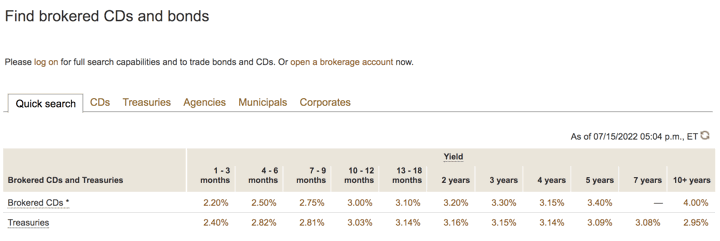
  • You can buy certificates of deposit via the bond desks of Vanguard and Fidelity. You may need an account to see the rates. These “brokered CDs” offer FDIC insurance and easy laddering, but they don’t come with predictable early withdrawal penalties. Right now, I see a 5-year CD at 3.30% APY. Be wary of higher rates from callable CDs listed by Fidelity.

Longer-term Instruments
I’d use these with caution due to increased interest rate risk, but I still track them to see the rest of the current yield curve.

  • Willing to lock up your money for 10 years? You can buy long-term certificates of deposit via the bond desks of Vanguard and Fidelity. These “brokered CDs” offer FDIC insurance, but they don’t come with predictable early withdrawal penalties. You might find something that pays more than your other brokerage cash and Treasury options. Right now, I see a 10-year CD at 3.85% APY vs. 3.04% for a 10-year Treasury. Watch out for higher rates from callable CDs from Fidelity.
  • How about two decades? Series EE Savings Bonds are not indexed to inflation, but they have a unique guarantee that the value will double in value in 20 years, which equals a guaranteed return of 3.5% a year. However, if you don’t hold for that long, you’ll be stuck with the normal rate which is quite low (currently 0.10%). I view this as a huge early withdrawal penalty. But if holding for 20 years isn’t an issue, it can also serve as a hedge against prolonged deflation during that time. Purchase limit is $10,000 each calendar year for each Social Security Number. As of 6/6/2022, the 20-year Treasury Bond rate was 3.41%.

All rates were checked as of 6/6/2022.

Don’t Anchor Yourself To Your Portfolio High-Water Mark

Inside various financial forums, I am seeing the “anyone else worried?” 😓 posts as most portfolios are down double-digits. For a retiree with a $1 million portfolio, seeing $100,000 or $200,000 of value evaporate is understandably stressful. However, much of this is because you are comparing to your portfolio’s all-time high, or high-water mark, which is a relatively arbitrary number. Just because at one moment in time, there were a few willing buyers of your assets for a given price doesn’t mean you should anchor yourself to that number.

Step back and have some perspective. I would offer up this historical performance chart of the Vanguard Target Retirement 2050 Fund (VFIFX) as evidence that things really aren’t that bad if you take a step back. This chart tracks the growth of a $10,000 investment place in 2012 in this all-in-one Target Date Fund. Taken 5/30/22.

  • As of 5/30/22, the 10-year trailing return for VFIFX is 10.28% annualized even after the recent drop. Can you reasonably ask for more than 10% average annual returns for a decade?
  • If you invested in January 2020, right before the COVID pandemic started, you are still up 18.7% if you held through today.
  • If you invested funds anytime between January and August 2020, those funds are up even more than that!
  • The last time your investment value was this low was… March 2021. That’s it.

Things might get much worse, things might get better and never look back, I don’t know the future. This is another reason why I no longer check my portfolio balance on a daily basis. How can I say that, when his whole blog was once based on the idea that I would share my net worth every month?! Back then my savings rate was much more significant than my portfolio performance. Side hustle money made a big difference and I felt in control. These days, the opposite is true. The portfolio movement overwhelms our savings contributions.

Track something better. If you keep staring at that portfolio balance, you’ll get overly excited when you hit an arbitrary number like $50,000 and then get really depressed if it drops below and stays there for a while. You need to track something better. If you are still in the accumulation phase, your metric for success could be:

  • Your 401(k) contribution rate. A reasonable target might be 15% or higher.
  • Your overall savings rate. Heck, if you are tracking this number at all, you are probably way ahead of the game.
  • Your side hustle monthly total. If your day job has a fixed salary, you might focus on the side income instead.
  • Your portfolio’s 2-year trailing average or similar. Anything that has a longer time horizon and offers more perspective.

If you are in the spending phase, you could track something like your spending rate as a percentage of portfolio, and if that’s still reasonable then go back to enjoying your life. You may also explore a dynamic spending strategy.

Bottom line. Your quoted portfolio value in November or December 2021 doesn’t matter. If you tell yourself stuff like “I’ve lost $XX,000” since December 2021, you are experiencing the anchoring cognitive bias.

Investment Portfolio First Aid for Older Relative, Part 1: Assess The Situation

Although I enjoy managing my own investments, I’ve generally avoided managing other people’s money. That always felt like such an important responsibility to take on. Below is the real investment portfolio of an older family member (over 75) that is professionally managed by an large “brand name” financial firm. Understandably, the recent market volatility has hurt the balance and there is some concern, so I took a look.

Before opening up the statement, I joked to myself “There better not be that ARK ETF in there!”…. and there it was. Down 66%! 😱 Deep breaths! My thoughts went to the four basic steps to performing emergency first aid:

  1. Assess the situation
  2. Plan for interventions
  3. Implement first aid
  4. Evaluate the situation.

Here are some anonymized screenshots (with permission) that show holdings, balances, performance, and rough asset allocation breakdown.

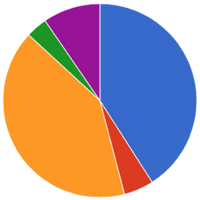
Why in the world does this portfolio only have 10% in bonds, at least according to the pie chart above? What exactly are those “alternatives”? I created a Google spreadsheet and started collecting more data from Morningstar:

The Goldman Sachs “multistrategy” fund turns out to consist of roughly 50% net stocks and 50% net cash/bonds. So the overall asset allocation is about 80% stocks and 20% bonds. Perhaps they confused the “age in bonds” rule of thumb with “age in stocks”? 🤔

I don’t know all the details and communications that took place before the creation and implementation of this portfolio, but my first impression is not positive. In addition to an overly-aggressive asset allocation, I see a mishmash of high-cost mutual funds. There isn’t a single penny in a low-cost index fund as a core holding! I don’t believe that you need 15 different funds to be “diversified”. While a relatively small holding, the fact that ARK ETF holdings are down 67% also means they decided to buy in after all of the initial outperformance. In other words, performance chasing.

Speaking of performance, the portfolio is down 25% from the initial purchase amounts. That’s seems like a lot for someone in their 70s, and we haven’t even technically hit a bear market in the S&P 500 yet.

2022 Berkshire Hathaway Annual Shareholder Meeting Video, Transcript, and Notes

Here are my notes on the 2022 Berkshire Hathaway Annual Shareholder Meeting. This year, CNBC has the rights to record and host the full video and transcripts (morning session, afternoon session) and they did a nice job with syncing the text and sound. I enjoyed listening to it like a podcast first and then reading through the text a second time around. There are many financial media articles with highlights, but here are my personal takeaways and notes.

Berkshire Hathaway is their life’s work and legacy. It’s fascinating to see how they have tried their best to build it to last forever. I recently listened to an outdoor podcast called Dirtbag Diaries where a 78-year-old man suffering from late-stage Parkinson’s disease still completed a 10-day whitewater rafting trip in the Canadian wilderness. Some folks just have more life energy than life time left, and wring out every last bit. Inspiring.

Warren Buffett is 91 and Charlie Munger is 98. These guys could be relaxing. They know the end is near, but they still have energy and are doing what they love. They built Berkshire bit by bit and the shareholders that they will leave behind are close family and friends that trust them. BRK is their legacy, and they have carefully crafted it to keep growing for those shareholders long past their lifetimes.

But most — a great many of them just say, you know, “We’ve saved this money. And we trust you and Charlie.” And that’s a great motivator, this trust.

“And, you know, take care of it and I’m not going to learn accounting and try to read all those statements or anything of the sort.”

You know, if I went broke, it wouldn’t really make any difference. It’d keep doing what I do. I’d figure out a way to read a paper and watch a little TV (Laughter) and think about things and talk to Charlie.

But the idea of losing, permanently, other people’s money — people who trust us — really, really — that’s just a future I don’t want to have.

So, the one thing I can tell you about Berkshire — although I can’t predict what our earnings will be, and I can’t predict what the stock will do, and I can’t — we don’t know. We don’t know what the economy will do and all of that sort of thing.

But we do know that we wake up every morning and we want to be safer, in terms of your eventual investment.

Now, whether you make the most money or anything, we do not want you to get a terrible result because you’ve decided to become our partner. And that’s a pledge you can live by.

They aren’t done yet, either. As long as they are able, they will keep adding pieces. They spent $40 billion is just three weeks, and are probably still buying stuff as I type this. The media usually only focuses their attention on certain purchases, but you can track their 13F filings to see exactly they bought and sold. Sites like Dataroma parse them for you, but if you plan on copycat investing be warned that the data is delayed and also Buffett is not always buy and hold forever. He’s not always right, and when Buffett realizes this, he can also sell quickly. Being late after he buys and late after he sells can be a very bad combo.

Berkshire Hathaway share repurchase timing gives some hints. They also bought back a few more BRK shares in January to March 2022 ($3 billion), but none in April 2022 once the price rose. This should give you a hint as to what Buffett thinks is a “good deal” on BRK shares. He wouldn’t buy back shares unless they were safely below his estimate of intrinsic value. You may see those 2021 and early 2022 prices again…

Cash is like oxygen. We should all keep adequate cash reserves in 100% liquid and safe places. Home equity lines of credit can (and have been) frozen quickly. Credit card limits can be reduced. We should know by now that crazy stuff happens quickly.

When 2008 and 2009 — the national panic came along — we didn’t own anybody’s commercial paper. You know, we didn’t have money market funds. We have Treasury bills. And, as I may get into it a little later, I’ll explain to you why.

We would — we believe in having cash.

And there have been a few times in history, and there will be more times in history, where if you don’t have it, you know, you don’t get to play the next day. I mean, it’s just —

It’s like oxygen, you know? It’s there all the time. But if it disappears for a few minutes, it’s all over.

Gambling and investing are getting mixed up yet again. Sports gambling is growing. Short-dated options trading is growing. Crypto has many shady pockets. Remember that casino owners make reliable profits while feeding the gamblers with hope. Which side do you want to be on? Buffett noticed this as a 21-year-old newlywed visitor to Las Vegas:

They’d gone to great lengths to come out to do something that was mathematically unintelligent, and they knew it was unintelligent.

And, I mean, they couldn’t do it fast enough, in terms of rolling the dice, you know, and trying to determine whether they were hot or whatever they may be.

And I looked around at that group. And everybody there knew that they were doing something that was mathematically dumb, and they’d come thousands of miles to do it, and they were —

And I said to my wife, I said, you know, I’m going to get rich.

How to beat inflation? Invest in your own human capital.

But the best thing you can do is to be exceptionally good at something. If you’re the best doctor in town, if you’re the best lawyer in town, if you’re the best whatever it may be, no matter whether people are paying you with a zillion dollars or paying with — they’re going to give you some of what they produce in exchange for what you deliver.

And if you’re the one they pick out to do any particular activity, sing, or play baseball, or be their lawyer, whatever it may be, whatever abilities you have can’t be taken away from you, they can’t actually be inflated away from you.

Somebody else will give you some of the wheat they produce, or the cotton, or whatever it may be, and they will trade you for the skill you have.

So, the best investment by far is anything that develops yourself. And, again, it’s not taxed. (Applause) So that’s what I would do.

Find the intersection of something that interests you, something you have a talent for, and something that pays the bills.

CHARLIE MUNGER: Well — if you stop to think about it, there are two things that neither one of us has ever succeeded at: One, we’ve never succeeded at anything that didn’t interest us, right?

WARREN BUFFETT: Right.

CHARLIE MUNGER: And we’ve never succeeded at anything that was really hard where we didn’t have much aptitude for it.

WARREN BUFFETT: Yeah. And we’ve been doing whatever we pleased for 60 years.

CHARLIE MUNGER: Yeah, we did.

Peerstreet Update 2022: Interest Rate Spreads, Secondary Market, Pocket 3.5% APY

Another one of my Peerstreet loans was paid off recently, and I realized that it has been over a year since my last update on this experiment in real-estate debt. Here’s my current view on this unique investment.

Peerstreet in a nutshell. “Fractional investments meet hard money lending”. Real estate investors need money quickly to purchase a property, so they pay a higher interest rate for lighting-fast funding but usually only hold the debt for 12-36 months. This used to be for wealthy folks with lots of cash lying around, but Peerstreet lets SEC-accredited investors put in as little as $1,000 to fund a portion of any specific property. The loans are backed by a first lien on the real estate property.

My performance in a nutshell. Since 2016, I have funded 72 loans on 72 different properties with between $1,000 to $5,000 each. I have earned nearly $5,000 in interest at an overall IRR of 6.8% so far (verified with Excel). 67 of the loans have been paid off, 2 are current on their payments and mature in 2022, and 3 are in various stages of being late. Due to rising real estate prices, I am just being patient and letting Peerstreet handle the legal gymnastics.

Why I stopped investing in a nutshell. My 72 loans were all between 7% and 10% interest. The median was 7.50% and the average was closer to 8%. However, in the past year the rates have been more often in the 6.5% to 7% range. Traditional 30-year fixed mortgage rates are now close to 6%, and Peerstreet’s rates are a bit higher now but I am still choosing to sit out at these offered rates. I have been seeing loans taking longer to become fully funded so perhaps I’m not alone. Below are the two most recent loans available, just as an example:

Secondary marketplace. Peerstreet has added a new feature where selected people (usually larger institutions) can make offers on your existing loans prior to maturity, possibly offering you valuable liquidity. In my experience, I have only received a few lowball bids on my loans that are in foreclosure, on the order of 50 cents on the dollar. No thanks. It will be much more interesting if/when they open this up to everyone, so that you can have a more efficient marketplace for loans in default.

Peerstreet Pocket 3.5% APY. Peerstreet also rolled out an optional feature called Pocket that pays higher-than-online-bank rates on your short-term cash. They just raised the rate up to 3.5% APY. You can deposit daily, but only withdraw once a month (with two weeks notice). The funds are not FDIC-insured and are backed by the financial ability of Peerstreet (effectively this is lending money to a young start-up company).

Bottom line. I still like the idea of Peerstreet and have had an overall positive experience (you do need enough invested to maintain proper diversification across loans), but the interest rates currently being paid out just aren’t high enough to maintain my interest. I’m currently withdrawing my funds gradually as the loans get paid back over time and investing them elsewhere. 10% interest rates would get my attention back, though! 💰

If you are interested, you can sign up and browse investments at PeerStreet for free before depositing any funds or making any investments. You must qualify as an accredited investor (either via income or net worth) to invest. If you already invest with them, they now sync with Mint.com.

Best Interest Rates on Cash – May 2022 Update

Here’s my monthly roundup of the best interest rates on cash as of May 2022, roughly sorted from shortest to longest maturities. We all need some safe assets for cash reserves or as a bond substitute, and there are often lesser-known opportunities available to individual investors. Check out my Ultimate Rate-Chaser Calculator to see how much extra interest you’d earn by moving money between accounts. Rates listed are available to everyone nationwide. Rates checked as of 5/10/2022.

Significant changes since last month: Rates are moving. Brokered CDs and US Treasury bonds close to 3% for 5 years. 1-year Treasury close to 2%. 9.62% Savings I Bonds still available if you haven’t done it yet. 4% APY on up to $6,000 for liquid savings at Current with no direct deposit requirement.

Fintech accounts
Available only to individual investors, fintech companies often pay higher-than-market rates in order to achieve fast short-term growth (often using venture capital). “Fintech” is usually a software layer on top of a partner bank’s FDIC insurance.

  • 4% APY on $6,000. Current offers 4% APY on up to $6,000 total ($2,000 each on three savings pods). No direct deposit required. $50 referral bonus for new members with $200+ direct deposit with promo code JENNIFEP185. Please see my Current app review for details.
  • 3% APY on up to $100,000, but requires direct deposit and credit card spend. HM Bradley pays up to 3% APY if you open both a checking and credit card with them, and maintain $1,500 in total direct deposit each month and make $100 in credit card purchases each month. Please see my updated HM Bradley review for details.
  • 3% APY on 10% of direct deposits + 1% APY on $25,000. One Finance lets you earn 3% APY on “auto-save” deposits (up to 10% of your direct deposit, up to $1,000 per month). Separately, they also pay 1% APY on up to another $25,000 with direct deposit. New customer $50 bonus via referral. See my One Finance review.
  • 3% APY on up to $15,000, requires direct deposit and credit card transactions. Porte requires a one-time direct deposit of $1,000+ to open a savings account. Porte then requires $3,000 in direct deposits and 15 debit card purchases per quarter (average $1,000 direct deposit and 5 debit purchases per month) to receive 3% APY on up to $15,000. New customer bonus via referral. See my Porte review.
  • 1.20% APY on up to $50,000. You must maintain a $250 direct deposit each month for this balance cap, otherwise you’ll still earn 1.20% on up to $5,000. They also pay 6% on USDC stablecoin, but I avoid this as it is not FDIC-insured (and you can get higher rates elsewhere if you did want to hold USDC.) New customer $100 bonus via referral. See my OnJuno review.
  • 1.25% APY (no balance cap). SoFi is now offering 1.25% APY with no balance cap. You must maintain a direct deposit each month of any amount. Convenient if you already have a relationship with them. See $25 + $300 SoFi Money new account and deposit bonus.

High-yield savings accounts
Since the huge megabanks pay essentially no interest, I think every should have a separate, no-fee online savings account to accompany your existing checking account. The interest rates on savings accounts can drop at any time, so I list the top rates as well as competitive rates from banks with a history of competitive rates. Some banks will bait you with a temporary top rate and then lower the rates in the hopes that you are too lazy to leave.

Short-term guaranteed rates (1 year and under)
A common question is what to do with a big pile of cash that you’re waiting to deploy shortly (plan to buy a house soon, just sold your house, just sold your business, legal settlement, inheritance). My usual advice is to keep things simple and take your time. If not a savings account, then put it in a flexible short-term CD under the FDIC limits until you have a plan.

  • No Penalty CDs offer a fixed interest rate that can never go down, but you can still take out your money (once) without any fees if you want to use it elsewhere. CFG Bank has a 13-month No Penalty CD at 1.07% APY with a $500 minimum deposit. Ally Bank has a 11-month No Penalty CD at 0.60% APY for all balance tiers. Marcus has a 13-month No Penalty CD at 0.75% APY with a $500 minimum deposit. You may wish to open multiple CDs in smaller increments for more flexibility.
  • Department Of Commerce Federal Credit Union has a 12-month certificate at 2.15% APY. $500 minimum. 180 day interest penalty on early withdrawals. Anyone can join this credit union through a $5 membership in the American Consumer Council (ACC). Enter ACC membership number on the online application.

Money market mutual funds + Ultra-short bond ETFs
Many brokerage firms that pay out very little interest on their default cash sweep funds (and keep the difference for themselves). Unfortunately, money market fund rates are very low across the board right now. Ultra-short bond funds are another possible alternative, but they are NOT FDIC-insured and may experience short-term losses at times. These numbers are just for reference, not a recommendation.

  • The default sweep option is the Vanguard Federal Money Market Fund which has an SEC yield of 0.53%.
  • Vanguard Ultra-Short-Term Bond Fund currently pays 1.79% SEC yield ($3,000 min) and 1.89% SEC Yield ($50,000 min). The average duration is ~1 year, so your principal may vary a little bit.
  • The PIMCO Enhanced Short Maturity Active Bond ETF (MINT) has a 1.68% SEC yield and the iShares Short Maturity Bond ETF (NEAR) has a 1.38% SEC yield while holding a portfolio of investment-grade bonds with an average duration of ~6 months.

Treasury Bills and Ultra-short Treasury ETFs
Another option is to buy individual Treasury bills which come in a variety of maturities from 4-weeks to 52-weeks. You can also invest in ETFs that hold a rotating basket of short-term Treasury Bills for you, while charging a small management fee for doing so. T-bill interest is exempt from state and local income taxes. Right now, this section isn’t very interesting as T-Bills are yielding close to zero!

  • You can build your own T-Bill ladder at TreasuryDirect.gov or via a brokerage account with a bond desk like Vanguard and Fidelity. Here are the current Treasury Bill rates. As of 5/9/2022, a new 4-week T-Bill had the equivalent of 0.50% annualized interest and a 52-week T-Bill had the equivalent of 1.94% annualized interest.
  • The Goldman Sachs Access Treasury 0-1 Year ETF (GBIL) has a 0.38% SEC yield and the SPDR Bloomberg Barclays 1-3 Month T-Bill ETF (BIL) has a 0.23% (!) SEC yield. GBIL appears to have a slightly longer average maturity than BIL.

US Savings Bonds
Series I Savings Bonds offer rates that are linked to inflation and backed by the US government. You must hold them for at least a year. If you redeem them within 5 years there is a penalty of the last 3 months of interest. The annual purchase limit for electronic I bonds is $10,000 per Social Security Number, available online at TreasuryDirect.gov. You can also buy an additional $5,000 in paper I bonds using your tax refund with IRS Form 8888.

  • “I Bonds” bought between May 2022 and October 2022 will earn a 9.62% rate for the first six months. The rate of the subsequent 6-month period will be based on inflation again. More on Savings Bonds here.
  • In mid-October 2022, the CPI will be announced and you will have a short period where you will have a very close estimate of the rate for the next 12 months. I will have another post up at that time.
  • See below about EE Bonds as a potential long-term bond alternative.

Prepaid Cards with Attached Savings Accounts
A small subset of prepaid debit cards have an “attached” FDIC-insured savings account with exceptionally high interest rates. The negatives are that balances are severely capped, and there are many fees that you must be careful to avoid (lest they eat up your interest). There is a long list of previous offers that have already disappeared with little notice. I don’t personally recommend nor use any of these anymore, as I feel the work required and the fees charged if you mess up exceeds any small potential benefit.

  • Mango Money pays 6% APY on up to $2,500, if you manage to jump through several hoops. Requirements include $1,500+ in “signature” purchases and a minimum balance of $25.00 at the end of the month.
  • NetSpend Prepaid pays 5% APY on up to $1,000 but be warned that there is also a $5.95 monthly maintenance fee if you don’t maintain regular monthly activity.

Rewards checking accounts
These unique checking accounts pay above-average interest rates, but with unique risks. You have to jump through certain hoops which usually involve 10+ debit card purchases each cycle, a certain number of ACH/direct deposits, and/or a certain number of logins per month. If you make a mistake (or they judge that you did) you risk earning zero interest for that month. Some folks don’t mind the extra work and attention required, while others would rather not bother. Rates can also drop suddenly, leaving a “bait-and-switch” feeling.

  • Quontic Bank is offering 1.01% APY on balances up to $150,000. May be useful for those with high balances. You need to make 10 debit card point of sale transactions of $10 or more per statement cycle required to earn this rate.
  • The Bank of Denver pays 2.00% APY on up to $10,000 if you make 12 debit card purchases of $5+ each, receive only online statements, and make at least 1 ACH credit or debit transaction per statement cycle. If you meet those qualifications, you can also link a Kasasa savings account that pays 1.00% APY on up to $25k. Thanks to reader Bill for the updated info.
  • Presidential Bank pays 2.25% APY on balances between $500 and up to $25,000, if you maintain a $500+ direct deposit and at least 7 electronic withdrawals per month (ATM, POS, ACH and Billpay counts).
  • Evansville Teachers Federal Credit Union pays 3.30% APY on up to $20,000. You’ll need at least 15 debit transactions and other requirements every month.
  • Lake Michigan Credit Union pays 3.00% APY on up to $15,000. You’ll need at least 10 debit transactions and other requirements every month.
  • (I no longer recommend this credit union myself, but the rate is still good.) Lafayette Federal Credit Union is offering 2.02% APY on balances up to $25,000 with a $500 minimum monthly direct deposit to their checking account. No debit transaction requirement. They are also offering new members a $100 bonus with certain requirements. Anyone can join this credit union via partner organization ($10 one-time fee).
  • Find a locally-restricted rewards checking account at DepositAccounts.

Certificates of deposit (greater than 1 year)
CDs offer higher rates, but come with an early withdrawal penalty. By finding a bank CD with a reasonable early withdrawal penalty, you can enjoy higher rates but maintain access in a true emergency. Alternatively, consider building a CD ladder of different maturity lengths (ex. 1/2/3/4/5-years) such that you have access to part of the ladder each year, but your blended interest rate is higher than a savings account. When one CD matures, use that money to buy another 5-year CD to keep the ladder going. Some CDs also offer “add-ons” where you can deposit more funds if rates drop.

  • Department Of Commerce Federal Credit Union has a 5-year certificate at 3.05% APY. $500 minimum. 180 day interest penalty on early withdrawals. Anyone can join this credit union through a $5 membership in the American Consumer Council (ACC). Enter ACC membership number on the online application.
  • Live Oak Bank has a 5-year CD at 2.75% APY ($2,500 minimum) with an early withdrawal penalty of 180 days of interest.
  • KS StateBank has a 5-year CD at 2.70% APY ($500 min). Early withdrawal penalty is 18 months of interest.
  • You can buy certificates of deposit via the bond desks of Vanguard and Fidelity. You may need an account to see the rates. These “brokered CDs” offer FDIC insurance and easy laddering, but they don’t come with predictable early withdrawal penalties. Right now, I see a 5-year CD at 3.20% APY. Be wary of higher rates from callable CDs listed by Fidelity.

Longer-term Instruments
I’d use these with caution due to increased interest rate risk, but I still track them to see the rest of the current yield curve.

  • Willing to lock up your money for 10 years? You can buy long-term certificates of deposit via the bond desks of Vanguard and Fidelity. These “brokered CDs” offer FDIC insurance, but they don’t come with predictable early withdrawal penalties. You might find something that pays more than your other brokerage cash and Treasury options. Right now, I see a 10-year CD at 3.00% APY vs. 2.98% for a 10-year Treasury. Watch out for higher rates from callable CDs from Fidelity.
  • How about two decades? Series EE Savings Bonds are not indexed to inflation, but they have a unique guarantee that the value will double in value in 20 years, which equals a guaranteed return of 3.5% a year. However, if you don’t hold for that long, you’ll be stuck with the normal rate which is quite low (currently 0.10%). I view this as a huge early withdrawal penalty. But if holding for 20 years isn’t an issue, it can also serve as a hedge against prolonged deflation during that time. Purchase limit is $10,000 each calendar year for each Social Security Number. As of 5/9/2022, the 20-year Treasury Bond rate was 3.38%.

All rates were checked as of 5/10/2022.

Warren Buffett’s Activision Merger Arbitrage “Bank/Credit Card Bonus” Deal

While listening to the 2022 Berkshire Hathaway Annual Meeting Q&A session (full video and transcript at CNBC), I was amused to hear that Warren Buffett announced that he bought shares of Activision Blizzard stock as part of a “workout”.

The very short version is that Microsoft (MSFT) has entered an agreement to purchase Activision Blizzard (ATVI) for $95 a share. As of close today 5/9/2022, you could buy ATVI for about $77.17 a share. If the sale goes through and closes in June 2023, you would earn a 23% return a little over a year.

The amusing part is that given the size of Berkshire Hathaway, even buying 10% of ATVI at the current price would only cost about $6 billion with a fixed upside of around $1.4 billion. If the deal closes, Berkshire would increase its $700 billion market cap at most by a one-time 0.2%. That’s the same ratio as someone with a $100,000 net worth doing a bank or credit card bonus deal for $200. 🤔

Even though Warren Buffett spends most of his time gradually building Berkshire Hathaway into a cash-gushing legacy fortress that will run for the next 100 years, he still can’t give up a good short-term deal either! It’s like an old habit. I love it! 🤣 Here’s how he ends it:

And incidentally, I don’t talk this over with Charlie. I mean, you know, he knows that occasionally I’ll see an arbitrage deal and do it. And, you know, 50 years ago we were doing it together, and his general feeling is, “Why is Warren fooling around with this kind of stuff, even.”

But it’s the old fire horse that occasionally it looks like the odds are in our favor. But absolutely we can lose money on that company, and, you know, fairly large sums of money, depending on what happened if the deal blows up.

And there will be a lot of people that want the deal to blow up. But Microsoft doesn’t want it to blow up, so we’ll just have to see what happens.

In addition, you and I can stroll over any brokerage app and participate in this “special situation” opportunity as well. There is still risk involved, and I’m sure there is plenty of discussion about it on various stock trading forums that I never visit, but here are my notes:

  • Around October and November 2021, Berkshire Hathaway acquired shares of ATVI at an average price of about $77 a share. This was the decision of either Ted Weschler or Todd Combs, as Buffett corrected. This would indicate that $77 a share would already reflect a margin of safety below intrinsic value, by their estimation, even without any acquisition talks.
  • In January 2022, Microsoft announced an agreement to buy ATVI at $95 a share in an all-cash deal. MSFT has more than enough cash to comfortably pay for this deal.
  • Since then, the shares have traded around $75 to $82 a share. Even after Buffett announced his participation in this deal, the price hasn’t moved much.
  • The primary risk is that US or EU regulators will stop the transaction due to anti-trust concerns. MSFT will pay a break-up fee of approximately $4 a share if it fails due to anti-trust issues.
  • Although he downplays it, I can only assume that Buffett – with all his experience – really does believe that this transaction has a good likelihood of going through, and even if it doesn’t the downside is limited. He has a different view than the market, and is willing to bet real money on it.

As an illustration, for every $1,000 invested into ATVI at $77.17 a share and cashed out at $95 a share, the upside potential is a $230 as of June 2023 (deal deadline, a little over 13 months from now). You can scale this number up or down based on your investment. $10,000 invested means $2,300 upside, and so on. The downside potential is unknown if it falls apart, and theoretically unlimited as with any business.

Disclosure: I bought a small position in ATVI in my side money account. This is not a recommendation for your situation and you should perform your own due diligence. Some people like to bet on a football game because it makes it more interesting, but I’d rather participate in something with an expected positive return and an educational component. I don’t believe in paper trading; skin in the game is a better teacher.

Vanguard ETF & Mutual Fund Expense Ratio Drops (Updated May 2022)

vglogoUpdated May 2022. Vanguard regularly announces expense ratio cuts to their mutual funds and ETFs. This post serves to keep track of these updates, as Vanguard usually removes the press releases after a certain amount of time. Most changes will be minor, it is always good to see continuing progress.

April 29, 2022 press release. Highlights:

  • Vanguard Total US Bond Market ETF (BND) lowered to 0.03%.
  • Vanguard Short-Term Bond ETF (BSV) lowered to 0.04%.
  • Vanguard Intermediate-Term Bond ETF (BIV) lowered to 0.04%.
  • Vanguard Long-Term Bond ETF (BLV) lowered to 0.04%.

February 2022 press release.

  • Vanguard Total International Stock Market (VXUS) lowered to 0.07%.
  • Vanguard Total World Stock ETF (VT) lowered to 0.07%.
  • Vanguard FTSE Emerging Markets ETF (VWO) lowered to 0.08%.
  • Vanguard Total International Bond ETF (BNDX) lowered to 0.07%.
  • Vanguard FTSE All-World ex-US ETF (VEU) lowered to 0.07%.
  • Vanguard FTSE All-World ex-US Small-Cap ETF (VSS) lowered to 0.07%.

Vanguard Select ETFs. These 13 Vanguard Select ETFs are what Vanguard thinks should be the building blocks of your portfolio due to their diversification, low costs, and liquidity. Here are the current expense ratios on the four broadest ones + their classic S&P 500 ETF:

  • Vanguard Total US Stock Market (VTI) at 0.03%.
  • Vanguard Total International Stock Market (VXUS) at 0.07%.
  • Vanguard Total US Bond Market (BND) at 0.03%.
  • Vanguard Total International Bond (BNDX) at 0.07%.
  • Vanguard 500 Index (VOO) at 0.03%.

Background. When you invest in a mutual fund or ETF, the fund company charges you a fee called the annual net expense ratio. If you hold a steady $10,000 in a hypothetical fund with a 1% expense ratio, that would result in an annual charge of $100. These expenses are actually deducted daily in tiny increments from the funds’ net asset value (NAV), and while the numbers can seem small initially they will compound quietly and relentlessly over time. Here is an illustration from the Vanguard website comparing the Vanguard average expense ratio vs. the industry average over different time periods (source):

Vanguard has a long history of lowering their expense ratios as their assets under management grow, whereas the industry average hasn’t changed nearly as much (source).

The Vanguard Effect. In recent years as index funds have shot up in popularity, most of the major providers have introduced similar low-cost products (notably iShares, Fidelity, and Schwab). Every subsequent “price drop” is less newsworthy or impactful to my portfolio. However, I think competition is great and even Vanguard needs to be kept on its toes. I have bought ETFs from other providers when they are the best available option.

However, you can’t ignore the fact that Vanguard has been the leader in the industry. The super-low-cost ETFs only exist where Vanguard has already established itself. If Vanguard hasn’t pushed the cost down in a specific area, their competitors know that and keep the costs high. Here’s a chart showing the “Vanguard Effect“.

Due to the combination of Vanguard’s excellent ETFs and their not-as-excellent customer service recently, you may want to consider buying Vanguard ETFs for free at your preferred brokerage firm including Fidelity, Schwab, TD Ameritrade, and E-Trade.

Savings I Bonds May 2022 Inflation Update: 9.62% Interest Rate!

May 2022 rate confirmed at 9.62%. Official press release. The variable inflation-indexed rate for I bonds bought from May 1, 2022 through October 31, 2022 will indeed be 9.62% as predicted. Every single I bond will earn this rate eventually for 6 months, depending on the initial purchase month. The fixed rate (real yield) is also 0% as predicted. Still a good deal.

See you again in mid-October for the next early prediction for November 2022.

Original post 4/12/22:

Inflation (and thus I Bonds) 🚀🚀🚀! Savings I Bonds are a unique, low-risk investment backed by the US Treasury that pay out a variable interest rate linked to inflation. With a holding period from 12 months to 30 years, you could own them as an alternative to bank certificates of deposit (they are liquid after 12 months) or bonds in your portfolio.

New inflation numbers were just announced at BLS.gov, which allows us to make an early prediction of the May 2022 savings bond rates a couple of weeks before the official announcement on the 1st. This also allows the opportunity to know exactly what a April 2022 savings bond purchase will yield over the next 12 months, instead of just 6 months. You can then compare this against a May 2022 purchase.

New inflation rate prediction. September 2021 CPI-U was 274.310. March 2022 CPI-U was 287.504, for a semi-annual increase of 4.81%. Using the official formula, the variable component of interest rate for the next 6 month cycle will be 9.62%. You add the fixed and variable rates to get the total interest rate. The fixed rate hasn’t been above 0.50% in over a decade, but if you have an older savings bond, your fixed rate may be up to 3.60%.

Tips on purchase and redemption. You can’t redeem until after 12 months of ownership, and any redemptions within 5 years incur an interest penalty of the last 3 months of interest. A simple “trick” with I-Bonds is that if you buy at the end of the month, you’ll still get all the interest for the entire month – same as if you bought it in the beginning of the month. It’s best to give yourself a few business days of buffer time. If you miss the cutoff, your effective purchase date will be bumped into the next month.

Buying in April 2022. If you buy before the end of April, the fixed rate portion of I-Bonds will be 0%. You will be guaranteed a total interest rate of 0.00 + 7.12 = 7.12% for the next 6 months. For the 6 months after that, the total rate will be 0.00 + 9.62 = 9.62%.

Let’s look at a worst-case scenario, where you hold for the minimum of one year and pay the 3-month interest penalty. If you theoretically buy on April 30th, 2022 and sell on April 1st, 2023, you’ll earn a ~6.51% annualized return for an 11-month holding period, for which the interest is also exempt from state income taxes. If you theoretically buy on April 30th, 2022 and sell on July 1, 2023, you’ll earn a ~7.17% annualized return for an 14-month holding period. Comparing with the best interest rates as of April 2022, you can see that this is much higher than a current top savings account rate or 12-month CD.

Buying in May 2022. If you buy in May 2022, you will get 9.62% plus a newly-set fixed rate for the first 6 months. The new fixed rate is officially unknown, but is loosely linked to the real yield of short-term TIPS, and is thus very, very, VERY likely to be 0%. Every six months after your purchase, your rate will adjust to your fixed rate (set at purchase) plus a variable rate based on inflation.

If you have an existing I-Bond, the rates reset every 6 months depending on your purchase month. Your bond rate = your specific fixed rate (based on purchase month, look it up here) + variable rate (total bond rate has a minimum floor of 0%). So if your fixed rate was 1%, you’ll be earning a 1.00 + 9.62 = 10.62% rate for six months.

Buy now or wait? Given that the current I bond rate is already much higher than the equivalent alternatives, I would personally buy in April to lock in the high rate for the longest possible time. Who knows what will happen on the next reset? I already purchased up to the limits first thing in January 2022. You are also getting a much better “deal” than with TIPS, as the fixed rate is currently negative with short-term TIPS.

Unique features. I have a separate post on reasons to own Series I Savings Bonds, including inflation protection, tax deferral, exemption from state income taxes, and educational tax benefits.

Over the years, I have accumulated a nice pile of I-Bonds and consider it part of the inflation-linked bond allocation inside my long-term investment portfolio. Right now, the inflation protection “insurance” is paying off with high yields and no principal risk.

Annual purchase limits. The annual purchase limit is now $10,000 in online I-bonds per Social Security Number. For a couple, that’s $20,000 per year. You can only buy online at TreasuryDirect.gov, after making sure you’re okay with their security protocols and user-friendliness. You can also buy an additional $5,000 in paper I bonds using your tax refund with IRS Form 8888. If you have children, you may be able to buy additional savings bonds by using a minor’s Social Security Number. TreasuryDirect also allows trust accounts to purchase savings bonds.

Note: Opening a TreasuryDirect account can sometimes be a hassle as they may ask for a medallion signature guarantee which requires a visit to a physical bank or credit union and snail mail. Don’t expect to be able to open an account in 5 minutes on your phone.

Bottom line. Savings I bonds are a unique, low-risk investment that are linked to inflation and only available to individual investors. Right now, they promise to pay out a higher fixed rate above inflation than TIPS. You can only purchase them online at TreasuryDirect.gov, with the exception of paper bonds via tax refund. For more background, see the rest of my posts on savings bonds.

[Image: 1950 Savings Bond poster from US Treasury – source]

Cash Rates Early Update: 5-Year CDs at 3% APY, 5-Year MYGA Rates at 3.65%

I’m going to wait a bit on my full May interest rate update, as I expect more rate changes early this week. Even the rates quoted below may become outdated quickly, but I wanted to point out certain rates at multi-year highs and also near the psychological 3% level. Here are a few examples as of 5/1/22:

  • Brokered CD rates: 3.05% APY for 5-year CDat Vanguard and Fidelity fixed income desks (non-callable, Capital One and Goldman).
  • Credit union CD rate: 3.03% APY for 5-year certificate at Department Of Commerce Federal Credit Union.
  • US Treasury Bonds: 2.97% yield to maturity at 5 years length, secondary market.
  • Fixed Annuity: 3.65% rate on 5-year MYGA from The Standard (A Rating) on 5/2/22 via Blueprint Income. Possibly as high as 3.85% with $100,000 at Stan the Annuity Man (varies by state). Learn more about MYGAs here and here.

I have no idea where rates will go from here. They may go much higher. 🤷 I haven’t decided when to lock in something, but I’m definitely paying attention.

Vanguard’s Special Tax-Efficient ETF and Mutual Fund Combo

This is a bit of an “inside baseball” topic appealing only to serious DIY investors, but I found this FT article about Vanguard’s unique tax-efficient fund structure quite interesting. Apparently, Vanguard has both a patent and special SEC permission that allows it have have a mutual fund and ETF version of the identical underlying portfolio, just as different share classes. The patent expires in 2023, but the SEC may not give other fund providers the special permission:

Vanguard’s “exchange traded fund-as-a-share-class” structure allows the Pennsylvanian powerhouse to operate a mutual fund and a sister ETF as essentially the same vehicle, generating superior tax efficiency and economies of scale.

As we saw with the Vanguard Target Retirement fund fiasco, if a mutual fund has to sell shares a whole, it can generate a lot of taxable capital gains that get distributed to all individual mutual fund holders even if they didn’t sell themselves. The article explains how ETFs have a different tax structure that allows more separation, and how sharing a portfolio with ETFs benefits Vanguard mutual fund holders.

The arrangement has provided clear tax deferral benefits for investors, however, due to a quirk in US capital gains tax regulations.

When mutual fund investors redeem, the sale of underlying holdings in a “cash” transaction potentially triggers a tax liability for all investors, even those not redeeming.

In contrast, the in-kind transactions that ETFs typically engage in means trading activity occurs outside of the fund so there is no tax “pass-through”.

By bolting together a mutual fund and an ETF, Vanguard is able to siphon securities that have appreciated out of the mutual fund into the ETF and dispose of them via an AP, so the tax liability is not triggered.

“That was the origin of the Vanguard plan. They started this because they had an awful lot of capital gains build up and thought ‘can we not kick it out?’” Pershkow said.

This did make me wonder about the flip side – are ETF investors even a little bit exposed to the mutual fund side? If there was a market crisis severe enough that a huge amount of mutual fund assets were suddenly sold off, might that create a large enough capital gain that the ETFs could not “absorb” it through their structure? Could ETF holders then still be stuck with a shared capital gains distribution?

ETFs and mutual funds now have different expense ratios. Vanguard launched their first index ETF, the Vanguard Total Stock Market ETF (VTI), back in 2001. For many years, Vanguard kept the expense ratio of the (admiral) mutual fund and ETF share classes exactly the same. However, these days there is a slight differential. It seems obvious to me that ETFs are cheaper for Vanguard to manage, and they are trying to avoid the ETF holders having to subsidize the mutual fund holders. A few examples:

  • Vanguard Total Stock Market: ETF 0.03% vs. Mutual Fund 0.04%
  • Vanguard Total International Stock: ETF 0.07% vs. Mutual Fund 0.11%
  • Vanguard Total Bond Market: ETF 0.04% vs. Mutual Fund 0.05%
  • Vanguard Total International Bond: ETF 0.07% vs. Mutual Fund 0.11%

Tax-free mutual fund to ETF conversions. This leads back to an actionable reminder. If held at Vanguard, these 18 mutual funds [pdf] can be converted to ETFs in a tax-free conversion and leave you with a lower expense ratio. Unfortunately, I couldn’t find a a way to do this online. You may need to test out Vanguard’s phone customer service.

The PDF covers a few of the pros and cons of mutual funds vs. ETFs.

Each mutual fund and its corresponding ETF carry the same degree of risk because—as 2 share classes of the same fund—they invest in identical portfolios of underlying stocks and bonds. The most noticeable differences are:

– ETFs have much lower investment minimums because you only have to buy 1 share at a time, not meet a $3,000 (or higher) minimum.
– ETFs are priced in real time throughout the trading day, whereas mutual funds are priced once, at the end of the day.

I would also add:

  • Buying a mutual fund used to be a lot simpler than buying an ETF if you just wanted to buy a fixed amount like $500 worth, but with many brokerages offering fractional shares, it’s less of an issue now. However, Vanguard itself does not support fractional shares. All things equal, I still enjoy the relative ease of dollar-based purchases of mutual funds at Vanguard.
  • When you buy an ETF, you may buy at a premium or discount to net asset value (NAV). In contrast, mutual fund purchases and redemptions are always done exactly at end-of-day NAV. In some cases, the difference may be larger than any expense ratio differences. Of course, the random intraday fluctuations may be greater than the NAV premium/discount as well.

One partial (but more complicated) solution is to occasionally convert your holding ETFs if you accumulate a sizable amount such that the expense ratio difference is significant. But for new purchases, use the mutual fund as long as you can meet the initial minimums. This way, most of your holdings will be the ETFs at the lower expense ratio.

In the end, these are relatively small differences in expense ratio. 0.01% ER difference times $100,000 = $10 a year. You will need to accumulate a sizable portfolio before the values are in the hundreds of dollars per year.

Vanguard Customer Service Complaints

Vanguard is based right outside of Philadelphia, so the Philadelphia Inquirer often provides helpful insights on the company. Their new article Vanguard clients take to social media over customer service mishaps (possible paywall?) provides a good overview of the ongoing customer service concerns at Vanguard. I guess I am not alone.

“If I’m calling, it’s because I really need someone,” said Blumenkrantz, a 68-year-old retiree of the Internal Revenue Service. He needed help finding the correct amount for a required minimum distribution from an IRA. After posting on Vanguard’s Facebook account, “I got a boilerplate response directing me to the same phone number I’ve been unsuccessfully using.”

Loyal Vanguard clients, such as Blumenkrantz, are coming out publicly — in interviews, on social media, and in letters to the company — saying they’re fed up with what they see as declining customer service.

As a decades-long customer myself, it’s not just that Vanguard is growing fast because they have a suddenly popular product that they just can’t keep up. That might be understandable. What is annoying is that they are consciously spending even more money on advertising, questionable marketing arrangements, and annoying pop-up ads when I log into my account to grow even faster, while obviously not spending the same amount on hiring enough skilled staff.

It’s like they keep cramming more people on the bus, while yelling “Hey everyone! Get on the bus!”, while not making the bus any bigger.

via GIPHY

Internally, Vanguard customer service reps say that they’re overwhelmed.

“I never thought I’d have to tell a client looking to transfer $1 million to call back because of call volumes,” said one person currently working at Vanguard. “The only way to fix the issue is by mass hiring.”

The Inquirer article also included some results from JD Power’s customer satisfaction surveys, showing that Vanguard phone support was a weak point relative to Fidelity and Schwab.

I would love to be able to recommend Vanguard without any reservations. Right now, I can only recommend buying their ETFs from a commission broker where you are comfortable. Using their favored nautical terms: I feel the Vanguard ship is headed in the wrong direction. I am still hopeful that Vanguard will steer the ship back on course.