Best Interest Rates Survey: Savings Accounts, Treasury Bills, Money Markets, ETFs – July 2025

Here’s my monthly survey of the best interest rates on cash as of July 2025, roughly sorted from shortest to longest maturities. Banks and brokerages love taking advantage of our idle cash, and you can often earning more money while keeping the same level of safety by moving to another FDIC-insured bank or NCUA-insured credit union. Check out my Ultimate Rate-Chaser Calculator to see how much extra interest you could earn from switching. Rates listed are available to everyone nationwide. Rates checked as of 7/9/2025.

TL;DR: Savings account interest rates are mostly stable (maybe a tiny bit lower on average), top rates are still those above 4.00% APY. Short-term T-Bill rates at around 4.3%. Top 5-year CD rates are ~4.25% APY, while 5-year Treasury rate is ~4%.

High-yield savings accounts*
Since the huge megabanks still pay essentially no interest, everyone should at least have a separate, no-fee online savings account to piggy-back onto your existing checking account. The interest rates on savings accounts can drop at any time, so I list the top rates as well as competitive rates from banks with a history of competitive rates and solid user experience. Some banks will bait you with a temporary top rate and then lower the rates in the hopes that you are too lazy to leave.

  • The top saving rate at the moment: HUSTL Financial at 5.00% APY (no min), a division of Vantage West Credit Union, member NCUA (and thus not a fintech). No direct experience with this one; wonder how long it will last? The “good/excellent” savings rate zone appears to be roughly 4% and above. CIT Platinum Savings is now at 4.00% APY with $5,000+ balance. There are many banks in between.
  • SoFi Bank is at 3.80% APY + up to $325 new account bonus with direct deposit. You must maintain a direct deposit of any amount (even $1) each month for the higher APY. SoFi has historically competitive rates and full banking features. See details at $25 + $300 SoFi Money new account and deposit bonus.
  • Here is a limited survey of high-yield savings accounts. They aren’t the top rates, but a group that have historically kept it relatively competitive such that I like to track their history. I’d call this the “okay/good” zone of 3.50%+.

Short-term guaranteed rates (1 year and under)
A common question is what to do with a big pile of cash that you’re waiting to deploy shortly (plan to buy a house soon, just sold your house, just sold your business, legal settlement, inheritance). My usual advice is to keep things simple and take your time. If not a savings account, then put it in a flexible short-term CD under the FDIC limits until you have a plan.

  • No Penalty CDs offer a fixed interest rate that can never go down, but you can still take out your money (once) without any fees if you want to use it elsewhere. Marcus has a 7-month No Penalty CD at 4.15% APY ($500 minimum deposit) and 13-month at 4.00% APY. Farmer’s Insurance FCU has a 9-month No Penalty CD at 4.25% APY ($1,000 minimum deposit). USA USALLIANCE Financial CU has a 11-month No Penalty CD at 4.20% APY ($500 minimum deposit).
  • Eagle Bank has a 12-month certificate at 4.45% APY ($1,000 min). Early withdrawal penalty is 90 days of interest.

Money market mutual funds
Many brokerage firms that pay out very little interest on their default cash sweep funds (and keep the difference for themselves). Note: Money market mutual funds are highly-regulated, but ultimately not FDIC-insured, so I would still stick with highly reputable firms.

  • Vanguard Federal Money Market Fund (VMFXX) is the default sweep option for Vanguard brokerage accounts, which has an SEC yield of 4.23% (changes daily, but also works out to a compound yield of 4.31%, which is better for comparing against APY). Odds are this is much higher than your own broker’s default cash sweep interest rate.
  • Vanguard Treasury Money Market Fund (VUSXX) is an alternative money market fund which you must manually purchase, but the interest will be mostly (100% for 2024 tax year) exempt from state and local income taxes because it comes from qualifying US government obligations. Current SEC yield of 4.18% (compound yield of 4.26%).

Treasury Bills and Ultra-short Treasury ETFs
Another option is to buy individual Treasury bills which come in a variety of maturities from 4-weeks to 52-weeks and are fully backed by the US government. You can also invest in ETFs that hold a rotating basket of short-term Treasury Bills for you, while charging a small management fee for doing so. T-bill interest is exempt from state and local income taxes, which can make a significant difference in your effective yield.

  • You can build your own T-Bill ladder at TreasuryDirect.gov or via a brokerage account with a bond desk like Vanguard and Fidelity. Here are the current Treasury Bill rates. As of 7/8/25, a new 4-week T-Bill had the equivalent of 4.30% annualized interest and a 52-week T-Bill had the equivalent of 4.11% annualized interest.
  • The iShares 0-3 Month Treasury Bond ETF (SGOV) has a 4.18% SEC yield (0.09% expense ratio) and effective duration of 0.10 years. SPDR Bloomberg Barclays 1-3 Month T-Bill ETF (BIL) has a 4.15% SEC yield (0.136% expense ratio) and effective duration of 0.15 years. The new Vanguard 0-3 Month Treasury Bill ETF (VBIL) has a 4.19% SEC yield (0.07% expense ratio) and effective duration of 0.10 years.

US Savings Bonds
Series I Savings Bonds offer rates that are linked to inflation and backed by the US government. You must hold them for at least a year. If you redeem them within 5 years there is a penalty of the last 3 months of interest. The annual purchase limit for electronic I bonds is $10,000 per Social Security Number, available online at TreasuryDirect.gov.

  • “I Bonds” bought between May 2025 and October 2025 will earn a 3.98% rate for the first six months. The rate of the subsequent 6-month period will be based on inflation again. More on Savings Bonds here.
  • In mid-October 2025, the CPI will be announced and you will have a short period where you will have a very close estimate of the rate for the next 12 months. I will post another update at that time.

Rewards checking accounts
These unique checking accounts pay above-average interest rates, but with unique risks. You have to jump through certain hoops which usually involve 10+ debit card purchases each cycle, a certain number of ACH/direct deposits, and/or a certain number of logins per month. If you make a mistake (or they judge that you did) you risk earning zero interest for that month. Some folks don’t mind the extra work and attention required, while others would rather not bother. Rates can also drop suddenly, leaving a “bait-and-switch” feeling.

  • OnPath Federal Credit Union (my review) pays 7.00% APY on up to $10,000 if you make 15 debit card purchases, opt into online statements, and login to online or mobile banking once per statement cycle. Anyone can join this credit union via $5 membership fee to join partner organization. You can also get a $100 Visa Reward card when you open a new account and make qualifying transactions.
  • Genisys Credit Union pays 6.75% APY on up to $7,500 if you make 10 debit card purchases of $5+ each per statement cycle, and opt into online statements. Anyone can join this credit union via $5 membership fee to join partner organization.
  • La Capitol Federal Credit Union pays 5.75% APY on up to $10,000 if you make 15 debit card purchases of at least $5 each per statement cycle. Anyone can join this credit union via partner organization, Louisiana Association for Personal Financial Achievement ($20).
  • First Southern Bank pays 5.50% APY on up to $25,000 if you make at least 15 debit card purchases, 1 ACH credit or payment transaction, and enroll in online statements.
  • Credit Union of New Jersey pays 6.00% APY on up to $25,000 if you make 12 debit card purchases, opt into online statements, and make at least 1 direct deposit, online bill payment, or automatic payment (ACH) per statement cycle. Anyone can join this credit union via $5 membership fee to join partner organization.
  • Andrews Federal Credit Union pays 5.50% APY (down from 6%) on up to $25,000 if you make 15 debit card purchases, opt into online statements, and make at least 1 direct deposit or ACH transaction per statement cycle. Anyone can join this credit union via partner organization.
  • Find a locally-restricted rewards checking account at DepositAccounts.

Certificates of deposit (greater than 1 year)
CDs offer higher rates, but come with an early withdrawal penalty. By finding a bank CD with a reasonable early withdrawal penalty, you can enjoy higher rates but maintain access in a true emergency. Alternatively, consider building a CD ladder of different maturity lengths (ex. 1/2/3/4/5-years) such that you have access to part of the ladder each year, but your blended interest rate is higher than a savings account. When one CD matures, use that money to buy another 5-year CD to keep the ladder going. Some CDs also offer “add-ons” where you can deposit more funds if rates drop.

  • Mountain America Credit Union (MACU) has a 5-year certificate at 4.25% APY ($500 minimum), 4-year at 4.20% APY, 3-year at 4.15% APY, 2-year at 4.00% APY, and 1-year at 4.20% APY. Early withdrawal penalty for the 4-year and 5-year is 365 days of interest. Anyone can join this credit union via partner organization American Consumer Council for a one-time $5 fee (or try promo code “consumer”).
  • Lafayette Federal Credit Union (LFCU) has a 5/4/3/2/1-year certificates at 4.28% APY ($500 min). Slightly higher rates with jumbo $100,000+ balances. Note that the early withdrawal penalty for the 5-year is a relatively large 600 days of interest. Anyone nationwide can join LFCU by joining the Home Ownership Financial Literacy Council (HOFLC) for a one-time $10 fee.
  • You can buy certificates of deposit via the bond desks of Vanguard and Fidelity. You may need an account to see the rates. These “brokered CDs” offer FDIC insurance and easy laddering, but they don’t come with predictable early withdrawal penalties. Right now, I see a 5-year non-callable brokered CD at 4.05% APY (callable: no, call protection: yes). Be warned that both Vanguard and Fidelity will list higher rates from callable CDs, which importantly means they can (and will!) call back your CD if rates drop significantly later.

Longer-term Instruments
I’d use these with caution due to increased interest rate risk (tbh, I don’t use them at all), but I still track them to see the rest of the current yield curve.

  • Willing to lock up your money for 10 years? You can buy long-term certificates of deposit via the bond desks of Vanguard and Fidelity. These “brokered CDs” offer FDIC insurance, but they don’t come with predictable early withdrawal penalties. You might find something that pays more than your other brokerage cash and Treasury options. Right now, I see a 10-year CDs at 4.00% (non-callable) vs. 4.33% for a 10-year Treasury. Watch out for higher rates from callable CDs where they can call your CD back if interest rates drop.

All rates were checked as of 7/9/25.

* I no longer recommend fintech companies due to the possibility of loss due to poor recordkeeping and lack of government regulation. (Ex. Evergreen Wealth at 5% APY is a fintech.)

Photo by insung yoon on Unsplash

MMB Portfolio Dividend & Interest Income – 2025 Q2 Update

Here’s my 2025 Q2 income update as a companion post to my 2025 Q2 asset allocation & performance update. Even though I don’t focus on high-dividend stocks or covered-call income strategies – I still track the income from my portfolio as an alternative metric to price performance. The total income goes up much more gradually and consistently than the number shown on brokerage statements, which helps encourage consistent investing. Here’s a related quote from Jack Bogle (source):

The true investor will do better if he forgets about the stock market and pays attention to his dividend returns and to the operating results of his companies. – Jack Bogle

Stock dividends are a portion of profits that businesses have decided to distribute directly to shareholders, as opposed to reinvesting into their business, paying back debt, or buying back shares. They have explicitly decided that they don’t need this money to improve their business, and that it would be better to distribute it to shareholders. The dividends may suffer some short-term drops, but over the long run they have grown faster than inflation.

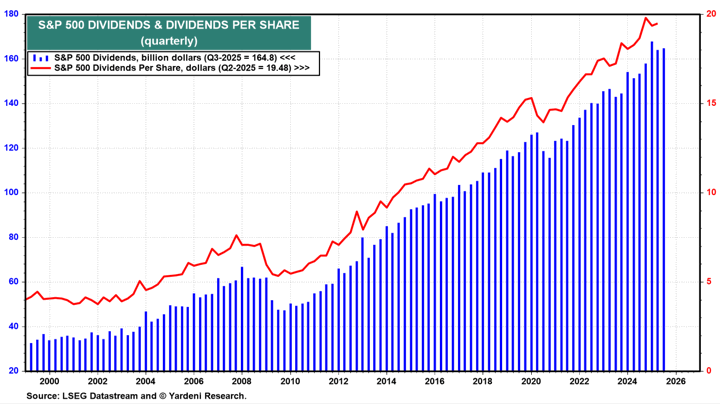
Here is the historical growth of the S&P 500 total dividend, which tracks roughly the largest 500 stocks in the US, updated as of 2025 Q2 (via Yardeni Research):

Tracking the income from my portfolio. Three of the primary income “trees” that distribute income in my portfolio are Vanguard Total US Stock ETF (VTI), Vanguard Total International Stock ETF (VXUS), and Vanguard Real Estate Index ETF (VNQ).

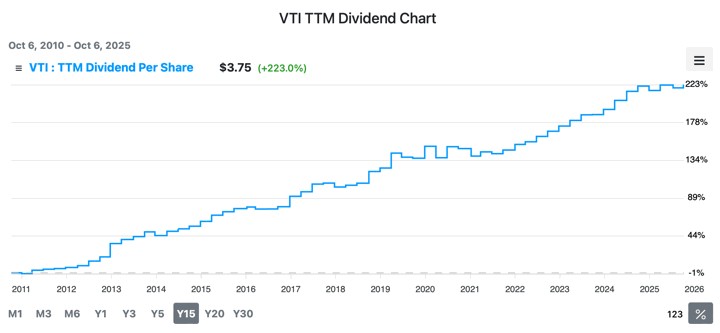
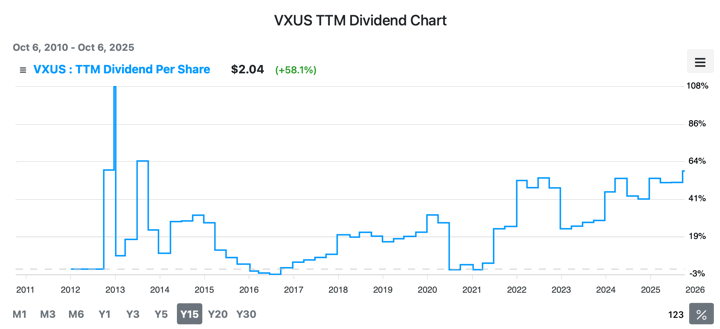
In the US, the dividend culture is somewhat conservative in that shareholders expect dividends to be stable and only go up. Thus the starting yield is lower, but grows more steadily with smaller cuts during hard times. Companies do buybacks as well, often because they are easier to discontinue. Here is the updated 2010-2025 chart of the trailing 12-month (ttm) dividend per share paid by the Vanguard Total US Stock ETF (VTI) via WallStNumbers.com.

European corporate culture tends to encourage paying out a higher (sometimes even fixed) percentage of earnings as dividends, but that also means the dividends move up and down with earnings. The starting yield is currently higher but may not grow as reliably. Here is the updated 2010-2025 chart of the trailing 12-month (ttm) dividend per share paid by the Vanguard Total International Stock ETF (VXUS).

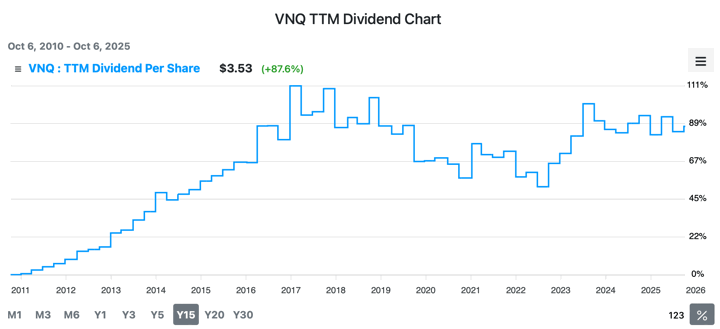
In the case of Real Estate Investment Trusts (REITs), they are legally required to distribute at least 90 percent of their taxable income to shareholders as dividends. Historically, about half of the total return from REITs is from this dividend income. Here is the updated 2005-2025 chart of the trailing 12-month (ttm) dividend per share paid by the Vanguard Real Estate Index ETF (VNQ). I extended this one out because the history was available to go beyond the 2008 Financial Crisis.

The dividend yield (dividends divided by price) also serve as a rough valuation metric. When stock prices drop, this percentage metric usually goes up – which makes me feel better in a bear market. When stock prices go up, this percentage metric usually goes down, which keeps me from getting too euphoric during a bull market.

Finally, the last income component of my portfolio comes from interest from bonds and cash. Vanguard Short-Term Treasury ETF (VGSH) and Schwab US TIPS ETF (SCHP) are example holdings, with the actual amount varying with the prevailing interest rates, the real rates on TIPS, and the current rate of inflation.

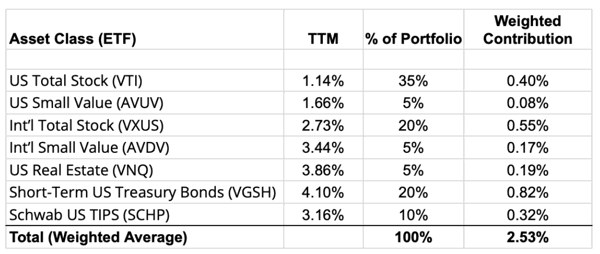
Dividend and interest income yield. To estimate the income from my portfolio, I use the weighted “TTM” or “12-Month Yield” from Morningstar (checked 7/3/24), which is the sum of the trailing 12 months of interest and dividend payments divided by the last month’s ending share price (NAV) plus any capital gains distributed (usually zero for index funds) over the same period. My TTM portfolio yield is now roughly 2.61%.

In dividend investing circles, there is a metric called yield on cost, which is calculated by dividing the current dividend by the original purchase price. In other words, while my portfolio yield today is 2.61%, that is because the current market price is also a lot higher. The yield-on-cost based on say 10 years ago, may be on the order of 5% or so. 2.61% may not seem like a lot today, but as you watch it grow it feels very powerful.

What about the 4% rule? For big-picture purposes, I support the simple 4% or 3% rule of thumb, which equates to a target of accumulating roughly 25 to 33 times your annual expenses. I would lean towards a 3% withdrawal rate if you want to retire young (closer to age 50) and a 4% withdrawal rate if retiring at a more traditional age (closer to 65). I don’t enjoy debating this number. It’s just a quick and dirty target to get you started, not a number sent down from the heavens! You will always have time to adjust later.

During the accumulation stage, your time is better spent focusing on earning potential via better career moves, improving your skillset, networking, and/or looking for asymmetrical (unlimited upside, limited downside) entrepreneurial opportunities where you have an ownership interest.

Our dividends and interest income are not automatically reinvested. They are simply another “paycheck”. As with our other variable paychecks, we can choose to either spend it or invest it again to compound things more quickly. You could use this money to cut back working hours, pursue a different career path, start a new business, take a sabbatical, perform charity or volunteer work, and so on. You don’t have to wait until you hit a magic number. Our life path is very different because of this philosophy. FIRE is Life!

MMB Portfolio Asset Allocation & Performance – 2025 Q2 Update

I try to limit checking my portfolio to once a quarter, and this is my 2025 Q2 update that includes our combined 401k/403b/IRAs and taxable brokerage accounts but excludes our house and side portfolio of self-directed investments. Following the concept of skin in the game, the following is not a recommendation, but a sharing of our actual, imperfect DIY portfolio.
“Never ask anyone for their opinion, forecast, or recommendation. Just ask them what they have in their portfolio.” – Nassim Taleb

How I Track My Portfolio
Here’s how I track my portfolio across multiple brokers and account types:

  • The Empower Personal Dashboard real-time portfolio tracking tools (free) automatically logs into my different accounts, adds up my various balances, tracks my performance, and calculates my overall asset allocation daily. Formerly known as Personal Capital.
  • Once a quarter, I also update my manual Google Spreadsheet (free to copy, instructions) because it helps me calculate how much I need in each asset class to rebalance back towards my target asset allocation. I also create a new sheet each quarter, so I have a personal archive of my net worth dating back many years.

2025 Q2 Asset Allocation and YTD Performance
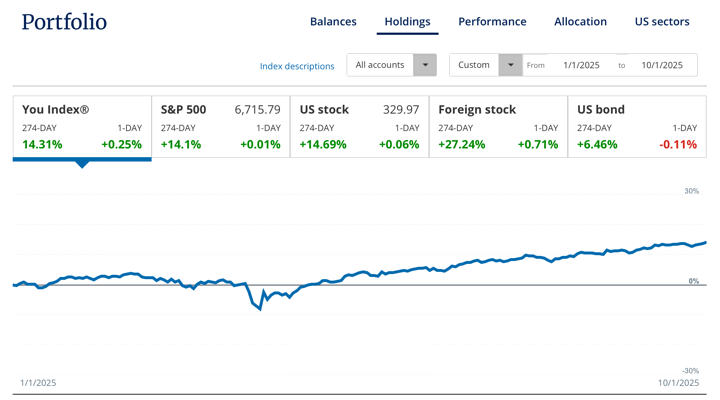
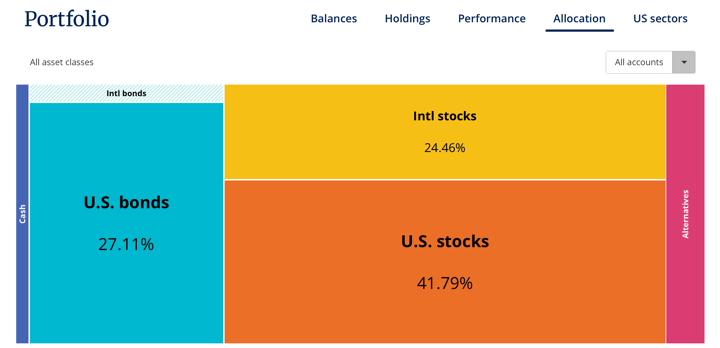
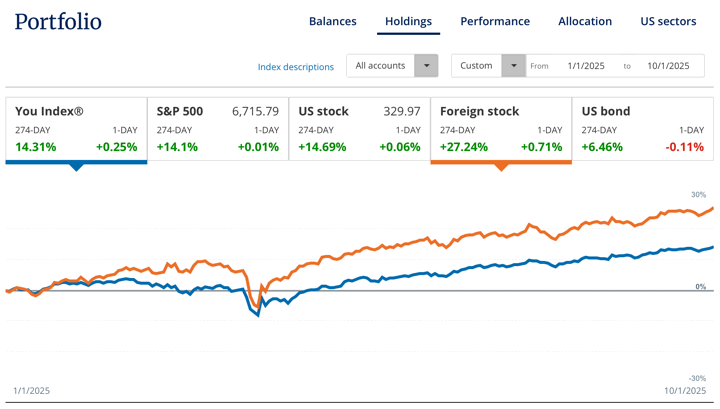
At the top of this post are updated performance and asset allocation charts, per the “Holdings” and “Allocation” tabs of my Empower Personal Dashboard.

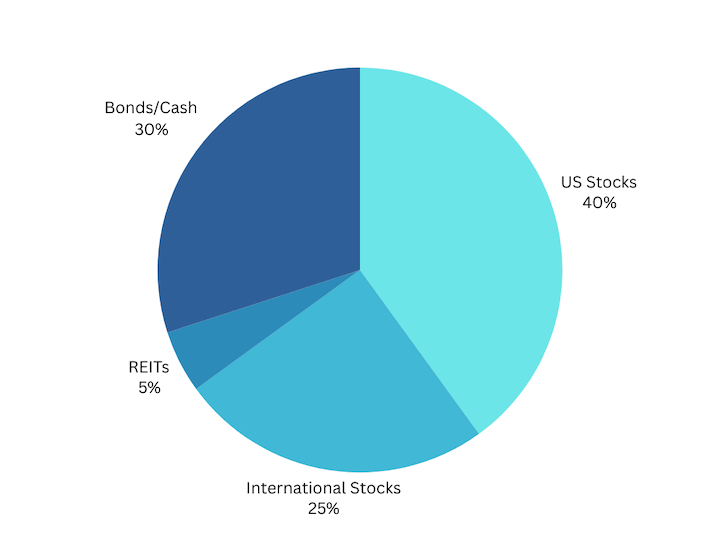
The major components of my portfolio are broad index ETFs. I do mix it up a bit around the edges, but not very much. Here is a model version of my target asset allocation with sample ETF holdings for each asset class.

  • 35% US Total Market (VTI)
  • 5% US Small-Cap Value (AVUV)
  • 20% International Total Market (VXUS)
  • 5% International Small-Cap Value (AVDV)
  • 5% US Real Estate (REIT) (VNQ)
  • 20% US “Regular” Treasury Bonds and/or FDIC-insured deposits (VGSH)
  • 10% US Treasury Inflation-Protected Bonds (SCHP)

Big picture, it is 70% businesses and 30% very safe bonds/cash:

By paying minimal costs including management fees, transaction spreads, and tax drag, I am trying to essentially guarantee myself above-average net performance over time.

I do not spend a lot of time backtesting various model portfolios. You’ll usually find that whatever model portfolio is popular at the moment just happens to hold the asset class that has been the hottest recently.

The portfolio that you can hold onto through the tough times is the best one for you. I’ve been pretty much holding this same portfolio for 20 years. Check out these ancient posts from 2004 and 2005. Every asset class will eventually have a low period, and you must have strong faith during these periods to earn those historically high returns. You have to keep owning and buying more stocks through the stock market crashes. You have to maintain and even buy more rental properties during a housing crunch, etc. A good sign is that if prices drop, you’ll want to buy more of that asset instead of less. I don’t have strong faith in the long-term results of commodities, gold, or bitcoin – so I don’t own them.

Performance details. According to Empower, the S&P 500 bounced back from it’s earlier drop and foreign stocks continued their excellent performance this year (up over 18% YTD). Rather refreshing that international diversification is boosting my portfolio returns instead of dragging them down! 🌍

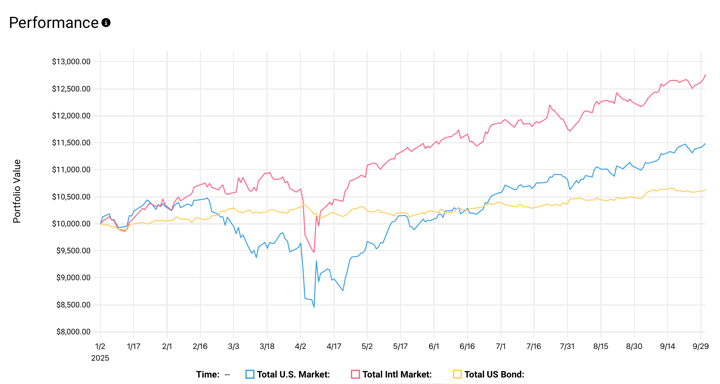
Over the last quarter, here’s a Growth of $10,000 chart courtesy of Testfolio for some of the major ETFs that shows the difference in performance in the broad indexes:

As is usually the case, just a few buy transactions to reinvest excess dividends and interest towards rebalancing the portfolio. No sell transactions at all.

I’ll share about more about the income aspect in a separate post.

US Asset Valuations vs. Rest of the World (Last 30 Years)

If you enjoy finance charts as I do, I recommend following Callum Thomas of TopDownCharts either via X/Twitter or weekly e-mail newsletter. One of the recurring themes recently is the extended outperformance of US assets vs. the rest of the world. But importantly, a good portion of this outperformance is due to an increase in valuation, meaning folks are paying a higher price per dollar of earnings. That’s not the same as the price increasing simply because earnings are higher.

This chart shows how US asset overall are at higher relative valuations:

This chart shows the relative valuation trends (US over ex-US, Growth over Value, and Large-cap over Small-cap stocks):

Find more interesting charts in their recent 10 Charts to Watch in 2025 (half-time) post.

What does this all mean? Mostly it’s just an interesting part of history to me. Roughly 2/3rds of my stock holdings are US and I’m not selling any of it, so I’m not making a contrarian bet or anything. However, I do think that remaining diversified with exposure to the rest of the world is the way to go. Nearly all Target Date Funds in 401k plans are already diversified in this manner. A lot can happen in the next 30 years.

UBS Global Investment Returns Yearbook: 125 Years of Market History (1900-2025)

The 2025 edition of the UBS Global Investment Returns Yearbook is available for free download in a 22-page PDF with 10 Key Insights on the UBS website. This annual publication provides an excellent “big picture” overview of the last 125 years of market history, and serves as a partial antidote to all the junk we are bombarded with about what happened in the the last 24 hours.

UBS Global Investment Returns Yearbook documents long-run returns on stocks, bonds, bills, currencies and other assets since 1900. Its goal is to inform investors about long-run historical performance, to interpret it, analyze it, learn from it, and help illuminate current concerns.

I definitely recommend downloading the report and at least scrolling through the historical charts and headline insights. The lessons may be familiar, but they are a good reminder of what builds wealth over the long run.

  • The composition of the stock market changes significantly over time.
  • Stock outperformance over bonds and cash over the long run is huge.
  • Patience is required to capture this outperformance from stocks.
  • Diversification can help, but it’s not guaranteed.

Best Broker for DIY Investors? Customer Satisfaction Survey Results 2025

The American Customer Satisfaction Index (ACSI) is a “national cross-industry measure of customer satisfaction” and they recently released their survey results on the finance vertical. Below are their rankings for “online investment”, which covers the major brokers for do-it-yourself investors. Measured categories include mobile app quality, customer service, and research tools.

#1 Fidelity was at the top both this year and last year, but the main difference from the previous years is the significantly increased gap between Fidelity and the rest of the field, notably #2 (Schwab) and #3 (Vanguard). Morgan Stanley/E-Trade and Merrill Edge also had big drops.

The majority of my assets remain split between Fidelity and Vanguard, and over time I actually like having the features of both. See also: AI Pioneer Divides Assets Across Multiple Banks and Brokerages.

Sources: RIABiz, ASCI Press Release.

Portfolio Asset Allocation: Asset Class Risk/Return Charts (2025)

While continuing my CFP course on Investment Planning, their sections on portfolio construction and asset allocation contained several updated 2025 versions of charts (including data through the end of 2024) that I have been posting on this site since the early days. Crazy that I first started looking at this stuff in the 2000s and now the 25-year charts barely go back that far!

1. Based on the past 25 years of performance (2020-2024), here is a chart of annualized return vs. standard deviation (volatility, a proxy of risk).

Takeaways: International stocks have had a very bad run, performing worse than long-term US bonds. T-Bills/Cash staked out their usual position as low risk/low return. I would also note that the difference between a 7% average annual return and a 3% average annual return over 25 years is huge, and this chart doesn’t really communicate that.

2. Here is the range of S&P 500 stock returns for various holding period lengths from 2020-2024.

Takeaways: Your range of average annual returns narrows as your holding period lengthens. This fits with the feeling that the swings in the past seem to fade away over time. But that doesn’t change the fact that going forward, your (hopefully large) stock portfolio in retirement might still drop by 40% in a single year.

3. Here is a bar chart of the top performing asset classes for various holding period lengths from 1926-2024.

Takeaways: For 25-year periods, 99% of the time stocks win. But a lot of those were overlapping 25-year periods. You have to consider how confident you are using 100 years of looking back to predict 50+ years into the future.

4. Here is the range of annual returns for the major asset classes from 2000-2024.

Takeaways: As you might expect, stocks are the most volatile by far.

5. Here is the Growth of $1 chart from 2020-2024 for selected major asset classes.

Takeaways: Long-term bonds actually beat stocks for a long time, as this period started right during the Dot-Com crash. But stocks still came back to win by a significant margin. Cash barely keeps with in inflation, so the inability to keep up with inflation is its own risk.

6. Here is the impact of blending different percentages of stocks and bonds on their combined performance and volatility.

Takeaways: These charts do change with the time period, but they usually show that owning around ~20% in stocks can actually give you a better return with the same amount of volatility (risk proxy) rather than owning zero stocks. So even if you are very risk-averse, owning at least some stocks is often advised. On the other end, there is often diminishing returns when you go above ~80% stocks.

TIAA Traditional and Lifetime Income Annuities Now Available to Public via IRA

TIAA-CREF recently announced that they are allowing the public to invest in their fixed and income annuities inside a Traditional or Roth IRA (via Bogleheads). This includes their most well-known TIAA Traditional Annuity, which has traditionally been only available to those working in nonprofit colleges, universities, hospitals (TIAA stands for Teachers Insurance and Annuity Association of America).

This was a Father’s Day coincidence, as what they suggest is very similar to what I helped set up for my father. As a long-time educator, the bulk of his retirement savings was accumulated using the TIAA Traditional annuity through both employer and employee contributions. After considering many factors, I advised him to annuitize a portion of it upon retirement for guaranteed lifetime income. The rest of the portfolio was stock and bond mutual funds.

In the example that TIAA provides, they annuitize 1/3rd of the total available portfolio, and the rest is spent down using the popular “4% withdrawal rule”. Their claim is that “annuitizing a portion of your savings with TIAA Traditional offers between 33% and 43% more income than a 4% withdrawal strategy.”

Looking at the fine print, they state:

Calculation uses the TIAA Traditional “new money” income rate for a single life annuity with a 10-year guarantee period at age 67 using TIAA’s standard payment method beginning income on March 1, 2025 (7.9462%).

So a 67yo person taking a single-life income annuity with a 10-year guarantee, which pays out 8% of principal every year. So if you annuitized $1,000,000, you would get roughly $80,000 a year in annual income, guaranteed, every year until death (with minimum 10 years of payments, or $800,000). 8% is double (100% more) what you’d get out from the “4% rule”, so if you annuitize 1/3rd if your portfolio, it would boost the first-year income by 33%. Math works out.

Here are some additional details I would emphasize:

  • With the income annuity used, the 8% withdrawal rate won’t ever go up or adjust with inflation. It’s a fixed payout every year, so the real inflation-adjusted value will decrease over time. After 15 years or 30 years, the payout from $1M would still be $80,000.
  • The “4% rule” taken from perhaps a 60% stock/40% bond portfolio is designed to be raised with inflation each year. After 15 years, the $40,000 a year from $1M would be $62,000 with 3% average inflation and $72,000 a year with 4% average inflation. After 30 years, the $40,000 a year from $1M would be $97,000 with 3% average inflation and $130,000 a year with 4% average inflation.
  • At death, the TIAA annuity would have zero value (assuming past the 10-year guarantee). Your 60/40 portfolio may have a lot (or a little, or nothing) left over.
  • The TIAA annuity is a guaranteed only by the claims-paying ability of TIAA. TIAA is usually one of the absolute top-rated insurance companies in terms of safety, but it doesn’t print its own money.

Overall, I felt that the trade-offs were worth it for my parents. They are financially conservative folks. Their annuitized income was lower because they took a joint-life annuity with my mother, but when added on top of their combined Social Security, their guaranteed monthly paycheck in retirement was large enough to cover all of their basic monthly expenses. Unless there was a big one-time expense, they would not have to take a single penny out of the rest of their investment portfolio.

I knew the value of the TIAA income would decrease over time due to inflation, but some studies have shown that retiree expenses also tend to trend downward over time. Social Security will still go up with inflation, and so should their investment portfolio over the long run.

TIAA Traditional as an accumulation vehicle. My dad was already with TIAA Traditional for decades before I started helping him with his finances, and while I am thankful for the financial stability of TIAA-CREF, I don’t know that I would pick the TIAA Traditional Annuity if I was starting out today. As a fixed annuity, there is a guaranteed minimum interest rate and then they credit extra if their underlying investments do well. The value thus is always increasing steadily and never goes down, which some people may like. Even a “safe” bond fund can have a negative year, as we saw recently.

Based on the numbers that I have seen, the long-term average return of TIAA Traditional will probably be very close to that of a low-cost Total US Bond Fund like BND. So it’s like a bond fund with smoothed returns. But this also means the long-term average return of TIAA Traditional will likely not be as high as if you held a Target Retirement Fund with stocks/bonds. Thus, I could see TIAA Traditional as a partial substitution for the bond portion of your portfolio, especially if you plan on annuitizing it upon retirement and can thus earn some of that vague “loyalty bonus”. THAT is the main advantage of TIAA – the ability to earn an excellent annuitization income rate from a very solid company.

(You can view the current TIAA Traditional interest rates here. Note that there are multiple different rate classes, and since the IRA class is fully liquid, it tends to offer one of the lower rates.)

For my parents, I am quite happy with the results of annuitizing a portion of your retirement portfolio. It depends on your own goals, but a fixed base monthly paycheck in retirement offers great peace of mind. I personally enjoy the fact that they stress much less about market swings. If TIAA continues to offer competitive income payout rates along with their top-tier safety rating, I will definitely keep this option in mind for myself.

Self-Paced CFP: Insurance Planning Highlights and Self-Paced Study Experiences

Finally… I passed the “Insurance Planning” course for my University of Georgia Self-Paced CFP class. That’s only #2 out of the 7 topics, but here are a few quick observations so far:

  • After trying a couple of times… 😅 I was not able to pass the course exams without studying the course materials first. You need 80% correct to pass, and I’d be in the 60% to 80% range without any studying.
  • I’ve been able to pass the exams after only reading the online course slides and review questions. I haven’t opened the textbooks once (as shown in pristine condition above!), even though I spent extra for the physical textbooks (as opposed to electronic-only).
  • As a personal finance geek, I did know a lot of the material beforehand, but there are definitely new bits that I’m learning here and there. The material is dry, but it covers a lot of topics.
  • Like many other professional certification exams, much of passing means studying specifically for the test. The questions aren’t necessarily weighted by what’s commonly used in financial planning practice, but by what is easiest to test in a multiple-choice format. That means memorizing formulas that require a financial calculator, “none of the above”, “all of the above”-type questions, and minor differences in definitions. I now understand why even after completing this educational course requirement, most CFP applicants sign up for another ~$1,000 “cram course” that just drills you on sample test questions.

Back to Insurance Planning. I got stuck on this course for while as it is a very wide topic with some rather dull topics, so here is a high-level overview of what was covered.

Three main categories of “Pure Risk” for individuals and families:

  • Personal
  • Property
  • Liability

Principles and Purpose of Insurance

  • Types of risk (pure vs. speculative)
  • Methods of managing risk (avoidance, reduction, retention, transfer)

Property and Casualty Insurance

  • Homeowners and renters insurance
  • Auto insurance
  • Liability and umbrella policies
  • Business-related coverage

Life Insurance

  • Types (term, whole, universal, variable)
  • Suitability and needs analysis
  • Policy selection, riders, beneficiary designations

Health Insurance and Disability Insurance

  • Health plans (PPO, HMO, HDHP, etc.)
  • Medicare and Medicaid
  • Social Security
  • Disability coverage (short-term, long-term, own vs. any occupation)
  • Long-Term Care Insurance

Employee and Group Benefits

  • Group life, health, and disability plans
  • COBRA and continuation coverage
  • Cafeteria and flexible spending accounts

Annuities

  • Types (fixed, variable, immediate, deferred)
  • Payout options and guarantees
  • Tax treatment and suitability

Role of a financial planner.

  • Coverage level determination
  • Help clients identify coverage gaps or excesses.
  • Refer clients to qualified Property & Casualty (P&C) agents.
  • Evaluate insurance as part of a broader financial plan.
  • Review and update over time

For example, for personal liability insurance you would ask about:

  • Personal Auto Policy (PAP): For motor vehicle-related liabilities.
  • Homeowners Policy: Covers bodily injury/property damage to others.
  • Comprehensive Personal Liability (CPL) Policy: Standalone liability coverage.
  • Umbrella Policy: Broad, high-limit policy supplementing existing coverages.

You may not need all of them individually, but some combination of these should work together to make sure there no holes. It’s also possible that you may have duplicate coverage or otherwise too much insurance.

A lot of financial advice focuses on “offense”: maximizing income, minimizing expenses, and optimizing investments. But “defense” is just as important, as it includes protecting from loss of future income and loss of existing assets.

Best Interest Rates Survey: Savings Accounts, Treasuries, CDs, Money Markets, ETFs – June 2025

Here’s my monthly survey of the best interest rates on cash as of June 2025, roughly sorted from shortest to longest maturities. Banks and brokerages love taking advantage of our idle cash, and you can often earning more money while keeping the same level of safety by moving to another FDIC-insured bank or NCUA-insured credit union. Check out my Ultimate Rate-Chaser Calculator to see how much extra interest you could earn from switching. Rates listed are available to everyone nationwide. Rates checked as of 6/4/2025.

TL;DR: Savings account interest rates are mostly stable overall, topping out around 4.60% APY. Short-term T-Bill rates at around 4.3%. Top 5-year CD rates are ~4.25% APY, while 5-year Treasury rate is ~4%.

High-yield savings accounts*
Since the huge megabanks still pay essentially no interest, everyone should at least have a separate, no-fee online savings account to piggy-back onto your existing checking account. The interest rates on savings accounts can drop at any time, so I list the top rates as well as competitive rates from banks with a history of competitive rates and solid user experience. Some banks will bait you with a temporary top rate and then lower the rates in the hopes that you are too lazy to leave.

  • The top saving rate at the moment: Elevault at 4.60% APY (no min), which appears to be an app-only subsidiary of Southern Bancorp, member FDIC (and thus not a fintech). The “good/excellent” savings rate zone appears to be roughly 4% and above. CIT Platinum Savings is now at 4.10% APY with $5,000+ balance. There are many banks in between.
  • There are also now a lot of savings accounts with higher rates but also added hoops. Examples: Roger.bank at 4.65% APY (no min), but does require an additional companion checking account. Axos One Savings at 4.66% APY (no min), but requires an Axos One Checking with direct deposit of $1,500+ and minimum balance of $1,500.
  • SoFi Bank is at 3.80% APY + up to $325 new account bonus with direct deposit. You must maintain a direct deposit of any amount (even $1) each month for the higher APY. SoFi has historically competitive rates and full banking features. See details at $25 + $300 SoFi Money new account and deposit bonus.
  • Here is a limited survey of high-yield savings accounts. They aren’t the top rates, but a group that have historically kept it relatively competitive such that I like to track their history. I’d call this the “okay/good” zone of 3.50%+.

Short-term guaranteed rates (1 year and under)
A common question is what to do with a big pile of cash that you’re waiting to deploy shortly (plan to buy a house soon, just sold your house, just sold your business, legal settlement, inheritance). My usual advice is to keep things simple and take your time. If not a savings account, then put it in a flexible short-term CD under the FDIC limits until you have a plan.

  • No Penalty CDs offer a fixed interest rate that can never go down, but you can still take out your money (once) without any fees if you want to use it elsewhere. Marcus has a 7-month No Penalty CD at 4.00% APY ($500 minimum deposit) and 13-month at 3.90% APY. Farmer’s Insurance FCU has 9-month No Penalty CD at 4.25% APY ($1,000 minimum deposit). Kinecta FCU has 9-month Liquid CD at 4.25% APY ($10,000 minimum) that allows for daily penalty-free withdrawals of up to 50% of the start of day balance. Consider opening multiple CDs in smaller increments for more flexibility.
  • Eagle Bank has a 12-month certificate special at 4.55% APY ($1,000 min). Early withdrawal penalty is 90 days of interest.

Money market mutual funds
Many brokerage firms that pay out very little interest on their default cash sweep funds (and keep the difference for themselves). Note: Money market mutual funds are highly-regulated, but ultimately not FDIC-insured, so I would still stick with highly reputable firms.

  • Vanguard Federal Money Market Fund (VMFXX) is the default sweep option for Vanguard brokerage accounts, which has an SEC yield of 4.23% (changes daily, but also works out to a compound yield of 4.31%, which is better for comparing against APY). Odds are this is much higher than your own broker’s default cash sweep interest rate.
  • Vanguard Treasury Money Market Fund (VUSXX) is an alternative money market fund which you must manually purchase, but the interest will be mostly (100% for 2024 tax year) exempt from state and local income taxes because it comes from qualifying US government obligations. Current SEC yield of 4.23% (compound yield of 4.31%).

Treasury Bills and Ultra-short Treasury ETFs
Another option is to buy individual Treasury bills which come in a variety of maturities from 4-weeks to 52-weeks and are fully backed by the US government. You can also invest in ETFs that hold a rotating basket of short-term Treasury Bills for you, while charging a small management fee for doing so. T-bill interest is exempt from state and local income taxes, which can make a significant difference in your effective yield.

  • You can build your own T-Bill ladder at TreasuryDirect.gov or via a brokerage account with a bond desk like Vanguard and Fidelity. Here are the current Treasury Bill rates. As of 6/4/25, a new 4-week T-Bill had the equivalent of 4.28% annualized interest and a 52-week T-Bill had the equivalent of 4.08% annualized interest.
  • The iShares 0-3 Month Treasury Bond ETF (SGOV) has a 4.17% SEC yield (0.09% expense ratio) and effective duration of 0.10 years. SPDR Bloomberg Barclays 1-3 Month T-Bill ETF (BIL) has a 4.13% SEC yield (0.136% expense ratio) and effective duration of 0.15 years. The new Vanguard 0-3 Month Treasury Bill ETF (VBIL) has a 4.19% SEC yield (0.07% expense ratio) and effective duration of 0.10 years.

US Savings Bonds
Series I Savings Bonds offer rates that are linked to inflation and backed by the US government. You must hold them for at least a year. If you redeem them within 5 years there is a penalty of the last 3 months of interest. The annual purchase limit for electronic I bonds is $10,000 per Social Security Number, available online at TreasuryDirect.gov.

  • “I Bonds” bought between May 2025 and October 2025 will earn a 3.98% rate for the first six months. The rate of the subsequent 6-month period will be based on inflation again. More on Savings Bonds here.
  • In mid-October 2025, the CPI will be announced and you will have a short period where you will have a very close estimate of the rate for the next 12 months. I will post another update at that time.

Rewards checking accounts
These unique checking accounts pay above-average interest rates, but with unique risks. You have to jump through certain hoops which usually involve 10+ debit card purchases each cycle, a certain number of ACH/direct deposits, and/or a certain number of logins per month. If you make a mistake (or they judge that you did) you risk earning zero interest for that month. Some folks don’t mind the extra work and attention required, while others would rather not bother. Rates can also drop suddenly, leaving a “bait-and-switch” feeling.

  • OnPath Federal Credit Union (my review) pays 7.00% APY on up to $10,000 if you make 15 debit card purchases, opt into online statements, and login to online or mobile banking once per statement cycle. Anyone can join this credit union via $5 membership fee to join partner organization. You can also get a $100 Visa Reward card when you open a new account and make qualifying transactions.
  • Genisys Credit Union pays 6.75% APY on up to $7,500 if you make 10 debit card purchases of $5+ each per statement cycle, and opt into online statements. Anyone can join this credit union via $5 membership fee to join partner organization.
  • La Capitol Federal Credit Union pays 5.75% APY on up to $10,000 if you make 15 debit card purchases of at least $5 each per statement cycle. Anyone can join this credit union via partner organization, Louisiana Association for Personal Financial Achievement ($20).
  • First Southern Bank pays 5.50% APY on up to $25,000 if you make at least 15 debit card purchases, 1 ACH credit or payment transaction, and enroll in online statements.
  • Credit Union of New Jersey pays 6.00% APY on up to $25,000 if you make 12 debit card purchases, opt into online statements, and make at least 1 direct deposit, online bill payment, or automatic payment (ACH) per statement cycle. Anyone can join this credit union via $5 membership fee to join partner organization.
  • Andrews Federal Credit Union pays 5.50% APY (down from 6%) on up to $25,000 if you make 15 debit card purchases, opt into online statements, and make at least 1 direct deposit or ACH transaction per statement cycle. Anyone can join this credit union via partner organization.
  • Find a locally-restricted rewards checking account at DepositAccounts.

Certificates of deposit (greater than 1 year)
CDs offer higher rates, but come with an early withdrawal penalty. By finding a bank CD with a reasonable early withdrawal penalty, you can enjoy higher rates but maintain access in a true emergency. Alternatively, consider building a CD ladder of different maturity lengths (ex. 1/2/3/4/5-years) such that you have access to part of the ladder each year, but your blended interest rate is higher than a savings account. When one CD matures, use that money to buy another 5-year CD to keep the ladder going. Some CDs also offer “add-ons” where you can deposit more funds if rates drop.

  • Mountain America Credit Union (MACU) has a 5-year certificate at 4.25% APY ($500 minimum), 4-year at 4.20% APY, 3-year at 4.15% APY, 2-year at 4.00% APY, and 1-year at 4.20% APY. Early withdrawal penalty for the 4-year and 5-year is 365 days of interest. Anyone can join this credit union via partner organization American Consumer Council for a one-time $5 fee (or try promo code “consumer”).
  • Lafayette Federal Credit Union (LFCU) has a 5/4/3/2/1-year certificates at 4.28% APY ($500 min). Slightly higher rates with jumbo $100,000+ balances. Note that the early withdrawal penalty for the 5-year is a relatively large 600 days of interest. Anyone nationwide can join LFCU by joining the Home Ownership Financial Literacy Council (HOFLC) for a one-time $10 fee.
  • You can buy certificates of deposit via the bond desks of Vanguard and Fidelity. You may need an account to see the rates. These “brokered CDs” offer FDIC insurance and easy laddering, but they don’t come with predictable early withdrawal penalties. Right now, I see a 5-year non-callable brokered CD at 4.30% APY (callable: no, call protection: yes). Be warned that both Vanguard and Fidelity will list higher rates from callable CDs, which importantly means they can (and will!) call back your CD if rates drop significantly later.

Longer-term Instruments
I’d use these with caution due to increased interest rate risk (tbh, I don’t use them at all), but I still track them to see the rest of the current yield curve.

  • Willing to lock up your money for 10 years? You can buy long-term certificates of deposit via the bond desks of Vanguard and Fidelity. These “brokered CDs” offer FDIC insurance, but they don’t come with predictable early withdrawal penalties. You might find something that pays more than your other brokerage cash and Treasury options. Right now, I see a 10-year CDs at [none listed] (non-callable) vs. 4.35% for a 10-year Treasury. Watch out for higher rates from callable CDs where they can call your CD back if interest rates drop.

All rates were checked as of 6/4/25.

* I no longer recommend fintech companies due to the possibility of loss due to poor recordkeeping and lack of government regulation. (Ex. Evergreen Wealth at 5% APY is a fintech.)

Photo by insung yoon on Unsplash

Merrill Edge + BofA Preferred Rewards = Up to $1,000 ACAT Transfer Bonus, Improved Credit Card Rewards

Updated May 2025. Merrill Edge is the self-directed brokerage arm formed after Bank of America and Merrill Lynch merged together. They are currently offering an increased cash bonus of up to $1,000 for moving “new money” or assets over to them from another brokerage firm. The offer code is 1000PR. Offer valid for both new and existing IRAs and taxable brokerage accounts (they call them Cash Management Accounts).

Here’s an overview along with my personal experience as I’ve had an account with them for a few years now.

Cash bonus. If you are holding shares of stock, ETFs, or mutual funds elsewhere, you can simply perform an “in-kind” ACAT transfer over to Merrill Edge. Your 100 shares of AAPL will remain 100 shares of AAPL, so you don’t have to worry about price changes, lost dividends, or tax consequences. Any cost basis should transfer over as well. Make a qualifying transfer and/or deposit to your new account within 45 days and maintain your balance for at least 90 days. The fine print version:

  1. You must enroll by entering the offer code in the online application during account opening or by providing it when speaking with a Merrill Financial Solutions Advisor at 877.657.3847.
  2. Fund your account with at least $20,000 in qualifying net new assets within 45 days of account opening. Assets transferred from other accounts at MLPF&S, Bank of America Private Bank, or 401(k) accounts administered by MLPF&S do not count towards qualifying net new assets.
  3. You must be enrolled in Preferred Rewards as of 90 days from meeting the funding criteria described in Step 2.
  4. After 90 days from meeting the funding criteria described in Step 2, your cash reward will be determined by the qualifying net new assets in your account (irrespective of any losses or gains due to trading or market volatility) as follows:
  • $100 bonus with $20,000+ in new assets
  • $200 bonus with $50,000+ in new assets
  • $400 bonus with $100,000+ in new assets
  • $1,000 bonus with $250,000 or more in new assets

Customers not enrolled in Preferred Rewards as of 90 days after funding will receive the following cash reward: qualifying net new assets of $20,000 to $49,999 receive $100; for $50,000-$99,999, receive $150; for $100,000-$249,999, receive $250; for $250,000 or more, receive $600.

Note that Preferred Rewards tiers usually requires a while to reach, unless you satisfy their “fast track” requirements:

You can enroll, and maintain your membership, in the Bank of America Preferred Rewards® program if you have an active, eligible personal checking account with Bank of America® and maintain the balance required for one of the balance tiers. The balance tiers are $20,000 for the Gold tier, $50,000 for the Platinum tier, $100,000 for the Platinum Honors tier, and $1,000,000 for the Diamond Honors tier. Balances include your combined, qualifying Bank of America deposit accounts (such as checking, savings, certificate of deposit) and/or your Merrill investment accounts (such as Cash Management Accounts, 529 Plans). You can satisfy the combined balance requirement for enrollment with either:

– a three-month combined average daily balance in your qualifying deposit and investment accounts, or
– a current combined balance, provided that you enroll at the time you open your first eligible personal checking account and satisfy the balance requirement at the end of at least one day within 30 days of opening that account.

After I did a similar bonus a couple years ago with a partial transfer (just enough to satisfy one of the tiers), a Merrill Edge rep contacted me and offered me a custom bonus to move even more assets over. (The bonus ratios were about the same, but higher limits.) Therefore, if you are considering this and happen to have more than $250,000 to transfer over, you may want to give them a call and see if they can offer even more money.

(Additional Outgoing ACAT Fee Reimbursement: Merrill Edge will also reimburse you any outgoing ACAT transfer fee or final closure fees that your old broker may charge you. You will need to contact Merrill directly and then send them a copy of your final statement with the fee shown.)

You can even transfer in Admiral Shares of Vanguard mutual funds – they won’t let you buy any additional shares, but you can only hold or sell them. You can, however, buy more shares of the corresponding Vanguard ETF if you wish. (Alternatively, you should consider having Vanguard convert your Admiral share into ETFs on a one-time basis that will preserve your original cost basis. After you have ETFs, you can move those over to Merrill Edge and trade them as you wish.)

The features for the account itself seem like most other online brokerages. Unlimited commission-free online stock, ETF and options trades (+ $0.65 per-contract fee). You can trade ETFs, fixed income, mutual funds, and options.

Preferred Rewards bonus. The Preferred Rewards program is designed to rewards clients with multiple account and higher assets located at Bank of America banking, Merrill Edge online brokerage, and Merrill Lynch investment accounts. Here is a partial table taken from their comparison chart (click to enlarge):

BofA checking accounts. With Gold status ($20k in assets) and above, you’ll get the monthly maintenance fee on up to 4 checking or savings accounts waived. That means you no longer have to worry about a minimum balance or maintaining direct deposit, depending on your account type. You’ll also get waived ATM fees at non-BofA ATMs at Platinum and above (12/year at $50k assets, unlimited at $100k). Free cashier’s checks.

Credit card rewards. With the Preferred Rewards boost, you can get up to 2.6% cash back on all your purchases with the Bank of America Unlimited Cash Rewards card, or 2.6% towards travel and no foreign transaction fees with the Bank of America Travel Rewards Card. You can also get 5.2% cash back on the first $2,500 in combined grocery/wholesale club/gas purchases each quarter with the Bank of America Customized Cash Rewards Card.

My personal experience. In terms of Merrill Edge, I’ve had an account with them for several years now and my lightning review is that they have a “okay/good” user interface and solidly “good” customer service (i.e. real, informed humans available 24/7 on the phone, not email-only customer service that takes hours to days like Robinhood). I am not an active trader and only make about 10-15 trades a year, but have been quite satisfied with the account. I can also move money instantly between my Merrill Edge and Bank of America checking accounts, making it relatively easy to sweep out idle cash into an external savings account, as their default cash sweep pays nearly zero interest. Don’t leave too much cash there!

The biggest financial benefit to this BofA/Merrill Edge combo with Preferred Rewards has probably been the 75% boost to their credit card rewards, allowing me to get a flat 2.625% cash back on virtually all my daily purchases. The second biggest benefit has probably been this cash bonus, and the third is the waived checking and ATM fees.

The ongoing credit card rewards would be the main reason to do this deposit offer, as the bonus percentages alone aren’t that high. For example, a $400 bonus on a $100,000 transfer amount is only 0.4%. Other brokerage transfer bonuses can be 1%, even 2%, and up.

Bottom line. Merrill Edge is currently offering up to $1,000 if you move over new assets to their self-directed brokerage. This can simply be mutual fund or ETFs shares currently being held elsewhere. When you keep enough assets across Bank of America and Merrill Edge, their Preferred Rewards program can offer ongoing perks like waived bank account fees and boosted credit card rewards.

More Details on Warren Buffett Stepping Back

I’m not sure how many of you follow Warren Buffett and Berkshire Hathaway closely, but here are a couple of significant updates as a follow-up to the 2025 Annual Shareholder Meeting where he announced that he was stepping down as CEO at the end of 2025:

As he will no longer be CEO, I am assuming this means that he will also not write anything in the annual Letter to Shareholders, which means that his public interactions will be severely limited to whatever few interviews he grants, if any. The end of an era.