
It took me an extra year to get around to it, but it only took me about 15 minutes to actually open and fund my new Fidelity Charitable Donor-Advised Fund (DAF). I even donated stocks instead of just cash, but the donating appreciated securities were from an existing Fidelity taxable brokerage account. Here’s a brief review of the process.
Step 1: Create Fidelity account. Provide personal details, including name, address, and Social Security Number. Similar to opening a new bank or brokerage account. They need this information for tax purposes. If, for example, you make 20 donations of $100 all to different charities, you will only have one $2,000 tax receipt at the end of the year. If you already have a Fidelity account log-in, it links easily.
Step 2: Contribution selection. If donating from a Fidelity brokerage account, they have a special tool that searches for tax lots with the largest unrealized gains. This maximizes the tax advantage of your donation. This ability to find specific lots is neat and overrides your usual default setting for tax lots (ex. First-in, First-out). You can also enter you desired donation amount and it will tell you how many shares you should donate to approximate that amount (final number will depend on market price). For now, I chose to donate enough to satisfy the minimum opening amount of $5,000. Here’s a screenshot:

Step 3: Investment selection. Pre-packaged or customized allocation. One of the benefits of a DAF is that you can invest your money in between the time of initial contribution and eventual distribution. I did not spend a lot of time agonizing over this choice, as I don’t plan on keep a large amount of funds in there. We are not talking about an obscene amount of money here, so I feel better about distributing it sooner and helping out now. I am mainly using the DAF for the bonus tax savings and thus making my effective contribution larger.
Still, I was happy to see that I could create a custom allocation using low-cost index fund choices, including a Total US Stock Market Index at 0.015% annual expense ratio and US Bond Index at 0.025% annual expense ratio. Keep in mind there is also a 0.60% annual administrative fee (minimum $100). I mostly hope that the market gains will more than offset the maintenance fees.
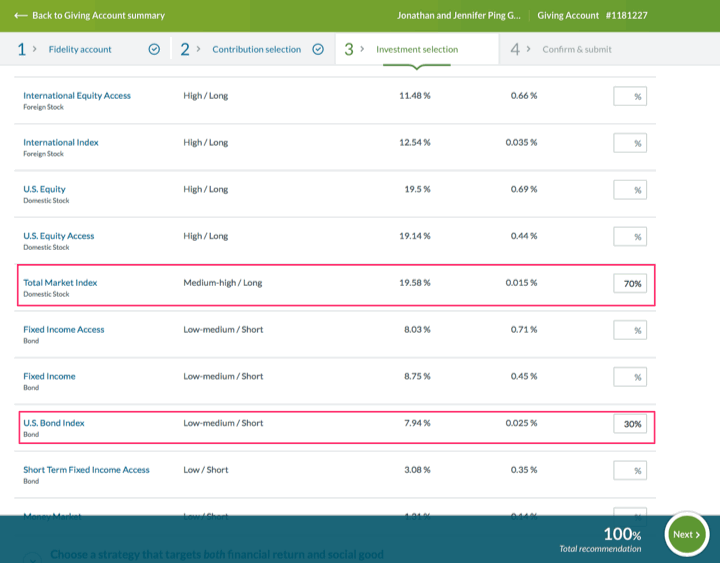
Step 4. Confirm and Submit. The overall user experience was smooth and my choices were summarized in a clear and concise manner. The actual sale of my shares will take a few business days. It is made clear that this is an irrevocable charitable contribution. This means I am eligible to take an itemized deduction for this contribution immediately.
You can also choose to donate stocks from an outside brokerage account, but that process will take more time (and possibly more work). I plan on trying this out later, to test out that experience.
 If you own stocks in a taxable brokerage account and make charitable donations, consider donating your stocks this year instead of just writing a check. Why? Given the all-time market highs, your stocks, mutual funds, and/or ETFs probably have unrealized capital gains. When you donate an appreciated security that you’ve held for at least a year, you’ll both avoid paying long-term capital gains tax AND get a tax deduction for the full current market value.



 Investment research firm Morningstar has released their annual 529 College Savings Plans

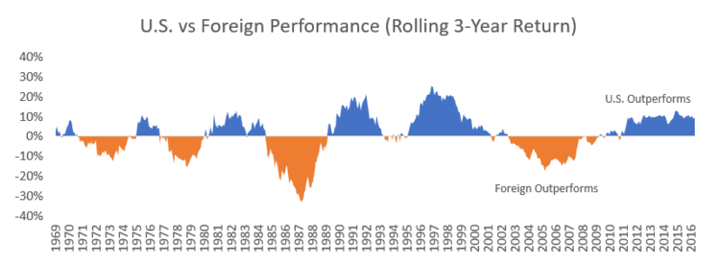
 One of the common reasons given for only investing the S&P 500 or only US-based companies is that the businesses operate globally. “McDonald’s and Coca-Cola sell burgers and soda everywhere. Disney is everywhere. ExxonMobil sells energy around the world.” I understand the sentiment, but how about some real numbers? The Morningstar article

 All this talk about portfolio rebalancing is to improve your risk-adjusted return, not to maximize absolute returns. You are trying to squeeze the most return out of a given degree of risk. Otherwise, if you do nothing eventually whatever has a higher return (historically always stocks) will outperform and take over the portfolio.
 Fidelity, Schwab, TD Ameritrade, E-Trade, Interactive Brokers, Ally Invest all now offer free stock trades. Vanguard offers free trades on all ETFs, not just their own. The new differentiators are things like user interface, customer service, and interest on cash sweep accounts. How about some cash in my pocket too?
 Robinhood brokerage has finally re-launched the high-interest cash sweep option after their failed (and illegal?) 2018 mash-up of checking accounts and SIPC-insurance.
  The Best Credit Card Bonus Offers – 2026
 Big List of Free Stocks from Brokerage Apps
 Best Interest Rates on Cash - 2026
 Free Credit Scores x 3 + Free Credit Monitoring
 Best No Fee 0% APR Balance Transfer Offers
 Little-Known Cellular Data Plans That Can Save Big Money
 How To Haggle Your Cable or Direct TV Bill
 Big List of Free Consumer Data Reports (Credit, Rent, Work)