 The financial news industry loves to provide constant updates of the S&P 500 along with endless guesses as to why it blipped up or down. I like reading about finance and it still drives me crazy! It just makes people focus on the short-term and think of the stock market like a roulette wheel. If you step back and take a longer-term view, here is a basic model for explaining the total return of the stock market:
Total Stock Returns = Earnings Growth + P/E Valuation Changes + Dividends
Here’s a quick common sense explanation:
Earnings growth. If your earnings stay the same, then all other things equal, one would expect the value of your company to stay the same as well. If earnings go up, again all other things equal, your company should be worth more, right?
Price-to-earnings ratio shows how much people are willing to pay as a multiple of earnings. When people are optimistic, the P/E ratio is high. When people are pessimistic, the P/E ratio is low. However, the overall ratio has some natural resistance points. A P/E of 10 means a 10% earning yield (ex. $100 share price and $10 of earnings per share). A P/E of 25 means a 4% earnings yield (ex. $100 share price and $4 of earnings per share).
Dividends. Cash money! In the long run, dividends tend to grow roughly at the same rate as earnings.
The WSJ Daily Shot used Bloomberg data to break down the performance of the S&P 500 total return by these components:

You can see that the dividend contribution has been pretty consistent at about 2% a year. Earnings have been going up the last 5 years, which is good news. Finally, we see that the P/E ratio has been a big part of the swings back and worth.
In The Little Book of Common Sense Investing, Jack Bogle called the changes in P/E ratio the “speculative return”, as opposed to something based on fundamentals. He made the following prediction about the future 10-year average return that book (originally published March 2007).

This was not meant to be an exact prediction. The main point was a warning that the future long-term returns were going to be lower than the historical returns of the last 25 years due to a lower dividend yield and somewhat elevated valuations. The annual return of Vanguard Total US Stock Market ETF (VTI) from March 2007 to March 2017 turned out to be 5.7%. According to the most recent quote (10/4/19), the average annual returns over the last 18 years has been 7%, last 15 years has been 9%, and the last 10 years has been 13%.
Bottom line. It can be educational to see the stock market return broken down into its parts: earnings growth, valuation change, and dividends. Much of the roller coaster performance we see every year is just the P/E ratio swinging back and forth. If you take a step back, you might find it easier to ignore the short-term volatility and focus on the long-term drivers of returns.







 The financial prediction industry is simply mind-boggling to me. There is zero long-term memory or accountability. You can make all the predictions you want about the stock market, gold prices, and interest rates, and nobody remembers your bad calls. You get a contrarian call right, and all of a sudden you’re on all the TV interviews and news articles.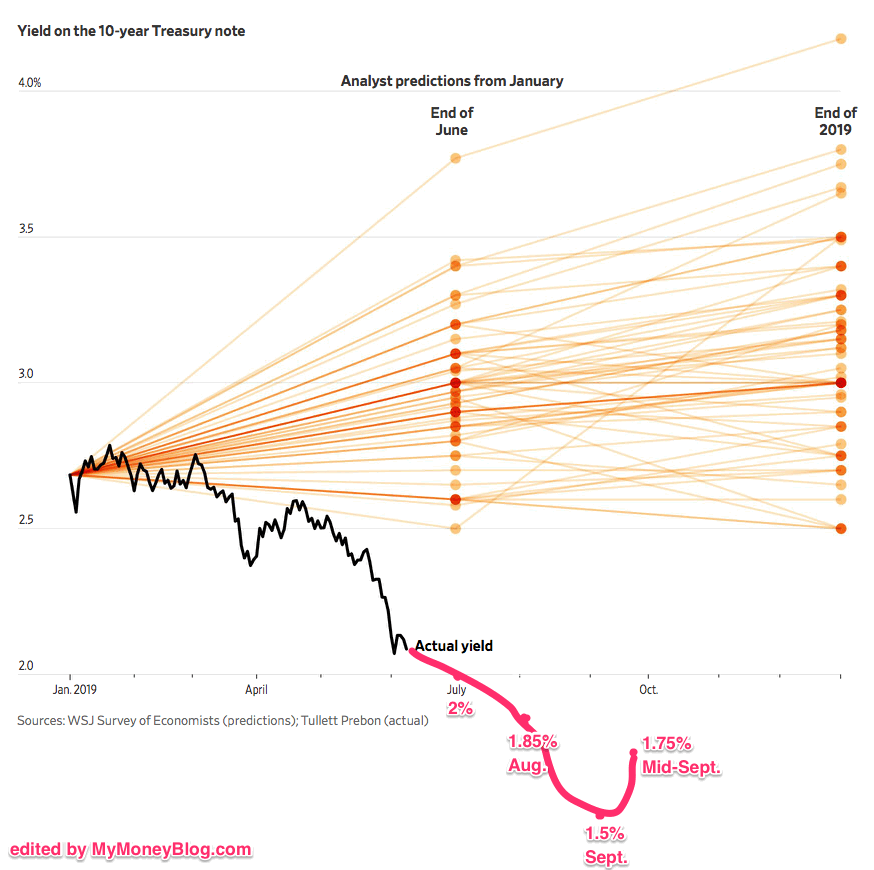


 Morningstar has another educational article about
 The Best Credit Card Bonus Offers – 2026
 Big List of Free Stocks from Brokerage Apps
 Best Interest Rates on Cash - 2026
 Free Credit Scores x 3 + Free Credit Monitoring
 Best No Fee 0% APR Balance Transfer Offers
 Little-Known Cellular Data Plans That Can Save Big Money
 How To Haggle Your Cable or Direct TV Bill
 Big List of Free Consumer Data Reports (Credit, Rent, Work)