 Last week, the yield on the 30-year US Treasury bond dropped below 2% for the first time in history. Many other articles will try to explain why this happened, and what this means for the future. Not me. I have no clue what’s coming and don’t think anyone else does either. Here’s the historical yield chart via Financial Times:

Reader skg recently shared that the original 1992 edition of Your Money or Your Life by Vicki Robin and Joe Dominguez is now available online (partially to promote the new 2018 edition).
 I rate this book a “must read” for those interested in a philosophical inspiration behind financial independence. However, the specific investing advice inside was to put all of your money into a ladder of 30-year US treasury bonds. Here an excerpt from the book on what they were looking for:
1. Your capital must produce income.
2. Your capital must be absolutely safe.
3. Your capital must be in a totally liquid investment. You must be able to convert it into cash at a moment’s notice, to handle emergencies.
4. Your capital must not be diminished at the time of investment by unnecessary commissions, “loads,” “promotional” or “distribution” expenses (often called “12b- 1 fees”), management fees or expense fees.
5. Your income must be absolutely safe.
6. Your income must not fluctuate. You must know exactly what your income will be next month, next year and twenty years from now.
7. Your income must be payable to you, in cash, at regular intervals; it must not be accrued, deferred, automatically reinvested, etc. You want complete control.
8. Your income must not be diminished by charges, management fees, redemption fees, etc.
9. The investment must produce this regular, fixed, known income without any further involvement or expense on your part. It must not require maintenance, management, geographic presence or attention due to “acts of God.”
That sounds pretty good, right? But then you have to remember that Joe retired about 1970 and this book was written about 1990. Look again at rates from 1970-1990 in the chart above. Another excerpt:
For most of this century, up until the late 1960s, interest rates were under 5 percent. Since their peak in 1981, long-term interest rates have been wending their way back down toward their historical norms. You did not need to catch the bond market at those abnormal highs in order to reach FI. Even at 5 or 6 percent, this program will work.
In 1969, when Joe reached FI, his capital was invested in bonds with interest averaging 6.85 percent and maturities extending into the 1990s. Through a few judicious bond swaps, and with no income other than the income from the bonds, his portfolio now has an average yield of 9.85 percent and maturities extending to the year 2007 on average.
Note that bolded quote “Even at 5 or 6 percent, this program will work”. Well, what about 2%? It probably wasn’t even on his radar as a possibility at that time. I’m sure something else will happen in the next 30 years that isn’t on my radar now.
Even buying the safest bonds in the world and locking them in for the longest period possible is not free from risk. Long-term bonds can still be one component of a diversified portfolio, assuming you understand when it will do well and when it won’t. However, it is important to realize that owning 100% long-term bonds at 2% leaves you very vulnerable to future inflation.
This is only a small part of the book, and there is additional discussion about being flexible in your own spending:
Your choices, attitudes, beliefs, habits, tastes, fears and desires have the ultimate effect on your bottom line.
Bottom line. Every time I see the line “for the first time in history”, I am reminded that no portfolio is 100% safe. We can look back at history as guide, but also accept its limitations. Even buying the safest bonds in the world and locking them in for the longest period possible is not free from risk. Preparing for retirement isn’t just about your investment portfolio, but also having adequte insurance coverage and your ability to be flexible in both spending and earning.


 You’ve probably heard of the “4% rule” when withdrawing income from a retirement portfolio. I think using such a rule is fine when you are early in the accumulation phase, although I like the “3% rule” better for early (long) retirements. But heck, reach 25x expenses first and then reassess. However, when it’s actually time to spend down that money, the execution can be tricky. If you start out taking 4% on a $1,000,000 portfolio ($40,000) and then the market drops 50%, will you really take $40,000 (8%) out of your sub-$500,000 portfolio the next year?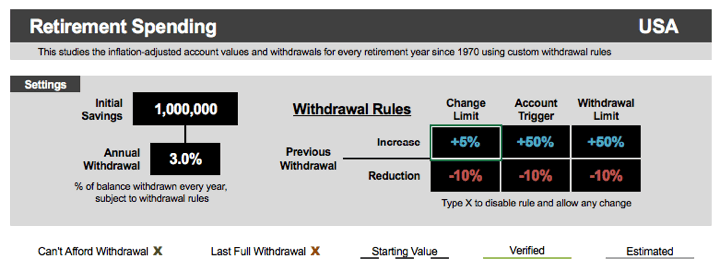


 If you read about investing in stocks and bonds, there is a lot of discussion about rebalancing your portfolio. Should you rebalance? When? How often? How much? Carl Ozeck contributes his thoughts on the Vanguard Blog article




 While poking around the Bogleheads investing forum, I came across a
 The Best Credit Card Bonus Offers – 2026
 Big List of Free Stocks from Brokerage Apps
 Best Interest Rates on Cash - 2026
 Free Credit Scores x 3 + Free Credit Monitoring
 Best No Fee 0% APR Balance Transfer Offers
 Little-Known Cellular Data Plans That Can Save Big Money
 How To Haggle Your Cable or Direct TV Bill
 Big List of Free Consumer Data Reports (Credit, Rent, Work)