My Money Blog Portfolio Asset Allocation, July 2018

portpie_blank200

Here’s my quarterly portfolio update for Q2 2018. These are my real-world holdings and includes 401k/403b/IRAs and taxable brokerage accounts but excludes our house, cash reserves, and a few side investments. The goal of this portfolio is to create enough income to cover our regular household expenses. As of 2018, we are “semi-retired” and spending some of the dividends and interest from this portfolio.

Actual Asset Allocation and Holdings

I use both Personal Capital and a custom Google Spreadsheet to track my investment holdings. The Personal Capital financial tracking app (free, my review) automatically logs into my accounts, tracks my balances, calculates my performance, and gives me a rough asset allocation. I still use my custom Rebalancing Spreadsheet (free, instructions) because it tells me where and how much I need to direct new money to rebalance back towards my target asset allocation.

Here is my portfolio performance for the year and rough asset allocation (real estate is under alternatives), according to Personal Capital:

Here is my more specific asset allocation, according to my custom spreadsheet:

Stock Holdings
Vanguard Total Stock Market Fund (VTI, VTSMX, VTSAX)
Vanguard Total International Stock Market Fund (VXUS, VGTSX, VTIAX)
WisdomTree SmallCap Dividend ETF (DES)
Vanguard Small Value ETF (VBR)
Vanguard Emerging Markets ETF (VWO)
Vanguard REIT Index Fund (VNQ, VGSIX, VGSLX)

Bond Holdings
Vanguard Limited-Term Tax-Exempt Fund (VMLTX, VMLUX)
Vanguard Intermediate-Term Tax-Exempt Fund (VWITX, VWIUX)
Vanguard High-Yield Tax-Exempt Fund (VWAHX, VWALX)
Vanguard Inflation-Protected Securities Fund (VIPSX, VAIPX)
iShares Barclays TIPS Bond ETF (TIP)
Individual TIPS securities
U.S. Savings Bonds (Series I)

Target Asset Allocation. Our overall goal is to include asset classes that will provide long-term returns above inflation, distribute income via dividends and interest, and finally offer some historical tendencies to balance each other out. I personally believe that US Small Value and Emerging Markets will have higher future long-term returns (along with some higher volatility) than US Large/Total and International Large/Total, although I could be wrong. I don’t hold commodities, gold, or bitcoin as they don’t provide any income and I don’t believe they’ll outpace inflation significantly.

I think it’s important to imagine an asset class doing poorly for a long time, with bad news constantly surround it, and only hold the ones where you still think you can maintain faith.

Stocks Breakdown

  • 38% US Total Market
  • 7% US Small-Cap Value
  • 38% International Total Market
  • 7% Emerging Markets
  • 10% US Real Estate (REIT)

Bonds Breakdown

  • 50% High-quality, Intermediate-Term Bonds
  • 50% US Treasury Inflation-Protected Bonds

I have settled into a long-term target ratio of 67% stocks and 33% bonds (2:1 ratio) within our investment strategy of buy, hold, and occasionally rebalance. With a self-managed, simple portfolio of low-cost funds, we minimize management fees, commissions, and taxes.

Real-world asset allocation details. No major changes from the last quarterly update. For both simplicity and cost reasons, I am no longer buying DES/DGS and will be phasing them out whenever there are tax-loss harvesting opportunities. New money is going into the more “vanilla” Vanguard versions: Vanguard Small Value ETF (VBR) and Vanguard Emerging Markets ETF (VWO).

My taxable muni bonds are split roughly evenly between the three Vanguard muni funds with an average duration of 4.5 years. I am still pondering going back to US Treasuries due to changes in relative interest rates and our marginal income tax rate. Issues with high-quality muni bonds are unlikely, but still a bit more likely than US Treasuries.

The stock/bond split is currently at 70% stocks/30% bonds. Once a quarter, I reinvest any accumulated dividends and interest that were not spent. I don’t use automatic dividend reinvestment. Looks like we need to buy more bonds and emerging markets stocks.

Performance and commentary. According to Personal Capital, my portfolio has basically broken even so far in 2018 (+1.5% YTD). I see that during the same period the S&P 500 has gained 6.5% (excludes dividends) and the US Aggregate bond index lost 1.7%. My portfolio is relatively heavy in international stocks which have done worse than US stocks so far this year.

An alternative benchmark for my portfolio is 50% Vanguard LifeStrategy Growth Fund (VASGX) and 50% Vanguard LifeStrategy Moderate Growth Fund (VSMGX), one is 60/40 and one is 80/20 so it also works out to 70% stocks and 30% bonds. That benchmark would have a total return of +2.8% YTD (as of 7/25/18).

As usual, I’ll share about more about the income aspect in a separate post.

Vanguard How America Saves 2018: How Does Your 401k Compare?

Vanguard recently released How America Saves 2018 report [PDF], which looks at the nearly 5 million 401k, 403b, and other defined-contribution retirement plans that they service. If you are curious about how your 401k stats compare with others, there is a great deal of information in this report. Here are a few quick stats based on 2017 data:

  • Average aggregate contribution rate amongst participants was 10.3% (employer and employee total).
  • Average maximum “employer match” contribution was 7% of income. Nearly 2/3rds of participants received the maximum employer match.
  • Average employee contribution was 6.8% of income.
  • Maxing out. 13% of participants saved the maximum annual amount of $18,000 ($24,000 age 50+) for 2017.
  • Average account balance was $103,866; the median balance was $26,331. A small number of plans with very high balances skews this often-quoted average upward.
  • Target-date funds. 58% of participants had their entire account balance invested in a single target-date fund or similar managed allocation. In other words, 58% let someone else pick their portfolio.
  • Automatic enrollment. Plans with automatic enrollment have a 92% participation rate.
  • Withdrawals and rollovers. About 1/3rd of participants could have cashed out their balance (with taxes and penalties) because they switched jobs. 84% of those folks kept their money in retirement plans. In terms of assets, 98% of all plan assets available for distribution were preserved and only 2% were taken in cash.
  • Loans. 15% of participants had a loan outstanding at year-end 2017.

These numbers don’t tell the entire story, as the average includes workers across different age groups, income levels, job tenures, and so on.

Longleaf Partners Funds: Reasons To Buy Higher-Cost, Concentrated, Actively-Managed Mutual Funds

I can’t recall the exact source or quote, but I read something along the lines of this in a forum recently:

We don’t really want to hear other people’s opinions. We want to hear our own opinions out of other people’s mouths.

In other words, confirmation bias:


(source: Chainsawsuit.com)

The majority of my portfolio is in low-cost, diversified, passive-managed mutual funds. In order to hear a different take, I read the shareholder letters of Longleaf Partners Funds (Southeastern Asset Management), which are respectable examples of higher-cost, concentrated, actively-managed mutual funds. The managers “eat their own cooking”, meaning they put a substantial portion of their personal net worth into the funds. They have a limited number of holdings, try to avoid asset bloat, and try to outline their positions in shareholder letters.

In their most recent 2nd Quarter 2018 letter [pdf], they share a presentation that explains their position:

Why We Believe Active Long-Term Value Investing in Common Stocks Will Actually Work
Active investing is out of favor; long-term investing (or really, long-term anything) is out of favor; value investing as we practice it is out of favor; and, investing in common stocks is out of favor compared to private equity. Doing all four of these things really makes us the skunk at the party.

Many have given up on active, long-term, engaged value investing in public equities just at the point when we believe it offers the best risk/reward proposition. Indexing’s multi-year momentum has pushed more assets into fewer stocks because they have gone up and left behind an expanding universe of highly competitive, well-governed and managed businesses with unique advantages that are materially underpriced in their publicly traded securities.

They make several interesting points, including the high amount of “closet indexers” out there. (Haven’t there always been a lot of closet indexers though?) I tried to see things from their perspective, but in the end I think their 1% expense ratio is just too high to overcome. It will definitely take a bear market for their performance gap to narrow.

In the meantime, their real problem is that poor relative performance. For every $10,000 invested in their flagship Partners fund 10 years ago, you would have about $18,000 today. If you had put it in a low-cost S&P 500 index fund, you would have about $27,000 today. That’s the difference between 6% and 10% annualized returns over the last 10 years. The extra drag from their ~1% expense ratio accounts for about a quarter of the performance gap.

Longleaf Partners Fund very well might turn things back around. I have no position in any of their funds, but I’ll keep reading their free shareholder letters and watch them try their best to play a very difficult game.

Retirement: Start Saving Regularly, Even If You Start Small

T. Rowe Price has a brochure The Benefit of Saving Regularly For Retirement [pdf] which has the common advice that you target saving at least 15% of your gross income each year to prepare for retirement. Of course, the earlier you start, the better. The added wrinkle here is that they offer an alternative route if you find 15% a stretch when you are young.

In their simulation, if you start saving at age 25 at a 6% rate and increase it 1% each year until you reach 15% (and then stay at 15%), you’ll actually come out ahead of someone who starts saving at age 30 at a 15% rate. You’ll even do okay if you start at age 30 at a 6% savings rate and increase it 2% a year until your reach 15% (and then stay at 15%). The two big takeaways are (1} start, even if small and (2) bump up your savings even if just a little by banking some of your raises each year.

The assumptions made seemed largely reasonable:

Examples beginning at age 25 assume a beginning salary of $40,000 escalated 5% a year to age 45 then 3% a year to age 65. Examples beginning at age 30 assume a beginning salary of $50,000 escalated 5% a year to age 45 then 3% a year to age 65. Example beginning at age 40 assumes a beginning salary of $80,000 escalated 5% a year to age 45 then 3% a year to age 65. Annual rate of return is 7%. All savings are assumed tax-deferred. Multiple of ending salary saved divides final ending portfolio balance by ending salary at age 65.

Bottom line. Start saving regularly, no matter the amount. Even if you feel like you can’t save 10% or 20% or whatever you read somewhere, just should start as soon as possible with a smaller number. After a year, try to increase your savings rate by 1% or 2%. Repeat each year. This can help minimize how much you “feel” the savings, while still ending up with a healthy nest egg. Build the habit.

Vanguard Will Offer Commission-Free Trades on All ETFs (Including iShares, Fidelity, Schwab, Etc)

Vanguard made a splash last week when it announced that it will offer commission-free trades on all ETFs in it brokerage accounts. Vanguard ETFs had been free to trade already. Starting in August, they will add nearly 1,800 ETFs from competitors including Blackrock (iShares), Schwab, State Street (SPDR), Powershares, WisdomTree, etc. Also see WSJ article (paywall?).

Pros. It is now cheaper to keep all my assets in only Vanguard accounts. In the past, if I wanted to buy a WisdomTree ETF, I might have held it in external account for cheaper trades. I could buy a Schwab ETF if that flavor is a lot cheaper. I could do some tax-loss harvesting in the same account. Simplicity and convenience are good. (Although, some would argue that it isn’t a bad idea to spread your money across different brokerage custodians.)

This is a bold move meant to disrupt the more limited commission-free ETF lists from other providers including TD Ameritrade, Schwab, and Fidelity. None of their lists include Vanguard ETFs, yet now Vanguard will include all of them. How will this change the competitive landscape? Will others move to match this “deal”?

Cons. Basically… who’s paying for this? Vanguard is known historically for being the “at cost” choice. They paid their employees, did their work, and then charged you what it cost to run the fund. There was no extra profit component for public or private shareholders. You had confidence that when they lowered their expense ratios, that would be a long-term move. Vanguard has never given out big sign-up bonuses or paid for the naming rights of “Vanguard Arena”.

However, in my opinion this move brings them closer to their competitors where they lose money on marketing and promotions and then have to cover that cost by charging a little extra on other things. Vanguard has already increased their ad budget significantly in recent years. I estimate the cost of a stock trade at about $2 per trade. That’s close to what the leanest, high-volume competitors charge when they can’t offset the trade costs with other revenue sources. So basically Vanguard is “paying” $2 a trade and hopefully offsetting that cost somewhere else. This must add up (especially for active traders), otherwise Schwab or TD Ameritrade would have already offer it. Instead, they charge for access to their no-transaction-free platforms.

As a supposed “owner-investor” in Vanguard, I was never asked my opinion on this. Vanguard is basically saying that growth of assets is good for everyone, don’t worry that the money to pay for these trades has to come from your Vanguard ETF and mutual fund holdings. As long as expense ratios only go downward, I suspect nobody will push back too hard.

Vanguard is also heavily pushing their Personal Advisory Services (PAS) at 0.30% of assets. How does the money flow between PAS and their ETFs? If PAS makes more money, does it help lower the expense ratios on my Total Stock Market ETF shares? It’s not very transparent.

In the end, you have to trust that Vanguard is still working for the good of their investors, and not just growing and accumulating a lot of well-paid executives and management. (Owner-investors also don’t know anyone’s salary at Vanguard.) As someone who has seen this sort of more-more-more philosophy in “non-profit” healthcare institutions, I am a little worried. I hope I’m wrong, and this move won’t cost Vanguard investors very much while making ETFs cheaper overall.

Reminder: Don’t Put Too Much Employer Stock Into Your 401(k)

Every time a large corporation stumbles, you will see something along these lines: Having Too Much Employer Stock in Your 401(k) Is Dangerous. That doesn’t prevent it from being solid advice. The best advice bears repeating.

Why? If your retirement savings are heavily concentrated in your employer stock, you human capital and your investment capital are directly linked. If your company falters, then you can lose both your job and your retirement security. Past examples include Enron, MCI Worldcom, and Tyco. Remember that any individual stock can go to zero.

In a large, multinational corporation, even a mid-level executive simply won’t affect the bottom line that much. You could be doing a great job, but what if the top brass commits fraud, takes on too much debt, or otherwise mismanages the company.

This time around, it is General Electric (GE). Per Morningstar data, $100,000 invested in GE stock on January 1st, 2017 would be about $47,000 today. Over the same period, $100,000 invested in a S&P 500 index fund would be about $124,000. That’s a gap of over $75,000 on a starting balance of $100,000. GE may recover eventually, but even that won’t help a retiree who needs the money now.

The Fortune article provides a list of other large company 401(k) plans that have heavy allocations to their own stock. Some of these are highly-respected companies, but then again so was GE.

  • Sherwin Williams (62%)
  • Colgate Palmolive (56%)
  • Exxon Mobil (54%)
  • Lowe’s Home Improvement (50%)
  • PACCAR (50%)
  • Dillard’s Department Stores (48%)
  • Chevron (44%)
  • McDonalds (39%)
  • Costco (38%)
  • Cerner (37%)

In my opinion, things are different if you are a majority owner of a small, private business. Yes, you also have a lot of eggs in one basket, but you directly control that basket! In addition, your upside could be much, much greater.

Consider that Vanguard charges money for financial advice through their Vanguard Managed Account Program (VMAP). When they analyzed the before-and-after results from actual participants, they found that their biggest impact was simply helping people reduce their exposure to company stock. They found that 12% of participants initially had a concentrated position of 20% or more in employer stock.

If you’re reading this, you can implement this advice for free! Do not invest more than 10% of your 401(k) plan in company stock. Consider reallocating funds into a low-cost, diversified index fund or other similar alternative. (Companies themselves are not allowed to exceed 10% in company stock for pension plans.)

Retirement Nest Egg Calculators: Running Out of Money vs. Running Out of Time

If you have researched retirement at all (early or otherwise), you’ve probably ran across various retirement calculators online. You input how much money you have (or plan to have), your asset allocation, and it spits out some numbers. This Vanguard Retirement Nest Egg Calculator is a good example of a simple version.

Let’s try an example. If I am 40 years old and thus assume I have up to 50 years left in retirement, and I want to maintain a 4% withdrawal rate ($40,000 a year from a $1,000,000 portfolio that is 65% stocks/30% bonds/5% cash), the tool uses Monte Carlo simulations to calculate that I have an 80% chance of lasting 50 years.

There is effectively one output: the odds of not running out of money. Either you still have at least a dollar, or you don’t. In my example, I have an 80% chance of having $1 or more at age 90.

But what if you also considered the odds of running out of time? Yes, that’s a euphemism for dying. (Ever notice how many of those we have?) In another neat tool from Engaging-Data.com, Will Your Money Last If You Retire Early? adds some helpful nuance to this analysis. You input the same types of information, but now in any given year you are provided the overall odds of each of these things happening:

  • Red – You are alive, but ran out of money.
  • Light green – You are alive, with less money than you started with. (Kinda nervous?)
  • Green – You are alive, with between 100% and 200% of what you started with. (Nice and comfy.)
  • Dark green – You are alive, with over 200% of what you started with. (In hindsight, I didn’t need to save so much…)
  • Grey – You are pushing up daisies. (In hindsight, maybe should’ve retired earlier…)

Here are sample results for the early retirement scenario above at 4% withdrawal rate (age 40, retirement horizon 50 years, $40k from a $1m 65/35/5 portfolio). I picked the female mortality table – if you have a male/female couple, it’s safer to pick the person likely to live longer.

There’s an angry streak of red where I’m broke. Of course, there’s a bigger streak of grey where I’m not breathing.

Here’s the same scenario, except with a lower 3% withdrawal rate ($30,000 a year from a $1,000,000 initial portfolio):

That change got rid of the red, but there is a lot of dark green. (1% makes a big difference.)

Here are sample results for a more traditional retirement scenario: (age 65, retirement horizon 25 years, $40k from a $1m 65/35/5 portfolio)

As a financially conservative person, these charts help illustrate why I prefer working with a 3% safe withdrawal rate for early retirement (50 and under) and 4% safe withdrawal rate for traditional retirement (closer to 65).

My favorite part of this tool is that it makes you take into account your mortality. It’s not all about staying above $1 in the bank, but also about maximizing your years of freedom. If you’re 40, you have a 10% chance of dying before even reaching 65. (This is why most people know someone who died shortly after retirement.) Is it better to have zero chance of broke and be 70, or 5% chance of broke and 60 with 10 more years of retirement (and 10 fewer years of work)? It is better to live a little more luxuriously for shorter time, or a little more frugally for a longer time? Playing around with all the different input variables might help you weigh the options.

Age-Sensitive Safe Withdrawal Rate Strategy? Age Divided By 20

Should a person who retires at age 70 withdraw the same amount of money from their portfolio as someone who is age 40? You’re talking about a retirement period that is likely twice as long as the other. In an article titled The “Feel Free” Retirement Spending Strategy [pdf], Evan Inglis of Nuveen Asset Management and a fellow of the Society of Actuaries proposed a safe withdrawal strategy that adjusts for age.

To determine a safe percentage of savings to spend, just divide your age by 20 (for couples, use the younger spouse’s age). For someone who is 70 years old, it’s safe to spend 3.5 percent (70/20 = 3.5) of their savings. That is the amount one can spend over and above the amount of Social Security, pension, employment or other annuity-type income. I call this the “feel free” spending level because one can feel free to spend at this level with little worry about significantly depleting one’s savings.

You can think of this is as a lower bound. He also proposes an upper bound:

At the other end of the spectrum, divide your age by 10 to get what I call the “no more” level of spending. If one regularly spends a percentage of their savings that is close to their age divided by 10 (e.g., at age 70, 70/10 = 7.0 percent) then their available spending will almost certainly drop significantly over the years, especially after inflation is considered.

Therefore, the lower and upper bounds for a person retiring at 70 would be 3.5% and 7%. The lower and upper bounds for a person retiring at 40 would be 2% and 4%.

Note that he also admits that spending 3% of your assets each year is an even simpler rule of thumb:

Even though there are lots of things to think about, for the vast majority of people, very simple guidelines will be most useful. My simple answer to the questions “How much can I spend?” or “Do we have money enough saved?” is that if someone plans to spend less than 3 percent of their assets in a year (over and above any Social Security or other pension, annuity or employment income), then they have enough money saved and they aren’t spending too much. This is a fairly conservative estimate, but people tell me they want to be conservative with their retirement spending. They would rather feel safe than spend a lot of money, and I think that is very appropriate in our current economic environment.

Another idea to add to your knowledge banks. Basically, if you are young you have to be sensitive about permanently damaging your portfolio early on with the double-whammy of negative returns and high spending.

Others will say that you should spend more when you’re young, as you’ll be able to enjoy it more. That may be true if you have long-term care insurance. I know lots of people who are still quite active and traveling at 70. I’m also at that age where I have checked out some of those “nice” assisted-living facilities for my parents, and they cost serious bucks.

My Money Blog Portfolio Income – June 2018

dividendmono225When it comes to making your portfolio last a lifetime, you may be surprised at how long that might be. According to this Vanguard longevity tool, for a couple both age 40 today, there is a 50% chance that one will live to 88. That’s 48 years.

For a young person making a plan to reach financial independence at a very early age (under 50), I think using a 3% withdrawal rate is a reasonable rule of thumb. For someone retiring at a more traditional age (closer to 65), I think 4% is a reasonable rule of thumb.

In addition, I track the dividend yield of my portfolio. This is not necessarily my spending target, but more of a very safe benchmark number. Having lived through a crisis like 2008, I know that it can be hard to appreciate “very safe” things until the poo hits the fan. The analogy I fall back on is owning a rental property. If you are reliably getting rent checks that increase with inflation, you can sit back calmly and ignore what the house might sell for on the open market.

Specifically, I track the “TTM Yield” or “12 Mo. Yield” from Morningstar, which the sum of a fund’s total trailing 12-month interest and dividend payments divided by the last month’s ending share price (NAV) plus any capital gains distributed over the same period. I like this measure because it is based on historical distributions and not a forecast. Below is a very close approximation of my most recent portfolio update (66% stocks and 34% bonds).

Asset Class / Fund % of Portfolio Trailing 12-Month Yield (Taken 6/11/18) Yield Contribution
US Total Stock
Vanguard Total Stock Market Fund (VTI, VTSAX)
25% 1.69% 0.42%
US Small Value
Vanguard Small-Cap Value ETF (VBR)
5% 1.82% 0.09%
International Total Stock
Vanguard Total International Stock Market Fund (VXUS, VTIAX)
25% 2.75% 0.69%
Emerging Markets
Vanguard Emerging Markets ETF (VWO)
5% 2.42% 0.12%
US Real Estate
Vanguard REIT Index Fund (VNQ, VGSLX)
6% 3.48% 0.21%
Intermediate-Term High Quality Bonds
Vanguard Intermediate-Term Tax-Exempt Fund (VWIUX)
17% 2.86% 0.49%
Inflation-Linked Treasury Bonds
Vanguard Inflation-Protected Securities Fund (VAIPX)
17% 2.64% 0.45%
Totals 100% 2.47%


Our overall plan is still based on a 3% withdrawal rate. This calculation tells us that 2.5% will come out as income “naturally”, and we would have to take the remaining 0.5% by selling shares. Living off a portfolio is an area of ongoing debate, so don’t let anyone convince you that there is a “right” answer. I’m not a financial firm convincing you to let me handle your money. I’m not here to pitch you an easily-achievable dream lifestyle. Even if you run a bunch of numbers looking back to 1920, that’s still trying to use 100 years of history to forecast 50 years into the future.

Your life is not a Monte Carlo simulation, and you need a plan to ride out the rough times. We are a real 40-year-old couple with three young kids, and this money has to last us a lifetime (without stomach ulcers). Michael Pollan says that you can sum up his eating advice as “Eat food, not too much, mostly plants.” You can sum up my thoughts on portfolio income as “Spend mostly dividends and interest. Don’t eat too much principal.”

Stock Market Game: Buy & Hold vs. Market Timing

Here’s an interactive “game” at Engaging-Data.com where you can test out your stock market timing skills based on actual historical returns. You’ll be given a randomly-selected 3-year period of the S&P 500 from 1950-2018. You start out fully invested, but you can sell or buy at any time. The simulator tracks your returns vs. just holding on through the entire period. Can you consistently pick the right times to jump in and out?

I like the WarGames reference. The only winning move is not to play.

While the game is interesting, I think a crucial thing missing is the emotion of the moment. (Not that this is the fault of the programmer.) In my experience, casual investors tend to get caught up in market timing due to one of two emotions: the fear of missing out (FOMO), and the fear of losing everything. The housing bubble was all about FOMO. The “smart” move was to get on that property ladder at any price, with any time horizon, with any loan terms. Then in the 2008 stock crash, I was getting every variation of the “why not sell and wait for the dust to settle???”. The “prudent” move became sitting it out. As of early 2018, things have been pretty comfortable for while, and “buy and hold” looks both smart and prudent again.

I think buy and hold is a valid strategy, but simple is not easy. It will be hard again soon enough. When the next crisis eventually occurs, I hope that I can be a boring example of buy and hold. In the meantime, hopefully this game will at least keep you on your toes.

Personal Capital Review: Automatically Track Net Worth and Portfolio Asset Allocation

Personal Capital is free financial website and app that links all of your accounts to track your spending via bank and credit cards, investments, and net worth. You provide your login information, and they pull in the information for you automatically so you don’t have to type in your passwords every day on 7 different websites. Personal Capital’s strength is in investments, including portfolio tracking, performance benchmarking, and asset allocation analysis.

Net worth. You can add your home value, mortgage, checking/savings accounts, CDs, credit cards, brokerage, 401(k), and even stock options to build your customized Net Worth chart. You can also add investments manually if you’d prefer. I have a habit of accumulating bank and credit union accounts, so I find account aggregation quite helpful.

Cash flow. The Cash Flow section tracks your income and expenses by pulling in data from your bank accounts and credit cards. This chart compares where you are this month against the same time last month. If you hate budgeting, you may find it easier to view a real-time snapshot of your spending behavior. Their expense categorization tool is pretty accurate, and if it isn’t you can change it manually. However, it isn’t quite as advanced as Mint.com, where you for example you can make a rule to always classify “Time Warner Cable” as “Utilities” and not “Online Services”.

Portfolio. This is where Personal Capital is better than many competing services, by analyzing my overall asset allocation, holdings, and performance relative to benchmarks. If you’re like me, you have investments spread across multiple custodians. I now have investments at Vanguard, Fidelity (401k), Schwab, TransAmerica (401k), and Merrill Edge. It’s nice to be able to see everything together in one picture. They can also analyze your retirement accounts fees to see if you are quietly getting charged too much.

For comparison, Mint did not allow manual input of investments and it did not break down my asset allocation correctly based on my linked accounts. In fact, all it shows is a big orange pie chart with “99.9% Not Sure” and “0.00 Other”.

Personal Capital considers the major asset classes to be US stocks, International stocks, US Bonds, International Bonds, and Cash. The “Alternatives” classification includes Real Estate, Gold, Energy, and Commodities.

If you have one bank account, one credit card, and a 401(k), you may not need this type of account aggregation service. Life tends to get messy though, and this helps me maintain a high-level “big picture” view of things.

Security. As with most similar services, Personal Capital claims bank-level, military-grade security like AES 256-bit encryption. The background account data retrieval is run by Envestnet/Yodlee, which partners with other major financial institutions like Bank of America, Vanguard, and Morgan Stanley. Before you can access your account on any new device, you’ll receive an automated phone call, email, or SMS asking to confirm your identity. Their smartphone apps are compatible with Touch ID/Face ID on Apple and mobile PINs on Android devices.

In terms of the big picture, my opinion is that by making it more convenient, I am able to keep a closer eye on all my account and thus actually make myself less likely to be affected by a security issue.

How is this free? How does Personal Capital make money? Notice the lack of ads. Personal Capital makes money via an optional paid financial advisory service, and they are using this as a way to introduce themselves. (People who sign up for portfolio trackers tend to have money to manage…) They are a hybrid advisor, combining their online tools with real human access. Their management fees are 0.89% annually for the first $1 million, with slightly lowered pricing as you go past $1 million in assets. As an SEC-registered RIA fiduciary that now manages over $7 billion, I think this improves their credibility as a company built to handle sensitive information.

Note that if you give them your phone number, they will call you to offer a free financial consultation. If you answer the phone or e-mail them that you don’t want to be contacted anymore, they will honor that request. Or you could ask them your hardest financial question and see how they respond. However, if you simply ignore the phone calls, they will keep calling. Now, you can keep using the portfolio software for free no matter what happens. But, if you aren’t interested, I would highly recommend simply being upfront with them. A simple “no thank you” and you’re good.

If you’re upfront with them, they’ll be upfront with you. I’m still a DIY guy when it comes to my money, and they have been happy to keep monitoring my accounts for free, without any additional phone calls over the last 5 years.

Bottom line. It’s not what you make, it’s what you keep that counts. The free financial dashboard software from Personal Capital helps you track your net worth, cash flow, and investments. I recommend it for tracking stock and mutual fund investments spread across different accounts. I’d link your accounts on the desktop site, but interact daily through their Android/iPhone/iPad apps for optimal convenience (log in with Touch ID or mobile-only PIN).

Jack Bogle Profile & Vanguard Historical Chart in Barron’s Magazine

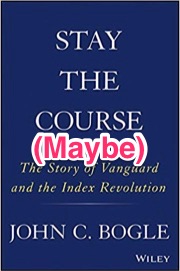
barr_boglecoverThe Barron’s magazine cover article* this week is a profile of Jack Bogle, founder of Vanguard. It covers a lot of things that Bogle fans may already know (origin story, dislike of ETFs), but there were several bits that were new to me. I look forward to reading his last book that includes an “anecdote-rich history of Vanguard” and personal reflections.

(*Barron’s has a paywall, but usually allows limited access to Google search visitors. Try searching “Jack Bogle’s Battle” in a private window.)

Here’s a chart of how Vanguard has changed since 1974:

vanguardbarr

The article brings up the argument that index funds are becoming too popular and now bad for the world. I don’t worry about this at all. If inefficiencies become easy to take advantage of, things will naturally swing back. The loudest complainers always seem to be high-fee managers who are getting paid less lavishly for their services:

His favorite punching bag remains the mutual-fund industry. He likes to point out that closet indexing is pervasive with actively managed funds, and that traditional funds haven’t passed along economies of scale until pressured by Vanguard’s fees. There have been few casualties yet among asset managers, even as active stock funds suffered outflows nine of the past 10 years. And the industry has surely improved: Investor outcomes are better, costs are lower, information is better, thanks in part to Bogle.

Says Bogle, paraphrasing Martin Luther King Jr., “the arc of fiduciary duty is long, but moving in the right direction.” Bogle intends to see that it keeps doing so. “I have no corporate power,” he continues. “But I believe I still have more ethical and intellectual power. And that is good enough for me.”

Bogle is one of those rare authentic voices who say what they think and don’t care if others agree (even the rich and powerful). The adjective “cantankerous” is used – I hope to be called that eventually!