New 401k Plan Fee Disclosures Completely Worthless?

I’ve written about how recent fee disclosure requirements for 401(k) retirement plans have brought a spotlight on bad 401k plans and their potentially embarrassed plan sponsors.

But after reading the fee disclosure on my wife’s own 401(k) plan, I must say that I’m now thinking that maybe nothing really happened at all. Check out what mine says under “Potential General Administrative Fees and Expenses”:

Administrative Fee – Per Account When applicable, other general administrative fees for plan services (e.g., legal, accounting, auditing, recordkeeping) may from time to time be deducted as a fixed dollar amount from your account. The actual amount deducted from your account, as well as a description of the services to which the fees relate will be reported on your quarterly benefit statements.

Translation: We might charge you some fees. We might not. Helpful, eh?

There’s more:

[Read more…]

GMO July 2013 7-Year Asset Class Forecast

It may qualify as market noise, but I admit to looking at the GMO 7-Year Asset Class Forecasts whenever they come out once a quarter (or more often now?). You can read it and other market commentary from Jeremy Grantham (whose opinions I respect) for free by registering on their website. The most recent one was released a few days ago:


Source: GMO.com (click to enlarge)

Most of the time, I just like looking at these forecasts because they reinforce the idea that I should rebalance and buy whatever has been underperforming lately. Right now, that’s Emerging Market stocks. I also see some logic in buying some Timber REITs as part of my REIT exposure, as I don’t believe Timber REITs are included in the Vanguard REIT ETF (VNQ). Invest in tree farms!

I don’t like the “High Quality US Stocks” category because it doesn’t explicitly state what those are. How else will we know if the prediction was right?

Vanguard Balanced Fund: The Benefit of Balancing Stocks and Bonds

An important tenet of portfolio construction is diversifying between stocks and bonds. While poking around on Morningstar, I stumbled across a quick real-world example of how this works.

Let’s say you had $10,000 back on January 1st, 1993. Now, let’s see how that money would have grown over time until today (August 9, 2013) depending on what you invested it in. That’s means holding over a 20-year period – that’s 20 years of bubbles, crashes, euphoria, fear, and a constant flow of bold predictions and catchy newspaper headlines.

1. Vanguard Total Stock Market Index Fund, Investor Shares (VTSMX).

Let’s say you invested in this huge, popular index fund that passively tracks the entire US stock market. (See What’s Inside the Vanguard Total Stock Market Index Fund?) From afar, you may be happy with this chart. But having lived through it, I can say that it was quite a wild ride. People tend to remember the highest value of their portfolio. Your money would have grown to $37,000, only to fall all the way back to $23,000 in the Tech Bubble Crash (a 38% drop). Later, your $46,000 would have dropped 50% all the way to $23,000 during the Housing Bubble Crash. So between 2003 and 2009, your money would have gone nowhere even as inflation rose. Many people went to cash. But if you stuck it out, today you’d be sitting on a balance of $58,621.

2. Vanguard Total Bond Market Index Fund, Investor Shares (VBMFX)
Now, what if you invested in this fund that tracks the overall US bond market?

[Read more…]

$30,000 Beat-the-Benchmark Experiment Update – August 2013

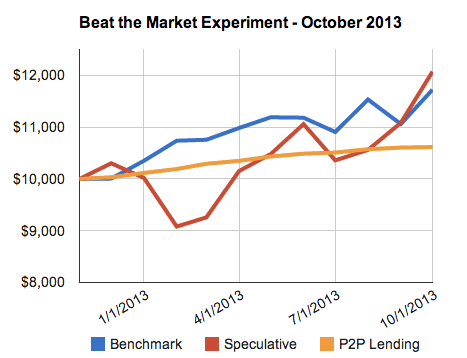
Here’s the August 2013 update for my Beat the Market Experiment, a series of three portfolios started on November 1st, 2012:

  1. $10,000 Passive Benchmark Portfolio that would serve as both a performance benchmark and an real-world, low-cost portfolio that would be easy to replicate and maintain for DIY investors.
  2. $10,000 Beat-the-Benchmark Speculative Portfolio that would simply represent the attempts of an “average guy” who is not a financial professional and gets his news from mainstream sources to get the best overall returns possible.
  3. $10,000 P2P Consumer Lending Speculative Portfolio – Split evenly between LendingClub and Prosper, this portfolio is designed to test out the alternative investment class of person-to-person loans. The goal is again to beat the benchmark by setting a target return of 8-10% net of defaults.

As requested, I updated the scale to zoom in on the comparison chart. You can view it the old way here.

Summary. Values are as of August 1, 2013. 9 months into this experiment, the passive benchmark portfolio remains the leader and if anything is widening the gap. My neglected speculative portfolio has been more volatile and also consistently behind the benchmark in this bull market. As for the P2P portfolio, it is starting to look like LendingClub may perform better than Prosper. Although my Prosper portfolio is earning slightly higher average interest, it also has significantly more late loans which has more than offset the higher interest. I’m slightly above 8% annualized return for LendingClub currently using my metrics, slightly below 7% for Prosper.

$10,000 Benchmark Portfolio. I put $10,000 into index funds at TD Ameritrade due to their 100 commission-free ETF program that includes free trades on the most popular low-cost, index ETFs from Vanguard and iShares. Also no minimum balance requirement, no maintenance fees, no annual fees. The portfolio was based loosely on a David Swensen model portfolio. Screenshot, click to enlarge:

[Read more…]

Shareholder Yield: Better Stock Screening Metric Than Dividend Yield?

I’ve read a few books about dividend investing and remain interested in the idea, although I’m not confident enough (yet?) to allocate my portfolio that way. Portfolio manager and writer Mebane Faber has a short book called Shareholder Yield: A Better Approach to Dividend Investing that offers another tweak on dividend investing strategy.

The book starts with an overview of history and academic research. First, a little over half the total return of the US stock market since 1871 is due to dividends. The smaller half is price appreciation, which when people talk about the S&P 500 index is all price appreciation. Second, stocks with higher dividends have had a higher historical return than stocks with little or no dividends.

So dividends are good, but they aren’t the entire picture. There are five ways for management to deploy the free cash flow generated by the company:

  1. Invest in existing operations,
  2. Acquire other businesses,
  3. Pay down debt,
  4. Repurchase stock (reducing outstanding shares), and
  5. Distribute cash to shareholders.

[Read more…]

Should I Still Contribute to a Bad 401(k) Plan?

Along with other factors, new fee disclosure requirements for 401(k) plans have brought a lot of attention recently on “bad” 401(k) plans. These are plans with little or no employer match, higher-than-average fees, and/or limited investment choices.

I’ve gotten a few questions from readers who wonder if they should stop contributed to their subpar plans completely? As with most things, the answer depends. But here are some factors that I’d consider first.

Can You Save Better Elsewhere?
Depending on your situation, it may be better to put money away in other tax-advantaged vehicles like a Traditional or Roth IRA instead of your 401k/403b/similar plan. If you plan on socking away $5,000 a year, that is under the IRA annual contribution limits. Alternatively, if you have self-employment income you can look into a SEP-IRA, SIMPLE IRA, or Self-Employed 401k plan where you can choose the custodian.

Bad 401(k) Now, Awesome Rollover IRA Later?
According to the Bureau of Labor Statistics, the median employee tenure is less than 5 years. Even workers in “management, professional, and related occupations” had median tenures of 5.5 years. In other words, these days people don’t stay in their jobs very long. (Of course, some people may stay in their jobs for 30 years.)

When you switch jobs, you’re free from the bonds of your crappy 401k plan and can roll it over to a new provider with low fees and great investment options. Very few plans are so bad that you wouldn’t endure five years of mediocrity in exchange for 20-50+ years of precious tax advantages.

[Read more…]

$30,000 Beat-the-Benchmark Experiment Update – July 2013

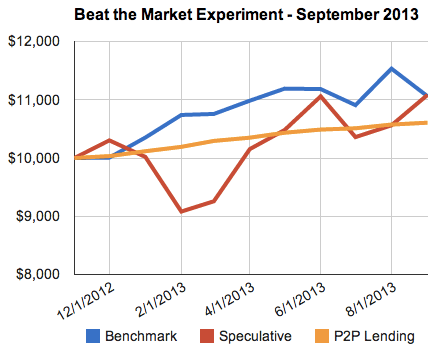
Here’s the July 2013 update for my Beat the Market Experiment, a series of three portfolios started on November 1st, 2012:

  1. $10,000 Passive Benchmark Portfolio that would serve as both a performance benchmark and an real-world, low-cost portfolio that would be easy to replicate and maintain for DIY investors.
  2. $10,000 Beat-the-Benchmark Speculative Portfolio that would simply represent the attempts of an “average guy” who is not a financial professional and gets his news from mainstream sources to get the best overall returns possible.
  3. $10,000 P2P Consumer Lending Speculative Portfolio – Split evenly between LendingClub and Prosper, this portfolio is designed to test out the alternative investment class of person-to-person loans. The goal is again to beat the benchmark by setting a target return of 8-10% net of defaults.
1307_btmsummary

Summary. Values are as of July 1, 2013. 8 months into this experiment, the passive benchmark portfolio remains the leader despite a slight drop this month. The speculative portfolio has definitely been more volatile and is back to lagging again. As for the P2P portfolio, it is starting to look like LendingClub may perform better than Prosper. Prosper simply has more late loans in the pipeline, although I’m still hopeful for solid overall returns.

$10,000 Benchmark Portfolio. I put $10,000 into index funds at TD Ameritrade due to their 100 commission-free ETF program that includes free trades on the most popular low-cost, index ETFs from Vanguard and iShares. The portfolio was based loosely on a David Swensen model portfolio. Screenshot, click to enlarge:

[Read more…]

Investment Returns By Asset Class: Mid-2013 Update

We’ve reach the midway point of 2013, and here are the returns of the major asset classes as benchmarked by passive mutual funds and ETFs. Return data was taken after market close at the end of June 2013. I’m still tweaking the format, in the hopes of making it easier to understand. Below is a chart of the all the trailing total returns for year-to-date, trailing 1-year, and trailing 10-year periods.

Market Commentary

The big news recently is the Fed talking about possibly tapering off its quantitative easing. Since that drove interest rates up, bond prices fell. I think this was a good reminder that we are in abnormal times, with the super-low interest rates being artificially depressed and that one day we will revert back to the mean. Even though my bond holdings fell as well, I’m fine with that if that’s a result of a healthy stock market and it means higher interest rate payouts in the future.

Stocks prices have pulled back a bit recently, but are still well above levels from a year ago. If you bought and held since 2009, you’re still happy. Gold has dropped nearly 30% since the beginning of the year. I just don’t understand gold prices, which is why I don’t own it. I can see a place for it as a diversifier, but it just seems too volatile and speculative to be considered “real money”.

The details:

[Read more…]

MYGA Deferred Fixed Annuities: Maximize State Guaranty Coverage Limits

A recent article by Scott Burns talked about investing in deferred fixed annuities with CD-like qualities, an example offered a 3% yield guaranteed for 5 years plus no surrender charges (similar to early withdrawal penalty) after 5 years. This is a better rate than current bank CDs offer, and annuities can grow tax-deferred for those saving for retirement (withdraw as early as age 59.5)*. After the 5 years, you roll the annuity over to another company if the new rate is no longer good enough. These are also referred to as MYGAs (multi-year guarantee annuities). The catch? The annuities that have the best rates often don’t have the highest credit ratings.

A possible solution? Make sure you stay under the coverage limits of your state’s Life & Health Guaranty Association. From NOHLGA.com:

State life and health insurance guaranty associations are state entities (in all 50 states as well as Puerto Rico and the District of Columbia) created to protect policyholders of an insolvent insurance company. All insurance companies (with limited exceptions) licensed to sell life or health insurance in a state must be members of that state’s guaranty association.

These are not federally-backed like FDIC insurance. Instead, all the member insurance companies agree to cover each other in cases of insolvency up to the policy limits. In order to be a licensed insurer, you need to maintain a certain level of financial stability. But just like banks, some insurers are stronger than others. So if you’re going to go over the limits, the standard advice is to go with a top credit rating from AM Best, Moody’s, or S&P. However, credit ratings can go down over time, and you may be holding these annuities for many years. Therefore, it’s still safest to stay under the limits.

(You may not hear much about these guaranty associations because it is illegal for insurance brokers to use them in advertisements as a reason to buy annuities. I find this somewhat ironic, considering all the misleading statements they are allowed to make about equity-linked or equity-indexed annuity products.)

While they vary from state to state, virtually all states offer at least $100,000 in coverage for withdrawal and cash values for annuities. (Connecticut and Washington offer $500,000 in coverage. In California, the limit is 80% not to exceed $250,000.) Look up your specific state’s limits here or here.

In order to maximize your coverage, the process is similar to that for FDIC insurance – spread your money across different institutions and use different ownership titles. Let’s say you have $100,000 in state annuity coverage. The details may vary by state, but for many states that number is per owner designation, per company. The Mr. Annuity website has a helpful article [pdf] about how to structure your annuities to maximize your coverage.

If a client has $300,000 and wants to make certain all the money is protected, including future interest earnings, while taking advantage of the highest rate possible, we set up 3 contracts in Company A for $80,000 each. In annuity 1, the husband is the Owner and Annuitant. In annuity 2, the wife is the Owner and Annuitant. In annuity 3, the husband and wife are Joint Owners with the husband as the Annuitant. Then, we’ll put $60,000 in the next highest rate we can find in Company B, normally with the husband as Owner and Annuitant. That way, as the money grows, it will be protected under the guaranty laws because they are covered up to $100,000 per owner designation, per company.

I made a quick illustration of this theoretical example:

annuitysafe

Notice that you need to leave some room for growth, that way your future earnings are covered as well.

* I’m not saying these annuities are a great deal for everyone. If you are in a situation with a high-income and are already maxing all your other tax-deferred accounts like IRAs, 401ks, and are still looking for safer retirement investments with steady growth then this might be an option to consider due to the ability to get tax-deferred growth with rates competitive with current bond yields. I’m still in research mode.

$30,000 Beat-the-Benchmark Experiment Update – June 2013

Here’s a condensed June 2013 update for my Beat the Market Experiment, a series of three portfolios started on November 1st, 2012:

  1. $10,000 Passive Benchmark Portfolio that would serve as both a performance benchmark and an real-world, low-cost portfolio that would be easy to replicate and maintain for DIY investors.
  2. $10,000 Beat-the-Benchmark Speculative Portfolio that would simply represent the attempts of an “average guy” who is not a financial professional and gets his news from mainstream sources to get the best overall returns possible.
  3. $10,000 P2P Consumer Lending Speculative Portfolio – Split evenly between LendingClub and Prosper, this portfolio is designed to test out the alternative investment class of person-to-person loans. The goal is again to beat the benchmark by setting a target return of 8-10% net of defaults.
1306_btmsummary

Summary. Values are as of June 1, 2013. 7 months into this experiment, the passive benchmark portfolio remains the leader although last month it was pretty flat. The speculative portfolio is bouncing back quite nicely, almost matching the benchmark portfolio. The P2P lending portfolio is still rather young, but I’m satisfied with the current trend of having 5 out of 450+ loans that are over 30 days late.

$10,000 Benchmark Portfolio. I put $10,000 into index funds at TD Ameritrade due to their 100 commission-free ETF program that includes free trades on the best low-cost, index ETFs from Vanguard and iShares. The portfolio was based loosely on a David Swensen model portfolio. Screenshot, click to enlarge:

[Read more…]

MMB Retirement Portfolio Update – June 2013

Here’s a mid-2013 update of our retirement portfolio, including employer 401(k) plans, self-employed retirement plans, Traditional and Roth IRAs, and taxable brokerage holdings. Cash reserves (emergency fund), college savings accounts, experimental portfolios, and day-to-day cash balances are excluded. The purpose of this portfolio is to eventually create income and enable financial freedom.

Target Asset Allocation

Since my last update, I made a minor change to our target asset allocation by removing Emerging Markets as a separate added weighting as it now includes some huge companies and comprises nearly 20% of the Total World ex-US (Total International) asset class.

aa_updated2013_all

[Read more…]

Book Review: Damn Right! Biography of Charlie Munger

I recently finished reading the biography of Charles Munger done by Janet Lowe, Damn Right! Behind the Scenes with Berkshire Hathaway Billionaire Charlie Munger, originally published in 2000. The book did a pretty good job of filling in details about his childhood and family history, although much of it was pieced together from existing speeches, books, and articles about Warren Buffett and Munger. (Although if you haven’t read any of that other stuff, you wouldn’t notice.) In any case, I still found many passages worth highlighting and saving:

On learning business skills from playing poker:

“Playing poker in the Army and as a young lawyer honed my business skills. What you have to learn is to fold early when the odds are against you, or if you have a big edge, back it heavily because you don’t get a big edge often. Opportunity comes, but it doesn’t come often, so seize it when it does come.”

On the merits of buying and holding onto investments for the long haul:

There are huge advantages for an individual to get into a position where you make a few great investments and just sit back and wait: You’re paying less to brokers. You’re listening to less nonsense. And if it works, the governmental tax system gives you an extra 1, 2 or 3 percentage points per annum compounded.

And you think that most of you are going to get that much advantage by hiring investment counselors and paying them 1% to run around, incurring a lot of taxes on your behalf? Lots of luck.

[Read more…]