Low-Cost Investing: The Next Consumer Revolution?

Joe Davis and Andy Clarke of The Vanguard Blog had a thought-provoking post comparing the increasing popularity of broadly-diversified, low-cost portfolios to the historical spread of certain technologies:

Much like electricity, refrigeration, and other great ideas, the broadly diversified, low-cost portfolio has the potential to raise our standard of living. […] The adoption of great ideas typically follows an “S” curve, starting slowly, then accelerating. Eventually, the great idea becomes commonplace. The adoption of the “broad low-cost portfolio” seems to be following this pattern.

Here’s a chart they created illustrating how the adoption of various technologies spread to include the majority of US households.

vg_marketpen

Defined as the percentage of U.S. mutual fund and ETF assets under management with annual expense ratios of less than 25 basis points (0.25%), low-cost investing has grown from less than 5% penetration in 1995 to about 25% of industry assets in 2012. Very few ETFs or mutual funds charge such low amounts unless they passively track an index, so at least right now low-cost is nearly synonymous with index funds. Will low-cost investing one day be as common as owning a car?

Tadas Viskanta adds more commentary in this Abnormal Returns post. It does seem like index fund investing has been gaining some momentum lately, partially because most hedge funds have been lagging major indexes for some time.

Vanguard Total International Stock Index Fund Review (VGTSX, VTIAX, VXUS)

(See also: Vanguard Total Stock Index Fund Review)

The Vanguard Total International Stock Index Fund is available both as a mutual fund (VGTSX, VTIAX) and an ETF (VXUS). Across all shares classes, there is currently around $90 billion dollars invested in this fund, making it one of the top 10 largest funds in the world. As the name suggests, this fund attempts to include all the investable companies from every single country in the world outside the US. From Indonesia to Morocco, from Luxembourg to Hong Kong. It also includes small-cap, mid-cap, and large-cap companies, unlike many other “total international” index funds. Such a wide coverage area makes this fund very fascinating. Let’s take a look inside.

[Read more…]

$10,000 Beat-the-Benchmark Experiment Update – May 2013

Here’s a condensed May 2013 update for my Beat the Market Experiment, a series of three portfolios started on November 1st, 2012:

  1. $10,000 Passive Benchmark Portfolio that would serve as both a performance benchmark and an real-world, low-cost portfolio that would be easy to replicate and maintain for DIY investors.
  2. $10,000 Beat-the-Benchmark Speculative Portfolio that would simply represent the attempts of an “average guy” who is not a financial professional and gets his news from mainstream sources to get the best overall returns possible.
  3. $10,000 P2P Consumer Lending Speculative Portfolio – Split evenly between LendingClub and Prosper, this portfolio is designed to test out the alternative investment class of person-to-person loans. The goal is again to beat the benchmark by setting a target return of 8-10% net of defaults.

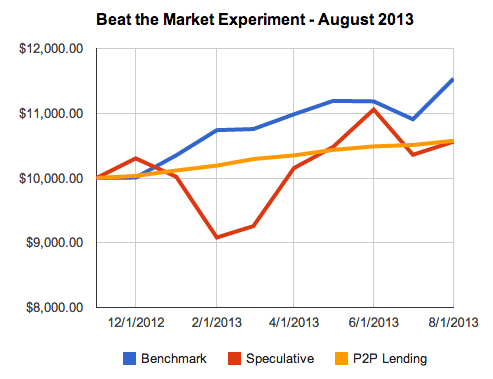
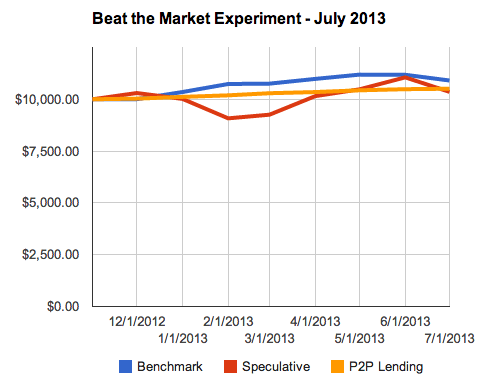
Executive summary. Six months have gone by since this experiment started, and the passive portfolio has ridden a hot stock market nearly the entire time. My speculative portfolio is catching back up a bit after my Apple holdings stumbled, while the P2P lending portfolio is still too young to make any firm conclusions. The details are below:

$10,000 Benchmark Portfolio. I put $10,000 into index funds at TD Ameritrade due to their 100 commission-free ETF program that includes free trades on the best low-cost, index ETFs from Vanguard and iShares. The portfolio was based loosely on a David Swensen model portfolio. Screenshot:

[Read more…]

Investment Returns By Asset Class – May 2013 Update

Here is my May 2013 update of the trailing total returns for selected major asset classes. Passive ETFs are used to represent major asset classes, as they represent actual investments that folks can buy and sell. Return data was taken after market close at the end of April 2013.

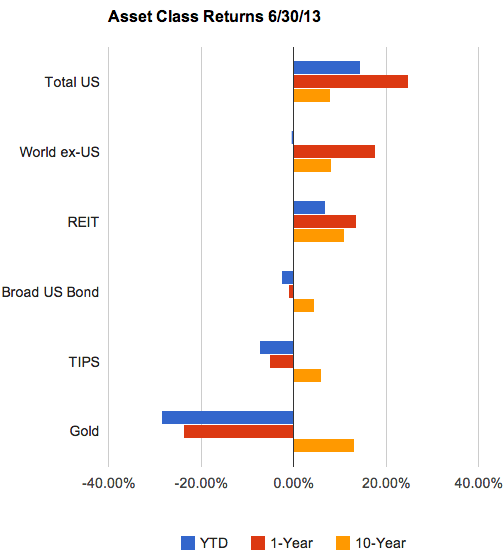
I’m trying out a new chart format, in the hopes of easier visual comparisons. Below is a chart of the all the trailing returns for 1-month, 1-year, 5-year, and 10-year periods.

If you focus on the blue and red bars, you can see that in the short-term the stock markets around the world have been on quite a tear. Meanwhile, gold has been dropping. If you’re holding gold as a diversification tool, this may not be a bad thing to see. If you focus on the 10-year trailing returns of the green bars, just about everything looks rosy at the moment. Unless you were making some manic moves like bailing out during the crisis, your portfolio should have done pretty well over the last decade.

In terms of bonds, they have been a relatively safe place to be over the last several years, but you can also can see the effect of dropping rates on their recent returns. Future bond returns are very likely to be lower than in the past.

Here is the usual table of actual numerical values for those same asset classes:

[Read more…]

Vanguard Total Stock Market Index Fund Review: What’s Inside (VTSMX, VTSAX, VTI)

(This post is part of a new series taking a closer look at some popular portfolio holdings.)

The Vanguard Total Stock Market Index Fund is one of the largest funds in the world, and definitely the largest index fund. For individual retail investors, it is available in mutual fund flavors (VTSMX, VTSAX) as well as ETF flavor (VTI). Across all shares classes, there is currently over $230 billion dollars of total assets invested in this fund – that’s nearly a quarter of a trillion dollars! If you own a Vanguard Target Retirement or LifeStrategy fund, you own this fund as well. So let’s try to understand what’s inside.

Despite the name, the Vanguard Total Stock Market Index fund only tries to represent all the stocks in the U.S. equity market, from big to small, from financial companies to shoe store chains. The fund is currently transitioning from tracking the MSCI US Broad Market Index to the CRSP US Total Market Index. These are both market-cap weighted indexes, which means that the amount of each stock held is directly proportional to the total market value of the company. In other words, if all Nike shares together are worth $50 billion while Skechers is worth $1 billion, then the index would hold 50 times more Nike than Skechers.

Market Capitalization Weighting

[Read more…]

Swensen Portfolio 10-Year Trailing Returns Redux

Here is a check-in on the trailing 10-year total returns for the David Swensen model portfolio, courtesy of ETFPM.com. Last update was in 2011. As a reminder, here is the model portfolio asset allocation with representative ETFs:

30% Domestic US Equity (VTI)
15% Foreign Developed Equity (VEA)
10% Emerging Markets (VWO)
15% Real Estate (VNQ)
15% U.S. Treasury Bonds (IEF)
15% Inflation-Protected Securities (TIP)

The chart below shows the growth of $1,000 invested this way and rebalanced annually (eMAC), starting from January 2003 until the end of March 2013. eMAC stands for “efficent multi-asset class”.

Again, we see that this low-cost, diversified index fund portfolio (+169%) has done well over the last 10.3 years, besting the S&P 500 (+118%) handily as well as the Dow Jones Credit Suisse Hedge Fund Index (not shown anymore, but +95% roughly). We also see that a 30% Stock, 70% Long-term Treasury bond portfolio does pretty well, but I tend to dismiss that as rearview-mirror investing. Yes, looking backward it did well, but I doubt you could find any portfolio manager telling their clients to hold 30% Stocks and 70% Long-Term Treasuries as a long-term portfolio during the period between 2003-2007.

Total Economy Portfolio: Adding Small Value Stock, REIT Exposure

In many investing books such as David Swensen’s Unconventional Success or Bill Schultheis’ The Coffeehouse Investor, you may see model portfolios that include an allocation to smaller companies and/or real estate investment trusts (REITs). Historically, adding these less-correlated asset classes have improved a portfolio’s overall return while reducing volatility. Author and portfolio manager Rick Ferri proposes another lens from which to view why such additions add value in his Forbes article called The Total Economy Portfolio.

Briefly, Ferri points out that the number of publicly traded companies has fallen by over 50% in the last 16 years, and those public companies together earn only about half of the U.S. economy’s profits. What is missing, and what should we do to replace them?

The two main areas of the economy that are underrepresented on the stock market are small businesses and commercial real estate. That means increasing small company and real estate exposure in your portfolio should help you track the economy better. […] My “Economic Tilt Portfolio” is allocated 65% to the Wilshire 5000, 25% to the Russell 2000 small-cap value index and 10% to the Dow Jones U.S. Select Real Estate Investment Trust index.

The chart from the article below compares the total return of the Total US Stock Market (Wilshire 5000) vs. the Economic Tilt Portfolio:

[Read more…]

$10,000 P2P LendingClub & Prosper Loan Portfolio Update – April 2013

Here’s the April 2013 update for my peer-to-peer lending portfolio, the last of three “real money” portfolios being tracked monthly as part of my Beat the Market Experiment. See also the $10,000 Benchmark and $10,000 Speculative portfolio updates.

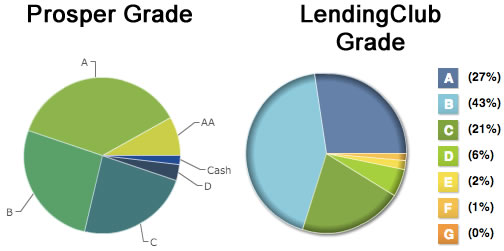
For this one, I started with $10,000 split evenly between Prosper Lending and Lending Club, and went to work lending other people money and earning interest with an 8% target net return. So it’s also a race-within-a-race to see which option offers the best returns.

$5,000 LendingClub Loan Portfolio. Below is a screenshot of my LendingClub account as of 4/1/13. I’ve had loans at LC before, but sold them all on the secondary market and started fresh for this tracking experiment. Here are screenshots of my total balance and my portfolio details. I would say my overall risk level is moderate-conservative with mostly A and B rated loans (top two grades).


(click to enlarge)

The portfolio is now 5 months old, with 208 currently active loans, 9 loans that were paid off early, and 5 in funding. Two of the active loans are currently between 31-120 days late, which according to LendingClub have a 53% recovery rate overall. But to be conservative I will now assume the remaining $48 in principal to be completely lost. The current weighted average interest rate is reported as 12.33%, which will hopefully offer enough cushion to still net an 8% return.

I pick loans using a preset filter based on my LendingClub filters post as well as my Prosper filter research noted below. I never spend any time reading individual loan descriptions, keeping it passive and scalable. The filters are saved online and it takes just a minute to reinvest interest, although I still tend to forget until I do these updates. In addition to outstanding loan principal, the account also has $37.02 in idle cash, $125 in funding limbo, and $40.39 in accrued interest.

LendingClub.com account value: $5,161 (includes principal + accrued interest, minus 30+ day lates, after fees)

$5,000 Prosper.com Loan Portfolio. Below are screenshots of my Prosper account page as of 4/1/13.

[Read more…]

LikeAssets Review: A Reality Check For Your Portfolio

Over the years, I’ve noticed that people tend to overestimate their own stock-picking prowess – myself included. Especially over longer periods of time, if you’re not tracking things carefully you probably don’t know how well you’re doing on a relative basis. We all tend to remember the winners and forget the losers. The sooner you figure out you’re not Buffett, the sooner you can improve your returns. (Otherwise, the sooner you can start your own hedge fund.)

If you like the idea of my Beat The Market Experiment but don’t want to expend too much effort in tracking your own performance, you should check out LikeAssets.com. This new portfolio tracking site recently became the backend for the Wall Street Journal’s Portfolio tool (paid subscribers only), but the direct site is free to all. I’ve been playing around with it for a few days, and here’s my review.

LikeAssets is similar to a Mint.com, SigFig, or Personal Capital (review) in that you hand over your login information and they automatically sync with your brokerage accounts to pull in your holdings. However, their key differentiator is that they automatically choose the appropriate benchmark ETFs based on your holdings in order to determine your “alpha” (excess return above benchmark). You don’t have to do anything. So if you’re holding a bunch of big dividend-paying companies, you’ll probably be matched up with a large-cap value index ETF. The custom benchmark goes even further to match your trades in real-time, not just your current asset allocation:

How is the LikeAssets custom benchmark calculated?
A benchmark portfolio is constructed based on the types of securities in your portfolio. When you make a trade, your custom benchmark portfolio mirrors the trade using an appropriate ETF or set of ETFs.

Once you sign up, you can either choose to import your data electronically from a supported brokerage firm, or manually input your trades. Supported firms include Fidelity, Vanguard, TD Ameritrade, Schwab, E-Trade, Scottrade, and OptionsXpress. Below is a screenshot of my linked TD Ameritrade benchmark portfolio. I would expect my “alpha” here to be close to zero as they are already passive investments, and that is indeed the case.


(click to enlarge)

Unfortunately LikeAssets only works with about 50 brokers right now, and my TradeKing speculative portfolio is currently not supported. Typing in the trades manually is somewhat of a pain as you’d expect, although the software does automatically fill in your buy/sell price based on the market’s closing price that day (not exact, but a good estimate and you can edit it). In addition, dividend distributions are automatically calculated for you (any reinvestment of dividends still must be input manually). Here’s a screenshot of my manually-input TradeKing account:

[Read more…]

$10,000 Beat-the-Benchmark Speculative Portfolio Update – April 2013

Here’s the April 2013 update for my speculative portfolio, the second of three portfolios being tracked monthly as part of my Beat the Market Experiment. Here’s an update on the overall race; the bull stock market has pushed the passive benchmark portfolio into the lead past my lagging stock picks.

$10,000 Beat-the-Benchmark Speculative Portfolio as of April 1, 2013. Many people speculate with their money, buying and selling stocks now and then, but they rarely track their performance even though they may brag about their winners. Honest tracking is the primary reason for this “no-rules, just make money” account. I am using a TradeKing account for this portfolio as I’ve had an account with them for a while and am comfortable with their low-cost $4.95 trade structure, free tax-management gain/loss software, and free dividend reinvestment. Here is a screenshot taken from my TradeKing home page on 3/31/13 after market close:

[Read more…]

$10,000 Benchmark Portfolio Update – April 2013

Here’s the April 2013 update for my benchmark portfolio, the first of three portfolios started on November 1st, 2012 as part of my Beat the Market Experiment:

  1. $10,000 Passive Benchmark Portfolio that would serve as both a performance benchmark and an real-world, low-cost portfolio that would be easy to replicate and maintain for DIY investors.
  2. $10,000 Beat-the-Benchmark Speculative Portfolio that would simply represent the attempts of an “average guy” who is not a financial professional and gets his news from mainstream sources to get the best overall returns possible.
  3. $10,000 P2P Consumer Lending Speculative Portfolio – Split evenly between LendingClub and Prosper, this portfolio is designed to test out the alternative investment class of person-to-person loans. The goal is again to beat the benchmark by setting a target return of 8-10% net of defaults.

$10,000 Benchmark Portfolio as of April 1, 2013. My account is held at TD Ameritrade due to their 100 commission-free ETF program that includes free trades on the best low-cost, index ETFs from Vanguard and iShares. I funded it with $10,000 and bought all the ETFs required to be fully invested on 11/1/12. All trades were commission-free.

Here’s a screenshot from my account showing exact holdings and their market value on 3/31/13. With the current bull market, the benchmark portfolio gained nearly 10% in just 5 months.


(click to enlarge)

Here’s the asset allocation pie chart, tracked with a simple Google Docs spreadsheet:
[Read more…]

Investment Returns By Asset Class – April 2013 Update

Here is my April 2013 update of the trailing total returns for selected major asset classes. Passive ETFs are used to represent major asset classes, as they represent actual investments that folks can buy and sell. Return data was taken after market close at the end of March 2013.

Asset Class
Representative ETF
Benchmark Index
1-Mo 1-Year 5-Year 10-Year
Broad US Stock Market
Vanguard Total Stock Market (VTI)
MSCI US Broad Market Index
3.91% 14.62% 6.682% 9.24%
Broad International Stock Market
Vanguard Total International Stock (VXUS)
MSCI All Country World ex USA Investable Market Index
0.87% 8.72% -0.54% 10.43%
Emerging Markets
Vanguard Emerging Markets ETF (VWO)
FTSE Emerging Index
-1.56% 1.69% 0.90% 16.44%
REIT (Real Estate)
Vanguard REIT ETF (VNQ)
MSCI US REIT Index
2.90% 15.97% 7.37% 12.36%
Broad US Bond Market
Vanguard Total Bond Market ETF (BND)
Barclays U.S. Aggregate Float Adj. Bond Index
0.08% 3.66% 5.46% 5.04%
US Treasury Bonds – Short-Term
iShares 1-3 Year Treasury Bond ETF (SHY)
Barclays U.S. 1-3 Year Treasury Bond Index
0.00% 0.48% 1.61% 2.56%
US Treasury Bonds – Long-Term
iShares 20+ Year Treasury Bond ETF (TLT)
Barclays U.S. 20+ Year Treasury Bond Index
-0.31% 6.70% 8.28% 7.43%
TIPS / Inflation-Linked Bonds
iShares TIPS Bond ETF (TIP)
Barclays U.S. TIPS Index
0.22% 5.17% 5.80% 6.45%
(est.)
Gold
SPDR Gold Shares (GLD)
Price of Gold Bullion
0.58% -5.02% 10.90% 16.5%
(est.)

For an easy visual comparison, here is a chart of the 1-year trailing returns:

April 2013 Trailing 1-year Returns

I collect this information because it allows me to keep an eye on the market while still keeping the long-term returns in perspective. Often, the asset classes with the best long-term returns have had recent poor performance. The 1-year chart helps me decide where to invest new funds and also for rebalancing. Note that I do not necessarily invest in all the listed asset classes, see my personal portfolio for details.

[Read more…]