 I’m turning 40 years old this summer. This number has always been a psychological marker for me. I’ve always wanted to be financially secure and have started a family by age 40. According to this Atlantic article by Daniel Pink*, I’m far from the only one. Consider marathons:
Four people in four different professions living in four different parts of the world, all united by the common quest to run 26.2 miles. But something else links these runners and legions of other first-time marathoners. Red Hong Yi ran her first marathon when she was 29 years old. Jeremy Medding ran his when he was 39. Cindy Bishop ran her first marathon at age 49, Andy Morozovsky at age 59.
All four of them were what the social psychologists Adam Alter and Hal Hershfield call “nine-enders,” people in the last year of a life decade. They each pushed themselves to do something at ages 29, 39, 49, and 59 that they didn’t do, didn’t even consider, at ages 28, 38, 48, and 58—and didn’t do again when they turned 30, 40, 50, or 60.
The article contains several other insights that definitely applied to me. According to Alter and Hershfield:
“People are more apt to evaluate their lives as a chronological decade ends than they are at other times,” Alter and Hershfield explain. “Nine-enders are particularly preoccupied with aging and meaningfulness, which is linked to a rise in behaviors that suggest a search for or crisis of meaning.”
According to psychologist Clark Hull:
At the beginning of a pursuit, we’re generally more motivated by how far we’ve progressed; at the end, we’re generally more energized by trying to close the small gap that remains.
You could tell yourself that being 29 is no different than being 28 or 30, or you can just use this behavioral quirk to reach your goals. I’ve been working on “closing the gap” in terms of getting all my financial affairs in order. Here are all the things that I’ve been working on as a 39-year-old:
- Created a system to simulate a monthly “paycheck” so that things run smoothly and the bill gets paid even if I am not around to micromanage things (like I usually do). Dividends and interest flow to the emergency fund/cash buffer (savings account), which then automatically transfers a set amount each month to our day-to-day checking account.
- Beefed up our cash buffer. As part of the above-mentioned system, I increased our cash hoard to two years of expenses in FDIC-insured savings accounts and CDs. The idea is that this buffer “bucket” feeds the checking account, but also gets replenished by income and interest from our portfolio. As larger upfront expenses like a home repair or used car purchase comes up, the buffer can take a hit. The dividends come in quarterly spurts. The buffer allows us to handle shocks without disruption.
- Re-examined term life insurance. We are currently 10 years into a 30-year term policy with a level premium. We technically don’t need to replace any lost income anymore, so we considered canceling this policy. However, we decided that if something were to happen to one of us, we would still need to pay someone to replace childcare duties for three children. I don’t know how other single parents do it, but I know that I’d need help!
- Moved some missing assets into revocable living trusts for estate planning purposes. When we created this trust, we were mostly concerned about having a plan in place to take care of the children in case something happened to both of us. After you create a trust, you must manually move/retitle all your various brokerage accounts into it, and the paperwork can be a pain.
- Consolidated accounts. I still have a penchant for collecting new financial accounts, but I’ve also closed a bunch this year. Our grandparents used to hide money in jars around the house. I like to buy shares of Berkshire (BRK) and put them in brokerage accounts (often involving a bonus, and BRK gives off no dividends to worry about at tax time). I started over a decade ago with Sharebuilder (now Capital One Investing) and most recently got $5 worth from Stash.
- Bought a used 2015 Toyota minivan so that we have a reliable family vehicle for the next 10 years. I love sliding doors. I hate the inconvenience of a car breakdown.
- Started and put some money into a 529 plan for each kid. The amount isn’t enough to cover four years of college, we’ll just have to see how much it can grow as compared to tuition. I read somewhere that you should plan to save 1/3rd, fund 1/3rd from annual income, and leave the last 1/3rd for scholarships, grants, or student loans.
Everything on this list was being putting off because it was unpleasant. Most either dealt with the prospect of early death/severe disability, or annoying paperwork. The prospect of turning 40 got me over the hump. Next decade: Marathon at age 49?
* The article is actually an excerpt from his new book When: The Scientific Secrets of Perfect Timing.

 Here’s a reader question regarding my most recent


 Day 4 of the
 Here’s a working paper titled
  There are some (mostly young) skeptics, but Social Security should remain a major pillar of your future retirement income. For over 60% of current retirees aged 65+,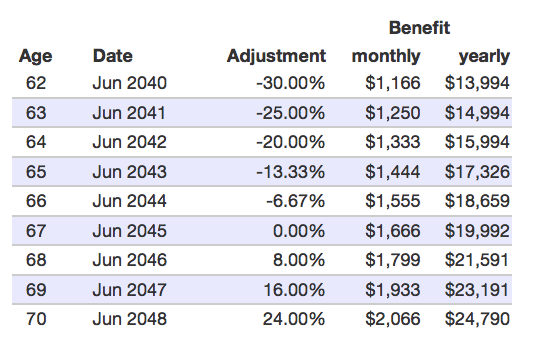

 With the ongoing bull stock market, more people are reaching


 Individual Retirement Arrangements (IRAs) are way to save money towards retirement that also saves on taxes. Each year, an individual’s total contributions to both traditional and Roth IRAs cannot be more than a certain dollar limit. If you are age 50+ at some time during the year, you can also contribute an additional amount. (You can’t contribute more than your taxable compensation for the year.)
 The Best Credit Card Bonus Offers – 2026
 Big List of Free Stocks from Brokerage Apps
 Best Interest Rates on Cash - 2026
 Free Credit Scores x 3 + Free Credit Monitoring
 Best No Fee 0% APR Balance Transfer Offers
 Little-Known Cellular Data Plans That Can Save Big Money
 How To Haggle Your Cable or Direct TV Bill
 Big List of Free Consumer Data Reports (Credit, Rent, Work)