 I was surprised to read the NY Times article Vanguard Warns of Worsening Odds for the Economy and Markets. Everything is written very carefully using odds so that there is no “prediction” that could be called “wrong” later on, but at the same time if there is a future recession, they will appear to have been “right”. I didn’t know that Vanguard did these sort of economic predictions or that they were deemed so noteworthy.
As the chart below reminds us, all bull markets must eventually come to an end:

The question is, what is the point? What is actionable about this? You could view this article as encouraging market timing (sell stocks now!), or it could be a prudent reminder to rebalance and assess your risk exposure (sell a little stock now? maybe?). The latter is always a good idea, so let’s be generous and call it that. I wonder what Jack Bogle thinks. I mean, the title of his upcoming book about the history of Vanguard is Stay the Course.
For posterity, I wanted to record their expected 10-year (annualized) returns for the following asset classes (as of mid-2018):
- US Stocks 3.9%
- International Stocks 6.5%
- US Total Bond (Corporate + Government) 3.3%
- International Bonds 2.9%
- Commodities 5.9%
- US Treasury Bonds 3%
- Cash 2.9%
These are nominal numbers. In another economic outlook article, Vanguard projects inflation to run slightly under 2% annualized.
 Like many others, I had a vague goal of $1 million net worth in my 20s. It’s easy to find a theoretical path a million. For example, $750 per month earning 8% returns for 30 years with get you there. Doing the actual earning, saving and investing is the hard part. It gets even harder during a bear market when your money feels like it is burning up in flames.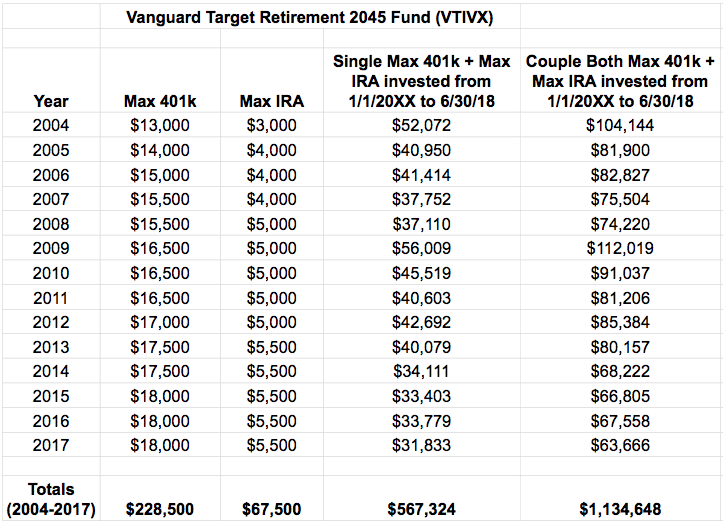



 Vanguard recently released How America Saves 2018 report [PDF], which looks at the nearly 5 million 401k, 403b, and other defined-contribution retirement plans that they service. If you are curious about how your 401k stats compare with others, there is a great deal of information in this report. Here are a few quick stats based on 2017 data:
 T. Rowe Price has a brochure The Benefit of Saving Regularly For Retirement [pdf] which has the common advice that you target saving at least 15% of your gross income each year to prepare for retirement. Of course, the earlier you start, the better. The added wrinkle here is that they offer an alternative route if you find 15% a stretch when you are young.
 Every time a large corporation stumbles, you will see something along these lines:
  You may have read recently that the Social Security Trust Fund is starting to shrink, and that it is projected to run out of money in 16 years. (Medicare’s trust fund is projected to run out in 8.) This is not the same thing as Social Security itself running out of money, as most Social Security payments to retirees come from the payroll taxes paid by current workers. As the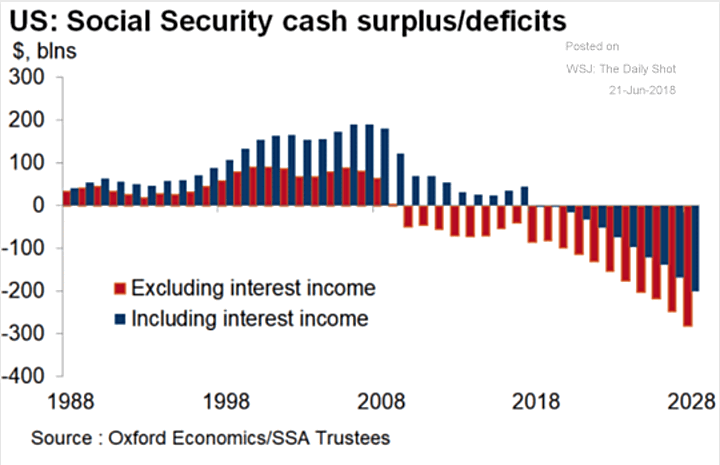

 If you have researched retirement at all (early or otherwise), you’ve probably ran across various retirement calculators online. You input how much money you have (or plan to have), your asset allocation, and it spits out some numbers. This


 Should a person who retires at age 70 withdraw the same amount of money from their portfolio as someone who is age 40? You’re talking about a retirement period that is likely twice as long as the other. In an article titled
  When it comes to making your portfolio last a lifetime, you may be surprised at how long that might be. According to this Vanguard longevity tool, for a couple both age 40 today, there is a 50% chance that one will live to 88. That’s 48 years.


 The Best Credit Card Bonus Offers – 2026
 Big List of Free Stocks from Brokerage Apps
 Best Interest Rates on Cash - 2026
 Free Credit Scores x 3 + Free Credit Monitoring
 Best No Fee 0% APR Balance Transfer Offers
 Little-Known Cellular Data Plans That Can Save Big Money
 How To Haggle Your Cable or Direct TV Bill
 Big List of Free Consumer Data Reports (Credit, Rent, Work)