Updated for 2026. As the brokerage 1099 forms for the 2025 Tax Year are coming out, here is a quick reminder for those subject to state and/or local income taxes. If you earned interest from a money market fund, a significant portion of this interest may have come from “US Government Obligations” like Treasury bills and bonds, which are generally exempt from state and local income taxes. However, in order to claim this exemption, you’ll likely have to manually enter it on your tax return after digging up a few extra details.
(Note: California, Connecticut, and New York exempt dividend income only when the mutual fund has met certain minimum investments in U.S. government securities. They require that 50% of a mutual fund’s assets at each quarter-end within the tax year consist of U.S. government obligations.)
Fidelity has released 2025 Percentage of Income from U.S. Government Securities [pdf]. Here are the results for the most popular core Fidelity money market funds:
- Fidelity® Treasury Only Money Market Fund (FDLXX, CUSIP 31617H300) – 98.67%.
- Fidelity® Government Money Market Fund (SPAXX, CUSIP 31617H102) – 50.90%. *Did not meet the minimum investment in U.S. Government securities required to exempt the distribution from tax in California, Connecticut, and New York.
- Fidelity® Government Cash Reserves (FDRXX, CUSIP 316067107) – 52.17%. *Did not meet the minimum investment in U.S. Government securities required to exempt the distribution from tax in California, Connecticut, and New York.
- Fidelity® Treasury Money Market Fund* (FZFXX, CUSIP 316341304) – 61.52%. *Did not meet the minimum investment in U.S. Government securities required to exempt the distribution from tax in California, Connecticut, and New York.
It is disappointing that SPAXX as a default cash sweep did not meet the requirements to exempt any of their interest from state income tax in California, Connecticut, and New York. They must have missed the 50% minimum cut-off in one of the four quarters of 2025.
This is why I mostly own FDLXX as my “pseudo-core” money market fund via automated recurring purchases. For more information on this “hack”, see my post Fidelity Treasury Only Money Market (FDLXX) as Fidelity Core Position Workaround.
To find the portion of Fidelity dividends that may be exempt from your state income tax, multiply the amount of “ordinary dividends” reported in Box 1a of your Form 1099-DIV by the percentage listed in the PDF. For example, if you earned $1,000 in total interest from Fidelity Treasury Only Money Market Fund (FDLXX) in 2025, then $986.70 could possibly be exempt from state and local income taxes. If your marginal state income tax rate was 10% that would be a ~$99 tax savings for every $1,000 in total interest earned.
On a net after-tax basis, folks with a ~10% state income tax rate will likely find that FDLXX earns more interest than the default core holdings of SPAXX/FZFXX, even though the gross yield of SPAXX/FZFXX is higher than that of FDLXX.
To obtain these tax savings, you’ll have to manually adjust your state/local income tax return. I don’t believe that TurboTax, H&R Block, and other tax software will do this automatically for you, as they won’t have the required information on their own. (I’m also not sure if they ask about it in their interview process.) If you use an accountant, you should also double-check to make sure they use this information. Here is some information on how to enter this into a previous version of TurboTax:
- When you are entering the 1099-DIV Box 1a, 1b, and 2a – click the “My form has info in other boxes (this is uncommon)” checkbox.
- Next, click on the option “A portion of these dividends is U.S. Government interest.”
- On the next screen enter the Government interest amount. This will be subtracted from your state return.
Standard disclosure: Check with your state or local tax office or with your tax advisor to determine whether your state allows you to exclude some or all of the income you earn from mutual funds that invest in U.S. government obligations.
[Image credit – Tax Foundation]
 The Best Credit Card Bonus Offers – 2026
 Big List of Free Stocks from Brokerage Apps
 Best Interest Rates on Cash - 2026
 Free Credit Scores x 3 + Free Credit Monitoring
 Best No Fee 0% APR Balance Transfer Offers
 Little-Known Cellular Data Plans That Can Save Big Money
 How To Haggle Your Cable or Direct TV Bill
 Big List of Free Consumer Data Reports (Credit, Rent, Work)
Do you have a good resource to compare these? For example, FDLXX has a 3.99% 7-day SEC yield and is 97.0032% state tax exempt while SPAXX has a 4.03% 7-day SEC yield and is 55.0877% state tax exempt. I can probably figure out the math on my own or go with my gut that FDLXX will ultimately yield more but I’d love to plug in my state and see.
You can try this spreadsheet that someone at bogleheads created:
https://www.bogleheads.org/forum/viewtopic.php?t=401821
I just rough math it mostly, for example if you have 10% state tax that is 100% exempt and 4% interest rate, you’re roughly getting 10% more interest or 0.40%. So 4.40% tax equivalent yield.
If you can only get 50% exempt w/ 10% state tax and 4% interest rate, that’s more like 5% more interest, or 0.20% more. Unless FDLXX is more than 0.20% less gross yield, it’s better to go with FDLXX. Not to mention, SPAXX has been so close to the 50% threshold in CA/CT/NY that in any given year it could be 0% state tax exempt. So I just go with FDLXX.
You can play around with this Fidelity calculator, but instead of your full state tax rate, just multiply it by the exempt percentage. So instead of a 10% tax rate, if you only have 50% exempt, just say your state tax rate is 5%.
https://digital.fidelity.com/prgw/digital/taxyieldcalc/
Thanks, this is helpful as I own SPAXX. For Vanguard money market VMFXX, the percentage is 58.97%. It appears directly on the Vanguard 1099 Consolidated.
Thank you for posting the institutional website link to the 2024 Fidelity percentages. On Friday, 2/21/2025, Fidelity finally posted the 2024 percentages from their retail website: https://www.fidelity.com/bin-public/060_www_fidelity_com/documents/taxes/TY24GSESupplementalLetter.pdf
The institutional version contains percentages listed with 6 significant digits (e.g. SPAXX is listed as 55.0877%), while the retail version contains percentages listed with 4 significant digits (e.g. SPAXX is listed as 55.09%). As you mentioned, the numbers are similar between the two versions.
Thanks for the update.
If I own SGOV, I have to do that for it as well. Is there a link for ishares as well? Also, I wonder why brokerages can’t do this and provide us a value. If I own, T-Bills, FDLXX and SGOV, Fidelity’s 1099 will include only state exempt income from TBills and I need to do the rest on my own? I think in the past years, I missed the manual portion and assumed their number is all inclusive! Thanks for the alert.
Here is the info for SGOV:
https://www.ishares.com/us/literature/tax-information/2024-ishares-us-government-source-income-information-stamped.pdf
What is FZFXX (50.5640% > 50%) not qualify for exemption in California, Connecticut, and New York.
I mean how come *FZFXX did not meet the minimum investment in U.S. Government securities required to exempt the distribution from tax in California, Connecticut, and New York?
My suspicion is that it did not need the requirement every quarter. Even though it met the requirement over the entire year, the 50% requirement has to be met at the end of every quarter.
Hello, I see you have SPAXX at 55.0877% but when I follow your link I don’t see that metric anywhere on the page? Also, why would the percentage be so low for a government money market fund?
Thanks,
Chris C.
The Fidelity doc first sent to advisors has it rounded to 55.0877%, but the consumer-facing doc later sent out rounds it to 55.09%.
Look for this:
Government money market funds are allowed to buy repurchase agreements from the federal reserve (look up “repos”), but they are not exempt from state and income taxes.
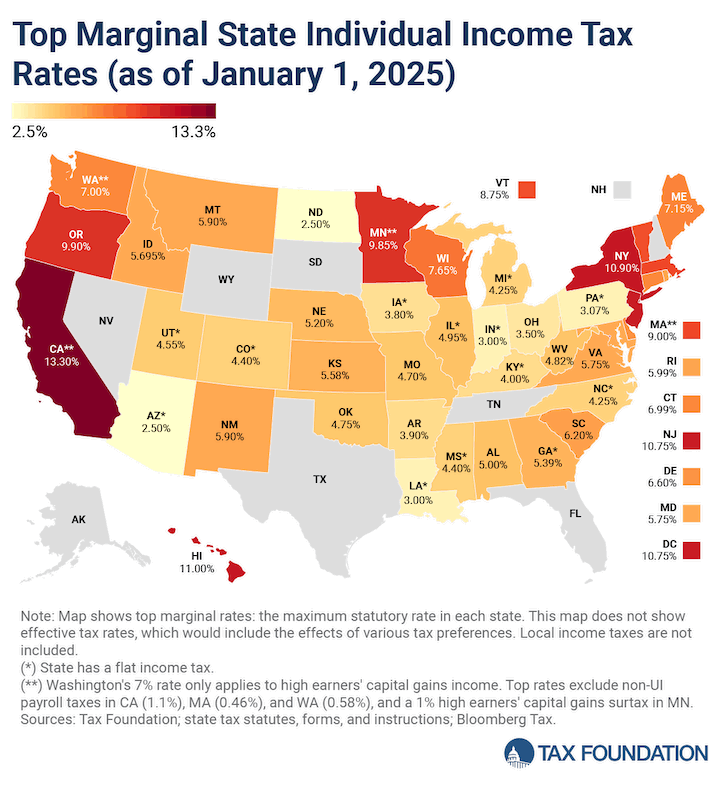
Just want to point out that the Tax Foundation map fails to include Maryland’s piggyback tax. On top of the state tax each county imposes a tax ranging between 2.25% and 3.30% for 2025. Making Maryland’s top tax rate 9.05%.
H&R Block calculates for you, but you have to select “From US Treasury Obligations” and enter the percentage on the next screen.
I’m not seeing where H&R Block calculates this. It shows 1099-INT as a state deduction (NC), but there isn’t any calculation of government dividends on 1099-DIV that flows through to the state return. I’m at a loss of where to enter this. Thanks
P.S. – first year using H&R. I know how this works in Turbotax.
Free Tax USA asks if any dividend income includes U.S. Government interest income. Answer yes, and it allows for you to put in the exempt amount
In TurboTax 2025 you don’t have to enable “My form has info in other boxes (this is uncommon).” in 1099-DIV section. Go to that step and you are asked in the next step and can enable “A portion of these dividends is U.S. Government interest.”. If you enable that checkbox you will then be asked to enter “U.S. Government interest” which is calculated by “… multiply the amount of ‘ordinary dividends’ reported in Box 1a of your Form 1099-DIV by the percentage listed in the PDF.” (ty25-gse-supplemental-letter.pdf). In my case the state refund was automatically adjusted after doing this. There was nothing to change in the state portion.
Can anyone point me to how to document what the 2025 Percentage of Income from U.S. Government Securities would be for 2025 for FRSXX (CUSIP 31607A802)?
It is not on the 2025 Fido sheet linked above.
FRSXX is one of the share classes of FOXXX, so you can use the same value:
“Fidelity® Investments Money Market Treasury Only Portfolio – All Classes FOXXX 99.59%”
Thank you Jonathan.
Is there anywhere, any document I can reference this at/from?
Did I miss it on the Fido tax resources page or??
If asked I’d like to understand where I “found” this information.
Just search the tax document for “Fidelity® Investments Money Market Treasury Only Portfolio”. It says “All Classes”, and FRSXX is one of the classes, the Institutional Class.
Thanks, I get that.
As much as I appreciate you sharing your knowledge and not doubting you BUT it would be nice to have some documentation from Fido that FRSXX does indeed = FOXXX for this purpose. Maybe a list of the FOXXX “all classes” CUSIP or symbol?
Pretty opaque, maybe it’s just me.
found this with a search of “FOXXX all classes”
https://institutional.fidelity.com/app/funds-and-products/542/fidelity-investments-money-market-treasury-only-portfolio-class-ii-foxxx.html
No idea how I might have found it without the info you provided though.
Thanks again.
Why don’t I see FDLXX on that list but you said its 98.67%?
Look for the exact name:
FDLXX is one of the share classes. Multiple share classes of a fund have a common portfolio but impose different expense structures.
I downloaded Fidelity’s 2025 Supplemental Information PDF, but did not specifically see my fund:
“FDUXX (Fidelity Treasury Money Market Fund, Daily Money)”
However, on page 7 (2nd to last page), 5th row from the bottom, I DO see this:
“Fidelity Treasury Money Market Fund – All Classes” = 61.52%, but SYMBOL=”Various”
On fidelity’s site, I did find Prospectus documents titled with “Fidelity Treasury Money Market Fund” and its class/Ticker is “Daily Money/FDUXX”, so it appears FDUXX should be included in part of that row, but…
…since these are taxes, I do not want to assume anything.
I did call Fidelity, but their contact did not know about this subject.
Can anyone please confirm whether FDUXX is included in that row, or provide other advice?
Yes, my understanding is that FDUXX is one of the share classes of ‘Fidelity® Treasury Money Market Fund”, so I would use the 61.52% rate.
You can confirm this using this page, which lists other share classes of the same fund, including yours, FDUXX.
https://institutional.fidelity.com/app/fund/sasid/details/58.html