 Morgan Housel wrote a post called The Biggest Returns which really resonated with my outlook on investing and personal finance. The main idea was that you should consider the impact of your efforts in relation to the time and energy spent.
The idea that reducing your needs has the same impact as increasing your income – but the former is more certain and in your control than the latter, so it has a higher expected value – is as true for someone spending $15,000 a year as it is someone spending $15 million per year.
The hard part is becoming satisfied with spending less. […] For me it’s been realizing that what makes people happy is having options – doing what you want, with who you want, when you want, where you want. And options come from savings and assets, which are the opposite of spending.
Stock returns: Limited control. I decided on an asset allocation and invested my money in low-cost, low-turnover investments. Learning about investing and asset allocation initially was a good investment of time, but I still have limited control of the outcome. More importantly, this gave me the conviction and patience that it will work out in the long run. But I still might lose money in any given year, and I can’t just put in more effort and improve that return. I only check in on my portfolio quarterly.
Cash returns: Moderate control. About 1/3rd of my portfolio is in high-quality bonds, which in my definition includes cash and certificates of deposit. Here, I have some more control. For example, if I put money into a 5-year CD at 4% APY, I have high confidence it will do better than a 5-year Treasury bond at 2.50% yield. Sometimes there are such opportunities for the individual investor, sometimes there aren’t. Therefore, I track the best interest rates monthly.
Income: Moderate to significant control. Income is obviously important, and I while would rate it as more important than spending, that doesn’t mean spending in not also very important. There are plenty of people who earn $250k and spend $250k per year, while a $85k earner could spend $60k and save even more. But that same 250k earner has the ability to “see the light” and have their saving explode over the next few years. Unfortunately, there are no easy, foolproof ways to earn a high income. Of course, you should invest in yourself and improve your marketable skills and thus increase your human capital. Some people can move up the corporate ladder, others will do better with a more entrepreneurial route.
Personal spending: Significant control. Managing your spending is all about priorities, but there are two simple ways to attack your spending. First, you could start from the bottom and get rid of the more questionable “wants”: Expensive food habits (coffee, alcohol, snacks), monthly entertainment subscriptions, gambling, etc). Second, you could start from the top and pair down the big “needs”. I could have gotten a mortgage approval for a 3,500 sf house in my neighborhood. I live in a 2,000 sf house. I could pay cash for nearly any vehicle on the market. I bought a used minivan. I could have had fewer kids… Oops!
Credit cards, bank bonuses, and other “found money”: Significant control. You won’t get rich solely from taking advantage of credit card sign-up bonuses, maximizing your cash back, or picking up $10-$100 here and there each week, but I estimate that it adds up to $3,000+ each year for our household. $3,000 is a 5% increase to a $60,000 income, or a free annual vacation. You should pick and choose what works for you; for example I refuse to drive around town (to buy gift cards, redeem coupons, buy and resell, etc). I prefer deals that can be done with just clicks.
This is also a good reminder that even though I might not write about them repeatedly, your biggest returns on effort might be: get a better job, relocate to a city with greater relative opportunity (income vs. cost-of-living), move into a smaller house, and buy a cheaper car (or find cheaper transportation). On a daily basis, the things that catch my eye (and thus what I write about) are actionable ideas where I have control of the outcome.
 Here’s my monthly roundup of the best interest rates on cash for February 2019, roughly sorted from shortest to longest maturities. Check out my
  Individual Retirement Arrangements (IRAs) are way to save money towards retirement that also saves on taxes. For 2019, the annual contribution limit for either Traditional or Roth IRAs increased to $6,000 (it is roughly indexed to inflation). The additional catch-up contribution allowed for those age 50+ stays at $1,000 (for a total of $7,000). You can’t contribute more than your taxable compensation for the year, although a spouse can contribute with no income if the other person has enough income.
 Employer-based retirement plans like the 401(k), 403(b), and Thrift Savings Plan are not perfect, but they are often the best available option to save money in a tax-advantaged manner. For 2019, the employee elective deferral (contribution) limit for these plans increased to $19,000 (it is indexed to inflation). The additional catch-up contribution allowed for those age 50+ stays at $6,000 (for a total of $25,000).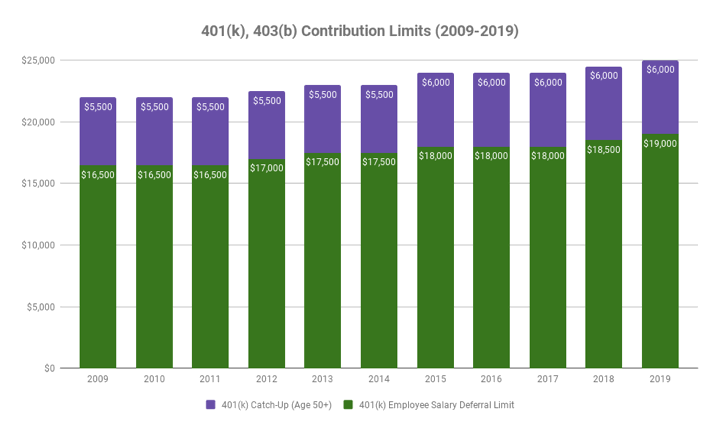
 Instead of just looking at one year of returns, I prefer taking a longer view. Most successful savers invest money each year over a long period of time, these days often into a target-date fund (TDF). Don’t get caught up in the daily news reporting the recent performance of the Dow or S&P 500.
 If you invest in stocks, you know that they go up and down. Below is an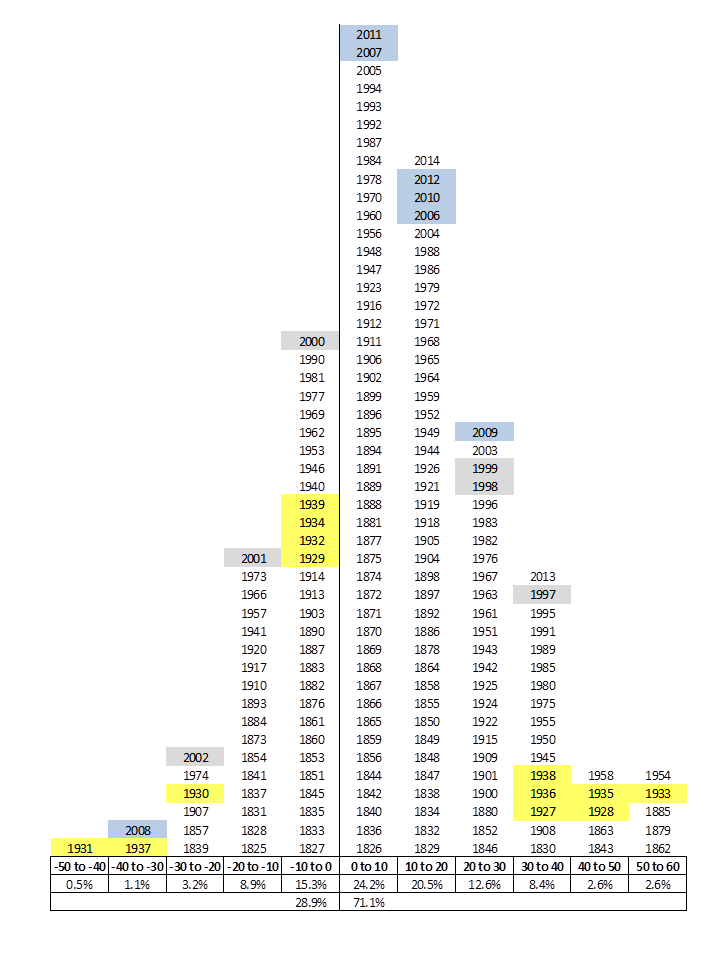

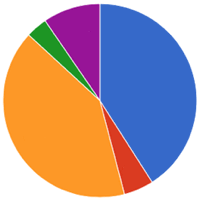

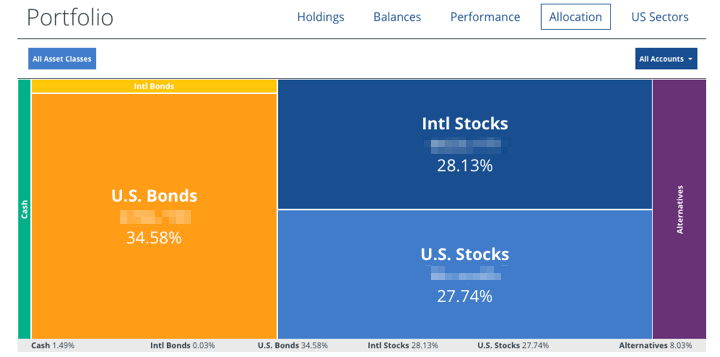
 Another one in the books! I don’t track the market daily as I think the discussion is full of noise and after-the-fact justifications. I check my portfolio quarterly to see where to reinvest dividends. At the end of the year, I like to record the annual returns for select asset classes as benchmarked by passive mutual funds and ETFs. Here is the 2018 data taken from Morningstar after market close 12/31/18.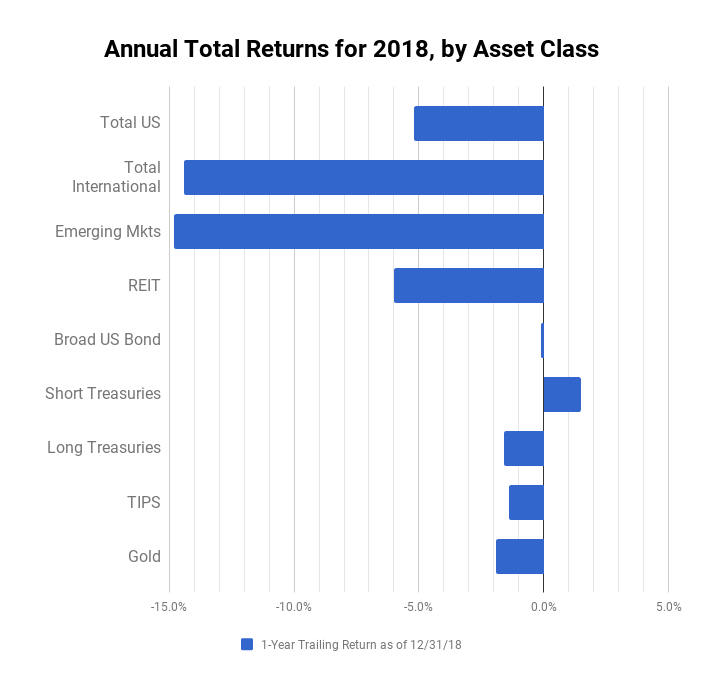

 I don’t really enjoy talking about stock market movements, but given that it has been the most common reader question recently and I wanted to start answering more reader questions, here we are. My overall take is the same:

 The Best Credit Card Bonus Offers – 2026
 Big List of Free Stocks from Brokerage Apps
 Best Interest Rates on Cash - 2026
 Free Credit Scores x 3 + Free Credit Monitoring
 Best No Fee 0% APR Balance Transfer Offers
 Little-Known Cellular Data Plans That Can Save Big Money
 How To Haggle Your Cable or Direct TV Bill
 Big List of Free Consumer Data Reports (Credit, Rent, Work)